
STATIC LEARNING ROUTE · UNGRADED PRACTICE
Scaffolds & work at height
Fictional Canal Yard project: façade work, material deliveries and installation tasks share a changing structure. A delivery delay is putting pressure on the access plan. Your job is to distinguish a workable system from a reassuring tag.
Read and practise without JavaScript or WebGL. This route does not record assessed game completion. Open the interactive course.
MISSION 1
The green tag problem
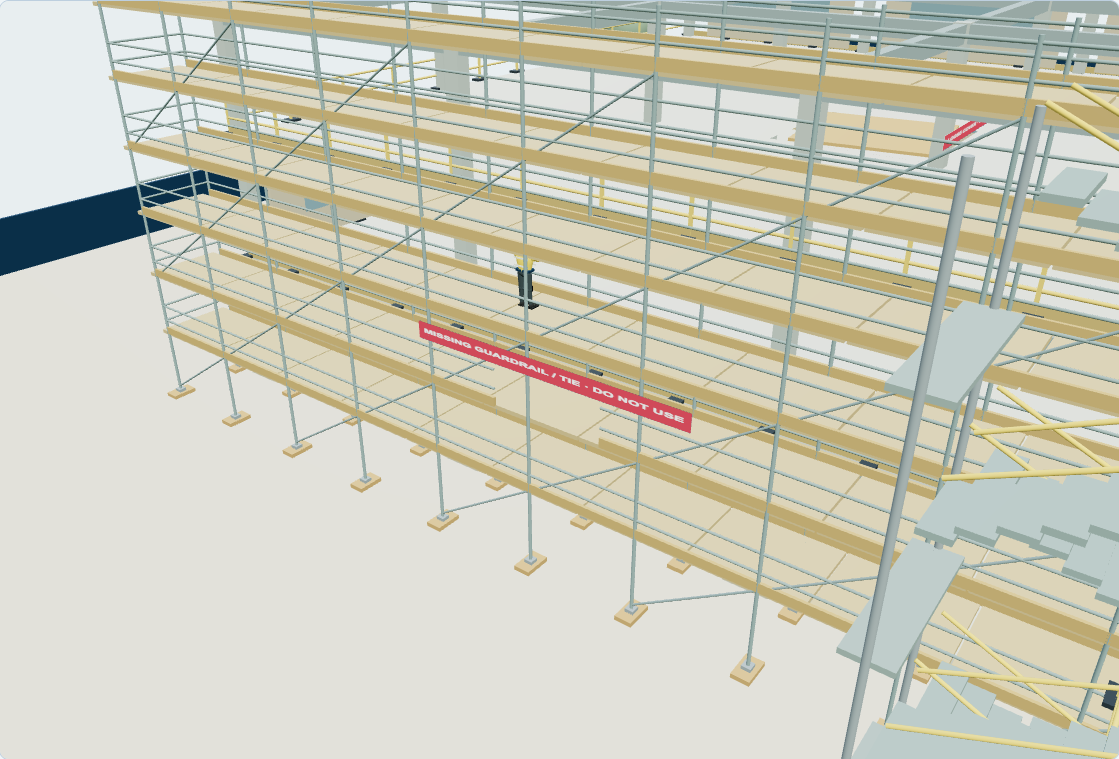

Identify an unauthorised scaffold alteration and the evidence needed for release.
A trade has removed ties and edge protection to receive materials; the scaffold has no confirmed revised handover.
Scaffolding is a temporary structure giving trades access and a supported place to work beside the building. Its platforms, supports and building connections act together. Here, material receiving has prompted removal of protective parts, so the original handover no longer describes the arrangement.
Look at the scaffold beside the unfinished frame, including the access stairs, working lifts and connection to the building. The inspection point describes a trade removing ties and guardrails to receive materials. A tie contributes to stability; a guardrail helps prevent a person falling. Removing either changes the conditions accepted at handover, even if the remaining platform looks tidy and its inspection tag is green. The access stairs provide a route to the platform, not permission to use an altered structure.
Begin with the delivery method. Could materials enter through a properly specified loading bay with suitable gates, avoiding an improvised opening? Give the scaffold contractor the actual loads, work sequence and any proposed sheeting or netting. These can change the forces on the structure. A suitable recognised configuration or competent design must cover the scaffold as used. Only competent people should erect, alter or dismantle it under suitable supervision; trades must request changes through that arrangement.
The useful inspection evidence connects the current structure with its design, handover and defect close-out. In Great Britain, construction scaffold inspection includes before first use, intervals no greater than seven days and after circumstances liable to affect safety. A user check still matters between formal inspections: yesterday’s report cannot clear a tie removed this morning.
People and harm
- Trades on the scaffold may fall or lose support after unauthorised alterations.
- Delivery workers below may be struck by falling materials or collapsing scaffold components.
- Scaffold contractors face additional exposure while making the altered structure safe.
Controls
- Close and physically prevent access to the affected scaffold and danger area; tell the scaffold owner and nearby trades why it is unavailable.
- Arrange competent assessment, reinstatement or an approved revised design and alteration; do not ask users to improvise replacement ties.
- Plan material loading, loading gates and allowable loads with the scaffold provider, retaining safe stair access and protected working platforms.
- Require a clear release after alteration and defect correction, and brief affected users on the revised limits and further change-control process.
Verify
- Compare the actual tie, bracing, foundation, platform and access arrangement with the applicable design or configuration and competent handover.
- Read the latest inspection findings and confirm defects were closed; check whether weather, impact, loading or alteration requires another inspection.
- Ask the receiving trade how the next load will enter without removing protection, and who can authorise a scaffold change.
Practise: Triage the altered scaffold pack
Review the model reasoning after trying it yourself
- A tie and guardrail were removed after yesterday’s handover. — Hold / resolve before use
- A competent provider’s suitable configuration/design for the intended loading. — Relevant evidence to check
- A green tag photographed before the alteration. — Does not establish safety
- The receiving trade promises to replace parts after the pallet arrives. — Does not establish safety
- Actual defect correction and competent release for the intended loading method. — Relevant evidence to check
- A loading opening has no agreed alteration or suitable gate arrangement. — Hold / resolve before use
Decision check
A pallet is waiting. The scaffold tag is dated yesterday, but the receiving trade has removed a rail and two ties. The supervisor says the scaffold contractor can attend after lunch. What evidence is needed before this loading operation can resume?
- A photograph of yesterday’s green tag and an extra person watching the opening.
- Competent assessment and correction or approved alteration, with the affected scaffold released for the intended loading arrangement.
- A promise to replace the parts immediately after the pallet is received.
Decision feedback
This reconnects the actual structure, safe loading method and release decision. Keep access controlled until those conditions are confirmed.
Transfer: The same decision applies to refurbishment, façade cleaning and industrial maintenance: coordinate a scaffold change with its competent provider before another trade changes it.
Source guidance
MISSION 2
Choose the stronger control
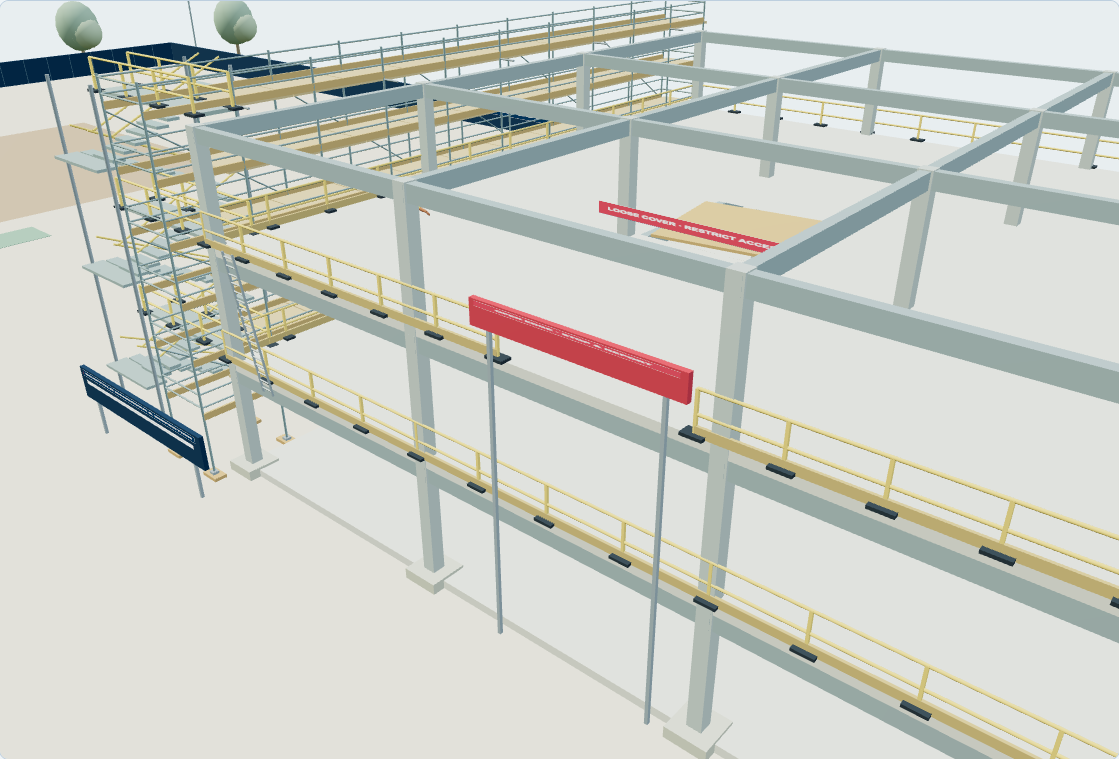
Distinguish avoiding height work, preventing falls and minimising consequences.
A worker approaches the slab edge where collective protection has not followed the work.
A leading edge is the exposed boundary where a floor or deck is still being constructed. People approach it to set out, fix or receive components. In this bay, the work has advanced beyond collective protection, leaving the approach and working position exposed.
The upper slab shows how rapidly a safe work area can change. A worker may be protected at the stairs yet reach a newly opened leading edge during fixing, survey or materials handling. The fall hazard includes the approach route, corners and loading points, not only the final working position. There is no universal two-metre exemption: work at any height needs suitable precautions where a fall could cause injury.
Follow the work-at-height hierarchy. Avoid the exposed task where practicable, for example through ground-level assembly or a different construction sequence. Where height work remains, provide a safe working place and collective fall prevention such as suitable edge protection that follows the advancing work. Collective protection does not depend on each person clipping on correctly. Keep materials and temporary routes from creating a way over or around it.
Personal systems need a deliberate design decision. Work restraint limits access to a fall position; fall arrest acts after a fall has begun. An arrest arrangement needs compatible equipment, a suitable anchor, clearance and a practical prompt rescue method. Issuing a harness at the stairs does not answer those questions. Coordinate the frame, slab and follow-on trades so protection remains continuous when responsibilities change.
People and harm
- Decking and fixing workers can fall while following the advancing slab work.
- Surveyors and follow-on trades may enter a bay whose protection has not followed.
- Workers on lower levels can be struck by tools or materials falling above.
Controls
- Prevent entry to the exposed work area and establish an alternative safe route while the responsible team arranges effective protection.
- Reduce height work through design and sequencing; install suitable collective edge protection before the advancing task creates access to the edge.
- Control loading openings, interfaces and removal of protection through an agreed method that maintains equivalent protection throughout the change.
- Where residual risk requires personal fall protection, verify the intended restraint or arrest system and practised rescue arrangement before use.
Verify
- Walk the entire intended route with the supervisor, stopping before unsafe areas; check corners, landing points, openings and the latest slab extension.
- Check edge protection is secured to an adequate structure, suitable for foreseeable forces and free from gaps created by other trades.
- Ask workers to describe a stop trigger and the rescue response for any personal system; confirm equipment and trained assistance are available.
Practise: Match the control with its place in the hierarchy
Review the model reasoning after trying it yourself
- Assemble the component at ground level where practicable. — Avoid work at height
- Provide a suitable guarded platform and protect changing openings. — Prevent a fall collectively
- Use a properly planned arrest system with suitable clearance and rescue where necessary. — Minimise residual consequences
- Check the actual edge protection and control changes before relying on it. — Verify and maintain controls
Decision check
Decking workers have finished one protected bay. The next bay is open at its edge, and an urgent survey is requested before guardrail installation. A harness is available but no anchor or rescue method has been confirmed. How should the supervisor release the survey task?
- Allow the survey because it will take only a few minutes and the worker has a harness.
- Ask the worker to stay an estimated arm’s length from the edge.
- Hold access and select a method that avoids the exposure or provides suitable fall prevention, verifying any necessary residual personal system.
Decision feedback
This applies the hierarchy to the actual task and route. The survey is released only when the protective arrangement works in that bay.
Transfer: Use this approach on mezzanines, flat roofs, loading platforms and maintenance walkways whenever the edge or access changes.
Source guidance
MISSION 3
The ladder is not the task
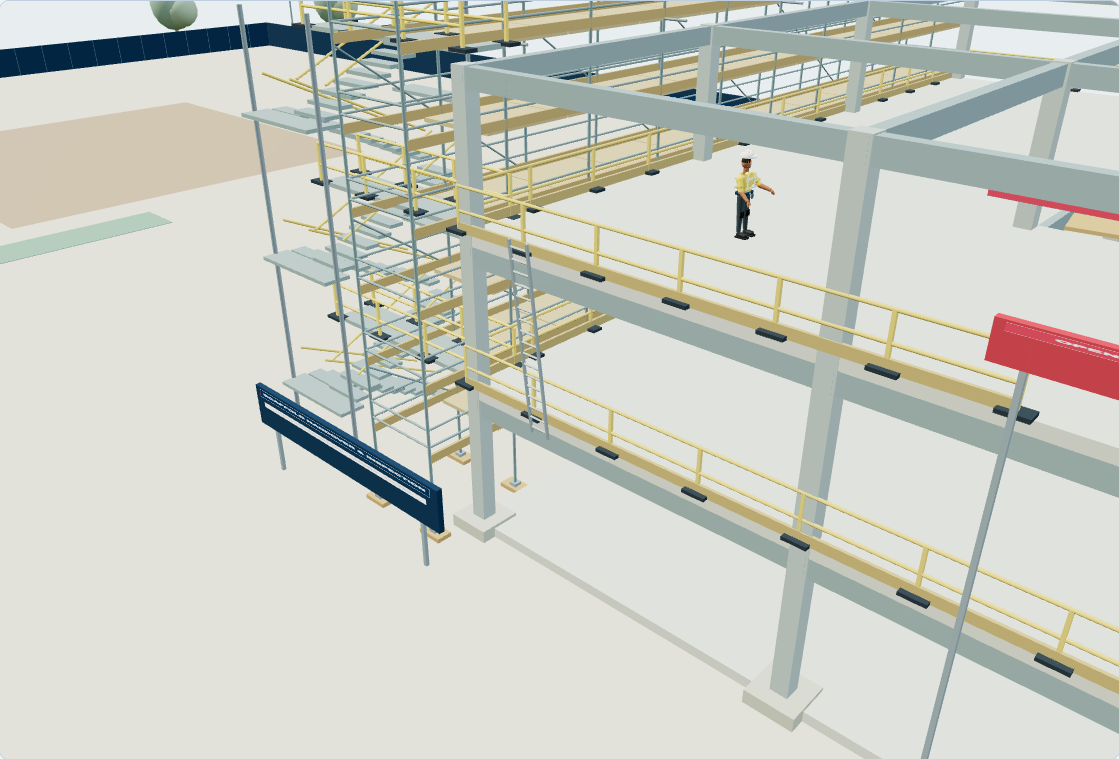
Select access equipment for task duration, force, reach and working position.
A trade proposes prolonged sideways pulling with both hands from the access ladder. Even a secured access ladder does not automatically provide a suitable working position.
An access ladder helps a person reach another level; using it as a work position is a separate decision. Here the proposed task adds prolonged sideways pulling with both hands. That demands stability and a working stance beyond merely securing the ladder for climbing.
The access ladder serves one purpose: reaching a level. The proposed prolonged sideways pulling with both hands is a different use. Securing the ladder does not turn it into a stable working platform for sustained force. Consider posture, reach, force, tools, duration, movement and the landing, rather than deciding from height alone. A low fall can still cause serious injury against the frame or materials below.
Ladders are legitimate equipment when the risk assessment justifies them within the work-at-height hierarchy, including the task’s low risk and the relevant short-duration or site-feature conditions. They are not automatically justified by a training card or a job lasting less than a stated number of minutes. Where the task needs a stable two-handed working position or substantial side force, select a suitable platform or other access arrangement.
For a ladder that is appropriate, selection, condition, firm support, securing, position and safe contact all need attention. Keep the route and landing usable, protect it from vehicles and doors and do not carry loads that undermine safe climbing. The scaffold access stairs in the scene offer another planned access route; workers should use the designated arrangement rather than invent shortcuts. Changes from access to working use require another task decision.
People and harm
- The ladder user can lose balance when applying force or reaching sideways.
- A helper below may be struck by the falling user, tool or ladder.
- Other trades can be exposed where a working ladder obstructs their access route.
Controls
- Stop the proposed unsuitable ladder task and assess a stable platform or alternative method that allows the required force and hand use safely.
- Avoid height work where practicable; justify any remaining ladder use by the actual task and environment through the work-at-height hierarchy.
- For suitable ladder work, select and inspect the right ladder, secure it correctly on sound support and protect the access and landing.
- Brief the task limits, safe climbing and material movement; require review if duration, reach, tools, force or surrounding activity changes.
Verify
- Ask the worker to describe the real sequence and tools, including any two-handed action, side force or repeated repositioning.
- Check the proposed alternative equipment fits the space, work height, surface and access without creating another unprotected edge or traffic conflict.
- For any retained ladder, verify condition, secure setup, landing and safe contact against its instructions; remove damaged equipment from use.
Practise: Choose what matters when selecting access for this task
Review the model reasoning after trying it yourself
- The job requires prolonged sideways pulling and both hands at the working position. — Select: Task demand is central to equipment selection.
- A suitable stable platform can provide the required position and reach. — Select: Select equipment for the work, surroundings and access.
- The task is low, so fall precautions do not apply. — Leave unselected: Low height does not remove injury risk.
- Risk assessment addresses duration, force, position and the surrounding work. — Select: A ladder is not a universal substitute for a working platform.
- A colleague holding the ladder makes every task suitable. — Leave unselected: Holding cannot fix unsuitable task selection.
Decision check
A contractor says a colleague can hold the ladder while they pull a cable sideways for repeated periods. The ladder itself is undamaged and tied at the top. Which fact determines whether the task may proceed from that ladder?
- Whether the task and environment actually justify ladder use, including a safe working position for the required reach, force and hand use.
- Whether a colleague is prepared to hold it for the whole job.
- Whether the task is below two metres from the floor.
Decision feedback
Task suitability comes before confidence in setup. In this case a stable alternative working arrangement is needed for the proposed sustained sideways work.
Transfer: The same selection question applies to cable installation, stock access, window cleaning and maintenance where a brief climb becomes a prolonged two-handed task.
Source guidance
MISSION 4
A board is not a barrier
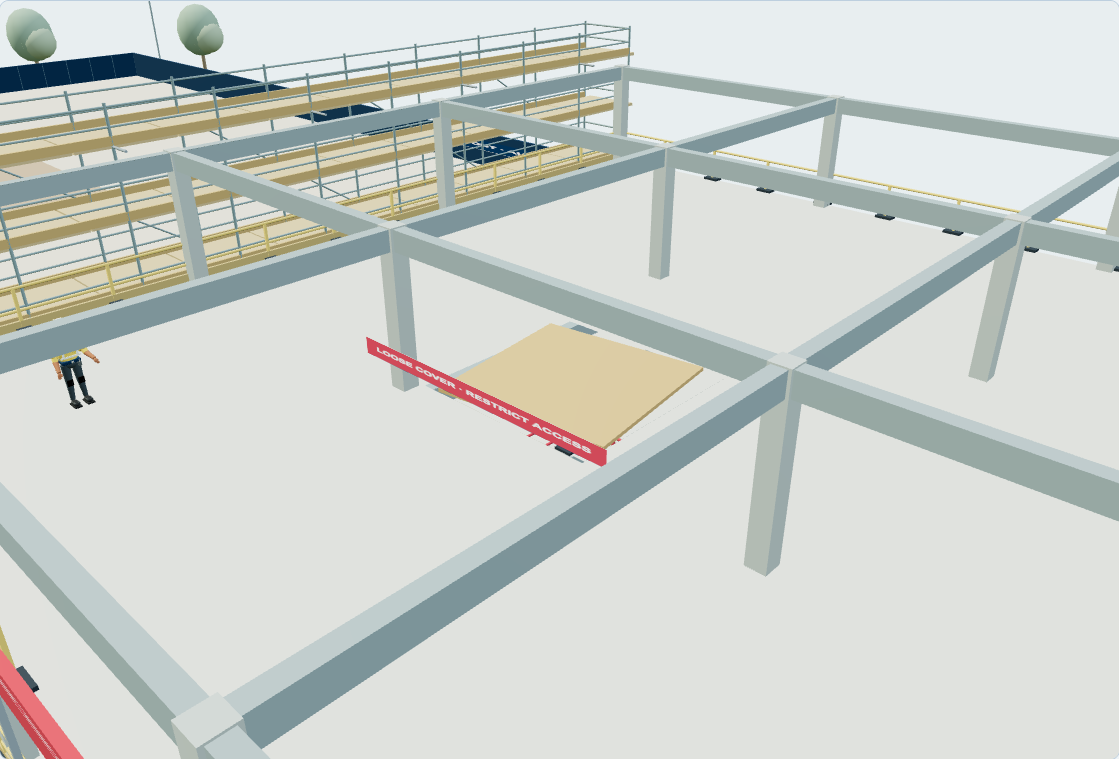
Choose a controlled response to an unsecured opening.
A sheet of plywood is lying over an opening with no verified fixing, load capacity or identification.
Floor penetrations allow pipes, cables or ducts to pass between building levels. During construction they create a fall route until permanently completed. The plywood here hides an opening, but its fixing and ability to carry the expected people or equipment have not been established.
The plywood on the upper floor may hide an opening rather than protect it. A cover can look substantial while being too weak, resting on an inadequate edge or free to slide when a trolley crosses it. Workers who did not create the penetration may mistake the sheet for spare material and lift it. This makes the handover between structural, mechanical and electrical trades part of the fall-prevention system.
Avoid unnecessary openings through coordinated design and installation. For those that remain, choose a suitable secured cover capable of supporting foreseeable people, materials and equipment loads, or provide effective edge protection. The supporting slab and fixings matter as much as the sheet. Mark the cover clearly, but remember that a warning is supplementary: paint cannot establish strength or stop displacement.
Plan how the opening will be used. A service installer who needs to remove a cover requires another protective arrangement before removal and a defined reinstatement check afterwards. Inspect around the opening as the floor use changes; a cover accepted for pedestrian passage may face different demands when pallets or powered equipment arrive. Keep the opening on the current workface information rather than relying on the original trade’s memory.
People and harm
- Workers crossing the floor may step onto a weak or displaced cover.
- Service installers may expose the opening when lifting the sheet for their work.
- People on the floor below can be struck by a falling person or equipment.
Controls
- Restrict access to the uncertain opening without standing on or testing the sheet; arrange competent assessment and a safe replacement arrangement.
- Specify the cover, support and restraint for foreseeable loads, or install suitable edge protection around the penetration before opening the route.
- Identify the protected opening and control cover removal, including temporary protection, coordination with workers below and reinstatement ownership.
- Review covers when floor use, vehicle access, loading or trade activity changes; remove damaged arrangements from use and correct them promptly.
Verify
- Confirm the actual opening location, cover identity, support, fixing and permitted use with the responsible competent person and relevant work information.
- Check routes and deliveries will not introduce loads outside the accepted basis; do not use an improvised bounce or drive-over test.
- Ask the next trade to explain the removal and handback sequence, including how people remain protected while the service is installed.
Practise: Respond to an unsecured floor-opening cover
Review the model reasoning after trying it yourself
- Prevent access to the opening and protect other people in the affected area.
- Arrange a suitable secured cover or collective protection for the intended use and loads.
- Verify the protection, fixings, marking and any nearby work or loading interfaces.
- Communicate the protected route and control any later removal or change.
Decision check
The mechanical contractor needs to run pipework through the covered penetration. A pallet trolley will use the same floor later. The existing loose sheet is painted with the word HOLE, but nobody can identify its loading basis. Which arrangement deals with both installation and later floor use?
- Hold access, provide a suitable secured cover or edge protection, and agree protected removal and reinstatement for the service task and expected loads.
- Add a larger warning and leave the sheet loose so the contractor can lift it easily.
- Ask someone to stand on the sheet once to show it will support future deliveries.
Decision feedback
This addresses the load, displacement and trade-interface risks together. The later trolley use must be included in the accepted arrangement.
Transfer: Apply the same reasoning to roof penetrations, service risers, temporary trench covers and access hatches during maintenance or refurbishment.
Source guidance
MISSION 5
Plan the rescue before the lift
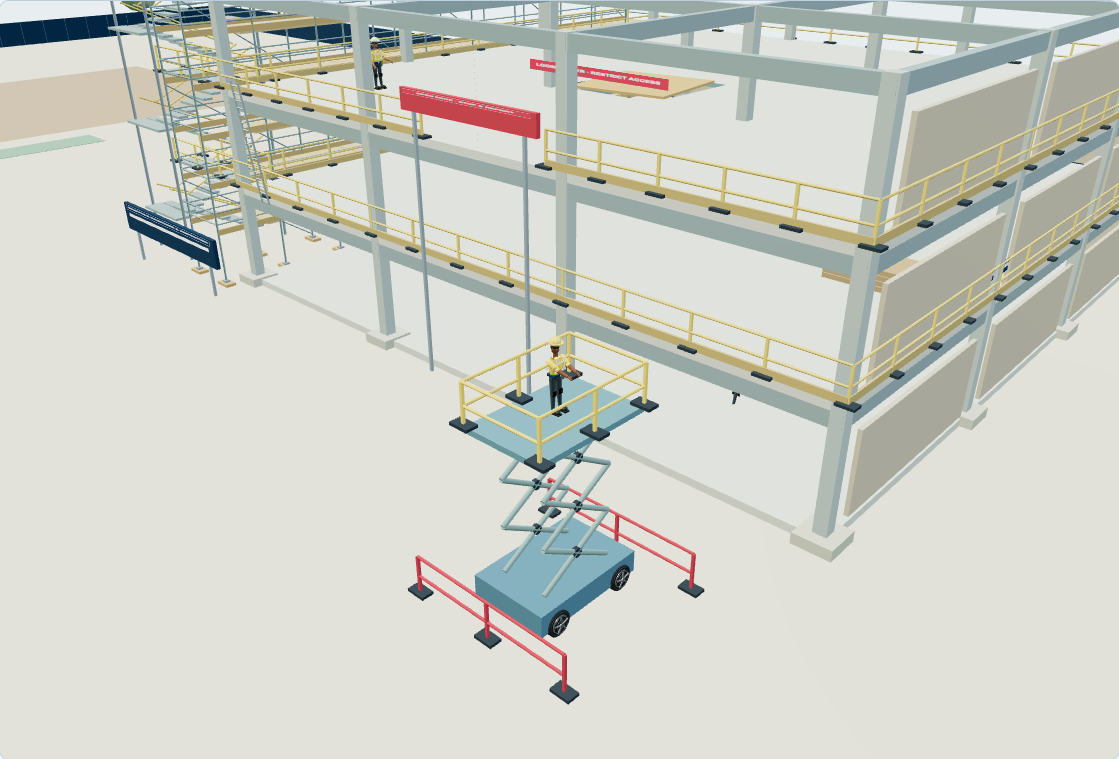
Identify entrapment, ground and rescue requirements before a MEWP operation.
The planned task will take the platform beneath a beam. The site team has not demonstrated the emergency lowering and recovery arrangement for that work.
A mobile elevating work platform carries workers and tools to an elevated working position. It can offer a guarded platform without standing on the structure. Here, the proposed movement beneath a beam creates a trapping space, and the ground recovery arrangement has not been demonstrated.
The platform is positioned beside the frame, but the planned movement beneath a beam introduces a different hazard from ordinary vehicle travel. An occupant can be trapped between the basket and the steelwork, potentially pushed onto the controls. A harness does not prevent crushing. Review the complete movement envelope, visibility, adjacent traffic, ground support and ability to recover the platform before selecting the machine and approach.
Avoid the tight overhead position where the task or sequence can be changed. Select a suitable MEWP and protective features for the remaining task; familiarisation must cover this particular model’s controls, limitations and emergency functions. Check ground bearing, slopes, buried features and any covers before setup. A machine’s examination record does not establish that a temporary cover can carry its wheels or outriggers.
A rescue plan must work when the person aloft cannot operate the controls. An available, briefed ground person needs safe access to the correct emergency controls and an understood communication and recovery method. Practise the arrangement safely; a statement that somebody can telephone the hire company is insufficient. Choose personal protection appropriate to the machine, risk assessment and manufacturer’s instructions. Keep people out of the area beneath and stop when wind, ground, clearance or other activity falls outside the accepted conditions.
People and harm
- Platform occupants can be crushed between the basket and overhead steelwork.
- Ground responders can be exposed if they improvise recovery beside an unstable machine.
- Nearby workers can be struck by platform movement or objects dropped during work.
Controls
- Hold the proposed under-beam movement and review whether another task sequence, approach or access method avoids the trapping position.
- Select suitable equipment and any necessary entrapment protection; confirm manufacturer-specific limits, ground support, overhead hazards and competent operation.
- Establish and safely practise the emergency lowering and rescue method with a named available ground responder and clear communication.
- Provide machine-specific personal protection where required and exclude others from falling-object and movement zones without blocking emergency access.
Verify
- Observe the planned movement from safe positions and identify potential trapping points, visibility loss, power lines and adjacent work interfaces.
- Check pre-use condition, maintenance and examination status together with the actual ground and cover capacity for this setup.
- Ask the ground responder to demonstrate knowledge of the correct controls and limitations safely, including action if the normal lowering route fails.
Practise: Plan the MEWP task as a complete operation
Review the model reasoning after trying it yourself
- The basket will move under steelwork. The operator has experience but no familiarisation with this machine. — Hold the task and confirm suitable equipment, task planning, operator capability and familiarisation.
- The machine stands near a service trench and the basket could trap a person against steelwork. — Verified ground/support suitability and measures addressing overhead entrapment and nearby routes.
- The operator may be unable to use the basket controls after entrapment. No one on the ground knows the emergency controls. — No. Establish and practise a suitable rescue arrangement with capable assistance.
Decision check
The operator is competent and the MEWP has a satisfactory examination report. The work now requires reaching beneath a beam. The only ground worker has never used this model’s emergency controls. What is the correct release decision for this changed task?
- Proceed because the operator’s harness will prevent entrapment.
- Keep the hire-company telephone number in the basket and start the movement.
- Hold the change until the approach and equipment are suitable and an available ground responder understands and safely practises the recovery method.
Decision feedback
The changed overhead envelope and emergency response are part of task planning, alongside equipment condition and operator competence.
Transfer: Use the same planning discipline when maintaining warehouse roofs, installing services in factories or working beneath pipe racks and bridge decks.
Source guidance
Take it to work
Pre-task checklist — Identify a check that cannot yet be confirmed and explain the hold point.
Audit the evidence — Compare the fictional records with the workface; what evidence would close the gap?
Risk assessment library — Search “Scaffold inspection and handover”. Compare scope and controls with this task. No item deep-link is assumed.
Build a task briefing — Search “Scaffold access and alterations”. Add this task’s stop trigger, reporting route and a comprehension question.
Use a real workplace resource only within your authorisation. This course uses fictional evidence and does not submit operating records.
Independent selected CN1 topic study, Great Britain baseline. Underlying source review limitations remain. Competent technical/site review before adoption; no NEBOSH approval or qualification award claimed.