
STATIC LEARNING ROUTE · UNGRADED PRACTICE
People, plant & site traffic
Fictional Canal Yard project: early deliveries, revised hoarding and moving plant compete for limited space. You coordinate the movement plan and test whether people are protected throughout the journey.
Read and practise without JavaScript or WebGL. This route does not record assessed game completion. Open the interactive course.
MISSION 1
The delivery starts outside
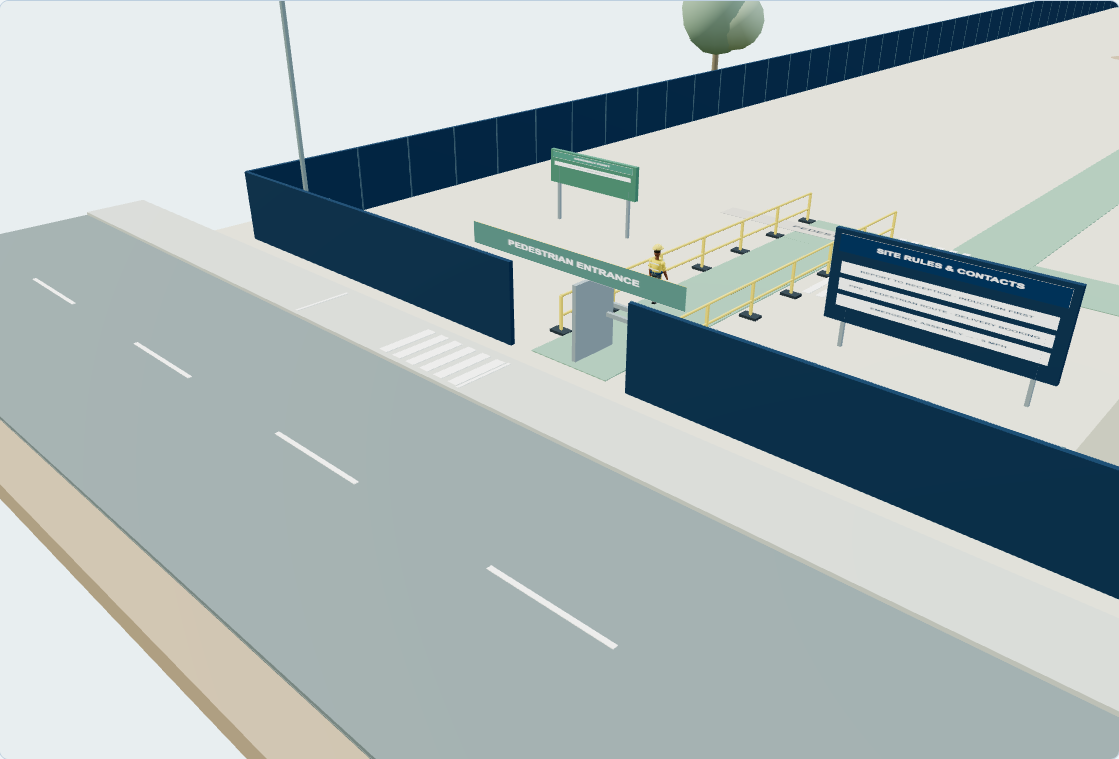

Protect the public throughout an arrival and departure.
An arriving lorry crosses the pavement while a pedestrian approaches the gate.
A site entrance connects the internal delivery system with a public footway and road. Lorries cross that boundary to bring materials or remove waste. The gate, waiting space and crossing arrangement organise those movements while allowing people outside the site to continue their journey.
Look beyond the hoarding at the lorry crossing the public pavement. Its turning path, gate swing and driver’s blind areas overlap a route used by people who have had no site induction. Someone using a wheelchair or pushing a pram may be unable to step aside; a stopped delivery can also force people into the road. The gate team must protect that whole encounter, including the vehicle’s exit, rather than regard the site boundary as the point where responsibility begins.
Start with the logistics design: reduce journeys, select a suitable entrance and time deliveries so that a receiving space is ready. Maintain a usable public route and separate site pedestrian entry. Where crossing remains necessary, provide visibility and a controlled method understood by the driver and authorised marshal. A horn, beacon or high-visibility jacket cannot create separation. Any highway restriction or diversion needs the relevant arrangements; site staff should not improvise traffic control beyond their authority. Recheck the crossing when hoarding, parking or roadworks change.
People and harm
- Members of the public may enter the turning path without understanding site signals.
- The driver has blind areas around the cab and along the vehicle.
- Gate workers can be trapped between a moving lorry, gates and fixed structures.
Controls
- Book deliveries against actual receiving capacity, including enough time for the gate crossing and safe unloading.
- Keep the public footway usable and maintain a separate, protected route from pedestrian entrance to site office.
- Provide clear sightlines, suitable lighting and an agreed stop signal; only trained and authorised people direct movements.
- Hold or reroute an arrival safely when the crossing, receiving area or communication is unavailable; escalate highway changes appropriately.
Verify
- Watch one complete arrival and departure: confirm pedestrians stay protected throughout the turn, gate movement and vehicle stopping.
- Ask the driver and marshal separately who can stop the crossing and what happens if visual contact is lost.
- Check sightlines from the cab and pavement at busy times, including parked vehicles, darkness and people with mobility needs.
Practise: Plan the whole arrival
Review the model reasoning after trying it yourself
- A usable, protected public route is maintained throughout the vehicle turn. — Useful protection / evidence
- The unloading bay is occupied and there is no agreed safe waiting position. — Hold before movement
- The vehicle has an amber beacon. — Warning alone is insufficient
- Driver and authorised marshal understand the stop signal and loss-of-contact rule. — Useful protection / evidence
- A parent with a pushchair is approaching the swept path. — Hold before movement
- The driver promises to sound the horn continuously. — Warning alone is insufficient
Decision check
A delivery arrives early. The unloading bay is occupied and a parent with a pushchair approaches the entrance. The driver offers to edge across very slowly. What is the best decision at this gate crossing?
- Hold the vehicle in the agreed safe waiting arrangement until both the crossing and receiving space are ready.
- Let the vehicle creep forward while the marshal waves the parent into the road.
- Sound the horn continuously and rely on the amber beacon.
Decision feedback
This prevents exposure before movement starts. The gate team can protect the public route and coordinate the entire arrival rather than create a queue across it.
Transfer: Use the same whole-journey check for fuel deliveries, waste collections and plant transport: consider everyone affected on both sides of the gate.
Source guidance
MISSION 2
Yesterday’s route is obsolete
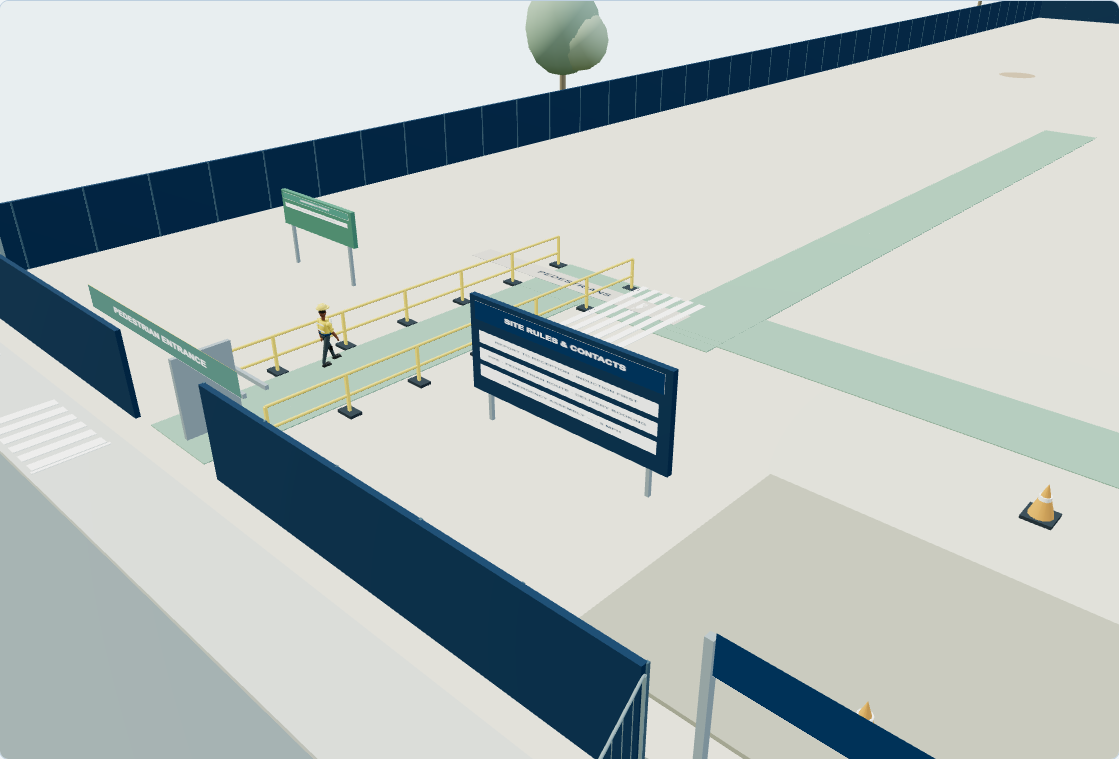
Identify who must coordinate and communicate a changed route.
The signed pedestrian route passes through a newly created delivery zone; emergency contacts and visitor instructions are hard to read.
A site induction introduces people to the current construction arrangements before they encounter unfamiliar risks. The notice board reinforces important information such as safe routes, alarms, first aid and reporting. Both help people make decisions; neither can repair an unsafe route or demonstrate understanding by itself.
At the notice board, yesterday’s diagram directs a new starter through today’s delivery area. The factual mismatch is more serious than an untidy display: a worker may follow an authorised-looking instruction straight into a moving vehicle zone. Emergency telephone numbers, first-aid contacts, assembly information and site rules must also be findable when someone is under pressure. Too much small print can hide the information that matters most.
Induction is an exchange that prepares a person for this site and their authorised tasks. It should explain current routes, significant risks, welfare, alarms, reporting and how to obtain help. Provide information people can understand, using suitable language, demonstrations or other accessible formats, then ask them to show or explain the important actions. A signature proves attendance at most. Changes need a fresh briefing for affected workers and visitors, including delivery drivers; updating the notice board alone will not reach people already working remotely.
People and harm
- New starters and visitors may follow an obsolete route into active delivery space.
- Experienced workers may retain yesterday’s instructions after the layout has changed.
- People with language, literacy or sensory needs may miss inaccessible emergency information.
Controls
- Close the conflicting route physically and establish a safe alternative before directing people through the changed layout.
- Give one person ownership of current maps, emergency contacts and site-rule updates, coordinated with the construction phase plan.
- Use clear signs and understandable inductions tailored to visitors, different languages, literacy, disability and the person’s task.
- Brief everyone affected by a change and check understanding through demonstration, questions and observation during real work.
Verify
- Ask a new starter to walk the permitted route to welfare and identify the boundary they must not cross.
- Check notice-board contacts, route version and alarm instructions against the current workface, including the night or early shift.
- Sample people already on site: can they explain the change, emergency assembly point and how to report a missing control?
Practise: Find the owner of each route-control action
Review the model reasoning after trying it yourself
- Plan delivery slots, receiving space and a separated pedestrian route. — Site logistics / coordination
- Apply the agreed stop signal and stop safely if visual contact is lost. — Driver and authorised movement team
- Follow the current authorised route and report a blocked walkway. — All affected workers / visitors
- Reassess the route when hoarding, lighting or the work phase changes. — Competent review after change
Decision check
A worker signed the induction form on Monday. On Wednesday the pedestrian route moves, but the supervisor says a new map on the office wall is sufficient. What would demonstrate that the revised induction information has become effective?
- Every person signs a second form without leaving the office.
- The new diagram uses more safety symbols and a larger company heading.
- The route is protected, affected people are briefed and a sample can demonstrate the new journey and stop boundaries.
Decision feedback
This links information, physical controls and understanding. Sampling people at the workface can expose confusion that a document review misses.
Transfer: Check the same information-to-action chain for permits, equipment labels, evacuation diagrams and shift handovers.
Source guidance
MISSION 3
Clear the operating envelope
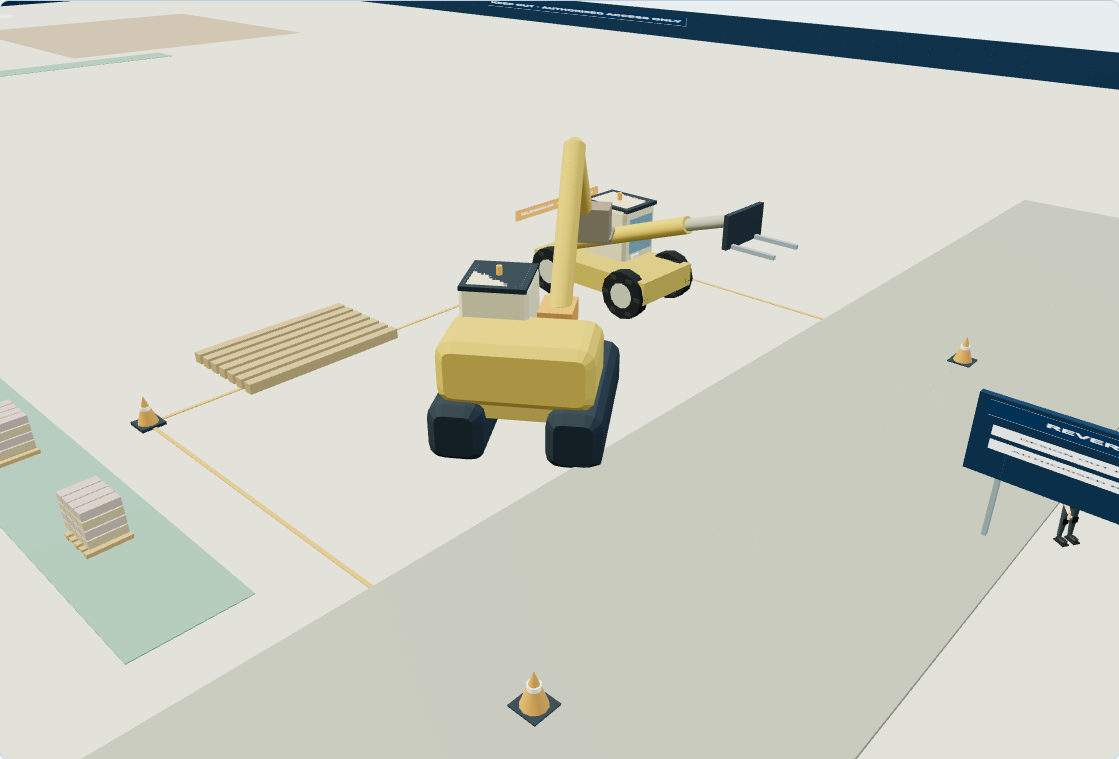
Sequence people exclusion, attachment checks and controlled plant movement.
The marked swing area is shown. A groundworker proposes crossing it during operation, and the team has not confirmed the attachment’s secure connection.
An excavator digs and moves material using a rotating upper structure and fitted attachment. A quick hitch allows compatible attachments to be changed. The marked operating area is shown, but a worker proposes crossing it while connection security has not been confirmed for the attachment.
The marked swing area is a starting control, but it protects nobody if a groundworker crosses it during operation. Consider the bucket, boom, counterweight and the gaps to structures or vehicles. A person can be crushed by slewing, struck by a moving attachment or hit by a bucket that detaches. The operator’s cab position and mirrors do not guarantee a clear view of every approach.
Keep people outside the operating area using a workable segregated layout and a defined approach procedure. If authorised assistance is essential, stop the operation and establish a safe state before anyone approaches. HSE’s 2025 safety notice highlights unintended excavator movement when a control is inadvertently contacted during communication; use the machine’s safety control lever or isolation devices correctly under the agreed method. A stopped-looking machine with its engine at idle is not necessarily protected against movement.
The quick hitch needs its own equipment-specific verification. Different systems have different securing and checking methods. The competent operator must follow the actual manufacturer’s instructions when changing and checking an attachment, including any specified retaining device and verification. Do not substitute a bolt or copy a check from a different hitch. Maintain the system, investigate uncertainty and remove safety-critical defects from use. A secure attachment does not remove the need to exclude people from its movement and drop zone.
People and harm
- Groundworkers can be trapped by the slewing counterweight or struck by an attachment.
- Slingers and signallers can be exposed when approaching to communicate or connect equipment.
- Nearby trades may enter a shortcut through the marked operating zone.
Controls
- Stop movement and keep people outside the full operating zone; provide a safe alternative route rather than normalising shortcuts through the swing area.
- Use a planned authorised approach with communication and the correct machine movement-isolation controls before necessary personnel enter the relevant area.
- Verify attachment compatibility and security using the hitch-specific manufacturer method after fitting and at the required checks; never improvise retaining parts.
- Use competent authorised operators, appropriate visibility aids, maintenance and defect isolation; coordinate nearby plant, structures and groundworkers throughout the shift.
Verify
- Walk the pedestrian approaches from a safe position and check the exclusion accounts for the counterweight, boom, attachment and nearby trapping gaps.
- Ask the operator to explain the specific hitch check and demonstrate relevant knowledge safely, without putting a person under or beside a suspended attachment.
- Confirm the approach and communication method includes correct control isolation, and observe whether production pressure is encouraging people to bypass it.
Practise: Protect people before an excavator movement
Review the model reasoning after trying it yourself
- Stop the movement and keep people outside the slew/attachment danger area.
- Confirm a suitable separated route and the operator’s agreed communication method.
- Verify the correct attachment connection checks using the equipment’s specified method.
- Resume only under the authorised arrangement, stopping again if separation or communication fails.
Decision check
A worker wants to ask the operator a question and proposes walking between the excavator and a stack. The engine is idling and the operator is leaning out to speak. Nobody has verified the newly fitted attachment. What should happen before any authorised approach?
- Walk in once eye contact is made because the engine is only idling.
- Stop the operation, maintain exclusion, use the agreed approach and correct movement-isolation method, and resolve the attachment-security uncertainty.
- Stand under the bucket so the operator can see the worker clearly.
Decision feedback
The person-machine interface and attachment barrier both need to work. An authorised approach must be planned from a safe state.
Transfer: Apply the same principles to loaders, grabs, cranes and other mobile plant where close communication or attachment changes create exposure.
Source guidance
MISSION 4
The tipping point has moved
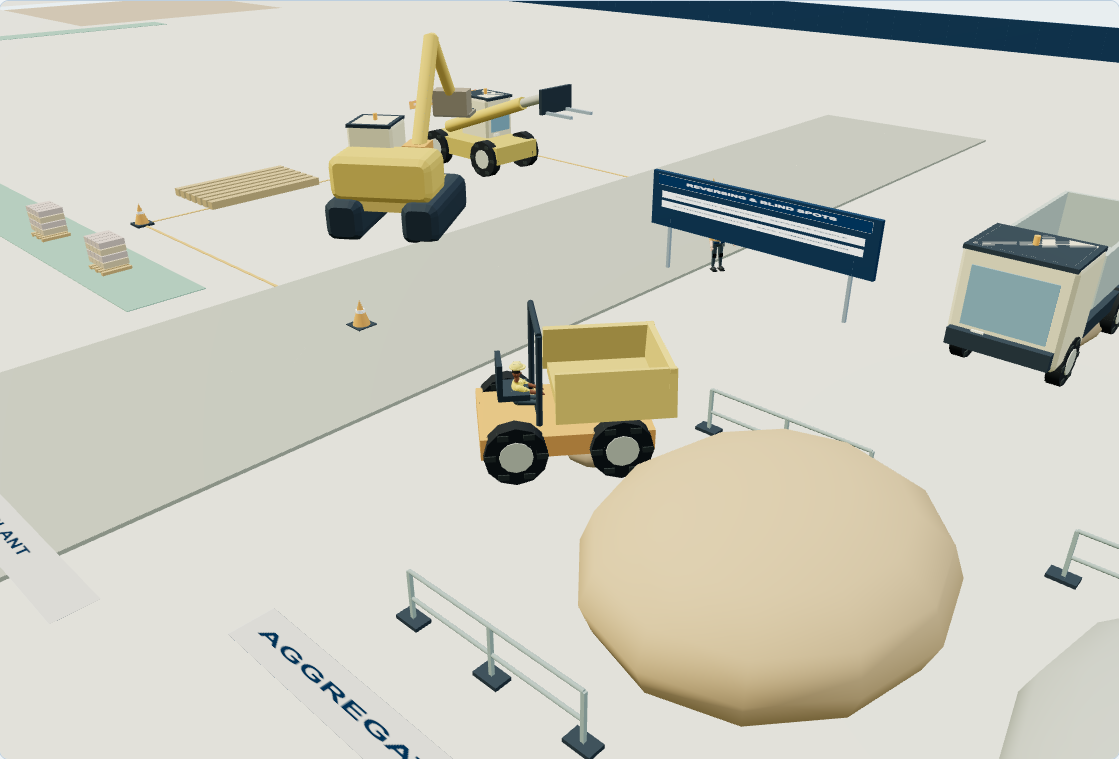
Select evidence for a changed dumper tipping point.
The next tipping location is reported to have uneven ground and a side slope. Its stability and suitability for the loaded dumper have not been confirmed.
A site dumper carries loose material in a skip and discharges it at a planned position. Its stability depends on the vehicle, load and ground throughout travel and tipping. Here, the next discharge point has an unverified uneven surface and side slope.
The proposed tipping point is uneven and has a side slope. A loaded dumper’s stability changes with load distribution, steering, gradient, surface and tipping movement. A location that looked adequate while empty or dry may become unsuitable under a loaded vehicle after rain. Excavation edges, stockpiles and weak ground add the possibility of collapse beneath the wheels as well as overturning.
Choose a suitable machine and a planned route and tipping position within the manufacturer’s limits. Avoid using dumpers on stockpiles where practicable. Provide suitable edge protection or wheel stops at a competent-established safe position where required; these do not establish that the supporting ground is sound. Do not use a guessed universal slope or edge distance from the scene. The task needs verified ground and operational arrangements for the actual vehicle and load.
Rollover protection and the operator restraint work together to protect the driver’s survival space if an overturn occurs; they do not make an unstable tipping operation acceptable. Keep pedestrians out of the travel, loading and tipping zones and preserve visibility. Pre-use checks, maintenance and supervision must address brakes, steering, tyres, restraints and other safety-critical features. Rough routes also create whole-body vibration and jolting, so surface maintenance protects health as well as immediate stability.
People and harm
- Dumper operators can be crushed or ejected if the vehicle overturns.
- Groundworkers at the tipping point can be struck by the machine or discharged material.
- Pedestrians on shared approaches can be hit where visibility or route separation fails.
Controls
- Hold tipping at the uncertain position and arrange a suitable stable location, approach and exclusion before directing the loaded machine there.
- Select and operate the dumper within manufacturer limits for ground, gradients, load and tipping; do not treat rough-terrain capability as unlimited.
- Provide suitable rollover protection and ensure the correct operator restraint is used, alongside competent authorised operation and pre-use defect checks.
- Maintain routes and tipping areas, control edges and pedestrians, and reassess after rain, ground disturbance or a changed load or machine.
Verify
- Check the actual loaded route and tip position for slope, settlement, water, ruts, edges and restricted visibility against the accepted method.
- Verify the dumper’s condition, restraint and rollover protection and that the operator understands its particular loading and operational limits.
- Ask who accepts and inspects the tipping position, and confirm the driver can refuse or stop a delivery when the location has changed.
Practise: Choose evidence before approving a changed dumper tipping point
Review the model reasoning after trying it yourself
- Competent confirmation of ground, edge and route suitability for the actual dumper and load. — Select: A new tipping position is a change to the operating conditions.
- A stop block is present, so ground stability can be assumed. — Leave unselected: A stop arrangement cannot make unverified ground stable.
- Suitable edge protection/stop arrangements and the exclusion of people from the tipping area. — Select: Control the vehicle and the people exposed to the operation.
- Operator capability and the applicable operating instructions are confirmed. — Select: Task and equipment competence still apply.
- The last driver used it without incident. — Leave unselected: A successful past trip does not verify the current ground or loading.
Decision check
The agreed tipping area is waterlogged. A supervisor suggests unloading on a nearby sloping stockpile instead, saying the dumper has rollover protection and the driver has done it before. What is the appropriate decision?
- Proceed slowly because rollover protection makes any low-speed tip acceptable.
- Ask the driver to lean uphill while tipping.
- Hold the tip and establish a suitable verified location and route within the machine’s limits, with pedestrians excluded.
Decision feedback
The waterlogging and alternative slope are changed conditions. A safe operational arrangement must be established before unloading.
Transfer: Use the same approach for agricultural tipping trailers, waste vehicles and other equipment whose stability changes during discharge.
Source guidance
MISSION 5
The load changes the plan
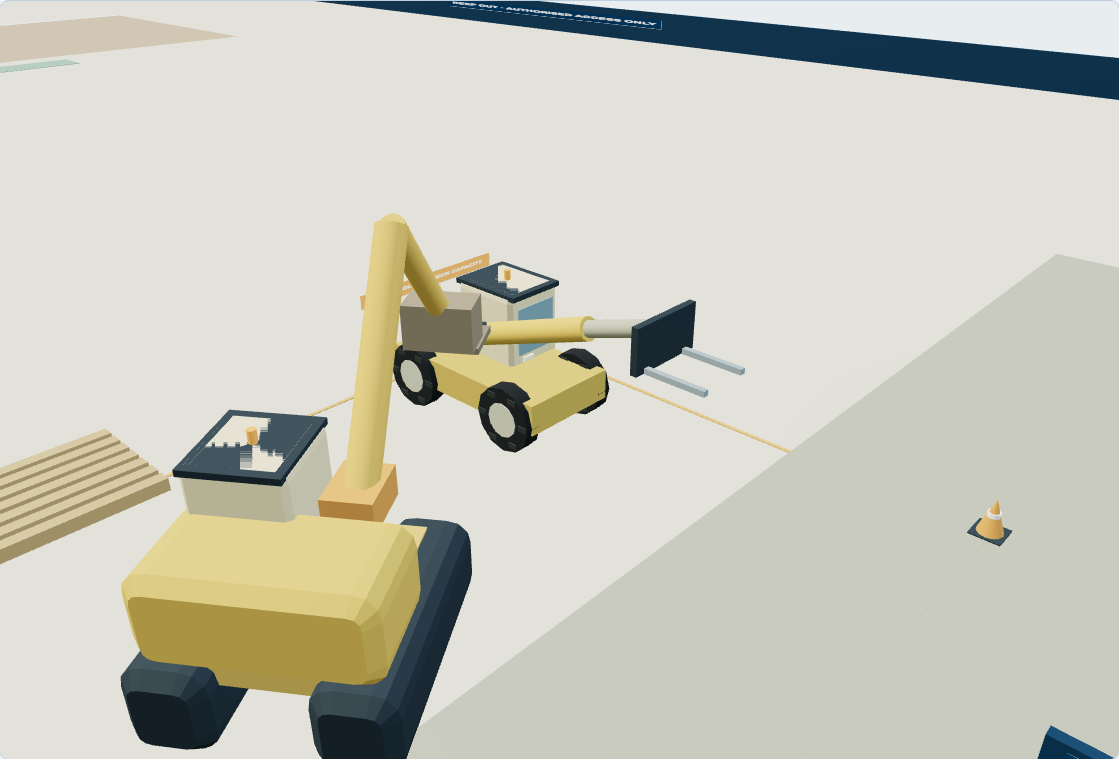
Challenge uncertain load, visibility and attachment assumptions before a telehandler movement.
The machine is shown without a load. The proposed bulky pallet may obscure visibility and require a reach not yet checked against the equipment configuration.
A telehandler lifts and places materials using a boom that changes height and reach. Changing reach or attachments changes its handling capability and stability. The model shows an unloaded machine; the proposed bulky pallet has not yet been checked for capacity, visibility and placement conditions.
The parked telehandler has no load in the teaching view. The proposed bulky pallet introduces the real decision: can this exact machine and attachment place this load at the required reach on this ground while people remain protected? Maximum capacity printed on the machine is not available at every boom extension or height. Load centre, attachment and configuration can change the safe working capacity and stability.
Competent planning needs reliable load information and the manufacturer’s applicable capacity information for the actual configuration. Account for the attachment’s suitability and secure connection, the landing position, ground and gradient. An overload indicator is a protective aid, not a method for discovering whether an unknown lift is acceptable. Never ignore a warning or assume experience with a similar machine supplies the missing chart information.
The bulky pallet may obstruct forward vision or amplify existing blind spots from the boom and cab. Arrange handling and travel so the operator has adequate visibility and people are separated; if the intended arrangement cannot achieve that, change the load, route, equipment or method. Travel position and slope handling must follow the specific instructions and safe plan, avoiding movement with a raised load. Prepare the destination before starting so no one stands below or reaches into a trapping space to persuade the pallet into position.
People and harm
- Operators can be injured if the machine overturns during travel or placement.
- Pedestrians can be struck where the bulky pallet or boom obscures the operator’s view.
- Receiving workers can be trapped between the load, forks and landing structure.
Controls
- Hold the handling operation until reliable load information, reach and landing requirements are matched to the machine’s applicable capacity information.
- Confirm attachment compatibility, connection, condition and any configuration-dependent capacity limits; keep protective indicators functional and respect their warnings.
- Provide suitable ground and a clear planned route and landing, with effective pedestrian separation and an adequate visibility arrangement.
- Use competent authorised operators familiar with this machine, pre-use checks and required examination, following the manufacturer’s travel and placement instructions.
Verify
- Ask the operator or planner to show the applicable chart and how it covers this pallet, attachment, reach and machine setup.
- Check visibility from the actual operating position and the whole route, including blind corners, boom-side approaches, overhead hazards and pedestrians.
- Confirm the receiving point is stable and ready, and that no one needs to stand beneath the forks or between the load and a structure.
Practise: A bulky load arrives during a route change
Review the model reasoning after trying it yourself
- The supplier gives an approximate load weight. The telehandler must reach further than on the previous lift. — Hold and establish actual load information, reach, attachment and applicable capacity/ground conditions.
- The load obscures forward vision. A pedestrian shortcut runs through the receiving area. — Plan a suitable movement method and remove or control pedestrian exposure before moving.
- The team proposes an unapproved attachment to save a delivery delay. — Keep the hold until suitable equipment, compatible attachment and competent planning are verified.
Decision check
A pallet’s overall weight is within the telehandler’s headline capacity. It must be placed farther out than previous loads and blocks the forward view. The driver suggests lifting until the warning sounds to see how far the boom can extend. Which step should precede the proposed placement?
- Verify load and configuration-specific capacity, ground, reach, attachment and visibility, changing the method if those conditions cannot be met.
- Start slowly and use the warning as the limit for this unknown configuration.
- Keep the load raised high enough for the operator to look beneath it while travelling.
Decision feedback
The accepted operation needs more than a headline weight comparison. An indicator warning must not be used as an experimental capacity test.
Transfer: The principle also applies to variable-reach lifting equipment, forklift attachments and loader cranes: a changed attachment or load position needs a new suitability check.
Source guidance
Take it to work
Pre-task checklist — Identify a check that cannot yet be confirmed and explain the hold point.
Audit the evidence — Compare the fictional records with the workface; what evidence would close the gap?
Risk assessment library — Search “Vehicle loading and deliveries”. Compare scope and controls with this task. No item deep-link is assumed.
Build a task briefing — Search “Plant and equipment before work”. Add this task’s stop trigger, reporting route and a comprehension question.
Use a real workplace resource only within your authorisation. This course uses fictional evidence and does not submit operating records.
Independent selected CN1 topic study, Great Britain baseline. Underlying source review limitations remain. Competent technical/site review before adoption; no NEBOSH approval or qualification award claimed.