Vehicle movement and customer safety
Free online training · Approximate learning time: 90–140 minutes · Self-paced
Full public teaching and readers are free without an account. A free learner account is required for saved LMS progress and recorded assessment. Completion and any course-completion certificate depend on the configured LMS conditions. Open the course overview.
90–140 minutes · Includes activities, model practice and assessment.
Independent awareness and decision learning for vehicle repair. Practical competence, EV high-voltage work, asbestos work and other specialist tasks require separate training and authorisation. GB baseline; check corresponding Northern Ireland duties and local arrangements.
Understand this repair environment
Separate people from moving vehicles from the public pavement to the repair bay.
Follow the work, not just the equipment
A vehicle repair centre is a changing transport workplace. A customer arrives on foot, a recovered car comes off a transporter, a technician reverses towards a lift and a parts driver looks for reception. These journeys can overlap even when each person is behaving as they normally would. Start with the routes and the people who use them, including visitors unfamiliar with the layout and anyone who needs assistance.
Draw the movements before choosing signs. Ask which reversing movements can be removed, where pedestrians can stay physically separate and how necessary crossings are controlled. Check parking, delivery times, visibility, lighting and what happens when a bay is unavailable. High-visibility clothing helps people be seen but does not prevent a vehicle entering their space. A banksman is a trained part of a planned system, not a substitute for a poor layout.
The condition to verify is a protected journey during actual work. An empty-site photograph or a quiet morning inspection will miss the afternoon delivery conflict. Observe representative movements safely, speak with drivers and reception staff, and record changes that require the route to be reassessed.
Fictional applied case
At collection time a parts van blocks the marked footpath. Reception directs customers through the workshop while a technician reverses a repaired car around a blind corner. A replacement floodlight is on order. The supervisor proposes giving visitors reflective vests until tomorrow.
Open the interactive lesson and check →
Choose controls that fit the actual task
Use source guidance to distinguish control selection, work instructions and evidence of effectiveness.
How does the safe site, safe vehicle, safe driver and safe journey model work?
The model separates transport risk into parts that can be checked, owned and improved.
Workplace transport and road driving overlap, but they need different controls. A yard needs route design, segregation, reversing control and loading rules. A road journey needs planning, fatigue control, vehicle roadworthiness, phone rules, weather decisions and realistic schedules.
The model is useful because it stops organisations blaming the driver for risks created by layout, deadlines, vehicle defects, poor delivery control or unmanaged grey fleet.
When are banksmen useful and where do they fail?
Banksmen can support controlled movements, but they do not replace segregation, layout and vehicle controls.
A banksman is sometimes needed for reversing, lifting, manoeuvring or complex vehicle movements. But using a banksman as the main control for poor design is weak. The banksman can be struck, ignored, hidden in a blind spot or drawn into the line of fire.
If a movement happens repeatedly, redesign the route or loading area where practicable rather than relying on manual signalling every time.
One-off complex delivery. Banksman role: Control movement and communication; Better design question: Can timing and area be isolated?.
Routine reversing. Banksman role: May support but should not be default; Better design question: Can one-way route remove reversing?.
Poor visibility. Banksman role: Guide only from safe position; Better design question: Can cameras, mirrors or route design improve visibility?.
Public interface. Banksman role: Coordinate with barriers and exclusion; Better design question: Can public be physically separated?.
No safe standing point. Banksman role: Do not use banksman as sacrificial control; Better design question: Redesign movement or stop.
How does work-related road driving fit into workplace transport?
Road risk needs safe journey, safe driver and safe vehicle controls alongside site transport controls.
Many organisations manage site vehicles carefully but overlook road journeys. A field engineer driving between jobs, a manager visiting sites or a worker using a private car for business still creates work-related road risk.
The organisation should control journey need, timing, fatigue, distraction, vehicle condition, driver competence, insurance, emergency arrangements and pressure from appointments or delivery targets.
Journey need. Good practice: Avoid unnecessary journeys; Weak practice: Drive because it is habit.
Timing. Good practice: Allow rest and realistic schedules; Weak practice: Back-to-back jobs encourage speeding.
Driver fitness. Good practice: Fatigue and medication concerns can be reported; Weak practice: Drivers fear reporting issues.
Distraction. Good practice: No calls or messages while driving; Weak practice: Work calls expected on the road.
Vehicle. Good practice: Maintenance, tyres and defects are controlled; Weak practice: Private vehicles unchecked.
Emergency. Good practice: Breakdown and lone-worker routes are known; Weak practice: Driver improvises.
Sources: HSE Workplace transport; HSE Driving and riding safely for work; HSE Workplace transport checklist, reversing; HSE Safe workplace; HSENI Driving at work
Is this a work journey?
A private-car trip between work sites is work travel and needs the grey-fleet checks. Ordinary travel between home and the usual workplace is generally commuting; a home-origin journey to somewhere other than the normal workplace may be work travel. Establish the actual purpose and pattern using the applicable GB or NI route, including relevant motorcycles and cycles. Do not classify every journey from home alike.
Fictional road decision: delay changes the plan
A technician’s site-to-site appointment is delayed. The fleet/line manager checks the actual vehicle, authorisation, business-use insurance, defects and driver fatigue, then reschedules or provides another safe arrangement instead of asking the driver to recover time. Hold the journey if the vehicle or driver is not fit for it. Record the revised appointment, work cover and receiving contact; a valid MOT alone does not release the trip.
Apply the guidance to this garage
The condition to verify is a protected journey during actual work. An empty-site photograph or a quiet morning inspection will miss the afternoon delivery conflict. Observe representative movements safely, speak with drivers and reception staff, and record changes that require the route to be reassessed.
The source section sets out the wider principles. In the garage, apply them to this exact observation: The reception-to-workshop door is open and a visitor is approaching a vehicle bay. The worker’s immediate protective response is Guide the visitor back to the protected waiting area; keep the workshop boundary controlled. The supervisor must then resolve the arrangement and verify A supervisor observes the customer journey: visitors reach the waiting area without entering vehicle bays, and the workshop access control works.
Fictional applied case
A customer wants to photograph a worn component. Their vehicle is raised in an active bay and they start through the open door.
Open the interactive lesson and check →
Keep the public outside vehicle operations
Customer service should fit a protected public route; workshop access needs a deliberate safe arrangement.
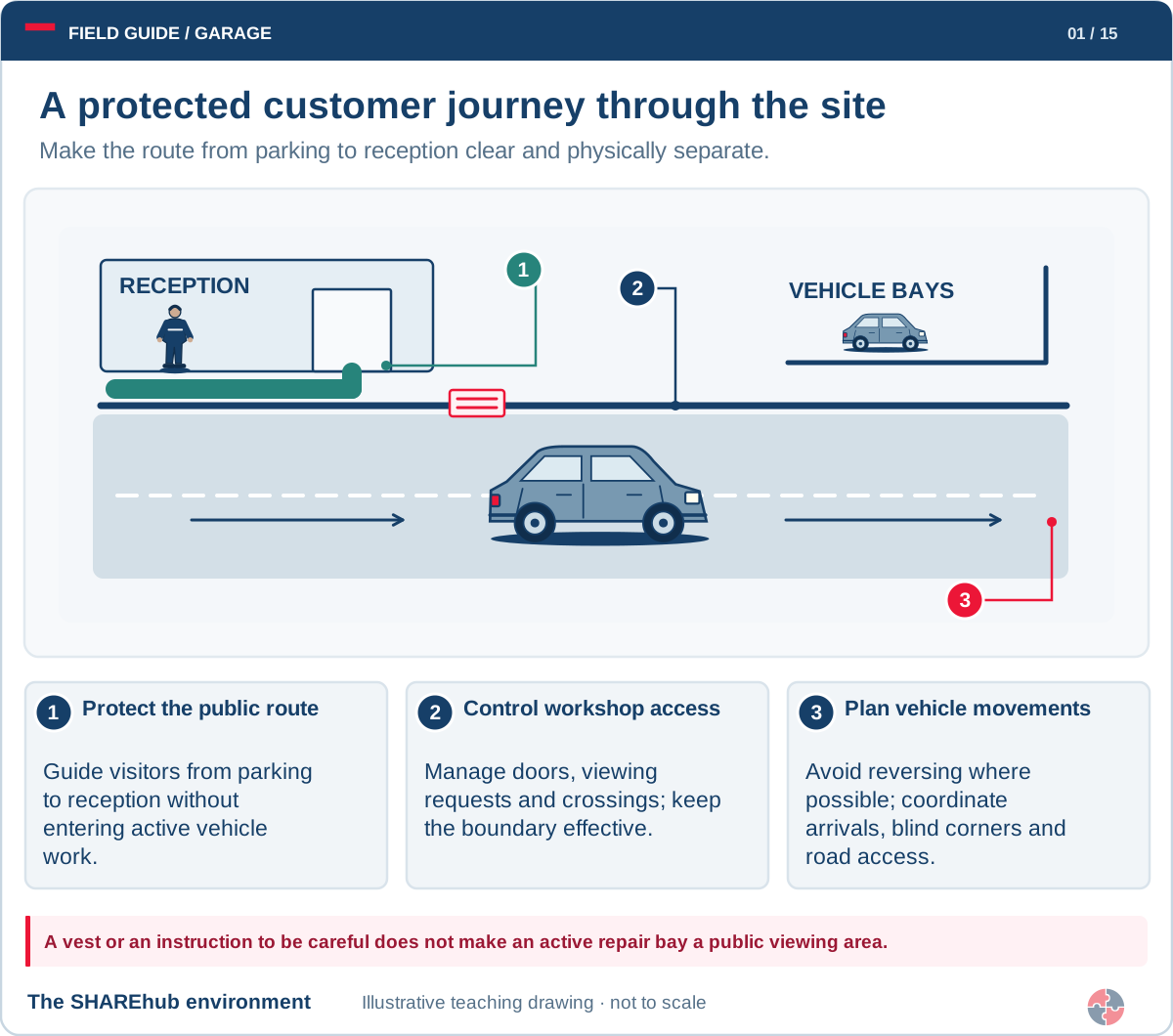
Understand the garage task
Follow the customer from the reception seats towards the open workshop door. Their car is familiar, but the repair environment is not: vehicles move between eight mechanical bays, lifting arms extend into working space and technicians concentrate on the job. An unexpected pedestrian can be struck or force a driver or mechanic into an unsafe reaction. Customer ownership of the vehicle does not make the work area a safe viewing point.
The stronger control is a public journey that reaches reception and waiting facilities without crossing vehicle work. A controlled workshop boundary supports that layout. If a customer needs to see a defect, arrange an assessed, supervised viewing method and stop conflicting operations where necessary. A warning, a high-visibility vest or an instruction to watch the mechanics leaves the visitor exposed to the same vehicle movements.
What effective control looks like
- Provide a direct, accessible route between customer parking, reception and the protected waiting area.
- Keep workshop access controlled and explain where customers can safely wait or obtain an update.
- Plan any necessary viewing with an authorised employee rather than allowing visitors to follow vehicles.
- Review the route when bays, deliveries or temporary barriers change, including access for people needing assistance.
How does the safe site, safe vehicle, safe driver and safe journey model work?
The model separates transport risk into parts that can be checked, owned and improved.
Workplace transport and road driving overlap, but they need different controls. A yard needs route design, segregation, reversing control and loading rules. A road journey needs planning, fatigue control, vehicle roadworthiness, phone rules, weather decisions and realistic schedules.
The model is useful because it stops organisations blaming the driver for risks created by layout, deadlines, vehicle defects, poor delivery control or unmanaged grey fleet.
When are banksmen useful and where do they fail?
Banksmen can support controlled movements, but they do not replace segregation, layout and vehicle controls.
A banksman is sometimes needed for reversing, lifting, manoeuvring or complex vehicle movements. But using a banksman as the main control for poor design is weak. The banksman can be struck, ignored, hidden in a blind spot or drawn into the line of fire.
If a movement happens repeatedly, redesign the route or loading area where practicable rather than relying on manual signalling every time.
One-off complex delivery. Banksman role: Control movement and communication; Better design question: Can timing and area be isolated?.
Routine reversing. Banksman role: May support but should not be default; Better design question: Can one-way route remove reversing?.
Poor visibility. Banksman role: Guide only from safe position; Better design question: Can cameras, mirrors or route design improve visibility?.
Public interface. Banksman role: Coordinate with barriers and exclusion; Better design question: Can public be physically separated?.
No safe standing point. Banksman role: Do not use banksman as sacrificial control; Better design question: Redesign movement or stop.
How does work-related road driving fit into workplace transport?
Road risk needs safe journey, safe driver and safe vehicle controls alongside site transport controls.
Many organisations manage site vehicles carefully but overlook road journeys. A field engineer driving between jobs, a manager visiting sites or a worker using a private car for business still creates work-related road risk.
The organisation should control journey need, timing, fatigue, distraction, vehicle condition, driver competence, insurance, emergency arrangements and pressure from appointments or delivery targets.
Journey need. Good practice: Avoid unnecessary journeys; Weak practice: Drive because it is habit.
Timing. Good practice: Allow rest and realistic schedules; Weak practice: Back-to-back jobs encourage speeding.
Driver fitness. Good practice: Fatigue and medication concerns can be reported; Weak practice: Drivers fear reporting issues.
Distraction. Good practice: No calls or messages while driving; Weak practice: Work calls expected on the road.
Vehicle. Good practice: Maintenance, tyres and defects are controlled; Weak practice: Private vehicles unchecked.
Emergency. Good practice: Breakdown and lone-worker routes are known; Weak practice: Driver improvises.
Sources: HSE Workplace transport; HSE Driving and riding safely for work; HSE Workplace transport checklist, reversing; HSE Safe workplace; HSENI Driving at work
Is this a work journey?
A private-car trip between work sites is work travel and needs the grey-fleet checks. Ordinary travel between home and the usual workplace is generally commuting; a home-origin journey to somewhere other than the normal workplace may be work travel. Establish the actual purpose and pattern using the applicable GB or NI route, including relevant motorcycles and cycles. Do not classify every journey from home alike.
Fictional road decision: delay changes the plan
A technician’s site-to-site appointment is delayed. The fleet/line manager checks the actual vehicle, authorisation, business-use insurance, defects and driver fatigue, then reschedules or provides another safe arrangement instead of asking the driver to recover time. Hold the journey if the vehicle or driver is not fit for it. Record the revised appointment, work cover and receiving contact; a valid MOT alone does not release the trip.
Verify before release
- Walk the customer route during a busy arrival period and check that it avoids vehicle manoeuvres.
- Check that the workshop door control works and staff challenge unintended entry consistently.
- Ask reception staff to demonstrate the safe arrangement for a customer requesting to view a repair.
Use the evidence in a repair decision
Customer service should fit a protected public route; workshop access needs a deliberate safe arrangement.
For this case, the observation is: The reception-to-workshop door is open and a visitor is approaching a vehicle bay. Keep the observation distinct from an inferred cause. Customers may not recognise moving vehicles, lift operations or restricted work zones. Compare the controls in the guide with what is actually present, identify the unresolved gap and state who must resolve it before the task or route is released.
Fictional applied case
A customer wants to photograph a worn component. Their vehicle is raised in an active bay and they start through the open door.
Open the interactive lesson and check →
Blind corners: remove the reversing conflict
A traffic plan must match today’s route and movements. Remove unnecessary reversing before relying on warnings or human reactions.
Understand the garage task
At the workshop corner, follow the reversing car towards the doorway. A person leaving the building can enter its path before either person has a clear view. They may be carrying parts or taking a shortcut. Parked cars, rain and workshop noise can make warnings less useful. The unsafe arrangement is the meeting of people and moving vehicles at a blind corner.
Could the car leave forwards, use a drive-through bay or follow a one-way route? Separate the pedestrian route and position necessary crossings where both parties can see. Assess any unavoidable reverse and keep uninvolved people clear. Mirrors, cameras and alarms assist visibility but do not prove the area is empty. A trained signaller needs an assessed arrangement, safe position and agreed communication.
What effective control looks like
- Stop an uncontrolled movement and keep pedestrians out of the conflict area while the planned traffic arrangement is restored.
- Keep the turning area available; do not let temporary vehicle or parts storage turn a forward route into an unplanned reverse.
- Brief employees and visiting drivers on reporting points, routes and exceptional manoeuvres before they enter the working area.
- If an assessed operation uses a signaller, agree the signals and ensure the driver stops immediately if visual contact is lost.
How can the ISO 45001 hierarchy of controls prevent vehicle collisions during workplace transport and work journeys?
Remove the hazard where reasonably practicable. If it remains, consider a safer method, engineering controls and safe work arrangements before personal protective equipment for residual risk.
HSE places elimination, substitution, engineering, administrative controls and personal protective equipment in that order. Verify that the chosen controls work on the actual task.
ERICPD (Eliminate, Reduce including substitution, Isolate, Control, personal protective equipment (PPE), Discipline) is a SHARE decision prompt cross-mapped to HSE’s five-level hierarchy. Apply it to the vehicle movement, loading task and road journey separately. A sign, banksman or high-visibility garment cannot compensate for a layout that repeatedly puts people in the vehicle path.
How can the ERICPD hierarchy of controls prevent vehicle collisions during workplace transport and work journeys?
ERICPD is a planning crossmap. Its prompts do not add a sixth rung or rank Isolate above engineering. Discipline verifies and sustains every control level.
How can the ISO 45001 hierarchy of controls prevent vehicle collisions during workplace transport and work journeys?
The hierarchy of controls in ISO 45001:2018 comes under Clause 8.1.2 (Eliminating hazards and reducing OH&S risks), which is located within Clause 8 ("Operation").
ESEAP: Elimination, Substitution, Engineering controls, Administrative controls and PPE. Control order: HSE hierarchy of controls and IOSH hierarchy of control guidance.
Sources: HSE hierarchy of control
Control-map basis: HSE hierarchy of control; HSE Workplace transport checklist, reversing; HSE Driving and riding safely for work; HSE Workplace transport; HSE Safe workplace; HSE Safe drivers
Verify before release
- Observe the real route at busy arrival and collection times; check doorway visibility from both the pedestrian and driver positions.
- Walk the separated route and inspect barriers, crossings, lighting and obstructions after parking or layout changes.
- Review near misses with drivers and workshop staff, assign improvements and confirm the revised movement works in practice.
Use the evidence in a repair decision
A traffic plan must match today’s route and movements. Remove unnecessary reversing before relying on warnings or human reactions.
For this case, the observation is: A vehicle reverses around the building where a pedestrian route emerges from a doorway. Keep the observation distinct from an inferred cause. The driver and pedestrian may be unable to see each other in time. Compare the controls in the guide with what is actually present, identify the unresolved gap and state who must resolve it before the task or route is released.
Fictional applied case
A returned vehicle occupies the turning space. A technician proposes reversing the next car around the blind doorway while another worker waves customers back.
Open the interactive lesson and check →
The site entrance: protect customers and passing pedestrians
Design the entrance around the people who use it, including unfamiliar visitors and the public outside the gate.
Understand the garage task
Trace the natural walk from customer parking to reception. It crosses the opening used by arriving and departing cars. A visitor may be looking for the desk rather than watching movements; passing pedestrians may not expect a car to emerge. Parked cars can hide a child or wheelchair user. The assessment must extend beyond employees inside the gate.
Make the public route direct, accessible and recognisable, with physical separation wherever practicable. Plan visitor spaces, signs and crossings together. Check how a driver sees pedestrians before crossing the footway. Queues, deliveries and collection peaks must not block sight lines or the walking route. Changes at the public boundary require competent planning; a quick diversion must not send customers into the road.
What effective control looks like
- Show customers where to park and how to reach reception before they need to choose a route through vehicle movements.
- Maintain suitable pedestrian separation and a controlled, visible crossing wherever a vehicle route must be crossed.
- Keep gates, signs, parked cars, waste containers and delivery storage out of the required sight lines and access routes.
- Plan bookings and deliveries to reduce congestion, and give staff authority to hold vehicle movements when the entrance is unsafe.
How does the work lead to harm?
A reversing lorry, lift truck or mobile plant can strike a pedestrian before either person can react. Loading and unloading add crush and falling-load paths; public-road journeys add collision risk from fatigue, distraction, defects and pressure. Find the person-vehicle conflict in the actual movement sequence before selecting the control.
Identify the source, route to the person, early signal, strongest practicable control and stop decision. Test that decision in real work and after change.
Sources: HSE Workplace transport; HSE Workplace transport checklist, reversing; HSE Driving and riding safely for work
Verify before release
- Follow the route as a new visitor would, checking access needs, signs and the temptation to take a shorter unsafe path.
- Observe drivers emerging at collection time and check visibility with typical parked vehicles, not only in an empty yard.
- Ask reception staff about queues, confused visitors and near misses; verify that changes protect people passing the entrance too.
Use the evidence in a repair decision
Design the entrance around the people who use it, including unfamiliar visitors and the public outside the gate.
For this case, the observation is: Customers walk from parking spaces through the entrance used by arriving and departing cars. Keep the observation distinct from an inferred cause. Visitors, passing pedestrians and vehicles can meet at the public-road boundary. Compare the controls in the guide with what is actually present, identify the unresolved gap and state who must resolve it before the task or route is released.
Fictional applied case
A delivery van parks across the protected customer path. Reception suggests putting a cone in the entrance and asking visitors to walk around the van.
Open the interactive lesson and check →
A safe route needs light, visibility and a sound surface
Verify what people can see and where they walk. A completed lamp repair is only one part of a safe-route check.
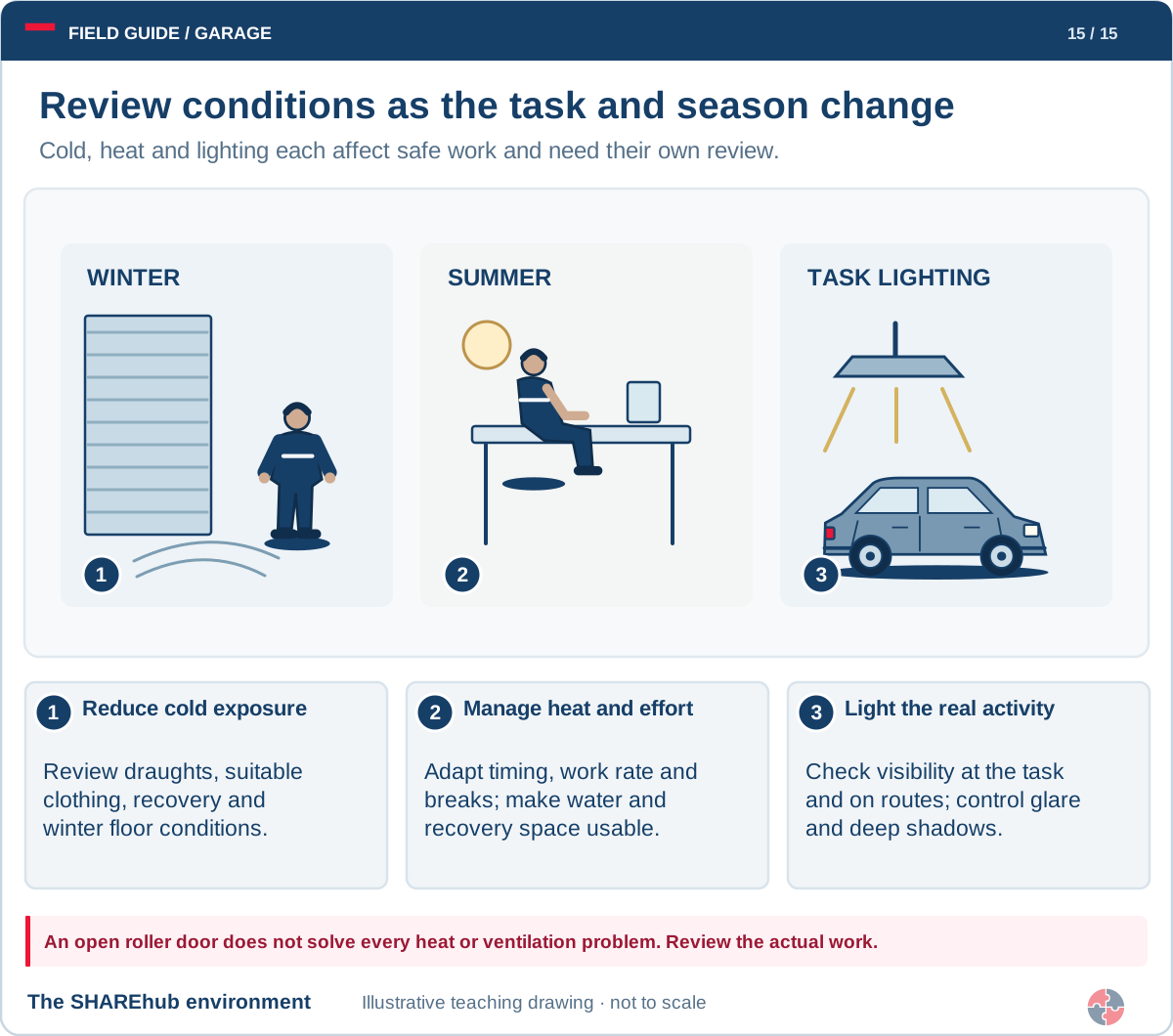
Understand the garage task
Beside the failed wall lamp, uneven paving is hidden in shadow. Someone leaving the bright workshop may struggle to see the darker path, particularly while carrying parts. Nearby vehicles add another problem: pedestrians need to see the route and drivers need to recognise people. This is a route-maintenance issue as well as a lighting defect.
Provide lighting suited to doors, corners, crossings and changes of level. More brightness alone can create glare, shadows or a difficult transition between indoors and outside. Maintain lamps, fittings and controls so routes are lit when needed, including winter darkness. Repair paving and remove obstructions rather than making a defective route more visible. Where a lighting failure could endanger people, assess suitable emergency lighting and a safe response.
What effective control looks like
- Protect or close the affected route and give people a checked alternative while the fault and surface defect are resolved.
- Position and maintain lighting to reveal the walking surface and people at vehicle interfaces without dazzling drivers or pedestrians.
- Repair uneven paving, manage drainage and keep the route clear; do not rely on a warning sign hidden in the same shadow.
- Include lighting in planned inspections and provide a clear fault-reporting and response arrangement for staff working after dark.
How should slip and trip controls be assured?
Assurance should test whether controls work in practice, not whether the page or procedure exists.
Assurance should include frontline checks, manager review and periodic independent sampling where risk warrants it. The purpose is to find weak signals early, close actions properly and update the risk assessment when work changes.
Sample contamination, route defects and cleaning handback against HSE slip/trip factors and HSE wet-floor access controls; a completed inspection form is not proof of safe conditions.
Verify before release
- Inspect during the hours when the route is actually dark, viewing it from workshop doors and approaching vehicle positions.
- Check the repaired surface and lighting together, including shadows from parked cars, glare and changes between bright and dim areas.
- Confirm scheduled checks, fault completion and any required emergency-lighting tests; ask late-shift workers about remaining difficulties.
Use the evidence in a repair decision
Verify what people can see and where they walk. A completed lamp repair is only one part of a safe-route check.
For this case, the observation is: A failed lamp leaves uneven paving and the side pedestrian route in shadow. Keep the observation distinct from an inferred cause. Poor light can hide surface defects, approaching vehicles and changes in level. Compare the controls in the guide with what is actually present, identify the unresolved gap and state who must resolve it before the task or route is released.
Fictional applied case
A replacement floodlight makes the side route much brighter, but its beam faces drivers entering the yard. The broken paving has not been repaired.
Open the interactive lesson and check →
Capstone: decide whether the job may proceed
Combine the observations, restrictions and verification into one justified work decision.
Read the whole case before releasing a part
At collection time a parts van blocks the marked footpath. Reception directs customers through the workshop while a technician reverses a repaired car around a blind corner. A replacement floodlight is on order. The supervisor proposes giving visitors reflective vests until tomorrow.
Hold the conflicting vehicle movements, establish a protected usable customer route and resolve the obstruction and visibility before releasing movements.
Separate immediate protection from the investigation of causes. Use factual observations, the actual equipment and task information, and the appropriate competent roles. Where the evidence is missing, keep the affected operation restricted rather than treating uncertainty as permission.
Build the release evidence
- A customer follows the car into the workshop: A supervisor observes the customer journey: visitors reach the waiting area without entering vehicle bays, and the workshop access control works.
- Reversing at a blind workshop corner: The transport lead observes real vehicle movements and checks that the planned route prevents unnecessary reversing and keeps pedestrians out of remaining reversing areas.
- Customer parking crosses the vehicle entrance: The transport lead walks the customer route and observes arrivals and departures, confirming parking, sight lines and crossings protect visitors and passing pedestrians.
- A dark route beside the building: The responsible person checks the route in darkness after repairs, confirming adequate visibility without hazardous glare and that paving defects have been resolved.
Make the handover usable
State what may proceed, what remains held, who owns each unresolved issue and the evidence required to change the decision. Ask the next person to explain the restriction in their own words. Record a defined review point and communicate any change to affected colleagues, contractors and visitors. A form is useful only when it represents the actual arrangement.
Fictional applied case
At collection time a parts van blocks the marked footpath. Reception directs customers through the workshop while a technician reverses a repaired car around a blind corner. A replacement floodlight is on order. The supervisor proposes giving visitors reflective vests until tomorrow.
Open the interactive lesson and check →
Take the learning into a real briefing
Turn the selected control into a clear question, observation and review trigger.
Prepare a short toolbox conversation
Choose one relevant task from this course. Describe its current scope, then ask a colleague to identify the people exposed and the control that must work. Avoid asking only whether everyone understands: a useful response explains the action and what would make the job stop.
Provide a direct, accessible public route, clear reception arrangements and safe viewing where required.
For the fictional exercise below, write the observation, harm pathway, immediate protection, responsible role and evidence needed before release. Use the packaged worksheet; do not enter real personal or company information or submit an operational record.
Check the claim against the workplace
- A supervisor observes the customer journey: visitors reach the waiting area without entering vehicle bays, and the workshop access control works.
- The transport lead observes real vehicle movements and checks that the planned route prevents unnecessary reversing and keeps pedestrians out of remaining reversing areas.
- The transport lead walks the customer route and observes arrivals and departures, confirming parking, sight lines and crossings protect visitors and passing pedestrians.
- The responsible person checks the route in darkness after repairs, confirming adequate visibility without hazardous glare and that paving defects have been resolved.
Follow up the change
Arrange a proportionate check after the control is used in representative conditions. If the observation contradicts the claimed protection, retain the restriction, report the discrepancy and revisit the assessment. Keep course completion separate from permission to perform specialist work.
Fictional applied case
At collection time a parts van blocks the marked footpath. Reception directs customers through the workshop while a technician reverses a repaired car around a blind corner. A replacement floodlight is on order. The supervisor proposes giving visitors reflective vests until tomorrow.
Open the interactive lesson and check →
