
Vehicle movement and customer safety
Separate people from moving vehicles from the public pavement to the repair bay.
Free training · Approximately 90–140 minutes · Self-paced
Reception teams, technicians, drivers and workshop supervisors.
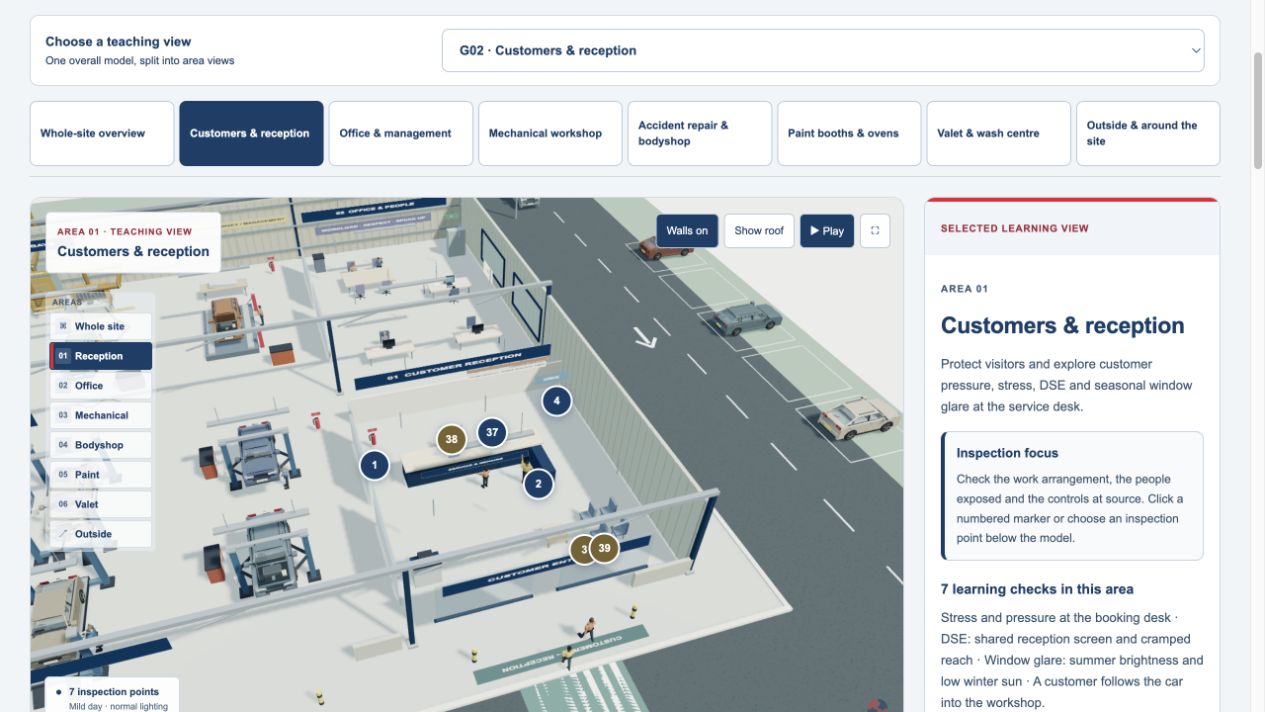
What you will learn
- Separate people from moving vehicles from the public pavement to the repair bay.
- Explain the harm pathway and who is exposed in the selected repair scenarios.
- Choose immediate protection, sustained controls and evidence for a safe release.
- Apply a fictional risk assessment, briefing and control-check exercise to the job.
8 detailed lessons · 7 applied activities · 3 required model or equivalent text practices · 16 final questions.
Public reading and browser practice are free. A free learner account is required to save LMS assessment, completion and a named certificate. Complete all required items, reach 80% and answer every critical question correctly.
Course map
Understand the repair and the people
- Understand this repair environment
- Choose controls that fit the actual task
Recognise the exposure and energy
- Keep the public outside vehicle operations
- Blind corners: remove the reversing conflict
Choose and apply effective controls
- The site entrance: protect customers and passing pedestrians
Verify the working arrangement
- A safe route needs light, visibility and a sound surface
Make the release decision
- Capstone: decide whether the job may proceed
- Take the learning into a real briefing
Primary guidance
- HSE: Workplace transport in motor repair
- HSE: Reversing vehicles
- HSE: Pedestrians and public routes
- HSE: Lighting for traffic and pedestrian areas
- HSE: Safe and healthy workplace facilities
Scope
Independent awareness and decision learning for vehicle repair. Practical competence, EV high-voltage work, asbestos work and other specialist tasks require separate training and authorisation. GB baseline; check corresponding Northern Ireland duties and local arrangements.