Full public teaching and readers are free without an account. A free learner account is required for saved LMS progress and recorded assessment. Completion and any course-completion certificate depend on the configured LMS conditions. Full course outline and access routes.
Lesson 1
A recipe change begins before the seasoning reaches the mixer
Connect supplier information, recipe authority and the consumer-facing label.
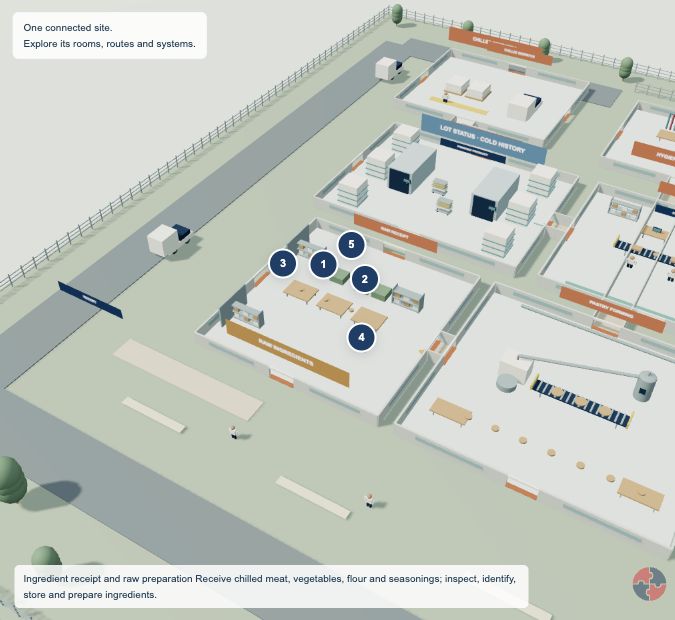
Actual SHAREsimulate FOOD-Z01 model zone. The fictional case supplies the facts; the picture does not establish live plant or product conditions.
A recipe change begins before the seasoning reaches the mixer
Allergen control starts with knowing what enters the product. A replacement seasoning may have the same flavour name while containing a different ingredient mixture. Compare its exact supplier identity and current specification with the authorised recipe before use. Familiar packaging or a purchasing description such as equivalent does not establish equivalence for allergens, formulation or the process.
In this fictional factory, a substitute stock powder arrives during a supplier shortage. The old specification and label are available, but the new supplier code has not been reviewed. Keep that substitution controlled while the authorised technical team establishes the ingredient and allergen implications. If it has already been used, preserve the relevant lot and production links so the affected scope can be identified without guessing.
The consumer-facing information must describe the actual food. For manufactured prepacked food, the applicable ingredient and allergen declaration requirements need to be satisfied; do not confuse this with the different route for food packed for direct sale. The destination market and nation also matter. An operator should compare the authorised versions, while the competent labelling team owns the legal and technical review.
Consider other routes opened by the change. A new allergen can affect shared equipment, storage containers, rework and later products even where the current pie label is correct. The authorised review therefore examines cross-contact and cleaning arrangements as well as the artwork. Adding a precautionary statement is not an operator-level shortcut for unresolved formulation or control evidence, and this course does not approve a free-from claim.
For the exercise, match four cards: supplier specification, approved recipe, ingredient issue and first finished label. Mark the version and identity needed on each connection. Then explain what remains held when one card refers to the previous seasoning. A useful response names the affected material, decision owner and evidence required before use; it does not quietly edit a production sheet to make the substitution appear routine.
How should allergen risk be managed?
Keep ingredient, recipe, substitution and cross-contact information current so customers receive accurate allergen information. Apply the correct nation and food-format labelling route; stop service when the ingredient or allergen status cannot be confirmed.
Allergens deserve their own control route because ordinary cleanliness is not enough. A small amount of allergen can be serious for a sensitised person. Controls need to cover recipes, substitutions, supplier changes, menu wording, staff handover, cleaning and serving practices.
The safest culture is one where staff do not guess. If allergen information is uncertain, the answer should be checked before food is served.
Allergen control points
Control point
What good looks like
Failure scenario
Control pointSupplier and ingredient control
What good looks likeApproved suppliers and checked ingredient changes.
Failure scenarioA substitute product contains an undeclared allergen.
Control pointRecipe and menu control
What good looks likeCurrent recipes and allergen matrix match what is actually cooked.
Failure scenarioKitchen changes a sauce but the menu is not updated.
Control pointCross-contact control
What good looks likeSeparate utensils, storage, cleaning and preparation for allergen-sensitive meals.
Failure scenarioShared tongs transfer allergen to a supposedly safe meal.
Control pointCommunication
What good looks likeStaff know how to answer and when to check.
Failure scenarioFront-of-house staff reassure a customer without verifying.
Control pointIncident response
What good looks likeAllergic reaction triggers first aid, investigation and review.
Failure scenarioNear miss is treated as customer preference rather than safety failure.
Records should prove that significant food safety controls are being completed, checked and corrected when they fail.
Food records should be quick to complete but meaningful. They should show the control, the result, the person checking it and the action taken when the result is outside the expected standard. Records that show perfect ticks every day but no defects, no corrective action and no manager review may be weaker than they look.
For higher-risk catering, records should also help managers identify patterns: repeated fridge failures, poor probe calibration, missed cleaning, supplier problems, complaints, allergen queries or staff training gaps.
Food safety evidence register
Record
What it proves
Review trigger
RecordFood safety management system
What it provesHazards, controls, monitoring and corrective actions are defined.
Review triggerMenu, process, supplier or premises change.
RecordTemperature records
What it provesCritical storage, cooking, cooling and hot-holding controls are checked.
Review triggerOut-of-range reading or equipment fault.
RecordCleaning schedule
What it provesCleaning tasks are allocated and verified.
Review triggerFailed inspection, pest activity or complaint.
RecordTraining matrix
What it provesFood handlers and supervisors are competent for their role.
Review triggerNew starter, role change or incident.
RecordAllergen matrix
What it provesAllergen information is current and communicated.
Review triggerSupplier, recipe or menu change.
RecordMaintenance records
What it provesEquipment affecting food safety is kept reliable.
Review triggerRepeated defect or breakdown.
RecordIncident and complaint log
What it provesLearning is captured and actioned.
Review triggerIllness complaint, allergen near miss or enforcement feedback.
Specific official context: GOV.UK food hygiene for businesses; Government HACCP food safety management; Food Standards Scotland guidance; FSA government allergen guidance2026. Food examples require the actual food-business status, nation, food category and validated safe methods. Current government HACCP management guidance covers hazard identification, critical controls/limits, monitoring, corrective action, verification and records for food businesses; specialist meat-plant scope differs. FSA government allergen guidance updated 17 July 2026 applies England/Wales/NI; accurate ingredients, food-format labels, changes and cross-contact controls. GB assimilated law/NI movement or EU routes require actual product review.
Applied case
The replacement stock powder uses a different supplier code; the available specification and label still describe the previous ingredient.
Decision and explanation
Whether the replacement’s current specification, approved recipe, cross-contact controls and label are consistent.
Ingredient identity and the actual change implications matter. Similar flavour or price cannot establish correct allergen information or safe shared-line arrangements.
Lesson 2
Clear the label path, then prove the first complete pack
Verify label changeover across reels, printers, rejects and outer packaging.
Actual SHAREsimulate FOOD-Z05 model zone. The fictional case supplies the facts; the picture does not establish live plant or product conditions.
Clear the label path, then prove the first complete pack
An allergen declaration can be technically correct on the approved artwork and still fail at the packing line. The physical reel, printer setting, product and outer case have to match that approved information. Changeover control therefore follows the materials through the actual machine, including spare reels, part-used stock, rework locations and packs caught between process steps.
The model shows old-flavour label reels beside the first packs of a new flavour. Their presence is a visible cue to check line clearance, not proof that every pack carries the wrong label. Stop uncertain release and identify the changeover interval. Compare the actual ingredient and recipe records with the label revision and the completed pack. Keep the assessment bounded by reliable evidence rather than an assumed start time.
A first-pack check should examine what a customer will receive, not only an artwork screen or an empty label sample. The product identity, ingredient declaration, allergen emphasis and other approved information must be correct and legible. Where cases or multipacks carry information, check consistency with their contents. Follow the defined independent verification arrangements; two signatures copied from one unexamined screen provide weak assurance.
Line clearance needs a dependable destination for obsolete or unused packaging under the site procedure. Leaving an old reel within reach invites the next operator to restore it when the new reel runs out. Deal with rejected and partially packed product so it cannot accidentally re-enter the released stream. A later correct sample does not retrospectively establish which earlier packs were labelled correctly.
Practise by inspecting a fictional changeover board containing a current recipe, old reel, new reel and finished case. Choose the evidence that supports release and explain the missing links. Record the affected interval, stock locations, correction and authorised disposition. The goal is a repeatable match between food and information through normal running, interruptions and shift changes, rather than a single impressive first-off photograph.
How should allergen risk be managed?
Keep ingredient, recipe, substitution and cross-contact information current so customers receive accurate allergen information. Apply the correct nation and food-format labelling route; stop service when the ingredient or allergen status cannot be confirmed.
Allergens deserve their own control route because ordinary cleanliness is not enough. A small amount of allergen can be serious for a sensitised person. Controls need to cover recipes, substitutions, supplier changes, menu wording, staff handover, cleaning and serving practices.
The safest culture is one where staff do not guess. If allergen information is uncertain, the answer should be checked before food is served.
Allergen control points
Control point
What good looks like
Failure scenario
Control pointSupplier and ingredient control
What good looks likeApproved suppliers and checked ingredient changes.
Failure scenarioA substitute product contains an undeclared allergen.
Control pointRecipe and menu control
What good looks likeCurrent recipes and allergen matrix match what is actually cooked.
Failure scenarioKitchen changes a sauce but the menu is not updated.
Control pointCross-contact control
What good looks likeSeparate utensils, storage, cleaning and preparation for allergen-sensitive meals.
Failure scenarioShared tongs transfer allergen to a supposedly safe meal.
Control pointCommunication
What good looks likeStaff know how to answer and when to check.
Failure scenarioFront-of-house staff reassure a customer without verifying.
Control pointIncident response
What good looks likeAllergic reaction triggers first aid, investigation and review.
Failure scenarioNear miss is treated as customer preference rather than safety failure.
Specific official context: FSA government allergen guidance2026; Food Standards Scotland guidance. Food examples require the actual food-business status, nation, food category and validated safe methods. Current government HACCP management guidance covers hazard identification, critical controls/limits, monitoring, corrective action, verification and records for food businesses; specialist meat-plant scope differs. FSA government allergen guidance updated 17 July 2026 applies England/Wales/NI; accurate ingredients, food-format labels, changes and cross-contact controls. GB assimilated law/NI movement or EU routes require actual product review.
Applied case
The artwork system shows the new label, but an old reel remains fitted to the packing machine and the first finished case has not been checked.
Decision and explanation
Verified line clearance and a checked actual product/label/case match for the current run.
The physical output must match the approved information. The artwork approval is necessary context but cannot prove which reel is producing the packs.
Lesson 3
Clean for the allergen and demonstrate the changeover
Distinguish a visually acceptable clean from the evidence required for allergen control.
Actual SHAREsimulate FOOD-Z05 model zone. The fictional case supplies the facts; the picture does not establish live plant or product conditions.
Clean for the allergen and demonstrate the changeover
Cleaning has an objective: remove the relevant residues from the actual equipment sufficiently for the next approved use. A bright surface can meet an appearance expectation while leaving uncertainty about allergenic material in a joint, seal or difficult access point. The required method and verification must reflect the product soil, equipment, allergen and following recipe. Do not invent one swab, chemical or contact-time rule for every line.
In the fictional changeover, a creamy filling is followed by another authorised product with different allergen information. The cleaning team has completed its ordinary sign-off, but the required allergen verification is absent. Keep the changeover controlled and ask what the approved method requires. A disinfection record does not, by itself, prove that the allergen-cleaning method was followed or that all relevant parts were included.
Validation concerns whether the defined cleaning arrangement is capable of controlling the relevant risk. Routine verification checks that the arrangement continues to work as intended. Operators need a usable method and clear acceptance/escalation criteria; the competent technical team decides the validation and verification approach. Repeating a test until it gives a favourable result without investigating the earlier result creates a misleading record.
Access must also be safe. If parts need dismantling, the task-specific machinery controls and isolation apply before anyone reaches into the equipment. Cleaning tools, rinse movement and reassembly can transfer residue back to a cleaned surface. Verify the complete changeover, including storage of utensils, shared containers and rework, rather than inspecting only the easiest visible panel.
Your practical task is to order the evidence: defined method, safe access, completed cleaning, specified verification, correct reassembly and authorised release for the next product. Identify which item is missing in the case and explain why appearance cannot replace it. Use the course exercise sheet if the live Hub tool is gated. A learning answer does not approve a real cleaning validation or permit a new allergen claim.
How should allergen risk be managed?
Keep ingredient, recipe, substitution and cross-contact information current so customers receive accurate allergen information. Apply the correct nation and food-format labelling route; stop service when the ingredient or allergen status cannot be confirmed.
Allergens deserve their own control route because ordinary cleanliness is not enough. A small amount of allergen can be serious for a sensitised person. Controls need to cover recipes, substitutions, supplier changes, menu wording, staff handover, cleaning and serving practices.
The safest culture is one where staff do not guess. If allergen information is uncertain, the answer should be checked before food is served.
Allergen control points
Control point
What good looks like
Failure scenario
Control pointSupplier and ingredient control
What good looks likeApproved suppliers and checked ingredient changes.
Failure scenarioA substitute product contains an undeclared allergen.
Control pointRecipe and menu control
What good looks likeCurrent recipes and allergen matrix match what is actually cooked.
Failure scenarioKitchen changes a sauce but the menu is not updated.
Control pointCross-contact control
What good looks likeSeparate utensils, storage, cleaning and preparation for allergen-sensitive meals.
Failure scenarioShared tongs transfer allergen to a supposedly safe meal.
Control pointCommunication
What good looks likeStaff know how to answer and when to check.
Failure scenarioFront-of-house staff reassure a customer without verifying.
Control pointIncident response
What good looks likeAllergic reaction triggers first aid, investigation and review.
Failure scenarioNear miss is treated as customer preference rather than safety failure.
Plan intervention hazards before removing guards or opening plant. Control energy, movement, height, substances, contractors and nearby operations for the whole job.
Identify every energy source, bring equipment to the required state, securely isolate, prevent reconnection and release or restrain stored energy. A stop command or open guard is not secure isolation. Use planned exceptional powered fault-finding only with competent specialists and designed protection. Coordinate group work and shift changes. HSE maintenance of work equipment and HSE L22 Safe use of work equipment.
At handback, account for people and tools, restore guards and devices, verify the affected functions and authorise a controlled restart. A permit is a coordination tool where the risk system requires it; it does not substitute for physical controls. Contractors need equipment identity, instructions, hazard information and a defined interface.
Applied case
Cleaning appears complete after the creamy filling, but the applicable changeover verification has not been performed.
Decision and explanation
Keep the changeover held and complete the approved evidence and release process safely.
Use the validated method and required verification, with safe access and authorised release. Appearance and improvised labelling are not substitutes.
Lesson 4
A failed detector challenge is a product-control event
Use challenge, rejection and trace evidence to bound a foreign-body detection failure.
Actual SHAREsimulate FOOD-Z05 model zone. The fictional case supplies the facts; the picture does not establish live plant or product conditions.
A failed detector challenge is a product-control event
Foreign-body control is a system, not simply the detector display. The food-safety plan must identify the hazard, suitable preventive controls and any detection/rejection arrangements used for this product and pack. A challenge check examines an intended function under its defined conditions. Its method, acceptance criteria and response to failure must be established before the result is needed.
The fictional packing line fails a challenge while packs continue towards dispatch. Stop the uncontrolled release and follow the specified hold and escalation procedure. Establish the last reliable check and the product, equipment and time information needed to determine the affected scope. Do not assume that the only affected pack is the challenge item, or that every earlier lot is implicated without examining reliable evidence.
A detector alarm alone may not establish effective rejection. The actual arrangement can include detection, diversion, confirmation, secure reject handling and response when the mechanism cannot perform. Competent people investigate and restore the relevant functions safely. Operators should not reach into moving conveyors or defeated guards to recover a test item, even when preventing consumer harm feels urgent.
Equipment repair and product disposition answer different questions. A successful check after repair can support readiness for later controlled production; it does not prove the status of packs that passed during the uncertain interval. The responsible food-safety team assesses those lots using the approved procedure. Any additional inspection or reprocessing route needs its own suitability and authority; passing the same pack repeatedly is not a universal remedy.
For practice, place cards for the last reliable check, failed challenge, stopped release, repaired function and held lots on a timeline. Mark what is observed, what is documented and what remains unknown. Explain the two releases separately: equipment back to controlled service and affected product to a justified disposition. Accurate reject reconciliation and hold identity make that separation workable during a busy packing shift.
What hazards does food safety control?
Food safety controls biological, chemical, physical and allergenic hazards that can make food unsafe.
The four hazard groups should be explained in human terms. Biological hazards can make people acutely ill. Chemical hazards can contaminate food through cleaning products, pest control chemicals or maintenance substances. Physical hazards can injure someone immediately. Allergens can cause severe reactions even when the premises look clean and well-run.
The strongest food safety cultures avoid blame-heavy shortcuts. If a fridge temperature is wrong, food has been left out, a supplier changes ingredients or staff are unsure about allergens, the system should make it normal to stop, segregate, check and record the decision.
How harm occursAllergic reaction or anaphylaxis where information or cross-contact fails.
Control focusAccurate information, separation, cleaning and staff communication.
Hazard typeProcess failure
ExamplesUndercooking, poor cooling, broken refrigeration or reheating failure.
How harm occursPathogens survive or multiply.
Control focusCritical limits, monitoring, corrective action and verification.
Specific official context: GOV.UK food hygiene for businesses; Government HACCP food safety management; Food Standards Scotland guidance; FSA government allergen guidance2026. Food examples require the actual food-business status, nation, food category and validated safe methods. Current government HACCP management guidance covers hazard identification, critical controls/limits, monitoring, corrective action, verification and records for food businesses; specialist meat-plant scope differs. FSA government allergen guidance updated 17 July 2026 applies England/Wales/NI; accurate ingredients, food-format labels, changes and cross-contact controls. GB assimilated law/NI movement or EU routes require actual product review.
What food safety records should a business keep?
Records should prove that significant food safety controls are being completed, checked and corrected when they fail.
Food records should be quick to complete but meaningful. They should show the control, the result, the person checking it and the action taken when the result is outside the expected standard. Records that show perfect ticks every day but no defects, no corrective action and no manager review may be weaker than they look.
For higher-risk catering, records should also help managers identify patterns: repeated fridge failures, poor probe calibration, missed cleaning, supplier problems, complaints, allergen queries or staff training gaps.
Food safety evidence register
Record
What it proves
Review trigger
RecordFood safety management system
What it provesHazards, controls, monitoring and corrective actions are defined.
Review triggerMenu, process, supplier or premises change.
RecordTemperature records
What it provesCritical storage, cooking, cooling and hot-holding controls are checked.
Review triggerOut-of-range reading or equipment fault.
RecordCleaning schedule
What it provesCleaning tasks are allocated and verified.
Review triggerFailed inspection, pest activity or complaint.
RecordTraining matrix
What it provesFood handlers and supervisors are competent for their role.
Review triggerNew starter, role change or incident.
RecordAllergen matrix
What it provesAllergen information is current and communicated.
Review triggerSupplier, recipe or menu change.
RecordMaintenance records
What it provesEquipment affecting food safety is kept reliable.
Review triggerRepeated defect or breakdown.
RecordIncident and complaint log
What it provesLearning is captured and actioned.
Review triggerIllness complaint, allergen near miss or enforcement feedback.
Specific official context: GOV.UK food hygiene for businesses; Government HACCP food safety management; Food Standards Scotland guidance; FSA government allergen guidance2026. Food examples require the actual food-business status, nation, food category and validated safe methods. Current government HACCP management guidance covers hazard identification, critical controls/limits, monitoring, corrective action, verification and records for food businesses; specialist meat-plant scope differs. FSA government allergen guidance updated 17 July 2026 applies England/Wales/NI; accurate ingredients, food-format labels, changes and cross-contact controls. GB assimilated law/NI movement or EU routes require actual product review.
Applied case
The detector has been repaired and now passes its approved challenge, but packs produced since the last reliable check remain in the warehouse.
Decision and explanation
What justified disposition applies to product from the uncertain interval.
Restoring equipment readiness does not determine earlier product status. Preserve the failure record and apply the approved assessment to the held scope.
Lesson 5
A tidy-looking seal can still lose product protection
Connect seal condition, process evidence and the approved packaging specification.
Actual whole-site SHAREsimulate pie factory model. This overview supplies layout context; inspect the lesson schematic and stated case for this zone.
A tidy-looking seal can still lose product protection
Packaging protection depends on the actual product and its validated system. The right tray and attractive film do not establish an intact seal. Filling across a sealing surface, misalignment, damaged material or unsuitable settings can undermine the intended barrier. The consequence is more than a cosmetic defect when product safety or shelf life relies on that package remaining sound.
In the model, filling is caught across a tray seal. Stop uncertain release and compare the observation with the approved pack-integrity requirements. Establish whether the problem is isolated or part of an interval using line conditions, checks and product identity. Avoid pressing the film with a finger and declaring the seal satisfactory. The approved inspection method must address the type of failure that matters.
Investigating the cause can involve fill placement, sealing-surface cleanliness, material identity, equipment condition and the defined process settings. Use competent operators and maintainers within their roles; do not defeat cutter or forming safeguards to watch the problem more closely. If adjustment changes a validated parameter or material, the responsible technical review must establish the acceptable arrangement before release.
Keep the product decision distinct from cosmetic sorting. A pack can look improved after wiping while its original closure remains compromised. Relabelling a date, resealing or repacking is not automatically an approved recovery method. The authorised food-safety process considers the full product history and the suitability of any proposed disposition. Do not grant the original shelf life to a changed package without supporting evidence.
For the exercise, compare three evidence cards: approved packaging specification, reliable integrity check and a close-up photograph. State what each can establish and what it cannot. Then write a short hold description identifying the run, affected interval, observed defect and decision owner. Your recommendation should restore the cause and verify the intended protection, rather than rewarding the first sample that appears neat enough to ship.
What hazards does food safety control?
Food safety controls biological, chemical, physical and allergenic hazards that can make food unsafe.
The four hazard groups should be explained in human terms. Biological hazards can make people acutely ill. Chemical hazards can contaminate food through cleaning products, pest control chemicals or maintenance substances. Physical hazards can injure someone immediately. Allergens can cause severe reactions even when the premises look clean and well-run.
The strongest food safety cultures avoid blame-heavy shortcuts. If a fridge temperature is wrong, food has been left out, a supplier changes ingredients or staff are unsure about allergens, the system should make it normal to stop, segregate, check and record the decision.
How harm occursAllergic reaction or anaphylaxis where information or cross-contact fails.
Control focusAccurate information, separation, cleaning and staff communication.
Hazard typeProcess failure
ExamplesUndercooking, poor cooling, broken refrigeration or reheating failure.
How harm occursPathogens survive or multiply.
Control focusCritical limits, monitoring, corrective action and verification.
Specific official context: GOV.UK food hygiene for businesses; Government HACCP food safety management; Food Standards Scotland guidance; FSA government allergen guidance2026. Food examples require the actual food-business status, nation, food category and validated safe methods. Current government HACCP management guidance covers hazard identification, critical controls/limits, monitoring, corrective action, verification and records for food businesses; specialist meat-plant scope differs. FSA government allergen guidance updated 17 July 2026 applies England/Wales/NI; accurate ingredients, food-format labels, changes and cross-contact controls. GB assimilated law/NI movement or EU routes require actual product review.
Specific official context: FSA government allergen guidance2026; Food Standards Scotland guidance. Food examples require the actual food-business status, nation, food category and validated safe methods. Current government HACCP management guidance covers hazard identification, critical controls/limits, monitoring, corrective action, verification and records for food businesses; specialist meat-plant scope differs. FSA government allergen guidance updated 17 July 2026 applies England/Wales/NI; accurate ingredients, food-format labels, changes and cross-contact controls. GB assimilated law/NI movement or EU routes require actual product review.
Applied case
A pack with filling in the seal is wiped clean. No approved integrity assessment has established whether the closure remains effective.
Decision and explanation
Keep suspect packs controlled and use the approved integrity and disposition process.
Appearance after wiping cannot establish the original seal’s function. Package protection and any recovery method need appropriate evidence.
Lesson 6
Release a matched food-and-information system
Coordinate change, packing evidence and communication without bypassing consumer protection.
Actual SHAREsimulate FOOD-Z01 model zone. The fictional case supplies the facts; the picture does not establish live plant or product conditions.
Release a matched food-and-information system
The release decision brings together several controls that can fail independently. Correct allergen information cannot compensate for an ineffective seal, and a successful detector challenge cannot confirm which seasoning was used. Treat product, process, pack and information as connected evidence with clear ownership. A single completion tick should not conceal an unresolved question in one of those areas.
Consider a shift where the new recipe is approved, the line clearance is complete and the current label matches, but a detector failure interval remains open. Those satisfactory facts remain valuable. They do not authorise the held product. Record what has been established and precisely what still prevents release so the next shift does not repeat work or assume that a partly green checklist means everything is ready.
Communication must follow the actual scope. Recipe changes affect ingredient issue, production, cleaning, packing and potentially later products. Affected-label or packaging stock may exist in stores, at the line and in rework. Where a concern involves supplied product, use the incident escalation arrangements promptly; authorised people decide the relevant customer and authority communications. This course exercise must not generate real notifications or withdrawal records.
Separate learning from authority. Completion demonstrates awareness and decisions against the course scenarios. It does not appoint the learner as food-safety release authority or validate a consumer claim. Use the employer’s defined roles, current specifications and relevant national requirements. Scotland’s food authority route and GB–NI movement arrangements need their actual review rather than assuming every UK label question has one answer.
Build a fictional release board with four columns: current approved information, demonstrated operating controls, held scope and authorised disposition. Move a card only when evidence resolves the question it represents. Add the person responsible and the communication needed at handover. The exercise rewards a coherent explanation of the remaining gap, including when the correct outcome is to keep product unavailable despite production pressure.
What food safety records should a business keep?
Records should prove that significant food safety controls are being completed, checked and corrected when they fail.
Food records should be quick to complete but meaningful. They should show the control, the result, the person checking it and the action taken when the result is outside the expected standard. Records that show perfect ticks every day but no defects, no corrective action and no manager review may be weaker than they look.
For higher-risk catering, records should also help managers identify patterns: repeated fridge failures, poor probe calibration, missed cleaning, supplier problems, complaints, allergen queries or staff training gaps.
Food safety evidence register
Record
What it proves
Review trigger
RecordFood safety management system
What it provesHazards, controls, monitoring and corrective actions are defined.
Review triggerMenu, process, supplier or premises change.
RecordTemperature records
What it provesCritical storage, cooking, cooling and hot-holding controls are checked.
Review triggerOut-of-range reading or equipment fault.
RecordCleaning schedule
What it provesCleaning tasks are allocated and verified.
Review triggerFailed inspection, pest activity or complaint.
RecordTraining matrix
What it provesFood handlers and supervisors are competent for their role.
Review triggerNew starter, role change or incident.
RecordAllergen matrix
What it provesAllergen information is current and communicated.
Review triggerSupplier, recipe or menu change.
RecordMaintenance records
What it provesEquipment affecting food safety is kept reliable.
Review triggerRepeated defect or breakdown.
RecordIncident and complaint log
What it provesLearning is captured and actioned.
Review triggerIllness complaint, allergen near miss or enforcement feedback.
Specific official context: GOV.UK food hygiene for businesses; Government HACCP food safety management; Food Standards Scotland guidance; FSA government allergen guidance2026. Food examples require the actual food-business status, nation, food category and validated safe methods. Current government HACCP management guidance covers hazard identification, critical controls/limits, monitoring, corrective action, verification and records for food businesses; specialist meat-plant scope differs. FSA government allergen guidance updated 17 July 2026 applies England/Wales/NI; accurate ingredients, food-format labels, changes and cross-contact controls. GB assimilated law/NI movement or EU routes require actual product review.
How should allergen risk be managed?
Keep ingredient, recipe, substitution and cross-contact information current so customers receive accurate allergen information. Apply the correct nation and food-format labelling route; stop service when the ingredient or allergen status cannot be confirmed.
Allergens deserve their own control route because ordinary cleanliness is not enough. A small amount of allergen can be serious for a sensitised person. Controls need to cover recipes, substitutions, supplier changes, menu wording, staff handover, cleaning and serving practices.
The safest culture is one where staff do not guess. If allergen information is uncertain, the answer should be checked before food is served.
Allergen control points
Control point
What good looks like
Failure scenario
Control pointSupplier and ingredient control
What good looks likeApproved suppliers and checked ingredient changes.
Failure scenarioA substitute product contains an undeclared allergen.
Control pointRecipe and menu control
What good looks likeCurrent recipes and allergen matrix match what is actually cooked.
Failure scenarioKitchen changes a sauce but the menu is not updated.
Control pointCross-contact control
What good looks likeSeparate utensils, storage, cleaning and preparation for allergen-sensitive meals.
Failure scenarioShared tongs transfer allergen to a supposedly safe meal.
Control pointCommunication
What good looks likeStaff know how to answer and when to check.
Failure scenarioFront-of-house staff reassure a customer without verifying.
Control pointIncident response
What good looks likeAllergic reaction triggers first aid, investigation and review.
Failure scenarioNear miss is treated as customer preference rather than safety failure.
Recipe, cleaning and label evidence are complete. A defined detector-failure lot still lacks an authorised disposition.
Decision and explanation
The verified controls can be recorded as satisfactory while the detector-affected lot remains held.
Keep the evidence distinctions. Satisfactory controls remain useful, but they cannot offset an unresolved consumer-safety decision.
Lesson 7
Seasoning substitution changes allergens
Explain the decision using the observed condition, the harm route and the evidence needed for release.
Actual SHAREsimulate FOOD-Z01 model zone. The fictional case supplies the facts; the picture does not establish live plant or product conditions.
Understand the activity and how harm develops
A different seasoning can introduce a new allergen into the recipe and its label.
Match the supplier specification, ingredient identity, current recipe and released packaging before use. A familiar trade name can conceal a formulation change; purchasing and production must communicate substitutions.
Connect purchasing, actual recipe, changeover, cleaning and the label supplied to the consumer. Visually clean equipment may retain allergenic protein. The chosen validation and verification methods must suit the allergen, food matrix and equipment; a generic hygiene swab is not automatically proof of allergen removal.
Recognise the evidence boundary
Question
Case evidence
What is observed?
A replacement seasoning has a different supplier code from the recipe.
How can harm occur?
An undeclared ingredient can cause a serious allergic reaction in a consumer.
What information is needed?
Compare the current supplier specification with the authorised recipe and proposed label.
Protect, manage and verify
Purpose
Practical application
Immediate protection
Quarantine the substitute until the authorised allergen review approves its use and labelling.
Accountable work arrangement
The food-safety and allergen lead reconciles recipe, materials, cleaning and labels; only an authorised person releases the affected product or line. If the described protection is absent, defective or cannot be verified, keep the affected activity restricted while the responsible person resolves it. Use the current inspection evidence; the title alone is not the verdict.
Release verification
Check the approved specification, updated recipe and first labelled pack together.
Apply this at work
Explain the decision using the observed condition, the harm route and the evidence needed for release.
How should allergen risk be managed?
Keep ingredient, recipe, substitution and cross-contact information current so customers receive accurate allergen information. Apply the correct nation and food-format labelling route; stop service when the ingredient or allergen status cannot be confirmed.
Allergens deserve their own control route because ordinary cleanliness is not enough. A small amount of allergen can be serious for a sensitised person. Controls need to cover recipes, substitutions, supplier changes, menu wording, staff handover, cleaning and serving practices.
The safest culture is one where staff do not guess. If allergen information is uncertain, the answer should be checked before food is served.
Allergen control points
Control point
What good looks like
Failure scenario
Control pointSupplier and ingredient control
What good looks likeApproved suppliers and checked ingredient changes.
Failure scenarioA substitute product contains an undeclared allergen.
Control pointRecipe and menu control
What good looks likeCurrent recipes and allergen matrix match what is actually cooked.
Failure scenarioKitchen changes a sauce but the menu is not updated.
Control pointCross-contact control
What good looks likeSeparate utensils, storage, cleaning and preparation for allergen-sensitive meals.
Failure scenarioShared tongs transfer allergen to a supposedly safe meal.
Control pointCommunication
What good looks likeStaff know how to answer and when to check.
Failure scenarioFront-of-house staff reassure a customer without verifying.
Control pointIncident response
What good looks likeAllergic reaction triggers first aid, investigation and review.
Failure scenarioNear miss is treated as customer preference rather than safety failure.
A replacement seasoning has a different supplier code from the recipe. The next production or dispatch step is waiting for a decision.
Decision and explanation
Quarantine the substitute until the authorised allergen review approves its use and labelling.
The consumer needs information about the actual ingredients, not the marketing name. Recording alone leaves this harm route active: An undeclared ingredient can cause a serious allergic reaction in a consumer. This retains control of the affected work or product while the required evidence is established. Check the approved specification, updated recipe and first labelled pack together.
Lesson 8
Wrong label after flavour changeover
Explain the decision using the observed condition, the harm route and the evidence needed for release.
Actual SHAREsimulate FOOD-Z05 model zone. The fictional case supplies the facts; the picture does not establish live plant or product conditions.
Understand the activity and how harm develops
The wrong packaging after a flavour change can give the consumer incorrect allergen and ingredient information.
Reconcile product identity, packaging code, line clearance, printer settings and the first acceptable packs after changeover. Protect held stock from accidental release and check whether any affected packs have already left the site.
Connect purchasing, actual recipe, changeover, cleaning and the label supplied to the consumer. Visually clean equipment may retain allergenic protein. The chosen validation and verification methods must suit the allergen, food matrix and equipment; a generic hygiene swab is not automatically proof of allergen removal.
Recognise the evidence boundary
Question
Case evidence
What is observed?
Old-flavour label reels remain loaded beside the first new-flavour packs.
How can harm occur?
Consumers may receive incorrect allergen or product information.
What information is needed?
Compare ingredient and recipe records, reel identity and the first completed pack.
Protect, manage and verify
Purpose
Practical application
Immediate protection
Stop packing, segregate suspect packs and complete line clearance and label correction.
Accountable work arrangement
The food-safety and allergen lead reconciles recipe, materials, cleaning and labels; only an authorised person releases the affected product or line. If the described protection is absent, defective or cannot be verified, keep the affected activity restricted while the responsible person resolves it. Use the current inspection evidence; the title alone is not the verdict.
Release verification
Verify the approved label and bounded affected-lot decision before release.
Apply this at work
Explain the decision using the observed condition, the harm route and the evidence needed for release.
How should allergen risk be managed?
Keep ingredient, recipe, substitution and cross-contact information current so customers receive accurate allergen information. Apply the correct nation and food-format labelling route; stop service when the ingredient or allergen status cannot be confirmed.
Allergens deserve their own control route because ordinary cleanliness is not enough. A small amount of allergen can be serious for a sensitised person. Controls need to cover recipes, substitutions, supplier changes, menu wording, staff handover, cleaning and serving practices.
The safest culture is one where staff do not guess. If allergen information is uncertain, the answer should be checked before food is served.
Allergen control points
Control point
What good looks like
Failure scenario
Control pointSupplier and ingredient control
What good looks likeApproved suppliers and checked ingredient changes.
Failure scenarioA substitute product contains an undeclared allergen.
Control pointRecipe and menu control
What good looks likeCurrent recipes and allergen matrix match what is actually cooked.
Failure scenarioKitchen changes a sauce but the menu is not updated.
Control pointCross-contact control
What good looks likeSeparate utensils, storage, cleaning and preparation for allergen-sensitive meals.
Failure scenarioShared tongs transfer allergen to a supposedly safe meal.
Control pointCommunication
What good looks likeStaff know how to answer and when to check.
Failure scenarioFront-of-house staff reassure a customer without verifying.
Control pointIncident response
What good looks likeAllergic reaction triggers first aid, investigation and review.
Failure scenarioNear miss is treated as customer preference rather than safety failure.
Old-flavour label reels remain loaded beside the first new-flavour packs. The next production or dispatch step is waiting for a decision.
Decision and explanation
Stop packing, segregate suspect packs and complete line clearance and label correction.
Recording alone leaves this harm route active: Consumers may receive incorrect allergen or product information. This retains control of the affected work or product while the required evidence is established. Verify the approved label and bounded affected-lot decision before release. Commercial waste does not justify giving the consumer incorrect safety information.
Lesson 9
Foreign-body detection failure ignored
Explain the decision using the observed condition, the harm route and the evidence needed for release.
Actual SHAREsimulate FOOD-Z05 model zone. The fictional case supplies the facts; the picture does not establish live plant or product conditions.
Understand the activity and how harm develops
A failed foreign-body detection check calls into question the product made since the last satisfactory check.
The detection system needs validated performance for the food, packaging, contaminant and line configuration. Check rejection and segregation as well as detection. Repeating a check until it passes does not dispose of the intervening product history.
Control follows the food through receipt, storage, preparation, processing and dispatch. Monitoring tells the operator whether a defined control is being met; an uncertain lot needs an authorised disposition. Appearance, smell or a commercial deadline cannot demonstrate food safety.
Recognise the evidence boundary
Question
Case evidence
What is observed?
A detector challenge check fails but the conveyor keeps releasing packs.
How can harm occur?
Undetected foreign material can reach consumers and cause injury.
What information is needed?
Check the approved challenge procedure, reject function and last reliable check.
Protect, manage and verify
Purpose
Practical application
Immediate protection
Stop release and hold the product scope defined by the food-safety procedure.
Accountable work arrangement
The food-safety lead and authorised production or intake manager decide lot disposition using the approved specification, traceability and control records. If the described protection is absent, defective or cannot be verified, keep the affected activity restricted while the responsible person resolves it. Use the current inspection evidence; the title alone is not the verdict.
Release verification
Confirm repaired performance and authorised disposition of all affected lots.
Apply this at work
Explain the decision using the observed condition, the harm route and the evidence needed for release.
What food safety records should a business keep?
Records should prove that significant food safety controls are being completed, checked and corrected when they fail.
Food records should be quick to complete but meaningful. They should show the control, the result, the person checking it and the action taken when the result is outside the expected standard. Records that show perfect ticks every day but no defects, no corrective action and no manager review may be weaker than they look.
For higher-risk catering, records should also help managers identify patterns: repeated fridge failures, poor probe calibration, missed cleaning, supplier problems, complaints, allergen queries or staff training gaps.
Food safety evidence register
Record
What it proves
Review trigger
RecordFood safety management system
What it provesHazards, controls, monitoring and corrective actions are defined.
Review triggerMenu, process, supplier or premises change.
RecordTemperature records
What it provesCritical storage, cooking, cooling and hot-holding controls are checked.
Review triggerOut-of-range reading or equipment fault.
RecordCleaning schedule
What it provesCleaning tasks are allocated and verified.
Review triggerFailed inspection, pest activity or complaint.
RecordTraining matrix
What it provesFood handlers and supervisors are competent for their role.
Review triggerNew starter, role change or incident.
RecordAllergen matrix
What it provesAllergen information is current and communicated.
Review triggerSupplier, recipe or menu change.
RecordMaintenance records
What it provesEquipment affecting food safety is kept reliable.
Review triggerRepeated defect or breakdown.
RecordIncident and complaint log
What it provesLearning is captured and actioned.
Review triggerIllness complaint, allergen near miss or enforcement feedback.
Specific official context: GOV.UK food hygiene for businesses; Government HACCP food safety management; Food Standards Scotland guidance; FSA government allergen guidance2026. Food examples require the actual food-business status, nation, food category and validated safe methods. Current government HACCP management guidance covers hazard identification, critical controls/limits, monitoring, corrective action, verification and records for food businesses; specialist meat-plant scope differs. FSA government allergen guidance updated 17 July 2026 applies England/Wales/NI; accurate ingredients, food-format labels, changes and cross-contact controls. GB assimilated law/NI movement or EU routes require actual product review.
Applied case
A detector challenge check fails but the conveyor keeps releasing packs. The next production or dispatch step is waiting for a decision.
Decision and explanation
Stop release and hold the product scope defined by the food-safety procedure.
Recording alone leaves this harm route active: Undetected foreign material can reach consumers and cause injury. A later pass does not explain the failed interval or prove earlier product was effectively checked. This retains control of the affected work or product while the required evidence is established. Confirm repaired performance and authorised disposition of all affected lots.
Lesson 10
Seal contamination undermines pack integrity
Explain the decision using the observed condition, the harm route and the evidence needed for release.
Actual SHAREsimulate FOOD-Z05 model zone. The fictional case supplies the facts; the picture does not establish live plant or product conditions.
Understand the activity and how harm develops
Food or damage in the seal area can undermine a pack's intended protection during storage.
Validate the pack and sealing process for the product and use appropriate routine checks. A pack that looks closed may not retain its required integrity. Hold affected lots and investigate the equipment and product contamination route.
Control follows the food through receipt, storage, preparation, processing and dispatch. Monitoring tells the operator whether a defined control is being met; an uncertain lot needs an authorised disposition. Appearance, smell or a commercial deadline cannot demonstrate food safety.
Recognise the evidence boundary
Question
Case evidence
What is observed?
Filling is caught across a tray's sealing surface.
How can harm occur?
A compromised seal can defeat the product's validated protection and shelf life.
What information is needed?
Request approved pack-integrity checks and identify the affected production interval.
Protect, manage and verify
Purpose
Practical application
Immediate protection
Stop release, correct the sealing cause and hold suspect packs.
Accountable work arrangement
The food-safety lead and authorised production or intake manager decide lot disposition using the approved specification, traceability and control records. If the described protection is absent, defective or cannot be verified, keep the affected activity restricted while the responsible person resolves it. Use the current inspection evidence; the title alone is not the verdict.
Release verification
Verify integrity under the approved method and record the authorised lot decision.
Apply this at work
Explain the decision using the observed condition, the harm route and the evidence needed for release.
What food safety records should a business keep?
Records should prove that significant food safety controls are being completed, checked and corrected when they fail.
Food records should be quick to complete but meaningful. They should show the control, the result, the person checking it and the action taken when the result is outside the expected standard. Records that show perfect ticks every day but no defects, no corrective action and no manager review may be weaker than they look.
For higher-risk catering, records should also help managers identify patterns: repeated fridge failures, poor probe calibration, missed cleaning, supplier problems, complaints, allergen queries or staff training gaps.
Food safety evidence register
Record
What it proves
Review trigger
RecordFood safety management system
What it provesHazards, controls, monitoring and corrective actions are defined.
Review triggerMenu, process, supplier or premises change.
RecordTemperature records
What it provesCritical storage, cooking, cooling and hot-holding controls are checked.
Review triggerOut-of-range reading or equipment fault.
RecordCleaning schedule
What it provesCleaning tasks are allocated and verified.
Review triggerFailed inspection, pest activity or complaint.
RecordTraining matrix
What it provesFood handlers and supervisors are competent for their role.
Review triggerNew starter, role change or incident.
RecordAllergen matrix
What it provesAllergen information is current and communicated.
Review triggerSupplier, recipe or menu change.
RecordMaintenance records
What it provesEquipment affecting food safety is kept reliable.
Review triggerRepeated defect or breakdown.
RecordIncident and complaint log
What it provesLearning is captured and actioned.
Review triggerIllness complaint, allergen near miss or enforcement feedback.
Specific official context: GOV.UK food hygiene for businesses; Government HACCP food safety management; Food Standards Scotland guidance; FSA government allergen guidance2026. Food examples require the actual food-business status, nation, food category and validated safe methods. Current government HACCP management guidance covers hazard identification, critical controls/limits, monitoring, corrective action, verification and records for food businesses; specialist meat-plant scope differs. FSA government allergen guidance updated 17 July 2026 applies England/Wales/NI; accurate ingredients, food-format labels, changes and cross-contact controls. GB assimilated law/NI movement or EU routes require actual product review.
Applied case
Filling is caught across a tray's sealing surface. The next production or dispatch step is waiting for a decision.
Decision and explanation
Stop release, correct the sealing cause and hold suspect packs.
This retains control of the affected work or product while the required evidence is established. Verify integrity under the approved method and record the authorised lot decision. Manual pressure is not a validated replacement for the intended sealing process. Recording alone leaves this harm route active: A compromised seal can defeat the product's validated protection and shelf life.
Lesson 11
Visually clean equipment retains allergen residue
Explain the decision using the observed condition, the harm route and the evidence needed for release.
Actual whole-site SHAREsimulate pie factory model. This overview supplies layout context; inspect the lesson schematic and stated case for this zone.
Understand the activity and how harm develops
A visually clean line can still transfer allergenic protein to the next product.
Validate the cleaning method for the relevant allergen, equipment and worst credible changeover. Routine verification must use a suitable method with known limitations. An ATP hygiene result is not a universal test for allergenic protein, and a negative sample represents its sampled location and method only.
Connect purchasing, actual recipe, changeover, cleaning and the label supplied to the consumer. Visually clean equipment may retain allergenic protein. The chosen validation and verification methods must suit the allergen, food matrix and equipment; a generic hygiene swab is not automatically proof of allergen removal.
Recognise the evidence boundary
Question
Case evidence
What is observed?
A recipe-change clean looks complete but required allergen verification is missing.
How can harm occur?
Residual allergenic material can cross-contact the next product.
What information is needed?
Request the applicable validated cleaning method and its required verification evidence.
Protect, manage and verify
Purpose
Practical application
Immediate protection
Hold the changeover until the approved allergen-cleaning and release checks are satisfied.
Accountable work arrangement
The food-safety and allergen lead reconciles recipe, materials, cleaning and labels; only an authorised person releases the affected product or line. If the described protection is absent, defective or cannot be verified, keep the affected activity restricted while the responsible person resolves it. Use the current inspection evidence; the title alone is not the verdict.
Release verification
Verify the correct cleaning evidence and first product-label match before release.
Apply this at work
Explain the decision using the observed condition, the harm route and the evidence needed for release.
How should allergen risk be managed?
Keep ingredient, recipe, substitution and cross-contact information current so customers receive accurate allergen information. Apply the correct nation and food-format labelling route; stop service when the ingredient or allergen status cannot be confirmed.
Allergens deserve their own control route because ordinary cleanliness is not enough. A small amount of allergen can be serious for a sensitised person. Controls need to cover recipes, substitutions, supplier changes, menu wording, staff handover, cleaning and serving practices.
The safest culture is one where staff do not guess. If allergen information is uncertain, the answer should be checked before food is served.
Allergen control points
Control point
What good looks like
Failure scenario
Control pointSupplier and ingredient control
What good looks likeApproved suppliers and checked ingredient changes.
Failure scenarioA substitute product contains an undeclared allergen.
Control pointRecipe and menu control
What good looks likeCurrent recipes and allergen matrix match what is actually cooked.
Failure scenarioKitchen changes a sauce but the menu is not updated.
Control pointCross-contact control
What good looks likeSeparate utensils, storage, cleaning and preparation for allergen-sensitive meals.
Failure scenarioShared tongs transfer allergen to a supposedly safe meal.
Control pointCommunication
What good looks likeStaff know how to answer and when to check.
Failure scenarioFront-of-house staff reassure a customer without verifying.
Control pointIncident response
What good looks likeAllergic reaction triggers first aid, investigation and review.
Failure scenarioNear miss is treated as customer preference rather than safety failure.
A recipe-change clean looks complete but required allergen verification is missing. The next production or dispatch step is waiting for a decision.
Decision and explanation
Hold the changeover until the approved allergen-cleaning and release checks are satisfied.
Recording alone leaves this harm route active: Residual allergenic material can cross-contact the next product. This retains control of the affected work or product while the required evidence is established. Verify the correct cleaning evidence and first product-label match before release. The method may not detect the relevant allergen or represent the hard-to-clean locations.
Lesson 12
The substitute seasoning meets the changeover shift
Integrate ingredient change, allergen cleaning, label identity, detection and seal evidence.
Actual whole-site SHAREsimulate pie factory model. This overview supplies layout context; inspect the lesson schematic and stated case for this zone.
The substitute seasoning meets the changeover shift
The fictional factory is changing from one pie flavour to another. A substitute seasoning is waiting in controlled storage. Its current specification has arrived, but technical approval of the recipe and label has not been recorded. The line itself is clean in appearance, with its required allergen verification outstanding. Several new-flavour packs sit beside an old label reel. A detector challenge and seal sample are available for review.
Begin by distinguishing evidence from conclusions. The new specification confirms information about a named ingredient; it does not show that the authorised recipe and consumer label were changed correctly. A completed ordinary cleaning sheet does not fill a missing allergen verification requirement. The old reel is a reason to examine line clearance and actual packs, but its presence alone does not establish the full affected product interval.
Keep the substitute and uncertain production controlled while the responsible team reconciles these links. Ask whether any substitute has already been issued, and preserve that trace. The technical review must address the actual ingredient and any cross-contact implications for shared equipment, rework and later products. Do not add an unreviewed precautionary warning or claim that a future bake removes the allergen issue.
For the changeover, establish the approved cleaning method, safe access, completed steps and specified verification. Resolve the missing evidence without exposing cleaners to cutters, moving parts or stored energy. Confirm reassembly and the status of utensils and containers. A favourable test selected after ignoring an earlier failure is not a sound account of what happened. Keep the original record and corrective-action trail accurate.
At packing, inspect the physical label route and a complete pack against the approved product and artwork. Include outer cases where relevant, remove obsolete material through the defined clearance process and reconcile rejects or partially packed stock. The detector challenge must meet its defined acceptance criteria, including rejection where required. A later successful challenge cannot retrospectively establish product status during an earlier failed interval.
Check the seal using the approved integrity method for the actual product and package. If filling contamination indicates a compromised closure, retain the identified scope and investigate the cause safely. Do not wipe the defect away and restore the original shelf life by assumption. The responsible process decides whether a justified recovery route exists or another disposition is required, using the product history and validated protection requirements.
Your final output is a release board showing established facts, held scopes, missing evidence and decision owners. Some functions may be demonstrably ready while product remains held for a different reason. Brief the next shift so it can explain those distinctions using lot and label identities. In the exercise, use the portable worksheet and fictional facts only; no real recipe approval, claim, release, recall or customer communication is created.
How should allergen risk be managed?
Keep ingredient, recipe, substitution and cross-contact information current so customers receive accurate allergen information. Apply the correct nation and food-format labelling route; stop service when the ingredient or allergen status cannot be confirmed.
Allergens deserve their own control route because ordinary cleanliness is not enough. A small amount of allergen can be serious for a sensitised person. Controls need to cover recipes, substitutions, supplier changes, menu wording, staff handover, cleaning and serving practices.
The safest culture is one where staff do not guess. If allergen information is uncertain, the answer should be checked before food is served.
Allergen control points
Control point
What good looks like
Failure scenario
Control pointSupplier and ingredient control
What good looks likeApproved suppliers and checked ingredient changes.
Failure scenarioA substitute product contains an undeclared allergen.
Control pointRecipe and menu control
What good looks likeCurrent recipes and allergen matrix match what is actually cooked.
Failure scenarioKitchen changes a sauce but the menu is not updated.
Control pointCross-contact control
What good looks likeSeparate utensils, storage, cleaning and preparation for allergen-sensitive meals.
Failure scenarioShared tongs transfer allergen to a supposedly safe meal.
Control pointCommunication
What good looks likeStaff know how to answer and when to check.
Failure scenarioFront-of-house staff reassure a customer without verifying.
Control pointIncident response
What good looks likeAllergic reaction triggers first aid, investigation and review.
Failure scenarioNear miss is treated as customer preference rather than safety failure.
Records should prove that significant food safety controls are being completed, checked and corrected when they fail.
Food records should be quick to complete but meaningful. They should show the control, the result, the person checking it and the action taken when the result is outside the expected standard. Records that show perfect ticks every day but no defects, no corrective action and no manager review may be weaker than they look.
For higher-risk catering, records should also help managers identify patterns: repeated fridge failures, poor probe calibration, missed cleaning, supplier problems, complaints, allergen queries or staff training gaps.
Food safety evidence register
Record
What it proves
Review trigger
RecordFood safety management system
What it provesHazards, controls, monitoring and corrective actions are defined.
Review triggerMenu, process, supplier or premises change.
RecordTemperature records
What it provesCritical storage, cooking, cooling and hot-holding controls are checked.
Review triggerOut-of-range reading or equipment fault.
RecordCleaning schedule
What it provesCleaning tasks are allocated and verified.
Review triggerFailed inspection, pest activity or complaint.
RecordTraining matrix
What it provesFood handlers and supervisors are competent for their role.
Review triggerNew starter, role change or incident.
RecordAllergen matrix
What it provesAllergen information is current and communicated.
Review triggerSupplier, recipe or menu change.
RecordMaintenance records
What it provesEquipment affecting food safety is kept reliable.
Review triggerRepeated defect or breakdown.
RecordIncident and complaint log
What it provesLearning is captured and actioned.
Review triggerIllness complaint, allergen near miss or enforcement feedback.
Specific official context: GOV.UK food hygiene for businesses; Government HACCP food safety management; Food Standards Scotland guidance; FSA government allergen guidance2026. Food examples require the actual food-business status, nation, food category and validated safe methods. Current government HACCP management guidance covers hazard identification, critical controls/limits, monitoring, corrective action, verification and records for food businesses; specialist meat-plant scope differs. FSA government allergen guidance updated 17 July 2026 applies England/Wales/NI; accurate ingredients, food-format labels, changes and cross-contact controls. GB assimilated law/NI movement or EU routes require actual product review.
Specific official context: FSA government allergen guidance2026; Food Standards Scotland guidance. Food examples require the actual food-business status, nation, food category and validated safe methods. Current government HACCP management guidance covers hazard identification, critical controls/limits, monitoring, corrective action, verification and records for food businesses; specialist meat-plant scope differs. FSA government allergen guidance updated 17 July 2026 applies England/Wales/NI; accurate ingredients, food-format labels, changes and cross-contact controls. GB assimilated law/NI movement or EU routes require actual product review.
Applied case
A substitute specification is available but not approved; allergen verification is missing; the actual first pack and old reel require reconciliation. Detector and seal evidence must be assessed on their own merits.
Decision and explanation
Control the relevant material and product scopes, reconcile each missing link and obtain the appropriate documented decisions.
Each control answers a different safety question. Resolve the actual scope using reliable evidence; apparent cleanliness and one successful check cannot substitute for the missing links.
Lesson 13
Take a verified action into the workplace
Connect one actual task to an owner, evidence and a clear release or escalation decision.
Actual whole-site SHAREsimulate pie factory model. This overview supplies layout context; inspect the lesson schematic and stated case for this zone.
Turn awareness into a practical question
Manufactured-pie awareness for UK workplaces. Product-specific allergen, labelling, shelf-life and recovery decisions require authorised technical review for the food format and market; the course does not validate cleaning or consumer claims.
Choose one relevant operation from the course. Describe the person or product at risk, the mechanism of harm and the exact condition that needs controlling. Separate an observation from a conclusion. A display, signature, badge or clean appearance answers only a limited question.
Use the included practice resources to prepare a fictional task brief, risk review or verification question. Decide which competent role owns the decision and which evidence must be available before work or product is released. Keep food disposition and worker protection as distinct decisions where both apply.
At work, use your actual approved arrangements. Report uncertainty and preserve the relevant hold, restriction or safe state while it is resolved. Confirm that the action addressed the original harm route and check whether another shift, product, cleaning task or maintenance change could reintroduce it.
Course completion records awareness learning. It does not establish practical competence, certify a food business, validate a recipe, extend shelf life or authorise maintenance, chemical work or emergency entry.
How should allergen risk be managed?
Keep ingredient, recipe, substitution and cross-contact information current so customers receive accurate allergen information. Apply the correct nation and food-format labelling route; stop service when the ingredient or allergen status cannot be confirmed.
Allergens deserve their own control route because ordinary cleanliness is not enough. A small amount of allergen can be serious for a sensitised person. Controls need to cover recipes, substitutions, supplier changes, menu wording, staff handover, cleaning and serving practices.
The safest culture is one where staff do not guess. If allergen information is uncertain, the answer should be checked before food is served.
Allergen control points
Control point
What good looks like
Failure scenario
Control pointSupplier and ingredient control
What good looks likeApproved suppliers and checked ingredient changes.
Failure scenarioA substitute product contains an undeclared allergen.
Control pointRecipe and menu control
What good looks likeCurrent recipes and allergen matrix match what is actually cooked.
Failure scenarioKitchen changes a sauce but the menu is not updated.
Control pointCross-contact control
What good looks likeSeparate utensils, storage, cleaning and preparation for allergen-sensitive meals.
Failure scenarioShared tongs transfer allergen to a supposedly safe meal.
Control pointCommunication
What good looks likeStaff know how to answer and when to check.
Failure scenarioFront-of-house staff reassure a customer without verifying.
Control pointIncident response
What good looks likeAllergic reaction triggers first aid, investigation and review.
Failure scenarioNear miss is treated as customer preference rather than safety failure.
Records should prove that significant food safety controls are being completed, checked and corrected when they fail.
Food records should be quick to complete but meaningful. They should show the control, the result, the person checking it and the action taken when the result is outside the expected standard. Records that show perfect ticks every day but no defects, no corrective action and no manager review may be weaker than they look.
For higher-risk catering, records should also help managers identify patterns: repeated fridge failures, poor probe calibration, missed cleaning, supplier problems, complaints, allergen queries or staff training gaps.
Food safety evidence register
Record
What it proves
Review trigger
RecordFood safety management system
What it provesHazards, controls, monitoring and corrective actions are defined.
Review triggerMenu, process, supplier or premises change.
RecordTemperature records
What it provesCritical storage, cooking, cooling and hot-holding controls are checked.
Review triggerOut-of-range reading or equipment fault.
RecordCleaning schedule
What it provesCleaning tasks are allocated and verified.
Review triggerFailed inspection, pest activity or complaint.
RecordTraining matrix
What it provesFood handlers and supervisors are competent for their role.
Review triggerNew starter, role change or incident.
RecordAllergen matrix
What it provesAllergen information is current and communicated.
Review triggerSupplier, recipe or menu change.
RecordMaintenance records
What it provesEquipment affecting food safety is kept reliable.
Review triggerRepeated defect or breakdown.
RecordIncident and complaint log
What it provesLearning is captured and actioned.
Review triggerIllness complaint, allergen near miss or enforcement feedback.
Specific official context: GOV.UK food hygiene for businesses; Government HACCP food safety management; Food Standards Scotland guidance; FSA government allergen guidance2026. Food examples require the actual food-business status, nation, food category and validated safe methods. Current government HACCP management guidance covers hazard identification, critical controls/limits, monitoring, corrective action, verification and records for food businesses; specialist meat-plant scope differs. FSA government allergen guidance updated 17 July 2026 applies England/Wales/NI; accurate ingredients, food-format labels, changes and cross-contact controls. GB assimilated law/NI movement or EU routes require actual product review.
Specific official context: FSA government allergen guidance2026; Food Standards Scotland guidance. Food examples require the actual food-business status, nation, food category and validated safe methods. Current government HACCP management guidance covers hazard identification, critical controls/limits, monitoring, corrective action, verification and records for food businesses; specialist meat-plant scope differs. FSA government allergen guidance updated 17 July 2026 applies England/Wales/NI; accurate ingredients, food-format labels, changes and cross-contact controls. GB assimilated law/NI movement or EU routes require actual product review.
Applied case
The shift action log says “training completed, issue closed”. It records no condition check, product disposition or task owner.
Decision and explanation
The accountable person verifies the task-specific control and records the justified decision.
Learning supports the decision; evidence that the relevant control works is needed before the responsible person closes the action.