Full public teaching and readers are free without an account. A free learner account is required for saved LMS progress and recorded assessment. Completion and any course-completion certificate depend on the configured LMS conditions. Full course outline and access routes.
Lesson 1
Follow the food, then identify the safety decision
Map contamination, survival and growth through the receipt-to-dispatch flow.
Actual SHAREsimulate FOOD-Z01 model zone. The fictional case supplies the facts; the picture does not establish live plant or product conditions.
Follow the food, then identify the safety decision
A pie factory is a connected food process. A satisfactory finished-pack inspection cannot recover information lost when ingredients arrived, and a successful bake cannot protect cooked pies from later contamination. Start with the actual flow: approved supply, receipt, storage, preparation, processing, cooling, packing, controlled storage and dispatch. At each transition identify what could make the product unsafe and what evidence permits it to move forward.
In the fictional factory, the receiving team checks ingredient identity and condition while the food-safety team owns the approved acceptance specification. Production records link the issued ingredient to the pie batch. Packing links that batch to its label and finished lot. Dispatch links released stock to the receiving business. These connections have different owners, so a gap can survive several apparently satisfactory individual checks.
Distinguish three mechanisms. Contamination introduces an unwanted biological, chemical, physical or allergen hazard. Survival means a process did not adequately control a hazard already present. Growth means conditions allowed microorganisms to increase. A receipt delay, raw trolley crossing and missing bake evidence therefore need different investigations. Calling every problem a temperature issue hides the control that actually failed.
HACCP-based procedures organise these questions alongside reliable prerequisite arrangements such as cleaning, segregation, maintenance and supplier control. The competent team identifies significant hazards and the controls, monitoring, corrective actions, verification and records appropriate to this process. Do not declare every box a critical control point or copy a catering limit into an industrial pie specification. Product, process, intended use and jurisdiction matter.
For your practice map, place one evidence card at each handover: specification, receipt check, ingredient issue, batch identity, release status and dispatch destination. Mark one link unconfirmed and explain where product must wait while it is resolved. This is a fictional planning exercise, not permission to modify a real HACCP plan. A useful map makes the decision and its responsible person visible.
What does a simple HACCP food flow look like?
A simple HACCP food flow follows the food from purchase to service and identifies where contamination, growth, survival or allergen error can occur.
Food safety becomes easier to teach when the process is shown as a journey. At each stage the business should know the hazard, the control, the check and what action is taken if the check fails.
For low-risk staff refreshments, the flow may be simple. For cooked food, chilled high-risk food, buffets or vulnerable consumers, the flow needs more explicit control and evidence.
Example HACCP flow from purchase to service
Stage
What can go wrong
Control and evidence
StagePurchase
What can go wrongUnapproved supplier, damaged packaging, incorrect allergen information or high-risk product selected.
Control and evidenceApproved supplier list, specification, allergen data and purchasing rule.
StageDelivery
What can go wrongFood arrives warm, late, damaged, contaminated or past use-by date.
Control and evidenceDelivery check, temperature check, rejection rule and record.
StageStorage
What can go wrongRaw and ready-to-eat foods mix, fridge overloaded, allergens not segregated or stock rotation fails.
Control and evidenceSegregated storage, date labelling, fridge records and stock rotation.
StagePreparation
What can go wrongCross-contamination, poor hand hygiene, dirty equipment or allergen cross-contact.
Control and evidenceZoning, handwashing, cleaning, separate utensils and supervision.
StageCooking
What can go wrongFood is not cooked through or probe is inaccurate.
Control and evidenceCooking standard, probe check, calibration and corrective action.
StageHolding or cooling
What can go wrongFood spends too long at unsafe temperature.
Control and evidenceHot-hold checks, cooling method, time limits and discard rule.
StageService
What can go wrongWrong meal served, allergen information miscommunicated or buffet contaminated.
Control and evidenceService briefing, allergen check, clean utensils and customer communication.
Specific official context: GOV.UK food hygiene for businesses; Government HACCP food safety management; Food Standards Scotland guidance; FSA government allergen guidance2026. Food examples require the actual food-business status, nation, food category and validated safe methods. Current government HACCP management guidance covers hazard identification, critical controls/limits, monitoring, corrective action, verification and records for food businesses; specialist meat-plant scope differs. FSA government allergen guidance updated 17 July 2026 applies England/Wales/NI; accurate ingredients, food-format labels, changes and cross-contact controls. GB assimilated law/NI movement or EU routes require actual product review.
How does HACCP make food safety manageable?
A food business should identify significant biological, chemical, physical and allergen hazards and operate proportionate HACCP-based procedures. A staff welfare kitchen is not automatically a food business; establish the actual activity and legal status before imposing a commercial HACCP pack.
HACCP should be proportionate. A small workplace kitchen may use a simple documented safe-method system, while a catering operation or care setting may need detailed process controls, checks and verification. The point is not paperwork; it is knowing where loss of control would make food unsafe.
Critical control points often include cooking, chilling, hot holding, cooling and reheating. Not every check is critical, but every important check should have an action if it fails.
HACCP is not a complicated binder for specialists only. At its best, it is a simple way of thinking: what could make this food unsafe, where can that happen, what control prevents it, how do we know the control worked, and what do we do if it did not?
For a staff kitchen, the answer may be simple cleaning, labelling and fridge checks. For a commercial kitchen, care home or event caterer, the answer should include approved suppliers, delivery checks, cooking standards, hot holding, cooling, reheating, allergen controls and manager verification.
HACCP questions
Question
Why it matters
Evidence
QuestionWhat food is handled?
Why it mattersRisk differs between wrapped biscuits and cooked rice, meat, dairy or ready-to-eat foods.
EvidenceMenu, food list and supplier details.
QuestionWho may eat it?
Why it mattersVulnerable groups need tighter controls.
EvidenceService profile and vulnerability assessment.
QuestionWhere can hazards enter?
Why it mattersContamination can occur at delivery, storage, preparation, service or waste.
EvidenceProcess flow and task observation.
QuestionWhich controls are critical?
Why it mattersSome controls are essential to make the food safe.
EvidenceHACCP plan or safe method sheet.
QuestionWhat happens if a check fails?
Why it mattersA failed temperature or allergen check must trigger action.
EvidenceCorrective action record and food disposal decision.
QuestionHow is the system verified?
Why it mattersRecords can be completed without real control.
EvidenceManager checks, audits and inspection findings.
A finished pallet is labelled correctly, but its receipt record cannot yet be linked to the meat used in the batch.
Decision and explanation
The ingredient-to-batch evidence must be reconciled before the responsible person can justify release.
The label identifies the marketed product but does not reconstruct ingredient history. Trace the connected process and keep unresolved stock controlled.
Lesson 2
Receive chilled ingredients using evidence, not reassurance
Make a bounded receipt decision when the cold-chain history is incomplete.
Actual SHAREsimulate FOOD-Z01 model zone. The fictional case supplies the facts; the picture does not establish live plant or product conditions.
Receive chilled ingredients using evidence, not reassurance
At receipt, the delivery vehicle is part of the product history. A cold pallet at the door does not prove that the journey was controlled, just as one missing printout does not by itself prove the whole delivery unsafe. Establish what is known: ingredient and supplier identity, lot marks, packaging condition, relevant transport information and the checks required by the approved receipt specification.
Imagine that meat lot M-A arrives with intact outer packaging but without its expected transport record. The receiving operator should record that specific gap and prevent the lot being issued while the authorised decision is sought. Appropriate controlled storage protects the product during the investigation. Leaving it on the loading apron while people telephone the supplier creates a new uncertainty rather than resolving the original one.
A competent acceptance assessment considers the actual product and reliable time-temperature evidence against the applicable specification. It may involve checking suitable measuring equipment, the sampling method and whether available information belongs to this load. An air reading, a driver's recollection and a previous successful delivery are different forms of evidence. None should silently replace a product check that the procedure requires.
Keep physical and information controls together. The lot needs identifiable hold status in the storage location and stock system, a reason for the hold, the responsible decision-maker and a route for any additional evidence. If a pallet is divided, that status must follow its parts. Avoid writing an acceptance signature in advance simply to make the booking system close the delivery.
In the exercise, sort the receipt cards into observed, recorded and unconfirmed. Then document a concise escalation stating what is missing and what would allow an authorised acceptance, rejection or other disposition. Use the actual validated specification for any numerical requirement; this course supplies no universal factory receipt temperature or allowable delay. The result is a controlled decision, not a guess that everything probably remained cold.
Why does temperature control matter for food safety?
Set validated cooking, chilling, cooling, hot-holding and reheating controls for the food and jurisdiction. Avoid treating one temperature as a universal UK legal rule: Scottish commercial reheating law has a distinct 82°C route with exceptions, while other nations use different requirements and guidance.
Temperature control is one of the most familiar food safety topics, but it is often misunderstood. The question is not only whether a fridge number was written down. The question is whether the food was received, stored, cooked, cooled, reheated and served in a way that prevents harmful microbial growth.
Equipment reliability matters. Fridges, freezers, hot cupboards, probes and dishwashers should be checked, cleaned, calibrated where required and repaired promptly.
Temperature control examples
Control point
What can go wrong
Good practice evidence
Control pointDelivery
What can go wrongHigh-risk food arrives warm or damaged.
Good practice evidenceSupplier approval, delivery check and rejection record.
Control pointChilled storage
What can go wrongFridge overloaded, door left open or failed unit ignored.
Good practice evidenceTemperature log, action note and maintenance response.
Control pointCooking
What can go wrongCentre of food does not reach safe temperature.
Good practice evidenceProbe checks, cooking record and trained staff.
Control pointCooling
What can go wrongLarge containers cool too slowly.
Good practice evidencePortioning, blast chilling or timed cooling record.
Control pointReheating
What can go wrongFood reheated unevenly or repeatedly.
Good practice evidenceReheat standard, probe evidence and discard rule.
Control pointHot holding
What can go wrongFood drops below safe holding temperature.
Good practice evidenceHot-hold checks and time limits.
Records should prove that significant food safety controls are being completed, checked and corrected when they fail.
Food records should be quick to complete but meaningful. They should show the control, the result, the person checking it and the action taken when the result is outside the expected standard. Records that show perfect ticks every day but no defects, no corrective action and no manager review may be weaker than they look.
For higher-risk catering, records should also help managers identify patterns: repeated fridge failures, poor probe calibration, missed cleaning, supplier problems, complaints, allergen queries or staff training gaps.
Food safety evidence register
Record
What it proves
Review trigger
RecordFood safety management system
What it provesHazards, controls, monitoring and corrective actions are defined.
Review triggerMenu, process, supplier or premises change.
RecordTemperature records
What it provesCritical storage, cooking, cooling and hot-holding controls are checked.
Review triggerOut-of-range reading or equipment fault.
RecordCleaning schedule
What it provesCleaning tasks are allocated and verified.
Review triggerFailed inspection, pest activity or complaint.
RecordTraining matrix
What it provesFood handlers and supervisors are competent for their role.
Review triggerNew starter, role change or incident.
RecordAllergen matrix
What it provesAllergen information is current and communicated.
Review triggerSupplier, recipe or menu change.
RecordMaintenance records
What it provesEquipment affecting food safety is kept reliable.
Review triggerRepeated defect or breakdown.
RecordIncident and complaint log
What it provesLearning is captured and actioned.
Review triggerIllness complaint, allergen near miss or enforcement feedback.
Specific official context: GOV.UK food hygiene for businesses; Government HACCP food safety management; Food Standards Scotland guidance; FSA government allergen guidance2026. Food examples require the actual food-business status, nation, food category and validated safe methods. Current government HACCP management guidance covers hazard identification, critical controls/limits, monitoring, corrective action, verification and records for food businesses; specialist meat-plant scope differs. FSA government allergen guidance updated 17 July 2026 applies England/Wales/NI; accurate ingredients, food-format labels, changes and cross-contact controls. GB assimilated law/NI movement or EU routes require actual product review.
Applied case
Lot M-A is in suitable controlled storage. Packaging is intact, but the transport record has not been supplied.
Decision and explanation
Retain the identified lot under hold and obtain the evidence needed for the authorised disposition.
Current storage protects the lot while its history is assessed. Hold and trace the uncertain scope; neither automatic acceptance nor unrelated disposal is justified.
Lesson 3
Protect the raw-to-cooked boundary during real movements
Trace indirect contamination routes and restore segregation without overlooking affected product.
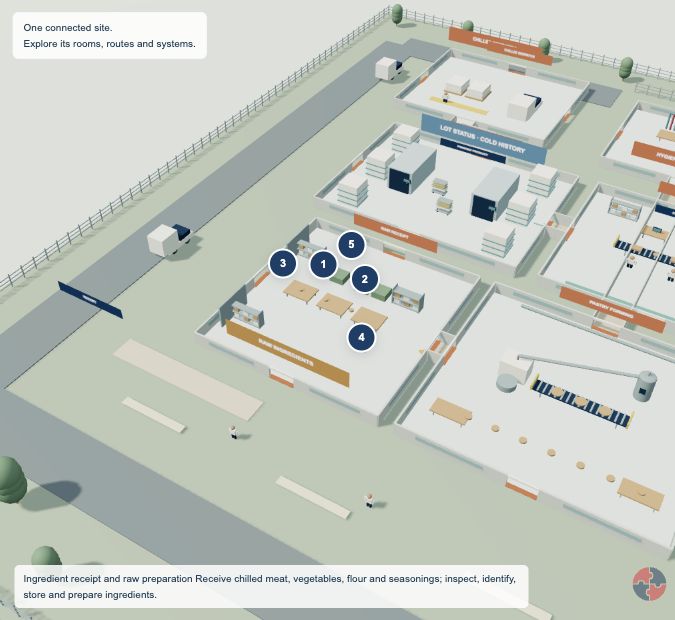
Actual whole-site SHAREsimulate pie factory model. This overview supplies layout context; inspect the lesson schematic and stated case for this zone.
Protect the raw-to-cooked boundary during real movements
A hygiene boundary is a controlled change in how materials, people and equipment move. Its purpose is to prevent contamination reaching product that will not receive the same protective processing again. A painted line communicates that boundary, but it cannot clean a trolley wheel, change clothing or decide whether a maintenance route is acceptable. Observe the real journey through the doorway and back.
In the model, a raw-meat trolley occupies the protected cooked-product route. The immediate question is not whether somebody saw raw meat touch a pie. Wheels, handles, containers and hands can create an indirect pathway. Establish where the trolley came from, what it touched and what exposed product or clean equipment could have been affected. Keep observations separate from assumptions about whether transfer definitely occurred.
Restore the approved separation arrangement using designated routes and appropriately controlled equipment, people and cleaning. Where a shared transition is permitted, its method must be suitable for the actual exposure and verified in use. An improvised spray at the doorway is not an equivalent system. Any cleaning intervention also needs safe equipment access and protection of food from chemicals, splashes and disturbance.
Product assessment and route restoration are connected but separate decisions. Moving the trolley away may remove the current obstacle while leaving uncertainty about pies already exposed. Identify the relevant batches and time window, retain them as required, and refer disposition to the authorised food-safety process. Do not quietly widen or narrow that scope because the dispatch list is inconvenient.
For the practical task, draw arrows from raw area to trolley handle, hand, door and cooked line. Remove the route at its strongest feasible point, then specify what evidence shows the replacement arrangement works. Watch a normal movement and an awkward exception, such as a breakdown call or returned container. A credible boundary remains workable during those exceptions and gives staff a clear stop route when it cannot be maintained.
Specific official context: FSA government allergen guidance2026; Food Standards Scotland guidance. Food examples require the actual food-business status, nation, food category and validated safe methods. Current government HACCP management guidance covers hazard identification, critical controls/limits, monitoring, corrective action, verification and records for food businesses; specialist meat-plant scope differs. FSA government allergen guidance updated 17 July 2026 applies England/Wales/NI; accurate ingredients, food-format labels, changes and cross-contact controls. GB assimilated law/NI movement or EU routes require actual product review.
Which contamination pathways should hygiene controls interrupt?
A hygiene system should break the chain between dirty work, the worker, welfare areas, vehicles, homes and other people.
Good hygiene design starts by asking where contamination can travel. Dust on gloves can move to a sandwich, a steering wheel or a phone. Wet PPE can hold biological contamination. Contaminated RPE can be stored in a clean locker. Shared tools can spread oils, chemicals or biological material. Food and drink in a dirty area can turn skin contamination into ingestion exposure.
These pathways are predictable, so they should be controlled through layout, welfare, storage, cleaning, laundry, supervision and worker briefing. If the only control is telling people to wash their hands, the system is too weak for anything beyond very low-risk work.
Pathway
How it causes harm
Control standard
Hands to mouth
Dust, chemicals, oils or biological material move from hands, gloves, phones or cigarettes into the body.
No eating/drinking in dirty areas, handwashing before breaks and clean storage for food and phones.
Skin contamination
Wet work, cement, solvents, oils, disinfectants or biological material damage skin or enter through damaged skin.
Avoid contact, suitable gloves, washing, skin checks and early reporting.
Contaminated PPE/RPE
Dirty gloves, coveralls, masks or respirators contaminate skin, lockers, vehicles or clean areas.
Doffing method, cleaning/replacement, separate storage and RPE hygiene checks.
Shared tools and vehicles
Contamination moves through handles, cabs, steering wheels, radios, tablets or shared workstations.
Clean/dirty rules, wipe-down schedule and clean hands before entering cabs or offices.
Welfare failure
No water, soap, towels, toilets, changing or eating areas makes safe hygiene unrealistic.
Planned welfare, daily checks, defect escalation and temporary provision for mobile sites.
Poor changing/storage
Workwear contaminates personal clothing or goes home for domestic washing.
Separate lockers, laundry route and controls for contaminated clothing.
Food/drink in contaminated areas
Eating, drinking or smoking where contaminants are present creates ingestion exposure.
Clean eating areas, supervision and clear boundary between work and welfare.
Applied case
The raw trolley has been removed, but it passed an uncovered cooked rack before anyone noticed.
Decision and explanation
Potentially affected product and the contamination pathway still require assessment.
Removing the immediate source does not determine the earlier exposure. Identify and control the affected scope while the authorised assessment restores product and route control.
Lesson 4
Keep returned trays out of clean circulation
Use identification, layout and verified cleaning to control transport-container returns.
Actual whole-site SHAREsimulate pie factory model. This overview supplies layout context; inspect the lesson schematic and stated case for this zone.
Keep returned trays out of clean circulation
Returned trays have a different status from clean items ready to enter production. They may carry food debris, dirty water or contamination acquired during use and transport. A familiar tray shape does not establish its hygiene status. The safe flow must show where dirty returns arrive, how they are contained, how cleaning is controlled and who releases them for their intended next use.
In the fictional return bay, soiled transport trays stand beside a clean stack after a busy collection. The labels identify the tray type, but neither stack has a reliable cleaning-status mark. The first action is to prevent uncertain items entering the protected product route and recover their identity. Guessing which stack looks cleaner would pass the uncertainty to people who reasonably expect released equipment.
Examine the physical arrangement as well as the washing record. Dirty and clean movement can mix when racks share a doorway, when staff lift both types with the same contaminated gloves, or when a clean stack is parked under an unclean return surface. Consider containers, lifting equipment, splash and handling routes. An excellent wash result is undermined if recontamination happens immediately afterwards.
The cleaning process must be appropriate to the material, soil and intended use, with the required checks and release evidence. Follow its approved method rather than inventing a detergent concentration, contact time or drying rule. A tick stating that the washer ran does not necessarily establish correct loading or the condition of a specific tray batch. Resolve missing evidence through the responsible hygiene team.
In practice, arrange four cards in sequence: dirty receipt, controlled cleaning, protected clean storage and identified release. Add a barrier preventing a tray from skipping a stage. Then test the exception: what happens when a label falls off or a load is interrupted? Your answer should maintain segregation and make recovery possible without relying on one person's memory. Protecting clean circulation is an operational system, not a judgement about appearance.
Specific official context: FSA government allergen guidance2026; Food Standards Scotland guidance. Food examples require the actual food-business status, nation, food category and validated safe methods. Current government HACCP management guidance covers hazard identification, critical controls/limits, monitoring, corrective action, verification and records for food businesses; specialist meat-plant scope differs. FSA government allergen guidance updated 17 July 2026 applies England/Wales/NI; accurate ingredients, food-format labels, changes and cross-contact controls. GB assimilated law/NI movement or EU routes require actual product review.
What food safety records should a business keep?
Records should prove that significant food safety controls are being completed, checked and corrected when they fail.
Food records should be quick to complete but meaningful. They should show the control, the result, the person checking it and the action taken when the result is outside the expected standard. Records that show perfect ticks every day but no defects, no corrective action and no manager review may be weaker than they look.
For higher-risk catering, records should also help managers identify patterns: repeated fridge failures, poor probe calibration, missed cleaning, supplier problems, complaints, allergen queries or staff training gaps.
Food safety evidence register
Record
What it proves
Review trigger
RecordFood safety management system
What it provesHazards, controls, monitoring and corrective actions are defined.
Review triggerMenu, process, supplier or premises change.
RecordTemperature records
What it provesCritical storage, cooking, cooling and hot-holding controls are checked.
Review triggerOut-of-range reading or equipment fault.
RecordCleaning schedule
What it provesCleaning tasks are allocated and verified.
Review triggerFailed inspection, pest activity or complaint.
RecordTraining matrix
What it provesFood handlers and supervisors are competent for their role.
Review triggerNew starter, role change or incident.
RecordAllergen matrix
What it provesAllergen information is current and communicated.
Review triggerSupplier, recipe or menu change.
RecordMaintenance records
What it provesEquipment affecting food safety is kept reliable.
Review triggerRepeated defect or breakdown.
RecordIncident and complaint log
What it provesLearning is captured and actioned.
Review triggerIllness complaint, allergen near miss or enforcement feedback.
Specific official context: GOV.UK food hygiene for businesses; Government HACCP food safety management; Food Standards Scotland guidance; FSA government allergen guidance2026. Food examples require the actual food-business status, nation, food category and validated safe methods. Current government HACCP management guidance covers hazard identification, critical controls/limits, monitoring, corrective action, verification and records for food businesses; specialist meat-plant scope differs. FSA government allergen guidance updated 17 July 2026 applies England/Wales/NI; accurate ingredients, food-format labels, changes and cross-contact controls. GB assimilated law/NI movement or EU routes require actual product review.
Applied case
Two visually similar stacks have become mixed. One was released after cleaning; the other arrived from customer returns.
Decision and explanation
Control the uncertain stacks, establish their status and use the approved cleaning/release route.
Appearance cannot restore lost status. Controlled identification and the approved cleaning/release process prevent uncertain returns becoming clean equipment.
Lesson 5
Make the vehicle ready before chilled stock leaves control
Coordinate storage, loading and vehicle readiness without inventing an exposure allowance.
Actual whole-site SHAREsimulate pie factory model. This overview supplies layout context; inspect the lesson schematic and stated case for this zone.
Make the vehicle ready before chilled stock leaves control
Dispatch is another controlled transition, not the end of food safety. Finished pies may have satisfactory processing and packing evidence yet lose their required protection while waiting for an unready vehicle. Plan loading around the approved product specification, the storage arrangement and the vehicle's demonstrated readiness. A booked collection time is a logistics commitment, not evidence that the load space is suitable.
The fictional dispatch team brings released pallet P-D to the loading position, then discovers the vehicle is still being prepared. A second pallet remains in controlled storage. Treat these as distinct histories. Stop further unnecessary staging and place the exposed pallet under the appropriate controlled arrangement while its history is assessed. Do not leave all stock waiting together simply to preserve the loading sequence.
Vehicle readiness includes the conditions relevant to this product, such as cleanliness, suitability, temperature-control arrangements, previous load considerations and the intended loading configuration. Check the evidence the site procedure requires and whether it relates to this vehicle and journey. A dashboard display alone may not answer every question about the load space or the food. Resolve discrepancies before dispatch release.
If delay or control failure occurs, record the affected lot, relevant times, available product information and action taken. The authorised food-safety assessment determines disposition using reliable history and the approved requirements. Rechilling does not erase an uncontrolled earlier period, and this awareness course does not supply a universal permitted staging time. Changing the plan should protect both product and people in the loading area.
For the exercise, compare two options: stage every pallet early, or release controlled quantities only when the loading arrangement is ready. Explain which uncertainties each option creates and who coordinates the decision. Complete the handover with the vehicle/load identity, released lots and unresolved restrictions. The driver and receiving business need accurate information, while internal records retain the evidence behind the dispatch decision.
Why does temperature control matter for food safety?
Set validated cooking, chilling, cooling, hot-holding and reheating controls for the food and jurisdiction. Avoid treating one temperature as a universal UK legal rule: Scottish commercial reheating law has a distinct 82°C route with exceptions, while other nations use different requirements and guidance.
Temperature control is one of the most familiar food safety topics, but it is often misunderstood. The question is not only whether a fridge number was written down. The question is whether the food was received, stored, cooked, cooled, reheated and served in a way that prevents harmful microbial growth.
Equipment reliability matters. Fridges, freezers, hot cupboards, probes and dishwashers should be checked, cleaned, calibrated where required and repaired promptly.
Temperature control examples
Control point
What can go wrong
Good practice evidence
Control pointDelivery
What can go wrongHigh-risk food arrives warm or damaged.
Good practice evidenceSupplier approval, delivery check and rejection record.
Control pointChilled storage
What can go wrongFridge overloaded, door left open or failed unit ignored.
Good practice evidenceTemperature log, action note and maintenance response.
Control pointCooking
What can go wrongCentre of food does not reach safe temperature.
Good practice evidenceProbe checks, cooking record and trained staff.
Control pointCooling
What can go wrongLarge containers cool too slowly.
Good practice evidencePortioning, blast chilling or timed cooling record.
Control pointReheating
What can go wrongFood reheated unevenly or repeatedly.
Good practice evidenceReheat standard, probe evidence and discard rule.
Control pointHot holding
What can go wrongFood drops below safe holding temperature.
Good practice evidenceHot-hold checks and time limits.
A simple HACCP food flow follows the food from purchase to service and identifies where contamination, growth, survival or allergen error can occur.
Food safety becomes easier to teach when the process is shown as a journey. At each stage the business should know the hazard, the control, the check and what action is taken if the check fails.
For low-risk staff refreshments, the flow may be simple. For cooked food, chilled high-risk food, buffets or vulnerable consumers, the flow needs more explicit control and evidence.
Example HACCP flow from purchase to service
Stage
What can go wrong
Control and evidence
StagePurchase
What can go wrongUnapproved supplier, damaged packaging, incorrect allergen information or high-risk product selected.
Control and evidenceApproved supplier list, specification, allergen data and purchasing rule.
StageDelivery
What can go wrongFood arrives warm, late, damaged, contaminated or past use-by date.
Control and evidenceDelivery check, temperature check, rejection rule and record.
StageStorage
What can go wrongRaw and ready-to-eat foods mix, fridge overloaded, allergens not segregated or stock rotation fails.
Control and evidenceSegregated storage, date labelling, fridge records and stock rotation.
StagePreparation
What can go wrongCross-contamination, poor hand hygiene, dirty equipment or allergen cross-contact.
Control and evidenceZoning, handwashing, cleaning, separate utensils and supervision.
StageCooking
What can go wrongFood is not cooked through or probe is inaccurate.
Control and evidenceCooking standard, probe check, calibration and corrective action.
StageHolding or cooling
What can go wrongFood spends too long at unsafe temperature.
Control and evidenceHot-hold checks, cooling method, time limits and discard rule.
StageService
What can go wrongWrong meal served, allergen information miscommunicated or buffet contaminated.
Control and evidenceService briefing, allergen check, clean utensils and customer communication.
Specific official context: GOV.UK food hygiene for businesses; Government HACCP food safety management; Food Standards Scotland guidance; FSA government allergen guidance2026. Food examples require the actual food-business status, nation, food category and validated safe methods. Current government HACCP management guidance covers hazard identification, critical controls/limits, monitoring, corrective action, verification and records for food businesses; specialist meat-plant scope differs. FSA government allergen guidance updated 17 July 2026 applies England/Wales/NI; accurate ingredients, food-format labels, changes and cross-contact controls. GB assimilated law/NI movement or EU routes require actual product review.
Applied case
Pallet P-D has waited at the loading position during a vehicle-preparation delay; pallet P-E has stayed in controlled storage.
Decision and explanation
Use each pallet’s reliable history and the approved requirements; prevent further uncontrolled staging.
Different histories require a bounded assessment. Restore control and use the authorised procedure rather than assuming a fixed delay is harmless.
Lesson 6
Make holds and traceability survive a busy handover
Reconcile ingredient, finished-lot and dispatch information before release or incident escalation.
Actual SHAREsimulate FOOD-Z01 model zone. The fictional case supplies the facts; the picture does not establish live plant or product conditions.
Make holds and traceability survive a busy handover
Traceability makes an affected product identifiable through connected business records. In the factory it also helps the team connect ingredients, processing, packing, hold status and dispatch. A batch number is useful only if it refers consistently to the material in front of you. Reworking, splitting pallets, replacing labels and combining production runs can break that connection unless the approved system captures them.
Consider a pallet whose physical quarantine tag is missing while its electronic status still says held. A dispatch operator finds a partly completed delivery record and assumes somebody already approved release. This is a conflict to resolve, not a choice between two equally convenient sources. Prevent dispatch of the uncertain scope, establish the product identity and recover the authorised hold or release decision.
Build the trace in both directions. Backwards, identify relevant ingredient suppliers, received lots and production use. Forwards, identify finished lots, quantities, storage locations and business destinations. Include stock still on site and material returned or reworked where relevant. A quantity discrepancy can expose a missing link, but an arithmetically balanced spreadsheet alone does not prove that all entries describe the right product.
If a food-safety concern may involve supplied product, escalate promptly through the incident procedure. The responsible team decides the withdrawal or recall actions and required communications with the relevant authority. A learner should preserve accurate evidence and report uncertainty, not contact real customers during this exercise or make an unauthorised declaration that the incident is closed. Do not invent a universal retention period for every trace record.
Your practice output is a short handover: identified lots, reason for control, location, missing link, evidence requested, decision owner and next review point. Give the receiving shift enough information to keep the hold effective without circulating unnecessary personal details. Test the system by tracing one fictional ingredient into its finished lots and destinations. Correct a demonstrated weakness in the process rather than merely completing the trace faster next time.
What food safety records should a business keep?
Records should prove that significant food safety controls are being completed, checked and corrected when they fail.
Food records should be quick to complete but meaningful. They should show the control, the result, the person checking it and the action taken when the result is outside the expected standard. Records that show perfect ticks every day but no defects, no corrective action and no manager review may be weaker than they look.
For higher-risk catering, records should also help managers identify patterns: repeated fridge failures, poor probe calibration, missed cleaning, supplier problems, complaints, allergen queries or staff training gaps.
Food safety evidence register
Record
What it proves
Review trigger
RecordFood safety management system
What it provesHazards, controls, monitoring and corrective actions are defined.
Review triggerMenu, process, supplier or premises change.
RecordTemperature records
What it provesCritical storage, cooking, cooling and hot-holding controls are checked.
Review triggerOut-of-range reading or equipment fault.
RecordCleaning schedule
What it provesCleaning tasks are allocated and verified.
Review triggerFailed inspection, pest activity or complaint.
RecordTraining matrix
What it provesFood handlers and supervisors are competent for their role.
Review triggerNew starter, role change or incident.
RecordAllergen matrix
What it provesAllergen information is current and communicated.
Review triggerSupplier, recipe or menu change.
RecordMaintenance records
What it provesEquipment affecting food safety is kept reliable.
Review triggerRepeated defect or breakdown.
RecordIncident and complaint log
What it provesLearning is captured and actioned.
Review triggerIllness complaint, allergen near miss or enforcement feedback.
Specific official context: GOV.UK food hygiene for businesses; Government HACCP food safety management; Food Standards Scotland guidance; FSA government allergen guidance2026. Food examples require the actual food-business status, nation, food category and validated safe methods. Current government HACCP management guidance covers hazard identification, critical controls/limits, monitoring, corrective action, verification and records for food businesses; specialist meat-plant scope differs. FSA government allergen guidance updated 17 July 2026 applies England/Wales/NI; accurate ingredients, food-format labels, changes and cross-contact controls. GB assimilated law/NI movement or EU routes require actual product review.
What evidence shows occupational foodborne illness is being managed?
Keep a dated record of symptom reports, exclusion and return decisions without circulating diagnoses.
Link each concern to the affected food, batch, preparation window, cleaning response and traceability or withdrawal decision. Temperature logs, allergen controls and staff training only help if supervisors act when a check fails.
Applied case
A missing pallet tag conflicts with an electronic hold; a delivery record is started but has no authorised release decision.
Decision and explanation
Stop the uncertain dispatch and reconcile identity, hold status and the release authority.
Conflicting status is a reason to control and reconcile the affected scope. Neither deleting the hold nor assuming an unfinished document is approval resolves the evidence.
Lesson 7
Unverified chilled ingredient delivery
Explain the decision using the observed condition, the harm route and the evidence needed for release.
Actual SHAREsimulate FOOD-Z01 model zone. The fictional case supplies the facts; the picture does not establish live plant or product conditions.
Understand the activity and how harm develops
An ingredient with uncertain delivery conditions must be kept out of production until its safety is established.
The receiving air temperature, product temperature and journey history answer different questions. Check against the approved material specification using the defined method; returning a warm lot to a fridge does not undo earlier growth.
Control follows the food through receipt, storage, preparation, processing and dispatch. Monitoring tells the operator whether a defined control is being met; an uncertain lot needs an authorised disposition. Appearance, smell or a commercial deadline cannot demonstrate food safety.
Recognise the evidence boundary
Question
Case evidence
What is observed?
A meat pallet waits at receipt with its delivery temperature record missing.
How can harm occur?
An interrupted cold chain can permit microbial growth before processing.
What information is needed?
Request the lot identity, transport history and receipt checks against the approved specification.
Protect, manage and verify
Purpose
Practical application
Immediate protection
Hold the uncertain lot in controlled storage for the authorised food-safety decision.
Accountable work arrangement
The food-safety lead and authorised production or intake manager decide lot disposition using the approved specification, traceability and control records. If the described protection is absent, defective or cannot be verified, keep the affected activity restricted while the responsible person resolves it. Use the current inspection evidence; the title alone is not the verdict.
Release verification
Reconcile reliable receipt evidence and recorded lot disposition before issue to production.
Apply this at work
Explain the decision using the observed condition, the harm route and the evidence needed for release.
Why does temperature control matter for food safety?
Set validated cooking, chilling, cooling, hot-holding and reheating controls for the food and jurisdiction. Avoid treating one temperature as a universal UK legal rule: Scottish commercial reheating law has a distinct 82°C route with exceptions, while other nations use different requirements and guidance.
Temperature control is one of the most familiar food safety topics, but it is often misunderstood. The question is not only whether a fridge number was written down. The question is whether the food was received, stored, cooked, cooled, reheated and served in a way that prevents harmful microbial growth.
Equipment reliability matters. Fridges, freezers, hot cupboards, probes and dishwashers should be checked, cleaned, calibrated where required and repaired promptly.
Temperature control examples
Control point
What can go wrong
Good practice evidence
Control pointDelivery
What can go wrongHigh-risk food arrives warm or damaged.
Good practice evidenceSupplier approval, delivery check and rejection record.
Control pointChilled storage
What can go wrongFridge overloaded, door left open or failed unit ignored.
Good practice evidenceTemperature log, action note and maintenance response.
Control pointCooking
What can go wrongCentre of food does not reach safe temperature.
Good practice evidenceProbe checks, cooking record and trained staff.
Control pointCooling
What can go wrongLarge containers cool too slowly.
Good practice evidencePortioning, blast chilling or timed cooling record.
Control pointReheating
What can go wrongFood reheated unevenly or repeatedly.
Good practice evidenceReheat standard, probe evidence and discard rule.
Control pointHot holding
What can go wrongFood drops below safe holding temperature.
Good practice evidenceHot-hold checks and time limits.
A meat pallet waits at receipt with its delivery temperature record missing. The next production or dispatch step is waiting for a decision.
Decision and explanation
Hold the uncertain lot in controlled storage for the authorised food-safety decision.
Cooling now cannot reconstruct missing evidence or reverse an earlier unsafe history. This retains control of the affected work or product while the required evidence is established. Reconcile reliable receipt evidence and recorded lot disposition before issue to production. Recording alone leaves this harm route active: An interrupted cold chain can permit microbial growth before processing.
Lesson 8
Raw-material trolley crosses the cooked boundary
Explain the decision using the observed condition, the harm route and the evidence needed for release.
Actual SHAREsimulate FOOD-Z01 model zone. The fictional case supplies the facts; the picture does not establish live plant or product conditions.
Understand the activity and how harm develops
A trolley used for raw ingredients can carry contamination into the area protecting cooked food.
Follow wheels, handles, footwear, utensils and people across the boundary. The hygiene zoning plan must match the actual material flow, including waste and maintenance; changing a sign does not clean a contaminated trolley.
Control follows the food through receipt, storage, preparation, processing and dispatch. Monitoring tells the operator whether a defined control is being met; an uncertain lot needs an authorised disposition. Appearance, smell or a commercial deadline cannot demonstrate food safety.
Recognise the evidence boundary
Question
Case evidence
What is observed?
A raw-meat trolley is parked in the protected cooked-product route.
How can harm occur?
Wheels, hands or containers can transfer contamination to ready-to-eat pies.
What information is needed?
Check movement routes, trolley identification and cleaning evidence for the boundary crossing.
Protect, manage and verify
Purpose
Practical application
Immediate protection
Keep raw and cooked movements separated using the approved hygiene arrangement.
Accountable work arrangement
The food-safety lead and authorised production or intake manager decide lot disposition using the approved specification, traceability and control records. If the described protection is absent, defective or cannot be verified, keep the affected activity restricted while the responsible person resolves it. Use the current inspection evidence; the title alone is not the verdict.
Release verification
Verify the route, equipment status and affected-product assessment before reopening circulation.
Apply this at work
Explain the decision using the observed condition, the harm route and the evidence needed for release.
Specific official context: FSA government allergen guidance2026; Food Standards Scotland guidance. Food examples require the actual food-business status, nation, food category and validated safe methods. Current government HACCP management guidance covers hazard identification, critical controls/limits, monitoring, corrective action, verification and records for food businesses; specialist meat-plant scope differs. FSA government allergen guidance updated 17 July 2026 applies England/Wales/NI; accurate ingredients, food-format labels, changes and cross-contact controls. GB assimilated law/NI movement or EU routes require actual product review.
Applied case
A raw-meat trolley is parked in the protected cooked-product route. The next production or dispatch step is waiting for a decision.
Decision and explanation
Keep raw and cooked movements separated using the approved hygiene arrangement.
This retains control of the affected work or product while the required evidence is established. Verify the route, equipment status and affected-product assessment before reopening circulation. Recording alone leaves this harm route active: Wheels, hands or containers can transfer contamination to ready-to-eat pies. Other surfaces and the movement itself remain uncontrolled transfer routes.
Lesson 9
Chilled goods staged for an unready vehicle
Explain the decision using the observed condition, the harm route and the evidence needed for release.
Actual whole-site SHAREsimulate pie factory model. This overview supplies layout context; inspect the lesson schematic and stated case for this zone.
Understand the activity and how harm develops
Chilled goods can warm during a dispatch delay before a vehicle is ready to preserve their required conditions.
Coordinate loading appointments, staging capacity, actual product history and vehicle readiness. The cold chain includes the waiting period, not only warehouse and vehicle setpoints. Re-cooling cannot erase an earlier unassessed excursion.
Control follows the food through receipt, storage, preparation, processing and dispatch. Monitoring tells the operator whether a defined control is being met; an uncertain lot needs an authorised disposition. Appearance, smell or a commercial deadline cannot demonstrate food safety.
Recognise the evidence boundary
Question
Case evidence
What is observed?
Finished pallets wait outside controlled storage while the vehicle is not ready.
How can harm occur?
An uncontrolled delay can break the product's required cold chain.
What information is needed?
Check staging duration, product history and the vehicle readiness specification.
Protect, manage and verify
Purpose
Practical application
Immediate protection
Return or retain goods under the approved controlled arrangement and hold uncertainty.
Accountable work arrangement
The food-safety lead and authorised production or intake manager decide lot disposition using the approved specification, traceability and control records. If the described protection is absent, defective or cannot be verified, keep the affected activity restricted while the responsible person resolves it. Use the current inspection evidence; the title alone is not the verdict.
Release verification
Verify vehicle readiness and reliable product history before authorised dispatch.
Apply this at work
Explain the decision using the observed condition, the harm route and the evidence needed for release.
Why does temperature control matter for food safety?
Set validated cooking, chilling, cooling, hot-holding and reheating controls for the food and jurisdiction. Avoid treating one temperature as a universal UK legal rule: Scottish commercial reheating law has a distinct 82°C route with exceptions, while other nations use different requirements and guidance.
Temperature control is one of the most familiar food safety topics, but it is often misunderstood. The question is not only whether a fridge number was written down. The question is whether the food was received, stored, cooked, cooled, reheated and served in a way that prevents harmful microbial growth.
Equipment reliability matters. Fridges, freezers, hot cupboards, probes and dishwashers should be checked, cleaned, calibrated where required and repaired promptly.
Temperature control examples
Control point
What can go wrong
Good practice evidence
Control pointDelivery
What can go wrongHigh-risk food arrives warm or damaged.
Good practice evidenceSupplier approval, delivery check and rejection record.
Control pointChilled storage
What can go wrongFridge overloaded, door left open or failed unit ignored.
Good practice evidenceTemperature log, action note and maintenance response.
Control pointCooking
What can go wrongCentre of food does not reach safe temperature.
Good practice evidenceProbe checks, cooking record and trained staff.
Control pointCooling
What can go wrongLarge containers cool too slowly.
Good practice evidencePortioning, blast chilling or timed cooling record.
Control pointReheating
What can go wrongFood reheated unevenly or repeatedly.
Good practice evidenceReheat standard, probe evidence and discard rule.
Control pointHot holding
What can go wrongFood drops below safe holding temperature.
Good practice evidenceHot-hold checks and time limits.
Finished pallets wait outside controlled storage while the vehicle is not ready. The next production or dispatch step is waiting for a decision.
Decision and explanation
Return or retain goods under the approved controlled arrangement and hold uncertainty.
This retains control of the affected work or product while the required evidence is established. Verify vehicle readiness and reliable product history before authorised dispatch. A forecast arrival does not control the actual time and temperature of the food. Recording alone leaves this harm route active: An uncontrolled delay can break the product's required cold chain.
Lesson 10
Held lot released through an incomplete trace
Explain the decision using the observed condition, the harm route and the evidence needed for release.
Actual whole-site SHAREsimulate pie factory model. This overview supplies layout context; inspect the lesson schematic and stated case for this zone.
Understand the activity and how harm develops
An incomplete trace can release stock that should remain held and can prevent the business finding affected customers.
Link ingredient lots, processing records, packaging, holds and dispatch. Test both the quantity balance and the ability to identify where affected product went. A recall exercise must demonstrate decisions and communication, not just a list of suppliers.
Control follows the food through receipt, storage, preparation, processing and dispatch. Monitoring tells the operator whether a defined control is being met; an uncertain lot needs an authorised disposition. Appearance, smell or a commercial deadline cannot demonstrate food safety.
Recognise the evidence boundary
Question
Case evidence
What is observed?
A quarantine tag is missing from a pallet whose dispatch record is incomplete.
How can harm occur?
Unsafe or unresolved product can be shipped without an effective recall scope.
What information is needed?
Reconcile lot identity, hold status, ingredients, packing and customer destinations.
Protect, manage and verify
Purpose
Practical application
Immediate protection
Stop dispatch of the uncertain scope and restore controlled hold and traceability.
Accountable work arrangement
The food-safety lead and authorised production or intake manager decide lot disposition using the approved specification, traceability and control records. If the described protection is absent, defective or cannot be verified, keep the affected activity restricted while the responsible person resolves it. Use the current inspection evidence; the title alone is not the verdict.
Release verification
The authorised release decision must reconcile every affected lot and destination.
Apply this at work
Explain the decision using the observed condition, the harm route and the evidence needed for release.
What food safety records should a business keep?
Records should prove that significant food safety controls are being completed, checked and corrected when they fail.
Food records should be quick to complete but meaningful. They should show the control, the result, the person checking it and the action taken when the result is outside the expected standard. Records that show perfect ticks every day but no defects, no corrective action and no manager review may be weaker than they look.
For higher-risk catering, records should also help managers identify patterns: repeated fridge failures, poor probe calibration, missed cleaning, supplier problems, complaints, allergen queries or staff training gaps.
Food safety evidence register
Record
What it proves
Review trigger
RecordFood safety management system
What it provesHazards, controls, monitoring and corrective actions are defined.
Review triggerMenu, process, supplier or premises change.
RecordTemperature records
What it provesCritical storage, cooking, cooling and hot-holding controls are checked.
Review triggerOut-of-range reading or equipment fault.
RecordCleaning schedule
What it provesCleaning tasks are allocated and verified.
Review triggerFailed inspection, pest activity or complaint.
RecordTraining matrix
What it provesFood handlers and supervisors are competent for their role.
Review triggerNew starter, role change or incident.
RecordAllergen matrix
What it provesAllergen information is current and communicated.
Review triggerSupplier, recipe or menu change.
RecordMaintenance records
What it provesEquipment affecting food safety is kept reliable.
Review triggerRepeated defect or breakdown.
RecordIncident and complaint log
What it provesLearning is captured and actioned.
Review triggerIllness complaint, allergen near miss or enforcement feedback.
Specific official context: GOV.UK food hygiene for businesses; Government HACCP food safety management; Food Standards Scotland guidance; FSA government allergen guidance2026. Food examples require the actual food-business status, nation, food category and validated safe methods. Current government HACCP management guidance covers hazard identification, critical controls/limits, monitoring, corrective action, verification and records for food businesses; specialist meat-plant scope differs. FSA government allergen guidance updated 17 July 2026 applies England/Wales/NI; accurate ingredients, food-format labels, changes and cross-contact controls. GB assimilated law/NI movement or EU routes require actual product review.
Applied case
A quarantine tag is missing from a pallet whose dispatch record is incomplete. The next production or dispatch step is waiting for a decision.
Decision and explanation
Stop dispatch of the uncertain scope and restore controlled hold and traceability.
This retains control of the affected work or product while the required evidence is established. The authorised release decision must reconcile every affected lot and destination. Supplier identity alone does not resolve the affected lot, quantities, process or customer destinations. Recording alone leaves this harm route active: Unsafe or unresolved product can be shipped without an effective recall scope.
Lesson 11
Dirty returned transport trays enter clean circulation
Explain the decision using the observed condition, the harm route and the evidence needed for release.
Actual whole-site SHAREsimulate pie factory model. This overview supplies layout context; inspect the lesson schematic and stated case for this zone.
Understand the activity and how harm develops
Returned trays can carry contamination into clean circulation through their surfaces and movement.
Keep dirty receipt, cleaning, drying, inspection and clean storage as a controlled flow. Verify the actual tray-cleaning process, including damaged trays and difficult locations. Visual tidiness or an empty tray is not evidence of hygienic suitability.
Control follows the food through receipt, storage, preparation, processing and dispatch. Monitoring tells the operator whether a defined control is being met; an uncertain lot needs an authorised disposition. Appearance, smell or a commercial deadline cannot demonstrate food safety.
Recognise the evidence boundary
Question
Case evidence
What is observed?
Soiled return trays are stacked beside clean product-contact transport items.
How can harm occur?
Returned contamination can enter the protected product route.
What information is needed?
Check tray segregation, cleaning status and the defined return flow.
Protect, manage and verify
Purpose
Practical application
Immediate protection
Keep dirty returns separate until the approved cleaning and release process is complete.
Accountable work arrangement
The food-safety lead and authorised production or intake manager decide lot disposition using the approved specification, traceability and control records. If the described protection is absent, defective or cannot be verified, keep the affected activity restricted while the responsible person resolves it. Use the current inspection evidence; the title alone is not the verdict.
Release verification
Verify identification and one-way movement prevent dirty and clean items mixing.
Apply this at work
Explain the decision using the observed condition, the harm route and the evidence needed for release.
Specific official context: FSA government allergen guidance2026; Food Standards Scotland guidance. Food examples require the actual food-business status, nation, food category and validated safe methods. Current government HACCP management guidance covers hazard identification, critical controls/limits, monitoring, corrective action, verification and records for food businesses; specialist meat-plant scope differs. FSA government allergen guidance updated 17 July 2026 applies England/Wales/NI; accurate ingredients, food-format labels, changes and cross-contact controls. GB assimilated law/NI movement or EU routes require actual product review.
Applied case
Soiled return trays are stacked beside clean product-contact transport items. The next production or dispatch step is waiting for a decision.
Decision and explanation
Keep dirty returns separate until the approved cleaning and release process is complete.
This retains control of the affected work or product while the required evidence is established. Verify identification and one-way movement prevent dirty and clean items mixing. Recording alone leaves this harm route active: Returned contamination can enter the protected product route. An empty tray can still transfer contamination onto food, packaging or clean equipment.
Lesson 12
One delivery, two pallet histories and a disputed release
Defend a coherent receipt-to-dispatch decision using bounded evidence and named authority.
Actual whole-site SHAREsimulate pie factory model. This overview supplies layout context; inspect the lesson schematic and stated case for this zone.
One delivery, two pallet histories and a disputed release
The dispatch board shows a full vehicle and a waiting customer. Pallet F-A contains pies from an ingredient lot whose receipt investigation remains open. Pallet F-B has complete receipt and batch records but has been staged while the vehicle is prepared. A returned tray stack stands near the clean dispatch equipment. The exercise asks for one coordinated plan while preserving the differences between these observations.
Begin by protecting the current state. Prevent the held ingredient-linked product being loaded. Keep other product under the appropriate controlled arrangement and stop further unnecessary staging. Separate the dirty returns from the clean circulation route. Inform the responsible operations and food-safety people of the specific observations. Avoid implying that every pallet is unsafe or that every satisfactory record has become invalid.
Next, draw the ingredient-to-finished-lot link for F-A. Locate the supplier lot identity, receipt evidence, storage status, issue record and affected production batches. Determine which uncertainty the authorised person must resolve. A satisfactory oven record may address processing but does not automatically settle an ingredient acceptance question. Record the scope and keep status consistent physically and electronically until a justified disposition is documented.
Assess F-B using its own reliable product history and the approved dispatch specification. Establish the staging event, available product evidence and vehicle readiness. Do not write a permitted delay from memory or borrow a catering example as an industrial factory rule. The responsible person may be able to make a different disposition from F-A, but that decision needs its own basis. Returning stock to a chiller is protective action, not retrospective proof of safety.
For the tray issue, inspect movement and contact routes. Identify whether uncertain return items entered clean circulation and whether released food or equipment could have been exposed. Restore the segregation, cleaning-status and release system. Where the evidence indicates an affected interval, retain and assess that scope. Where reliable records and physical separation show other stock stayed protected, preserve that distinction instead of widening the hold without a reason.
Complete a dispatch reconciliation before any authorised release. The record should identify the finished lots, quantities, vehicle, customer business, status and decision reference. If any suspect material has already left, use the incident escalation arrangements promptly so the responsible team can determine withdrawal, recall and authority communications. Do not submit a real report, notify customers or create operational records while practising the exercise.
Finally, brief the next shift on what can proceed, what remains held and exactly who can resolve each open point. Ask them to explain the plan back using the pallet identities rather than saying that dispatch is generally approved. A useful review also changes the work: prepare the vehicle before staging, maintain visible hold identity and keep dirty returns on their designated flow. The successful outcome is controlled, traceable decisions under pressure.
What does a simple HACCP food flow look like?
A simple HACCP food flow follows the food from purchase to service and identifies where contamination, growth, survival or allergen error can occur.
Food safety becomes easier to teach when the process is shown as a journey. At each stage the business should know the hazard, the control, the check and what action is taken if the check fails.
For low-risk staff refreshments, the flow may be simple. For cooked food, chilled high-risk food, buffets or vulnerable consumers, the flow needs more explicit control and evidence.
Example HACCP flow from purchase to service
Stage
What can go wrong
Control and evidence
StagePurchase
What can go wrongUnapproved supplier, damaged packaging, incorrect allergen information or high-risk product selected.
Control and evidenceApproved supplier list, specification, allergen data and purchasing rule.
StageDelivery
What can go wrongFood arrives warm, late, damaged, contaminated or past use-by date.
Control and evidenceDelivery check, temperature check, rejection rule and record.
StageStorage
What can go wrongRaw and ready-to-eat foods mix, fridge overloaded, allergens not segregated or stock rotation fails.
Control and evidenceSegregated storage, date labelling, fridge records and stock rotation.
StagePreparation
What can go wrongCross-contamination, poor hand hygiene, dirty equipment or allergen cross-contact.
Control and evidenceZoning, handwashing, cleaning, separate utensils and supervision.
StageCooking
What can go wrongFood is not cooked through or probe is inaccurate.
Control and evidenceCooking standard, probe check, calibration and corrective action.
StageHolding or cooling
What can go wrongFood spends too long at unsafe temperature.
Control and evidenceHot-hold checks, cooling method, time limits and discard rule.
StageService
What can go wrongWrong meal served, allergen information miscommunicated or buffet contaminated.
Control and evidenceService briefing, allergen check, clean utensils and customer communication.
Specific official context: GOV.UK food hygiene for businesses; Government HACCP food safety management; Food Standards Scotland guidance; FSA government allergen guidance2026. Food examples require the actual food-business status, nation, food category and validated safe methods. Current government HACCP management guidance covers hazard identification, critical controls/limits, monitoring, corrective action, verification and records for food businesses; specialist meat-plant scope differs. FSA government allergen guidance updated 17 July 2026 applies England/Wales/NI; accurate ingredients, food-format labels, changes and cross-contact controls. GB assimilated law/NI movement or EU routes require actual product review.
What food safety records should a business keep?
Records should prove that significant food safety controls are being completed, checked and corrected when they fail.
Food records should be quick to complete but meaningful. They should show the control, the result, the person checking it and the action taken when the result is outside the expected standard. Records that show perfect ticks every day but no defects, no corrective action and no manager review may be weaker than they look.
For higher-risk catering, records should also help managers identify patterns: repeated fridge failures, poor probe calibration, missed cleaning, supplier problems, complaints, allergen queries or staff training gaps.
Food safety evidence register
Record
What it proves
Review trigger
RecordFood safety management system
What it provesHazards, controls, monitoring and corrective actions are defined.
Review triggerMenu, process, supplier or premises change.
RecordTemperature records
What it provesCritical storage, cooking, cooling and hot-holding controls are checked.
Review triggerOut-of-range reading or equipment fault.
RecordCleaning schedule
What it provesCleaning tasks are allocated and verified.
Review triggerFailed inspection, pest activity or complaint.
RecordTraining matrix
What it provesFood handlers and supervisors are competent for their role.
Review triggerNew starter, role change or incident.
RecordAllergen matrix
What it provesAllergen information is current and communicated.
Review triggerSupplier, recipe or menu change.
RecordMaintenance records
What it provesEquipment affecting food safety is kept reliable.
Review triggerRepeated defect or breakdown.
RecordIncident and complaint log
What it provesLearning is captured and actioned.
Review triggerIllness complaint, allergen near miss or enforcement feedback.
Specific official context: GOV.UK food hygiene for businesses; Government HACCP food safety management; Food Standards Scotland guidance; FSA government allergen guidance2026. Food examples require the actual food-business status, nation, food category and validated safe methods. Current government HACCP management guidance covers hazard identification, critical controls/limits, monitoring, corrective action, verification and records for food businesses; specialist meat-plant scope differs. FSA government allergen guidance updated 17 July 2026 applies England/Wales/NI; accurate ingredients, food-format labels, changes and cross-contact controls. GB assimilated law/NI movement or EU routes require actual product review.
Why does temperature control matter for food safety?
Set validated cooking, chilling, cooling, hot-holding and reheating controls for the food and jurisdiction. Avoid treating one temperature as a universal UK legal rule: Scottish commercial reheating law has a distinct 82°C route with exceptions, while other nations use different requirements and guidance.
Temperature control is one of the most familiar food safety topics, but it is often misunderstood. The question is not only whether a fridge number was written down. The question is whether the food was received, stored, cooked, cooled, reheated and served in a way that prevents harmful microbial growth.
Equipment reliability matters. Fridges, freezers, hot cupboards, probes and dishwashers should be checked, cleaned, calibrated where required and repaired promptly.
Temperature control examples
Control point
What can go wrong
Good practice evidence
Control pointDelivery
What can go wrongHigh-risk food arrives warm or damaged.
Good practice evidenceSupplier approval, delivery check and rejection record.
Control pointChilled storage
What can go wrongFridge overloaded, door left open or failed unit ignored.
Good practice evidenceTemperature log, action note and maintenance response.
Control pointCooking
What can go wrongCentre of food does not reach safe temperature.
Good practice evidenceProbe checks, cooking record and trained staff.
Control pointCooling
What can go wrongLarge containers cool too slowly.
Good practice evidencePortioning, blast chilling or timed cooling record.
Control pointReheating
What can go wrongFood reheated unevenly or repeatedly.
Good practice evidenceReheat standard, probe evidence and discard rule.
Control pointHot holding
What can go wrongFood drops below safe holding temperature.
Good practice evidenceHot-hold checks and time limits.
F-A is linked to an unresolved receipt hold; F-B has a separate staging delay; dirty return trays are near clean equipment. Some records are satisfactory and must remain usable.
Decision and explanation
Keep the distinct uncertain scopes controlled, reconcile their evidence and release only through the responsible authorised decisions.
Control each genuine uncertainty without losing the distinctions. Receipt disposition, dispatch history and return-flow hygiene need connected evidence and appropriate authority.
Lesson 13
Take a verified action into the workplace
Connect one actual task to an owner, evidence and a clear release or escalation decision.
Actual whole-site SHAREsimulate pie factory model. This overview supplies layout context; inspect the lesson schematic and stated case for this zone.
Turn awareness into a practical question
Food-manufacturing awareness using a fictional pie factory. No product acceptance, process-validation, withdrawal or recall authority is conferred. Check the nation, product, food-business approval and destination-market requirements with the competent team.
Choose one relevant operation from the course. Describe the person or product at risk, the mechanism of harm and the exact condition that needs controlling. Separate an observation from a conclusion. A display, signature, badge or clean appearance answers only a limited question.
Use the included practice resources to prepare a fictional task brief, risk review or verification question. Decide which competent role owns the decision and which evidence must be available before work or product is released. Keep food disposition and worker protection as distinct decisions where both apply.
At work, use your actual approved arrangements. Report uncertainty and preserve the relevant hold, restriction or safe state while it is resolved. Confirm that the action addressed the original harm route and check whether another shift, product, cleaning task or maintenance change could reintroduce it.
Course completion records awareness learning. It does not establish practical competence, certify a food business, validate a recipe, extend shelf life or authorise maintenance, chemical work or emergency entry.
What does a simple HACCP food flow look like?
A simple HACCP food flow follows the food from purchase to service and identifies where contamination, growth, survival or allergen error can occur.
Food safety becomes easier to teach when the process is shown as a journey. At each stage the business should know the hazard, the control, the check and what action is taken if the check fails.
For low-risk staff refreshments, the flow may be simple. For cooked food, chilled high-risk food, buffets or vulnerable consumers, the flow needs more explicit control and evidence.
Example HACCP flow from purchase to service
Stage
What can go wrong
Control and evidence
StagePurchase
What can go wrongUnapproved supplier, damaged packaging, incorrect allergen information or high-risk product selected.
Control and evidenceApproved supplier list, specification, allergen data and purchasing rule.
StageDelivery
What can go wrongFood arrives warm, late, damaged, contaminated or past use-by date.
Control and evidenceDelivery check, temperature check, rejection rule and record.
StageStorage
What can go wrongRaw and ready-to-eat foods mix, fridge overloaded, allergens not segregated or stock rotation fails.
Control and evidenceSegregated storage, date labelling, fridge records and stock rotation.
StagePreparation
What can go wrongCross-contamination, poor hand hygiene, dirty equipment or allergen cross-contact.
Control and evidenceZoning, handwashing, cleaning, separate utensils and supervision.
StageCooking
What can go wrongFood is not cooked through or probe is inaccurate.
Control and evidenceCooking standard, probe check, calibration and corrective action.
StageHolding or cooling
What can go wrongFood spends too long at unsafe temperature.
Control and evidenceHot-hold checks, cooling method, time limits and discard rule.
StageService
What can go wrongWrong meal served, allergen information miscommunicated or buffet contaminated.
Control and evidenceService briefing, allergen check, clean utensils and customer communication.
Specific official context: GOV.UK food hygiene for businesses; Government HACCP food safety management; Food Standards Scotland guidance; FSA government allergen guidance2026. Food examples require the actual food-business status, nation, food category and validated safe methods. Current government HACCP management guidance covers hazard identification, critical controls/limits, monitoring, corrective action, verification and records for food businesses; specialist meat-plant scope differs. FSA government allergen guidance updated 17 July 2026 applies England/Wales/NI; accurate ingredients, food-format labels, changes and cross-contact controls. GB assimilated law/NI movement or EU routes require actual product review.
What food safety records should a business keep?
Records should prove that significant food safety controls are being completed, checked and corrected when they fail.
Food records should be quick to complete but meaningful. They should show the control, the result, the person checking it and the action taken when the result is outside the expected standard. Records that show perfect ticks every day but no defects, no corrective action and no manager review may be weaker than they look.
For higher-risk catering, records should also help managers identify patterns: repeated fridge failures, poor probe calibration, missed cleaning, supplier problems, complaints, allergen queries or staff training gaps.
Food safety evidence register
Record
What it proves
Review trigger
RecordFood safety management system
What it provesHazards, controls, monitoring and corrective actions are defined.
Review triggerMenu, process, supplier or premises change.
RecordTemperature records
What it provesCritical storage, cooking, cooling and hot-holding controls are checked.
Review triggerOut-of-range reading or equipment fault.
RecordCleaning schedule
What it provesCleaning tasks are allocated and verified.
Review triggerFailed inspection, pest activity or complaint.
RecordTraining matrix
What it provesFood handlers and supervisors are competent for their role.
Review triggerNew starter, role change or incident.
RecordAllergen matrix
What it provesAllergen information is current and communicated.
Review triggerSupplier, recipe or menu change.
RecordMaintenance records
What it provesEquipment affecting food safety is kept reliable.
Review triggerRepeated defect or breakdown.
RecordIncident and complaint log
What it provesLearning is captured and actioned.
Review triggerIllness complaint, allergen near miss or enforcement feedback.
Specific official context: GOV.UK food hygiene for businesses; Government HACCP food safety management; Food Standards Scotland guidance; FSA government allergen guidance2026. Food examples require the actual food-business status, nation, food category and validated safe methods. Current government HACCP management guidance covers hazard identification, critical controls/limits, monitoring, corrective action, verification and records for food businesses; specialist meat-plant scope differs. FSA government allergen guidance updated 17 July 2026 applies England/Wales/NI; accurate ingredients, food-format labels, changes and cross-contact controls. GB assimilated law/NI movement or EU routes require actual product review.
Why does temperature control matter for food safety?
Set validated cooking, chilling, cooling, hot-holding and reheating controls for the food and jurisdiction. Avoid treating one temperature as a universal UK legal rule: Scottish commercial reheating law has a distinct 82°C route with exceptions, while other nations use different requirements and guidance.
Temperature control is one of the most familiar food safety topics, but it is often misunderstood. The question is not only whether a fridge number was written down. The question is whether the food was received, stored, cooked, cooled, reheated and served in a way that prevents harmful microbial growth.
Equipment reliability matters. Fridges, freezers, hot cupboards, probes and dishwashers should be checked, cleaned, calibrated where required and repaired promptly.
Temperature control examples
Control point
What can go wrong
Good practice evidence
Control pointDelivery
What can go wrongHigh-risk food arrives warm or damaged.
Good practice evidenceSupplier approval, delivery check and rejection record.
Control pointChilled storage
What can go wrongFridge overloaded, door left open or failed unit ignored.
Good practice evidenceTemperature log, action note and maintenance response.
Control pointCooking
What can go wrongCentre of food does not reach safe temperature.
Good practice evidenceProbe checks, cooking record and trained staff.
Control pointCooling
What can go wrongLarge containers cool too slowly.
Good practice evidencePortioning, blast chilling or timed cooling record.
Control pointReheating
What can go wrongFood reheated unevenly or repeatedly.
Good practice evidenceReheat standard, probe evidence and discard rule.
Control pointHot holding
What can go wrongFood drops below safe holding temperature.
Good practice evidenceHot-hold checks and time limits.