Independent SHAREhub process-safety awareness using fictional cases and a Great Britain baseline; check the applicable Northern Ireland duties and actual site arrangements. This course does not award a NEBOSH qualification, establish specialist competence or authorise hazardous work.
This reader supplies the complete teaching. Use the interactive LMS course for assessed activities, saved progress and completion.
LESSON 1
Separate electrical injury, ignition and process upset
Separate electrical injury, ignition and process upset.
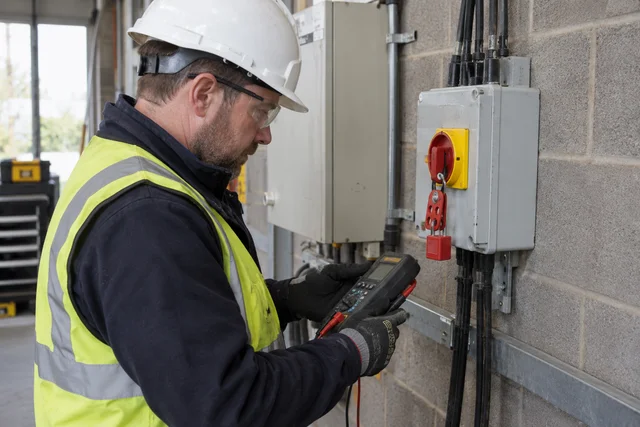
Existing SHAREhub photographic illustration. The written fictional case supplies the condition and decision evidence.
Understand the mechanism and the decision
An electrical event can harm through current passing through the body, an arc or hot surface, or the failure of equipment that a process depends on. In a plant handling flammable material, the same damaged connection may also provide ignition. These are related scenarios, but they do not have identical controls or evidence.
Begin with what can be energised, what material or atmosphere may be present and which process functions depend on the supply. A tidy cable route is useful physical protection; it does not establish suitable equipment or reliable supply to a critical service. The responsible assessment must consider normal operation, maintenance and foreseeable faults together.
A worker stands beside a separate anatomical overview of the heart, lungs, muscles and nerves. These normal tissues introduce the injury lesson; no electrical current path is shown.
Locate the heart, muscles and nerves as different living tissues. Follow the lesson’s isolation and competence boundaries before any intervention.
educational illustration · healthy anatomy; enlarged details and teaching colours.
Verify the control in the actual task
Ask for the relevant task assessment and the competent electrical/process review. Keep uncertainty visible rather than using continued operation as proof of suitability.
What does electricity and static electricity mean in workplace safety?
Electricity is controlled energy in systems or equipment; static electricity is charge imbalance that can discharge suddenly.
Electricity in a workplace includes fixed installations, switchgear, control panels, machinery circuits, portable tools, chargers, batteries, test equipment and temporary supplies. The key safety question is whether a person can contact live parts, whether a fault can release energy, and whether the system is suitable, maintained and used correctly.
Static electricity is not supplied by a socket. It develops when materials separate, rub, flow, spray, pour, filter, mix or move. The charge may remain on a surface, container, liquid, powder, person or item of plant until it finds a discharge route. In low-risk settings this may be a small snap; in explosive atmospheres it may provide ignition.
Electricity and static electricity compared - Electricity and static electricity compared
Aspect
Electricity
Static electricity
Energy source
Supplied or stored electrical energy.
Charge build-up from movement, separation or flow.
Typical harm
Shock, burns, arc flash, fire and secondary injury.
Spark ignition, startle, minor shock or process upset.
Main controls
Isolation, protection, equipment suitability and competence.
Bonding, earthing, antistatic equipment and atmosphere control.
Key evidence
Inspection, testing, isolation and maintenance records.
DSEAR assessment, continuity checks and transfer procedure.
Applied case
A damaged temporary cable serves a pump near a solvent task. A colleague says the only concern is a trip.
Test the assumption
Check only whether pedestrians can step over the cable. This does not establish acceptance. The running pump does not establish cable condition, ignition suitability or a safe response to power loss.
Evidence before acceptance
Ask for the relevant task assessment and the competent electrical/process review. Keep uncertainty visible rather than using continued operation as proof of suitability.
Test your decision
Which assessment is needed before the planned task proceeds?
Accept the cable if the pump still turns.
Address electrical injury, possible ignition and the consequences of losing the supplied function.
Check only whether pedestrians can step over the cable.
Compare the explanation
Address electrical injury, possible ignition and the consequences of losing the supplied function.
The running pump does not establish cable condition, ignition suitability or a safe response to power loss.
Existing SHAREhub photographic illustration. The written fictional case supplies the condition and decision evidence.
Understand the mechanism and the decision
Electrical injury can involve contact, burns and arc effects; a small external mark cannot establish the severity of an incident. Awareness training helps a worker recognise a concern and raise it. It does not provide the competence, authority or test equipment needed to establish an electrically safe working condition.
Opening a panel, probing a fault or trying a switch is different from reporting a damaged enclosure from a safe position. The actual safe system determines isolation, verification, access and competent roles. A label saying isolated is information to check through that system, not a personal invitation to touch conductors or defeat a guard.
Verify the control in the actual task
Confirm who controls the work boundary and what evidence the electrical safe system requires. Report damage and protect others using the site arrangements without improvising a repair.
How do shock, burns and arc flash fit into this topic?
Shock, burns and arc flash remain part of the topic because workplaces must manage both direct electrical injury and static ignition.
A page on electricity and static electricity should not reduce electricity to static sparks. People can still be killed or badly injured by direct contact with live parts, faulty equipment, exposed conductors, unsafe testing, damaged chargers, wet tools, temporary supplies and battery systems.
The difference is the risk pathway. Shock and burns usually involve current passing through or near a person. Arc flash involves fault energy being released through air. Static electricity may involve a person, liquid, powder or item of plant becoming charged and then discharging into an ignitable atmosphere.
A supervisor asks a worker without electrical authorisation to open a cabinet to confirm a loose wire.
Test the assumption
Open it because the supervisor has requested the check. This does not establish acceptance. A request and a casual touch do not establish a safe electrical condition or competence.
Evidence before acceptance
Confirm who controls the work boundary and what evidence the electrical safe system requires. Report damage and protect others using the site arrangements without improvising a repair.
Test your decision
What is the appropriate response to this request?
Decline the intrusive check and obtain the authorised competent electrical response.
Open it because the supervisor has requested the check.
Touch the enclosure first to see whether it feels live.
Compare the explanation
Decline the intrusive check and obtain the authorised competent electrical response.
A request and a casual touch do not establish a safe electrical condition or competence.
Use hazardous-area information for its proper purpose
Use hazardous-area information for its proper purpose.
Existing SHAREhub photographic illustration. The written fictional case supplies the condition and decision evidence.
Understand the mechanism and the decision
Hazardous-area classification helps specify where an explosive atmosphere can occur and the associated equipment arrangements. It is not a live measurement of the atmosphere, a prediction of every release or a map of all possible fire consequences. Its assumptions depend on the actual substances, sources of release and operating conditions.
Changes to release rate, ventilation or the task can challenge the basis used to classify an area. A person choosing equipment needs the relevant classification and specification through competent channels. Seeing a zone label does not establish that every device inside it is suitable, and being outside a marked boundary does not remove all process risk.
Verify the control in the actual task
Check the revision, location and task scope of the available information. Refer unclear or changed conditions to the responsible competent person rather than interpreting the drawing as a gas-free certificate.
How does hazardous area classification control electrical risk?
Hazardous area classification identifies where explosive atmospheres may occur so suitable equipment and controls can be selected.
DSEAR requires employers to assess fire and explosion risk from dangerous substances and to classify places where explosive atmospheres may occur. The classification should be based on release sources, frequency, duration, ventilation, properties of the substance and the controls that prevent or limit releases. It should not be a drawing exercise detached from real operations.
The existing 0/1/2 comparison describes gas and vapour. Combustible dust uses Zones 20/21/22 under the same frequency-and-duration principle. A competent classifier must also check the substance, release and ventilation; zone numbers alone do not select equipment. See HSE area-classification guidance.
Zones influence equipment selection, work controls and maintenance. If a classified area changes because of process modification, ventilation change, new walls, altered drainage, additional storage, revised operating conditions or temporary plant, the area classification and equipment suitability should be reviewed before the change is accepted.
Hazardous area classification basics - Hazardous area classification basics
Zone
Meaning in plain English
Control implication
Zone 0
Explosive atmosphere present continuously or for long periods.
Highest equipment protection and strict access/work control.
Zone 1
Explosive atmosphere likely in normal operation occasionally.
Equipment and work methods must be suitable for expected atmosphere.
Zone 2
Explosive atmosphere not likely in normal operation, or short duration if it occurs.
Equipment and ignition controls still need zone suitability.
Non-hazardous area
Explosive atmosphere is not expected to require special precautions.
Still needs control of abnormal releases and nearby interfaces.
Zone 20 (dust)
Combustible dust atmosphere present continuously, frequently or for long periods.
Select and maintain equipment for the actual dust and zone. See HSE
Zone 21 (dust)
Combustible dust atmosphere likely occasionally in normal operation.
Match equipment and inspection to the dust scenario. See HSE
Zone 22 (dust)
Combustible dust atmosphere unlikely in normal operation or short-lived if it occurs.
Do not assume ordinary equipment is suitable without assessment. See HSE
Zone classification starts with credible release sources, substance properties and ventilation, not a desire to permit ordinary equipment. A change to throughput, ventilation, bunding or enclosure can change the zone. The electrical designer must check the current drawing and substance group before selecting apparatus. See HSE hazardous-area classification
Applied case
A contractor offers an ordinary inspection lamp because the work position is just outside a line on an old drawing.
Test the assumption
Only whether the lamp has a long enough cable. This does not establish acceptance. The drawing and equipment selection must match the current task; past use elsewhere is not evidence of suitability.
Evidence before acceptance
Check the revision, location and task scope of the available information. Refer unclear or changed conditions to the responsible competent person rather than interpreting the drawing as a gas-free certificate.
Test your decision
What must be resolved before choosing the lamp?
Only whether the lamp has a long enough cable.
Whether the contractor has previously used it at another plant.
The current task and area basis, required equipment specification and suitability for the actual conditions.
Compare the explanation
The current task and area basis, required equipment specification and suitability for the actual conditions.
The drawing and equipment selection must match the current task; past use elsewhere is not evidence of suitability.
Treat temporary electrical equipment as a process change
Treat temporary electrical equipment as a process change.
Existing SHAREhub 2D teaching schematic. Use alongside the explanation and fictional case in this lesson.
Understand the mechanism and the decision
Temporary lighting, heaters, chargers and extension arrangements can introduce ignition, overloading, physical damage or loss of a needed service. Their short duration does not make their effects temporary in the risk assessment. The introduction of equipment also changes where cables, connections and people must be accommodated.
The review should connect equipment suitability with its location, use, protection and removal. A formal-looking inspection label may address only part of that evidence. The plant needs a controlled decision about the temporary arrangement and its interfaces; the contractor cannot supply site acceptance simply by declaring that the equipment is new.
Verify the control in the actual task
Ask the responsible roles to reconcile the temporary arrangement with the current process information and work controls, then communicate the accepted boundary to those carrying out the job.
Why are temporary electrics a process safety concern?
Temporary electrics can introduce ignition sources and bypass the design assumptions that normally protect hazardous areas.
Temporary lighting, pumps, generators, radios, cameras, chargers, heaters, test instruments, extension leads and welfare equipment are often introduced during maintenance, projects or breakdowns. If they are not assessed, they can cross into classified areas, overload circuits, create hot surfaces, damage cables or introduce sparks where flammable atmospheres may occur.
A strong permit system controls the exact equipment, location, duration, inspection, gas testing, isolation, cable route, power source and removal after work. Temporary should mean temporary; long-term temporary electrical arrangements often become unmanaged plant.
Protect route from vehicles, chemicals and weather.
Worksite inspection.
Temporary lighting
Suitable Ex rating or location outside hazardous area.
Lighting plan and inspection.
Generator/power supply
Positioned and earthed without creating ignition or fume risk.
Temporary power assessment.
Duration creep
Expiry date and removal/review requirement.
Temporary equipment register.
SIMOPS
Other work may release vapour near electrics.
Permit coordination and gas testing.
Applied case
A portable heater arrives for a maintenance job close to a flammable-liquid system; its intended position is not in the work pack.
Test the assumption
Use it for a short time while the paperwork catches up. This does not establish acceptance. Condition, design suitability, location and task interfaces are separate matters; new equipment is not automatic site approval.
Evidence before acceptance
Ask the responsible roles to reconcile the temporary arrangement with the current process information and work controls, then communicate the accepted boundary to those carrying out the job.
Test your decision
What should happen to the proposed heater use?
Accept it because the heater is new and has a plug.
Hold the proposed use until the task-specific suitability and site acceptance are resolved.
Use it for a short time while the paperwork catches up.
Compare the explanation
Hold the proposed use until the task-specific suitability and site acceptance are resolved.
Condition, design suitability, location and task interfaces are separate matters; new equipment is not automatic site approval.
Existing SHAREhub 2D teaching schematic. Use alongside the explanation and fictional case in this lesson.
Understand the mechanism and the decision
A power supply can support pumps, ventilation, cooling, detection and protective functions. Loss of supply may stop a hazardous activity, but it may also remove a control or leave material in an unsafe intermediate condition. The outcome depends on the actual system and its designed response, not a general rule that everything stops safely.
Identify the dependent functions and the arrangements for abnormal conditions. A backup source needs an established purpose, capacity and maintained availability; its presence is not proof of independence or adequate coverage. Workers must use the approved response for their role and must not bypass a trip to preserve production.
Verify the control in the actual task
Compare the outage scope with current dependency information, abnormal-operation instructions and responsible acceptance. Ensure the incoming shift knows which functions remain unavailable.
Which barriers depend on electrical systems?
Many process safety barriers depend on reliable electrical power, instrumentation, control and maintenance.
Electrical systems can be both hazards and safeguards. They may ignite a release, but they may also detect gas, trip a plant, close a valve, start firewater, sound an alarm, ventilate a building or provide emergency lighting. That dual role needs careful management.
Barrier assurance should define the performance required, owner, proof-test frequency, inspection method, impairment rules and evidence. If a barrier is bypassed, faulty or overdue, the site needs compensating measures and a decision on whether continued operation is tolerable.
Detect release and initiate alarm/trip where designed.
Calibration, proof test and alarm response records.
Emergency shutdown
Move plant to safe state.
Proof test and bypass management.
Fire pump/emergency power
Maintain mitigation during loss of normal supply.
Run tests and maintenance records.
Ventilation
Prevent accumulation of flammable/toxic atmosphere.
Performance tests and alarm checks.
Ex equipment
Avoid ignition in classified areas.
Inspection records and defect close-out.
Bonding/earthing
Prevent static accumulation and discharge.
Continuity checks and field inspection.
Applied case
A planned electrical outage lists the main motor but does not mention a shared ventilation supply.
Test the assumption
Assume the motor shutdown automatically makes every connected activity safe. This does not establish acceptance. Shared dependencies need an integrated review; an improvised connection can introduce further risk.
Evidence before acceptance
Compare the outage scope with current dependency information, abnormal-operation instructions and responsible acceptance. Ensure the incoming shift knows which functions remain unavailable.
Test your decision
What is the missing planning decision?
Assess all affected process and protective functions and agree the authorised plant state during the outage.
Assume the motor shutdown automatically makes every connected activity safe.
Restore ventilation by making a temporary unreviewed connection.
Compare the explanation
Assess all affected process and protective functions and agree the authorised plant state during the outage.
Shared dependencies need an integrated review; an improvised connection can introduce further risk.
Existing SHAREhub photographic illustration. The written fictional case supplies the condition and decision evidence.
Understand the mechanism and the decision
Contact and separation of materials can generate electrostatic charge during liquid flow, powder movement, filtration and handling. An electrostatic ignition event requires more than charge generation alone: charge must accumulate, a discharge path must occur and an ignitable atmosphere must be present at the relevant place and time.
Material conductivity, equipment construction and process conditions affect that pathway. A metal part, an insulating liner and a flexible hose can behave differently within the same task. Do not infer a safe arrangement from the fact that a metal vessel is connected to earth, or from the absence of a spark that anyone can see.
Verify the control in the actual task
Use actual material and equipment information in the review. Refer uncertainty before the task is released; this course does not specify flow rates, resistance limits or an engineered earthing design.
Which activities commonly generate static charge?
Static is common in liquid, powder, coating, packaging and material-handling tasks.
Static generation becomes important when the activity also creates or enters a flammable atmosphere. Pouring water is not the same as pouring solvent. Moving cardboard is not the same as pneumatic transfer of combustible powder.
A good DSEAR assessment looks at normal work and non-routine tasks: cleaning, maintenance, filter changes, product changeover, sampling, tank dipping and emergency drain-down.
Activity
Why charge forms
Control focus
Pumping flammable liquid
Liquid moves through pipe, hose, filter and valve.
A replacement insulating liner is introduced into a transfer vessel that previously used a different arrangement.
Test the assumption
The existing earth clip proves the liner cannot retain charge. This does not establish acceptance. A material change can alter the charge pathway even when the external metalwork is unchanged.
Evidence before acceptance
Use actual material and equipment information in the review. Refer uncertainty before the task is released; this course does not specify flow rates, resistance limits or an engineered earthing design.
Test your decision
Which conclusion is justified about the static controls?
The existing earth clip proves the liner cannot retain charge.
No visible spark means there is no electrostatic concern.
The material change needs a competent review of charge generation, accumulation and discharge controls.
Compare the explanation
The material change needs a competent review of charge generation, accumulation and discharge controls.
A material change can alter the charge pathway even when the external metalwork is unchanged.
Bonding connects conductive objects to reduce potential differences between them. Earthing provides a connection from the conductive system to Earth. Their effectiveness depends on the complete specified path.
Understand the mechanism and the decision
Bonding connects conductive parts so that hazardous potential differences between them are controlled. Earthing provides a path by which charge on suitable conductive equipment can dissipate to earth. These functions relate to a complete system, including contact quality and continuity, rather than the visual presence of a clip.
Neither label means that every material in the process conducts charge. A clamp attached to paint, corrosion or an unsuitable location may not provide the intended function. A person should follow the specified arrangement and checks; attaching extra improvised leads is not a substitute for a competent assessment of equipment and materials.
Verify the control in the actual task
Confirm the designated connection, inspection method and escalation route from the actual site system. Do not substitute a universal resistance value or visual rule for its verified requirements.
Basic electrical quantities
Voltage is a potential difference; current is the flow of electric charge; resistance opposes current. In a simple resistive circuit, V = I × R. This relationship is a learning model, not a method for deciding that contact with live equipment is safe.
Why the current path matters
Electric shock severity depends on factors including current, its path through the body and contact duration. Wet conditions or damaged insulation can change the exposure. Keep isolation, testing and electrical work within the competent, authorised safe system.
Bonding and earthing have different purposes
Bonding connects conductive objects to reduce potential differences between them. Earthing provides a connection from the conductive system to Earth. Their effectiveness depends on the complete specified path.
Fictional learning example
Separate the evidence from the decision
Part of the picture
What the example establishes
Visible
A transfer arrangement has clamps and a hose.
Unconfirmed
The suitability and continuity of the required conductive paths have not been verified.
Possible change
An insulating component has been substituted.
Pause and decide: Can the presence of a clamp establish that static ignition is controlled?
Compare the reasoning
No. Use the approved transfer and verification method and review the whole material/equipment/atmosphere combination. Bonding and earthing cannot compensate for an unsuitable component or uncontrolled hazardous atmosphere. Escalate a substitution through the applicable change route.
How do bonding and earthing control static electricity?
Bonding and earthing control static electricity by preventing dangerous potential differences and allowing charge to dissipate safely.
Bonding connects conductive items together so a spark is less likely between them. Earthing connects conductive equipment to earth so accumulated charge can dissipate. Both need suitable equipment, clean contact points, secure connections and inspection. A bonding clip attached to painted metal, a corroded clamp, a broken cable or a disconnected earth may provide confidence without control.
Static-control arrangements should define when bonding is required, what must be connected, the order of connection and disconnection, who checks it, what defects look like, whether continuity testing is needed, and how temporary equipment is controlled.
Bonding and earthing controls - Bonding and earthing controls
Control
Purpose
Evidence
Bonding connection
Keeps conductive items at the same potential.
Visual check and continuity test where required.
Earthing connection
Allows charge to dissipate to earth.
Inspection and earth verification.
Conductive hose
Maintains continuity during transfer.
Specification and condition check.
Antistatic footwear/flooring
Allows charge to dissipate from people.
Compatibility and inspection records.
Connection sequence
Prevents transfer before controls are made.
Procedure and supervision.
Defect management
Stops use of damaged clips/cables.
Quarantine and repair record.
Bonding connects conductive items to avoid a potential difference; earthing provides a path to earth. The process lead must check continuity of the whole transfer path, including hoses and portable containers, before flow and after repairs. A visible clip without sound contact is not proof. See HSE HSG140 safe use and handling of flammable liquids.
Applied case
A worker finds a bonding clip gripping a painted carrying handle rather than the designated connection point.
Test the assumption
Accept it because the jaws appear firmly closed. This does not establish acceptance. Mechanical grip does not prove the electrical function, and an improvised arrangement does not establish the design basis.
Evidence before acceptance
Confirm the designated connection, inspection method and escalation route from the actual site system. Do not substitute a universal resistance value or visual rule for its verified requirements.
Test your decision
What is the defensible decision?
Add a second random clip and start without the specified verification.
Treat the required connection as unconfirmed and follow the specified defect and review arrangement.
Accept it because the jaws appear firmly closed.
Compare the explanation
Treat the required connection as unconfirmed and follow the specified defect and review arrangement.
Mechanical grip does not prove the electrical function, and an improvised arrangement does not establish the design basis.
Evaluate liquids, powders and insulating components together
Evaluate liquids, powders and insulating components together.
Photorealistic illustrative UK workplace scene. Review checks: Avoid / redesign: Assess avoiding the solvent transfer. Control the task: Contain transfer and design suitable conductive paths and equipment. Verify before release: Read the full task example, checks and stop points on this page.
Understand the mechanism and the decision
Changes in liquid properties, powder characteristics, containers, liners or hose construction can change electrostatic behaviour. The relevant assessment must describe the actual materials and operation. A generic statement that a product is food, water-based or normally non-flammable does not establish the behaviour of every mixture or dust generated by it.
Personal antistatic measures may support a wider control system, but they cannot make an unsuitable transfer arrangement adequate by themselves. Similarly, ambient humidity is variable and does not supply a complete ignition-prevention strategy. Prioritise the release and charge pathways and the evidence that specified equipment and safeguards remain suitable.
Verify the control in the actual task
Ask who approves substitutions and what technical information supports acceptance. Keep the proposed change on hold where that evidence is missing rather than allowing familiar product names to decide the risk.
How do charge generation, accumulation and material behaviour interact?
Static risk depends on how charge is generated, whether it can dissipate and whether discharge can ignite the atmosphere.
The physics can be made practical. Flowing liquids, spraying paint, pouring powders, unrolling plastic film, pneumatic conveying and personnel movement can all create charge. Conductive items can be controlled if properly bonded and earthed. Insulating materials may hold charge on their surface and can be much harder to make safe.
Minimum ignition energy matters because different vapours and dusts need different amounts of energy to ignite. The value used for assessment must be treated carefully because real mixtures, concentration, turbulence, humidity and contamination can change the risk picture.
Technical point
Practical meaning
Control implication
Triboelectric charging
Charge forms when materials contact and separate.
Review pouring, transfer, rubbing, belts, clothing and packaging.
Flow electrification
Liquid moving through pipes, filters or hoses creates charge.
Control flow velocity, relaxation time, filters and conductive paths.
Spray charging
Droplets and aerosols can become charged during spraying.
Use booth ventilation, suitable equipment, bonding, PPE and DSEAR controls.
Powder charging
Powders charge during pouring, sieving, blending or pneumatic transfer.
Assess dust cloud, MIE, earthing, flexible intermediate bulk container (FIBC) type and housekeeping.
Conductive object
Can lose charge if connected to earth.
Verify bonding/earthing continuity and clean contact points.
Insulating object
May retain surface charge even near an earth.
Avoid unsuitable plastics or use specialist antistatic materials.
Isolated conductor
Metal part is conductive but not connected.
Bond clips, funnels, nozzles, drums and mobile vessels.
Human body charging
People can accumulate charge through movement and clothing.
Use antistatic footwear/flooring/clothing where justified by DSEAR.
Applied case
A supplier changes a flexible hose and proposes antistatic footwear as the only review action.
Test the assumption
Only the footwear colour and replacement date. This does not establish acceptance. Personal measures and weather assumptions cannot replace equipment and process suitability evidence.
Evidence before acceptance
Ask who approves substitutions and what technical information supports acceptance. Keep the proposed change on hold where that evidence is missing rather than allowing familiar product names to decide the risk.
Test your decision
What must the review address?
The hose and material behaviour, the transfer arrangement and the complete specified static-control system.
Only the footwear colour and replacement date.
Only the weather forecast because humidity will control static.
Compare the explanation
The hose and material behaviour, the transfer arrangement and the complete specified static-control system.
Personal measures and weather assumptions cannot replace equipment and process suitability evidence.
Verify the function, not the appearance of a connection
Verify the function, not the appearance of a connection.
Existing SHAREhub photographic illustration. The written fictional case supplies the condition and decision evidence.
Understand the mechanism and the decision
Inspection can identify damage, loose components and poor contact surfaces. Testing and maintenance may be needed to establish the performance of the specified system. These activities need competent people, suitable methods and a record that identifies what was checked; a photograph of a connected clip is not the same evidence.
An overdue check or failed indication should enter the actual defect process with its effect on the task made explicit. The responsible reviewer determines operating restrictions and restoration requirements. A note that an issue has been reported does not close it, and production history does not demonstrate current continuity or equipment condition.
Verify the control in the actual task
Check asset identity, test scope, result and outstanding action status. Do not perform electrical tests beyond your competence or treat a passed label for another asset as transferable.
What inspection and maintenance evidence is needed?
Inspection and maintenance evidence should prove that electrical and static-control barriers are suitable, connected, clean, intact and used.
Electrical safety evidence may include fixed installation inspections, equipment inspections, PAT arrangements, RCD tests, defect logs, isolation records and competent-person records. Static-control evidence may include DSEAR assessments, hazardous-area drawings, bonding and earthing checks, transfer-procedure audits, Ex equipment inspection, hose continuity checks and records of damaged clamps or cables being removed from service.
Evidence should be connected to the risk. If a site relies on bonding during solvent transfer, there should be a way to prove bonding equipment is available, suitable, checked and actually connected during transfer. If people rely on antistatic footwear, the floor and footwear system should be compatible and managed.
Evidence examples - Evidence examples
Evidence
What it proves
Weakness it detects
DSEAR assessment
Static ignition has been considered for dangerous substances.
Unrecognised charge-generation task.
Bonding inspection
Clips, cables and contacts are intact and usable.
Broken or painted contact point.
Continuity check
Conductive path exists where required.
Disconnected hose or poor earth path.
Ex inspection
Electrical equipment remains suitable for zone.
Damaged gland or incorrect equipment.
Permit audit
Static controls are applied before transfer/hot work.
Procedure not followed in field.
Defect trend
Recurring issues are visible to managers.
Repeated broken clips or missing earths.
Applied case
The current case pack contains a damaged lead report and an older photograph showing the clip attached.
Test the assumption
The old photograph because it proves a clip was once present. This does not establish acceptance. The evidence must answer the current functional question and the identified defect.
Evidence before acceptance
Check asset identity, test scope, result and outstanding action status. Do not perform electrical tests beyond your competence or treat a passed label for another asset as transferable.
Test your decision
Which evidence is needed before accepting the control?
The old photograph because it proves a clip was once present.
An operator statement that the last transfer was uneventful.
Current competent verification against the specified arrangement and closure of the relevant defect.
Compare the explanation
Current competent verification against the specified arrangement and closure of the relevant defect.
The evidence must answer the current functional question and the identified defect.
Review electrical and static substitutions through change control
Review electrical and static substitutions through change control.
Existing SHAREhub 2D teaching schematic. Use alongside the explanation and fictional case in this lesson.
Understand the mechanism and the decision
An apparently similar replacement can differ in protective features, environmental suitability, material behaviour or maintenance needs. Compatibility needs more than a matching connector or overall size. Equipment records and change control connect the replacement decision with the plant conditions and the original protective purpose.
The review also needs a plan for installation, inspection, documentation and handover. Temporary acceptance is a controlled decision with stated restrictions and review, not permission to leave a deviation unmanaged. The learner role is to recognise an unsupported substitution and obtain the responsible review, rather than certify the technical equivalence.
Verify the control in the actual task
Follow the case through selection, installation evidence and the current record set. Ensure unresolved limitations are visible to the person making the operating acceptance decision.
What should inspection and maintenance focus on?
Inspection should focus on whether ignition controls and safety-critical electrical functions remain effective in real plant conditions.
Inspection should not be limited to checking dates. Process plants need field evidence: equipment condition, glands, covers, cable routes, corrosion, water ingress, seals, labels, earthing, bonding, temporary equipment, switchgear condition and whether defects are closed in risk order. The inspection programme should understand the damage mechanisms affecting the site.
Maintenance backlog should be reviewed through a process safety lens. An overdue inspection in a hazardous area or impaired gas detector may carry a different risk from an ordinary work order. Deferrals need technical justification, time limits and compensating measures.
Inspection and maintenance priorities - Inspection and maintenance priorities
Inspection target
What to check
Weak signal
Ex equipment
Glands, covers, bolts, labels, corrosion and suitability.
Repeated minor Ex defects.
Earthing/bonding
Continuity and condition where static risk exists.
Loose bonding clamps or painted connections.
Gas/fire detection
Proof test, calibration and alarm response.
Nuisance alarms or overdue calibration.
Switchgear
Condition, maintenance, access and arc risk.
Deferred maintenance or water ingress.
Temporary electrics
Approval, routing, rating and removal date.
Long-term temporary cable runs.
Backlog
Risk-rank overdue work by major accident potential.
Low-priority label on safety-critical defect.
Applied case
A replacement control enclosure fits the existing mounting holes but its suitability documentation is unavailable.
Test the assumption
Whether the enclosure fits and its door closes. This does not establish acceptance. Physical fit and schedule pressure do not establish protective suitability.
Evidence before acceptance
Follow the case through selection, installation evidence and the current record set. Ensure unresolved limitations are visible to the person making the operating acceptance decision.
Test your decision
What should determine its acceptance?
Whether accepting it avoids delay to the restart.
The competent specification and change review for the actual service, followed by required verification.
Whether the enclosure fits and its door closes.
Compare the explanation
The competent specification and change review for the actual service, followed by required verification.
Physical fit and schedule pressure do not establish protective suitability.
Keep electrical incident response within the emergency plan
Keep electrical incident response within the emergency plan.
Existing SHAREhub 2D teaching schematic. Use alongside the explanation and fictional case in this lesson.
Understand the mechanism and the decision
An electrical incident can leave an ongoing hazard for people trying to help. The site plan must provide a means to raise the alarm, obtain competent assistance and prevent further exposure. A person collapsed near electrical equipment is not evidence that the energy source has become safe.
Awareness does not authorise an unplanned rescue, fault finding or panel entry. Follow the site emergency instructions, maintain personal safety and provide clear location and hazard information to responders. First aid belongs with trained assistance once a safe situation has been established through the appropriate arrangements.
Verify the control in the actual task
Know the alarm and assistance route before work begins. Do not invent a rescue method or rely on an awareness-course certificate as authority to operate electrical equipment.
How should electrical isolation be managed in process plants?
Isolation should control both electrical energy and process conditions that could change during work.
Electrical isolation in process plants often interfaces with process isolation. A motor may be electrically isolated, but the pump, line or vessel may still contain pressure, flammable material, toxic material or stored energy. The permit must therefore make clear what has been isolated, what remains hazardous and how the plant will be returned to service safely.
Isolation should consider multiple supplies, UPS systems, emergency power, instrument loops, interlocks, local/remote starts, auto-start equipment and control-system commands. Proof dead and lock-off protect workers; clear handback protects the plant from unsafe restart.
Isolation concerns - Isolation concerns
Concern
Why it matters
Evidence
Multiple supplies
Equipment may remain live through backup or control circuits.
Isolation plan and proof-dead record.
Remote start
Equipment may start from control room or automatic sequence.
Lock-off and control-room handover.
Process energy
Pressure or hazardous inventory remains after electrical isolation.
Process isolation and line-breaking controls.
Safety system impairment
Isolation may disable detection or shutdown.
Impairment log and compensating measures.
Handback
Unsafe energisation can occur after incomplete work.
Permit close-out and energisation checklist.
A motor can be electrically dead while the pump still contains pressure or flammable liquid. The permit issuer and electrical lead must agree both boundaries, prove the electrical condition at the point of work and release stored process energy before opening. A changed process state or remote-start path stops the job. See HSE safe electrical work
Applied case
A person falls beside damaged electrical equipment and a colleague moves to grab them while the energy state is unknown.
Test the assumption
Touch the person immediately without considering the energy source. This does not establish acceptance. An uncontrolled approach can create another casualty. The planned safe response must address the continuing source.
Evidence before acceptance
Know the alarm and assistance route before work begins. Do not invent a rescue method or rely on an awareness-course certificate as authority to operate electrical equipment.
Test your decision
What should guide the immediate response?
Raise the alarm and obtain the planned competent emergency response while avoiding further electrical exposure.
Touch the person immediately without considering the energy source.
Open the cabinet and search for a fault while others wait.
Compare the explanation
Raise the alarm and obtain the planned competent emergency response while avoiding further electrical exposure.
An uncontrolled approach can create another casualty. The planned safe response must address the continuing source.
Photorealistic illustrative UK workplace scene. Review checks: Change at source: Assess avoiding the solvent transfer. Make it observable: Read the full task example, checks and stop points on this page. Keep useful evidence: DSEAR assessment, approved method, continuity/inspection record, operator demonstration and deviation review.
Understand the mechanism and the decision
Electrical ignition control and static control must fit the same current task. A release assessment, area information, suitable equipment, material compatibility, specified connections and competent verification each answer different questions. One good record cannot stand in for the rest of the chain.
In the final case, separate facts from assumptions. A temporary light has no confirmed acceptance, the hose specification has changed and a required connection is recorded as defective. The responsible operating decision needs these issues reconciled and the authorised condition communicated; no general reassurance or personal protective item resolves all three.
Verify the control in the actual task
Name the outstanding decisions, responsible review routes and evidence the next shift must receive. Authorised restoration requires the actual control requirements, not simply a completed learning checklist.
What evidence shows electrostatic ignition risk is controlled?
Good evidence shows that controls are planned, used, checked, corrected and reviewed.
Evidence should be proportionate to the harm and task. Check whether the controls are used, work in practice, and trigger timely correction when conditions change.
Evidence item
What it should show
Assurance question
DSEAR assessment
Flammable atmosphere, static generation, ignition sources and controls.
Does it cover static explicitly?
Bonding/earthing records
Continuity tests, inspection, maintenance and defects.
Are controls tested, not just seen?
Equipment specification
Conductive hoses, containers, pumps, guns and Ex-rated equipment where needed.
Are replacements controlled?
SOPs and permits
Transfer, spraying, powder handling, sampling and cleaning steps.
Do procedures specify static controls and stop triggers?
Training records
Operators understand bonding, earthing, vapour/dust and emergency action.
Can workers explain why controls matter?
MOC records
Changes to materials, containers, hoses, flow, ventilation or equipment.
Was static risk reassessed after change?
Incident/near-miss records
Static shocks, clamp defects, vapour releases and control bypasses.
Are weak signals escalated?
These practical records and checks illustrate verifying the actual controls; they are not prescribed forms, technical approval or downloadable files.
Applied case
The solvent-transfer team is ready, but the temporary lamp, substituted hose and bonding defect remain unresolved in the handover.
Test the assumption
Start because the receiving vessel is metal. This does not establish acceptance. Initial uneventful operation is not a safe test of missing ignition-control evidence.
Evidence before acceptance
Name the outstanding decisions, responsible review routes and evidence the next shift must receive. Authorised restoration requires the actual control requirements, not simply a completed learning checklist.
Test your decision
What is the defensible release decision for the stated case?
Start because the receiving vessel is metal.
Start slowly and use the first few minutes to see whether problems occur.
Hold the proposed transfer and obtain an integrated review and verification of the unresolved controls.
Compare the explanation
Hold the proposed transfer and obtain an integrated review and verification of the unresolved controls.
Initial uneventful operation is not a safe test of missing ignition-control evidence.


 View full detail ↗


