Independent SHAREhub process-safety awareness. Selected learning maps to a numbered process-safety syllabus topic; this is not the NEBOSH qualification, approved provision, specialist design instruction or work authorisation. GB guidance is distinguished from corresponding NI requirements; establish applicability for the actual jurisdiction and establishment.
This reader supplies the complete teaching. Use the interactive LMS course for assessed activities, saved progress and completion.
LESSON 1
Protect before investigating
Separate emergency response from evidence collection.
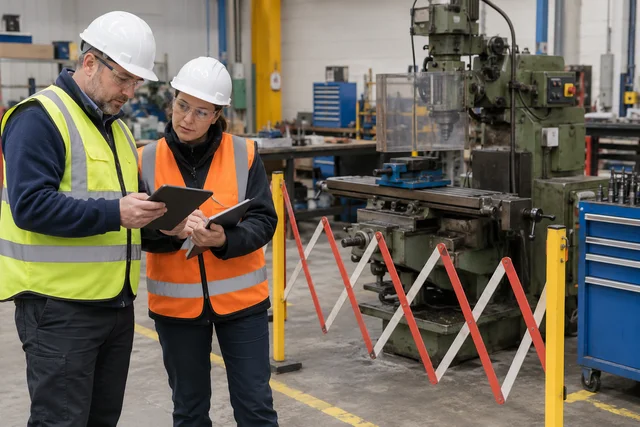
Existing SHAREhub photographic illustration. The written fictional case supplies the condition and decision evidence.
Protect before investigating
An investigation begins after the immediate response protects people and prevents further harm. Follow the site’s emergency arrangements, preserve restrictions and obtain competent support. Do not enter a suspected release area or disturb an isolation to collect a better photograph.
Evidence matters, but collecting it must not create another exposure. Note what is known safely, identify records that may be overwritten and arrange controlled preservation through the responsible roles. Investigators should understand which conditions changed during the response so later observations are not mistaken for the original event.
What should happen immediately after an incident?
The first priorities are life safety, emergency response, scene control, evidence preservation and escalation.
Investigation must never delay first aid, emergency response or making the area safe. Once people are protected, the scene should be preserved as far as reasonably possible. Equipment settings, isolation status, permits, alarms, photographs, closed-circuit television (CCTV), witness names and environmental conditions can disappear quickly.
The organisation should also decide whether the event needs Reporting of Injuries, Diseases and Dangerous Occurrences Regulations (RIDDOR) review, regulatory notification, insurer notification, specialist technical support, occupational health, human resources (HR), legal privilege consideration or family/victim liaison.
Make safe — Prevents further injury or escalation. Evidence to retain: Emergency response log and isolation status.
Care for people — Protects injured people and witnesses. Evidence to retain: First-aid, medical and support records.
Preserve scene — Keeps facts available before clean-up or restart. Evidence to retain: Photos, barrier tape, equipment status and access log.
Capture early facts — Memory and conditions change quickly. Evidence to retain: Initial witness list, timeline and supervisor note.
Escalate — Serious events need the right competence and reporting review. Evidence to retain: Notification record and investigation level decision.
At the evidence-collection decision
Preserve necessary functional medical/support facts through authorised restricted arrangements. Do not copy unrestricted clinical records into the general investigation folder; decide lawful access, purpose and retention before collection.
Applied case
Fictional exercise: A leak has been reported and the area remains restricted; a supervisor wants photographs from beside the flange.
Response
Protect people and manage escalation first.
Preservation
Record what changed during response as well as what was found.
Test your decision
What takes priority?
Follow the response restrictions and arrange safe evidence preservation.
Enter briefly because photographs are important.
Reopen the line to recreate the leak.
Compare the explanation
Follow the response restrictions and arrange safe evidence preservation.
Investigation cannot justify an uncontrolled exposure.
Explain why a no-injury event may merit substantial investigation.
Photorealistic illustrative UK workplace scene. Review checks: Avoid / redesign: Remove the need to open the line by redesigning sampling or maintenance access if technically valid. Control the task: Specify positive or otherwise justified proved isolation, with a safe vent/drain destination. Verify before release: Engineering validates process function; stop if the redesign leaves an untested hazard.
Judge potential as well as outcome
Actual harm is one consideration when choosing investigation depth. A small release stopped by chance may share a pathway with a much more serious event. Consider the credible potential, affected barriers, recurrence and uncertainty rather than using the injury count alone.
Do not invent a worst-case consequence without a basis. State the scenario and information needed to establish its significance. The responsible organisation selects a proportionate investigation with appropriate competence; the learner’s contribution is a defensible explanation of why the event should not be dismissed as harmless.
How should investigation levels be selected?
Investigation depth should match actual harm, potential harm, complexity and learning value.
A low-consequence event with clear facts may need a simple supervisor review. A high-potential near miss, major injury, dangerous occurrence, repeated event or process safety deviation needs deeper investigation, technical support and management oversight.
Potential severity matters. A dropped spanner that misses a person, a failed isolation, a gas detector alarm or a vehicle near miss may deserve serious investigation even where no injury occurred.
Level 1: local learning — Minor injury, low-potential near miss or simple defect. Supervisor review, short record and local action close-out.
Level 2: formal investigation — Lost-time injury, repeated event, high-potential near miss or control failure. Manager/health-and-safety-team-led investigation, interviews, evidence file and action plan.
Level 3: serious or specialist — Fatality, specified injury, major potential, fire/explosion, toxic release, structural failure or regulatory interest. Independent or senior-led team with technical specialists, formal report and executive review.
Process safety review — Loss of containment, failed safety-critical barrier, alarm flood, override, trip failure or permit/isolation weakness. Barrier analysis, human factors review, safety-critical action tracking and management review.
This page’s escalation scheme
Level 1/2/3 and the process-safety review category are an illustrative SHARE/company escalation scheme. HSG245 uses minimal, low, medium and high investigation levels. Resolve overlap by escalating for worst credible consequences, recurrence likelihood, complexity and specialist needs even where the actual injury was minor. The seven-stage workflow is an operational expansion of HSG245’s four steps.
Applied case
Fictional exercise: A wrong-route transfer is discovered before material flows. The route-selection control was bypassed.
Actual
No release occurred in this case.
Potential
The failed route control can still warrant examination.
Test your decision
Why investigate?
No release means there is nothing to learn.
It proves the most severe imagined accident was inevitable.
The event reveals a potentially important control weakness despite no release.
Compare the explanation
The event reveals a potentially important control weakness despite no release.
Potential and control failure matter without asserting a certain outcome.
Photorealistic illustrative UK workplace scene. Review checks: Change at source: Remove the need to open the line by redesigning sampling or maintenance access if technically valid. Make it observable: Engineering validates process function; stop if the redesign leaves an untested hazard. Keep useful evidence: Retain the evidence log, causal map, revised documents, field verification and later effectiveness check.
Build an honest timeline
A timeline connects events without pretending every entry is equally certain. Distinguish a time-stamped record from recollection and an inference from an observation. Preserve conflicting accounts until they can be examined; agreement is not created by deleting an inconvenient entry.
Record the source and limits of each item. An alarm log may show a signal but not prove how it was understood. A witness may explain the work context without recalling the exact time. Combining these sources can reveal a sequence while uncertainty remains explicit.
What evidence should be gathered?
Evidence should show what happened, what controls existed and how the work was actually done.
Evidence is broader than witness statements. It can include photographs, plant status, alarms, permits, maintenance history, training records, risk assessments, inspections, CCTV, environmental conditions, drawings, samples, isolation logs, competence records, contractor documents and previous incidents.
A good evidence log records what was collected, who collected it, where it came from, when it was collected and any limitations.
People evidence — For example: Witness interviews, supervisor account, injured person account, worker representative input. Explains work as done, perceptions, pressure and communication.
Physical evidence — For example: Damaged guard, broken tool, failed hose, product sample, dropped object. May show mechanism of failure.
Document evidence — For example: Risk assessment, method statement, permit, isolation certificate, maintenance record. Shows work as planned and control requirements.
Digital evidence — For example: CCTV, access control, telematics, alarm log, control-room data. Supports timeline and sequence.
Environmental evidence — For example: Lighting, noise, weather, temperature, housekeeping, congestion. Shows context and performance influencing factors.
History — For example: Previous near misses, audits, defects, complaints and overdue actions. Shows whether the event was foreseeable.
Illustrative evidence-register row
Fictional record E-04: original control-system event log; source system and export location; collector and collection time; known clock offset; restricted read-only original; named working-copy location; access/custody history; limitation “alarm clock not yet reconciled with CCTV”. Preserve CCTV and control data before routine overwrite through lawful access and proportionate retention.
Collect only necessary functional medical facts for the investigation. Keep clinical/support records in the authorised restricted process and link the necessary finding rather than copying unrestricted health records into the investigation folder.
Use open questions to understand work as performed.
Photorealistic illustrative UK workplace scene. Review checks: Setting: Maintenance line breaking at a fuel facility after a small release from a wrongly opened drain. Act: Make safe, preserve the scene, secure permit, drawings, tag history and prior near-miss actions. Hold / review: Hold restart if isolation cannot be independently verified or the same deficient permit remains in use.
Ask without supplying the answer
Begin with an open account of what happened and what information was available. Ask how the task normally works, what made it difficult and how decisions were understood. A leading question can replace the witness’s explanation with the investigator’s assumption.
Check understanding and distinguish direct observation from what the person later heard. Follow the organisation’s fair process and confidentiality arrangements without promising secrecy that cannot be delivered. Avoid asking people to agree with a pre-written cause before equipment, instructions and working conditions have been examined.
How should interviews be carried out?
Interviews should be fair, calm, structured and designed to understand facts rather than force admissions.
People remember events differently, especially after shock. Interviewers should explain the purpose, avoid blame language, use open questions first, ask one question at a time, let the witness draw or describe the task, and check understanding. Leading questions can contaminate evidence.
Interviews should explore task, equipment, environment, instructions, training, supervision, time pressure, communication, previous warnings and what would have made the safe action easier.
Set the tone — Better practice: explain learning purpose, confidentiality limits and support. Starting with blame or discipline.
Open questions — Better practice: ask 'Tell me what happened from your point of view'. Asking 'Why did you do that?' first.
Sequence — Better practice: build a timeline before interpretation. Jumping straight to causes.
Context — Better practice: ask about workload, equipment, supervision and constraints. Focusing only on the last action.
Check back — Better practice: read back key points and confirm accuracy. Putting words into the witness's mouth.
Close respectfully — Better practice: ask what could prevent recurrence and explain next steps. Leaving people anxious or unsupported.
Applied case
Fictional exercise: An interviewer begins, “You ignored the alarm because you were careless, correct?”
Open
Invite an account before testing particular details.
Leading
An assumed motive can distort the evidence.
Test your decision
What is the better opening?
Ask what the person saw, understood and did when the signal occurred.
Ask them to sign the assumed cause immediately.
Tell them which answer will close the investigation fastest.
Compare the explanation
Ask what the person saw, understood and did when the signal occurred.
Open questions preserve the person’s evidence and decision context.
Existing SHAREhub 2D teaching schematic. Use alongside the explanation and fictional case in this lesson.
Look beyond the last action
“Operator error” describes a label, not a complete explanation. Examine the task, information, interface, equipment condition, workload and supervision that shaped the action. Ask why the relevant barriers did not prevent or reveal the error.
This does not mean assuming every system failed or removing personal accountability. Evidence may support some contributing factors and leave others unconfirmed. A useful analysis explains a causal connection and tests alternatives. Repeating “why” without evidence can turn a plausible story into an unsupported root-cause claim.
Use Five Whys as a branching evidence enquiry
A causal question is a hypothesis until evidence supports it. Several paths may contribute to the same event; five answers are not a required stopping point.
Fictional learning example
Separate the evidence from the decision
Part of the picture
What the example establishes
Known
Oil was found on a walkway and a slip was reported.
Mechanical path
A seal defect may explain the release; inspect the relevant records and condition.
Organisational path
A reported defect may not have reached the right decision owner; test the communication and response history.
Pause and decide: Should “the operator did not notice” become the root cause?
Compare the reasoning
Only if supported, and it would still leave other mechanisms to investigate. Preserve the timeline, test competing explanations and look for missing or failed controls. Choose actions that address supported causes, then verify their practical effect and retain the reasoning for future users.
What is root cause analysis in practice?
Root cause analysis identifies the deeper system conditions that allowed the event pathway to exist.
A root cause is not always a single cause. Incidents usually have a network of causes: a technical weakness, a procedure weakness, a supervision gap, a competence issue, a maintenance backlog, a poor design decision and a culture signal may all combine.
If the only root cause is written as 'operator error', the investigation is probably unfinished. The better question is why the error was possible, likely, unrecovered or consequential.
Was the control suitable? — Design and selection. For example: Guard allowed access to moving part.
Was the control used? — Work as done and supervision. For example: Permit was issued but isolation was not verified.
Was the control maintained? — Asset integrity. For example: local exhaust ventilation (LEV) airflow was below design but not escalated.
Was competence real? — Training and experience. For example: New worker signed training but had never done the task.
Was drift normalised? — Culture and leadership. For example: Near misses were known but accepted as part of the job.
Was learning closed? — Assurance and review. For example: Previous action was closed without field verification.
Applied case
Fictional exercise: The wrong valve was selected; similar labels and an interrupted handover are reported but not yet examined.
Immediate
The selected valve is part of the event sequence.
Underlying
Conditions influencing selection require evidence, not assumption.
Test your decision
What should analysis do?
Close with “carelessness” alone.
Declare all management systems failed.
Test those factors and the relevant barriers against evidence.
Compare the explanation
Test those factors and the relevant barriers against evidence.
Analysis needs supported causal relationships, not a blame label or universal conclusion.
A fishbone, also called a cause-and-effect or Ishikawa diagram, places the event at its head. The main bones group possible contributors; smaller branches explore what led to each one. Categories are prompts to investigate, not findings.
Fishbone: explore the wider picture
Use it when several things may have contributed. Start with categories such as people, equipment, methods, materials, environment and management; rename them to suit the work. Add causes and subcauses without forcing a single chain.
Ask what led to a specific explanation. Branch when there is another reason, and stop where the evidence runs out. Five is a guide, not a target. Use the two methods together to examine a broad picture and its individual paths.
Define what happened, including the task, place and sequence. Keep the event separate from assumptions about why.
Gather accounts from people involved and add several possible explanations. Explore work conditions, equipment and management arrangements as well as individual actions.
Record supporting and contradictory evidence for each explanation. Keep untested ideas separate from accepted findings; add an open question where evidence is missing.
Review immediate, underlying and root causes from the evidence. A category, the final card or the depth of a branch does not decide the cause level.
Link actions to the supported causes, assign an owner and date, then check implementation and whether the action prevents recurrence.
Compare the worked examples
The two BuildOut reports examine the same invented excavator-arm/scaffold incident: 18 explanations and six actions. Their evidence references are fictional teaching records.
BuildOut fishbone
Six cause categories with subcauses, evidence checks and actions · 24 pages.
Compare a reminder with a more effective control response.
Existing SHAREhub 2D teaching schematic. Use alongside the explanation and fictional case in this lesson.
Design an action that changes the mechanism
Choose actions that address the established mechanism and consider stronger risk reduction before relying on another reminder. If ambiguous identification contributed, merely telling people to concentrate leaves the ambiguity in place. The appropriate solution still requires task-specific review and authorised implementation.
Specify the intended outcome, owner, implementation evidence and effectiveness check. Avoid prescribing an engineering modification from awareness training. Different actions may address immediate exposure and longer-term improvement; their status should not be merged into a single reassuring tick.
What makes investigation actions effective?
Actions should be specific, proportionate, risk-based, owned and verified.
Weak actions sound like reminders: 'retrain staff', 'be more careful', 'communicate better'. Strong actions change the conditions that made the event possible: redesign access, change maintenance priority, rewrite a permit hold point, add supervisor verification, improve procurement or fix a monitoring gap.
Actions should be ranked by risk and checked after completion. A photo of a sign is not evidence that behaviour or control reliability has changed.
Brief all staff — May not change the failed control. Better practice: update task method, brief the change and observe work as done.
Remind workers to isolate — Blames memory. Better practice: add independent isolation verification and permit hold point.
Existing SHAREhub photographic illustration. The written fictional case supplies the condition and decision evidence.
Close the loop in the workplace
Sending a report is dissemination, not proof of learning. Identify who needs the finding, which task or document changes and how the change will be used. A person receiving a long PDF may not recognise the one implication for their role.
Translate findings into the relevant operating, maintenance, competence or change arrangements. Check implementation and effectiveness, then return the result to people who raised the issue. Closure should show how the original weakness was addressed, with unresolved parts retained rather than hidden by the email date.
What does the incident learning loop look like?
The learning loop should connect each event to control improvement, verification and changes to the wider management system.
A useful learning-loop model is: event -> report -> triage -> investigate -> identify weak controls -> action -> verify -> communicate -> update risk profile, training and audit. The important point is that the loop does not end when the report is issued. It ends only when the organisation has changed something meaningful and checked that the change works.Investigating accidents and incidents, HSG245
In a mature system, the loop also feeds sideways and upward. Sideways means similar teams, sites and contractors receive the learning before the same weakness appears elsewhere. Upward means senior leaders see themes, repeated weak controls, overdue actions and resource gaps. Downward means workers see that reporting creates change, which improves trust and future reporting.
Loop stage
What should happen
Common failure
Event
Incident, near miss, unsafe condition, audit finding or weak signal occurs.
Evaluate whether another organisation’s event is relevant.
Photorealistic illustrative UK workplace scene. Review checks: Avoid / redesign: Eliminate shared reversing by redesigning delivery; use one-way routes and segregated pedestrian paths. Control the task: Eliminate the wet-cleaning/pedestrian overlap by rescheduling or using a dry method where suitable. Verify before release: Stop reversing or pedestrian access if barrier, visibility or agreed traffic route fails; reopen after physical control and briefing are verified.
Transfer the mechanism, not the headline
External learning starts by comparing mechanisms, not matching company names or products. A different industry may share a dependency, handover problem or loss-of-containment pathway. Conversely, similar equipment may operate under different conditions.
Record the relevant similarities, differences and questions requiring review. Do not copy another site’s limit, modification or emergency distance into local instructions. Use external learning to test local assumptions and decide whether competent assessment or a controlled change is needed. The story becomes useful when its applicability is examined.
How should external major accident learning be used?
External events should be tested against local vulnerability instead of being treated as interesting history.
For Diploma and process safety learners, external learning is a professional discipline. Major accidents such as Flixborough, Bhopal, Texas City, Buncefield and Anacortes are not there to memorise dates. They help organisations ask whether similar patterns exist locally: uncontrolled change, weak permit systems, poor start-up discipline, alarm and instrumentation weaknesses, contractor interfaces, fatigue, poor emergency planning or failure to learn from previous warnings.Investigating accidents and incidents, HSG245Managing for health and safety, HSG65
The practical test is not 'have we briefed the lesson?' but 'have we checked whether the same failure route could occur here?' That requires scenario review, barrier mapping, audit sampling, maintenance and proof-test checks, operator interviews and evidence that any gaps are closed.
External learning theme
Local question to ask
Evidence expected
Management of change
Could a technical or organisational change bypass our review process?
For named historical events, distinguish the investigation finding from the local lesson. CSB Texas City investigation and CSB Anacortes investigation are the US primary investigation routes; HSG245 (2004) is an investigation method, not an account of these later events. Use the listed Buncefield investigation for Buncefield. For each proposed transfer record the precise finding, local equipment/organisational similarity and evidence required before adopting a measure. US findings are not UK law; remaining named-case source-to-lesson mapping needs technical review.
Applied case
Fictional exercise: A published event concerns a different liquid but a similar shared shutdown dependency.
Similarity
A common dependency can make the mechanism relevant.
Difference
Operating conditions may prevent direct copying of controls.
Test your decision
What is useful?
Copy the other site’s settings.
Dismiss it solely because the liquid differs.
Review whether the same dependency exists locally and how it is controlled.
Compare the explanation
Review whether the same dependency exists locally and how it is controlled.
Transfer the causal question, not an unreviewed technical answer.
Existing SHAREhub photographic illustration. The written fictional case supplies the condition and decision evidence.
Protect knowledge that is not in the manual
Controlled drawings and procedures preserve explicit knowledge. Experienced staff may also know how abnormal conditions appear, where an interface is unreliable or why a past decision was made. That experience should be examined and captured where it matters rather than remaining dependent on one person.
Memory is not automatically authoritative. Compare recollection with current equipment and controlled information. Record the rationale and limits, and route any proposed instruction through its responsible owner. A useful knowledge system preserves context without converting an informal workaround into approved practice.
What types of knowledge should be controlled?
A mature system controls both formal information and practical experience because both can affect safety-critical decisions.
Formal information is easier to see: drawings, P&IDs, specifications, permits, inspection records, procedures, risk assessments, design studies and management of change files. Tacit knowledge is less visible: which valve sticks after a shutdown, which alarm is usually the first sign of instability, which drain route has trapped liquid before, which contractor needs close supervision, or why an old design assumption was accepted.
The aim is not to write down every memory. The aim is to identify knowledge that could affect safety, quality, environmental protection, legal compliance or major accident prevention and then make sure it is controlled in a way that survives absence, retirement, restructuring and change.
Photorealistic illustrative UK workplace scene. Review checks: Avoid / redesign: Avoid unnecessary transfer or route to safe destination. Control the task: Independent high-high trip with controlled design and end-to-end test. Verify before release: Planner records basis; hold transfer if destination is uncertain.
Keep knowledge aligned with the plant
A lesson can become misleading when the plant changes and its context is lost. Link information to the equipment, configuration, task and review basis it concerns. Retain a traceable rationale for superseded decisions rather than allowing an obsolete instruction to remain indistinguishable from the current version.
Changes in people and contractors can also remove knowledge. Handover should transfer critical history and unresolved concerns, not just file locations. Retrieval matters: a record that exists but cannot be found during a decision may offer little practical protection.
Where does corporate memory matter across the lifecycle?
Corporate memory matters at every stage from concept design through to decommissioning because each stage creates knowledge that later stages rely on.
Knowledge created during design is often needed decades later by operators, maintainers, emergency planners and project teams. If the basis of safety is not retained, later decisions may treat safety-critical assumptions as optional preferences. Likewise, information discovered during operation, inspection and incident investigation should feed back into design standards, procedures, maintenance plans and training.
The lifecycle view prevents ownership gaps. Engineers may create design knowledge, operators may discover practical limitations, maintenance teams may see degradation first, contractors may introduce temporary change and leaders may decide whether resources are available to act. Knowledge management joins these functions together.
Choose evidence that answers the original concern.
Photorealistic illustrative UK workplace scene. Review checks: Change at source: Eliminate shared reversing by redesigning delivery; use one-way routes and segregated pedestrian paths. Make it observable: Stop reversing or pedestrian access if barrier, visibility or agreed traffic route fails; reopen after physical control and briefing are verified. Keep useful evidence: Reporting data
Test learning effectiveness
An effectiveness check should revisit the weakness, not simply count attendance at the briefing. If a handover omission contributed, examine whether the revised handover communicates the required condition in realistic work. Choose a suitable sample and acknowledge its limits.
No recurrence may be encouraging but can be weak evidence for a rare event. Combine it with relevant control evidence. If the review finds that an action did not work, reopen the improvement question without rewriting history to claim it was never needed. Learning includes correcting an ineffective response.
What evidence shows organisational learning is working?
Evidence should show lessons are implemented, verified and retained, not merely identified.
Follow one near miss from report to potential-consequence classification, investigation, stronger action and field verification. Then check a comparable asset or site for the same weakness. An action marked complete after a briefing is not evidence that an alarm, barrier or decision route now performs as intended. Investigating accidents and incidents, HSG245
Evidence
What it should show
What to challenge
Reporting data
Near misses, weak signals and incidents are captured across sites and teams.
Photorealistic illustrative UK workplace scene. Review checks: Change at source: Avoid unnecessary transfer or route to safe destination. Make it observable: Planner records basis; hold transfer if destination is uncertain. Keep useful evidence: Board risk review samples knowledge risks alongside equipment and procedural controls.
Assemble a learning handover
A useful learning record connects the event, supported causes, relevant controls, agreed changes and evidence of their effect. Keep disputed or unknown points visible. A neat narrative should not take priority over an honest evidence boundary.
State who needs the knowledge and how it will survive changes in people, equipment and documents. Preserve outstanding restrictions until their proper release conditions are established. The final product of this exercise is a fictional learning plan, not a declaration that a real plant is safe or that legal reporting obligations have been satisfied.
What evidence shows that corporate memory is working?
Good evidence shows that knowledge is current, used, understood and converted into safer decisions.
Assurance should trace a credible scenario from hazard knowledge to current control evidence. For example, if a site relies on relief protection, the assessor should be able to see the design basis, the scenario assumptions, inspection and test records, MOC history, maintenance deferrals, alarm response guidance, operator training and leadership review of any impairment.
A strong audit does not ask only whether the site has a document. It samples whether different roles can find the right information, whether the information matches the plant, whether changes have been reflected in training and whether weak signals have been escalated.
Assurance evidence
Evidence area
What to sample
What good looks like
Process safety information
P&IDs, safe limits, design basis, relief assumptions and hazardous properties.
Current, controlled, technically reviewed and field-verified.
MOC records
Temporary and permanent changes, organisational changes and close-out packs.
Hazard review, approval, document updates, training and pre-start-up checks are complete.
Inspection history
Corrosion data, defect trends, repairs, overdue actions and temporary repairs.
Degradation is understood and risk decisions are visible.
Operating records
Shift logs, alarm histories, abnormal condition records and handover notes.
Plant state and critical conditions transfer reliably.
Incident learning
Investigation reports, action closure and recurrence checks.
Learning changes controls and is checked for effectiveness.
Competence evidence
Critical-task assessment, role handover and refresher training.
People can explain what matters, why it matters and when to escalate.
Applied case
Fictional exercise: The fictional wrong-route event has a verified cause, an implemented label change and an effectiveness review still pending.
Implemented
The agreed physical or procedural change exists.
Learned
Relevant people can use it and its intended effect is examined.
Test your decision
Which status is accurate?
The event is fully investigated only if every hypothesis is called a fact.
Implementation complete; effectiveness remains to be established and communicated.
Everything is closed because the labels changed.
Compare the explanation
Implementation complete; effectiveness remains to be established and communicated.
Preserve separate statuses and the remaining evidence need.