Independent SHAREhub awareness. This course does not provide a NEBOSH qualification, accreditation or authority to operate, design, isolate, test or maintain plant. Use competent site arrangements for real work.
This reader supplies the complete teaching. Use the interactive LMS course for assessed activities, saved progress and completion.
LESSON 1
A permit coordinates; it does not isolate
Explain the role and limitation of a permit-to-work.
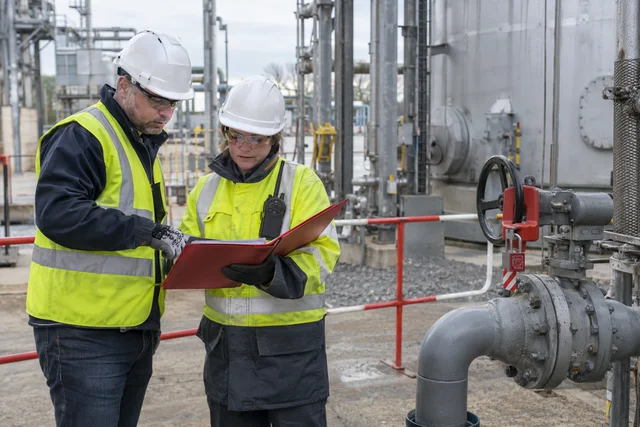
Existing SHAREhub photographic illustration. The written fictional case supplies the condition and decision evidence.
Understand the decision
A permit makes the task, location, duration, hazards, precautions and responsible people explicit. It coordinates work that needs formal control. The signature is not a physical barrier and does not make hazardous contents, energy or adjacent operations disappear.
The underlying risk assessment and method must establish how the work will be controlled. Consider whether the task can be avoided or completed by a safer method before selecting a permit. Use the permit to communicate and verify the agreed arrangement, not to make an unsuitable task acceptable.
Which level of work control is enough?
The control level should match the risk, complexity and live interface of the task.
Not every job needs a permit, but every job needs the right level of control. The mistake is treating the options as paperwork choices. RAMS, checklists, permits and specialist authorisations do different jobs. A RAMS describes the planned method; a pre-start check confirms the team and conditions are ready; a permit authorises specified high-risk work under defined controls; specialist authorisation confirms that a competent technical owner has accepted the control standard; stop and redesign is the correct answer when the proposed work cannot be made acceptably safe.
This ladder should be used by planners, supervisors and authorisers before work starts and again when conditions change. If a job moves up the ladder during the day because of weather, SIMOPS, unexpected services, poor isolation or scope creep, the work should pause and be reauthorised at the correct level.
Control level
Use when
Example
RAMS only
Routine task, stable environment, competent team and controls already embedded in normal procedure.
Routine low-level maintenance in a controlled workshop with no live interfaces or isolations.
Checklist / pre-start brief
The task is routine but needs confirmation of people, equipment, area condition or simple hold points before starting.
Identify scope details that distinguish one task from another.
Photorealistic illustrative UK workplace scene. Review checks: Avoid / redesign: Eliminate or redesign: the maintenance planner checks whether the repair can be completed without opening the line, or whether the pump can be taken fully out of service and worked on in a controlled workshop. Control the task: Isolate and engineer: the isolation authority selects a risk-based physical isolation scheme under HSE HSG253, identifies the exact line, secures energy sources, drains and vents to a safe system, and proves the boundary before work. Verify before release: Read the full task example, checks and stop points on this page.
Understand the decision
Describe the equipment and location so the crew and issuer identify the same plant. Include the task, permitted duration, interfaces, hazards, control evidence and conditions that require suspension. A nearby similar pipe is not an acceptable substitute for a damaged identifier.
Walk down or otherwise verify the task through the site’s competent arrangements. If the scope changes, stop using the original authorisation until it is reviewed. A permit for inspection does not automatically cover line opening, cutting or a different work location.
What should a permit actually say?
A permit should be specific enough that a competent person can verify the job, controls and stop conditions in the field.
A permit should be specific enough that a competent person can verify the job, controls and stop conditions in the field. The table gives practical examples, evidence expectations and common decision points so the section can be used for learning, supervision, audit and review.
Distinguish issuing, accepting, coordinating and specialist roles.
Photorealistic illustrative UK workplace scene. Review checks: Change at source: Eliminate or redesign: the maintenance planner checks whether the repair can be completed without opening the line, or whether the pump can be taken fully out of service and worked on in a controlled workshop. Make it observable: Read the full task example, checks and stop points on this page. Keep useful evidence: Permit, isolation certificate, test record, field check, stop/reissue history and signed handback.
Understand the decision
The issuer needs reliable plant and work information; the person accepting the work must understand the scope and controls. Specialists may provide isolation, atmosphere testing or technical review. An overall coordinator resolves interfaces between tasks and operations. Exact titles vary, so the site must make responsibilities clear.
A contractor does not gain plant knowledge simply by receiving a document. Use a two-way briefing and check understanding, including stop conditions. A signed acceptance without shared understanding leaves a communication gap at the point where decisions matter.
Who does what in a permit-to-work system?
Clear permit roles prevent assumption, duplicated authority and gaps between operations, maintenance and contractors.
Permit systems fail when titles exist but decision rights are unclear. The issuer must understand the area and hazards. The acceptor must understand the work and controls. The isolation authority must know how the plant is made safe. The gas tester must be competent to test correctly. The supervisor must monitor conditions, not just collect signatures.
Role
Main responsibility
Evidence of competence
Permit requester
Defines the work scope and need for permit control.
Work pack and risk assessment.
Area authority / issuer
Confirms area conditions, interactions and local safeguards.
Authorisation record and field verification.
Permit acceptor / performing authority
Accepts controls and briefs the work team.
Toolbox talk and work-team sign-on.
Isolation authority
Plans, applies and verifies isolations.
Isolation certificate, locks/tags and test record.
Gas tester
Tests atmosphere correctly and interprets results.
Competence record and calibrated instrument.
Fire watch / hole watch / standby
Monitors specified risks and escalation conditions.
Briefing, equipment and log.
Supervisor
Checks work remains within scope and stops change.
Monitoring record and stop-work authority.
Permit coordinator
Controls SIMOPS, permit clashes and overall permit board.
Permit register and conflict review.
Applied case
The contractor signs while believing the branch is empty; operations has not confirmed its service.
Acceptance
The receiving crew must understand the actual hazards and controls, not just receive paperwork.
Coordination
Someone must resolve the interactions between work packages and live operations.
Test your decision
What should the briefing resolve?
A shared, evidenced understanding of the plant, controls and stop conditions.
Whether the crew has used this permit format on previous jobs.
Which company will pay if the assumption is wrong.
Compare the explanation
A shared, evidenced understanding of the plant, controls and stop conditions.
The work needs common understanding, not merely transferred paperwork.
Recognise why switching off one item may leave exposure.
Work authorisation, physical isolation and verification are separate parts of control. Trace material, energy, backfeeds and retained contents for the actual work.
Understand the decision
Opening equipment can expose pressure, temperature, chemicals, electrical energy, movement or gravity. Feeds may arrive from connected plant, recirculation, temporary connections or stored energy. Stopping a pump does not establish that every route is isolated.
Competent planning traces the equipment boundary, credible feeds and means of preventing re-energisation or material entry. Drawings support the process but need verification against actual plant. Learners should recognise an unexplained connection as a stop condition, not attempt to test it by loosening a joint.
Trace the complete isolation boundary
Work authorisation, physical isolation and verification are separate parts of control. Trace material, energy, backfeeds and retained contents for the actual work.
Fictional learning example
Separate the evidence from the decision
Part of the picture
What the example establishes
Work scope
An instrument will be removed from a process line.
Possible feeds
Pressure or material may reach it from either direction or through another connection.
Retained hazard
The isolated section may still contain pressure, liquid, heat or hazardous residue.
Pause and decide: Does a closed, tagged valve prove that opening the instrument is safe?
Compare the reasoning
No. Use the approved isolation and verification arrangements for the equipment and task. Secure every specified point, control retained contents and prove the required outcome. Keep unexpected pressure, leakage or an uncertain boundary as a hold condition for the authorised roles.
Which energy sources must be identified?
A competent isolation plan looks beyond the obvious power switch.
Energy can be electrical, mechanical, hydraulic, pneumatic, chemical, thermal, gravitational, pressure, radiation or stored in springs, capacitors, accumulators, batteries, elevated loads and process inventory. Multi-energy systems are common in modern plant: a conveyor may have electrical drives, stored mechanical energy, pneumatic actuators, gravity hazards and automated controls. See HSG253 - The safe isolation of plant and equipment.
The isolation plan should be based on physical walkdown, drawings, operating knowledge, previous changes, site experience and challenge from the workers doing the task.
Energy source
How it can harm
Control example
Electrical
Shock, electrocution, arc flash or unexpected start.
Isolate, lock, prove dead and control back-feed.
Mechanical movement
Crushing, shearing, entanglement or amputation.
Block, pin, disengage and verify no movement.
Pressure
Injection, blast, projectile, release or burns.
Depressurise, drain, vent and verify.
Hydraulic/pneumatic
Unexpected actuator movement or stored pressure.
Isolate supply, bleed accumulators and secure parts.
Thermal
Burns from steam, hot product or cold cryogenic release.
Cool, drain, vent and wear suitable PPE.
Chemical/process inventory
Toxic, corrosive, flammable or asphyxiant release.
Clean, purge, gas test and use positive isolation where needed.
Gravity
Falling loads or drifting equipment.
Chock, prop, block or lower to safe position.
Applied case
A stopped pump is connected to a pressurised common header.
Connected source
A common header can remain pressurised after the local pump stops.
Stored source
Energy can remain trapped or mechanically stored after a normal shutdown.
Test your decision
Why is “pump stopped” insufficient?
A stopped pump guarantees every connected line is empty.
The common header can remain a source of pressure or material.
Pressure matters only when the motor is running.
Compare the explanation
The common header can remain a source of pressure or material.
Isolation concerns all routes and stored energy, not only the normal drive.
Distinguish applying devices from proving the required safe state.
Photorealistic illustrative UK workplace scene. Review checks: Avoid / redesign: Use a suitable external diagnostic or redesigned sampling arrangement if it removes the intrusive valve task. Control the task: Isolate connected feeds and energy sources, remove hazardous contents and verify the defined safe state before breaking containment. Verify before release: If the hazardous step remains, keep it within the task assessment and select the stronger feasible remaining controls.
Understand the decision
An isolation plan identifies the safe boundary and suitable method for the actual hazard. Locks and tags control devices and communicate status, but their presence alone does not prove the correct equipment is isolated or free of hazardous energy. Verification must address the relevant sources and the planned work.
Use authorised people, suitable methods and site records. A zero gauge can be misleading if the instrument is faulty, blocked or does not represent a trapped section. Do not prescribe one generic verification method for every system; resolve uncertainty before intrusive work.
How should isolation be verified?
Verification proves the isolation is effective at the point of work, not just applied somewhere upstream.
See the isolation boundary in physical form
Compare eight arrangements from HSG253 Figure 4. These original equipment illustrations explain the geometry and evidence; they do not select or authorise a scheme for your plant. Choose an arrangement, then open its proof and failure explanations.
8 isolation arrangements
Read the labels: E is the equipment/work boundary. P identifies a pressure-monitoring facility; B identifies a controlled bleed/test route. Test-path design, destination and bleed position must follow the authorised scheme. A gauge reading or a closed valve alone is not proof. Collection symbols mark the need for a specified controlled route; they do not prescribe a vessel, capacity or bleed-valve position.
Verification is the difference between a hopeful isolation and a controlled job. Electrical work needs proving dead; process work may need depressurisation, drain/vent checks, gas testing, sampling, pressure indication, bleed verification, flushing, purging or visual confirmation of blinds. See HSG253 - The safe isolation of plant and equipment.
Verification should be independent enough for the risk. A person should not simply trust the same label or drawing that could be wrong. Where consequences are high, independent verification and authoriser challenge are essential.
Hazard
Verification method
Common failure
Electrical energy
Test for dead with approved voltage indicator.
Tester not proved before/after or wrong circuit tested.
Pressure
Check gauges, vents, drains and bleed points.
Blocked gauge line gives false reading.
Flammable atmosphere
Gas test after purge and before line break.
Single test misses later vapour return.
Toxic/corrosive contents
Sample, drain, flush, isolate and PPE.
Dead leg or trapped pocket remains.
Mechanical movement
Try-start where safe, block and physical check.
Stored gravity/hydraulic energy not controlled.
Blind/spade
Visual check and blind list verification.
Wrong size/rating or wrong location.
Learning check: two apparent protections
A locked but wrongly identified isolator does not protect the work point. A correctly identified boundary still requires proof of every relevant energy/feed and each specified DBB barrier, with accepted evidence and a safe discharge destination. If identity or proof is missing, hold the intrusive work and use the roles/competence route. Do not turn this check into a generic valve-operating sequence or invent acceptance pressures.
Applied case
A gauge reads zero, but the location of a trapped leg is unclear.
Lock and tag
They secure and identify devices; the required isolation outcome still needs verification.
Zero indication
A single gauge can omit a trapped section or fail to represent its condition.
Test your decision
What is the defensible conclusion?
The first flange can be loosened as a further check.
Every dead leg must also be at zero.
The reading alone does not establish safe conditions throughout the work boundary.
Compare the explanation
The reading alone does not establish safe conditions throughout the work boundary.
A single indication does not prove the condition of all connected or trapped sections.
Explain why a first break requires specific planning.
Photorealistic illustrative UK workplace scene. Review checks: Change at source: Use a suitable external diagnostic or redesigned sampling arrangement if it removes the intrusive valve task. Make it observable: If the hazardous step remains, keep it within the task assessment and select the stronger feasible remaining controls. Keep useful evidence: Keep marked drawings, isolation certificate, independent check, locks, drain/test results, permit, SIMOPS coordination, first-break record and handback.
Understand the decision
The first opening of process equipment can release residual contents even after routine draining. Low points, blocked drains, deposits and connected branches can leave hazardous material or energy. The plan must address the actual contents, work position, containment and exposure controls.
Keep personnel outside the hazard route and use the authorised method. If the line identity or isolation cannot be verified, the safe response is to stop and escalate. Protective clothing can reduce some consequences but cannot replace control of unexpected process release.
What makes line breaking especially hazardous?
Line breaking is the point where containment is opened and hidden assumptions are tested.
The first crack of a flange can release pressure, vapour, liquid, sludge, solids, steam, corrosive material, toxic gas or flammable atmosphere. Even a small residual quantity can injure a worker if it is hot, under pressure, toxic or reactive. See HSG253 - The safe isolation of plant and equipment.
Line breaking should therefore use a deliberate break plan: verify isolation, control drainage, position workers out of the line of fire, loosen bolts cautiously, use drip trays or containment, wear task-specific PPE, control ignition sources and stop if unexpected pressure or material appears.
Control point
Why it matters
Good evidence
Line contents known
Controls depend on substance.
SDS/process data and sampling where needed.
Pressure removed
Prevents violent release.
Vent/drain verification.
Worker position
Avoids line of fire.
Pre-job briefing and observation.
Containment
Controls spills and exposure.
Drip tray, bunding or drain isolation.
PPE/RPE
Protects against residual risk.
Task-specific PPE assessment.
Stop criteria
Controls unexpected release.
Briefed hold points.
Applied case
A fitter is told to crack a flange to discover whether the line has drained.
First break
Residual contents can remain in low points, dead legs or blocked sections.
Unsafe discovery
Opening a joint to find out what remains creates exposure rather than controlled verification.
Test your decision
What should the learner challenge?
Using an uncontrolled opening to resolve unknown isolation or contents.
Only whether the fitter can open the joint quickly enough.
The need to identify the material before exposure.
Compare the explanation
Using an uncontrolled opening to resolve unknown isolation or contents.
Unknown hazardous contents must be resolved through the planned competent process.
Compare hot work with a safer planned alternative.
Existing SHAREhub photographic illustration. The written fictional case supplies the condition and decision evidence.
Understand the decision
Hot work includes activities capable of creating heat, sparks or another ignition source; it is wider than visible welding flame. In process areas, releases can come from the workpiece, drains or nearby operations. Consider removing the task from the hazardous area or using a suitable lower-hazard method through competent planning.
Calling a task “minor cutting” does not remove its ignition potential. An alternative method also needs assessment for its own hazards. The decision belongs in work planning before the crew arrives, not in an informal last-minute substitution at the workface.
How can the ISO 45001 hierarchy of controls prevent fire and explosion during hot work on process plant?
ERICPD is used here as a planning mnemonic. The linked HSE five-level hierarchy is the official source for the order and relative reliability of controls; the two labels are not identical.
Start at the physical hazard and prefer avoiding or redesigning the exposure before relying on instructions or PPE.
ERICPD is a planning mnemonic. Isolate usually maps to engineering, Discipline sustains controls, and the five-level hierarchy separately names substitution. These candidates require competent assessment of the actual task. HSE five-level hierarchyHSE five-level hierarchy
How can the ERICPD hierarchy of controls prevent fire and explosion during hot work on process plant?
ERICPD is a planning crossmap. Its prompts do not add a sixth rung or rank Isolate above engineering. Discipline verifies and sustains every control level.
ERICPD stage
Five-level mapping
Task intervention
Owner and check
Failure / stop
Eliminate
Elimination
Fabricate or repair offsite or use a no-hot-work method that avoids ignition at the process area.
How can the ISO 45001 hierarchy of controls prevent fire and explosion during hot work on process plant?
The hierarchy of controls in ISO 45001:2018 comes under Clause 8.1.2 (Eliminating hazards and reducing OH&S risks), which is located within Clause 8 ("Operation").
Crosswalk: ERICPD planning examples mapped to the five-level hierarchy. Physical and procedural controls may occupy separate rows; continuing assurance supports every level.
ERICPD stage
Five-level mapping
Task intervention
Owner and check
Failure / stop
Eliminate
Elimination
Fabricate or repair offsite or use a no-hot-work method that avoids ignition at the process area.
Interpret gas-test evidence within its conditions and limits.
Photorealistic illustrative UK workplace scene. Review checks: Avoid / redesign: Fabricate or repair offsite or use a no-hot-work method that avoids ignition at the process area. Control the task: Positively isolate, drain and clean equipment; segregate drains, vents and live operations. Verify before release: No credible alternative: justify hot work.
Understand the decision
Atmosphere testing must be suitable for the substances, locations and conditions relevant to the task. It supports a wider control plan; it does not establish that disconnected plant, deposits or later releases cannot create a hazard. The site specifies competent testing and any continued monitoring.
Identify what was tested, when, where and under what conditions. A result from another location or earlier operating state cannot simply be transferred. If conditions change or required monitoring fails, suspend the work through site arrangements rather than assume a previous result remains valid.
How should gas testing be planned and interpreted?
Gas testing is a warning and verification control; it is not a guarantee that conditions will remain safe.
The tester must know target gases and instrument limitations, verify calibration and pre-use function, test oxygen or toxic hazards where relevant, and sample low points, drains and connected spaces. A safe reading at one moment cannot prove future safety; specify retest or continuous monitoring and stop thresholds on the permit. HSE HSG250 permit-to-work systemsHSE COMAH permit-to-work technical measureHSE HSG250 permit-to-work systems
Gas testing should be planned by someone competent to understand the substance, equipment, location, weather, ventilation, low points and work method. The tester should know where vapour might collect, what the instrument detects, whether oxygen or toxic gases matter, when repeat testing is required and what reading stops the job.
A single test at chest height before work may miss heavier-than-air vapour in drains or pits. A single pre-start test may also miss vapour that returns later because a flange is opened, a drain dries out, a pump starts, a wind direction changes or sludge is disturbed. For high-risk work, the permit should define repeated or continuous monitoring.
Test issue
Good practice
Common failure
Tester competence
Trained in instrument use, limitations and site hazards.
Identify conflicts between hot work, releases and shared controls.
Photorealistic illustrative UK workplace scene. Review checks: Setting: Replace a gasket on hydrocarbon pump P-204 at a fuel terminal during a planned shutdown. Act: Identify the exact flange and boundary, plan the isolation, drain and vent to a safe route, and check concurrent work. Hold / review: A passing valve, blocked drain, residual pressure, odour, gas alarm or conflicting operation suspends the job for reassessment.
Understand the decision
Two individually planned jobs may be unsafe together. A line opening can release material into the area used by a hot-work crew; isolating a shared service can defeat another task’s protection. The coordinator needs an accurate view of work locations, timing and dependencies.
Resolve conflicts before authorisation and keep the permit board or equivalent current. Separation in time or a revised method may remove the conflict. Simply giving each crew its own permit does not demonstrate that the combined risk has been considered.
How should SIMOPS and permit clashes be controlled?
Simultaneous operations must be reviewed because individually safe tasks can become unsafe when combined.
SIMOPS is where permit systems earn their keep. Hot work near flammable transfer, drain opening near ignition sources, lifting over people, confined-space entry during nearby chemical cleaning, or electrical work during recommissioning can create risk not visible on a single permit.
The permit board, permit coordinator or area authority should actively check interactions at planning, issue, shift handover and revalidation. Electronic systems can help, but only if they are backed by field awareness.
The area authority needs a live view of permits, transfers, lifts and equipment impairments, including work by contractors. Where two jobs conflict, separate them in time or space, suspend one, or change the controls before either proceeds. A shift handover must identify live permits, plant status, tests due and anything that would invalidate authorisation.
Combination
What can go wrong
Control decision
Hot work + solvent transfer
Ignition source introduced near vapour release.
Separate in time/space, suspend transfer or prohibit hot work.
Line break + confined-space entry
Release changes atmosphere or rescue conditions.
Coordinate isolation, ventilation, gas testing and rescue.
Lifting + maintenance below
Dropped load or exclusion-zone conflict.
Stop lower-level work and establish exclusion zone.
Electrical isolation + recommissioning
Unexpected energisation during handback.
Use lock control, shift handover and controlled energisation.
Excavation + vehicle movement
Plant enters excavation zone or hits services.
Traffic plan, banksman, permit to dig and exclusion zone.
Contractor work + operations change
Work team unaware of process or area status change.
Revalidate permit after operational change.
Applied case
A second crew plans to open equipment connected to drains near the cutting task.
Two records
Separate permits do not make neighbouring release and ignition hazards independent.
Shared control
One crew’s work can disable ventilation or another protection relied on by others.
Test your decision
Which question needs a coordinated decision?
Whether the combined work can create a release-and-ignition path.
Whether both permits use different numbers.
Whether the crews have different employers.
Compare the explanation
Whether the combined work can create a release-and-ignition path.
Separate documents do not make interacting hazards independent.
Recognise changes that invalidate work authorisation.
Photorealistic illustrative UK workplace scene. Review checks: Change at source: Fabricate or repair offsite or use a no-hot-work method that avoids ignition at the process area. Make it observable: No credible alternative: justify hot work. Keep useful evidence: Major accident hazard register and DSEAR assessment.
Understand the decision
The work authority applies to stated conditions. A new leak, changed weather affecting dispersion, loss of ventilation or monitoring, unexpected plant state or changed work scope may invalidate that basis. Workers need a clear stop and reporting route without pressure to improvise.
At shift change, communicate the actual work state, open permits and continuing isolations. Renewal or revalidation must follow the site process; an old signature cannot silently cover different conditions or a new team. Preserve restrictions until a competent authorised decision resolves them.
What are the warning signs that hot work is not controlled?
Hot work warning signs usually appear before the fire: vague permits, late scope changes, weak isolation, poor testing and normalised shortcuts.
Warning signs are included because failure usually appears before a serious event. Treat these points as prompts for inspection, audit, supervision and management review rather than as simple compliance statements. HSE HSG250 permit-to-work systems
Suspend hot work. Assess the drain and connected system; implement and verify the necessary source/pathway controls, then retest and obtain competent permit revalidation. Preserve required drainage and environmental functions. HSE HSG250 permit-to-work systems
Fire watch given other tasks
Smouldering fire or spark spread may go unnoticed.
Photorealistic illustrative UK workplace scene. Review checks: Risk register: The site risk register includes hot work near tank bunds, loading gantries, drains, pump seals, tanker bays, empty containers and maintenance workshops. Permit standard: Hot work permits are red or red-edged in the site PTW system; lower-risk spark-potential work is defined separately in the local standard, but can be escalated to a red hot work permit by the area authority. Controls: Cold work is challenged first; where hot work remains, the area is cleaned, drained, gas tested, segregated and monitored with extinguishers and fire watch.
Understand the decision
Finishing the physical task is not the same as handing plant back. Account for people, tools, temporary equipment, openings and protection removed for the work. Record defects and reconcile permits and isolations through responsible roles before the authorised operating state changes.
Hot-work close-out also includes the task-specific checks and fire precautions defined by the site plan. Do not invent a universal watch period. The receiving operator needs a clear statement of what is complete, what remains restricted and what verification supports return.
What should happen before hot work is handed back?
Handback should prove the work area, equipment and plant are safe to return to operational control.
Handback is a common weak point because attention drops after the visible job is complete. A strong handback checks the work, fire watch, drains, covers, blinds, tools, temporary earths, alarms, gas detection, fire protection, removed guards, waste, housekeeping and operations readiness. HSE HSG250 permit-to-work systems
Operations should accept handback only when the plant condition is known. If work is incomplete, the permit should be suspended with a safe-state instruction and shift handover. If equipment has been changed, management of change or pre-start review may be needed before restart.
Combine identity, isolation, atmosphere and interface evidence.
Existing SHAREhub 2D teaching schematic. Use alongside the explanation and fictional case in this lesson.
Understand the decision
A sound permit decision has an evidence chain: defined task, assessed hazards, verified physical controls, capable people, coordinated interfaces and conditions for suspension and hand-back. Missing links stay visible rather than being replaced by confidence or signatures.
In your workplace transfer exercise, choose a task you understand and list the questions an authorised issuer would need answered. Use the portable resources to practise; do not create a real permit or infer issuing authority. A complete fictional form is still only a learning artefact.
What evidence shows a permit system is working?
Evidence should prove that permits are specific, field-verified, understood, monitored and audited.
Evidence should be read as a chain rather than a filing exercise. A single record rarely proves good management on its own; stronger assurance comes from matching records, observations, interviews, trends and verified action closure.
Evidence
What it should show
Weakness to challenge
Permit register
All permits visible, valid, coordinated and closed.
Expired or duplicate permits.
Field verification
Issuer/acceptor inspected real conditions.
Desk-issued permits.
Isolation certificates
Energy and substances isolated, locked, tagged and verified.
Permit says isolated without certificate.
Gas testing records
Instrument, location, time, result, competence and retest frequency.
Single gas test used for changing conditions.
Toolbox talk/sign-on
Work team understood scope, controls and stop conditions.
Names signed without briefing.
Permit audits
Quality of scope, controls, field reality and handback checked.
Audit counts permits but not quality.
Learning loop
Permit findings feed training, procedures and risk controls.
Same findings repeat.
Applied case
The resin-plant cutting pack has an ambiguous branch, an old gas result and uncoordinated line opening.
Missing link
An ambiguous line or old test cannot be repaired by collecting more signatures.
Fictional permit
The exercise develops reasoning and cannot authorise an actual job.
Test your decision
What is the appropriate overall decision?
Hold the proposed work while the identity, controls and interfaces are resolved through site authority.
Proceed once all three crews sign the same sheet.
Start with the shortest cut before the other work begins.
Compare the explanation
Hold the proposed work while the identity, controls and interfaces are resolved through site authority.
The unresolved conditions affect the task’s safety basis and cannot be signed away.