Optional presentation practice. Choices and model launches do not write LMS grades, completion or certificates. This extension takes additional learning time.
1. COSHH essentials Connect hazardous substances, exposure and effective controls.
2. Choose a learning route 3. Find the substance and the exposure route Explain how task exposure can cause harm.
Hazardous substances can enter through inhalation, skin contact or absorption, ingestion, injection and mucous membranes such as the eyes, nose and mouth. The route of entry is one of the most important assessment decisions because it decides what controls are needed.
Hazardous substances can enter through inhalation, skin contact or absorption, ingestion, injection and mucous membranes such as the eyes, nose and mouth. The route of entry is one of the most important assessment decisions because it decides what controls are needed. A vapour may mainly require ventilation and respiratory control; a skin sensitiser may require substitution, closed handling, suitable gloves, hygiene and skin surveillance; a contaminated sharp may require safe sharps systems and biological exposure controls. Inhalation is often the most obvious route because airborne dusts, fumes, gases, vapours and mists can reach the lungs. Skin exposure is just as important for irritants, corrosives, solvents and sensitisers. Ingestion usually happens indirectly through contaminated hands, food, drink, cigarettes, phones or poor hygiene.
4. The fictional case and decision boundary Explain how task exposure can cause harm.
Task and setting A fictional dispensing task has incomplete exposure information and an uncertain control condition. Decision to practise Fictional case: The supervisor has a safety data sheet but no account of dispensing, cleaning, exposure duration or people nearby. The file is called the completed assessment. Evidence to consider Use information in a task-specific assessment.
5. Decision 1: interpret the evidence Fictional case: The supervisor has a safety data sheet but no account of dispensing, cleaning, exposure duration or people nearby. The file is called the completed assessment.
What remains?
A task-specific assessment using the sheet and actual exposure information. (supported response) Nothing because the sheet has many pages. A conclusion that every listed substance is uncontrollable. A data sheet informs an assessment; it is not the complete task decision.
6. Reconsider the evidence What remains?
A task-specific assessment using the sheet and actual exposure information. (supported response) Nothing because the sheet has many pages. A conclusion that every listed substance is uncontrollable. A data sheet informs an assessment; it is not the complete task decision.
7. Decision 1 explained A data sheet informs an assessment; it is not the complete task decision.
Use information in a task-specific assessment.
8. Assess work rather than file the sheet Use information in a task-specific assessment.
A COSHH assessment should identify hazardous substances, assess exposure, decide controls, record findings, implement actions and review effectiveness. Start by creating a substance and process inventory. Include what is bought, what is generated and what appears during cleaning, maintenance, waste handling and emergencies.
A COSHH assessment should identify hazardous substances, assess exposure, decide controls, record findings, implement actions and review effectiveness. Start by creating a substance and process inventory. Include what is bought, what is generated and what appears during cleaning, maintenance, waste handling and emergencies. Then observe the task. The person doing the work often knows where dust escapes, where splashes occur and where the written procedure is unrealistic. The assessment should be task-based. A single product may need different assessments for brushing, spraying, decanting, heating, cleaning and waste handling. Similarly, a single dust hazard may need different controls for cutting, drilling, sweeping, bag emptying and filter changing. The output should be a usable control plan.
9. Separate substance information Sort the cards. Drag each card, or use its labelled category selector.
Sort the cards. Drag each card, or use its labelled category selector.
A current relevant data sheet. — Useful input. It informs the assessment. No account of dispensing or cleaning exposure. — Assessment gap. Actual task conditions are missing. The sheet alone proves the task safe. — Unsupported conclusion. It does not establish control in use. 10. Compare the reasoning: Separate substance information A current relevant data sheet. Useful input No account of dispensing or cleaning exposure. Assessment gap The sheet alone proves the task safe. Unsupported conclusion
Sort the cards. Drag each card, or use its labelled category selector.
A current relevant data sheet. — Useful input. It informs the assessment. No account of dispensing or cleaning exposure. — Assessment gap. Actual task conditions are missing. The sheet alone proves the task safe. — Unsupported conclusion. It does not establish control in use. 11. Prevent exposure before relying on PPE Compare source controls with personal protection.
ERICPD helps move the assessment from paperwork to stronger, practical control of exposure. For hazardous substances, the hierarchy is critical. Removing the substance or process is stronger than controlling dust after it is created.
ERICPD helps move the assessment from paperwork to stronger, practical control of exposure. For hazardous substances, the hierarchy is critical. Removing the substance or process is stronger than controlling dust after it is created. Using pellets instead of powder, pre-mixed materials instead of dry mixing, water suppression, closed transfer and enclosure can all reduce exposure before people need RPE. Administrative controls still matter, but they should support stronger controls. Written procedures, permits, restricted access and supervision are weak if the process still releases uncontrolled dust, vapour or fume. PPE and RPE can be essential, but they are vulnerable to poor fit, discomfort, wrong filter selection, poor maintenance and human behaviour. Good control should be designed, used, maintained and checked.
Open the related fictional model case
12. Decision 2: choose the response Fictional case: Extraction equipment is present, but its required condition during dispensing is unconfirmed. The team relies on seeing the fan rather than checking the actual capture arrangement.
What is needed?
An assumption that any mask supplies equivalent control. Relevant evidence that the source-control arrangement works for the task. (supported response) Only a photograph of the fan. Presence and suitability need task-specific verification.
13. Compare the consequences What is needed?
An assumption that any mask supplies equivalent control. Relevant evidence that the source-control arrangement works for the task. (supported response) Only a photograph of the fan. Presence and suitability need task-specific verification.
14. Decision 2 explained Presence and suitability need task-specific verification.
Recognise that equipment presence is not effectiveness.
15. Check control performance in use Recognise that equipment presence is not effectiveness.
Local exhaust ventilation (LEV), respiratory protective equipment (RPE) and personal protective equipment (PPE) only protect people when they are correctly selected, fitted, used, maintained, examined and supervised.
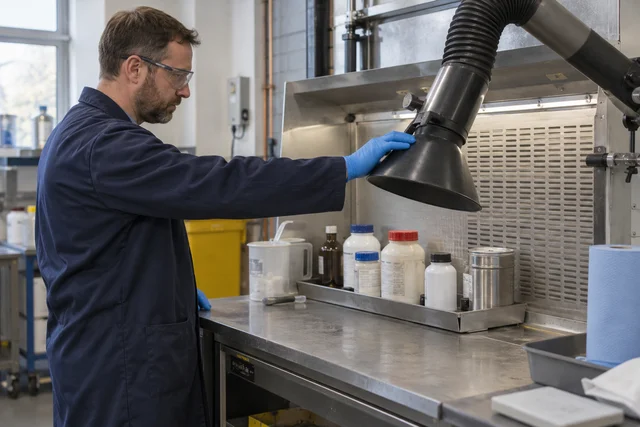
Local exhaust ventilation (LEV), respiratory protective equipment (RPE) and personal protective equipment (PPE) only protect people when they are correctly selected, fitted, used, maintained, examined and supervised. Local exhaust ventilation (LEV) should capture the contaminant close to where it is generated and move it away from the breathing zone. The hood design, capture velocity, ducting, filter, discharge point and user position all matter. A system can be installed and still fail if the hood is too far from the source, airflow is blocked, filters are overloaded, dampers are altered or operators work outside the capture zone. LEV requires routine checks and a thorough examination and test by a competent person at least every 14 months unless a more frequent interval applies.
16. Check the dispensing arrangement Choose every supported action. Leave the unsuitable actions unselected.
Choose every supported action. Leave the unsuitable actions unselected.
Establish relevant capture and control condition. — Supported action. Function matters. Count equipment presence as proof. — Leave unselected. Presence is narrower evidence. Use the defined response if required control is unavailable. — Supported action. Do not improvise exposure. 17. Compare the reasoning: Check the dispensing arrangement Establish relevant capture and control condition. Supported action Count equipment presence as proof. Leave unselected Use the defined response if required control is unavailable. Supported action
Choose every supported action. Leave the unsuitable actions unselected.
Establish relevant capture and control condition. — Supported action. Function matters. Count equipment presence as proof. — Leave unselected. Presence is narrower evidence. Use the defined response if required control is unavailable. — Supported action. Do not improvise exposure. 18. Keep monitoring and surveillance distinct Explain their purposes without replacing prevention.
Use it when a disease is associated with the substance, can be detected early and workplace conditions make occurrence likely; act on results and protect medical privacy.
Use it when a disease is associated with the substance, can be detected early and workplace conditions make occurrence likely; act on results and protect medical privacy. The HSE surveillance guide states these three criteria and says surveillance is a continuing process, not a one-off test. HSENI health-surveillance guidance gives the NI route: NI COSHH 2003 regulation 11 and Schedule 6 require relevant-doctor supervised medical surveillance for specified processes, at intervals no longer than 12 months where that condition applies. For isocyanate spray work, competent occupational health sets respiratory and skin surveillance; the employer receives appropriate fitness and trend information, not unrestricted clinical records. Investigate symptoms and control failure immediately. Air monitoring measures exposure; health surveillance looks for health change, so neither substitutes for the other.
Open the related fictional model case
19. Decision 3: apply and review Fictional case: An unlabelled liquid arrives at the task while the expected control arrangement is unavailable. Nobody has established the contents or the appropriate response for this change.
What is sound?
Use a small amount to discover its effect. Rely on the previous product’s assessment. Hold the affected task and use the responsible identification and review route. (supported response) Unknown identity and changed controls undermine the task basis.
20. Revisit the control or support boundary What is sound?
Use a small amount to discover its effect. Rely on the previous product’s assessment. Hold the affected task and use the responsible identification and review route. (supported response) Unknown identity and changed controls undermine the task basis.
21. Decision 3 explained Unknown identity and changed controls undermine the task basis.
Use the defined response and obtain competent review.
22. Act when identity or control is uncertain Use the defined response and obtain competent review.
A usable assessment names the check, stop point, decision owner and evidence at each stage of the work. Stop the affected task, move people to safety, prevent spread and use the specific emergency plan; do not identify substances by smell or improvise clean-up.
A usable assessment names the check, stop point, decision owner and evidence at each stage of the work. Stop the affected task, move people to safety, prevent spread and use the specific emergency plan; do not identify substances by smell or improvise clean-up. Sources for this explanation: HSE COSHH emergencies . A COSHH assessment should identify hazardous substances, assess exposure, decide controls, record findings, implement actions and review effectiveness. Start by creating a substance and process inventory. Include what is bought, what is generated and what appears during cleaning, maintenance, waste handling and emergencies. Then observe the task. The person doing the work often knows where dust escapes, where splashes occur and where the written procedure is unrealistic.
23. Resolve the changed task Arrange the steps for this case. Drag, or use Move up and Move down.
Arrange the steps for this case. Drag, or use Move up and Move down.
Hold the affected activity under the workplace arrangements. Establish substance identity and changed exposure conditions. Obtain the responsible assessment and control decision. Verify and communicate the accepted arrangement before use. This is an assessment-decision exercise, not a chemical handling or emergency-treatment procedure.
24. Compare the reasoning: Resolve the changed task 1 Hold the affected activity under the workplace arrangements. 2 Establish substance identity and changed exposure conditions. 3 Obtain the responsible assessment and control decision. 4 Verify and communicate the accepted arrangement before use.
Arrange the steps for this case. Drag, or use Move up and Move down.
Hold the affected activity under the workplace arrangements. Establish substance identity and changed exposure conditions. Obtain the responsible assessment and control decision. Verify and communicate the accepted arrangement before use. This is an assessment-decision exercise, not a chemical handling or emergency-treatment procedure.
25. Apply the lesson in a fictional workplace Unlabelled open containers and contaminated gloves sit on the paint-mixing bench.
Use the defined response and obtain competent review.
Open the related fictional model case
26. Take the learning into a fictional task Use the defined response and obtain competent review.
Task and people A fictional dispensing task has incomplete exposure information and an uncertain control condition. Control or support Recognise that equipment presence is not effectiveness. Check and review Use the defined response and obtain competent review.
27. Explain your reasoning without the answer sheet Use the supplied case facts. Explain why a choice fits the task and what remains uncertain. A points total or completed form cannot replace the required control or support arrangement.
28. Continue with the full course and Knowledge Hub Use the original course for its six lessons, required activities, final assessment and saved record. This optional companion does not change course grades, completion or certificates.
Enable JavaScript for interactive practice, or use the PowerPoint and its notes.


 All 50 presentations