Optional presentation practice. Choices and model launches do not write LMS grades, completion or certificates. This extension takes additional learning time.
1. PPE selection, use and care Choose protection for the remaining hazard, then keep its fit, compatibility and condition effective.
2. Choose a learning route 3. Start with the hazard, not the cupboard Explain why PPE follows stronger risk controls.
PPE protects the person rather than removing the source of harm. First consider avoiding the hazardous task, using a less hazardous material or method, and suitable engineering control such as containment or extraction.
PPE protects the person rather than removing the source of harm. First consider avoiding the hazardous task, using a less hazardous material or method, and suitable engineering control such as containment or extraction. Procedures and supervision maintain the arrangement; PPE then addresses the remaining exposure where needed.
An item is not a reason to accept failed upstream control. If required extraction is defective, putting on a mask does not authorise continuing unchanged. Use the task’s stop and review arrangements. The assessment must also consider hazards created by the control itself, such as gloves interfering with dexterity or becoming unsuitable around machinery. The page applies this layered reasoning to dust, chemicals, noise and other hazards; one instruction to wear protection cannot cover every task or exposure route.
4. The fictional case and decision boundary Explain why PPE follows stronger risk controls.
Task and setting Fictional case: a maintenance team has masks, glasses and gloves, but an extraction connection is defective, the eyewear interferes with the facepiece and reusable items are stored beside contaminated materials. Decision to practise The store supplies the same gloves for cleaning and handling sharp components, although the assessments describe different hazards. Staff struggle with grip during the second task. Evidence to consider Identify the evidence needed before choosing an item.
5. Decision 1: interpret the evidence The store supplies the same gloves for cleaning and handling sharp components, although the assessments describe different hazards. Staff struggle with grip during the second task.
What should selection consider?
The actual hazards, performance, wearer and task requirements for each use. (supported response) Only the brand already in stock. A rule that one glove type controls every hazard. Selection must fit the particular exposure and work, including usability.
6. Reconsider the evidence What should selection consider?
The actual hazards, performance, wearer and task requirements for each use. (supported response) Only the brand already in stock. A rule that one glove type controls every hazard. Selection must fit the particular exposure and work, including usability.
7. Decision 1 explained Selection must fit the particular exposure and work, including usability.
Identify the evidence needed before choosing an item.
8. Select for hazard, task and wearer Identify the evidence needed before choosing an item.
PPE suitability depends on the hazard and exposure route, the task, duration, environment and person. Gloves suitable for one chemical may not suit another or the work’s grip and dexterity needs. Eye protection and clothing also need the appropriate purpose and coverage.
PPE suitability depends on the hazard and exposure route, the task, duration, environment and person. Gloves suitable for one chemical may not suit another or the work’s grip and dexterity needs. Eye protection and clothing also need the appropriate purpose and coverage. A catalogue name is only a starting point.
Use the task assessment, relevant substance and equipment information and competent advice where necessary. Check whether the wearer can use the item safely and comfortably alongside the actual work. Explain its limits and when replacement or review is needed. If suitable protection is unavailable or the requirement is unclear, resolve that gap before relying on it. Do not choose a specialist protective system from a generic learning example or treat familiar appearance as technical equivalence.
9. Match the selection question Match each card to its meaning. Drag, or use the labelled category selector.
Match each card to its meaning. Drag, or use the labelled category selector.
Whether protection covers the actual substance and route — Hazard suitability. The assessment must define the protective purpose. Whether eyewear disrupts the facepiece seal — Compatibility. Items must work as a combination. Whether a strap is damaged before use — Current condition. Current defects matter even after earlier checks. 10. Compare the reasoning: Match the selection question Whether protection covers the actual substance and route Hazard suitability Whether eyewear disrupts the facepiece seal Compatibility Whether a strap is damaged before use Current condition
Match each card to its meaning. Drag, or use the labelled category selector.
Whether protection covers the actual substance and route — Hazard suitability. The assessment must define the protective purpose. Whether eyewear disrupts the facepiece seal — Compatibility. Items must work as a combination. Whether a strap is damaged before use — Current condition. Current defects matter even after earlier checks. 11. Check the combination together Recognise how one item can defeat another.
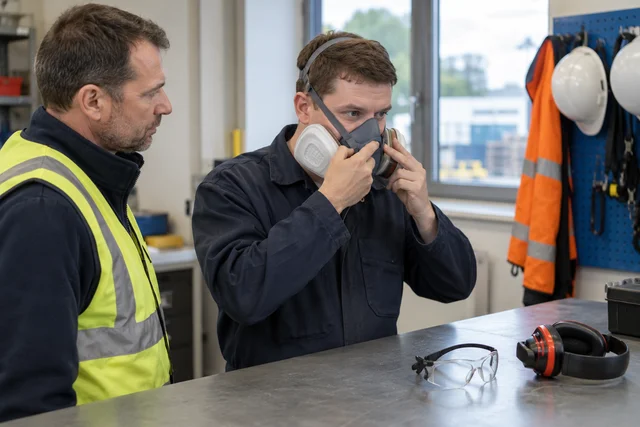
Items worn together need to remain compatible. Spectacle arms can disturb the seal of a tight-fitting respirator, and a helmet can affect ear-defender position. An item that works alone may fail as part of the complete combination.
Items worn together need to remain compatible. Spectacle arms can disturb the seal of a tight-fitting respirator, and a helmet can affect ear-defender position. An item that works alone may fail as part of the complete combination. This is a selection and use problem, not simply a reason to blame the wearer.
Check the actual items together on the person using the specified assessment and fitting arrangements. Consider comfort, movement, communication and the task environment as well as individual performance claims. If one item defeats another, obtain a suitable compatible combination; do not leave out required protection or improvise modifications. Workers should report slipping, interference or inability to perform the task. Confirm the agreed solution in actual use rather than accept separate signed records for conflicting items.
Open the related fictional model case
12. Decision 2: choose the response A worker offers a spare particulate facepiece for a task with unresolved vapour and atmosphere information. The supervisor assumes the word mask establishes suitable protection for any inhalation hazard.
What must be resolved?
A rule that every filter supplies oxygen. The actual hazard and suitable respiratory system, including its fit and limitations. (supported response) Whether the spare looks clean enough to cover all atmospheres. Different hazards need different systems; an unknown selection cannot be solved by generic appearance.
13. Compare the consequences What must be resolved?
A rule that every filter supplies oxygen. The actual hazard and suitable respiratory system, including its fit and limitations. (supported response) Whether the spare looks clean enough to cover all atmospheres. Different hazards need different systems; an unknown selection cannot be solved by generic appearance.
14. Decision 2 explained Different hazards need different systems; an unknown selection cannot be solved by generic appearance.
Distinguish filter selection, fit and atmosphere safety.
15. Respect respiratory-protection limits Distinguish filter selection, fit and atmosphere safety.
Respiratory protective equipment needs selection for the contaminant’s form, assessed exposure, protection needed, task and wearer. A particle filter does not automatically protect against a solvent vapour. A filtering facepiece does not supply missing oxygen or make an unknown atmosphere safe.
Respiratory protective equipment needs selection for the contaminant’s form, assessed exposure, protection needed, task and wearer. A particle filter does not automatically protect against a solvent vapour. A filtering facepiece does not supply missing oxygen or make an unknown atmosphere safe. Specialist selection belongs with the competent process.
Tight-fitting facepieces need the appropriate face-fit testing and correct use, including control of facial hair in the sealing area. The wearer must follow the specified checks and instructions. A test for another person or facepiece does not establish this combination fits. Report a damaged seal, unsuitable filter or uncertainty; do not enter exposure to see whether the equipment works. Awareness completion is not authority to select breathing apparatus, conduct fit tests or undertake rescue.
16. Select supported respiratory statements Choose every supported action. Leave the unsuitable actions unselected.
Choose every supported action. Leave the unsuitable actions unselected.
Use competent selection for particles, gases or vapours as relevant — Supported action. Filter purpose and actual exposure matter. A filter mask supplies missing oxygen — Leave unselected. Filtering does not add oxygen. Use the specified fitting and wearer checks — Supported action. A tight-fitting facepiece depends on a suitable seal. 17. Compare the reasoning: Select supported respiratory statements Use competent selection for particles, gases or vapours as relevant Supported action A filter mask supplies missing oxygen Leave unselected Use the specified fitting and wearer checks Supported action
Choose every supported action. Leave the unsuitable actions unselected.
Use competent selection for particles, gases or vapours as relevant — Supported action. Filter purpose and actual exposure matter. A filter mask supplies missing oxygen — Leave unselected. Filtering does not add oxygen. Use the specified fitting and wearer checks — Supported action. A tight-fitting facepiece depends on a suitable seal. 18. Keep protection effective between tasks Identify pre-use checks, cleaning, storage and replacement.
Inspection, cleaning, storage and timely replacement keep protection in its required condition. Follow the manufacturer’s instructions and the task arrangements for reusable and single-use equipment. Pre-use checks should identify damage, contamination, worn parts and relevant expiry or replacement conditions before exposure begins.
Inspection, cleaning, storage and timely replacement keep protection in its required condition. Follow the manufacturer’s instructions and the task arrangements for reusable and single-use equipment. Pre-use checks should identify damage, contamination, worn parts and relevant expiry or replacement conditions before exposure begins.
Store clean equipment where it will not be damaged or contaminated. Keep responsibility and supplies clear so a defect is resolved rather than passed to the next wearer. Do not improvise a repair or cleaning method that could damage performance. If the required clean, compatible protection is unavailable, arrange a suitable task decision before restarting. Maintenance records help show what happened, but the item’s actual state matters too; a completed check cannot overrule damage found at the point of use.
Open the related fictional model case
19. Decision 3: apply and review The extraction is repaired and a compatible combination is selected, but no one verifies whether the team can use and maintain it during the actual maintenance work.
What would establish a stronger control picture?
Count issued items as the full assurance result. Assume a new product removes every need for instruction. Confirm effective upstream control and the specified protection in actual use, with remaining problems addressed. (supported response) The control must work through the whole task and lifecycle, not stop at issue.
20. Revisit the control or support boundary What would establish a stronger control picture?
Count issued items as the full assurance result. Assume a new product removes every need for instruction. Confirm effective upstream control and the specified protection in actual use, with remaining problems addressed. (supported response) The control must work through the whole task and lifecycle, not stop at issue.
21. Decision 3 explained The control must work through the whole task and lifecycle, not stop at issue.
Distinguish an issue record from an effective control.
22. Verify use and learn from problems Distinguish an issue record from an effective control.
A PPE issue record establishes that equipment was handed over. Effective protection also needs suitability, fit, compatibility, understanding, correct use and continued condition during the task. Ask workers whether the arrangement is usable and check problems at the point of exposure.
A PPE issue record establishes that equipment was handed over. Effective protection also needs suitability, fit, compatibility, understanding, correct use and continued condition during the task. Ask workers whether the arrangement is usable and check problems at the point of exposure.
Repeated difficulties can reveal weak selection or upstream controls rather than a need for another reminder alone. Connect the finding to the task assessment, competent review and corrective action. Check the result after replacement or adjustment and communicate restrictions to those affected. The optional fictional exercise compares what the stores record shows with the actual work. It does not authorise you to approve specialist PPE or change a live task; workplace competence and the responsible decision process remain necessary.
23. Close the PPE improvement Make a decision at each point and use the feedback before continuing.
Make a decision at each point and use the feedback before continuing.
Stage 1: What has supply established? A new combination is supplied after the old items interfered.
Every exposure is now controlled permanently. — Reconsider. Supply alone cannot establish that. The items are available; suitability and effective use still need the specified checks. — Supported choice. Keep the evidence scope clear. Upstream controls can now be removed. — Reconsider. PPE does not release those requirements. Stage 2: What follows? A task check finds the combination works but storage still contaminates reusable items.
Retain the positive use finding and correct storage before claiming the full lifecycle controlled. — Supported choice. A favourable finding does not close another defect. Discard all useful evidence and restart every review without reason. — Reconsider. Keep evidence within its scope. Close the lifecycle action using the successful use check alone. — Reconsider. A positive use check does not resolve contaminated storage. 24. Compare the reasoning: Close the PPE improvement What has supply established? The items are available; suitability and effective use still need the specified checks. What follows? Retain the positive use finding and correct storage before claiming the full lifecycle controlled.
Make a decision at each point and use the feedback before continuing.
Stage 1: What has supply established? A new combination is supplied after the old items interfered.
Every exposure is now controlled permanently. — Reconsider. Supply alone cannot establish that. The items are available; suitability and effective use still need the specified checks. — Supported choice. Keep the evidence scope clear. Upstream controls can now be removed. — Reconsider. PPE does not release those requirements. Stage 2: What follows? A task check finds the combination works but storage still contaminates reusable items.
Retain the positive use finding and correct storage before claiming the full lifecycle controlled. — Supported choice. A favourable finding does not close another defect. Discard all useful evidence and restart every review without reason. — Reconsider. Keep evidence within its scope. Close the lifecycle action using the successful use check alone. — Reconsider. A positive use check does not resolve contaminated storage. 25. Apply the lesson in a fictional workplace Several noisy repairs operate together and colleagues raise their voices to communicate.
Distinguish an issue record from an effective control.
Open the related fictional model case
26. Take the learning into a fictional task Distinguish an issue record from an effective control.
Task and people Fictional case: a maintenance team has masks, glasses and gloves, but an extraction connection is defective, the eyewear interferes with the facepiece and reusable items are stored beside contaminated materials. Control or support Distinguish filter selection, fit and atmosphere safety. Check and review Distinguish an issue record from an effective control.
27. Explain your reasoning without the answer sheet Use the supplied case facts. Explain why a choice fits the task and what remains uncertain. A points total or completed form cannot replace the required control or support arrangement.
28. Continue with the full course and Knowledge Hub Use the original course for its six lessons, required activities, final assessment and saved record. This optional companion does not change course grades, completion or certificates.
Enable JavaScript for interactive practice, or use the PowerPoint and its notes.


 All 50 presentations