Optional presentation practice. Choices and model launches do not write LMS grades, completion or certificates. This extension takes additional learning time.
1. Silica and construction dust awareness Identify the material, avoid dusty work and keep source controls effective through cleanup.
2. Choose a learning route 3. Know what the task releases Distinguish silica from other construction dust and legacy hazards.
Construction work can release different dusts from concrete, stone, timber, plasterboard and other materials. Fine particles may reach deep into the lungs even when the air looks clear.
Construction work can release different dusts from concrete, stone, timber, plasterboard and other materials. Fine particles may reach deep into the lungs even when the air looks clear. Material, particle size, task energy, duration and enclosure influence exposure and harm; the word “dust” alone is not an adequate hazard description.
Concrete and some stone work can release respirable crystalline silica. Timber creates wood dust, while older refurbishment can disturb asbestos, lead coatings or other contaminants requiring separate assessment. Do not assume the same mask and vacuum suit every material. Identify what will be disturbed before cutting or sanding. Unknown material is a reason to hold and seek suitable information, rather than start work and decide the hazard from the cloud that appears.
4. The fictional case and decision boundary Distinguish silica from other construction dust and legacy hazards.
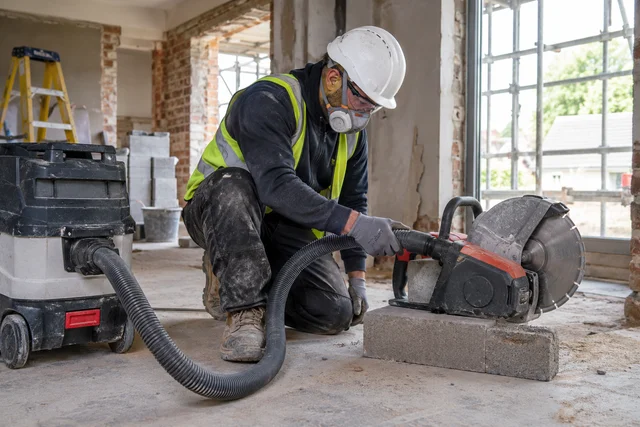
Task and setting Fictional case: a refurbishment crew cuts concrete channels indoors beside another trade. Its vacuum does not fit the tool, water supply fails and dry sweeping is planned so the room can reopen quickly. Decision to practise The crew calls the remaining indoor cuts too brief to need the planned controls. Another trade stands nearby and assumes only the tool operator can inhale silica dust. Evidence to consider Connect energetic work on silica-containing material to deep-lung exposure.
5. Decision 1: interpret the evidence The crew calls the remaining indoor cuts too brief to need the planned controls. Another trade stands nearby and assumes only the tool operator can inhale silica dust.
What is the correction?
Short tasks and bystanders can still face harmful exposure; control the actual release and people affected. (supported response) Only full-shift operators can be exposed. Outdoor or brief work is automatically safe. Task energy, setting and spread matter alongside duration.
6. Reconsider the evidence What is the correction?
Short tasks and bystanders can still face harmful exposure; control the actual release and people affected. (supported response) Only full-shift operators can be exposed. Outdoor or brief work is automatically safe. Task energy, setting and spread matter alongside duration.
7. Decision 1 explained Task energy, setting and spread matter alongside duration.
Connect energetic work on silica-containing material to deep-lung exposure.
8. Understand the silica harm route Connect energetic work on silica-containing material to deep-lung exposure.
Respirable crystalline silica is the fine airborne fraction that can be generated when silica-containing materials are cut, drilled, ground, polished or broken. Materials include concrete, mortar, brick and stone. Inhalation can cause serious disease including irreversible silicosis, chronic obstructive pulmonary disease and lung cancer.
Respirable crystalline silica is the fine airborne fraction that can be generated when silica-containing materials are cut, drilled, ground, polished or broken. Materials include concrete, mortar, brick and stone. Inhalation can cause serious disease including irreversible silicosis, chronic obstructive pulmonary disease and lung cancer.
Risk depends on the material and the actual operation, not only a percentage or task name. A brief high-energy indoor task can create significant exposure, and outdoor work is not automatically safe. People nearby may inhale dust without operating the tool. Prevent release where possible and control what remains at source. This awareness course does not calculate an individual dose, diagnose disease or identify a harmless amount of visible dust; it explains why planning and verified controls matter before symptoms occur.
9. Match the control stage Match each card to its meaning. Drag, or use the labelled category selector.
Match each card to its meaning. Drag, or use the labelled category selector.
Choose a route that avoids cutting — Avoid generation. Design can remove the dusty operation. Use effective compatible on-tool control — Capture or suppress. Verify capture or suitable suppression during use. Use the assessed vacuum or wet cleanup — Prevent secondary exposure. Do not re-release hazardous dust by dry sweeping. 10. Compare the reasoning: Match the control stage Choose a route that avoids cutting Avoid generation Use effective compatible on-tool control Capture or suppress Use the assessed vacuum or wet cleanup Prevent secondary exposure
Match each card to its meaning. Drag, or use the labelled category selector.
Choose a route that avoids cutting — Avoid generation. Design can remove the dusty operation. Use effective compatible on-tool control — Capture or suppress. Verify capture or suitable suppression during use. Use the assessed vacuum or wet cleanup — Prevent secondary exposure. Do not re-release hazardous dust by dry sweeping. 11. Avoid or reduce generation first Choose task design before a mask-only solution.
Before arranging a cut, ask whether it is necessary. A different service route, pre-sized component or off-site preparation may avoid or reduce dust generation. Evaluate a substitute method for all its hazards rather than assume a lower-silica choice creates harmless dust.
Before arranging a cut, ask whether it is necessary. A different service route, pre-sized component or off-site preparation may avoid or reduce dust generation. Evaluate a substitute method for all its hazards rather than assume a lower-silica choice creates harmless dust. Source prevention is stronger than asking people to breathe through protection around an uncontrolled release.
Where dusty work remains necessary, plan effective capture or suppression matched to the tool, material and environment. Keep other people away through suitable sequencing and segregation. Select residual respiratory protection from the assessment and wearer needs; it does not replace source controls. Provide the equipment and practical arrangements before work begins. A plan that requires an unavailable vacuum or impossible water supply is not ready merely because the method statement mentions it.
Open the related fictional model case
12. Decision 2: choose the response The crew’s vacuum runs but cannot connect to the cutting shroud. When water fails, the supervisor proposes finishing dry because only a few cuts remain and masks are available.
What is the appropriate decision?
Treat the remaining number of cuts as proof of safety. Hold the affected cutting until effective source control or a competently assessed alternative is ready. (supported response) Continue because a running vacuum is somewhere nearby. Required capture or suppression must work; PPE and short duration do not repair its failure.
13. Compare the consequences What is the appropriate decision?
Treat the remaining number of cuts as proof of safety. Hold the affected cutting until effective source control or a competently assessed alternative is ready. (supported response) Continue because a running vacuum is somewhere nearby. Required capture or suppression must work; PPE and short duration do not repair its failure.
14. Decision 2 explained Required capture or suppression must work; PPE and short duration do not repair its failure.
Recognise incompatible or failed controls as hold points.
15. Check capture, suppression and wearer fit Recognise incompatible or failed controls as hold points.
The task assessment needs the material, tool, duration, enclosure, people exposed and proposed control. Extraction must work with the tool and capture arrangement; water suppression must be suitable and available. Filters, shrouds, airflow and the changing work position can affect performance.
The task assessment needs the material, tool, duration, enclosure, people exposed and proposed control. Extraction must work with the tool and capture arrangement; water suppression must be suitable and available. Filters, shrouds, airflow and the changing work position can affect performance. A nearby running vacuum is not proof of capture.
Where respiratory protective equipment is required, it needs suitable protection, compatibility and correct use. Tight-fitting equipment needs face-fit testing for the wearer and an effective seal; facial hair in the sealing area can defeat that seal. Do not improvise a different respirator or filter to compensate for failed source control. Stop the affected method for failed extraction, lost suppression or uncontrolled dust and obtain restoration or a competently assessed alternative.
16. Select sound dust decisions Choose every supported action. Leave the unsuitable actions unselected.
Choose every supported action. Leave the unsuitable actions unselected.
Stop the affected method when required suppression fails — Supported action. Restore or obtain a competent alternative. Protect bystanders and adjacent trades — Supported action. Exposure is not limited to the operator. Use a clear-looking room as proof exposure is compliant — Leave unselected. Fine dust can be invisible and needs suitable evidence. 17. Compare the reasoning: Select sound dust decisions Stop the affected method when required suppression fails Supported action Protect bystanders and adjacent trades Supported action Use a clear-looking room as proof exposure is compliant Leave unselected
Choose every supported action. Leave the unsuitable actions unselected.
Stop the affected method when required suppression fails — Supported action. Restore or obtain a competent alternative. Protect bystanders and adjacent trades — Supported action. Exposure is not limited to the operator. Use a clear-looking room as proof exposure is compliant — Leave unselected. Fine dust can be invisible and needs suitable evidence. 18. Prevent secondary exposure at cleanup Include spread, waste and hand-back in the original method.
Dust can be released again during cleaning and spread through clothing, equipment, routes and adjacent work. Plan cleanup before starting so a controlled cut is not followed by an uncontrolled sweep.
Dust can be released again during cleaning and spread through clothing, equipment, routes and adjacent work. Plan cleanup before starting so a controlled cut is not followed by an uncontrolled sweep. Use a suitable vacuum or wet method for the assessed material rather than dry sweeping fine hazardous dust.
Protect nearby workers and public areas, maintain segregation and control slurry or waste through the planned route. Avoid moving dusty contamination into vehicles or welfare spaces. Check the area and resolve remaining defects before releasing access through the responsible arrangement. Do not equate a tidy floor with verified airborne exposure control. Unknown old material needs its own assessment and response; a general construction dust method does not authorise cleaning suspected asbestos or other specialist contamination.
Open the related fictional model case
19. Decision 3: apply and review The crew records that the vacuum was switched on and declares exposure compliant without representative evidence. A worker’s breathing concern is dismissed because the floor looks clean.
What is the sound response?
Treat a power light as a personal exposure measurement. Use visible cleanliness as a clinical diagnosis. Review actual controls and suitable exposure evidence, and route the health concern for appropriate support. (supported response) Equipment state, exposure and health questions need relevant evidence and competent roles.
20. Revisit the control or support boundary What is the sound response?
Treat a power light as a personal exposure measurement. Use visible cleanliness as a clinical diagnosis. Review actual controls and suitable exposure evidence, and route the health concern for appropriate support. (supported response) Equipment state, exposure and health questions need relevant evidence and competent roles.
21. Decision 3 explained Equipment state, exposure and health questions need relevant evidence and competent roles.
Separate equipment checks, monitoring and health support.
22. Verify exposure control and respond to concerns Separate equipment checks, monitoring and health support.
Workface checks help confirm that the planned equipment and segregation operate as intended. Exposure assessment or monitoring may be needed where control effectiveness is uncertain; a competent person selects and interprets the evidence.
Workface checks help confirm that the planned equipment and segregation operate as intended. Exposure assessment or monitoring may be needed where control effectiveness is uncertain; a competent person selects and interprets the evidence. An exposure limit is not a target for deliberately dusty work or a guarantee of no harm.
Health surveillance, where indicated by the actual risk, complements prevention rather than permits exposure. Workers should report relevant symptoms or failed controls through the established routes without self-diagnosis. Protect personal clinical information and use suitable occupational-health advice. The optional exercise follows a fictional concrete channel from design to cleanup. It identifies control readiness, stop triggers and verification questions without approving a real dust plan, selecting a universal respirator or claiming specialist competence.
23. Plan the whole dust workflow Arrange the steps for this case. Drag, or use Move up and Move down.
Arrange the steps for this case. Drag, or use Move up and Move down.
Identify the material, task and all people exposed Avoid or reduce dusty work and prepare effective controls Check control performance and hold for failure Clean safely and verify conditions before access hand-back Planning reaches beyond tool operation to secondary exposure and reopening the area.
24. Compare the reasoning: Plan the whole dust workflow 1 Identify the material, task and all people exposed 2 Avoid or reduce dusty work and prepare effective controls 3 Check control performance and hold for failure 4 Clean safely and verify conditions before access hand-back
Arrange the steps for this case. Drag, or use Move up and Move down.
Identify the material, task and all people exposed Avoid or reduce dusty work and prepare effective controls Check control performance and hold for failure Clean safely and verify conditions before access hand-back Planning reaches beyond tool operation to secondary exposure and reopening the area.
25. Apply the lesson in a fictional workplace The model shows a dust-suppression control. A crew proposes dry cutting near the public boundary when that control is unavailable, without an effective alternative.
Separate equipment checks, monitoring and health support.
Open the related fictional model case
26. Take the learning into a fictional task Separate equipment checks, monitoring and health support.
Task and people Fictional case: a refurbishment crew cuts concrete channels indoors beside another trade. Its vacuum does not fit the tool, water supply fails and dry sweeping is planned so the room can reopen quickly. Control or support Recognise incompatible or failed controls as hold points. Check and review Separate equipment checks, monitoring and health support.
27. Explain your reasoning without the answer sheet Use the supplied case facts. Explain why a choice fits the task and what remains uncertain. A points total or completed form cannot replace the required control or support arrangement.
28. Continue with the full course and Knowledge Hub Use the original course for its six lessons, required activities, final assessment and saved record. This optional companion does not change course grades, completion or certificates.
Enable JavaScript for interactive practice, or use the PowerPoint and its notes.


 All 50 presentations