Optional presentation practice. Choices and model launches do not write LMS grades, completion or certificates. This extension takes additional learning time.
1. Lifting operations awareness Plan the load, route and people, then check that today matches the plan.
2. Choose a learning route 3. Start with the need and harm pathway Start with the need and harm pathway.
First ask whether the load needs to move at all or whether delivery, assembly or the process can avoid the handling. A suitable aid can reduce manual effort but introduce runaway loads, trapping, poor steering or instability.
First ask whether the load needs to move at all or whether delivery, assembly or the process can avoid the handling. A suitable aid can reduce manual effort but introduce runaway loads, trapping, poor steering or instability. Lifting equipment adds higher-energy hazards such as suspended loads, overturning and dropped material. The equipment name does not explain which person could be struck or trapped along the actual movement path.
Follow the load from its starting position to a safe destination. Include attachment, raising, travel and landing, together with people near each stage. Consider whether the load can shift, leak, break or obstruct the operator view. A reduced manual-handling effort is a benefit, but the replacement mechanical operation still needs suitable equipment, competent planning and effective control of its own hazards.
4. The fictional case and decision boundary Start with the need and harm pathway.
Task and setting A workshop needs to move a motor. The proposed equipment has an examination report, but the load information, attachment arrangement and shared pedestrian route are not fully confirmed. Decision to practise A motor looks similar to one lifted before, but its replacement assembly changes the load and attachment information. The team proposes using the old routine method without checking the differences. Evidence to consider Establish the load and intended move.
5. Decision 1: interpret the evidence A motor looks similar to one lifted before, but its replacement assembly changes the load and attachment information. The team proposes using the old routine method without checking the differences.
What must planning establish?
Whether the old form can be reused unchanged. Reliable information and a suitable accepted method for this actual load. (supported response) Only a visual resemblance to the earlier motor. A routine plan remains useful only within its verified assumptions.
6. Reconsider the evidence What must planning establish?
Whether the old form can be reused unchanged. Reliable information and a suitable accepted method for this actual load. (supported response) Only a visual resemblance to the earlier motor. A routine plan remains useful only within its verified assumptions.
7. Decision 1 explained A routine plan remains useful only within its verified assumptions.
Establish the load and intended move.
8. Establish the load and intended move Establish the load and intended move.
A planned operation needs reliable information about the load, including mass, stability, centre of gravity and suitable attachment points where relevant. The route, destination and environment affect the required method. A routine method can support repeated work only while its assumptions remain true.
A planned operation needs reliable information about the load, including mass, stability, centre of gravity and suitable attachment points where relevant. The route, destination and environment affect the required method. A routine method can support repeated work only while its assumptions remain true. An unusual, fragile or changed load needs the proportionate competent review rather than a guess from a similar-looking item.
Define who plans, supervises, operates, signals and stops the move. Complexity and risk determine the level of planning and supervision, not a universal form length. If load identity, attachment or receiving space is uncertain, hold the affected operation. Do not use a trial lift as an informal method of discovering unknown load information or whether an improvised attachment will hold.
9. Match the lifting question Match each card to its meaning. Drag, or use the labelled category selector.
Match each card to its meaning. Drag, or use the labelled category selector.
Are identity, mass and balance known? — Load. The actual load drives planning. Does suitability cover this arrangement and support? — Equipment configuration. Capacity is conditional on configuration. Can pedestrians enter the landing area? — People and route. Exclusion must remain effective. 10. Compare the reasoning: Match the lifting question Are identity, mass and balance known? Load Does suitability cover this arrangement and support? Equipment configuration Can pedestrians enter the landing area? People and route
Match each card to its meaning. Drag, or use the labelled category selector.
Are identity, mass and balance known? — Load. The actual load drives planning. Does suitability cover this arrangement and support? — Equipment configuration. Capacity is conditional on configuration. Can pedestrians enter the landing area? — People and route. Exclusion must remain effective. 11. Select equipment for the actual configuration Select equipment for the actual configuration.
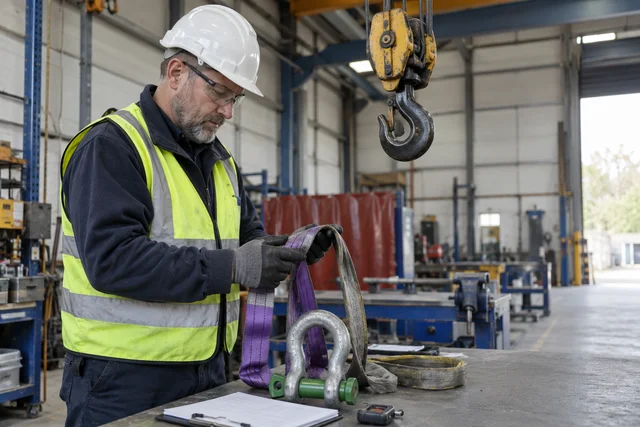
Equipment and accessories need suitable strength, stability and configuration for the proposed load and operation. Marked capacity is not a blanket approval for every reach, arrangement or attachment. The competent plan and manufacturer information establish the applicable conditions.
Equipment and accessories need suitable strength, stability and configuration for the proposed load and operation. Marked capacity is not a blanket approval for every reach, arrangement or attachment. The competent plan and manufacturer information establish the applicable conditions. The load must be secured using suitable points and accessories, and the route must support the equipment. Damaged or unidentified accessories cannot be accepted from appearance alone.
Do not improvise sling angles, attachment methods or capacity calculations from this awareness course. Recognise when the required information is missing and keep the move on hold. Consider the supporting ground or floor, clearances, equipment positioning and the receiving area together. A piece of equipment accepted in one configuration may be unsuitable when the actual reach, support or load arrangement changes.
Open the related fictional model case
12. Decision 2: choose the response A planned motor route is clear at briefing, but a delivery crew enters the landing area while two people give different signals. The operator is urged to finish before the next vehicle arrives.
What should govern continuation?
Which signal is shouted loudest. The need to finish before the vehicle arrives. Restored separation, clear communication and the accepted route conditions. (supported response) Current route and people controls matter more than schedule pressure or a clear earlier briefing.
13. Compare the consequences What should govern continuation?
Which signal is shouted loudest. The need to finish before the vehicle arrives. Restored separation, clear communication and the accepted route conditions. (supported response) Current route and people controls matter more than schedule pressure or a clear earlier briefing.
14. Decision 2 explained Current route and people controls matter more than schedule pressure or a clear earlier briefing.
Protect the route and coordinate people.
15. Protect the route and coordinate people Protect the route and coordinate people.
A suitable lifting arrangement can still harm people through an uncontrolled route. Plan exclusion, visibility, communication, turning, landing and other activities. Keep people out of the suspended-load or movement danger area through effective arrangements. A briefing or high-visibility clothing does not replace suitable separation.
A suitable lifting arrangement can still harm people through an uncontrolled route. Plan exclusion, visibility, communication, turning, landing and other activities. Keep people out of the suspended-load or movement danger area through effective arrangements. A briefing or high-visibility clothing does not replace suitable separation. A clear route at the start can change when deliveries, doors or another crew enter the area.
Confirm who gives the agreed signals and who can stop the operation. Avoid conflicting instructions and assumptions between operator and nearby workers. If visibility, separation, ground or destination no longer matches the plan, stop using the agreed safe response and obtain review. Do not ask a person to stand in a trapping area or steady a load with an unassessed method to preserve the schedule.
16. Interpret lifting assurance Sort the cards. Drag each card, or use its labelled category selector.
Sort the cards. Drag each card, or use its labelled category selector.
A hook is damaged today. — Actionable condition. Keep it out of use and report. The report is current, so every load is accepted. — Insufficient task release. Examination does not approve every operation. The route or load changed. — Actionable condition. Reopen the relevant planning assumptions. A replacement arrives, so route controls no longer matter. — Insufficient task release. Each required condition needs evidence. 17. Compare the reasoning: Interpret lifting assurance A hook is damaged today. Actionable condition The report is current, so every load is accepted. Insufficient task release The route or load changed. Actionable condition A replacement arrives, so route controls no longer matter. Insufficient task release
Sort the cards. Drag each card, or use its labelled category selector.
A hook is damaged today. — Actionable condition. Keep it out of use and report. The report is current, so every load is accepted. — Insufficient task release. Examination does not approve every operation. The route or load changed. — Actionable condition. Reopen the relevant planning assumptions. A replacement arrives, so route controls no longer matter. — Insufficient task release. Each required condition needs evidence. 18. Distinguish checks, maintenance and examination Distinguish checks, maintenance and examination.
User pre-use checks look for relevant current condition and readiness. Maintenance prevents deterioration. Competent thorough examination assesses safety-critical condition under the applicable requirements. They have different purposes and do not replace one another.
User pre-use checks look for relevant current condition and readiness. Maintenance prevents deterioration. Competent thorough examination assesses safety-critical condition under the applicable requirements. They have different purposes and do not replace one another. An in-date report cannot override a damaged hook, defective control or changed equipment configuration. Equipment duties depend on what it actually does, so a name alone cannot settle which regime applies.
Follow the applicable inspection arrangements, manufacturer information and defect process without inventing one interval for all equipment. Keep unsuitable or defective items out of use and report them through the responsible system. A user should not repair an accessory or prove capacity with an improvised load. Relevant evidence identifies the actual item, finding, action and verified closure before people rely on it again.
Open the related fictional model case
19. Decision 3: apply and review The damaged accessory is replaced, but the motor remains different from the load described in the plan and pedestrians can still enter the route. The team wants release based on the new item.
What must the release decision address?
The complete current load, method and route controls, not only the replacement. (supported response) Only the new accessory delivery note. The original plan regardless of its mismatched assumptions. Correcting one condition does not verify the rest of the task.
20. Revisit the control or support boundary What must the release decision address?
The complete current load, method and route controls, not only the replacement. (supported response) Only the new accessory delivery note. The original plan regardless of its mismatched assumptions. Correcting one condition does not verify the rest of the task.
21. Decision 3 explained Correcting one condition does not verify the rest of the task.
Reopen the plan when assumptions change.
22. Reopen the plan when assumptions change Reopen the plan when assumptions change.
A satisfactory equipment report does not release every lifting task. The actual load, route, configuration, people, ground and conditions must still match the accepted plan. Stop when wrapping fails, a load shifts, visibility is lost or another assumption becomes uncertain.
A satisfactory equipment report does not release every lifting task. The actual load, route, configuration, people, ground and conditions must still match the accepted plan. Stop when wrapping fails, a load shifts, visibility is lost or another assumption becomes uncertain. A changed load can require more than replacing a damaged accessory; it may alter the complete method. Competent roles determine the safe response and revised acceptance.
After a problem, verify the correction and the task conditions before continuing. Communicate restrictions and the responsible release decision to those involved. A booking, repair entry or equipment delivery alone does not establish readiness. Handback should leave the load and equipment in the accepted condition and keep unresolved defects out of service. Awareness learning does not authorise a person to improvise or approve a lift.
23. Choose readiness conditions Choose every supported action. Leave the unsuitable actions unselected.
Choose every supported action. Leave the unsuitable actions unselected.
The current load and equipment configuration match the accepted method. — Supported action. Use verified task information. Separation, signals and landing area are workable now. — Supported action. The live route matters. A similar-looking earlier load replaces missing data. — Leave unselected. Appearance is not the actual load evidence. An in-date report overrides a new defect. — Leave unselected. Act on present condition. 24. Compare the reasoning: Choose readiness conditions The current load and equipment configuration match the accepted method. Supported action Separation, signals and landing area are workable now. Supported action A similar-looking earlier load replaces missing data. Leave unselected An in-date report overrides a new defect. Leave unselected
Choose every supported action. Leave the unsuitable actions unselected.
The current load and equipment configuration match the accepted method. — Supported action. Use verified task information. Separation, signals and landing area are workable now. — Supported action. The live route matters. A similar-looking earlier load replaces missing data. — Leave unselected. Appearance is not the actual load evidence. An in-date report overrides a new defect. — Leave unselected. Act on present condition. 25. Apply the lesson in a fictional workplace The load weight, centre of gravity and route are uncertain, but the crane is ready to take the strain.
Reopen the plan when assumptions change.
Open the related fictional model case
26. Take the learning into a fictional task Reopen the plan when assumptions change.
Task and people A workshop needs to move a motor. The proposed equipment has an examination report, but the load information, attachment arrangement and shared pedestrian route are not fully confirmed. Control or support Protect the route and coordinate people. Check and review Reopen the plan when assumptions change.
27. Explain your reasoning without the answer sheet Use the supplied case facts. Explain why a choice fits the task and what remains uncertain. A points total or completed form cannot replace the required control or support arrangement.
28. Continue with the full course and Knowledge Hub Use the original course for its six lessons, required activities, final assessment and saved record. This optional companion does not change course grades, completion or certificates.
Enable JavaScript for interactive practice, or use the PowerPoint and its notes.


 All 50 presentations