Focused awareness learning based on SHAREhub pages. Apply the actual workplace arrangements and your role; completion is not practical competence or permission for specialist work.
This reader supplies the complete teaching. Use the interactive LMS course for assessed activities, saved progress and completion.
LESSON 1
Make a message change understanding
Connect sender, receiver and action.
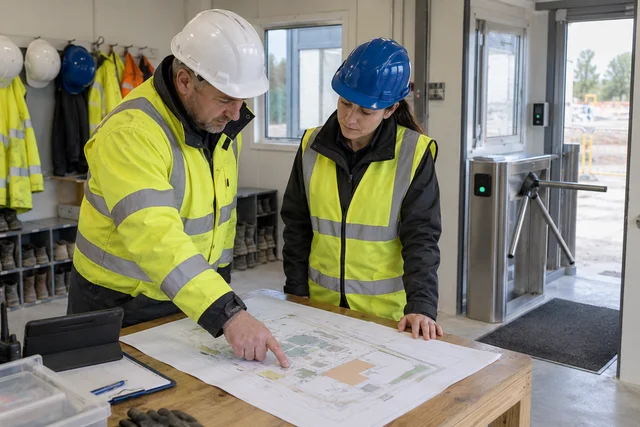
Existing SHAREhub photographic illustration. The written fictional case supplies the condition and decision evidence.
Make a message change understanding
Communication means creating shared meaning so that people understand information in broadly the same way and can respond appropriately. Communication includes the message, the sender, the receiver, the channel, the setting, the timing and the feedback loop. It can be formal or informal, spoken or written, digital or face-to-face, direct or implied through behaviour. A manager's tone, a supervisor's silence, a confusing email, a rushed handover and a well-designed diagram all communicate something. Good communication starts with purpose. The sender should know whether they are informing, instructing, consulting, persuading, coaching, warning, negotiating, recording, reassuring or learning. The audience should be clear on what they are expected to know, do, decide, remember or question. If that outcome is not clear, the communication method will often become cluttered or ineffective.
Applied case
Fictional case: A supervisor emails a changed restriction. The message reaches an inbox, but the receiving team continues using the previous arrangement and nobody checks what they understood.
Sent is one milestone
A message must reach the relevant people in time and support the required action. Ask what evidence shows understanding, particularly where the condition is safety-critical.
Test your decision
What has not been established?
That sending automatically proves understanding.
That another copy alone resolves the task condition.
Receipt, understanding and action by the people controlling the task.
Compare the explanation
Receipt, understanding and action by the people controlling the task.
Communication effectiveness is more than transmission.
Photorealistic illustrative UK workplace scene. Review checks: Generic toolbox talks: People cannot connect the message to today’s work. Unread procedures: Controls exist on paper but not in practice. Poor handover: Abnormal plant, defects or permits are missed.
Choose the exact task information
Treat a message as a control when a missed or ambiguous fact could defeat an isolation, permit, lift, process barrier or emergency response. The HSE human-factors assessment guidance asks sites to understand the real human role in a critical task. Trace the failure path: an inhibited high-level alarm is mentioned in a log, the incoming operator misses it, a transfer starts and an overfill follows. Reduce dependence on memory and messages at source by restoring the safeguard before transfer where practicable. Where temporary impairment remains, engineering interlocks and controlled physical isolation outrank a briefing. The written status, face-to-face exchange and receiving-person read-back are additional barriers. Stop transfer if plant state, permit owner or safeguard status is uncertain.
Applied case
Fictional case: A briefing says everything is normal while the current record contains a protective limitation. The next team does not know which task remains restricted or who decides release.
Actual and intended
A plan states what should happen next. The handover must also establish what is confirmed now, what remains uncertain and which condition prevents progression.
Test your decision
What should the message contain?
A reassuring summary that omits the exception.
The actual condition, relevant restriction, responsible role and next decision.
Only the intended production target.
Compare the explanation
The actual condition, relevant restriction, responsible role and next decision.
The message must preserve the information needed for safe control.
Existing SHAREhub 2D teaching schematic. Use alongside the explanation and fictional case in this lesson.
Use a focused two-way briefing
Verbal communication uses spoken words, questioning, listening, tone and timing to create immediate understanding between people. Verbal communication includes face-to-face conversations, meetings, phone calls, radio messages, toolbox talks, briefings, coaching, presentations, interviews, debriefs and emergency instructions. It is especially valuable where people need to ask questions, test assumptions, build trust, resolve disagreement or respond to changing conditions. Face-to-face discussion has particular strengths over digital communication. It allows people to read tone, pace, hesitation, facial expression and body language. It also makes it easier to spot confusion, invite quieter people into the conversation and correct misunderstandings in the moment. For complex, sensitive or high-risk topics, face-to-face communication is often the best first method, supported afterwards by a written summary.
Applied case
Fictional case: The toolbox talk is read without questions. Several workers interpret the same instruction differently, but attendance is treated as proof they can apply the required restriction.
Explain rather than agree
Ask someone to describe the relevant decision or stop condition. A yes answer may show agreement without revealing how the person will interpret the message.
Test your decision
What should improve?
A relevant question and explanation of how the instruction applies to the actual task.
Attendance alone as evidence of application.
Reading the same words faster to every shift.
Compare the explanation
A relevant question and explanation of how the instruction applies to the actual task.
Address access, language and practical distractions.
Photorealistic illustrative UK workplace scene. Review checks: Elimination: Finish maintenance and restore the safeguard before shift change where practicable. Substitution: Use a simpler, less hazardous operating route or defer a nonessential transfer. Engineering: Install a fail-safe line interlock or locked physical isolation against the identified wrong-transfer route, with a distinct inhibited-status display at the control point. Administrative: Use a current log plus two-way face-to-face handover, questions and receiving-person cross-check. PPE: Protective equipment addresses residual task exposure but does not cure a missing process message.
Match the method to the audience
Communication barriers include jargon, poor timing, overload, language, literacy, fatigue, noise, stress, weak trust, poor access and failure to check understanding. The barrier is rarely just one person not listening. A poor system may send long emails to non-desk workers, use acronyms with contractors, brief night shift by noticeboard, issue English-only instructions to a mixed-language crew, run toolbox talks in a noisy yard or expect workers to challenge a supervisor who has previously dismissed concerns. Overcoming barriers means designing the communication around people and work conditions. Use plain English, visuals, translation where needed, short briefings, repeat key messages, ask people to explain back, observe the work, give private routes for sensitive concerns and show that speaking up leads to action.
Applied case
Fictional case: A digital update is the only briefing route, but some affected contractors cannot access the system. The task starts before anyone checks whether they received the changed conditions.
Accessible is task-specific
Consider who needs the message, when they need it and whether they can use its format. The most convenient channel for the sender may leave an important group uninformed.
Test your decision
What is needed?
Treat lack of response as agreement.
Assume a general induction covers all later changes.
A usable route that reaches those affected and checks relevant understanding.
Compare the explanation
A usable route that reaches those affected and checks relevant understanding.
The communication method must fit the actual recipients.
Use clear current information at the decision point.
Existing SHAREhub photographic illustration. The written fictional case supplies the condition and decision evidence.
Keep the written record usable
Written communication should provide a clear, accurate and accessible record that people can understand, use and revisit. Written communication includes policies, procedures, risk assessments, method statements, safe systems of work, permits, handover logs, minutes, reports, emails, letters, memos, safety alerts, newsletters, training notes and contractor packs. It is essential where information must be consistent, traceable, detailed or legally defensible. The main weakness is false assurance. A long document can look professional while being unreadable at the point of work. Written information should be structured around the reader: plain English, clear headings, short sentences, active instructions, diagrams where helpful, version control and removal of outdated copies. Acronyms should be expanded and technical terms explained. Written communication works best when it is paired with discussion.
Applied case
Fictional case: The work pack includes an old printed instruction and a current digital revision. Their task limits differ, but the team chooses the familiar printout without resolving applicability.
Clarity and control
Use specific language, relevant sequence and current status. A long document or confident wording cannot repair a conflict about the task or the required condition.
Test your decision
What should happen?
Assume two conflicting copies create a stronger record.
Resolve the current applicable information through the responsible route.
Use whichever version is easier to find.
Compare the explanation
Resolve the current applicable information through the responsible route.
A record must support the actual decision consistently.
Photorealistic illustrative UK workplace scene. Review checks: Assess and analyse: Identifies safety-critical communication points in loading, permits, maintenance, shift handover and emergency response. Implement controls: Uses structured handovers, permit briefings, radio protocols, visitor information and contractor coordination meetings. Train and supervise: Trains operators and supervisors in check-back, escalation, plain language and challenging unclear instructions.
Check the message in work
Evidence should show not only that messages were sent, but that people understood them and acted on them. Evidence can be active or reactive. Active evidence includes briefings, question checks, supervisor observations, training assessments, consultation minutes, inspection findings and communication audits. Reactive evidence includes incident investigations, near misses, repeated defects, complaints, rumours, confusion during drills or people not following a changed rule. The best evidence connects communication to risk control. For example: after a new vehicle route briefing, are pedestrians using the route? After a permit system update, do contractors understand hand-back? After a safety alert, have similar defects reduced? A signature on a form is only the start. Consultation gives workers information in time to comment and influence a safety decision; a completed announcement is one-way communication.
Applied case
Fictional case: The manager announces a completed route decision and calls it consultation. Workers can explain the announcement, but their practical concerns had no opportunity to influence the choice.
Follow the effect
For a briefing, examine understanding and action. For consultation, also examine how relevant input reached the decision and how the result was returned to affected people.
Test your decision
What is the distinction?
Communication can inform; consultation also needs a meaningful opportunity to influence and a response.
Understanding an announcement proves consultation occurred.
Every concern must automatically become the chosen option.
Compare the explanation
Communication can inform; consultation also needs a meaningful opportunity to influence and a response.
The processes overlap but answer different questions.