Focused awareness learning based on SHAREhub pages. Apply the actual workplace arrangements and your role; completion is not practical competence or permission for specialist work.
This reader supplies the complete teaching. Use the interactive LMS course for assessed activities, saved progress and completion.
LESSON 1
Consult while a decision can change
Distinguish input from a finished announcement.
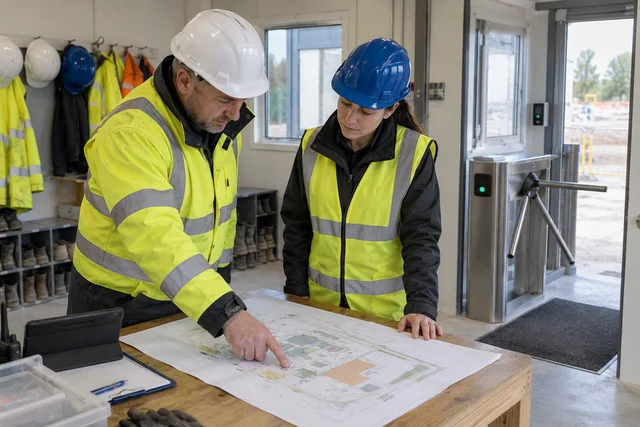
Existing SHAREhub photographic illustration. The written fictional case supplies the condition and decision evidence.
Consult while a decision can change
Consultation is the legal and practical process of discussing health and safety matters with workers or their representatives before decisions are made. Consultation, participation and engagement are closely linked but not identical. Consultation is the two-way discussion required by law. Participation is the practical involvement of workers in activities such as risk assessment, procedure design, inspections, incident investigations and safety committees. Engagement is the quality of the relationship: whether people feel listened to, respected, informed and able to influence work safely. This distinction matters because organisations often confuse a noticeboard, email or toolbox talk with consultation. Those methods may inform people, but they do not automatically consult them. Real consultation gives workers enough information to understand the issue, enough time to respond, a route to challenge or suggest improvements, and feedback explaining what will be done.
Applied case
Fictional case: A new method is approved before workers hear about it. The manager asks for signatures afterwards and describes those signatures as proof that the team influenced the decision.
Informing and involving
People need relevant information and a chance to raise practical concerns. An announcement can explain a decision without demonstrating that affected workers helped shape it.
Test your decision
What is missing?
An assumption that silence proves the choice is workable.
A timely opportunity to contribute before the relevant decision is fixed.
Attendance and signatures collected after the choice was already fixed.
Compare the explanation
A timely opportunity to contribute before the relevant decision is fixed.
Consultation needs meaningful influence and response.
Recognise that roles depend on arrangements and jurisdiction.
Photorealistic illustrative UK workplace scene. Review checks: Repeated damaged-cage handling concern ignored: Workers keep lifting unstable loads and may sustain acute strain or cumulative musculoskeletal injury. New chemical or equipment method imposed late: People cannot challenge exposure, maintenance or emergency assumptions before work begins; illness or injury may follow. Night-shift concerns absent from committee: A recurring guard defect remains hidden from daytime managers and contact with moving parts becomes more likely.
Use the appropriate representation route
Great Britain law uses different routes depending on whether recognised trade union safety representatives cover the workers. Where a recognised trade union appoints safety representatives, the 1977 Regulations apply to those represented employees. Where workers are not covered by that route, employers consult either elected representatives of employee safety or employees directly under the 1996 Regulations. HSE consultation law overview . Many organisations have mixed arrangements. The important practical test is whether every affected worker group has a real route to be consulted on risk, change and control. The structure should make worker voice routine, timely, evidence-based and connected to action close-out. A mature consultation system has more than a quarterly meeting. It has early consultation on change, practical inspection routes, clear issue escalation, feedback to workers, representative training and management accountability for close-out.
Applied case
Fictional case: A manager wants to appoint a convenient colleague as the representative without checking the recognised-union or employee consultation route applicable to the workplace and its location.
A route to influence
Representatives support worker input and challenge. They do not take over the employer’s responsibility to manage the risk or make every specialist task decision.
Test your decision
What should be established?
The correct representation and consultation arrangements for that workplace.
The manager’s preference alone.
A universal route copied from a different jurisdiction.
Compare the explanation
The correct representation and consultation arrangements for that workplace.
Existing SHAREhub 2D teaching schematic. Use alongside the explanation and fictional case in this lesson.
Include affected groups
Consultation should be designed around the people affected by the risk, including people who are not present in ordinary office-hours meetings. Consultation fails when it only reaches the easiest group. Night shifts, mobile workers, home workers, agency staff, subcontractors, workers with English as a second language, low-literacy workers and people in remote locations may all experience risks differently. A single intranet notice or daytime committee meeting will not usually be enough. Contractors need particular attention because they may create risks, receive risks from the host employer, or be affected by other contractors. Consultation does not remove the need for contractor management, but it does improve interface control. Pre-start meetings, induction feedback, permit handovers, stop-work routes and joint inspections can all reveal conflicts that paperwork misses.
Applied case
Fictional case: A route change affects nights and contractors. Consultation occurs only at a day meeting, and no alternative route lets the missing groups understand the proposal or contribute experience.
Who is missing?
Ask which shifts, roles and interfaces the proposal affects. Different work patterns can reveal a problem that the most accessible meeting group does not encounter.
Test your decision
What should improve?
Count absence as agreement.
Use only the day team’s view for every pattern.
An accessible opportunity for those affected groups to contribute relevant knowledge.
Compare the explanation
An accessible opportunity for those affected groups to contribute relevant knowledge.
Inclusion should reflect actual exposure and access.
Photorealistic illustrative UK workplace scene. Review checks: Eliminate: Improve fabrication or buy a finished component so the manual grinding stage is unnecessary. Reduce, including substitution: Choose a suitable lower-vibration finishing method or tool after checking finish, accessory compatibility and other hazards. Isolate: Clamp and support the component and segregate other people from sparks and fragments. Control: Use a maintained compatible tool/accessory and effective dust control; avoid unnecessary force and worn consumables. Control: Plan actual trigger time from representative vibration data and the required work, alongside wheel, dust and noise controls.
Use worker evidence to improve controls
A worked example shows consultation as a route to better work design, not just complaint handling. Warehouse workers repeatedly report shoulder and back discomfort when unloading mixed cages. A weak response tells workers to refresh manual handling training and reminds them to lift properly. The safety representative raises that cages are packed too high, wheels are damaged, delivery times create rushing and the unloading area has poor space for team handling. HSE matters for consultation . The stronger response involves the representative, supervisors and workers in reviewing the task. The employer changes supplier loading rules, repairs cages, provides better mechanical aids, changes delivery scheduling, updates the risk assessment and checks whether discomfort reports reduce. Ask the people who do the job before approving a change, test the proposal at work and close the feedback loop.
Applied case
Fictional case: Workers report repeated awkward handling. The meeting records the concern but chooses only another reminder, without examining the task arrangement that keeps creating the exposure.
From concern to decision
A representative can help describe the actual task and test assumptions. The resulting choice still needs responsible assessment, implementation and verification of the intended effect.
Test your decision
What should discussion examine?
Whether repetition makes the demand acceptable.
The task mechanism and stronger feasible changes with relevant assessment.
Only whether the reminder was received.
Compare the explanation
The task mechanism and stronger feasible changes with relevant assessment.
Consultation should inform controls, not merely record dissatisfaction.
Existing SHAREhub photographic illustration. The written fictional case supplies the condition and decision evidence.
Explain what happened to the input
Two-way communication works when people can raise issues easily and receive a clear response showing what was done, what was not done and why. Feedback loops are the difference between consultation and frustration. Workers may raise a concern about a guard, staffing level, welfare issue, chemical smell, defective ladder, high workload or confusing procedure. If they hear nothing back, they may stop reporting. If they see action or a reasoned explanation, the reporting route gains credibility. The response should match the risk. A serious imminent danger needs immediate escalation and control. A pattern of minor concerns may need trend analysis. A suggestion that cannot be adopted should still be answered respectfully, explaining the decision and any alternative.
Applied case
Fictional case: A proposal is reviewed and a different control is selected. Nobody explains the reasons or how the original concern is addressed, so workers assume the report was ignored.
Considered does not mean adopted
Not every option will be chosen. Explain the basis, how the concern is controlled and what evidence will show the selected arrangement works.
Test your decision
What should feedback include?
The reasoned decision, resulting arrangement and any remaining open question.
A promise every suggestion must be selected.
Only confirmation that a meeting occurred.
Compare the explanation
The reasoned decision, resulting arrangement and any remaining open question.
Meaningful consideration needs an understandable response.
Photorealistic illustrative UK workplace scene. Review checks: Concern raised: Representative logs concern with task examples and worker feedback. Assessment: Task observed with workers and rep, including load height, frequency, route and equipment. Action: Supplier packing, cage condition, route, staffing and mechanical aid controls improved.
Check participation changed practice
Assurance should test whether worker voice affects decisions and control improvement. A consultation audit should not simply check whether meetings exist. It should follow a sample concern from worker report through representative discussion, management response, action close-out and workforce feedback. It should also test whether representatives feel able to challenge, whether managers respond constructively and whether serious risk themes are reaching senior leadership. A clear pathway helps representatives and managers turn concerns into evidence, decisions, actions and feedback. The strength of representative involvement is not only that an issue is raised. It is that the issue can move through inspection, evidence, management response, committee review, action tracking and feedback without being lost or personalised. HSE when to consult .
Applied case
Fictional case: A committee agrees a change and records an owner. The arrangement is not yet implemented, but the meeting minute is presented as proof the handling concern is resolved.
A connected record
Link the concern, input, decision, owner and result. A meeting can support that trail, but the actual workplace evidence establishes whether the change addressed the issue.
Test your decision
What remains?
Only another meeting minute.
Transfer of the employer’s duty to the representative.
Implementation and verification of the selected control in relevant work.
Compare the explanation
Implementation and verification of the selected control in relevant work.