Focused awareness learning based on SHAREhub pages. Apply the actual workplace arrangements and your role; completion is not practical competence or permission for specialist work.
This reader supplies the complete teaching. Use the interactive LMS course for assessed activities, saved progress and completion.
LESSON 1
Know the awareness boundary
Separate urgent escalation from clinical treatment decisions.
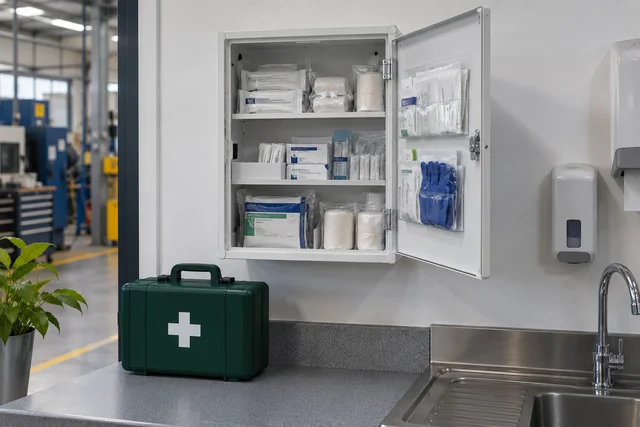
Existing SHAREhub photographic illustration. The written fictional case supplies the condition and decision evidence.
Know the awareness boundary
Workplace first aid requires an arrangement matched to the actual undertaking. This course helps you recognise the call route, available trained help, equipment locations and management gaps. It does not teach diagnosis, medication, resuscitation or casualty-specific treatment, and completion does not make you a first-aider.
For a medical emergency, call 999 or the applicable local emergency number and follow dispatcher advice. Do not delay an urgent call while a manager reviews provision or a form is completed. Explain the location clearly and use the site plan for access and assistance. Provide help within current training and the circumstances, without entering uncontrolled danger. Afterwards, managers can review whether the arrangement met the foreseeable need; that review is separate from the immediate emergency response.
Applied case
A worker becomes seriously unwell on the late shift. A colleague wants to wait for the manager to finish a staffing review before contacting emergency services or available trained help.
Training has a defined scope
Knowing the kit location and emergency number helps the response system. It does not confer treatment competence or replace casualty-specific advice from trained responders and emergency services.
Test your decision
What is the appropriate boundary?
Complete the needs assessment before any emergency call.
Use this awareness quiz as authority to diagnose the casualty.
Do not delay urgent emergency escalation for a management review; follow the emergency route and dispatcher advice.
Compare the explanation
Do not delay urgent emergency escalation for a management review; follow the emergency route and dispatcher advice.
Urgent care escalation and later provision review are different decisions.
Recognise when scene danger requires specialist response.
Photorealistic illustrative UK workplace scene. Review checks: No current needs assessment: Provision may not match the real workplace, especially after growth, new tasks or layout change. Named first-aiders not available: Treatment or emergency escalation can be delayed when the person on the notice is absent. Kits incomplete or expired: Basic treatment may be delayed or improvised with unsuitable materials.
Protect the responder too
An incident can expose a helper to the same danger as the casualty. Traffic, moving machinery, electricity, chemical release, fire, unstable ground, water or violence can make direct access unsafe. A second casualty worsens the emergency and delays effective help.
Use the workplace emergency arrangement to raise the alarm, control access and summon suitable responders. Do not enter a confined space, live electrical danger or other uncontrolled area for an improvised rescue. Report the hazard and casualty location accurately so the response matches the scene. Trained first-aiders still need a safe approach and appropriate support; their title does not remove a specialist rescue hazard. This lesson identifies that boundary without teaching rescue or clinical procedures, which require current role-specific training and an assessed emergency plan.
Applied case
A worker collapses beside machinery that may still move. An untrained colleague proposes reaching into the danger zone immediately because the first-aid kit is nearby.
A first-aid role is not rescue authority
A trained first-aider may still need specialist access and hazard control. Electrical, confined-space or machinery danger does not disappear because someone needs medical help.
Test your decision
What should guide the response?
Any colleague becomes a rescue specialist during an emergency.
Scene safety, urgent suitable help and the site emergency arrangement rather than an improvised dangerous entry.
Kit proximity makes the machine danger irrelevant.
Compare the explanation
Scene safety, urgent suitable help and the site emergency arrangement rather than an improvised dangerous entry.
Help must not create another casualty; the hazard needs suitable control and response.
Connect provision to hazards, people, geography and response.
Existing SHAREhub 2D teaching schematic. Use alongside the explanation and fictional case in this lesson.
Assess the actual need
A first-aid needs assessment considers foreseeable injuries and illness, work hazards, workforce, location and access to professional help. An office, mobile repair team and remote high-risk task do not necessarily need the same people, equipment or facilities. Headcount alone cannot answer the provision question.
Consider shifts, holidays, absence, multiple floors or buildings, contractors and relevant non-employees. Public-facing activity can add practical needs even where the employee duty has a different legal scope. Check how someone summons help, reaches equipment and guides responders to the scene. Managers need competent support where hazards or specialist arrangements demand it. Avoid copying a universal first-aider ratio or kit list into every activity. The course supplies assessment questions, not a numerical staffing formula or clinical equipment specification.
Applied case
The depot copies an office checklist because both sites employ similar numbers. It does not consider vehicle movement, outlying work areas, late shifts or the locked emergency gate.
A kit is one component
Provision may need trained people, information, facilities, communication and access as well as supplies. Counting boxes cannot establish that appropriate help reaches the person.
Test your decision
What should determine provision?
The depot’s actual hazards, people, working periods, locations and emergency access.
Headcount alone because every workplace is equivalent.
Only the number of unopened dressings.
Compare the explanation
The depot’s actual hazards, people, working periods, locations and emergency access.
Needs assessment must follow the undertaking and practical response conditions.
Explain role clarity without assuming competence from appointment.
Photorealistic illustrative UK workplace scene. Review checks: Elimination: Remove manual cleaning of the exposed blade by redesigning the cleaning task or replacing the equipment. Substitution: Choose a lower-risk pre-cut product or safer blade system if food quality and cleaning allow. Engineering controls: Fit compatible guarding or interlocked access and confirm cleaning mode does not bypass protection. Administrative controls: Write a cleaning sequence, isolate power and restrict the task to trained staff; position first-aid cover and emergency call route for all shifts. PPE: Select suitable cut protection for the residual task after checking dexterity and compatibility; gloves never replace guarding.
Separate appointed and trained roles
An appointed person takes charge of arrangements such as looking after equipment and contacting emergency services. The appointment itself does not confer first-aid competence. A first-aider needs suitable training for the identified need and current competence within that role. A person may hold both roles, but they are not interchangeable labels.
If the assessment requires trained cover, planned absence needs appropriate trained cover rather than renaming an untrained colleague. Workers should know who is actually available today, where they are and how to call them. Managers remain responsible for organising adequate provision and communicating changes. Avoid assigning treatment beyond a person’s training because they are calm, senior or nearest the kit. Clear roles reduce delay without turning administrative responsibility into clinical authority.
Applied case
The daytime first-aider is absent. A supervisor appoints the receptionist to maintain the kit and assumes this automatically supplies the trained cover required for the late repair task.
Appointment and ability differ
An appointed person can organise calls and supplies within that role. Treatment ability follows actual suitable training and competence, not the appointment or seniority alone.
Test your decision
What remains unresolved?
Nothing because maintaining a kit is identical to first-aid training.
Only the wording of the receptionist’s job title.
Appropriate trained cover where the needs assessment requires it.
Compare the explanation
Appropriate trained cover where the needs assessment requires it.
An appointed-person arrangement cannot substitute for an assessed need for trained first aid.
Identify absence cover, communication and access failures.
Existing SHAREhub photographic illustration. The written fictional case supplies the condition and decision evidence.
Make every shift and location reachable
First-aid arrangements need to work whenever people are working, including early starts, overtime, nights and off-site tasks. A name on the notice is not available cover if the person has left or works too far away. Check where the remaining people are and whether they can be contacted.
Remote or mobile work may need communication checks, location details, suitable equipment and a clear emergency-service access plan. Test the late shift rather than assume office-hour arrangements continue. If an activity depends on missing provision, the responsible manager must obtain suitable cover or safely change or hold the affected activity. This planned decision is separate from an emergency, when staff should use urgent escalation immediately. Avoid assigning a responder who cannot safely reach the person or obtain access through a locked boundary.
Applied case
The depot’s late team can contact the named first-aider only at home. An ambulance would meet a locked gate, and nobody has been assigned to provide access or location directions.
Availability includes access
A trained person elsewhere and a kit behind a locked door may not provide usable coverage. Check the actual route and time-critical interfaces through the assessed plan.
Test your decision
What should the planned cover review resolve?
A promise to find the gate key after an emergency begins.
Usable on-shift provision, communication, location and responder access for the actual work.
Only whether the daytime notice looks current.
Compare the explanation
Usable on-shift provision, communication, location and responder access for the actual work.
Response requires an achievable chain rather than names and equipment in isolation.
Use safe exercises and proportionate records to verify readiness.
Photorealistic illustrative UK workplace scene. Review checks: Setting: the leisure operator operates a pool and public areas during an evening shift. Act: Match the first-aid needs assessment to pool hazards, public numbers, shifts and absences; check alarms, kit and responder cover. Hold / review: Missing essential first-aid or rescue cover, failed alarm or blocked access holds the affected activity.
Check and improve the arrangement
A safe tabletop or communication check can reveal whether people know how to raise the alarm, contact help, describe the location and keep emergency access clear. Check supplies and facilities through the planned inspection route, with responsible ownership and action on missing or unsuitable items.
After an exercise, absence or incident, review the relevant failure and corrective action. A kit inspection does not prove staff coverage, and a current training record does not prove someone can access a remote scene. Protect personal information and use the proper incident-record route; the optional exercise uses no real casualty details. It maps a fictional late-shift call and access chain, identifies a missing link and proposes a check. It does not submit a real form, approve provision or certify first-aid ability.
Applied case
The depot completes a kit inspection, then closes the access finding without testing the gate arrangement or briefing the late team on emergency directions and responsibility.
Check a defined link
A call-route check can show who answers and what information is available. Keep its conclusion scoped; it does not demonstrate treatment ability or prove every emergency scenario.
Test your decision
What would support closing the access action?
A safe practical check of gate access, location information and responsible cover on the relevant shift.
The kit seal alone.
A declaration that a training certificate opens every gate.
Compare the explanation
A safe practical check of gate access, location information and responsible cover on the relevant shift.
Verify the function that failed rather than rely on evidence for a different part of the system.
Study a completed fictional industrial construction and commissioning plan. Compare its warning, roles, accountability, responder access, rescue limits and recovery decisions with the learning above. It includes a new fictional site schematic, a worked exercise and separate blank recording annexes.
Use this as a teaching example when developing arrangements for your own premises. The fictional layout and role identifiers are not live emergency instructions.