Focused awareness learning based on SHAREhub pages. Apply the actual workplace arrangements and your role; completion is not practical competence or permission for specialist work.
This reader supplies the complete teaching. Use the interactive LMS course for assessed activities, saved progress and completion.
LESSON 1
Understand fatigue as a work risk
Connect reduced alertness with controllable work demands.
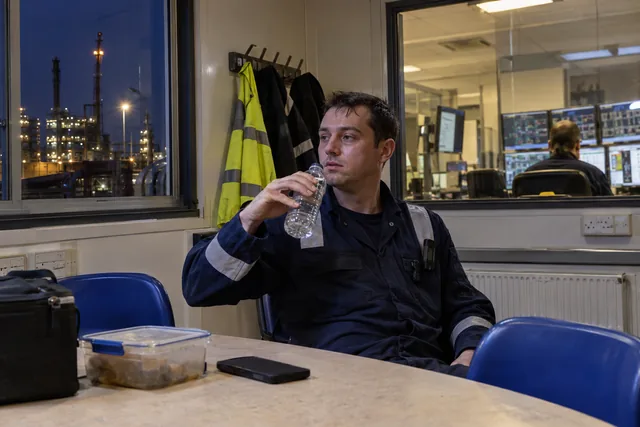
Existing SHAREhub photographic illustration. The written fictional case supplies the condition and decision evidence.
Understand fatigue as a work risk
Fatigue can impair attention, reaction, memory and judgement. It can follow one demanding period, accumulate through repeated inadequate recovery or arise with disruption to normal sleep timing. A person may therefore struggle even when the current shift is not unusually long. The consequences depend on the task and surrounding hazards.
Manage the work causes as well as offering personal information. Staffing, workload, shift timing, break cover, call-outs and journeys affect real recovery. Advice to sleep better cannot compensate for a schedule that prevents it. Workers should have a credible way to report concerns without pressure to conceal them. Managers need a task-risk decision and suitable support, rather than a clinical diagnosis of why the person is tired or a judgement about their commitment.
Applied case
The distribution team receives sleep-hygiene tips while routine shift extensions and overnight calls continue. Several workers report difficulty concentrating during the following duty period.
Impairment is the pathway
Fatigue matters when reduced attention or reaction meets a hazardous task. Identify the work demand and consequence rather than use tiredness as a label or proof of a medical condition.
Test your decision
What should management address?
Only whether workers read the sleep tips.
A diagnosis made from tiredness alone.
The actual work demands and recovery arrangement alongside appropriate support.
Compare the explanation
The actual work demands and recovery arrangement alongside appropriate support.
Personal advice cannot correct work design that repeatedly prevents recovery.
Recognise why night work and quick returns need planning.
Photorealistic illustrative UK workplace scene. Review checks: Source / exposure: Controls fail when planned rotas ignore actual hours, workload, break quality, handover and worker feedback. Possible consequence: A rota can look acceptable on paper while the real system is unsafe. Control failure: People may stay late, swap shifts, miss breaks, cover vacancies, commute long distances and handle demanding tasks at the worst alertness times.
Account for circadian timing
Circadian timing influences sleep and alertness. Night work and early starts can place demands when the body is normally prepared for sleep, and daytime sleep may be shorter or disturbed. Repeated nights, overtime and short turnaround can combine with workload and travel to reduce recovery.
Design the rota, staffing, breaks and task timing together. Consider rotation, consecutive duties, handover, welfare and worker feedback rather than treat coverage as the only objective. Worker preferences matter, but do not override evidence of unsafe fatigue. Context-dependent schedule guidance is not a universal safe or legal shift length. This course prescribes no hours limit; the responsible organisation must apply the actual risk assessment, relevant working-time rules and competent advice for the work and people involved.
Applied case
Workers prefer an extended night pattern, but actual overtime leaves little recovery before a demanding early duty. The planner treats preference as proof the combined sequence is safe.
Timing changes the demand
Two duties of equal length can differ in alertness and recovery effects. Review start times, nights, preceding work and the next duty rather than length alone.
Test your decision
What should inform the decision?
Only whether every slot on the rota is filled.
The whole duty sequence, recovery and task demands as well as consultation.
Preference alone regardless of actual exposure.
Compare the explanation
The whole duty sequence, recovery and task demands as well as consultation.
Consultation is important evidence within a work-risk assessment, not a substitute for it.
Use overtime, breaks and reports to find hidden demand.
Existing SHAREhub 2D teaching schematic. Use alongside the explanation and fictional case in this lesson.
Compare the roster with real exposure
A planned roster describes an intention. Actual hours, shift swaps, overtime, call-outs, missed breaks and journeys describe the exposure people experience. Compare both, including the preceding duty and realistic recovery before the next one. Review workload and the consequences of an error, not only weekly averages.
Use worker feedback, incidents and near misses to challenge a favourable schedule score. A fatigue index can help compare patterns but cannot overrule a sleepy-driving report or a safety-critical difficulty. Look for recurring exceptions and their cause: an absence-cover system that always extends the same team may need redesign. Keep a responsible owner for decisions and review after staffing, location, workload or shift changes. Records are useful when they reveal demand and lead to practical correction.
Applied case
The approved rota excludes two call-outs and several unrecorded extensions. A low-risk score is cited to dismiss reports that operators cannot maintain attention near the end of duty.
A score has a scope
A comparison tool can inform scheduling, but it does not measure every person’s current capability or cancel a failed break, unexpected extension or reported safety concern.
Test your decision
Which evidence needs attention?
Actual worked exposure, reports and task consequences rather than the planned score alone.
Only the original rota because it was approved.
A rule that unrecorded work cannot cause fatigue.
Compare the explanation
Actual worked exposure, reports and task consequences rather than the planned score alone.
Risk assessment must follow real work and respond to contrary evidence.
Choose work controls that make recovery and transfer possible.
Photorealistic illustrative UK workplace scene. Review checks: Rota design: Night work, early starts, rotation direction, consecutive shifts, shift length and recovery time. Staffing and workload: Whether people can take breaks, complete work without rushing and avoid excessive overtime. Task timing: High-consequence tasks during circadian lows, end-of-shift fatigue or after call-outs. Breaks and recovery: Protected rest, meal breaks, welfare access and recovery between shifts. Commute risk: Driving home after nights, long shifts, overtime or broken sleep.
Protect breaks and critical handover
Fatigue has greater potential consequence where one error can cause serious harm before recovery is possible. Driving, plant operation, isolation, alarm response and other critical tasks need clear readiness and stop decisions. An extra checker does not automatically authorise an unsafe person to continue.
Provide competent relief so breaks actually occur and handover is protected from competing demands. Safely defer or reassign non-urgent critical work when the plan cannot support it. During transfer, the incoming role needs reliable information on current state and outstanding actions; fatigue should not be hidden by a signature. Managers must resolve staffing and authority through the actual task arrangement. The course does not authorise a technical intervention or supply an alternative operating procedure; it identifies when the work system needs a safer decision.
Applied case
The only relief operator is absent, so the night team repeatedly skips breaks. A safety-critical handover is rushed between calls and accepted because both workers sign the log.
Willing is not necessarily ready
A person may want to help or avoid burdening colleagues. Task readiness still needs a safe decision when attention or performance is impaired; motivation cannot replace recovery or relief.
Test your decision
What needs correction?
Only more signatures on the same rushed exchange.
An assumption that a willing worker can safely continue any duty.
Usable competent relief and a protected, reliable handover for the actual task.
Compare the explanation
Usable competent relief and a protected, reliable handover for the actual task.
Breaks and handover must be operationally possible, not merely scheduled or signed.
Separate immediate protection from medical assessment.
Existing SHAREhub photographic illustration. The written fictional case supplies the condition and decision evidence.
Respond to unsafe duty and travel
A report of inability to perform a safety-critical task safely needs action before an incident. Use the responsible supervisor and local stop route for competent cover, safe deferral or another assessed arrangement. Do not shame the report or demand a diagnosis before addressing the immediate task risk.
Consider the journey after duty too. A person struggling to stay awake should not be pressured to drive home; arrange suitable rest or transport through the workplace plan. Do not rely on willpower or generic coping tips as permission for an unsafe journey. Individual health concerns may need confidential occupational-health or clinical advice, which managers should not replace. Record the work decision proportionately and review why the staffing or schedule brought the person to that point.
Applied case
The operator says they are struggling to stay awake after an extended night. The supervisor has relieved the task but insists the worker must immediately drive their own vehicle home.
Relief and travel are connected
Removing an unsafe task is a useful immediate step. Check that the next instruction does not expose the same impaired person to driving or another hazardous journey.
Test your decision
What remains to be addressed?
A promise that determination will prevent sleepiness.
Safe travel or rest through the arrangement, rather than pressure to undertake an unsafe drive.
Nothing because the production task has ended.
Compare the explanation
Safe travel or rest through the arrangement, rather than pressure to undertake an unsafe drive.
The consequence pathway can continue beyond the end of the scheduled duty.
Verify actions with worker feedback and real-hours evidence.
Photorealistic illustrative UK workplace scene. Review checks: Setting: A fictional fuel depot plans routine tanker-loading and control-room checks after a maintenance call-out extends the night shift; the desired outcome is safe completion by rested competent staff or deferral. Act: The operations manager compares roster and real hours, checks break cover, alarm load, contractor interfaces and the next safety-critical tasks. Hold / review: Do not continue impaired critical work or use an extra checker as permission.
Correct the recurring work pattern
After relief or an exception, review the source of the fatigue risk. Check staffing, actual exposure, break availability, travel and whether the same people repeatedly absorb extra work. An exceptional extension that becomes normal indicates a design or resourcing problem. Wellbeing messages alone cannot close it.
Use consultation and proportionate records to compare intended controls with actual work. Check the next relevant shift pattern and act on contrary reports. Protect personal health information and use suitable professional advice where needed. The optional exercise reconstructs a fictional duty sequence and identifies a safer staffing or task decision. It does not calculate clinical fitness, approve a real rota or set a universal hours threshold; it helps expose assumptions that require the responsible organisation’s assessment.
Applied case
The team is thanked for resilience after another extension. A review marks fatigue controlled because an advice poster was issued, without checking whether breaks or recovery improved.
Exceptions can reveal design failure
Repeated emergency cover is evidence about ordinary staffing and workload. Review the pattern and its causes rather than assess every extension as if it were unrelated.
Test your decision
What would support a meaningful close-out?
Evidence that work demands, relief and recovery improved during the relevant duties, with worker feedback.
Only proof that the poster was displayed.
A rule against recording further fatigue concerns.
Compare the explanation
Evidence that work demands, relief and recovery improved during the relevant duties, with worker feedback.
Verify changes to the actual exposure rather than the existence of a campaign.