Focused awareness learning based on SHAREhub pages. Apply the actual workplace arrangements and your role; completion is not practical competence or permission for specialist work.
This reader supplies the complete teaching. Use the interactive LMS course for assessed activities, saved progress and completion.
LESSON 1
Understand the legacy hazard
Connect asbestos-containing material with airborne fibres and delayed harm.
Locate the lungs, branching airways and diaphragm below them. The cutaway reveals structures normally hidden by the chest wall.
Trace the source-to-breathing-zone route in this lesson. Which change would prevent the contaminant reaching the person?
educational illustration · healthy anatomy; enlarged details and teaching colours.
Existing SHAREhub photographic illustration. The written fictional case supplies the condition and decision evidence.
Understand the legacy hazard
Asbestos is a group of fibrous minerals formerly used for properties such as heat resistance and strength. Products can release fibres when cut, drilled, broken, sanded or otherwise disturbed. Airborne fibres can be inhaled and cause serious disease many years later, so immediate comfort or lack of visible dust is not proof of safety.
Treat it first as a material that needs identification and protection before disturbance, rather than ordinary dirt to clean afterwards. Asbestos can remain in buildings and plant despite the end of new use. The safest decision often occurs during planning, when the job can avoid the material. This lesson explains the harm route; it does not diagnose disease, estimate an individual’s clinical risk or approve a safe exposure.
Applied case
The installer says a brief disturbance cannot matter because nobody coughs and no cloud is visible. The proposed work would drill directly through an unidentified ceiling board.
Delay is not reassurance
Asbestos disease can develop long after exposure. A person feeling well during a task does not establish controlled work or provide a basis for a medical reassurance.
Test your decision
What should the team understand?
Absence of coughing proves no asbestos risk.
Only visible debris can cause harm.
Fibres can be inhaled without immediate symptoms or an obvious cloud; material uncertainty must be resolved before disturbance.
Compare the explanation
Fibres can be inhaled without immediate symptoms or an obvious cloud; material uncertainty must be resolved before disturbance.
Delayed disease and fine fibres make immediate appearance an unreliable safety test.
Recognise likely contexts without attempting visual identification.
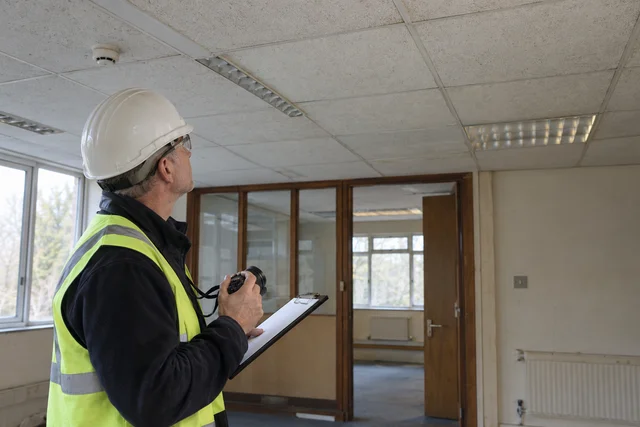
Photorealistic illustrative UK workplace scene. Review checks: FIND: The survey excludes the ceiling void. HOLD: Do not lift tiles or drill to investigate. RESOLVE: Arrange competent information and reassess the route.
Expect hidden material and uncertain appearance
Asbestos may remain in pre-2000 buildings and plant, including service areas, boards, coatings, insulation, cement products and flooring. It can be hidden above ceilings, behind panels or under later finishes. Refurbishment does not guarantee every older material was removed or recorded.
Appearance and colour names are not reliable identification at the workface. Products can be painted, mixed, aged or concealed; competent information and, where appropriate, sampling and analysis are needed. Do not take a sample yourself on the strength of this course. Condition and the planned disturbance matter as well as presence. An intact managed item in ordinary use is a different situation from drilling into a concealed board. Use the actual asset and task information rather than guess from a photograph or building appearance.
Applied case
The board above the ceiling is painted white. A colleague says that proves it is harmless because they remember a different colour associated with hazardous asbestos.
A new finish can hide old material
Paint or refurbishment can conceal a legacy product. Check records, scope and the actual workface rather than assume a modern-looking room contains only recent materials.
Test your decision
What is the correct response?
Break a corner to inspect the inside.
Do not identify asbestos by colour; hold disturbance and obtain suitable competent information.
Accept the colour comparison as analysis.
Compare the explanation
Do not identify asbestos by colour; hold disturbance and obtain suitable competent information.
Appearance cannot resolve the material or authorise sampling and disturbance.
Understand scope, exclusions and intrusive-work information.
Photorealistic illustrative UK workplace scene. Review checks: LOCATE: Identify the exact area and work depth. CHECK: Confirm survey scope and limitations. HOLD: Resolve unknown materials before disturbance.
Match the survey to the work
A management survey supports normal occupation and management within its scope. Intrusive refurbishment or demolition work can require a different, more intrusive survey matched to the intended work. The existence of a report does not establish that every concealed void or material was inspected.
Define where and how the job will disturb fabric, then check survey purpose, coverage, exclusions, assumptions and current conditions. The client or responsible owner needs competent advice where information does not cover the workface. A vague request for “an asbestos survey” can leave the important area unexamined. Do not ask ordinary workers to open the excluded area to resolve the uncertainty. Hold the affected work until suitable information and competent planning address it; a later survey date alone is not enough.
Applied case
The management report excludes the concealed ceiling void where the new cable must run. The supervisor proposes drilling because the front cover says the building has been surveyed.
Read the limitation
A survey can be useful and still not answer a particular job. Keep its findings within the inspected scope and obtain the missing information rather than dismiss or overextend the report.
Test your decision
What is the hold point?
The information does not cover the actual intrusive workface and needs competent resolution before disturbance.
Only whether the report is filed electronically.
Nothing if any survey exists.
Compare the explanation
The information does not cover the actual intrusive workface and needs competent resolution before disturbance.
Scope and exclusions determine what the report can support.
Identify competent planning and work-category boundaries.
Photorealistic illustrative UK workplace scene. Review checks: ELIMINATE: Redesign the work to avoid disturbance. SUBSTITUTE: Use asbestos-free materials after justified planned replacement. ENGINEERING: Use the specified containment and release controls. ADMINISTRATIVE: Confirm survey, category, competence and access. PPE / RPE: Use the specified, suitable and fitted protection.
Avoid disturbance before choosing PPE
First ask whether the task can avoid the material, for example through a different service route. Where work remains necessary, competent people must determine the material, work category, method and controls. A different tool or mask cannot turn an unknown panel into an approved job.
Licensed, notifiable non-licensed and other non-licensed work have different requirements that this course does not determine. Do not choose a category from the length of the task or a worker’s confidence. Suitable contractors, segregation, methods, waste and release arrangements follow the actual competent decision. Ordinary workers need to understand the scope they are permitted to undertake and when to stop. Awareness training is a preventive recognition layer, not permission to disturb asbestos-containing material using a generic dust plan.
Applied case
The team proposes a disposable mask and a slower drill speed instead of resolving the excluded void. Nobody has determined the material or appropriate work category.
Awareness has a hard boundary
Recognising suspect material and stopping is the expected awareness decision. Working on asbestos needs separate task-specific training, competence and controls; a course completion does not confer them.
Test your decision
What should come first?
Treat a mask as approval for drilling unknown material.
Choose a legal work category from the task’s short duration alone.
Avoid the disturbance where possible and obtain competent material and task planning before any necessary work.
Compare the explanation
Avoid the disturbance where possible and obtain competent material and task planning before any necessary work.
Identification and competent planning precede task-specific protective equipment.
Recognise the emergency reporting boundary without teaching cleanup.
Existing SHAREhub photographic illustration. The written fictional case supplies the condition and decision evidence.
Stop for unexpected material or disturbance
Unexpected suspect material, damaged known material or an apparent accidental disturbance needs the site asbestos response. Stop the affected work, avoid further disturbance and keep others from the affected area through the agreed arrangement. Inform the responsible supervisor or asbestos owner promptly with the location and what is known.
Do not sweep, use an ordinary vacuum, carry debris away or restart because the visible dust has settled. Competent asbestos specialists must determine the response, contamination controls and conditions for release. Follow their site-specific instructions rather than improvise decontamination from this course. Health or exposure concerns need appropriate occupational-health or medical advice; managers should not diagnose disease or promise there was no risk. Record the work facts and advice through suitable confidential routes.
Applied case
The drill damages the unidentified board. A worker offers to sweep the fragments into a general waste bag so the room can look clean before the building manager arrives.
Appearance does not release an area
A room looking tidy cannot establish contamination control after a suspect disturbance. The competent response and required release evidence govern access and restart.
Test your decision
What is the appropriate immediate boundary?
Treat settled dust as proof the area is released.
Stop further disturbance, protect others through the site response and obtain competent asbestos advice.
Sweep until no fragments are visible and restart.
Compare the explanation
Stop further disturbance, protect others through the site response and obtain competent asbestos advice.
Unplanned cleanup can spread fibres; specialist response and release remain necessary.
Connect management records, briefing and change review.
Photorealistic illustrative UK workplace scene. Review checks: FIND: The survey excludes the ceiling void. HOLD: Do not lift tiles or drill to investigate. RESOLVE: Arrange competent information and reassess the route.
Keep information useful for the next job
Asbestos information needs a responsible owner and a link to maintenance and project planning. Records should identify relevant location, condition, restrictions and actions, and reach the people who could disturb the material before work starts. An unread register does not protect a contractor at the ceiling.
Update the management information after relevant change, damage, survey findings or competent work. Keep uncertain and excluded areas visible rather than translate silence into “no asbestos”. Check that the task briefing and method use current information and defined stop triggers. The optional exercise compares a fictional cable route with a survey’s exclusions and plans questions for the responsible owner. It does not commission a real survey, classify asbestos work, authorise access, record exposure or qualify anyone to disturb, sample or remove material.
Applied case
The building manager receives new survey information but leaves the old contractor pack unchanged. The next installer is told that the absence of an entry for the void proves it is clear.
A blank is not a clearance
Missing or excluded information is uncertainty. The responsible owner must resolve it for the planned work rather than turn an empty register line into evidence of absence.
Test your decision
What should the handover establish?
Current task-relevant information, visible limitations and a competent resolution of uncertainty before disturbance.
Only that a register exists somewhere.
That every blank entry means asbestos is absent.
Compare the explanation
Current task-relevant information, visible limitations and a competent resolution of uncertainty before disturbance.
Information must reach the task and preserve its limits rather than create false clearance.

 View full detail ↗