Focused awareness learning based on SHAREhub pages. Apply the actual workplace arrangements and your role; completion is not practical competence or permission for specialist work.
This reader supplies the complete teaching. Use the interactive LMS course for assessed activities, saved progress and completion.
Explore an enlarged section of hair-bearing skin, with a hand and forearm for context. Layers, glands, nerves and vessels are enlarged for clarity.
Use the task in this lesson to identify contact, repeated wet work or contamination. Which change reduces contact before relying on gloves?
educational illustration · healthy anatomy; enlarged details and teaching colours.
Existing SHAREhub photographic illustration. The written fictional case supplies the condition and decision evidence.
Understand irritation and sensitisation
Skin is an active barrier. Repeated wet work, detergents, solvents and abrasion can damage it, leaving dryness, redness, itching or cracks. Irritant dermatitis involves direct damage to that barrier; allergic dermatitis involves sensitisation and an immune response. After sensitisation, small later exposures to the relevant allergen can trigger symptoms. Similar-looking symptoms do not allow a supervisor to diagnose which mechanism is involved or decide an individual treatment.
The workplace response begins with the contact route and early reporting. Ask which products, tasks, cleaning routines or glove conditions could cause or worsen the problem. Reduce contact and obtain appropriate occupational-health or medical advice where needed. Feeling that everyone has dry hands is not evidence that repeated exposure is acceptable or harmless.
Applied case
A worker reports red, itchy hands after repeated cleaning. A supervisor calls it ordinary sensitive skin and proposes leaving the task unchanged until the rash becomes severe.
Look beyond the label
Irritation and allergy are different mechanisms. Managers do not need to diagnose them before reducing harmful contact, listening to the worker and arranging the competent individual assessment.
Test your decision
What is the appropriate management response?
Wait for severe cracking before reviewing the task.
Diagnose allergy from appearance alone.
Act on the exposure and arrange appropriate advice without making a diagnosis.
Compare the explanation
Act on the exposure and arrange appropriate advice without making a diagnosis.
Early symptoms warrant contact-control review and the proper confidential advice route, not blame or an unsupported diagnosis.
Photorealistic illustrative UK workplace scene. Review checks: Contact-control failure: Repeated wet work, splashes, contaminated surfaces or an unsuitable/damaged glove leave skin exposed. Possible consequence: Irritant or allergic contact dermatitis may develop or worsen; concerning skin changes need appropriate professional assessment. Correct the exposure: Reduce contact through product/method and tools, verify glove compatibility and washing/drying arrangements, and provide confidential early reporting.
Find the whole contact pattern
A skin assessment must follow the complete working day. Repeated washing, handling diluted products, splashes, contaminated surfaces and prolonged glove wear can combine. A product that seems mild may still contribute to damage when contact is frequent. Gloves can trap sweat, and removing them for quick jobs can create unprotected contact. The relevant question is how the task brings material or wetness to the person, not just whether a container carries a warning symbol.
Observe actual handling, dosing, tools, cleaning, drying and glove changes with the workers. Include people who refill supplies, empty containers or clean equipment. Compare the observed routine with the planned method. Record uncertainty about the product or contact route rather than assuming that a short task or a diluted solution cannot affect skin.
Applied case
A cleaner uses diluted product repeatedly, washes between rooms and keeps damp gloves on for long periods. The assessment lists only occasional contact with the concentrated container.
Look beyond the label
Assess work as people really perform it. A brief individual contact can become substantial repeated exposure, while a tidy chemical store says little about wet hands during the shift.
Test your decision
What is missing from the assessment?
A conclusion that dilution eliminates every skin concern.
The repeated wet work and actual contact pattern across the shift.
Only the container purchase date.
Compare the explanation
The repeated wet work and actual contact pattern across the shift.
The exposure pattern includes frequency, wetness and glove conditions as well as the product in its original container.
Existing SHAREhub 2D teaching schematic. Use alongside the explanation and fictional case in this lesson.
Reduce contact before adding personal protection
Start by removing unnecessary hand contact. A suitable less harmful product or process may reduce the hazard, but it must still perform the required cleaning or disinfection function and avoid introducing other risks. Controlled dosing and long-handled tools can separate hands from the material. Good surfaces, methods and washing facilities support that physical control. Compatible gloves address remaining contact rather than make avoidable immersion acceptable.
Compare a proposed change with the actual task and verify it works in use. Writing that a safer product will be assessed is planning; a suitable replacement becomes substitution when it is actually adopted. Skin care and reporting support the controls but cannot cancel ongoing harmful contact. Ask who supplies, checks and maintains the chosen arrangement before treating a list of intentions as protection.
Applied case
The team proposes issuing more cream while continuing unnecessary hand contact with an unidentified cleaning product. Tools that would reduce contact are available but not included in the method.
Look beyond the label
Cream supports skin care; it is not a chemical-resistant glove or a replacement for contact reduction. Stronger controls must actually be implemented and checked during the task.
Test your decision
Which improvement should be prioritised?
Resolve product identity and reduce direct contact using suitable assessed methods.
Treat extra cream as complete protection.
Keep the product unknown because gloves are available.
Compare the explanation
Resolve product identity and reduce direct contact using suitable assessed methods.
Preventing contact and selecting suitable controls come before relying on skin-care products.
Photorealistic illustrative UK workplace scene. Review checks: Eliminate: Remove unnecessary hand contact with the cleaning product. Reduce: Assess a less harmful product against disinfection needs. Isolate: Use controlled dosing or long-handled tools and avoid splashes. Control: Keep surfaces clean and provide the method and washing facilities. PPE: Select compatible gloves for remaining contact.
Select and manage gloves for the actual task
No single glove protects against every product or activity. Selection should consider chemical compatibility, contact duration, splash or immersion, tear and puncture risks, dexterity and the wearer. Product information, manufacturer data and task observation support the choice. A glove accepted for one cleaning product cannot automatically be extended to a substitute. Gloves can also create other risks, including entanglement near rotating machinery or skin problems from prolonged sweating.
Define when gloves should be changed, how contamination is avoided during removal and where clean replacements are kept. Check condition and suitability in use, not only whether stock is issued. If the product or task changes, review the selection. Do not invent a universal safe wear time from glove colour or material name alone.
Applied case
A replacement cleaner arrives, and the store proposes the same glove because its colour matches the old one. No one has checked compatibility or the longer contact time.
Look beyond the label
An intact glove can still be chemically unsuitable. A compatible glove can also fail when contaminated, damaged or used outside its accepted conditions; check both selection and use.
Test your decision
What should determine glove acceptance?
The glove colour alone.
The fact that a glove was suitable for a different product.
Actual product and task compatibility with appropriate condition and change arrangements.
Compare the explanation
Actual product and task compatibility with appropriate condition and change arrangements.
Glove suitability is specific to the substance, contact and task; appearance does not demonstrate performance.
Report early and keep health information appropriate
Report early and keep health information appropriate.
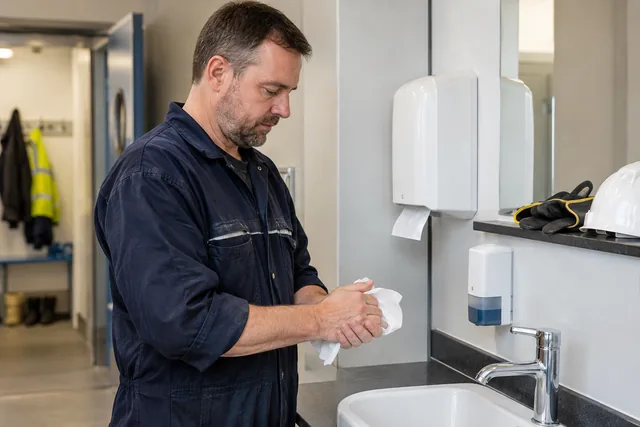
Existing SHAREhub photographic illustration. The written fictional case supplies the condition and decision evidence.
Report early and keep health information appropriate
Workers need to recognise dryness, itching, redness, cracking and other changes and know how to report them without blame. Where a risk-based health-surveillance scheme is required, the checks and follow-up should be agreed through competent arrangements. A trained responsible person may carry out an agreed non-diagnostic check; a positive finding needs the proper referral and task-control review. A manager should not diagnose from a photograph or circulate medical details to the whole team.
Management needs work-focused information: what exposure controls, restrictions, referral or follow-up are required. Clinical records belong in the confidential health process. Look for patterns across exposed workers while protecting individuals. A blank complaint log is weak reassurance if people do not know the route or fear that reporting will lead to blame.
Applied case
A worker shares a symptom photograph privately. The supervisor proposes adding it to the general team checklist and choosing a diagnosis before contacting occupational health.
Look beyond the label
Surveillance and reporting help identify early harm and trigger action. They do not remove the source, and confidential clinical detail should not become ordinary inspection evidence for general circulation.
Test your decision
What is the appropriate approach?
Delay contact-control review until the supervisor has diagnosed it.
Use the confidential reporting and advice route while reviewing the work exposure.
Publish the photograph to prove the concern is real.
Compare the explanation
Use the confidential reporting and advice route while reviewing the work exposure.
Useful work decisions can be made without sharing unnecessary clinical detail or making an unqualified diagnosis.
Stop the contact and verify the changed arrangement
Stop the contact and verify the changed arrangement.
Photorealistic illustrative UK workplace scene. Review checks: Setting: A cleaner repeatedly handles diluted detergent and disinfectant and washes hands many times per shift. Act: The manager checks product identity, reduces wet work, selects a less harmful product where suitable, provides dosing and long-handled tools, and verifies glove compatibility. Hold / review: Stop contact with an unknown product, failed dosing or unsuitable glove; report persistent redness, itching or cracks promptly.
Stop the contact and verify the changed arrangement
Escalate when product identity, dosing or glove suitability is uncertain, when contact is uncontrolled or when symptoms appear. Stop the affected contact and use the agreed reporting route. Serious acute reactions require emergency arrangements rather than waiting for a routine appointment. An awareness lesson does not provide a diagnosis, a treatment prescription or permission to continue through pain. The supervisor must connect the individual concern with the task that may be causing or worsening it.
Return follows a verified change to the exposure controls and any work-focused advice or restrictions. Check product information, tools, dosing, glove selection, washing and drying facilities, and worker understanding. Review others exposed to the same conditions. A referral booking or delivery of new gloves alone does not establish that the revised method works during the actual cleaning cycle.
Applied case
Dosing has failed and workers have contacted an uncertain mixture. New gloves are ordered, but the failed dosing and work method remain unchanged for the next cleaning shift.
Look beyond the label
Follow an issue through to the workface. A corrective action closes when the relevant contact control and advice are implemented and checked, not simply when an order or referral is raised.
Test your decision
What should support return to the affected task?
Resolved contact controls, suitable equipment and verified implementation with relevant advice.
The order confirmation for gloves alone.
A promise that workers will ignore irritation until the shift ends.
Compare the explanation
Resolved contact controls, suitable equipment and verified implementation with relevant advice.
The source and actual method need resolution; ordering equipment is not verification that exposure is controlled.

 View full detail ↗