Focused awareness learning based on SHAREhub pages. Apply the actual workplace arrangements and your role; completion is not practical competence or permission for specialist work.
This reader supplies the complete teaching. Use the interactive LMS course for assessed activities, saved progress and completion.
LESSON 1
Justify the choice rather than the convenience
Justify the choice rather than the convenience.
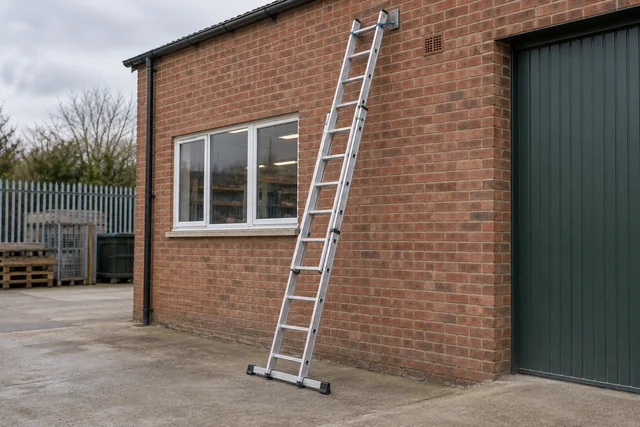
Existing SHAREhub photographic illustration. The written fictional case supplies the condition and decision evidence.
Justify the choice rather than the convenience
Ladders are not banned, but they are not automatically the first choice. The task assessment must show that the proposed use is appropriate when equipment offering more protection is considered. Low risk, brief light work or unalterable workplace features may support the choice. Duration alone cannot make an awkward, forceful or unstable job safe. Repeated work, heavy materials, traffic and poor ground can change the answer even when the component is within reach.
First consider avoiding height work and then suitable equipment that prevents falls. A ladder has no collective fall protection at the working position. Explain why this equipment is suitable for this location, task and user today. Owning one or expecting the job to be quick does not answer those questions.
Applied case
A supervisor chooses the nearest ladder for a short task requiring substantial force and awkward materials. The only recorded justification is that it will not take very long.
Look beyond the label
A brief task can still be unsuitable for a ladder. The decision needs the work, location, force, materials and protection considered together rather than a timer used as permission.
Test your decision
What should determine the access choice?
The fact that a ladder is already owned.
The worker ability to reach the component.
The complete task risk and suitable alternatives, not time alone.
Compare the explanation
The complete task risk and suitable alternatives, not time alone.
Reach and short duration do not establish a stable, suitable working position for the actual demands.
Photorealistic illustrative UK workplace scene. Review checks: Exposure route 1: Leaning ladder slips at feet or support; worker falls to a hard floor or structure. Exposure route 2: Stepladder tips during side reach or forceful work; worker falls sideways. Tool or material falls from ladder onto someone below.: Impact injury, including head injury.
Check condition before relying on the ladder
Users check for damaged stiles, feet, rungs, treads, locks, hinges and platforms as relevant to the design. Contamination, bent parts or uncertain engagement can defeat stability. Follow the manufacturer information, especially for extension or telescopic mechanisms. A current inspection label cannot override a visible defect. A pre-use check is different from the employer arrangements for competent detailed inspections, and neither justifies an improvised structural repair.
Check again after an event or change that may affect safety, such as a drop, impact, transport or new surface. Keep defective or uncertain equipment out of use and report it so another person does not pick it up. Before each ascent, confirm that the selected task, location and securing still match the assessment, not only that the ladder itself looks familiar.
Applied case
A ladder has a current inspection label but one foot is damaged after transport. The user suggests climbing carefully and reporting the damage at the end of the job.
Look beyond the label
A label is historic information, while damage is current evidence. Defect control must prevent the next user inheriting the same unsafe equipment, not merely record the problem later.
Test your decision
What is the appropriate response?
Repair the foot informally with available packing.
Keep it out of use and report the defect before climbing.
Use the label to override the damaged foot.
Compare the explanation
Keep it out of use and report the defect before climbing.
Present condition governs the user decision; a previous inspection does not remove a new defect.
Existing SHAREhub 2D teaching schematic. Use alongside the explanation and fictional case in this lesson.
Verify the support, securing and access route
A leaning ladder needs firm, level ground, a suitable strong support and effective protection against outward or sideways slip. Set it using its instructions and the applicable task guidance. Glazing or weak gutters are not reliable supports. Check the route and people or vehicles that could strike the setup. A ladder used to access another level also needs suitable securing and a safe landing transition; being long enough to reach is not the whole requirement.
Do not improvise stability from a convenient object or assume a colleague footing the ladder repairs poor ground. The assessed securing arrangement must actually work at this location. If the intended support, access or securing cannot be provided, hold the task and choose a suitable method through the responsible supervisor rather than experimenting while someone climbs.
Applied case
A ladder reaches the landing but rests on a weak gutter and cannot be secured as planned. A colleague offers to hold it while the worker tests the route.
Look beyond the label
Length answers only whether equipment reaches. Support, slip prevention, landing and surrounding movement determine whether that access arrangement can be used safely for the planned task.
Test your decision
What is the appropriate decision?
Hold the task until suitable support, securing and access are established.
Treat reaching the landing as complete acceptance.
Use the colleague as a substitute for every setup requirement.
Compare the explanation
Hold the task until suitable support, securing and access are established.
The actual support and stability must be suitable before a person relies on the route.
Photorealistic illustrative UK workplace scene. Review checks: Eliminate: Read the sign or clean the high point from ground level with a suitable tool, or lower a removable item for service; this removes the climb. Reduce: For repeated overhead maintenance, choose a guarded platform, tower or MEWP instead of a leaning ladder where space, ground and rescue arrangements permit. Isolate: Physically separate the access footprint from pedestrians and vehicles with a stable barrier, while retaining fire egress; a sign alone is not a barrier. Control: Where a ladder is justified for a low-risk short task, use firm level ground, sound feet and locks, and effective tying or stabilisation; sequence tools to preserve grip and avoid overreach. PPE: Wear task-suitable footwear and assessed head protection for residual impacts; a harness is not a generic substitute for ladder stability or a complete rescue plan.
Use the design without stretching its limits
A stepladder needs all feet on firm, level ground and its opening and locking mechanisms fully engaged. Use the intended working positions and handholds from its design and instructions. Work within the sides, avoid destabilising force and reposition rather than stretch. An ordinary stepladder is not a route for stepping onto another level. A platform model does not make every standing position or two-handed task acceptable.
Climbing and work need suitable contact and stability. Carry only appropriate light items in a way that preserves safe movement. If the task requires sustained force, extended two-handed work or awkward materials, reassess the access choice. Do not move, extend or modify equipment while standing on it. The real working method, not the equipment name, has to remain within its assessed use.
Applied case
A worker fully opens the stepladder but then reaches sideways to pull a seized fitting with both hands. The setup checklist was completed before the fitting condition became clear.
Look beyond the label
Condition, setup and use are separate questions. An undamaged, locked stepladder can still be the wrong place for a task that requires force, overreaching or prolonged unsupported work.
Test your decision
What should happen?
Continue because the opening locks were checked.
Ask a colleague to hand up a longer lever.
Stop and reassess the position and task rather than apply destabilising force.
Compare the explanation
Stop and reassess the position and task rather than apply destabilising force.
A sound setup does not make an unsuitable forceful task safe from that working position.
Existing SHAREhub photographic illustration. The written fictional case supplies the condition and decision evidence.
Consider the surrounding hazards
Look beyond the ladder to electrical services, traffic, doors, fragile surfaces and people below. A metal ladder, a carried tool or long material can contact live equipment or create an electrical danger. Choosing non-conductive material alone does not control that risk. Identify the hazard and use the competent electrical planning and isolation arrangements where relevant; do not guess a clearance or test a line by approaching it.
Protect the setup from doors and vehicle routes and control the falling-object path. Wind, wet or dirty surfaces and changes in lighting can affect the accepted conditions. Stop when the actual arrangement no longer matches the plan. Familiar premises and a short task do not justify assuming the electrical condition, traffic separation or support remains safe without verification.
Applied case
A proposed ladder route passes near electrical equipment whose status is uncertain, beside an active delivery door. The team suggests using a different ladder material and proceeding without coordination.
Look beyond the label
The environment can defeat otherwise sound equipment. A ladder check must connect to the task location, electrical boundary and movement controls rather than end at the ladder itself.
Test your decision
What needs resolution?
Only whether the worker has climbed there before.
The actual electrical and movement hazards through suitable competent arrangements.
Only a change to a non-conductive ladder without resolving the work boundary.
Compare the explanation
The actual electrical and movement hazards through suitable competent arrangements.
Material choice cannot replace control of live systems or people and vehicles striking the setup.
Photorealistic illustrative UK workplace scene. Review checks: Setting: a competent facilities worker must read the fixing label on a high internal sign and make a light adjustment, then hand the aisle back for normal use. Act: isolate or segregate the aisle without blocking a fire exit. Hold / review: if the fixing is seized, the worker must reach sideways, the floor becomes wet, a vehicle is diverted nearby or a foot or lock moves, descend and stop.
End the old scope when the job changes
An inspection can become a repair when a fixing is seized or a component needs removal. That change can add force, time, materials and falling-object exposure. Do not try one pull from the ladder to discover whether it works. Pause the extension and ask whether the work can be done from ground level or from a suitable protected position. Alternative equipment must also suit the ground, space, traffic and emergency arrangements.
Restart follows a revised accepted method and verified controls. Remove defective equipment from circulation, arrange competent inspections as required and communicate restrictions at handover. After an incident, use the site emergency and first-aid arrangements without creating another fall or electrical exposure. A course completion does not authorise a user to repair access equipment or approve a specialist rescue.
Applied case
The sign inspection confirms that two-handed removal is needed. Deliveries are due through the setup area, but the contractor proposes a quick trial before changing the agreed inspection method.
Look beyond the label
A change is a decision point before exposure, not after a failed attempt. Verify the revised method and interfaces, then communicate its limits to everyone affected by the work.
Test your decision
What should the supervisor require?
Reassessment and a suitable accepted method before the expanded repair.
A trial pull to decide whether reassessment is needed.
The original inspection permission as authority for removal.
Compare the explanation
Reassessment and a suitable accepted method before the expanded repair.
The changed demands end the assumption that the original inspection method remains suitable.