Focused awareness learning based on SHAREhub pages. Apply the actual workplace arrangements and your role; completion is not practical competence or permission for specialist work.
This reader supplies the complete teaching. Use the interactive LMS course for assessed activities, saved progress and completion.
LESSON 1
Start with how equipment can harm
Start with how equipment can harm.
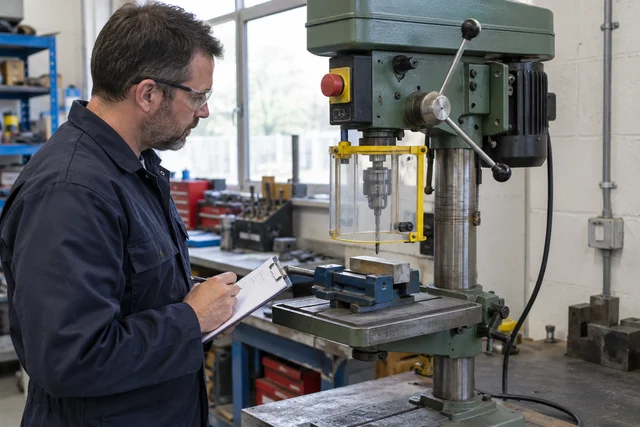
Existing SHAREhub photographic illustration. The written fictional case supplies the condition and decision evidence.
Start with how equipment can harm
Work equipment can cut, crush, draw in, entangle, eject material or release electrical, pressure or thermal energy. Noise, vibration, dust and fumes can also cause harm. The relevant question is how the actual task brings a person into that pathway, including setup, cleaning, adjustment and maintenance. An operator may be safe during normal running but exposed during a frequent jam. A general equipment label does not describe all those situations.
Identify the machine, material, users, environment and foreseeable interventions before choosing controls. Include cleaners, maintainers, contractors and people nearby. Compare what happens at the workface with the instructions. Repeated workarounds or difficult access are evidence that the equipment or method may not suit the job; they should inform the design and control review.
Applied case
A machine has no injury history during normal running, but operators regularly reach towards the feed path to clear material. The assessment considers only the steady production cycle.
Look beyond the label
A machine assessment must include the awkward jobs people really do. Repeated access for a jam is foreseeable work, not an exceptional event that can be omitted from the review.
Test your decision
Which part of the assessment needs attention?
A conclusion that no injury history proves safety.
The foreseeable intervention and its access to dangerous parts.
Only the production output figures.
Compare the explanation
The foreseeable intervention and its access to dangerous parts.
Risk follows the actual task, including interventions, rather than only the normal operating cycle.
Photorealistic illustrative UK workplace scene. Review checks: Source / exposure: Common failures involve unsuitable equipment, missing guarding, weak isolation, poor maintenance and weak defect control. Possible consequence: PUWER failures often become visible only after an incident, but the signals are usually present earlier: guards removed for cleaning, nuisance trips bypassed, damaged leads, uncontrolled hired equipment, repeated jams, missing manuals, untrained users or maintenance overdue. Control failure: The strongest PUWER systems treat defects and modifications as management-of-change issues, not just maintenance tasks.
Check suitability before and after purchase
Suitable equipment must fit its intended use, environment and people, including the tasks needed to keep it working. A conformity mark, supplier statement or low purchase price does not establish that a used or new machine is suitable for this operation. Consider material, capacity, stability, access, controls, safeguards, instructions and the actual cleaning and maintenance method. Hired or contractor equipment needs the same attention to its use and interfaces.
Check the physical machine against the accepted information before release. A change of product, layout or duty can invalidate earlier assumptions. Ask who controls modifications and how competent acceptance is recorded. Better purchasing can remove foreseeable dangerous interventions; accepting awkward access and then relying on warnings can build an avoidable failure into the daily work.
Applied case
A used machine carries a supplier mark and starts correctly, but its instructions do not cover the proposed material or the cleaning access needed after each production run.
Look beyond the label
Buying equipment is a chance to remove harm at source. The accepted duty must include cleaning and foreseeable maintenance, not just a demonstration that the machine produces an item.
Test your decision
What should govern acceptance?
Suitability for the actual use, safeguards and intervention needs.
The supplier mark as complete workplace approval.
Only the fact that the motor starts.
Compare the explanation
Suitability for the actual use, safeguards and intervention needs.
Product information contributes to the decision but cannot replace the task-specific suitability assessment.
Remove dangerous intervention before relying on behaviour
Remove dangerous intervention before relying on behaviour.
Existing SHAREhub 2D teaching schematic. Use alongside the explanation and fictional case in this lesson.
Remove dangerous intervention before relying on behaviour
Look for ways to eliminate the need to reach dangerous parts, such as correcting recurring jams or redesigning feed and cleaning access. Then use suitable physical safeguards and safe controls. Information, training and supervision support those measures, but they cannot make an exposed blade or nip point acceptable when effective guarding is practicable. PPE also cannot prevent every mechanical injury and may introduce other risks around moving parts.
The safeguarding decision must fit the machine and real access needs. A convenient long tool is not automatically equivalent to enclosing a dangerous part. Competent engineering review is needed for safety-function changes. If nuisance trips or bypasses occur, investigate the design and work pressures rather than simply issuing another warning while the hazardous route remains available.
Applied case
The machine jams daily, and workers use a longer tool while it runs. Management proposes extra warning signs instead of reviewing the jam cause and practical guarding arrangements.
Look beyond the label
A workaround can make a weak system look productive. Ask why dangerous access is needed and whether design or suitable guarding can remove that need before adding more instructions.
Test your decision
Which improvement addresses the stronger control opportunity?
Rely only on a larger warning sign.
Treat a long tool as automatic permission to work near motion.
Review the recurring jam and engineering prevention of dangerous access.
Compare the explanation
Review the recurring jam and engineering prevention of dangerous access.
The source of the intervention and feasible physical protection need review before relying on individual care.
Photorealistic illustrative UK workplace scene. Review checks: Is it suitable?: Task, material, speed, user, environment and compatibility. Can dangerous parts be reached?: Fixed guards, interlocks, distance guards, jigs and safe systems. Can it be stopped safely?: Stop controls, emergency stops and control reliability. Can it be isolated?: All energy sources including stored energy. Could it deteriorate dangerously?: Inspection and maintenance schedule.
Act on safeguards and condition defects
Missing guards, unreliable interlocks, damaged leads, repeated trips and overdue safety work are warning signs. A machine that still produces output may have lost an essential protective function. Users should know the checks relevant to their equipment and how to stop and report a concern. A sticker or an entry in a maintenance queue does not override a current safety defect. Repeated resets can hide the condition instead of resolving it.
Keep the affected equipment out of use where the required safeguard is ineffective, and prevent others inheriting the same defect. Record the machine identity, observation, immediate restriction and responsible action. Competent people assess and repair the function under the appropriate safe system. Do not defeat a device, reach into the danger or improvise a repair to demonstrate the fault.
Applied case
An interlock is unreliable and operators reset it repeatedly to keep production moving. A maintenance request exists, so the supervisor considers the reporting duty complete and proposes continued use.
Look beyond the label
A defect log is useful only when it changes the equipment status and leads to verified repair. Production output and a queued work order cannot establish that protection is available.
Test your decision
What remains necessary?
Bypass the interlock until maintenance arrives.
Control the unsafe use and obtain competent defect resolution.
Use the request number as proof the safeguard works.
Compare the explanation
Control the unsafe use and obtain competent defect resolution.
Reporting creates an action; it does not restore the protective function or justify unsafe operation.
Existing SHAREhub photographic illustration. The written fictional case supplies the condition and decision evidence.
Plan cleaning and jam response as real work
Cleaning and clearing blockages can expose people to dangerous movement and stored energy. The work needs a defined method, competent roles and the appropriate isolation and verification for every relevant source. A stopped motor does not prove that a conveyor, pressure system, suspended part or linked machine cannot move. An interlock or emergency stop is not automatically a maintenance isolation. Awareness training cannot supply a generic sequence for all equipment.
Use the actual machine information and authorised intervention arrangements. Keep people clear while the uncertainty is resolved; do not reach into a jam to find its cause or ask a colleague to watch the controls. If unexpected energy, material or linked operation appears, withdraw and revise the plan. Effective equipment design should make the required safe intervention usable in practice.
Applied case
A blocked machine is stopped at its control button. A cleaner plans to reach inside while a linked conveyor remains outside the intervention plan and stored movement has not been assessed.
Look beyond the label
Normal stop controls and verified isolation answer different questions. The intervention plan must prevent the actual harm pathway for everyone exposed, including linked equipment and stored energy.
Test your decision
What must happen before intrusive work?
Resolve and verify the complete safe intervention boundary through authorised arrangements.
Assume the control button isolates every source.
Ask another worker to watch for movement instead.
Compare the explanation
Resolve and verify the complete safe intervention boundary through authorised arrangements.
The point of work and all relevant energy or material paths must be covered, not just one stopped drive.
Photorealistic illustrative UK workplace scene. Review checks: Setting: A small manufacturer buys a used conveyor-fed trimming machine; frequent jams and awkward guard removal lead to clearing while the conveyor runs. Act: Stop exposed operation, preserve the fault and interlock history, assess cleaning and blockage tasks and specify a safe intervention method. Hold / review: Do not restart while an unreliable interlock, exposed dangerous part or uncontrolled energy remains; quarantine and label the machine.
Verify repair, competence and handback
Useful evidence connects the equipment and task to suitability, safeguards, inspection, maintenance and user understanding. The physical machine must match the record. A competent repair should address the specified protective function, with relevant testing and acceptance before reuse. Inspection arrangements depend on the equipment and circumstances; a generic annual certificate is not a substitute for the requirements that actually apply. Users still need current checks and a defect route.
Handback should account for people, tools, refitted guards and restored protective arrangements, with any changed method communicated to the owner and users. Demonstrate understanding of the actual work rather than counting attendance alone. Keep restrictions open where verification is missing. A signed work order or paid invoice cannot establish that the machine is ready for the task.
Applied case
A safeguard repair is marked complete, but the required functional check and revised cleaning instruction are outstanding. The production team asks to restart because the engineer has left the area.
Look beyond the label
Follow evidence to the working machine. A repair closes the defect only when the required function and actual task arrangements are verified and the responsible person accepts the handback.
Test your decision
What supports release?
The completed work-order label alone.
The absence of the engineer as proof of acceptance.
Verified protective function and an accepted usable method communicated to the team.
Compare the explanation
Verified protective function and an accepted usable method communicated to the team.
Handback requires the relevant restored function and safe-use arrangements, not merely administrative completion.