Focused awareness learning based on SHAREhub pages. Apply the actual workplace arrangements and your role; completion is not practical competence or permission for specialist work.
This reader supplies the complete teaching. Use the interactive LMS course for assessed activities, saved progress and completion.
LESSON 1
Distinguish the control functions
Distinguish the control functions.
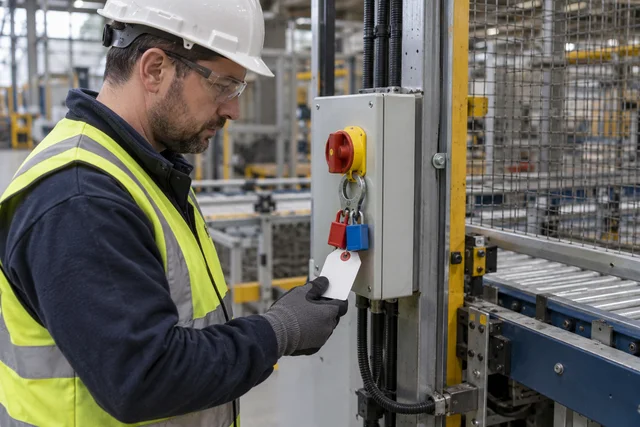
Existing SHAREhub photographic illustration. The written fictional case supplies the condition and decision evidence.
Distinguish the control functions
Isolation separates the work from relevant energy or material sources. Lockout prevents unauthorised reversal of the isolation; a tag communicates status. A stopped machine or a closed control command may leave pressure, electrical supply, gravity or another feed available. These controls have different functions and cannot be substituted simply because the equipment appears quiet. The worker needs protection at the actual point of work, not a reassuring action performed elsewhere.
Ask what could move, energise, flow, heat or release during the task. Identify who plans, applies, verifies and accepts the boundary through the authorised system. A lock on the wrong item does not protect the worker, and a correct label does not prove that every source is controlled. Keep the distinction between an applied control and verified effective protection clear.
Applied case
A pump is stopped and a tag hangs from a nearby switch. The team assumes this proves a connected pipe is safe to open, although the isolation boundary is unconfirmed.
Look beyond the label
A lock prevents a particular action; it cannot correct a wrong boundary. Verification must connect the applied controls to the real work point and the hazards that could reach it.
Test your decision
What is missing?
Only a larger tag.
A conclusion that absence of pump noise proves an empty line.
Verified protection of the actual work point from all relevant sources.
Compare the explanation
Verified protection of the actual work point from all relevant sources.
Stop status and communication do not establish an effective complete isolation at the work point.
Photorealistic illustrative UK workplace scene. Review checks: Source / exposure: Common failures are usually predictable and should be designed out or caught by assurance. Possible consequence: Wrong line identity, passing valves, back-feed, blocked drains and incomplete handback can each defeat a signed plan. Control failure: Treat these as testable failure modes with named checks, not as reminders to be careful.
Include stored energy and connected feeds
Relevant sources may include electricity, hydraulic or pneumatic pressure, gravity, spring force, heat, moving parts and process contents. Energy can remain after a supply is stopped. Linked equipment, temporary hoses, bypasses or return lines can create another route into the work. A drawing or remembered arrangement may not reflect a modification. Looking at the main drive alone can miss the source that eventually harms the worker.
Planning must account for the actual plant and the proposed intervention, including stored loads and residual material. Competent people determine the suitable isolation method and verification. Users should report unexpected connections or uncertainty before intrusive work. Do not loosen a fitting, approach a suspended part or start an unreviewed trial to discover whether the energy is present; the safe method must establish that without exposing a person.
Applied case
The main electrical supply is addressed, but a raised component and pressure source remain outside the plan. The team says the task is electrical, so mechanical energy does not matter.
Look beyond the label
Use the harm route rather than the job label. A maintenance task can expose electrical, pressure and gravity hazards together, so a single-source plan may leave the worker unprotected.
Test your decision
What should the planning boundary include?
Only parts that are moving at this moment.
Every relevant energy and material source for the actual intervention.
Only the energy named in the job title.
Compare the explanation
Every relevant energy and material source for the actual intervention.
Stored and connected hazards can remain when visible movement or the main supply has stopped.
Existing SHAREhub 2D teaching schematic. Use alongside the explanation and fictional case in this lesson.
Establish the exact scope and physical boundary
Plan the job before authorisation. Define the work point, equipment identity, contents, connections, isolation boundary, competent roles and the evidence needed to accept the safe state. Current drawings and records are inputs, but the actual plant must match them. Temporary connections, old labels and undocumented changes are reasons for field verification through the competent system. A familiar line colour or inherited instruction is not enough to resolve a mismatch.
Consider other teams and simultaneous work that could change the plant state. Define how work is suspended, handed over and reaccepted. If the boundary or contents remain uncertain, hold the intrusive job rather than letting production pressure reduce the control. The plan should give workers a usable stop route and identify who can resolve a discrepancy before anyone opens containment.
Applied case
The drawing identifies one valve, but the field tag and temporary return hose suggest a different boundary. A permit is prepared using the old drawing without resolving the discrepancy.
Look beyond the label
Two records can agree and still describe the wrong plant. The accepted scope must be tied to the actual equipment and connections through the appropriate competent verification.
Test your decision
What is the appropriate planning decision?
Hold the intrusive task until identity and boundary are reconciled and accepted.
Choose whichever label is easier to read.
Treat the prepared permit as proof the drawing is correct.
Compare the explanation
Hold the intrusive task until identity and boundary are reconciled and accepted.
Authorisation cannot create missing physical identity or boundary evidence.
Photorealistic illustrative UK workplace scene. Review checks: Elimination: Use a suitable external diagnostic or redesigned sampling arrangement if it removes the intrusive valve task. Engineering controls: Use an approved closed sampling system or safely removable module to reduce open access. Engineering controls: Isolate connected feeds and energy sources, remove hazardous contents and verify the defined safe state before breaking containment. Engineering controls: Provide suitable drainage, containment, local extraction and support for the valve and connected pipework. Administrative controls: Agree the permit, contamination checks, line identification and hand-back with operations and contractors.
Require proof appropriate to the work point
Applying an isolation is not the same as demonstrating its effectiveness. Verification needs to establish the required safe condition for the actual work and relevant hazards. The competent plan selects the evidence and acceptance criteria. A locked but wrongly identified isolator, a passing valve, blocked drain or unrecognised feed can defeat a signed record. A single zero indication cannot be promoted into proof that every pressure or material path is safe.
This awareness course does not supply electrical tests, valve operations or a generic process-isolation arrangement. Ask whether the specified proof covers the right boundary, every relevant source and a safe destination for removed contents. Where evidence is missing or inconsistent, retain the work hold and obtain competent resolution. Do not use an initial opening as the test of whether the plan worked.
Applied case
A signed isolation record is offered, but the required proof at the identified work point is absent. The team proposes slightly opening the line to see whether anything remains.
Look beyond the label
Proof belongs before a person is exposed. The right method and acceptance criteria depend on the actual system; an awareness example cannot establish them for an unknown line or energy source.
Test your decision
What should happen?
Use the first opening as the proof.
Accept the signature as equivalent to every specified result.
Retain the intrusive-work hold and obtain the required competent verification.
Compare the explanation
Retain the intrusive-work hold and obtain the required competent verification.
The verification must precede exposure; a signature or trial release cannot replace it.
Existing SHAREhub photographic illustration. The written fictional case supplies the condition and decision evidence.
Treat opening containment as a critical boundary
Opening containment can release pressure, vapour, liquid, solids, hot material, toxic residue or a flammable atmosphere. A small retained quantity may still cause serious harm. The safe system must address the actual contents, residual condition, worker position, containment and other exposures before opening. PPE supports the assessed controls but cannot establish that the line is empty, isolated or safe. The method needs competent task-specific planning and authorisation.
If unexpected pressure, material, odour or another feed appears, stop and withdraw through the planned safe response, keep others clear and report the changed condition. Do not continue loosening, add a corrective substance or improvise a drain route. Reassessment must resolve why the accepted condition differs from reality before further work is authorised. Emergency action follows the site arrangements from a safe position.
Applied case
An unexpected residue appears during an authorised task and the team is unsure of its identity. A worker proposes continuing slowly because the planned quantity was described as small.
Look beyond the label
Residual quantity alone does not define harm. Pressure, temperature and hazardous properties matter, so unexpected material is a stop signal even when a job was previously authorised.
Test your decision
What should guide the response?
Identify the residue by touching or smelling it closely.
Stop and use the planned safe withdrawal and competent reassessment route.
Continue because a small quantity cannot injure.
Compare the explanation
Stop and use the planned safe withdrawal and competent reassessment route.
Unexpected contents invalidate assumptions and require the planned protective response, not further exposure as a trial.
Photorealistic illustrative UK workplace scene. Review checks: Setting: Maintenance must remove a pump spool in a fuel terminal. Act: Establish and prove initial isolation; then safely depressurise, drain and purge the section. Hold / review: Stop if pressure returns, the line identity is uncertain, isolation leaks, the drain path is blocked or the adjacent team changes the system.
Control pauses, people and return to service
Shift changes, pauses and multiple teams can weaken control if the plant state is assumed rather than communicated. Handover should identify what is isolated, open or incomplete, which restrictions apply and what must not be operated. The authorised system needs to protect everyone still exposed and control changes to locks and boundaries. A colleague finishing their part does not mean another person work is complete.
Handback is more than removing locks. Relevant checks can include people and tools clear, containment restored, guards and protective functions reinstated, required tests accepted and remaining restrictions understood. Actual plant requirements determine the details. The responsible authorised roles decide release using that evidence. Keep unresolved points visible to the incoming team; a completed maintenance entry does not itself establish readiness for service.
Applied case
The outgoing team reports its repair complete while another team remains on a connected section. The incoming operator is told to remove the restriction because the main job number is closed.
Look beyond the label
A handover preserves the actual safety state across people and time. Administrative closure must not remove a restriction while another team, open system or required protective check remains unresolved.
Test your decision
What should determine release?
The current complete work and plant state, including every affected team and required verification.
The closed main job number alone.
The outgoing team finish time as permission for everyone.
Compare the explanation
The current complete work and plant state, including every affected team and required verification.
Isolation and handback protect all people in the boundary, not only the first team to finish.