Focused awareness learning based on SHAREhub pages. Apply the actual workplace arrangements and your role; completion is not practical competence or permission for specialist work.
This reader supplies the complete teaching. Use the interactive LMS course for assessed activities, saved progress and completion.
LESSON 1
Recognise the space and the serious risk
Recognise the space and the serious risk.
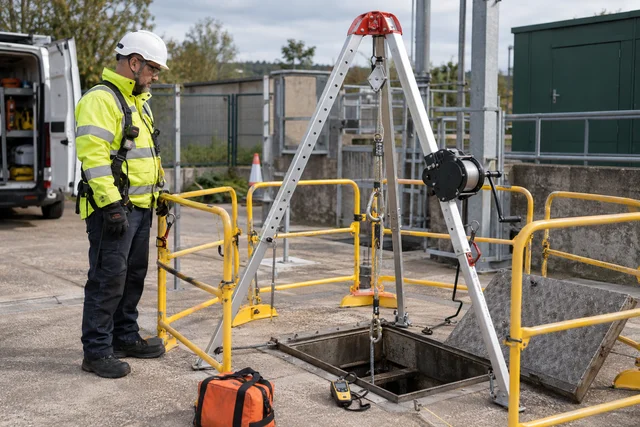
Existing SHAREhub photographic illustration. The written fictional case supplies the condition and decision evidence.
Recognise the space and the serious risk
A confined space is substantially enclosed and has one or more specified serious risks arising from the place, contents, atmosphere or work. It need not be tiny, fully sealed or difficult to enter. Serious risks can include fire or explosion, dangerous heat, harmful atmosphere or oxygen deficiency, rising liquid and engulfment by free-flowing solids. Difficult access is an important planning issue but is not, alone, the definition.
Tanks, chambers, pits, ducts and other familiar work locations may need assessment. A large entrance or previous safe visit cannot settle present conditions. Ask what could change through the contents, connected plant or intended task. Do not enter to decide whether the space is hazardous. Keep people out while the responsible competent assessment resolves the actual risk and applicable arrangements.
Applied case
A large chamber has a wide opening and has been entered before. The team assumes it cannot be confined because access is easy, although a harmful atmosphere could develop inside.
Look beyond the label
Easy access can make a hazardous space feel ordinary. The serious risk can come from the contents, atmosphere or work, so familiarity and opening size cannot establish safe entry.
Test your decision
What should determine the assessment?
The enclosure and credible serious risks, not entrance size alone.
Only whether a person can stand upright.
Only the history of earlier visits.
Compare the explanation
The enclosure and credible serious risks, not entrance size alone.
Confined-space recognition depends on the risk and substantial enclosure, not a small-opening rule.
Photorealistic illustrative UK workplace scene. Review checks: Atmosphere: Low oxygen or toxic gas can cause collapse or asphyxiation. Contents: Incoming liquid or free-flowing solids can drown or engulf a person. Work changes: Cleaning, hot work or chemicals can create a new serious risk.
Consider more than a single gas reading
Atmospheric hazards may be invisible. Oxygen can be depleted or displaced; toxic gases or vapours can accumulate; flammable material can create fire or explosion conditions. The task itself may introduce a hazard. Physical dangers also include machinery, incoming liquid, moving solids, heat, poor communication and difficult movement. A gas detector does not prevent flooding, stop an agitator or provide a usable rescue route.
The competent assessment must cover the complete task and changing conditions. No smell, no visible mist and a familiar appearance are not proof of safety. A result from unsuitable equipment, a wrong location or an irrelevant time can create false reassurance. An awareness learner must not select alarm limits, sampling positions or breathing equipment from memory; the authorised system defines the proper competent method.
Applied case
A team has an earlier gas result but no assessment of a connected liquid feed or moving equipment. They describe the reading as a complete safety certificate for the chamber.
Look beyond the label
A measurement answers a defined question at a time and place. A safe system must also address connected energy, contents, changing work and rescue rather than rely on one reassuring number.
Test your decision
What remains unresolved?
Nothing because one reading controls every hazard.
Only a repeat of the earlier atmosphere result without addressing feeds.
The other serious risks and whether current conditions and controls are established.
Compare the explanation
The other serious risks and whether current conditions and controls are established.
Atmospheric evidence has a scope and does not control physical or incoming-material hazards.
Existing SHAREhub 2D teaching schematic. Use alongside the explanation and fictional case in this lesson.
Test a suitable no-entry option first
First ask whether the objective can be achieved without putting a person into the space. Remote inspection, external sampling or suitable cleaning access may remove the entry exposure. The alternative must itself be assessed: equipment used from outside can create pressure, chemical release or public-exposure hazards. Avoidance is not achieved simply by moving the operator a short distance while leaving another person exposed to the same entry risk.
For the drainage case, a competent review can consider inspection and clearance from outside. If entry remains necessary, establish why a practicable no-entry method cannot achieve the task safely, then use a space-specific safe system. Owning entry equipment or being experienced in the chamber does not remove the need to examine the stronger option before committing people.
Applied case
A drainage task can potentially be inspected from outside, but the team plans entry because the harness is already available. No one has reviewed whether the remote method would meet the objective.
Look beyond the label
A no-entry method removes this exposure only when it genuinely achieves the task without transferring danger to another person. Assess the alternative itself and retain a clear competent decision.
Test your decision
What should planning consider first?
Entry as the default because it was used last time.
Whether a suitable safe no-entry method can achieve the task.
Which available harness is quickest to fit.
Compare the explanation
Whether a suitable safe no-entry method can achieve the task.
Avoiding entry is the first opportunity; available equipment does not justify bypassing it.
Photorealistic illustrative UK workplace scene. Review checks: Eliminate: Remote camera and jetting from outside where safely feasible. Substitute: Change cleaning method or use external access, checking pressure and chemical hazards. Engineering: Lock/isolate inlets and energy; verify zero flow, ventilate and test relevant atmosphere. Administrative: Permit, standby, entry count, communications, repeat testing and drilled rescue. PPE: Task-specific protection or breathing apparatus only with trained team and rescue.
Require a complete competent safe system
If entry cannot be avoided, the safe system must fit the exact space and work. It brings together authorisation, competent people, isolation, cleaning, atmosphere assessment, suitable equipment, ventilation, supervision, communication and rescue. A permit may support the arrangement, but the document is not the control itself. Roles must be clear before work: who authorises, who enters, who remains outside and who can stop the job.
Use current information and verify required conditions through the competent system. Isolation must address relevant feeds, machinery and stored hazards, not just the main electrical switch. The atmosphere can change with the task, connected operations or ventilation. If essential information, control or communication is missing, retain the entry hold. Do not invent an entry procedure from this short awareness course.
Applied case
A permit is prepared for entry, but the connected feed, responsible standby role and required communication method remain unconfirmed. The team suggests completing those details once someone is inside.
Look beyond the label
A complete-looking permit cannot supply a missing standby person, isolation or communication link. Verify the working arrangement, not only that the form contains headings for the controls.
Test your decision
What is the appropriate decision?
Do not start entry until the required safe system and conditions are established.
Use the permit number as complete authorisation.
Enter briefly to help finish planning.
Compare the explanation
Do not start entry until the required safe system and conditions are established.
Planning and implemented controls must precede exposure; the entry itself cannot be the information-gathering shortcut.
Existing SHAREhub photographic illustration. The written fictional case supplies the condition and decision evidence.
Make rescue real before entry
Rescue must be planned, equipped, staffed and practised for the exact space and foreseeable casualty condition before entry. The route for an incapacitated person can differ from normal access. Communication, competent responders, suitable equipment and emergency-service access all matter. A harness alone does not establish a retrieval system. Calling emergency services is important in an emergency but cannot be the only planned provision for the work.
The standby person must not enter spontaneously. Ordinary colleagues can become additional casualties in an unassessed atmosphere or other danger. If a required rescuer, equipment item or communication link is unavailable, entry does not start. If an essential arrangement fails during the task, use the planned withdrawal and response from safety. Awareness completion does not create specialist rescue competence or authority.
Applied case
The named rescuer is absent, but the team has a phone and a harness. A supervisor proposes relying on a nearby colleague to enter and assist if a problem occurs.
Look beyond the label
Check recovery with the real access geometry and foreseeable casualty condition. A person walking through an opening does not prove that an incapacitated person can be recovered safely by the planned team.
Test your decision
What must be resolved?
Only the phone battery level.
A promise that a colleague will improvise entry.
The task-specific competent rescue capability before entry.
Compare the explanation
The task-specific competent rescue capability before entry.
Recovery requires an established capability; available items and goodwill do not make a rescue plan.
Photorealistic illustrative UK workplace scene. Review checks: Define: Agree the inspection outcome and consider a remote camera from outside. Decide: Do not enter merely because a permit form is available. If entry remains: Use a competent space-specific assessment, safe system and rescue plan.
Act on change and retain the entry hold
Conditions can change after assessment or testing. New work, a failed ventilation arrangement, unexpected contents, a feed change or lost communication can invalidate the accepted safe state. Use the specified stopping, withdrawal and emergency route rather than remaining inside to diagnose the failure. Keep others out and tell the responsible people what is known and uncertain. Do not make an unplanned rescue attempt or re-enter because an obvious symptom disappears.
Restart needs competent reassessment, restored controls and the required authorisation for current conditions. Evidence should connect the task, people, isolation, atmosphere arrangements, equipment and rescue readiness. A previous permit or successful visit does not carry forward indefinitely. Handover must communicate unfinished work and restrictions so the incoming team does not interpret a paused task as an available space.
Applied case
Communication fails during planned entry and the task is paused. Later the device reconnects, but the team has not checked the current space conditions or revalidated the interrupted work.
Look beyond the label
Re-entry is a new decision about the present condition. Restore and verify the required controls and rescue arrangements, then use the proper authorisation rather than relying on the earlier successful start.
Test your decision
What supports restarting?
The old permit as proof nothing else changed.
Competent review and accepted restoration of the complete current arrangement.
The device reconnecting alone.
Compare the explanation
Competent review and accepted restoration of the complete current arrangement.
One restored component does not establish the full safe system after an interruption.
Study a completed fictional industrial construction and commissioning plan. Compare its warning, roles, accountability, responder access, rescue limits and recovery decisions with the learning above. It includes a new fictional site schematic, a worked exercise and separate blank recording annexes.
Use this as a teaching example when developing arrangements for your own premises. The fictional layout and role identifiers are not live emergency instructions.