
Crown Fuels and process safety / Process-safety leadership, competence and change
Crown Fuels and process safety · SH-FUEL-01Process-safety leadership, competence and change
Free online training · Approximate learning time: 130–210 minutes · Self-paced
Turn policy, worker knowledge and barrier evidence into decisions that protect the whole fuel journey.
Full public teaching and readers are free without an account. A free learner account is required for saved LMS progress and recorded assessment. Completion and any course-completion certificate depend on the configured LMS conditions.
Who this course is for
Terminal managers, supervisors, safety advisers, operators and people coordinating drivers or contractors.
A fuel terminal can look orderly while a protective system is unavailable. This course follows the management choices behind the visible equipment: who can stop a task, who resolves uncertainty, how competence is demonstrated and how an organisation learns. Use the fictional Crown Fuels office and gate cases to practise decisions; local responsibilities and competent technical authority remain essential.
Fuel-terminal leaders, supervisors, operators and contractor coordinators; transfer principles to downstream delivery while checking actual premises duties.
Learning outcomes
- Distinguish personal injury performance from evidence of major-accident barrier health.
- Use competence, worker participation and contractor coordination to control actual safety-critical tasks.
- Manage temporary change and incident learning through verified action, ownership and clear operating limits.
Course outline
Understand major-accident prevention
- See the accident pathway behind the green dashboardExplain why process-safety assurance needs evidence of the barriers controlling a credible major event.
- Make leadership visible at the hold pointDescribe management actions that support a safe hold and ensure unresolved risks reach the right authority.
Leadership, competence and workforce voice
- Demonstrate competence across the operator–contractor boundarySeparate training attendance from demonstrated task capability and coordinate responsibilities before work.
- Keep temporary change, fatigue and learning connectedExplain how organisational changes and human factors can weaken barriers and require verified follow-through.
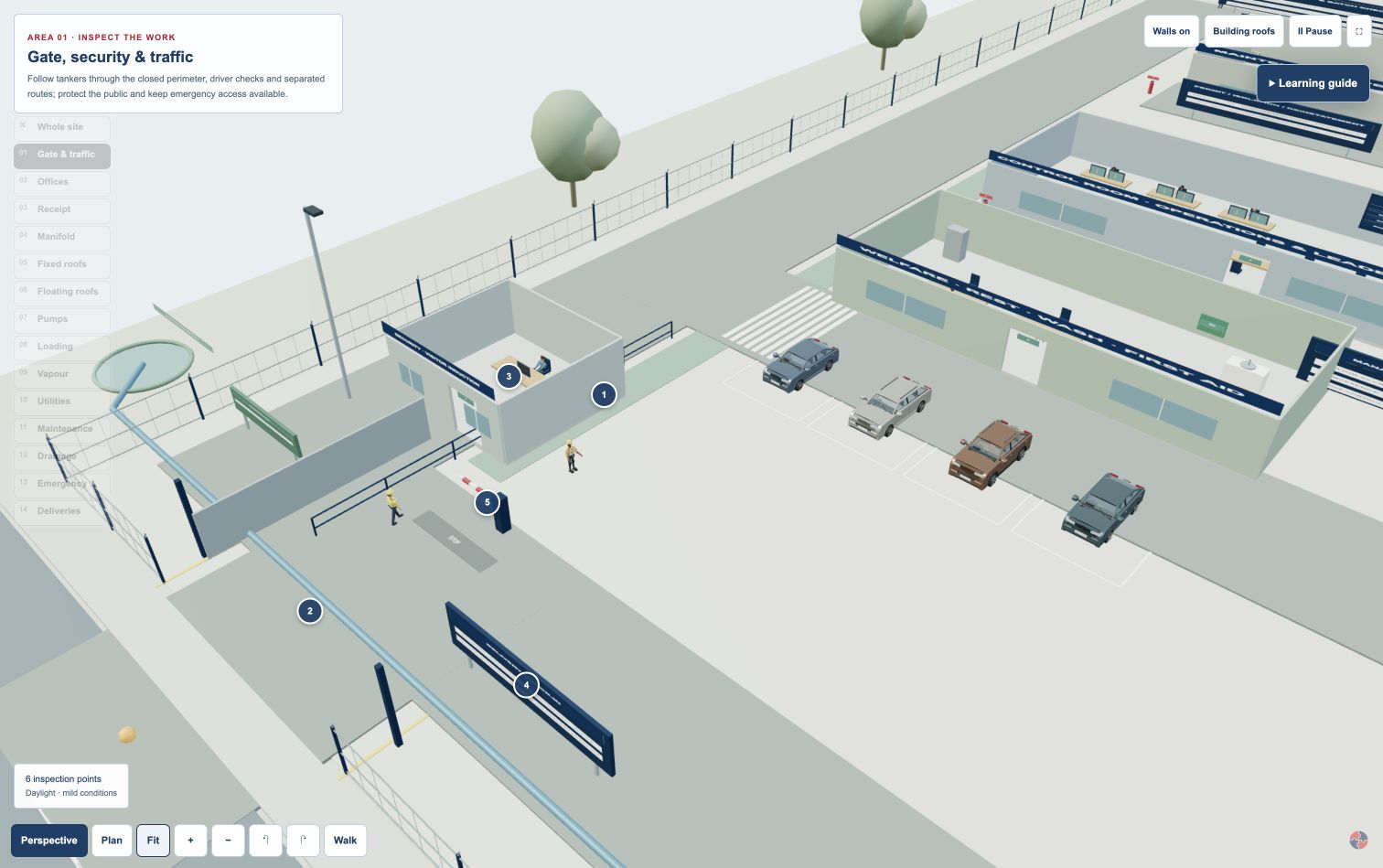
- Keep the closed perimeter effective and escape usableA perimeter is a functioning arrangement, not merely a fence drawn on the site plan.
- Demonstrate competence for this terminal and taskAuthorise the capability required at this plant, including recovery from disagreement and failure, rather than treating a certificate as universal competence.
- Agree the operator–contractor interface before workContracting out a service requires cooperation and clear control of the interfaces that can defeat safety barriers.
Manage interfaces and change
- Measure major-accident barriers, not just injury outcomesA useful process-safety indicator connects a known scenario to a control, a performance test and a timely accountable decision.
- Turn leadership commitment into defensible operating decisionsLeaders influence barrier reliability through the decisions they reward, the resources they provide and the response they give to unwelcome evidence.
- Close the causes of a near miss, then check the learning worksComplete the improvement, verify its performance and retain its rationale; a briefing alone rarely closes an engineering and communication failure.
Learn from barrier evidence
- Control the whole life of a temporary changeTemporary changes require the same understanding of hazards and interfaces as permanent ones, plus deliberate control of time and restoration.
- Turn frontline warnings into action on the barrierWorker voice adds safety value when it changes understanding and action, with a visible route from the report to the condition at the plant.
- Design the control-office task for human capabilityReliable human performance comes from manageable work and usable information, supported by competence and recovery arrangements.
Make and defend a safe operating decision
- The delayed receipt leadership reviewIntegrate barrier health, competence, worker information and change control into a justified management decision.
- Turn the learning into a verified workplace actionChoose a bounded action, owner, task-specific evidence and escalation trigger within your role.
Activities, model practice and assessment
Work through 4 required applied activities and 3 model-practice pauses, with explanatory feedback and independent lesson decisions. Complete 9 distinct model mission sequences across those pauses. Use the actual fictional Crown Fuels model or its equivalent accessible route to complete the required decision sequences; launching the model alone does not complete practice.
The 20-question assessment requires at least 80% plus every designated critical safety answer. Complete the required activities, practice and lesson checks. Points and badges cannot offset a critical safety error.
Use the LMS for confirmed save/resume and recorded results. Any certificate follows its configured passed-completion and grade conditions.
Open the public interactive practice copy; public practice is separate from the LMS record.
Sources and learning provenance
Original fictional cases are paired with public SHAREhub teaching and structured topic records. Use the applicable jurisdiction and primary guidance for live work.
Topic sections, source identities and versions
| Public topic | Chunk and version | Jurisdiction and sources |
|---|---|---|
| process-safety-versus-personal-safety · model | process-safety-versus-personal-safety--model 2.0 | source-hse_developing_process_safety_indicators_hsg254 |
| process-safety-leadership-and-visible-commitment · worked-example | process-safety-leadership-and-visible-commitment--worked-example 2.0 | Great Britain, Northern Ireland source-hse_leadership_for_the_major_hazard_industries_indg277, source-hse_essential_principles_of_good_leadership |
| competence-management-for-process-safety-critical-roles · assessment | competence-management-for-process-safety-critical-roles--assessment 20261016-letter-review-1 | Great Britain source-pscomp-hse-competence, source-pscomp-hse-human |
| management-of-change-in-process-safety · temporary | management-of-change-in-process-safety--temporary 2.0 | Great Britain, Northern Ireland hse-moc, hse-hsg254 |
| major-accident-hazard-awareness-for-leaders · offsite | major-accident-hazard-awareness-for-leaders--offsite 2.0 | Great Britain, Northern Ireland hse-comah, hseni-comah, hse-buncefield |
| contractor-management-in-process-industries · contractor-rules-bridging | contractor-management-in-process-industries--contractor-rules-bridging 20261016-letter-review-1 | Great Britain, Northern Ireland source-pcm-hse-hsg159, source-pcm-hse-customer, source-pcm-ni-maint |
| process-safety-objectives-targets-and-indicators · model | process-safety-objectives-targets-and-indicators--model 2.0 | source-hse_developing_process_safety_indicators_hsg254 |
| organisational-learning-from-incidents-and-near-misses · application | organisational-learning-from-incidents-and-near-misses--application 2.1 | Great Britain, Northern Ireland hse-hierarchy, hse-traffic, hsg245, hse-human, hse-risk, hse-consult, gb-riddor, ni-riddor, hsg253, hse-slips |
| worker-engagement-in-major-accident-prevention · consult-route | worker-engagement-in-major-accident-prevention--consult-route 4.0 | Great Britain, Northern Ireland source-gb_safety_reps, source-gb_consult, source-ni_safety_reps, source-ni_consult, source-hse_when, source-hse_involve |
| human-factors-in-process-operations · workload-fatigue | human-factors-in-process-operations--workload-fatigue | Great Britain source-hse-workload |
| management-of-change-in-process-safety · worked-example | management-of-change-in-process-safety--worked-example 2.0 | Great Britain, Northern Ireland hse-flixborough, hse-moc, hse-controls |
| process-safety-leadership-and-visible-commitment · evidence-pack | process-safety-leadership-and-visible-commitment--evidence-pack 2.0 | source-hse_leadership_for_the_major_hazard_industries_indg277 |
Course SH-FUEL-01 · version 2026.10.20.1. .
Questions about this course
Is this training free?
Full public teaching and readers are free without an account. A free learner account is required for saved LMS progress and recorded assessment. Completion and any course-completion certificate depend on the configured LMS conditions.
How long should I allow?
Approximately 130–210 minutes, including teaching, lesson checks, required activities, model or accessible practice and one assessment attempt. Individual pace, review and retries vary. Save and resume in the LMS.
Can I learn without a 3D-capable browser?
Yes. The complete HTML reader provides the teaching. Required model practice has an equivalent accessible decision route in the interactive course. Use the LMS route for recorded learning.
What is required to pass?
Complete the required learning, activities, practice and lesson decisions. The 20-question final assessment requires at least 80% plus every designated critical safety answer. Points cannot compensate for a critical safety error. Follow the feedback before retrying.
Does this authorise fuel operations?
Fuel-terminal leaders, supervisors, operators and contractor coordinators; transfer principles to downstream delivery while checking actual premises duties. This independent course does not award a NEBOSH qualification or replace competent task assessment, practical training or site authorisation.