SHARE Knowledge Hub
Process Safety Versus Personal Safety
Personal safety controls injuries from everyday tasks; process safety prevents low-frequency, high-consequence loss of containment, fire, explosion and toxic or energy release. Both matter, but they need different evidence. A tidy site with excellent PPE compliance can still have overdue relief tests, bypassed trips or unstable operating limits. Leaders should see both sets of measures and act on the barrier that could fail today.
Understanding Process Safety Versus Personal Safety
Personal safety controls injuries from everyday tasks; process safety prevents low-frequency, high-consequence loss of containment, fire, explosion and toxic or energy release. Both matter, but they need different evidence. A tidy site with excellent PPE compliance can still have overdue relief tests, bypassed trips or unstable operating limits. Leaders should see both sets of measures and act on the barrier that could fail today.
Why this matters at work
Keep four concepts separate. A hazard is the potential source of harm; an event is the loss of control or challenge to a safeguard; exposure is the way people or the environment encounter the hazard; and consequence is the resulting harm. Counting only consequences misses control failures that fortunately caused no injury. Counting hazards without current condition does not show whether risk is controlled.
Minimum assurance evidence for hazard, event, exposure and consequence should trace one live or recently completed case through these checkpoints: Describe: Separate hazard, event, exposure and outcome [Event taxonomy]; Link: Map safeguards and credible consequences [Scenario record]; Learn: Use actual and potential severity [Investigation decision]. Confirm that the classification matched the credible harm pathway, source data and operating context; that personal and process implications were both considered where relevant; that thresholds led to the required decision; and that the final condition was verified in the field. Record uncertainty, excluded scope and failed hand-offs with an accountable corrective owner.
How organisations manage this in practice
Prevention stops the initiating event or loss of control; control limits development after it begins; mitigation reduces consequences after release or escalation. The same measure should not be credited in several stages without evidence. Strong systems prioritise elimination and prevention while maintaining control and mitigation because prevention can fail.
Engineering controls depend on design, installation, operating envelope and physical condition. Administrative controls depend on usable information, competence, supervision, time and compliance under real conditions. Both can support personal and process safety, but their evidence differs. A procedure cannot repair an undersized relief path, and equipment cannot manage a task for which its operating limits are unknown.
Minimum assurance evidence for management of technical and organisational change should trace one live or recently completed case through these checkpoints: Screen: Identify all safety and organisational effects [Change request]; Approve: Use competent review and defined conditions [MOC record]; Validate: Check field state and post-change performance [Closeout review]. Confirm that the classification matched the credible harm pathway, source data and operating context; that personal and process implications were both considered where relevant; that thresholds led to the required decision; and that the final condition was verified in the field. Record uncertainty, excluded scope and failed hand-offs with an accountable corrective owner.
How can I practise this topic in 3D?
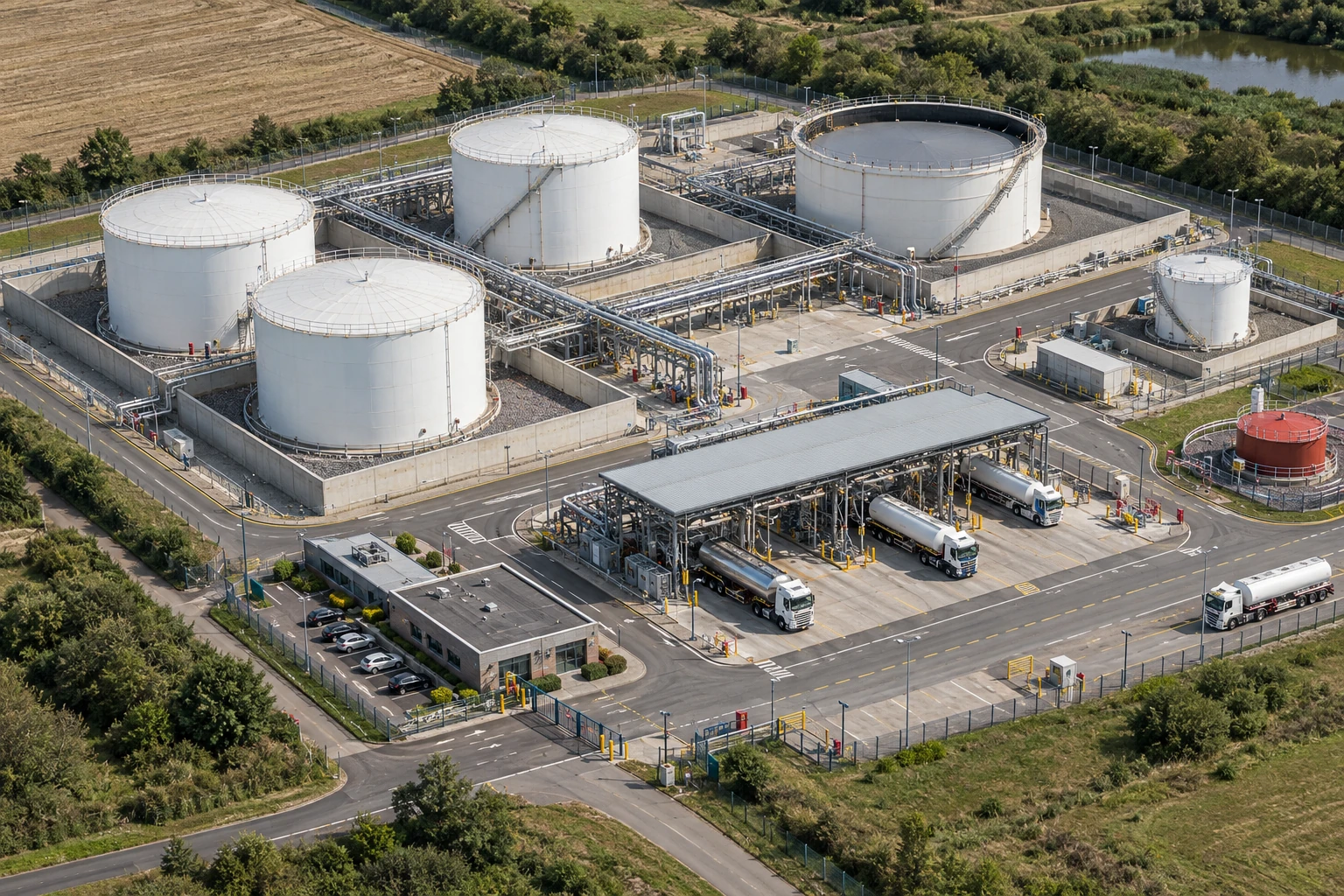

The dashboard counts injuries but misses failing barriers
All related inspection points 1 across 1 location
Crown Fuels terminal 1 inspection point
Practice in the SHAREhub environment. Browser practice is separate from workplace competence and formal learning records.
What is the difference between process safety and personal safety?
Personal safety usually prevents individual harm from work tasks; process safety prevents high-consequence loss-of-control events.
Personal safety matters. Slips, trips, falls, manual handling injuries, cuts, burns, vehicle strikes and occupational ill health can cause serious harm. But process safety asks a different question: could hazardous inventory, energy or plant failure escalate into multiple fatalities, community harm, environmental damage, asset loss or business interruption?
A fuel terminal can have no lost-time injuries while overfill protection is bypassed. A refinery can have good PPE compliance while alarm management, start-up procedures and siting are weak. The two safety domains should reinforce each other, but one must not be used as a proxy for the other.
| Aspect | Personal safety | Process safety |
|---|---|---|
| Main concern | Individual injury or ill health from work tasks. | Major accident events and loss of control. |
| Typical events | Slip, cut, manual handling injury, fall, contact with moving part. | Loss of containment, fire, explosion, toxic release, runaway or overpressure. |
| Frequency/severity | Often more frequent and visible. | Often rarer but potentially catastrophic. |
| Core evidence | Inspections, training, observations, injury trends and task controls. | Barrier health, MOC, alarms, trips, relief, integrity and emergency readiness. |
| Common metric | Accident frequency, near misses, task observations. | Leading/lagging process safety indicators and high-potential events. |
| Failure risk | Immediate task harm. | Escalation across plant, people, public, environment and assets. |
A slip hazard has a direct task path to an individual injury. A major-accident path can accumulate silently: hazardous inventory, an initiating event, multiple degraded safeguards, then loss of containment and fire, blast or toxic exposure. The site should not trade one risk domain against the other. Personal injury measures help manage routine work; process-safety measures need to test the control systems for credible high-consequence scenarios.
Source: HSE developing process safety indicators HSG254
Source: HSE COMAH 2015 guidance
A low injury rate does not interrupt the process harm chain: overdue relief examination plus a bypassed alarm and unclosed change can allow pressure or level to exceed limits, followed by containment failure, fire, blast or hazardous exposure. These outcomes differ from slips or cuts and require scenario-specific barrier evidence and stop rules. Source: HSE developing process safety indicators HSG254
Process-safety learning also includes small releases, protective-function demands and control failures. The low-frequency/high-consequence description explains major-accident potential; it does not exclude lesser events or shared controls protecting the same people.
How can the hierarchy of controls guide controls for both major accidents and personal injury?
Eliminate, Reduce including substitution, Isolate, Control, personal protective equipment (PPE) and Discipline (ERICPD) is a prompt for decisions. HSE’s five-level hierarchy prioritises elimination, substitution, engineering controls, administrative controls and PPE. They are related frameworks, not identical laws; apply them to the actual task and check the resulting control.
Eliminate the process hazard or the task hazard where a redesign can remove it; a successful housekeeping campaign does not remove tank overfill risk.
Substitute or reduce hazardous inventory, pressure or material, and separately reduce exposure to routine manual or traffic hazards. Verify that the new process and work design do not create a different failure path.
Isolate and engineer: independent shutdown, relief and containment protect the major-accident scenario; guards and segregation protect routine tasks. Check each barrier against its own performance standard and stop when the relevant critical control is impaired.
Control, PPE and Discipline: procedures, competence and emergency drills sustain process controls while supervision and PPE may reduce personal task exposure. PPE cannot prevent a tank rupture or toxic release. ERICPD and HSE’s five-level hierarchy help select controls but do not make injury-rate data a proxy for process barrier health.
Source: HSE hierarchy of controls
Source: HSE developing process safety indicators HSG254
How can the ERICPD hierarchy of controls guide controls for both major accidents and personal injury?

| ERICPD control level | Topic-specific example | Source and full task context |
|---|---|---|
| Eliminate | Remove a feasible loss-of-containment or dangerous-task scenario through redesign. | Read the full task example, checks and stop points on this page. HSE hierarchy of controls · HSE developing process safety indicators HSG254 |
| Reduce | Assess a genuinely less hazardous material/process; lower inventory or pressure alone is reduction. | Read the full task example, checks and stop points on this page. HSE hierarchy of controls · HSE developing process safety indicators HSG254 |
| Isolate | Provide independent shutdown, relief, containment, guarding and physical segregation appropriate to the same task. | Read the full task example, checks and stop points on this page. HSE hierarchy of controls · HSE developing process safety indicators HSG254 |
| Control | Maintain procedures, competence, permit/bypass controls, drills and review across both safety lenses. | Read the full task example, checks and stop points on this page. HSE hierarchy of controls · HSE developing process safety indicators HSG254 |
| PPE | Use suitable residual task equipment; procedures and emergency drills are administrative controls, not PPE. | Read the full task example, checks and stop points on this page. HSE hierarchy of controls · HSE developing process safety indicators HSG254 |
| Discipline | Verify actual barrier/task condition even when injury statistics are green. | Read the full task example, checks and stop points on this page. HSE hierarchy of controls · HSE developing process safety indicators HSG254 |
How can the ISO 45001 hierarchy of controls guide controls for both major accidents and personal injury?

| ESEAP control level | Topic-specific example | Source and full task context |
|---|---|---|
| Elimination | Remove a feasible loss-of-containment or dangerous-task scenario through redesign. | Read the full task example, checks and stop points on this page. HSE hierarchy of controls · HSE developing process safety indicators HSG254 |
| Substitution | Assess a genuinely less hazardous material/process; lower inventory or pressure alone is reduction. | Read the full task example, checks and stop points on this page. HSE hierarchy of controls · HSE developing process safety indicators HSG254 |
| Engineering controls | Provide independent shutdown, relief, containment, guarding and physical segregation appropriate to the same task. | Read the full task example, checks and stop points on this page. HSE hierarchy of controls · HSE developing process safety indicators HSG254 |
| Administrative controls | Maintain procedures, competence, permit/bypass controls, drills and review across both safety lenses. | Read the full task example, checks and stop points on this page. HSE hierarchy of controls · HSE developing process safety indicators HSG254 |
| PPE | Use suitable residual task equipment; procedures and emergency drills are administrative controls, not PPE. | Read the full task example, checks and stop points on this page. HSE hierarchy of controls · HSE developing process safety indicators HSG254 |
Why can low injury rates hide high process safety risk?
Major accident risk is rare, complex and barrier-dependent, so ordinary injury metrics may not reveal degraded controls.
Personal injury rates often count events that occur frequently enough to create visible trends. Major accident events may not occur for years, even when barriers are degraded. That time lag creates false confidence. The organisation may believe it is safe because no one has been hurt, while leaks, bypasses, overdue proof tests and poor MOC are accumulating.
The useful model is two lenses on the same workplace. The personal safety lens asks whether people are protected from task injuries. The process safety lens asks whether hazardous inventory remains contained and major accident barriers are healthy.
| Workplace example | Personal safety lens | Process safety lens |
|---|---|---|
| Fuel transfer | Slips, manual handling, vehicle interface and PPE. | Overfill, vapour release, ignition, containment and emergency shutdown. |
| Reactor start-up | Access, heat exposure and manual tasks. | Runaway reaction, alarms, trips, relief and operating envelope. |
| Maintenance on pipework | Cuts, lifting, tools and work at height. | Isolation, residual pressure, hazardous contents and line breaking. |
| Warehouse aerosols | Manual handling and vehicle movement. | Flammable inventory, ventilation, ignition sources and fire spread. |
| Boiler house | Burns, slips and access. | Pressure system integrity, relief, combustion and gas detection. |
| Confined-space cleaning | Access, rescue and PPE. | Toxic/asphyxiant atmosphere, isolation and loss of containment. |
The two columns select questions; they are not exclusive hazard categories. Access, rescue, isolation and atmosphere control can protect the same people in the same confined-space event. Small releases, demands and failed functions belong in process-safety learning even without a site-wide major accident or catastrophic harm.
What does this distinction look like on a real site?
A worked example shows why a low injury rate must not stop process safety challenge.
Crownway Fuels Ltd has celebrated 18 months with zero lost-time injuries. The site is tidy, PPE compliance is good and toolbox talks are frequent. However, relief valves are overdue for inspection, critical alarms are bypassed, MOC actions remain open after a temporary repair, and operators have occasionally worked outside the safe operating envelope to keep transfers moving.
That is the classic trap: a site can look disciplined through a personal safety lens while process safety is drifting. A mature review would still recognise good injury prevention, but it would immediately ask what could happen if containment, overpressure protection, alarms, safe limits and MOC controls were demanded today.
| Evidence | Personal safety interpretation | Process safety interpretation |
|---|---|---|
| Zero LTIs for 18 months | Zero reported LTIs alone does not establish task-control effectiveness. Check exposure, reporting completeness, ill-health information and actual controls. | Does not prove major accident barriers are healthy. |
| Good PPE compliance | People follow visible rules. | PPE does not prevent tank overfill or vapour cloud formation. |
| Critical alarms bypassed | May not affect injury statistics. | Alarm barrier, operator response and escalation discipline may be degraded. |
| Relief valves overdue | May not create immediate injury. | Overpressure protection availability and inspection confidence are weakening. |
| Open MOC actions | May look like project close-out admin. | Safe limits, procedures, training or design assumptions may be wrong. |
| Working outside the envelope | May be seen as experienced operators coping. | The process is operating beyond the basis of safety. |
| Small leaks | Minor maintenance issue. | Potential weak signal for containment integrity. |
| Temporary repair | Housekeeping may still look good. | Mechanical integrity and MOC may be drifting. |
Operational example: decisions and evidence
Task material and setting: Crownway Fuels Ltd reports zero lost-time injuries for 18 months, but relief tests are overdue, alarms are bypassed and MOC actions remain open.
People and prerequisites: Operations owns safe limits; instrument and mechanical specialists own trip and relief evidence; process-safety lead integrates scenarios; executive sponsor owns resources.
Before: Compare personal-injury evidence with current barrier status for overfill, overpressure, containment and emergency response.
During: Field-check bypasses, proof tests and temporary repairs rather than accepting a green injury dashboard; ask operators about actual operating envelope.
Hold or stop: Pause the affected transfer or pressure operation when independent protection is unproved or safe limits are exceeded, even if the personal-safety record is excellent.
Completion and hand back: Restore and prove barriers, close MOC actions, and review why the dashboard failed to prompt earlier intervention.
Evidence: Injury and process-safety measures side by side, test/repair records, impairment decisions, field verification and leader action.
Source: HSE developing process safety indicators HSG254
Source: HSE COMAH 2015 guidance
What goes wrong when process safety is treated like personal safety?
The organisation measures the wrong things and can miss degraded high-consequence barriers.
Behavioural observations, PPE checks and injury-rate dashboards can support safety, but they cannot replace relief-system assurance, alarm management, inspection, MOC, process knowledge and emergency readiness. When process safety is squeezed into a personal safety framework, leaders may get reassuring numbers while the basis of safety weakens.
The reverse is also true: process safety excellence does not remove the need to prevent everyday injuries and ill health. The goal is integration with clear distinction, not competition.
| Failure mode | How it develops | What competent management does |
|---|---|---|
| TRIR/LTI fixation | Leaders use injury rates as the main safety proof. | Use separate process safety indicators and barrier dashboards. |
| Behaviour-only programmes | Focus on worker actions misses design and barrier health. | Include engineering, maintenance, MOC and leadership controls. |
| PPE overemphasis | Visible PPE compliance hides containment or ignition risk. | Test higher-order controls and safety-critical systems. |
| Near misses under-classified | Leaks or alarms treated as low-level defects. | Classify high-potential process safety events. |
| Audit scope too narrow | Audits sample housekeeping but not process safety systems. | Audit scenarios, barriers and evidence. |
| Leadership questions too generic | Leaders ask 'any accidents?' instead of 'which barriers are degraded?' | Use process safety question sets. |
| Emergency readiness ignored | No injury means drills and response are neglected. | Test realistic major accident response. |
What evidence should show both safety domains are controlled?
Evidence should show personal safety controls and process safety barriers separately, then connect them in management review.
A strong management system does not choose between personal safety and process safety. It keeps separate indicators where needed and brings them together for decision-making. The evidence should show task risk controls, occupational health controls and major accident barriers.
The board pack should therefore include injury/ill-health trends and process safety barrier health. If one is strong and the other is weak, leaders need to see the difference.
| Evidence item | What good looks like | Weakness to challenge |
|---|---|---|
| Personal safety indicators | Injuries, near misses, inspections, observations and task control trends. | Used as the only safety dashboard. |
| Process safety indicators | Loss of containment, alarm health, proof tests, bypasses, MOC and backlog. | Missing from leadership review. |
| Barrier registers | Safety-critical controls have owners and performance standards. | No clear link between scenarios and controls. |
| High-potential event review | Leaks, trips, alarms and near misses assessed for escalation potential. | Events classified by actual harm only. |
| MOC records | Changes reviewed for major accident implications. | Change treated as engineering admin. |
| Emergency exercises | Major accident scenarios tested. | Only evacuation drills completed. |
| Leadership minutes | Both personal and process safety challenged. | Low injury rate celebrated without barrier review. |
How should leaders review both types of safety?
Leaders should use different questions for personal safety and process safety, then look for interactions.
A strong review asks: are people getting injured or becoming ill, and are major accident barriers healthy? The answers may differ. A plant may have high personal injury exposure during turnaround work and high process safety risk during start-up, but the indicators and controls are not identical.
Leaders should also look for interactions. A fatigued maintenance team can create both personal injury risk and process safety error. Poor housekeeping can create trip risk and fire load. Weak contractor control can affect PPE, isolation, hot work and process integrity.
| Review area | Personal safety question | Process safety question |
|---|---|---|
| Performance | Who is being hurt and why? | Which barriers are degraded or demanded? |
| Indicators | What do injury, near-miss and health trends show? | What do loss-of-containment, alarm, MOC and maintenance data show? |
| Controls | Are task controls used and supervised? | Are safety-critical controls available and tested? |
| Learning | What did recent injuries teach us? | What did high-potential events and weak signals teach us? |
| Assurance | Do inspections match work as done? | Do audits test scenarios and barriers? |
| Resources | Do teams have safe tools and staffing? | Do barriers have engineering, maintenance and competence resources? |
What do learners commonly misunderstand?
The common mistake is saying process safety is simply more serious personal safety, rather than a different risk-control discipline.
A strong answer distinguishes hazards, consequences, frequency, controls, indicators and evidence. It should explain why low injury rates can coexist with high major accident risk and why both personal and process safety are needed.
A weak answer says personal safety is about people and process safety is about plant. People, plant, procedures and organisations matter in both; the real distinction is the type of event and the evidence needed to control it.
| Learner question | Strong answer should include | Weak answer to avoid |
|---|---|---|
| What is process safety? | Control of major accident hazards and loss-of-control scenarios. | Safety in factories. |
| Why are injury rates not enough? | Major accidents are rare and barrier-dependent. | They are lagging indicators. |
| Give a process safety example | Loss of containment leading to fire/explosion/toxic release. | Someone slipping in a plant room. |
| Give a personal safety example | Manual handling, cuts, slips, falls or contact injuries. | Any worker injury. |
| How should both be managed? | Integrated system with distinct indicators and evidence. | Use one safety dashboard. |
Which legal duties and guidance are relevant?
Process safety topics sit across general health and safety law, major accident control, equipment safety, dangerous substances and management-system duties.
| Duty or guidance | What it requires | How to apply it |
|---|---|---|
| Health and Safety at Work etc. Act 1974 | Requires employers to protect workers and others so far as reasonably practicable. | GB general duty protects against both routine injury and high-consequence work risks. |
| Management of Health and Safety at Work Regulations 1999 | Requires risk assessment, preventive arrangements, competence, cooperation and review. | GB risk assessment and preventive arrangements should examine both task injury and major-hazard scenarios. |
| COMAH Regulations 2015 | In-scope lower-tier sites need a major accident prevention policy (MAPP) and safety-management arrangements; upper-tier sites additionally need a safety report. | For in-scope GB sites, lower-tier MAPP/safety-management addresses major accidents; upper-tier sites additionally prepare a safety report. Injury rates alone are not barrier evidence. |
| DSEAR 2002 | Requires dangerous substances and explosive atmosphere risks to be eliminated or controlled. | For GB dangerous-substance work, separately assess fire/explosion scenarios beyond routine task-injury measures. |
| PUWER 1998 | Requires work equipment to be suitable, maintained and used safely. | For GB work equipment, maintain equipment that protects routine tasks and safety-critical process functions. |
| Pressure Systems Safety Regulations 2000 | Requires pressure systems and protective devices to be managed safely. | For in-scope GB pressure systems, manage stored-pressure hazards through limits, protection and examination, not injury counts. |
| Health and Safety at Work (Northern Ireland) Order 1978 | Apply the general health, safety and welfare duty to this work setting. | NI general duty covers people exposed to both routine and high-consequence work hazards. |
| Management of Health and Safety at Work Regulations (Northern Ireland) 2000 | Assess work risks and maintain preventive arrangements appropriate to the actual task. | NI assessment and arrangements need evidence for both injury prevention and major-hazard control. |
| Control of Major Accident Hazards Regulations (Northern Ireland) 2015 | In-scope lower-tier sites need a major accident prevention policy (MAPP) and safety-management arrangements; upper-tier sites additionally need a safety report. | For in-scope NI sites, lower-tier MAPP/safety-management focuses on major accidents; upper-tier sites also prepare safety reports. |
GB general duties cover work risks, while COMAH adds major-accident duties only for in-scope establishments. NI has separate general and COMAH instruments. Neither law says low personal-injury numbers prove process-safety controls are healthy; use scenario-specific evidence.
Source: HSE COMAH 2015 guidance
How should the control be managed and reviewed?
For a GB workplace, HSE guidance supports identifying the actual risk, taking practical protective steps and reviewing whether they work. Name the decision owner, check the control during the real task and correct a failed arrangement. Apply the separate Northern Ireland duties and guidance where the work is in NI.
GB management guidance: HSE managing health and safety
What training and competence are needed?
Training should help people recognise major accident weak signals as well as everyday injury hazards.
Training should be role-based. General awareness creates a baseline, but supervisors, managers, advisers and senior leaders need different levels of decision-making, verification and escalation competence.
| Role | What to demonstrate | Who checks | Record and reassessment |
|---|---|---|---|
| Workers and supervisors | Distinguish a routine injury hazard from a major-accident weak signal and report both. | Supervisor tests a fuel-transfer case. | Briefing and report feedback. |
| Technical specialists | Show how barrier failure could release hazardous energy or material. | Independent peer reviews a scenario. | Barrier standard and test evidence. |
| Managers | Challenge green injury data when process barriers are degraded. | Process-safety lead tests a dashboard decision. | Hold and resource record. |
| Boards and auditors | Review both injury and major-hazard assurance without averaging them. | Independent assurance samples field closure. | Management review and trend. |
Source context: HSE developing process safety indicators HSG254
How could Crownway Fuels Ltd manage this in practice?

Crownway Fuels Ltd would manage everyday injury risks and major-release risks together while using evidence suited to each.
Crownway Fuels Ltd · practical example
Read two dashboards before calling the depot safe
The key lesson Personal-safety results do not demonstrate that major-accident safeguards are healthy; different risks need relevant control indicators.
The situation: A depot celebrates a period without lost-time injuries. The same review pack contains repeat leaks and unresolved tests of protective systems.
Why this matters: Rare major events can be preceded by deteriorating containment or protection even when everyday injury statistics are favourable.
How Crownway Fuels Ltd would manage it
- Identify both risk pictures — Health and Safety Lead. Describe significant injury and occupational-health risks alongside credible fuel-release, fire and explosion scenarios. Explain which controls prevent or limit each.
- Select meaningful measures — Site Manager. Track suitable workface controls and events for each risk. Include relevant leaks, protection impairments and overdue critical assurance rather than relying only on injury rates.
- Investigate the exceptions — Maintenance Coordinator. Check what repeat leaks and unresolved tests mean for containment and protective functions. Make uncertainty and affected operations clear.
- Make the operating decision — Operations Director. Act on critical-control weaknesses even when the injury measure is good. Assign resources, restrictions and accountable actions according to the actual scenario risk.
- Review the improvement — Managing Director. Ask whether controls and exposure have improved, not simply whether the next month was event-free. Retain attention to routine injuries and health while strengthening major-hazard assurance.
When the conditions change
- Recognise the trigger
- Leaks or unresolved protective-system tests indicate impaired depot safeguards despite good injury figures.
- Make the immediate decision
- The Site Manager applies the assessed restrictions on operations relying on those impaired safeguards.
- Verify the next step
- The authorised operating manager uses verified containment and protective-function evidence to accept operation; the injury dashboard is not the release criterion.
What good looks like
The review can show good injury performance and poor barrier condition at the same time, and management acts on both without averaging them away.
Evidence to look for: Scenario-linked indicators, personal-safety information, control exceptions, decisions and verified actions.
Common mistake to avoid: Using a long injury-free period to claim that process-safety risk is under control.
Apply this to your work: Which serious scenario could be getting worse without appearing in your injury rate?
Guidance behind the management approach: HSE HSG254: process-safety performance indicators. Use the topic's legal and technical guidance for the applicable work and location.
Crownway's workers face manual handling, slips, vehicle and contractor risks, but the site also stores and transfers hazardous fuels. The business would track injury prevention and major accident barrier health separately so one does not hide the other.
| Management element | How the business would manage it | Evidence to review |
|---|---|---|
| Separate | Use distinct personal and process safety indicators. | Dashboard sections. |
| Connect | Review interactions such as fatigue, contractors and housekeeping. | Risk review. |
| Challenge | Ask barrier questions even when injury performance is good. | Leadership minutes. |
| Learn | Classify high-potential process safety events. | Event review. |
| Assure | Audit scenarios, barriers and personal risk controls. | Assurance programme. |
Source context: HSE developing process safety indicators HSG254
How does a fuel depot illustrate process safety beyond personal safety?
Inspect containment, transfer and protection functions that can affect many people. PPE or individual behaviour does not by itself establish major-accident prevention.
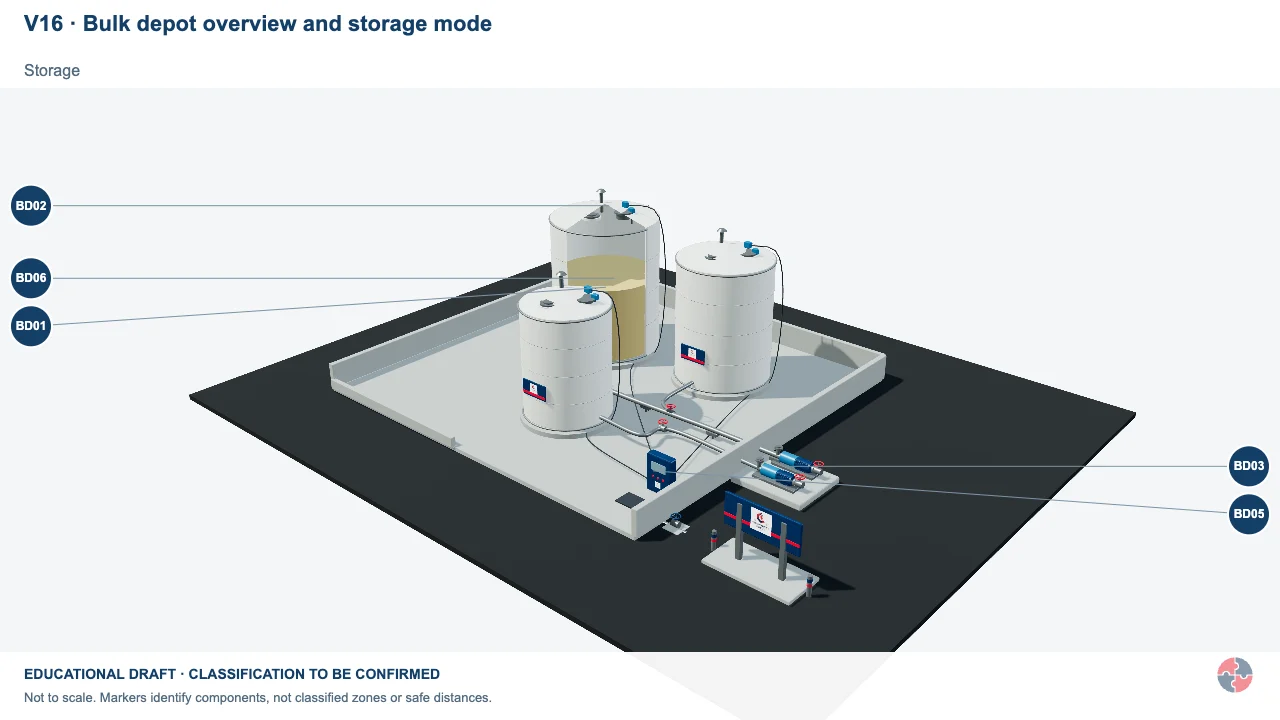
Bulk depot overview and storage mode
Explore the bulk depot system and compare selectable Zone 0, Zone 1 and Zone 2 teaching volumes around its petrol example.
Activity focus: Use cutaway for the internal vapour spaces, then compare the rounded vent, pump and mode-dependent connection envelopes.
Educational illustration, not to scale. Coloured zones are teaching examples, not a site-specific hazardous-area classification.
What do the acronyms and key terms mean?
Acronyms should be understood before they are used in assessments, briefings, audits or learning answers.
Acronyms can exclude newer readers if they are not explained. This section keeps the main terms available at the end of the page so the article stays readable while still supporting learners and audit users.
| Acronym | Meaning | Plain-English use |
|---|---|---|
| COMAH | Control of Major Accident Hazards | Major-accident regime with separate GB and Northern Ireland regulations; check site threshold. |
| PSM | Process Safety Management | Management of major accident hazard controls. |
| MOC | Management of Change | Controlled review before changes are made. |
| SCE | Safety Critical Element | A system, structure or component whose failure could contribute to a major accident. |
| KPI | Key Performance Indicator | A measure used to track performance. |
Unlock another resource
You have used this month’s two free downloads. Publish a post in your own words to unlock one more resource, or choose SHARE Individual for 10 downloads per month.
You decide whether to share. If you do, use the relevant platform disclosure tools and do not make claims you do not genuinely hold.