
Crown Fuels and process safety / Tank storage, floating roofs and integrity
Crown Fuels and process safety · SH-FUEL-04Tank storage, floating roofs and integrity
Free online training · Approximate learning time: 140–220 minutes · Self-paced
Understand what each tank feature does, and what evidence is needed before receiving, accessing or relying on it.
Full public teaching and readers are free without an account. A free learner account is required for saved LMS progress and recorded assessment. Completion and any course-completion certificate depend on the configured LMS conditions.
Who this course is for
Bulk storage operators, supervisors, maintenance planners, inspectors and safety advisers.
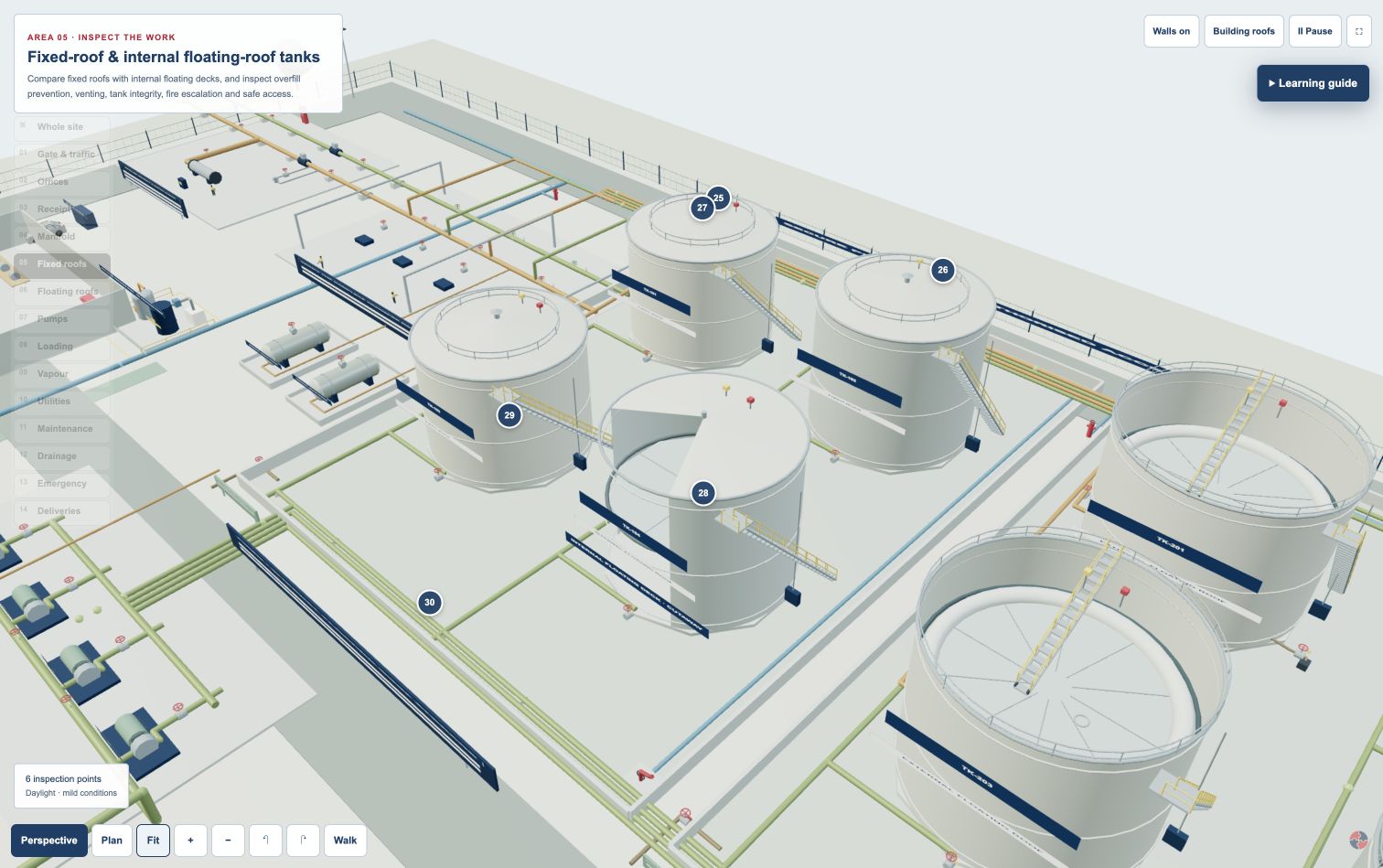
A clean shell and familiar tank name cannot demonstrate the condition of the complete storage system. Compare fixed roofs, internal floating decks and external floating roofs, then connect capacity, venting, integrity, roof transitions, drainage and access to a controlled storage decision. Model views are illustrative and do not provide design values, inspection findings or permission to enter or access a tank.
Fixed-roof, internal-floating-roof and external-floating-roof bulk storage; model geometry provides learning context and no engineering dimensions or access authorisation.
Learning outcomes
- Distinguish tank configurations and the remaining vapour, integrity and access hazards.
- Recognise the separate receiving-capacity, venting, inspection and containment evidence needed for safe storage.
- Hold uncertain roof transitions, access and degradation for competent review and verify operating restrictions before release.
Course outline
Understand tanks and their boundaries
- Identify the tank without inventing its conditionCompare fixed, internal floating and external floating configurations while recognising their limits.
- Set the receiving question before the level risesExplain the difference between a level indication, usable capacity and verified overfill protection.
Establish storage safeguards
- Inspect the whole containment and breathing systemConnect visible condition, hidden degradation, venting and escalation controls.
- Manage moving roofs, drainage and access as planned tasksRecognise that roof position and access change the hazards and require task-specific evidence.
- Establish safe receiving margin before tank fillingSafe receiving capacity is a justified operating condition, supported by reliable information and effective protection; it is not the tank's advertised volume.
- Keep an atmospheric tank’s breathing and relief paths effectiveAtmospheric tanks need effective controlled breathing and relief; the label 'atmospheric' does not remove pressure and vacuum failure mechanisms.
- Understand what an internal floating deck does and does not controlA process feature that reduces emissions is not a certificate of safe atmosphere or permission to enter.
Inspect tank integrity, escalation and roof seals
- Connect hidden deterioration findings to operating decisionsInspection creates safety value when findings change the condition or justified use of the asset and remain visible to those operating it.
- Preserve the layout and access that limit fire escalationThe space around major inventories is part of the protection system when separation, equipment coverage and response access depend on it.
- Floating-roof seals: an unresolved defect is a barrier impairmentDefect recording starts the assurance process; an authorised technical decision and demonstrated repair complete it.
Control floating-roof drains, transitions and access
- Roof drainage and bund drainage: follow two different safety functionsA drain label describes an outlet, not permission to open it. Identify the source, containment boundary and destination first.
- Landing and re-floating: a change of operating modeA transition deserves its own operating basis whenever the equipment’s physical or protective behaviour changes.
- Roof access: assess the whole journey and a credible rescueA safe route to a hazard is only complete when the return and credible rescue are workable too.
Decide storage readiness from evidence
- The receiving tank with an incomplete storyIntegrate configuration, receiving margin, integrity and roof-task restrictions into a justified storage decision.
- Turn the learning into a verified workplace actionChoose a bounded action, owner, task-specific evidence and escalation trigger within your role.
Activities, model practice and assessment
Work through 4 required applied activities and 3 model-practice pauses, with explanatory feedback and independent lesson decisions. Complete 9 distinct model mission sequences across those pauses. Use the actual fictional Crown Fuels model or its equivalent accessible route to complete the required decision sequences; launching the model alone does not complete practice.
The 20-question assessment requires at least 80% plus every designated critical safety answer. Complete the required activities, practice and lesson checks. Points and badges cannot offset a critical safety error.
Use the LMS for confirmed save/resume and recorded results. Any certificate follows its configured passed-completion and grade conditions.
Open the public interactive practice copy; public practice is separate from the LMS record.
Sources and learning provenance
Original fictional cases are paired with public SHAREhub teaching and structured topic records. Use the applicable jurisdiction and primary guidance for live work.
Topic sections, source identities and versions
| Public topic | Chunk and version | Jurisdiction and sources |
|---|---|---|
| bulk-storage-and-tank-farm-safety · vents-roofs | bulk-storage-and-tank-farm-safety--vents-roofs 20261016-letter-review-1 | Great Britain, Northern Ireland hsg176, hse-comah, buncefield |
| bulk-storage-and-tank-farm-safety · overfill-decision | bulk-storage-and-tank-farm-safety--overfill-decision 20261016-letter-review-1 | Great Britain, Northern Ireland hsg176, buncefield |
| asset-integrity-and-mechanical-integrity · inspection | asset-integrity-and-mechanical-integrity--inspection 20261016-letter-review-1 | Great Britain, Northern Ireland hse-mi-guide, hse-ndt, hse-pressure, hse-mi-tool |
| bulk-storage-and-tank-farm-safety · integrity | bulk-storage-and-tank-farm-safety--integrity 20261016-letter-review-1 | Great Britain, Northern Ireland hsg176, hse-comah, buncefield |
| bulk-storage-and-tank-farm-safety · overfill | bulk-storage-and-tank-farm-safety--overfill 20261016-letter-review-1 | Great Britain, Northern Ireland hsg176, hse-comah, buncefield |
| passive-fire-protection-layout-and-separation · layout-separation | passive-fire-protection-layout-and-separation--layout-separation 2.1 | Great Britain, Northern Ireland gb-dsear-detail, hsg176, hse-layout, hse-pfp, ew-guide, hse-ppe-hierarchy |
| bulk-storage-and-tank-farm-safety · bunding | bulk-storage-and-tank-farm-safety--bunding 20261016-letter-review-1 | Great Britain, Northern Ireland hsg176, hse-comah, buncefield |
| confined-spaces-risk-management · risk-assessment | confined-spaces-risk-management--risk-assessment 20261016-letter-review-1 | Great Britain, Northern Ireland source-csrm-hse-l101, source-csrm-hse-law, source-csrm-ni-law, source-csrm-ni-acop |
| bulk-storage-and-tank-farm-safety · worked-decisions | bulk-storage-and-tank-farm-safety--worked-decisions 20261016-letter-review-1 | Great Britain, Northern Ireland hsg176, hse-comah, buncefield |
| asset-integrity-and-mechanical-integrity · programme | asset-integrity-and-mechanical-integrity--programme 20261016-letter-review-1 | Great Britain, Northern Ireland hse-mi-guide, hse-mi-tool, hse-hsg65 |
Course SH-FUEL-04 · version 2026.10.20.1. .
Questions about this course
Is this training free?
Full public teaching and readers are free without an account. A free learner account is required for saved LMS progress and recorded assessment. Completion and any course-completion certificate depend on the configured LMS conditions.
How long should I allow?
Approximately 140–220 minutes, including teaching, lesson checks, required activities, model or accessible practice and one assessment attempt. Individual pace, review and retries vary. Save and resume in the LMS.
Can I learn without a 3D-capable browser?
Yes. The complete HTML reader provides the teaching. Required model practice has an equivalent accessible decision route in the interactive course. Use the LMS route for recorded learning.
What is required to pass?
Complete the required learning, activities, practice and lesson decisions. The 20-question final assessment requires at least 80% plus every designated critical safety answer. Points cannot compensate for a critical safety error. Follow the feedback before retrying.
Does this authorise fuel operations?
Fixed-roof, internal-floating-roof and external-floating-roof bulk storage; model geometry provides learning context and no engineering dimensions or access authorisation. This independent course does not award a NEBOSH qualification or replace competent task assessment, practical training or site authorisation.