Vehicle lifts, tools and stored pressure
Free online training · Approximate learning time: 95–150 minutes · Self-paced
Full public teaching and readers are free without an account. A free learner account is required for saved LMS progress and recorded assessment. Completion and any course-completion certificate depend on the configured LMS conditions. Open the course overview.
95–150 minutes · Includes activities, model practice and assessment.
Independent awareness and decision learning for vehicle repair. Practical competence, EV high-voltage work, asbestos work and other specialist tasks require separate training and authorisation. GB baseline; check corresponding Northern Ireland duties and local arrangements.
Understand this repair environment
Keep heavy vehicles, powered tools and pressure systems under verified control.
Follow the work, not just the equipment
The energy in an ordinary service bay can be easy to overlook. A raised vehicle stores gravitational energy, a compressed-air receiver stores pressure and a powered tool can release force faster than a person can react. Map what can move, fall, rotate, pressurise or become electrically live before choosing equipment or touching a defect. The same repair may involve several of these sources.
Vehicle mass and its distribution matter throughout the job. Removing a major component can change balance after the vehicle was initially positioned. Manufacturer information, suitable rated equipment, sound contact points and effective locking or support arrangements must match the actual vehicle and work. A trolley jack is a lifting device; working underneath requires suitable secure support. Do not improvise support points or substitute pins, blocks or procedures.
Equipment records answer different questions. A service record describes maintenance, a thorough examination reports the competent examination findings and user checks address current condition. None cancels an observed fault. Match records to the asset, inspect the actual arrangement and use the defined defect-isolation process if suitability or integrity is uncertain.
Fictional applied case
A gearbox is to be removed from a vehicle on a two-post lift. One pad is close to damaged sill material. The only document available is a recent service invoice. An air receiver has also been modified, and the team proposes using a frayed inspection lamp to finish before closing.
Open the interactive lesson and check →
Choose controls that fit the actual task
Use source guidance to distinguish control selection, work instructions and evidence of effectiveness.
How can the hierarchy of controls prevent dropped loads and unsafe lifting operations?
Remove the need for hazardous handling where feasible, then select equipment and controls for the residual lift.
Eliminate, Reduce, Isolate, Control, Personal protective equipment (PPE) and Discipline (ERICPD) below maps to the five-level hierarchy for a motor lifted from a workshop bay. HSE lifting overview sets the planning and equipment principles. The supervisor holds the move if load identity, attachment, travel clearance or equipment condition is uncertain.
The five levels are elimination, substitution, engineering, administrative controls and PPE. “Discipline” is the sustained inspection, feedback and repair that keeps each selected level effective.
How can the ERICPD hierarchy of controls prevent dropped loads and unsafe lifting operations?
ERICPD is a planning crossmap. Its prompts do not add a sixth rung or rank Isolate above engineering. Discipline verifies and sustains every control level.
Worked activity: Task application for Load-Handling Equipment and Lifting Operations
- Activity and release context
- Eliminate, Reduce, Isolate, Control, Personal protective equipment (PPE) and Discipline (ERICPD) below maps to the five-level hierarchy for a motor lifted from a workshop bay. HSE lifting overview sets the planning and equipment principles. The supervisor holds the move if load identity, attachment, travel clearance or equipment condition is uncertain.
- Full example
- Read the activity, checks and hand-back in context
How can the ISO 45001 hierarchy of controls prevent dropped loads and unsafe lifting operations?
The hierarchy of controls in ISO 45001:2018 comes under Clause 8.1.2 (Eliminating hazards and reducing OH&S risks), which is located within Clause 8 ("Operation").
ESEAP: Elimination, Substitution, Engineering controls, Administrative controls and PPE. Control order: HSE hierarchy of controls and IOSH hierarchy of control guidance.
Worked activity: Task application for Load-Handling Equipment and Lifting Operations
- Activity and release context
- Eliminate, Reduce, Isolate, Control, Personal protective equipment (PPE) and Discipline (ERICPD) below maps to the five-level hierarchy for a motor lifted from a workshop bay. HSE lifting overview sets the planning and equipment principles. The supervisor holds the move if load identity, attachment, travel clearance or equipment condition is uncertain.
- Full example
- Read the activity, checks and hand-back in context
Apply the guidance to this garage
Equipment records answer different questions. A service record describes maintenance, a thorough examination reports the competent examination findings and user checks address current condition. None cancels an observed fault. Match records to the asset, inspect the actual arrangement and use the defined defect-isolation process if suitability or integrity is uncertain.
The source section sets out the wider principles. In the garage, apply them to this exact observation: A mechanic is beneath a raised car with a misplaced lifting pad and uncertain arm locking. The worker’s immediate protective response is Stop work and keep people clear; a competent operator must make the vehicle safely supported. The supervisor must then resolve the arrangement and verify A trained operator confirms the vehicle-specific support points, sound pads, engaged locks and stability before work underneath, and reassesses balance when major components are removed.
Fictional applied case
A gearbox removal is about to start. The car was stable when first raised, but nobody has considered its balance after removal.
Open the interactive lesson and check →
Keep support and balance safe throughout the repair
A safe lift is a controlled operation with the right support at every stage, not a stable-looking vehicle at one moment.
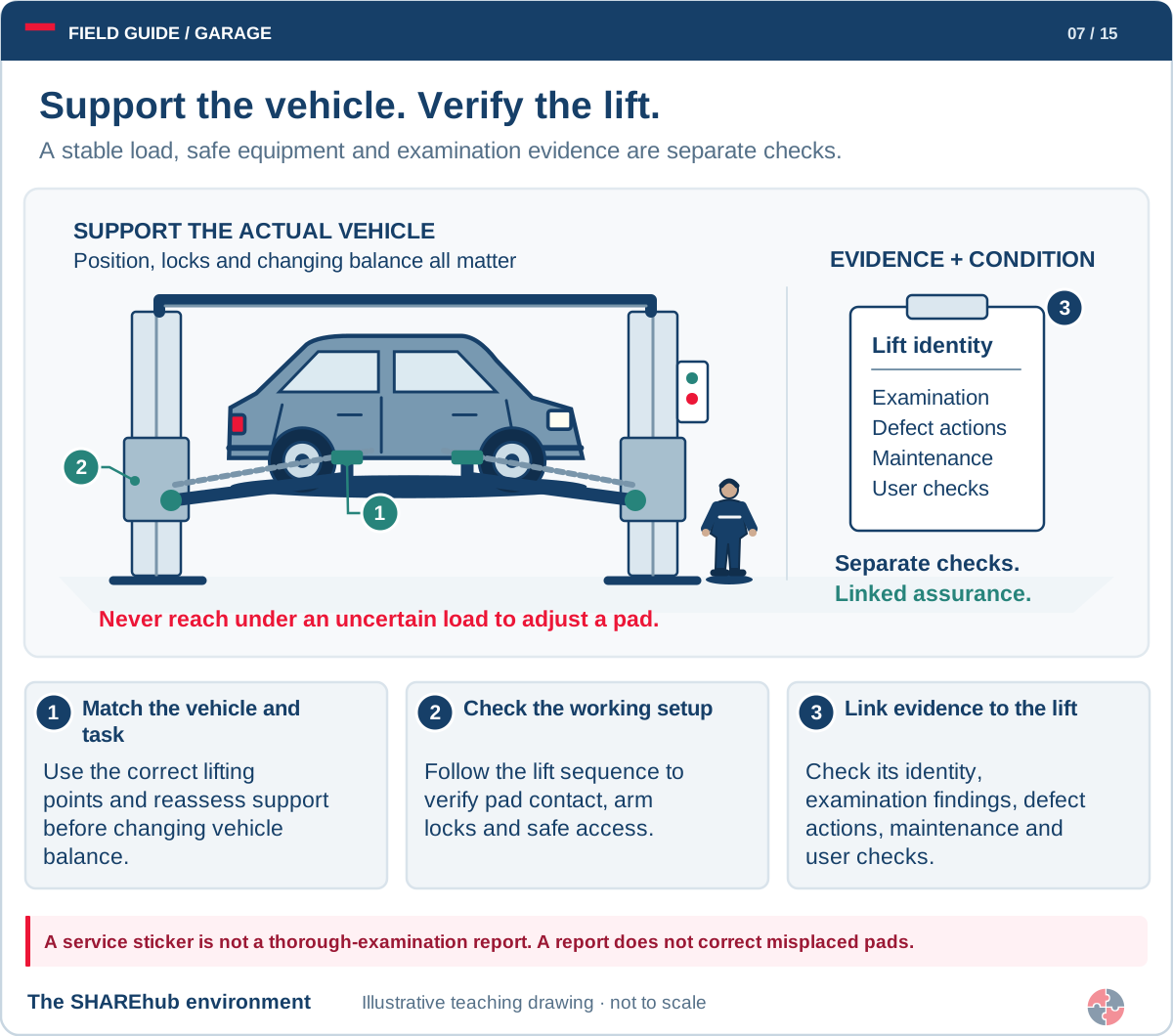
Understand the garage task
At the two-post lift, a misplaced pad and uncertain arm locking are more significant than whether the car looks level. The vehicle weight must be carried through the correct lifting points and sound equipment. A mechanic beneath the car has little chance of escaping a sudden fall. The same risk can develop later if removal of an engine, gearbox or other major component changes the vehicle’s balance.
Stop work and keep people clear when support is uncertain. A competent operator must use a vehicle-specific safe method to recover and support the load; do not reach under an unstable car to adjust a pad. The lift’s capacity, installation, condition and safety features matter alongside the chosen support points. Examination and servicing support safe equipment, but neither can compensate for incorrect positioning or an uncontrolled change to the load.
What effective control looks like
- Use the vehicle maker’s lifting information and a suitable rated lift with sound pads and support arrangements.
- Check arm locks and correct pad contact using the lift maker’s safe operating sequence before work underneath.
- Plan major component removal and reassess balance or supplementary support before changing the load.
- Restrict use to trained operators and withdraw a lift with safety-critical defects or uncertain support.
How can the hierarchy of controls prevent dropped loads and unsafe lifting operations?
Remove the need for hazardous handling where feasible, then select equipment and controls for the residual lift.
Eliminate, Reduce, Isolate, Control, Personal protective equipment (PPE) and Discipline (ERICPD) below maps to the five-level hierarchy for a motor lifted from a workshop bay. HSE lifting overview sets the planning and equipment principles. The supervisor holds the move if load identity, attachment, travel clearance or equipment condition is uncertain.
The five levels are elimination, substitution, engineering, administrative controls and PPE. “Discipline” is the sustained inspection, feedback and repair that keeps each selected level effective.
How can the ERICPD hierarchy of controls prevent dropped loads and unsafe lifting operations?
ERICPD is a planning crossmap. Its prompts do not add a sixth rung or rank Isolate above engineering. Discipline verifies and sustains every control level.
Worked activity: Task application for Load-Handling Equipment and Lifting Operations
- Activity and release context
- Eliminate, Reduce, Isolate, Control, Personal protective equipment (PPE) and Discipline (ERICPD) below maps to the five-level hierarchy for a motor lifted from a workshop bay. HSE lifting overview sets the planning and equipment principles. The supervisor holds the move if load identity, attachment, travel clearance or equipment condition is uncertain.
- Full example
- Read the activity, checks and hand-back in context
How can the ISO 45001 hierarchy of controls prevent dropped loads and unsafe lifting operations?
The hierarchy of controls in ISO 45001:2018 comes under Clause 8.1.2 (Eliminating hazards and reducing OH&S risks), which is located within Clause 8 ("Operation").
ESEAP: Elimination, Substitution, Engineering controls, Administrative controls and PPE. Control order: HSE hierarchy of controls and IOSH hierarchy of control guidance.
Worked activity: Task application for Load-Handling Equipment and Lifting Operations
- Activity and release context
- Eliminate, Reduce, Isolate, Control, Personal protective equipment (PPE) and Discipline (ERICPD) below maps to the five-level hierarchy for a motor lifted from a workshop bay. HSE lifting overview sets the planning and equipment principles. The supervisor holds the move if load identity, attachment, travel clearance or equipment condition is uncertain.
- Full example
- Read the activity, checks and hand-back in context
Verify before release
- Observe a competent operator checking the actual vehicle, pad condition, locking and support before access underneath.
- Check that instructions cover the vehicles and repair tasks used across all eight mechanical bays.
- Review a major-component job to confirm that changing balance and any additional support were planned.
Use the evidence in a repair decision
A safe lift is a controlled operation with the right support at every stage, not a stable-looking vehicle at one moment.
For this case, the observation is: A mechanic is beneath a raised car with a misplaced lifting pad and uncertain arm locking. Keep the observation distinct from an inferred cause. A vehicle can fall when support points, balance or locking are wrong. Compare the controls in the guide with what is actually present, identify the unresolved gap and state who must resolve it before the task or route is released.
Fictional applied case
A gearbox removal is about to start. The car was stable when first raised, but nobody has considered its balance after removal.
Open the interactive lesson and check →
Distinguish servicing from thorough examination
Check what the document actually proves, which asset it covers and whether its findings have been acted upon.
Understand the garage task
The lift has a recent service sticker, but the manager cannot find its report of thorough examination. A service usually maintains or replaces parts; an examination assesses safety-critical condition and produces findings that inform continued use. Treating the sticker as complete assurance can hide unresolved defects, the wrong equipment identity or a missed examination. Equally, a current report does not rule out damage that developed yesterday.
Check the actual lift’s examination arrangements, report, findings and completed defect actions before authorising use. HSE’s motor-repair guidance recommends six-monthly thorough examination of vehicle lifts. The wider LOLER framework uses equipment-specific intervals or a scheme drawn up by a competent person; do not apply one interval blindly to every item in the garage. Keep routine checks, maintenance and safe-use training operating alongside the examination regime.
What effective control looks like
- Link the lift’s unique identity to accessible examination reports, maintenance records and the applicable examination arrangements.
- Arrange a competent thorough examination and act on defects within the restrictions and times specified.
- Prevent unsafe use when condition or essential examination evidence cannot be established; escalate to the responsible manager.
- Retain operator checks and planned maintenance rather than treating examination as a replacement for either.
Why does a satisfactory examination report not release every lifting task?
Examination, maintenance, user checks and lift planning answer different questions. A thorough examination records the competent examiner’s findings within its scope and date. It does not select the machine for today’s load, establish the floor condition or prove that the current rigging arrangement is correct. Related guidance: Thorough examination of lifting equipment.
Match the report to the actual asset and accessories and read defects, due dates and any examination scheme. A report for a similar hoist or an accessory with a different identity is not evidence for the item being used. A serious defect needs the response required by the applicable law and competent examiner, not an administrative extension because replacement equipment is late. Related guidance: Thorough examination of lifting equipment.
A newly damaged sling remains held even if its next periodic examination is months away. Conversely, ordinary maintenance is not itself the statutory thorough examination. Where exceptional damage, failure, installation or other circumstances raise an examination requirement, obtain the competent decision for that equipment and applicable legal route before relying on it. Related guidance: Thorough examination of lifting equipment.
The person undertaking examination needs the relevant theoretical and practical equipment competence and sufficient independence and impartiality. HSE distinguishes this role from the person doing routine maintenance to avoid assessing their own maintenance. Do not treat an employer job title as evidence of that competence. Record the actual report, defect response and equipment release; separately verify the task-specific lift plan. Related guidance: Thorough examination of lifting equipment.
Guidance for these decisions: Thorough examination of lifting equipment; LOLER overview; Safe lifting by machine. Apply the legal route for the work location; illustrative scenarios are SHARE teaching examples.
Verify before release
- Match report identity and scope to the physical lift, including relevant safety-critical parts and findings.
- Check the due arrangement and evidence that required defect repairs were completed before release.
- Observe operator checks and review recent damage or changes that may require additional competent assessment.
Use the evidence in a repair decision
Check what the document actually proves, which asset it covers and whether its findings have been acted upon.
For this case, the observation is: The lift has a maintenance sticker, but its thorough-examination report cannot be found. Keep the observation distinct from an inferred cause. Servicing and statutory thorough examination serve different purposes; one does not replace the other. Compare the controls in the guide with what is actually present, identify the unresolved gap and state who must resolve it before the task or route is released.
Fictional applied case
A booking is waiting and the service contractor says the lift was lubricated last week. The thorough-examination report remains unavailable.
Open the interactive lesson and check →
Recognise the stored-energy system behind the air tools
Pressure safety depends on limits, protective devices, competent examination and safe maintenance of the real system.
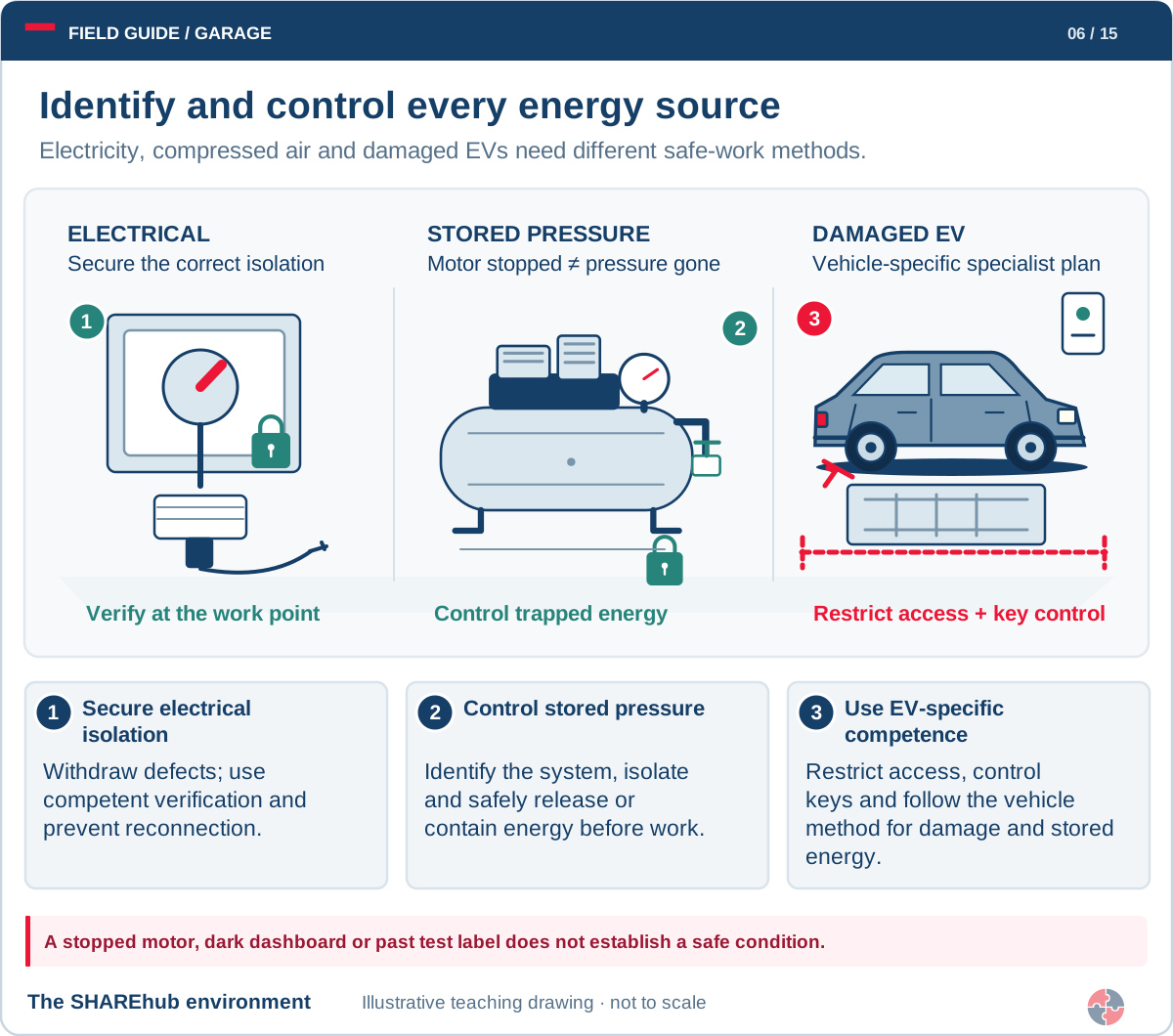
Understand the garage task
The compressor receiver supplies several workshop tasks, but its gauge is damaged and examination information is unavailable. The receiver stores energy even between compressor cycles. A failure can release fragments, high-pressure air or a whipping hose, affecting people well beyond the person using an air tool. Stopping the motor does not by itself prove that the vessel and connected pipework are depressurised.
Withdraw unsafe equipment and arrange competent action. The responsible person must establish the system’s safe operating limits and whether pressure-system written-scheme requirements apply, then have the relevant parts examined accordingly. Routine servicing, pressure-system examination and user checks serve different purposes. Repair work requires a planned isolation and release of stored pressure; loosening a fitting to find out whether pressure remains is not an acceptable verification method.
What effective control looks like
- Identify the receiver, protective devices and connected system, with safe operating limits available to responsible staff.
- Use competent advice to establish the applicable written scheme and ensure examinations are completed and findings resolved.
- Maintain gauges, relief protection, hoses and couplings and provide a clear defect-reporting and withdrawal process.
- Plan competent isolation, depressurisation and verified safe conditions before maintenance; control restart and handback.
What is a written scheme of examination?
For a qualifying pressure system, the user or owner must have a suitable written scheme before operation; a competent person draws it up or certifies it, and it identifies covered parts, examination methods, intervals and preparation for safe examination. Before first use of a qualifying system, the written scheme must be in place and the required examination undertaken; keep the system out of use until both are satisfied.
The scheme must cover protective devices and relevant vessels or pipework whose failure could cause danger, subject to the applicable legal text and competent scope decision. It is not a maintenance schedule, a generic certificate or proof that an examination has happened. See HSE L122 Safety of pressure systems.
How does pressure-system examination work?
The system parts in the written scheme must be examined by a competent person in accordance with that scheme, with reports and actions that show whether continued use is safe.
The competent person needs suitable knowledge, resources, independence and authority for the actual system. Examination does not replace operator checks, maintenance, safe limits, protective devices or correct repair. Do not infer intervals from a generic boiler or compressor example.
Sources: HSE L122 Safety of pressure systems; HSE Pressure Systems Safety Regulations overview; Pressure Systems Safety Regulations 2000; Pressure Systems Safety Regulations Northern Ireland 2004; HSENI L122 approved for use in Northern Ireland
Verify before release
- Match the examination arrangement and records to the actual receiver and relevant connected components.
- Check that safety-critical defects, including the damaged gauge, are resolved before authorised return to use.
- Ask staff to explain the defect response and verify that motor shutdown is not being mistaken for pressure release.
Use the evidence in a repair decision
Pressure safety depends on limits, protective devices, competent examination and safe maintenance of the real system.
For this case, the observation is: The air receiver has a damaged gauge and no accessible examination information. Keep the observation distinct from an inferred cause. Failure can release stored energy, fragments or whipping hoses. Compare the controls in the guide with what is actually present, identify the unresolved gap and state who must resolve it before the task or route is released.
Fictional applied case
Air tools become sluggish during a busy shift. A worker proposes increasing receiver pressure while another begins replacing the damaged gauge.
Open the interactive lesson and check →
Separate powered-tool exposure from final torque accuracy
A correctly tightened wheel and a controlled vibration/noise exposure require separate, connected checks.
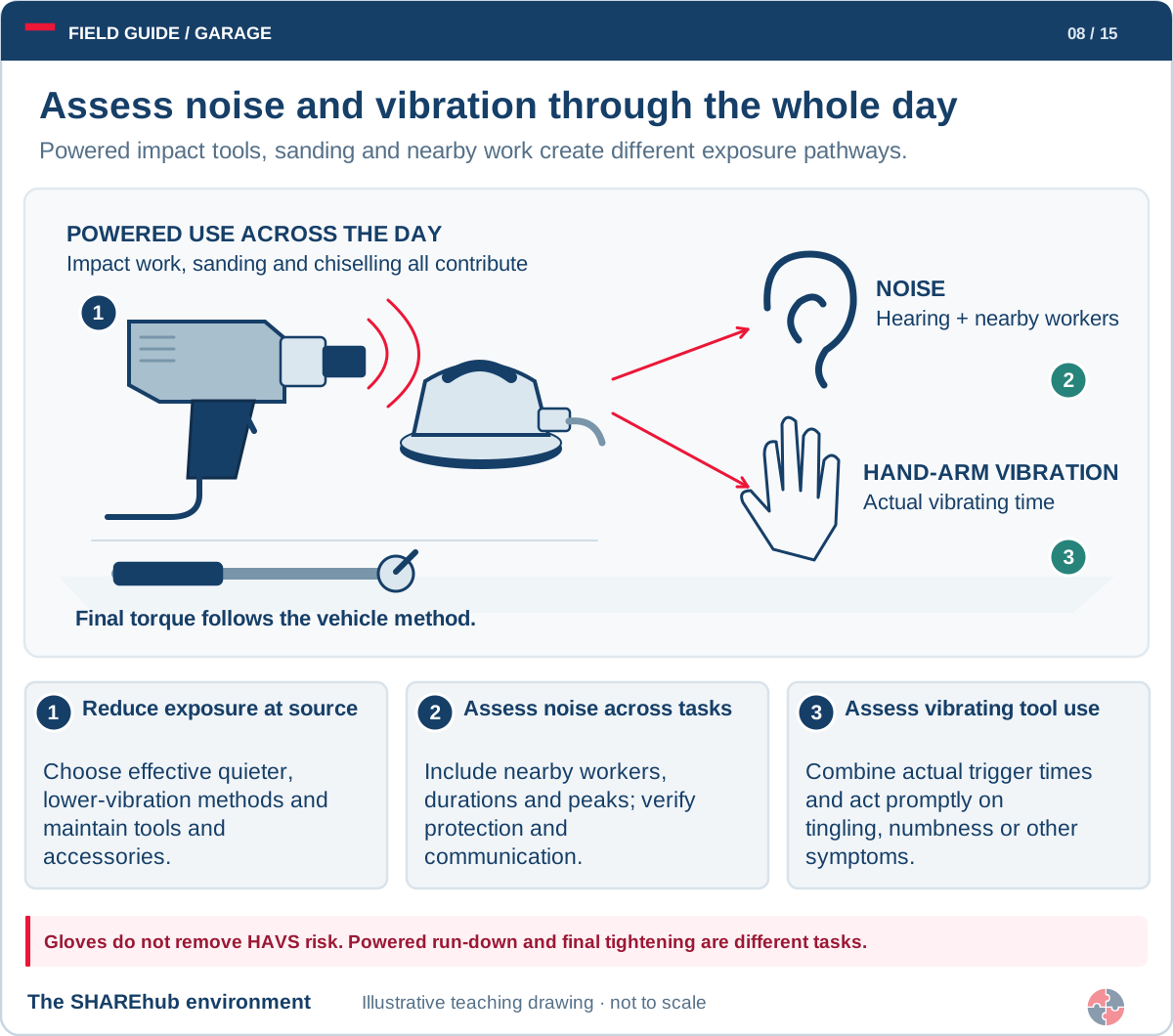
Understand the garage task
The wheel-work bay combines repeated powered impact use with rushed final tightening. Those are related but different decisions. An impact wrench transmits vibration and noise during powered operation; a manual torque wrench has different handling and accuracy considerations. Selecting the right final torque method does not automatically control the day’s accumulated vibration from wheel work, sanding or other powered tools.
Use the vehicle maker’s wheel-fastening procedure and suitable maintained equipment. Assess hand-arm vibration using credible tool data and realistic contact or trigger times across the person’s tasks. Look first for methods and suitable lower-vibration tools that reduce exposure, then organise remaining work and respond to early symptoms. Gloves cannot be relied on to prevent HAVS. Noise also reaches nearby workers, so its assessment and controls should reflect the bay’s combined operations.
What effective control looks like
- Follow the vehicle maker’s fastening sequence and specified final torque process with suitable maintained equipment.
- Select effective lower-vibration tools and keep sockets, consumables and air supply appropriate to the tool.
- Estimate exposure from actual powered use across all tools, including busy days, and reduce it at source.
- Provide training, early symptom reporting and indicated health surveillance; manage remaining noise with assessed controls.
How should stronger source controls be chosen?
Start by avoiding the hazardous task or release, then use suitable substitution and physical controls before relying on work rules or personal protection.
The order guides a decision; the actual control depends on this task, the people exposed and what a change could introduce. A supervisor should observe the control during real work, hold a failed task and obtain a competent release after correction. HSE guidance for this control decision
Verify before release
- Observe a real wheel job and distinguish powered run-down from the required final torque procedure.
- Compare the exposure assessment with actual tools, contact time and additional vibrating tasks performed that day.
- Check that maintenance and health-surveillance actions lead to work changes where needed, with clinical details kept confidential.
Use the evidence in a repair decision
A correctly tightened wheel and a controlled vibration/noise exposure require separate, connected checks.
For this case, the observation is: A powered impact wrench is used repeatedly and final wheel tightening is being rushed. Keep the observation distinct from an inferred cause. Powered impact tools transmit vibration and noise. A manual torque wrench has different ergonomic and accuracy concerns. Compare the controls in the guide with what is actually present, identify the unresolved gap and state who must resolve it before the task or route is released.
Fictional applied case
A technician completes several wheel jobs with an impact wrench, then uses a manual torque wrench correctly. They also used a sander earlier.
Open the interactive lesson and check →
Act on damage before the next electrical test date
Inspect the equipment in front of you; a past test never excuses a present defect.
Understand the garage task
The inspection lamp’s cable is crushed where it crosses an oily work area. A person handling the lamp may contact damaged insulation, while the trailing lead is also vulnerable to further crushing and can obstruct movement. Electrical equipment in a garage experiences impacts, liquids, sharp edges and frequent relocation. A test label describes a previous check; it cannot establish that a newly damaged cable remains safe.
Take the lamp out of use, prevent reconnection and report the defect for competent repair or replacement. Do not tape over damage and continue. Then improve the equipment selection and lead route so the same failure does not recur. User checks, formal visual inspection and electrical testing address different faults and should follow the actual risk and equipment conditions. There is no universal annual portable-appliance-test interval that makes every workshop item safe.
What effective control looks like
- Provide suitable lighting for the task and environment, considering an appropriate safer supply or battery-powered option.
- Route or support leads away from vehicle wheels, sharp edges, oils and pedestrian movement.
- Train users to stop, safely disconnect or isolate and report visible damage before further use.
- Use competent repair and a risk-based maintenance system that responds to defects, movement and workshop conditions.
Why is annual PAT testing alone not enough?
A worked example shows why the maintenance system matters more than the sticker.
A construction contractor has all tools tested every January. In March, an angle grinder is dropped, the cable is damaged, and the plug is pulled by the cable each day. The tool still has a valid test sticker, so workers keep using it. The weakness is not the test; it is the absence of user checks, defect reporting, supervision and quarantine.
The competent response is to train users on pre-use checks, inspect high-risk tools frequently, quarantine damaged equipment immediately, repair or dispose through a competent route, review storage and cable routing, and use defect trends to improve procurement and supervision.
Download comparison table (PDF · A4 landscape)
Operational example and hold points
Task material and setting: Cleaning contractor uses a mains floor polisher at a wet entrance; supply, rating and cable route matter.
People and prerequisites: User, supervisor, competent electrical maintainer and nearby pedestrians; product information and suitable supply are available.
Before: Confirm suitability, route lead away from water and traffic, check plug/casing/lead and inspection history.
During: Keep lead dry and protected, watch for damage or protective-device trips, keep others clear.
Hold or stop: Crushed or exposed cable, wet connection or repeated trip; disconnect and quarantine.
Completion and hand back: Competent repair/inspection/test where needed, then supervisor releases the machine for use.
Evidence: Equipment specification, risk assessment, user check, defect quarantine, repair/test and return-to-use decision.
Safe stop before quarantine
Stop use and isolate from the supply only if this can be done without touching wet or damaged live parts. Otherwise keep people away and obtain competent help. Quarantine follows safe isolation; do not reach for a hazardous plug simply to attach a label.
Verify before release
- Confirm the damaged lamp cannot be borrowed or reconnected while awaiting repair or disposal.
- Check the replacement arrangement during an actual under-vehicle task, including lighting quality and lead protection.
- Review defect patterns and inspection arrangements after repeated damage instead of relying only on test stickers.
Use the evidence in a repair decision
Inspect the equipment in front of you; a past test never excuses a present defect.
For this case, the observation is: A portable lamp has a crushed cable crossing an oily work area. Keep the observation distinct from an inferred cause. Damaged insulation can expose users to electric shock; the cable is also a trip and damage hazard. Compare the controls in the guide with what is actually present, identify the unresolved gap and state who must resolve it before the task or route is released.
Fictional applied case
A mechanic points to a current test sticker and suggests wrapping the crushed cable in insulating tape to finish the job.
Open the interactive lesson and check →
Capstone: decide whether the job may proceed
Combine the observations, restrictions and verification into one justified work decision.
Read the whole case before releasing a part
A gearbox is to be removed from a vehicle on a two-post lift. One pad is close to damaged sill material. The only document available is a recent service invoice. An air receiver has also been modified, and the team proposes using a frayed inspection lamp to finish before closing.
Keep the affected work unavailable until competent checks establish the vehicle support, relevant examination evidence and safe equipment condition for this job.
Separate immediate protection from the investigation of causes. Use factual observations, the actual equipment and task information, and the appropriate competent roles. Where the evidence is missing, keep the affected operation restricted rather than treating uncertainty as permission.
Build the release evidence
- Incorrect support on the two-post lift: A trained operator confirms the vehicle-specific support points, sound pads, engaged locks and stability before work underneath, and reassesses balance when major components are removed.
- A service sticker is mistaken for a lift examination: The responsible manager verifies the current competent-person examination report, due date and defect actions, alongside evidence that operators perform checks and maintenance is effective.
- Compressed-air receiver and stored pressure: A competent person checks safe operating limits, protective devices and examination findings; the manager confirms defects are resolved and unsafe equipment remains isolated.
- Powered impact use and final wheel torquing: A competent supervisor observes actual tool use and trigger time, checks the exposure assessment against the task, and verifies the final torque procedure is followed.
- A damaged inspection-lamp cable: A competent person confirms repair or replacement is safe; the supervisor checks that the faulty lamp was withdrawn and the replacement lead is protected from damage.
Make the handover usable
State what may proceed, what remains held, who owns each unresolved issue and the evidence required to change the decision. Ask the next person to explain the restriction in their own words. Record a defined review point and communicate any change to affected colleagues, contractors and visitors. A form is useful only when it represents the actual arrangement.
Fictional applied case
A gearbox is to be removed from a vehicle on a two-post lift. One pad is close to damaged sill material. The only document available is a recent service invoice. An air receiver has also been modified, and the team proposes using a frayed inspection lamp to finish before closing.
Open the interactive lesson and check →
Take the learning into a real briefing
Turn the selected control into a clear question, observation and review trigger.
Prepare a short toolbox conversation
Choose one relevant task from this course. Describe its current scope, then ask a colleague to identify the people exposed and the control that must work. Avoid asking only whether everyone understands: a useful response explains the action and what would make the job stop.
Use vehicle-specific lifting points, rated equipment, sound pads, arm locks and trained operators.
For the fictional exercise below, write the observation, harm pathway, immediate protection, responsible role and evidence needed before release. Use the packaged worksheet; do not enter real personal or company information or submit an operational record.
Check the claim against the workplace
- A trained operator confirms the vehicle-specific support points, sound pads, engaged locks and stability before work underneath, and reassesses balance when major components are removed.
- The responsible manager verifies the current competent-person examination report, due date and defect actions, alongside evidence that operators perform checks and maintenance is effective.
- A competent person checks safe operating limits, protective devices and examination findings; the manager confirms defects are resolved and unsafe equipment remains isolated.
- A competent supervisor observes actual tool use and trigger time, checks the exposure assessment against the task, and verifies the final torque procedure is followed.
- A competent person confirms repair or replacement is safe; the supervisor checks that the faulty lamp was withdrawn and the replacement lead is protected from damage.
Follow up the change
Arrange a proportionate check after the control is used in representative conditions. If the observation contradicts the claimed protection, retain the restriction, report the discrepancy and revisit the assessment. Keep course completion separate from permission to perform specialist work.
Fictional applied case
A gearbox is to be removed from a vehicle on a two-post lift. One pad is close to damaged sill material. The only document available is a recent service invoice. An air receiver has also been modified, and the team proposes using a frayed inspection lamp to finish before closing.
Open the interactive lesson and check →
