Read the complete lesson, revisit the model tasks and compare your decisions with explained answers. The readable route includes every core screen and the optional deeper explanations.
Reading and practice: this page does not submit an assessment, award a certificate or record LMS completion. Use SHARElms for saved assessed learning. The compact interactive course is planned for 45–60 minutes; reading every optional panel here adds time.
Recognise hand-held, hand-guided and held-workpiece exposure, and distinguish HAV from HAVS and whole-body vibration.
Connect repeated hand-transmitted vibration with circulation, sensation and hand function, without diagnosing from symptoms or a model.
Explain the main Great Britain duties and correctly interpret the action and limit values.
Use representative magnitude and actual contact time to combine a person’s daily exposure contributions.
Apply ESEAP and the Knowledge Hub’s ERICPD planning prompts to grinding and concrete-breakout decisions, including verification and stop/restart conditions.
Respond promptly and supportively to symptoms, changed work or failed controls, and implement occupational-health work advice.
Start with prevention and the law
4 minutes in the compact interactive route, including its activities. Extra reading is optional.
M1-S1
Why this course starts with prevention
Your hands connect the job to the rest of your life: fastening a button, holding a cup or feeling a small component. Hand-transmitted vibration can put those abilities at risk. The aim is to prevent harm before symptoms become familiar.
The Control of Vibration at Work Regulations 2005 apply to this course’s Great Britain framework. Employers must assess the risk and eliminate it at source where reasonably practicable, or reduce it as low as reasonably practicable. Assessment should produce a better method and practical controls, not only a number on a form.
The purpose is to prevent harm; the exposure estimate supports that purpose.
More context (optional)
You will work through a technician’s day, inspect the original hand model, calculate a fictional daily total and make control decisions. Keep your own work in mind, but use the fictional cases rather than entering personal medical information.
A prevention programme links the work assessment, effective controls, information and training, appropriate health surveillance, and review. Workers need a method they can follow and a clear way to report symptoms, defects or changed conditions.
A supervisor checks that the agreed equipment and method are achievable today. The employer remains responsible for the assessment and control arrangements. A competent assessor supplies suitable exposure evidence; occupational-health professionals advise on health and work restrictions.
Assess the actual work and record significant findings.
Implement and verify effective controls.
Inform, instruct, train and consult people.
Provide appropriate health surveillance.
Review changes, concerns and control effectiveness.
More context (optional)
Health surveillance supports prevention by identifying concerns and informing control review. It does not make an uncontrolled task acceptable. Likewise, attending training or completing a questionnaire does not remove the duty to control exposure.
The exposure action value is 2.5 m/s² A(8), equivalent to 100 exposure points. Reaching or exceeding it triggers a planned programme to reduce exposure. The exposure limit value is 5.0 m/s² A(8), equivalent to 400 points, and must not be exceeded in normal daily planning.
Neither value guarantees that a person will remain free of harm. Below 100 points, practical prevention and responses to symptoms still matter. Between 100 and 400, a planned reduction programme is required; being below the limit does not authorise unchanged work.
If exposure exceeds the limit, act immediately to bring it below the limit, find the cause and prevent recurrence. This course uses daily planning; unusual statutory provisions require competent specialist consideration, not a way to average away a poor day.
PRACTISE YOUR UNDERSTANDING
A report estimates daily exposure below the action value. A worker reports new numbness. What follows?
The estimate proves the work is safe; no action is needed.
Review the exposure and arrange appropriate health advice.
Wait for the next annual questionnaire.
Compare your answer and the explanation
Best response: Review the exposure and arrange appropriate health advice.
Correct. Values guide action; credible symptoms still need attention.
The estimate proves the work is safe; no action is needed.
An estimate does not explain symptoms or guarantee individual safety.
Review the exposure and arrange appropriate health advice.
Act on the concern while checking the work and the estimate.
Wait for the next annual questionnaire.
A new concern should be reported and considered promptly.
These reader activities are for practice and self-checking. Use the assessed course for recorded progress, scored submissions and completion.
A completed assessment, training record and inspection label are useful inputs. The plan must still match today’s production demands and actual contact time.
Prevention needs the roles to connect. Workers report what is happening; assessors check exposure evidence; managers make the method workable; health professionals advise on individual work needs. No one should expect the worker to diagnose a condition or tolerate symptoms to finish a job.
More context (optional)
Imagine that a supervisor has a completed assessment, a worker has received training and the tool has a current inspection label. Those are useful inputs, but the task can still fail if production demands require longer tool contact than the plan allows.
PRACTISE YOUR UNDERSTANDING
Match each action with the role that should lead it.
Drag each card to a destination, or select a card and choose its labelled destination. Then check your matches.
Destinations: Employer / manager; Worker; Competent exposure assessor; Occupational-health professional
Provide a workable control programme and act on restrictions.
Use the agreed method and report unusual vibration or symptoms.
Check that magnitude and contact-time evidence represents the job.
Assess health concerns and advise on fitness or restrictions.
Compare your answer and the explanation
Card
Match
Why
Provide a workable control programme and act on restrictions.
Employer / manager
The employer puts resources, methods and controls in place.
Use the agreed method and report unusual vibration or symptoms.
Worker
Reporting helps the system respond before more exposure occurs.
Check that magnitude and contact-time evidence represents the job.
Competent exposure assessor
Competent assessment explains the data and its uncertainty.
Assess health concerns and advise on fitness or restrictions.
Occupational-health professional
Clinical judgement and confidential medical detail belong with the appropriate health professional.
These reader activities are for practice and self-checking. Use the assessed course for recorded progress, scored submissions and completion.
Locate the index finger in the whole hand. The separate cutaway enlarges skin, bones, vessels and nerves; colours distinguish the structures.
Keep circulation, sensation and movement distinct. Which tool or work-method change would reduce the exposure described here?
educational illustration · healthy anatomy; enlarged details and teaching colours.
Hand–arm vibration, or HAV, is mechanical vibration transmitted into the hands and arms through contact during work. Hand–arm vibration syndrome, or HAVS, describes a group of health effects associated with repeated hand-transmitted exposure.
Risk depends on the exposure, work conditions and person. Support the worker who reports symptoms; do not blame them.
Whole-body vibration enters mainly through a supporting surface such as a seat or the feet. It has its own assessment criteria. A vehicle operator’s seat exposure should not be added to hand–arm exposure points.
Hazard
A source or situation with potential to cause harm.
Exposure
Contact with vibration: its magnitude and duration in the work.
Harm
An adverse health or functional effect.
Risk
The likelihood and seriousness of harm in the circumstances.
More context (optional)
A vibrating source is the hazard. Risk depends on the exposure and circumstances, including the work pattern, equipment condition and the person. The worker with symptoms is not the hazard and should not become the target of blame.
Do not search only for large breakers. Rotary sanders, impact tools, cutting tools and powered outdoor equipment can all create relevant hand contact. A fixed machine can also create HAV when the person holds a vibrating workpiece against it.
Ask which part of the hand touches what, whether the contact is vibrating and for how long. Consider both hands and changes in grip. A bystander may face dust, noise or flying material, but the HAV route normally requires physical contact with the source or workpiece.
PRACTISE YOUR UNDERSTANDING
Where does vibration enter in each example?
Drag each card to a destination, or select a card and choose its labelled destination. Then check your matches.
Destinations: Hand-held tool; Hand-guided equipment; Held workpiece; Whole-body route
A technician holds a powered sander against a panel.
A grounds worker guides a powered mower by its handles.
A fabricator holds a component against a pedestal grinder.
A driver receives vibration through a vehicle seat.
Compare your answer and the explanation
Card
Match
Why
A technician holds a powered sander against a panel.
Hand-held tool
The hand contacts the vibrating tool.
A grounds worker guides a powered mower by its handles.
Hand-guided equipment
The hands receive vibration through the controls.
A fabricator holds a component against a pedestal grinder.
Held workpiece
The component can carry vibration into the hand even when the machine is stationary.
A driver receives vibration through a vehicle seat.
Whole-body route
This is a separate whole-body route and is assessed separately.
These reader activities are for practice and self-checking. Use the assessed course for recorded progress, scored submissions and completion.
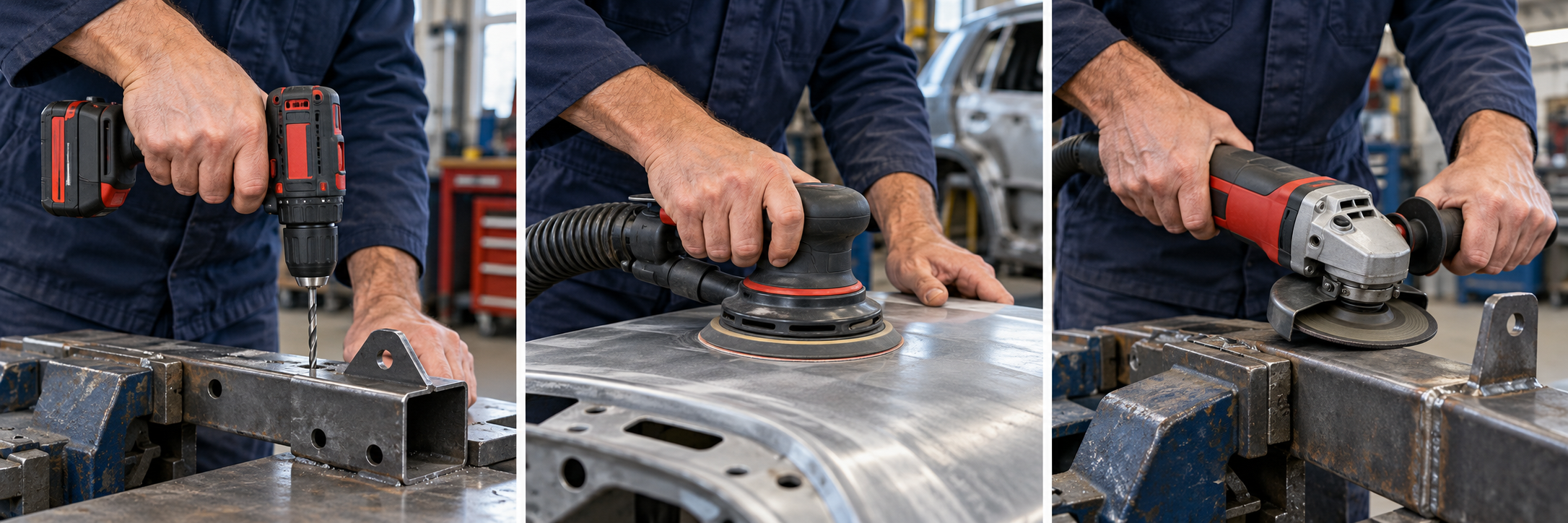
A technician drills a bracket, sands a panel and later grinds a repair. None of those task names tells you the daily exposure on its own. Every relevant tool or process contributes to the same person’s day.
Use representative vibration and actual contact time for each operation. Short maintenance jobs, overtime and unusual repairs can be missed when an assessment uses only a tidy average day. Ask the people doing the work to describe ordinary and demanding shifts.
Three staged non-operating workshop demonstrations with a drill, sander and grinder; the same technician across the tasks.
Drilling · Sanding · Grinding
Every tool contributes to the same person’s daily exposure.
More context (optional)
The images show staged, non-operating demonstrations. They illustrate the work pattern; they are not evidence of a tool’s vibration value or instructions for carrying out the task.
PRACTISE YOUR UNDERSTANDING
Which uses belong in this technician’s hand–arm daily exposure review?
Select all that apply.
The morning drill task.
Short sanding bursts between other jobs.
The later grinding task.
Forklift seat vibration, added into the same HAV points.
An unexpected impact-wrench job added near the end of the shift.
Compare your answer and the explanation
Best responses: The morning drill task. Short sanding bursts between other jobs. The later grinding task. An unexpected impact-wrench job added near the end of the shift.
Correct. Include all relevant hand-transmitted contributions for that person’s day.
The morning drill task.
Include representative magnitude and actual contact time.
Short sanding bursts between other jobs.
Short bursts can contribute to the same daily total.
The later grinding task.
Changing tools does not reset the day.
Forklift seat vibration, added into the same HAV points.
Seat exposure is whole-body vibration and needs separate assessment.
An unexpected impact-wrench job added near the end of the shift.
Unplanned work can invalidate the original total.
These reader activities are for practice and self-checking. Use the assessed course for recorded progress, scored submissions and completion.
A task plan describes conditions; it is not permanent permission. Harder material, unexpected reinforcement, worn consumables or rising production demand may change vibration and time. Unusual vibration can also indicate a defect.
The response should be practical: pause, make the equipment safe under the task procedure and get the method reviewed by the right person. Do not rescue an unsuitable method by applying more force or accepting longer contact without reassessment.
PRACTISE YOUR UNDERSTANDING
A short drilling task meets harder material. The bit is worn and the worker pushes harder. What should happen first?
Keep the old time allowance because the model number is unchanged.
Pause and review the method, accessory, representative vibration and contact time.
Move the worn tool to another worker without checking either person’s total.
Compare your answer and the explanation
Best response: Pause and review the method, accessory, representative vibration and contact time.
Correct. A changed job needs a decision before more exposure.
Keep the old time allowance because the model number is unchanged.
The conditions have changed even if the tool identity has not.
Pause and review the method, accessory, representative vibration and contact time.
Restore a suitable, achievable method before more work.
Move the worn tool to another worker without checking either person’s total.
Sharing exposure without a revised plan is not a control.
Consequences to consider
More force and prolonged contact can invalidate the estimate.
Arrange a suitable accessory or method and verify the revised plan.
The defect remains and another person acquires exposure.
What evidence would you want before restart?
Suitable equipment and method, representative inputs, achievable limits, control checks and a person authorised to accept the revised method.
These reader activities are for practice and self-checking. Use the assessed course for recorded progress, scored submissions and completion.
Locate the index finger in the whole hand. The separate cutaway enlarges skin, bones, vessels and nerves; colours distinguish the structures.
Keep circulation, sensation and movement distinct. Which tool or work-method change would reduce the exposure described here?
educational illustration · healthy anatomy; enlarged details and teaching colours.
Vibration reaches the hand through contact with a tool, control or workpiece. Repeated exposure can affect blood vessels, peripheral nerves and hand function. Magnitude and duration matter, along with practical factors such as grip demands, posture, cold and susceptibility.
Vessels supply tissue with blood. Sensory nerves carry information about touch. Muscle and tendon function helps translate control into movement and grip. One person can experience several effects, but a teaching image cannot predict diagnosis or severity.
Controls can interrupt the chain at the source, contact route or duration. This image is illustrative anatomy.
Hand gripping a handle beside an entire open hand and forearm with vessels and nerves visible through transparent skin. Illustrative anatomy.
Contact transmits vibration · Blood vessels and peripheral nerves
Repeated exposure can affect circulation, sensation and hand function.
More context (optional)
Interrupting the chain at its source, contact route or duration can reduce risk. The illustration is an anatomy teaching aid, not a clinical photograph or an image of diagnosed damage.
Cold-triggered finger whitening can indicate a vascular concern. Tingling, numbness and reduced touch can indicate a sensory concern. Symptoms may overlap and have other causes.
People may describe ordinary consequences: dropping a fastener, struggling with a zip or not trusting their grip. Do not dismiss a report because the task was completed or the hand looks normal.
The useful response is prompt reporting and appropriate assessment, together with an exposure review. Do not wait for a dramatic colour change or assume that symptoms prove HAVS.
More context (optional)
Vascular symptoms can include episodes in which fingers become white, often in cold or damp conditions, and pain as colour returns. Neurological symptoms can include tingling, numbness, reduced touch and difficulty handling small parts. These patterns may overlap and have other causes.
PRACTISE YOUR UNDERSTANDING
Which statements about circulation and sensory effects are appropriate?
Select all that apply.
Cold-triggered finger whitening can be a circulation warning sign.
Tingling can matter even when fingers have never turned white.
A normal-looking hand proves that nerves are healthy.
Warm gloves remove the need to control vibration.
Loss of feeling can make small components harder to handle.
Compare your answer and the explanation
Best responses: Cold-triggered finger whitening can be a circulation warning sign. Tingling can matter even when fingers have never turned white. Loss of feeling can make small components harder to handle.
Correct. Circulation, sensation and hand function need distinct explanations.
Cold-triggered finger whitening can be a circulation warning sign.
A colour change needs assessment; the course does not diagnose its cause.
Tingling can matter even when fingers have never turned white.
Sensory effects do not depend on visible blanching.
A normal-looking hand proves that nerves are healthy.
Appearance cannot establish sensory health.
Warm gloves remove the need to control vibration.
Warmth helps cold protection; it does not remove exposure.
Loss of feeling can make small components harder to handle.
Sensation and dexterity matter to reliable hand use.
These reader activities are for practice and self-checking. Use the assessed course for recorded progress, scored submissions and completion.
Recognising a warning sign is a work-safety skill. Diagnosing a condition is a clinical task. This distinction lets you respond early without attaching an unsupported label to a colleague.
Listen, identify affected tasks and arrange appropriate advice. Consider current work needs for reliable grip and sensation; do not ask someone to prove symptom tolerance.
More context (optional)
Each observation in the matching exercise illustrates a system. The associations are not diagnostic criteria.
A supervisor should listen, note the affected tasks and arrange the reporting and assessment route. Consider whether reliable sensation and grip are needed for current work, and seek appropriate work advice. Avoid asking someone to prove they can tolerate pain or numbness.
PRACTISE YOUR UNDERSTANDING
Match the observation to the main system or effect it illustrates.
Drag each card to a destination, or select a card and choose its labelled destination. Then check your matches.
Destinations: Circulation; Sensation; Hand function
Fingers go white during a cold-triggered episode.
Difficulty feeling a small washer between finger and thumb.
Grip feels unreliable when holding a tool or cup.
Pins and needles after tool use without visible whitening.
Compare your answer and the explanation
Card
Match
Why
Fingers go white during a cold-triggered episode.
Circulation
This illustrates restricted circulation; the cause needs assessment.
Difficulty feeling a small washer between finger and thumb.
Sensation
Touch information depends on the sensory system.
Grip feels unreliable when holding a tool or cup.
Hand function
Functional changes matter to everyday life and may involve several causes.
Pins and needles after tool use without visible whitening.
Sensation
A sensory concern can occur without an obvious vascular sign.
These reader activities are for practice and self-checking. Use the assessed course for recorded progress, scored submissions and completion.
The palm-side cutaway reveals tendons, a nerve and the band across the wrist. The enlarged detail helps distinguish the structures discussed in this lesson.
Locate the tendons and nerve at the wrist. Which force, repetition, reach or recovery demand should the task assessment examine?
educational illustration · healthy anatomy; enlarged details and teaching colours.
Carpal tunnel syndrome, or CTS, involves pressure on the median nerve at the wrist. It can produce tingling, numbness, pain or weakness and may be worse at night. CTS is not another name for every neurological HAVS effect.
Your role is to recognise a concern, report it and help implement suitable controls and work advice. Do not self-diagnose or make a fixed recovery promise.
More context (optional)
Clinical assessment distinguishes the cause and individual needs. CTS may have treatment options such as splinting, injection or surgery when appropriate; these are not general treatments for established vibration-related vascular or sensory damage.
PRACTISE YOUR UNDERSTANDING
A worker has night-time tingling and weak grip. Which statement is most accurate?
This confirms a particular HAVS stage.
It must be CTS caused only by vibration.
Report and obtain assessment; CTS and vibration-related effects need to be distinguished.
Compare your answer and the explanation
Best response: Report and obtain assessment; CTS and vibration-related effects need to be distinguished.
Correct. Similar symptoms may have different explanations and management needs.
This confirms a particular HAVS stage.
Symptoms and an image cannot establish diagnosis or stage.
It must be CTS caused only by vibration.
Several conditions can cause symptoms; CTS has multiple risk factors.
Report and obtain assessment; CTS and vibration-related effects need to be distinguished.
Assessment establishes the cause and relevant work advice.
These reader activities are for practice and self-checking. Use the assessed course for recorded progress, scored submissions and completion.
Locate the index finger in the whole hand. The separate cutaway enlarges skin, bones, vessels and nerves; colours distinguish the structures.
Keep circulation, sensation and movement distinct. Which tool or work-method change would reduce the exposure described here?
educational illustration · healthy anatomy; enlarged details and teaching colours.
Explore the original SHAREknowledge hand model rather than a replacement animation. The first task is to distinguish circulation from sensation and movement. Use its named buttons if selecting a small structure in the 3D view is difficult.
More context (optional)
The teaching motion is simplified. Blood-flow dots and nerve cues represent different systems. They are not measurements, diagnostic findings or stages that every exposed person will pass through. You can complete the same learning with the labelled 2D explanation.
PRACTISE YOUR UNDERSTANDING
Trace blood supply and sensory information in the original SHAREknowledge model.
Open the model and choose Load 3D, or use the 2D lesson if preferred. Start in Normal function, then Circulation.
Use the named-part list to select Digital artery (HV-02), Small-vessel network (HV-03) and Venous return (HV-04). Follow supply, tissue circulation and return. Zoom is optional.
Choose Sensation and movement. Select Sensory nerve (HV-05), Fingertip sensation (HV-06), and Muscle and tendon (HV-07). Read the named explanations.
Compare the separate vascular and sensory examples under Damage and effects. These are different components, not a sequence of disease stages.
Complete the same learning using text
Arteries supply blood to finger tissue. The small-vessel network serves the tissue and veins return blood.
Sensory nerves carry information about touch. Muscle/tendon structures support movement and force.
The appearance or colour of a model cannot diagnose a person or predict their recovery.
FOLLOW-UP CHECK
What is the main distinction between the red vessels and the sensory nerves?
A useful model explanation answers a functional question. Ask what the structure does, which concern it helps explain and what prevention action follows. A reduced sense of touch and a cold-triggered circulation episode may call attention to different systems, even when the person experiences both.
More context (optional)
The model is a place to practise an explanation. It does not establish whether a particular worker is fit for a task. That decision depends on appropriate assessment and work advice.
PRACTISE YOUR UNDERSTANDING
Which explanation correctly connects the model structures with their functions?
Arteries carry touch signals and nerves carry blood.
Now switch to the model’s task-control view. The hand and tool illustrate how contact creates an exposure route. Opening the hand is a teaching control; it is not advice to release a running tool.
A stronger work intervention changes the job so that the person does not need that exposure, or reduces it effectively. Before adopting the change, check the complete task, including machinery, workholding, dust and other people.
Do not interpret enlarged or slowed tool motion as a vibration emission value. The exposure estimate still needs representative magnitude and actual contact time.
PRACTISE YOUR UNDERSTANDING
Find the contact route and consider how to interrupt it.
Use the anatomy to explain why prevention matters, then identify a work change and verify that it reduces the relevant risk.
More context (optional)
Some supporting measures have a different purpose. Warmth helps protect against cold; dust extraction addresses airborne dust. They remain important, but should not automatically be credited as reductions in the operator’s vibration dose.
The body systems explain why prevention matters; the contact route explains where work changes can help. Do not stop at recognising the hazard. Ask which change makes the risk smaller and how you will know the change worked.
PRACTISE YOUR UNDERSTANDING
Match the intervention to what it changes.
Drag each card to a destination, or select a card and choose its labelled destination. Then check your matches.
Destinations: Remove the hazardous step; Engineer support / contact conditions; Manage remaining duration; Protect from cold
Buy a suitable finished component so manual grinding is unnecessary.
Provide a suitable counterbalance and support arrangement for a retained tool task.
Plan and verify a lower personal daily contact time.
Provide suitable warm, dry clothing and gloves.
Compare your answer and the explanation
Card
Match
Why
Buy a suitable finished component so manual grinding is unnecessary.
Remove the hazardous step
This removes the grinding step if the revised output truly meets the need.
Provide a suitable counterbalance and support arrangement for a retained tool task.
Engineer support / contact conditions
This can reduce handling demands; verify the actual vibration/control effect.
Plan and verify a lower personal daily contact time.
Manage remaining duration
Time management addresses remaining exposure, not elimination.
Provide suitable warm, dry clothing and gloves.
Protect from cold
This helps cold protection, not a reliable numerical HAV-dose reduction.
These reader activities are for practice and self-checking. Use the assessed course for recorded progress, scored submissions and completion.
7 minutes in the compact interactive route, including its activities. Extra reading is optional.
M5-S1
First check the inputs
For each operation, you need representative in-use vibration magnitude and actual hand-contact duration. Manufacturer emission information may help, but confirm that it represents the material, accessory, condition and work method. A convenient low value is not a good estimate.
Observe a representative cycle and account for variation. Trigger time is a practical term for exposure duration; it includes relevant contact with vibrating workpieces as well as time pressing a trigger. Count all the relevant operations for the same person’s day.
More context (optional)
A timer can help estimate time. It cannot repair poor magnitude data or replace controls. HSE cautions that measurements on the wrist, back of the hand or fingers are unlikely to represent the required contact measurement.
PRACTISE YOUR UNDERSTANDING
A repair occupies four hours. Observation shows 45 minutes of actual vibrating hand contact. Which duration belongs in that operation’s calculation?
Four hours automatically.
45 minutes, if the observation represents the task, with other exposures added separately.
Zero because the contact was intermittent.
Compare your answer and the explanation
Best response: 45 minutes, if the observation represents the task, with other exposures added separately.
Correct. Check that the observation is representative and include other tool use.
Four hours automatically.
Job duration includes activities when vibration may not reach the hands.
45 minutes, if the observation represents the task, with other exposures added separately.
Use actual exposure duration and account for all other relevant operations.
Zero because the contact was intermittent.
Short bursts still contribute.
These reader activities are for practice and self-checking. Use the assessed course for recorded progress, scored submissions and completion.
A(8) expresses daily exposure on an eight-hour reference basis. For one operation, A(8) = a × √(T/8), where a is representative vibration magnitude and T is actual exposure time in hours. Eight hours is the reference period, not a requirement to expose someone for an eight-hour shift.
Exposure points express the same daily exposure in a form that is easy to combine. Each operation contributes 2 × a² × T points. Add those contributions for the same person’s day, then compare the total with 100 and 400.
More context (optional)
In this fictional case the three contributions are 100, 100 and 36 points. The important decision is what the total requires, not simply whether the calculator displays a number.
PRACTISE YOUR UNDERSTANDING
Enter or review the three fictional operations. Calculate the daily total, then interpret it.
Use magnitude in m/s² and actual contact duration in minutes. The values are classroom examples, not generic tool ratings.
A real control should reduce the exposure contribution, not merely sound better. In the points formula, vibration magnitude is squared while contact time is proportional. That is why a genuine reduction in magnitude can be valuable.
Keep the comparison fair. Here the operation is held constant except for one input. On a real job, a lower-vibration tool may take longer, or a better process may shorten contact. You need both pieces of evidence.
Use these three rows as separate comparisons. They are not three operations to add into one person’s day.
PRACTISE YOUR UNDERSTANDING
Compare two changes to an operation at 5 m/s² for 120 minutes. Which gives the larger reduction?
Use the calculator to compare the starting case, half the contact time, and half the magnitude. Keep the other input unchanged in each comparison.
A supplier offers a lower-vibration tool. Before changing the work plan, ask whether it can complete the actual task efficiently and with the required finish. An unsuitable or underpowered tool may keep hands in contact for much longer.
The result also depends on tool condition, accessory choice and technique. A useful trial records the task and conditions, checks the vibration evidence, observes realistic contact time and considers dust, noise, ergonomics and other hazards.
Five questions before buying or hiring (optional)
The calculation supports the decision. It does not certify suitability, fitness for work or a safe duration for an individual.
1. Can the task change? Compare feasible design or process alternatives that remove or reduce hand-transmitted contact, and assess their other hazards.
2. Will the equipment do this job? Trial the actual work, required finish, realistic completion time and handling demands; consult the people who will use it.
3. What exposure will result? Request relevant in-use vibration information, its source and the conditions it represents. Compare whole-task contact time as well as magnitude.
4. Can its performance be sustained? Check maintenance, suitable consumables, inspection and replacement arrangements.
5. What instruction and support do operators need? Confirm practical use, ergonomics, training and a useful route for reporting problems. A declared emission figure alone does not select the best method.
PRACTISE YOUR UNDERSTANDING
Two fictional methods complete the same task: A is 6 m/s² for 60 minutes; B is 4 m/s² for 180 minutes. Which comparison is correct?
B must be better because its vibration magnitude is lower.
A contributes 72 points and B contributes 96; assess suitability and other risks before selecting a method.
Both are safe because they are below 100 points.
Compare your answer and the explanation
Best response: A contributes 72 points and B contributes 96; assess suitability and other risks before selecting a method.
Correct. Compare the whole task using representative evidence.
B must be better because its vibration magnitude is lower.
The longer contact time changes the total.
A contributes 72 points and B contributes 96; assess suitability and other risks before selecting a method.
A lower magnitude does not guarantee a lower complete-task exposure.
Both are safe because they are below 100 points.
Neither number guarantees safety or removes reasonably practicable prevention.
Consequences to consider
Selecting by a label alone can increase the exposure contribution.
A credible trial considers output, time, exposure, other hazards and operator feedback.
A threshold-only decision can miss practical reductions or individual concerns.
What else would the trial need to compare?
Task quality, actual completion time, handling demands, dust/noise controls, compatibility, maintenance and operator feedback.
These reader activities are for practice and self-checking. Use the assessed course for recorded progress, scored submissions and completion.
6 minutes in the compact interactive route, including its activities. Extra reading is optional.
M6-S1
Start with the five-level hierarchy
ESEAP is the hierarchy used here: Elimination, Substitution, Engineering controls, Administrative controls and PPE. It encourages you to address the source and work design before relying mainly on time limits or behaviour.
Elimination removes the hazardous step if the output can be achieved without it. Substitution replaces it with a suitable alternative that reduces the relevant risk. Engineering controls change equipment, support or separation. Administration manages the remaining work and exposure. PPE addresses relevant residual hazards.
A measure’s name is not enough. Ask what it changes in this task and verify the effect. A machine-mounted method may remove hand contact but introduce movement or crushing hazards requiring assessment.
PRACTISE YOUR UNDERSTANDING
Put the five ESEAP levels in effectiveness order, starting with the strongest source-focused approach.
Drag to reorder, or use labelled move-up/move-down controls. This ranks the levels, not every possible real-world measure.
Administrative controls
PPE
Substitution
Elimination
Engineering controls
Compare your answer and the explanation
Elimination
Substitution
Engineering controls
Administrative controls
PPE
Correct: Elimination, Substitution, Engineering, Administrative controls, PPE. Start by asking whether the hazardous step can be removed.
These reader activities are for practice and self-checking. Use the assessed course for recorded progress, scored submissions and completion.
The Knowledge Hub also uses ERICPD: Eliminate, Reduce, Isolate, Control, PPE and Discipline. It is a practical planning crossmap, not a second legal hierarchy with six effectiveness rungs.
Isolate may point to engineered separation. Control may be physical or procedural. Discipline means that people maintain checks, act on reports and retain restrictions at handover. It should support every level, rather than suggest that a worker’s symptoms are a failure of discipline.
Warm, dry clothing and suitable gloves can help protect circulation from cold. Eye, face, hearing and respiratory protection may also be needed for the task’s remaining hazards. Selection should account for fit, condition, compatibility and the actual work.
Do not rely on anti-vibration gloves as the basis for reducing the calculated vibration dose. They cannot make a failed method, defective tool or excessive exposure acceptable. The task still needs suitable equipment, effective controls and a realistic work plan.
More context (optional)
Likewise, dust extraction is important for dust, but its presence does not automatically lower the vibration transmitted to the operator’s hands.
PRACTISE YOUR UNDERSTANDING
A glove supplier claims 50% vibration reduction. The plan halves the worker’s exposure points. Is that a sound basis for planning?
Yes, any glove marketed as anti-vibration permits that reduction.
No. Do not generally credit gloves as a reliable HAV-dose reduction; assess the task and strengthen source controls.
Yes, if the worker reports that the gloves feel comfortable.
Compare your answer and the explanation
Best response: No. Do not generally credit gloves as a reliable HAV-dose reduction; assess the task and strengthen source controls.
Correct. Warmth and comfort do not establish a 50% reduction in vibration dose.
Yes, any glove marketed as anti-vibration permits that reduction.
A marketing claim does not establish the vibration reduction in actual use.
No. Do not generally credit gloves as a reliable HAV-dose reduction; assess the task and strengthen source controls.
Suitable gloves may help warmth and other assessed needs without providing a reliable numerical vibration reduction.
Yes, if the worker reports that the gloves feel comfortable.
Comfort does not validate an exposure calculation.
These reader activities are for practice and self-checking. Use the assessed course for recorded progress, scored submissions and completion.
The selected control must fit today’s task. Changes in throughput, material, accessories or tool condition can alter exposure. A completed form or timer cannot release a method that has become unsuitable.
The supervisor needs authority to pause unsuitable work. Rotation only helps when it reduces personal daily exposure; retrospective warnings cannot prevent exposure already received.
Check the selected handheld tool against the task-specific verification and stop/restart checks.More context (optional)
The image illustrates an inspection of a portable handheld tool. Checking condition is one part of readiness; it is not proof of vibration magnitude or an approval to use the tool. Apply the task-specific verification and stop/restart checks.
Give the supervisor authority and resources to pause or redesign the work. Rotation only helps if it actually reduces each person’s daily exposure. A warning delivered after the shift is too late to prevent that day’s exposure.
PRACTISE YOUR UNDERSTANDING
The grinder starts vibrating unusually halfway through the job. A timer says there is still allowance left. What is the best next step?
Continue to use the allowance because it was approved.
Pause under the procedure, remove defective equipment from use and arrange a competent review before restart.
Wear thicker gloves and finish quickly.
Compare your answer and the explanation
Best response: Pause under the procedure, remove defective equipment from use and arrange a competent review before restart.
Correct. An exposure allowance does not release a defective or unsuitable method.
Continue to use the allowance because it was approved.
The estimate assumed suitable conditions that may no longer apply.
Pause under the procedure, remove defective equipment from use and arrange a competent review before restart.
The condition of the tool and method matters as well as elapsed time.
Wear thicker gloves and finish quickly.
Gloves cannot compensate for abnormal vibration or a possible defect.
Consequences to consider
A defect or changed condition may continue to expose the worker.
The appropriate person can resolve the defect and accept an achievable revised method.
The possible defect and unreliable plan remain.
Who should authorise restart?
The person identified in the task arrangements, after required condition, suitability and exposure evidence has been resolved; not the timer alone.
These reader activities are for practice and self-checking. Use the assessed course for recorded progress, scored submissions and completion.
6 minutes in the compact interactive route, including its activities. Extra reading is optional.
M7-S1
Case 1: grinding welds on steel components
A fabricator removes excess weld material with a hand-held grinder. The work needs a required finish, compatible tools and consumables, stable workholding and control of vibration alongside wheel, dust, noise, sparks and fire hazards.
The original Knowledge Hub gives this task its own ERICPD and ESEAP click-throughs. Do not replace them with generic pyramid labels. Each level adds a control, an owner or verification task, and a reason to hold or restart.
More context (optional)
Use the original explorer below. The core route needs one carefully read panel here; all eleven grinding panels remain available if you want to compare more levels.
PRACTISE YOUR UNDERSTANDING
Explore Grinding welds on steel components using the original Knowledge Hub controls.
Select Grinding welds on steel components in the source explorer.
Open ERICPD and ESEAP to see the two planning views.
For the core route, open one level and read Control for this activity, Owner and verification, and Stop / restart decision. More panels remain available for reference.
Before continuing, explain what the selected measure changes and who checks it. Do not automatically credit a dust, noise or fragment control as a HAV-dose reduction.
The strongest option may be to improve fabrication or buy a finished component so the manual grinding stage is unnecessary. The process owner must check that the required output is achieved and the step is genuinely removed.
If grinding remains, select the strongest feasible remaining controls. A suitable alternative process or tool needs validation. Maintained compatible equipment, workholding and realistic personal contact time then need practical checks.
Hold the work for abnormal vibration, defective consumables, uncontrolled exposure or symptoms needing review. Restart requires the agreed evidence and authority, not a glove claim or a completed form.
PRACTISE YOUR UNDERSTANDING
A proposed finishing method has a lower declared vibration value, but the team has not checked the required finish or accessory compatibility. What should happen?
Adopt it immediately because substitution is high in the hierarchy.
Validate the output, compatibility, whole-task exposure and new risks before adoption.
Use the old grinder with new gloves instead of considering alternatives.
Compare your answer and the explanation
Best response: Validate the output, compatibility, whole-task exposure and new risks before adoption.
Correct. The process or technical owner must validate the alternative before it is adopted.
Adopt it immediately because substitution is high in the hierarchy.
A high-level label does not prove a suitable or lower-risk result.
Validate the output, compatibility, whole-task exposure and new risks before adoption.
The source Reduce/Substitution panel requires suitability and verification.
Use the old grinder with new gloves instead of considering alternatives.
Gloves do not replace a review of stronger feasible controls.
Consequences to consider
The trial may create unresolved risks or fail the required output.
The owner can accept or reject it using task-specific evidence.
The original exposure remains without testing stronger options.
When could grinding be classed as eliminated?
When fabrication is improved or a suitable finished component is obtained so the hazardous manual grinding step is genuinely unnecessary, and the process owner verifies the required output.
These reader activities are for practice and self-checking. Use the assessed course for recorded progress, scored submissions and completion.
A crew proposes hand-held breaking of identified concrete. Relevant hazards include vibration, respirable crystalline silica, noise, fragments, services, structural conditions and equipment movement. A good method addresses the complete work.
The source Eliminate/Elimination panel asks whether design changes or a suitable preformed section can remove breakout. Reduce/Substitution considers an assessed remote or lower-vibration demolition method suitable for the concrete, access and structure.
Where breakout remains, inspect the source verification and stop/restart conditions. A boundary can protect other people from fragments while the operator still has hand-transmitted exposure to control.
PRACTISE YOUR UNDERSTANDING
Explore Breaking out a concrete pad using the original Knowledge Hub controls.
A control panel becomes useful when the people doing the task know its hold conditions and who can accept a revised method. Record unresolved restrictions so the next shift does not restart by assumption.
More context (optional)
Discipline in ERICPD supports this reliability: observe real contact time, consumable wear and material changes; keep work on hold while defects or required evidence remain unresolved. It supports every control rather than becoming a reason to blame a worker.
You have now applied the actual source controls to two different tasks. Keep the complete panels available as reference, then use the same reasoning when your own work changes.
PRACTISE YOUR UNDERSTANDING
Which changes require a hold or review rather than automatic continuation under the original breakout plan?
Select all that apply.
Unexpected services or reinforcement.
The dust control fails.
Actual breaking time increases beyond the assessed arrangement.
The operator still has the same gloves, so all other changes can be ignored.
A worn consumable or abnormal vibration is found.
Compare your answer and the explanation
Best responses: Unexpected services or reinforcement. The dust control fails. Actual breaking time increases beyond the assessed arrangement. A worn consumable or abnormal vibration is found.
Correct. Hold conditions are linked to the actual task, not only the exposure total.
Unexpected services or reinforcement.
The method and conditions need review before restart.
The dust control fails.
An essential control has failed even if the HAV estimate was low.
Actual breaking time increases beyond the assessed arrangement.
The exposure plan may no longer fit the work.
The operator still has the same gloves, so all other changes can be ignored.
PPE cannot release failed source controls or changed conditions.
A worn consumable or abnormal vibration is found.
Equipment condition can invalidate the method and exposure assumptions.
These reader activities are for practice and self-checking. Use the assessed course for recorded progress, scored submissions and completion.
5 minutes in the compact interactive route, including its activities. Extra reading is optional.
M8-S1
Health surveillance is a prevention loop
Appropriate surveillance helps identify concerns, protect individuals and check whether controls are working. The programme should include a baseline before relevant exposure and periodic screening, usually at least annually, with earlier attention when needed.
Where people are at risk or likely to reach the action value, the employer must arrange suitable surveillance as required. Positive or concerning screening responses lead to the appropriate competent clinical assessment; a questionnaire alone does not diagnose HAVS or certify fitness.
Never wait for the next scheduled check to report new tingling, numbness, colour changes, pain or loss of hand function.
How the health-surveillance tiers fit together (optional)
The HSE tiered approach describes an initial questionnaire (Tier 1), periodic screening (Tier 2), assessment by an appropriately trained occupational-health professional (Tier 3), and diagnosis or fitness assessment by a suitably qualified doctor (Tier 4). Concerns can require earlier assessment rather than waiting for the next routine questionnaire.
Tier 5 uses additional standardised tests where clinically appropriate. It is optional specialist testing, not a routine requirement for every worker and not a sequence everyone must complete. A screening response does not itself establish a diagnosis or work clearance.
PRACTISE YOUR UNDERSTANDING
A worker notices new tingling two months after a routine health questionnaire. What should they do?
Wait for the next annual questionnaire.
Report promptly through the work route and obtain appropriate health advice.
Self-diagnose a stage from a hand image.
Compare your answer and the explanation
Best response: Report promptly through the work route and obtain appropriate health advice.
Correct. Report a new concern when it occurs.
Wait for the next annual questionnaire.
Routine surveillance does not replace prompt reporting.
Report promptly through the work route and obtain appropriate health advice.
Early attention supports exposure review and individual work advice.
Self-diagnose a stage from a hand image.
Images and symptoms alone cannot establish the diagnosis or stage.
These reader activities are for practice and self-checking. Use the assessed course for recorded progress, scored submissions and completion.
People may normalise tingling, assume it is tiredness or worry that speaking up will cost them work. A calm, private response makes reporting more likely. Ask what has been happening and which tasks are involved; do not ask the person to diagnose themselves.
Review current and recent exposure, changes in tools or workload, and whether reliable grip or sensation is needed for the next task. Arrange appropriate health advice and make a practical interim work decision through the established procedure.
Agree who will do what and when you will follow up. Consider whether colleagues doing the same work may also be at risk. A low recorded total or normal-looking hand does not dismiss the concern.
Managers need enough information to arrange suitable work and implement restrictions. They do not need unrestricted access to the person’s confidential clinical record. Keep the conversation private and share information through the appropriate channels.
Maintain the health/work records required by the prevention programme and act on professional advice. Use surveillance findings to review the assessment and controls, rather than filing them separately from the job.
An employer must report doctor-diagnosed HAVS under RIDDOR when the worker’s regular work meets the specified vibration criteria. New symptoms still need prompt reporting, exposure review and health assessment; do not wait for diagnosis.
Health records, confidential advice and RIDDOR (optional)
The course asks you to practise the work response using fictional people. Do not record your own or a colleague’s symptoms in an eLearning answer box.
Keep the employer’s health record separate from the confidential medical record held by occupational health. The employer needs fitness-for-work advice, restrictions and review arrangements so suitable work can be provided. Keep health records for workers under surveillance. Where no statutory period is specified, HSE advises retaining the health record at least while the person remains employed; use appropriate confidential handling and retention arrangements.
RIDDOR has a specific diagnosis-and-work test. HAVS is reportable when diagnosed by a doctor and the person’s work regularly involves the specified percussive or vibrating power tools, or holding material that vibrates during powered processing. The employee supplies the employer with the medical diagnosis in writing. A self-employed person’s doctor may provide a verbal diagnosis; the relevant current work exposure must still apply.
Carpal tunnel syndrome has its own RIDDOR criteria for regular use of percussive or vibrating hand-held power tools. Symptoms alone are not a reportable diagnosis. Use the current HSE occupational-disease guidance for the reporting decision while continuing prompt symptom reporting, exposure control and appropriate clinical referral.
PRACTISE YOUR UNDERSTANDING
Match the information to the appropriate work or clinical handling.
Drag each card to a destination, or select a card and choose its labelled destination. Then check your matches.
Destinations: Manager’s work-action information; Confidential clinical information
Fitness advice and restrictions needed to organise suitable work.
The agreed equipment, exposure or task adjustment.
Detailed examination findings and medical history.
The date for reviewing an adjustment with occupational health.
Compare your answer and the explanation
Card
Match
Why
Fitness advice and restrictions needed to organise suitable work.
Manager’s work-action information
Managers need actionable work advice and must implement it.
The agreed equipment, exposure or task adjustment.
Manager’s work-action information
This supports the work plan and control follow-up.
Detailed examination findings and medical history.
Confidential clinical information
Clinical records are held and handled through the appropriate health service.
The date for reviewing an adjustment with occupational health.
Manager’s work-action information
The work-action record should support follow-up without unnecessary medical detail.
These reader activities are for practice and self-checking. Use the assessed course for recorded progress, scored submissions and completion.
The workplace aim is to prevent further harmful exposure and support appropriate work. Individual advice may lead to different tasks, reduced exposure, equipment changes or restrictions. The plan should be achievable and reviewed with the right professionals.
Recovery is uncertain. Vascular symptoms may improve slowly after reducing exposure; persistent sensory loss may not recover. Do not promise that warmth, exercise or a fixed tool-free period reverses established damage.
CTS may have its own treatment options. Keep those clinical decisions separate from the employer’s continuing duty to control vibration and implement work advice.
More context (optional)
Recovery is uncertain. Vascular symptoms may improve slowly after reducing or stopping exposure in some circumstances, while persistent sensory loss may not recover. Do not promise that warmth, exercise or a set period off tools will reverse established damage.
PRACTISE YOUR UNDERSTANDING
Which recovery message is appropriate?
A fixed break from tools guarantees full recovery.
Follow individual clinical and work advice, prevent further harmful exposure and avoid fixed recovery promises.
CTS treatment proves all vibration-related sensory loss can be reversed.
Compare your answer and the explanation
Best response: Follow individual clinical and work advice, prevent further harmful exposure and avoid fixed recovery promises.
Correct. Support suitable work without promising a predictable cure.
A fixed break from tools guarantees full recovery.
Recovery varies; established damage may persist.
Follow individual clinical and work advice, prevent further harmful exposure and avoid fixed recovery promises.
Some symptoms may improve after reduction or cessation, but improvement is not assured and can be slow.
CTS treatment proves all vibration-related sensory loss can be reversed.
CTS management cannot be generalised to all HAVS effects.
These reader activities are for practice and self-checking. Use the assessed course for recorded progress, scored submissions and completion.
4 minutes in the compact interactive route, including its activities. Extra reading is optional.
M9-S1
Use a short pre-task conversation
Confirm the actual tool, consumable and method. Consider stronger feasible source controls, and check that dust, noise and other hazards also have suitable controls.
Confirm the person’s other tools and actual contact-time arrangements, the condition checks and the reason to pause. Make sure the supervisor knows who can obtain competent advice and accept a revised method.
More context (optional)
The conversation should produce a method people can use. A plan that depends on impossible production time or excessive force is not reliable.
Before the job starts, confirm the actual tool, consumable and work method. Ask whether a stronger feasible control could remove or reduce the hand-transmitted exposure. Check that dust, noise and other relevant hazards have their own controls.
PRACTISE YOUR UNDERSTANDING
Match the pre-task question to the evidence that answers it.
Drag each card to a destination, or select a card and choose its labelled destination. Then check your matches.
Destinations: Suitable method and equipment; Credible personal exposure plan; Verification and restart authority; Reporting and individual work advice
Does the selected process achieve the required output without unnecessary hand contact?
Which other relevant tools will this person use today?
Who resolves a defect or accepts a revised method before restart?
Does the worker know how to report symptoms and are any restrictions implemented?
Compare your answer and the explanation
Card
Match
Why
Does the selected process achieve the required output without unnecessary hand contact?
Suitable method and equipment
The method should address the task, equipment and associated risks.
Which other relevant tools will this person use today?
Credible personal exposure plan
One operation is only part of the daily total.
Who resolves a defect or accepts a revised method before restart?
Verification and restart authority
A clear hold/restart arrangement makes the control usable.
Does the worker know how to report symptoms and are any restrictions implemented?
Reporting and individual work advice
The plan must work for the person, not only the task.
These reader activities are for practice and self-checking. Use the assessed course for recorded progress, scored submissions and completion.
A late extra task can change the daily total. Worn equipment or reported symptoms can require action even when the old estimate looks low.
More context (optional)
The supervisor needs authority to hold the task while those issues are resolved. Consider a different suitable process or an achievable revised schedule. Do not redistribute an unresolved defect or rely on a retrospective warning after the work.
Production pressure often exposes the gap between a paper plan and the real job. A late extra task can change the daily total. A worn consumable can change magnitude and completion time. A symptom report can require individual work advice regardless of the calculated total.
PRACTISE YOUR UNDERSTANDING
Near the end of the shift, an extra grinding repair is added. The worker has already used a drill and sander, and a maintenance concern remains unresolved. What is the best decision?
Use only the grinder’s allowance and ignore earlier tools.
Pause the added task, resolve the tool concern and review the method and personal daily exposure before approval.
Give the job to another person without checking their work or the defect.
Compare your answer and the explanation
Best response: Pause the added task, resolve the tool concern and review the method and personal daily exposure before approval.
Correct. A useful plan covers both the method and the person’s complete day.
Use only the grinder’s allowance and ignore earlier tools.
Daily contributions belong to the same person, and the condition concern still matters.
Pause the added task, resolve the tool concern and review the method and personal daily exposure before approval.
This joins equipment condition, task suitability and all-tool exposure.
Give the job to another person without checking their work or the defect.
The defect remains and the other person’s exposure must also be assessed.
Consequences to consider
The original estimate and task readiness may be invalid.
The supervisor can obtain evidence and an achievable revised method before exposure.
The same uncontrolled method is transferred rather than resolved.
What if the original estimate looked low?
A low estimate does not release defective equipment or an unsuitable changed task. Review the evidence and practical controls.
These reader activities are for practice and self-checking. Use the assessed course for recorded progress, scored submissions and completion.
Identify the exposure route, the proposed change, the responsible person and the evidence needed to show that it works. Include the reason to stop if conditions change, and how you will review the result with the people doing the task.
More context (optional)
Think about one task in your area that could benefit from a stronger control or a better exposure plan. You do not need to submit a personal or medical account. Use the questions here to shape a work discussion after the course.
PRACTISE YOUR UNDERSTANDING
Which actions would make a local improvement plan credible?
Select all that apply.
Name the task, measure, owner and verification check.
Include a stop condition and who may authorise restart.
Declare success because everyone attended this course.
Consult operators and review ordinary as well as demanding days.
Keep all clinical detail in a general team file.
Compare your answer and the explanation
Best responses: Name the task, measure, owner and verification check. Include a stop condition and who may authorise restart. Consult operators and review ordinary as well as demanding days.
Correct. Turn learning into a specific, verified work improvement.
Name the task, measure, owner and verification check.
Specific ownership and evidence make a measure reviewable.
Include a stop condition and who may authorise restart.
People need to know what to do when assumptions fail.
Declare success because everyone attended this course.
Learning supports action; attendance does not prove work controls are effective.
Consult operators and review ordinary as well as demanding days.
The real work pattern matters.
Keep all clinical detail in a general team file.
Use appropriate confidential channels; managers need work advice.
These reader activities are for practice and self-checking. Use the assessed course for recorded progress, scored submissions and completion.
Use feedback to revisit a topic. In real work, seek appropriate task or clinical advice when the evidence does not support a suitable decision.
More context (optional)
You have practised finding the contact route, explaining the health concern, estimating exposure and choosing controls for two different tasks. The final assessment checks those decisions rather than asking you to recall the appearance of a diagram.
Use the feedback if you need to revisit a topic. In real work, ask for the appropriate task or clinical advice when the evidence does not support a safe, suitable decision. Completing an awareness course is the start of applying the method, not approval for every tool task.
PRACTISE YOUR UNDERSTANDING
Which statement best captures the standard to carry into the next job?
Stay below the limit and all other concerns can wait.
Use the strongest feasible verified controls, account for the whole day and act promptly on change or symptoms.
Gloves, a timer and this certificate prove the job is controlled.
Compare your answer and the explanation
Best response: Use the strongest feasible verified controls, account for the whole day and act promptly on change or symptoms.
Correct. You are ready to apply these decisions in the final check.
Stay below the limit and all other concerns can wait.
The limit does not replace prevention, suitable methods or responses to symptoms.
Use the strongest feasible verified controls, account for the whole day and act promptly on change or symptoms.
This connects prevention, exposure assessment, verification and individual support.
Gloves, a timer and this certificate prove the job is controlled.
Those do not by themselves establish effective controls or fitness.
These reader activities are for practice and self-checking. Use the assessed course for recorded progress, scored submissions and completion.
ESEAP gives the five-level effectiveness order. ERICPD is the source page’s practical planning crossmap. Discipline supports every control. A measure aimed at dust, noise or fragments does not automatically reduce the operator’s HAV dose.
Use maintained, compatible equipment and dust control. Avoid excess force. Plan trigger time and effective rotation, with symptom reporting and surveillance.
Owner and verification
Equipment owner checks condition, vibration data, trigger time and workholding. Supervisor confirms limits, communication and restart authority.
Stop / restart decision
Hold for defects, abnormal vibration, uncontrolled exposure or symptoms requiring review. Stop if agreed method, cover, communication or limits cannot be maintained.
Use representative data to plan trigger time. Check throughput, wheel, dust and noise controls. Rotation must lower exposure. Keep reporting and surveillance.
Owner and verification
Supervisor confirms limits, communication and restart authority; accepts a maintained tool and achievable controls. Hand over checks/restrictions.
Stop / restart decision
Stop if the agreed method, competent cover, communication or limits fail. Keep the hold until defects and required evidence are resolved.
Provide support, dust control and maintained equipment. Confirm services and structural limits. Plan vibration, dust and noise. Rotation must reduce exposure.
Owner and verification
Equipment owner checks concrete identity, services, tool condition, dust control and exposure. Supervisor confirms limits, communication and restart authority.
Stop / restart decision
Hold for unexpected services/reinforcement, failed controls or exposure beyond the plan. Stop if method, communication, cover or limits fail.
Confirm services and structural limits. Plan exposure and effective rotation. Review time, wear and material changes. Reassess unexpected changes.
Owner and verification
Supervisor confirms limits, communication and restart authority, then accepts the revised safe method. Retain checks and restrictions at handover.
Stop / restart decision
Stop for longer breakout, unexpected reinforcement/services or an unworkable method. Keep the hold until required evidence is resolved and the revised method accepted.
The course combines the supplied SHARElearn curriculum and Knowledge Hub with primary HSE, legislative and NHS references. The original legislation route is identified separately from current HSE duty guidance.