Full public teaching and readers are free without an account. A free learner account is required for saved LMS progress and recorded assessment. Completion and any course-completion certificate depend on the configured LMS conditions. Open the course overview.
Lesson 1
An open leisure facility needs an operating basis
Judge whether supervision and emergency access match the activity and users.
Actual fictional SHAREsimulate hotel model: Pool & spa. The stated case supplies the conditions; the image does not prove a defect or control state.
Assess the users, activity and response capability
A pool that was suitable for one activity may not be suitable for another. Users, visibility, bather load, supervision, emergency arrangements and connected spa operation all matter. Compare today’s activity with the documented normal operating and emergency arrangements before admitting users.
Supervision must be planned for the actual facility and foreseeable use. An observer being somewhere nearby does not demonstrate that hazards can be recognised and the required response delivered. Staff must understand their competence limits and the action to take if staffing, visibility or response capability falls outside the agreed arrangements.
The gym and changing rooms belong in the same review. A defect label that leaves equipment available does not reliably prevent use. Water near electrical equipment and an obstructed emergency access route require control of the actual exposure, not simply a note for the next inspection.
Work through this separate hotel case
A private children's session is added while the assigned pool responder is also covering gym reception.
Apply the same control test whenever the activity, users, product, staffing or conditions change. Match competent supervision and rescue capability to assessed activities, occupancy and visibility; restrict activities that exceed the available arrangements. Check connected areas: Pool and spa use, supervision, water monitoring and opening checks.
Evidence to establish: Compare the actual activity and users with the assessed supervision and rescue arrangements. Check the actual roster, duties, communication and rescue readiness before opening. Check scanning sight lines and a safe planned emergency exercise with the actual staff and activity, including breaks and simultaneous demands.
How should uncertainty be handled?
Uncertainty should be recorded, challenged and reduced before decisions rely on weak assumptions.
Risk assessment is not a guessing competition. If exposure levels are unknown, plant condition is uncertain, worker competence is unproven or the credible worst case is disputed, the assessment should say so and assign action. Sometimes the right decision is to stop the task until information improves.
Uncertainty can also come from change: new contractors, unusual weather, temporary equipment, production pressure, out-of-hours work, altered layout or maintenance backlogs.
Uncertainty
Why it matters
Action
Unknown exposure
Health risk cannot be judged reliably.
Commission monitoring or use a more protective control.
Unknown plant condition
Safeguards may not work when needed.
Inspect, test and verify before operation.
Unknown competence
People may not recognise loss of control.
Check training, authorisation and supervision.
Unknown interface
Two teams may create risk for each other.
Hold coordination meeting and agree control ownership.
Unknown emergency route
Response may fail under pressure.
Drill, test and update emergency plan.
Applied case
A private children's session is added while the assigned pool responder is also covering gym reception.
Decision and explanation
Do not start the affected session until required cover and response are available.
This controls the relevant exposure rather than relying on appearance or reassurance. Check scanning sight lines and a safe planned emergency exercise with the actual staff and activity, including breaks and simultaneous demands. Numbers alone do not establish adequate supervision. Ability, activity, sight lines and an immediately available competent response also matter. Parental involvement can support safety but does not automatically replace the operator's assessed supervision and emergency arrangements.
Lesson 2
Distinguish measurements, symptoms and decisions
Respond to unclear pool water, conflicting readings and damaged suction protection.
Actual fictional SHAREsimulate hotel model: Pool & spa. The stated case supplies the conditions; the image does not prove a defect or control state.
Hold uncertainty where an essential control is unproven
Pool appearance and instrument readings answer different questions. Reduced clarity can affect the ability to see a person or hazard, while apparently clear water does not prove satisfactory microbiological or chemical control. Contradictory readings require a reliable check under the competent operating procedure before a safe-use claim is made.
A spa combines warm water, aerosol generation and changing user load. Its risk assessment, maintenance and monitoring arrangements must address the actual system and use. Do not increase use simply because a display appears normal; consider the whole control programme and any stop criteria.
This course develops recognition, reporting and the safe hold decision. It does not teach rescue techniques, prescribe chemical dosing or replace operator and lifeguard competence. Keep users away from damaged suction protection or other serious defects and use the authorised emergency or technical response.
Work through this separate hotel case
A manual test and the pool controller disagree just before the next group is due to enter.
Apply the same control test whenever the activity, users, product, staffing or conditions change. Maintain instruments and reagents, train authorised testers and define how conflicting readings trigger restriction, investigation and release. Check connected areas: Pool and spa use, supervision, water monitoring and opening checks.
Evidence to establish: Check sampling, test reliability, instrument checks and the approved treatment procedure. Reconcile reliable readings and complete required corrective checks before release. Check sampling method, reagent condition and instrument verification, then document the resolved discrepancy and the authorised operating decision.
How should uncertainty be handled?
Uncertainty should be recorded, challenged and reduced before decisions rely on weak assumptions.
Risk assessment is not a guessing competition. If exposure levels are unknown, plant condition is uncertain, worker competence is unproven or the credible worst case is disputed, the assessment should say so and assign action. Sometimes the right decision is to stop the task until information improves.
Uncertainty can also come from change: new contractors, unusual weather, temporary equipment, production pressure, out-of-hours work, altered layout or maintenance backlogs.
Uncertainty
Why it matters
Action
Unknown exposure
Health risk cannot be judged reliably.
Commission monitoring or use a more protective control.
Unknown plant condition
Safeguards may not work when needed.
Inspect, test and verify before operation.
Unknown competence
People may not recognise loss of control.
Check training, authorisation and supervision.
Unknown interface
Two teams may create risk for each other.
Hold coordination meeting and agree control ownership.
Unknown emergency route
Response may fail under pressure.
Drill, test and update emergency plan.
Applied case
A manual test and the pool controller disagree just before the next group is due to enter.
Decision and explanation
Hold affected opening and escalate to the authorised pool operator without guessed dosing.
A mean does not establish which result is valid and may conceal an unsafe deviation. Retain the evidence and investigate. Automatic instruments can be faulty or unrepresentative. Resolve the discrepancy using the approved competent method. This controls the relevant exposure rather than relying on appearance or reassurance. Check sampling method, reagent condition and instrument verification, then document the resolved discrepancy and the authorised operating decision.
Lesson 3
Match supervision to the activity being offered
Review users, sight lines, workload and available response before a pool session starts.
Actual fictional SHAREsimulate hotel model: Pool & spa. The stated case supplies the conditions; the image does not prove a defect or control state.
Match supervision to the activity being offered
A pool supervision arrangement needs to fit the actual activity and people using it. A quiet adult session, a children’s party and an activity involving equipment can place different demands on observation and response. Consider visibility across the water, blind spots, the ability to recognise a developing problem and whether the planned responder can actually respond. Do not substitute a universal course ratio for the competent pool-specific assessment.
Check the interfaces with other duties. A person assigned to reception or a gym enquiry may not be able to maintain the pool observation assumed in the operating plan. Breaks, absence, changing attendance and an altered activity can expose that weakness. Use the normal and emergency operating arrangements for the actual facility and obtain the responsible manager’s decision where they cannot be delivered.
In the fictional hotel, a private session is added while the responder is covering another area. Hold the affected session while a workable arrangement is established. Verify the people, equipment, communication and conditions before release, and make the restriction clear to booking and reception staff. A booking confirmation is a commercial record; it is not evidence that supervision and emergency capability are available.
How should uncertainty be handled?
Uncertainty should be recorded, challenged and reduced before decisions rely on weak assumptions.
Risk assessment is not a guessing competition. If exposure levels are unknown, plant condition is uncertain, worker competence is unproven or the credible worst case is disputed, the assessment should say so and assign action. Sometimes the right decision is to stop the task until information improves.
Uncertainty can also come from change: new contractors, unusual weather, temporary equipment, production pressure, out-of-hours work, altered layout or maintenance backlogs.
Uncertainty
Why it matters
Action
Unknown exposure
Health risk cannot be judged reliably.
Commission monitoring or use a more protective control.
Unknown plant condition
Safeguards may not work when needed.
Inspect, test and verify before operation.
Unknown competence
People may not recognise loss of control.
Check training, authorisation and supervision.
Unknown interface
Two teams may create risk for each other.
Hold coordination meeting and agree control ownership.
Unknown emergency route
Response may fail under pressure.
Drill, test and update emergency plan.
Applied case
A children’s session is confirmed by reception, but the person expected to supervise is covering a gym induction.
Decision and explanation
A verified supervision and response arrangement suitable for the actual users and activity.
A verified supervision and response arrangement suitable for the actual users and activity. In the fictional hotel, a private session is added while the responder is covering another area. Hold the affected session while a workable arrangement is established. Verify the people, equipment, communication and conditions before release, and make the restriction clear to booking and reception staff. A booking confirmation is a commercial record; it is not evidence that supervision and emergency capability are available.
Lesson 4
Manage the whole wet-side journey
Follow users through changing, pool access and return routes to identify changing conditions.
Actual fictional SHAREsimulate hotel model: Pool & spa. The stated case supplies the conditions; the image does not prove a defect or control state.
Manage the whole wet-side journey
Leisure users move between surfaces and activities. Water carried from a shower can affect a corridor; changing equipment can alter a route; a person leaving a pool may be tired, distracted or unfamiliar with the layout. Follow the actual journey rather than treating the pool edge as the boundary of the assessment. Include users needing assistance and the workers who clean while the facility remains in use.
Control contamination and the environment through design, maintenance and the work method. Check drainage, surface condition, lighting, cleaning arrangements and how people are separated from affected work. A sign provides information but does not remove a contaminant or make an unsuitable surface effective. Footwear advice cannot compensate for every surface or contamination problem. Use the actual assessment to determine the arrangement.
After a report, verify the full result. Has the cause been addressed as well as the visible water? Is the alternative route usable and does it preserve emergency access? Who can reopen the affected area? Repeated reports should trigger review of the system, not simply repeated reminders to be careful. The model’s coloured floor is illustrative; judge the stated condition and supporting evidence.
How can the ISO 45001 hierarchy of controls remove slip and trip hazards from workplace routes?
Control classification: Classify the mechanism separately from its upkeep: physical floor repair, drainage, barriers, protected routes, compartmentation, fire doors and suitable disposal facilities are physical measures where specified. Cleaning schedules, inspections, policies, funding, supervision and verification are administrative arrangements maintaining them. A verbal instruction is not a physical barrier. Read this correction with the source table. Retained overview and stage artwork requires the matching classification update.
Remove or reduce the hazard before relying on procedures or personal protection.
For slips and trips, assess the actual task and first look for a way to remove the hazard. Where that is not possible, consider a safer substitute, engineered separation and then clear work procedures. PPE protects against remaining exposure; it does not make an uncontrolled task safe. HSE hierarchy of controls
The selected measures need a named owner, a usable stop point and a check that they still work when the task or conditions change. In Northern Ireland, verify the separate legal route and site instructions.
For the wet entrance, eliminate recurring water entry at source where practicable. Reduce contamination with suitable matting, drainage and a cleaning method that leaves the route safe; physically prevent access while unsafe and provide an alternative. Repair floor and route defects, then select footwear for residual risk and sustain checks. ERICPD (Eliminate, Reduce, Isolate, Control, PPE, Discipline) is a teaching prompt; Discipline means competent cleaning, supervision and defect closure. HSE slip and trip factors; HSE barriers and cleaning.
How can the ERICPD hierarchy of controls remove slip and trip hazards from workplace routes?
ERICPD is a planning crossmap. Its prompts do not add a sixth rung or rank Isolate above engineering. Discipline verifies and sustains every control level.
Worked activity: Wet leisure-centre entrance
Activity and exposure
Wet entrance at a public leisure centre during heavy rain.
Before work
Wet leaves and rainwater carried through an entrance onto a smooth floor; no mat change or drainage response.
During the activity
Close or physically separate the wet route, give a safe alternative, remove contamination and inspect matting and drainage.
Hold or stop
Do not reopen while the floor remains wet or the alternate route creates another hazard.
Hand-back and release
Repair the recurrent water source, choose suitable matting/flooring, brief cleaners and reopen after a dry-floor check.
Evidence to retain
Record weather trigger, barrier time, floor condition, repair owner, worker feedback and repeat incidents.
How can the ISO 45001 hierarchy of controls remove slip and trip hazards from workplace routes?
The hierarchy of controls in ISO 45001:2018 comes under Clause 8.1.2 (Eliminating hazards and reducing OH&S risks), which is located within Clause 8 ("Operation").
ESEAP mapping crosswalk: these are retained ERICPD source rows, mapped to the five ESEAP levels. Read the control-classification correction for mixed physical and administrative measures; six source rows do not mean six ESEAP levels.
Five-level control stage(s)
Topic-specific example
Source and full task context
Elimination
Remove recurring water entry at source where practicable.
A shower leak repeatedly sends water onto the approach to the pool, and staff replace the warning sign after each complaint.
Decision and explanation
Review and control the source, surface, cleaning and route arrangement, then verify effectiveness.
Review and control the source, surface, cleaning and route arrangement, then verify effectiveness. After a report, verify the full result. Has the cause been addressed as well as the visible water? Is the alternative route usable and does it preserve emergency access? Who can reopen the affected area? Repeated reports should trigger review of the system, not simply repeated reminders to be careful. The model’s coloured floor is illustrative; judge the stated condition and supporting evidence.
Lesson 5
Keep spa and water evidence distinct from appearance
Recognise when operating evidence is missing or conflicting and maintain the appropriate restriction.
Actual fictional SHAREsimulate hotel model: Pool & spa. The stated case supplies the conditions; the image does not prove a defect or control state.
Keep spa and water evidence distinct from appearance
Water can look clear while a control decision remains unresolved. Treatment, circulation, cleaning and monitoring work as a system. The relevant limits and responses belong to the actual competent operating plan for that pool or spa, not to a general awareness course. Different systems and activities can create different exposure routes, and a spa requires its own appropriate infection-control arrangements.
Check what a record actually establishes. Link the reading, location, time, method and action to the system in use. Consider instrument status and the competence of the person taking and interpreting the measurement. Where records conflict or a required check cannot be confirmed, follow the planned restrictions and escalation. Do not select the reading that permits opening or add a guessed result to complete the sheet.
In the fictional hotel, the spa’s record and display disagree before a busy session. Keep the relevant use restricted until the responsible competent person resolves the uncertainty and verifies the release conditions. Document the reason and hand it to reception so a booking or guest request cannot silently reopen the service. This course does not teach dosing, water-treatment design or a substitute operating limit.
How can the hierarchy of controls control Legionella growth and harmful aerosol exposure?
The written scheme explains how the risk assessment will be controlled in daily practice.
A written control scheme should be practical enough for the people using it. It should identify the system, responsible roles, control measures, monitoring, frequencies, action levels, cleaning, disinfection, sampling if needed, record keeping and escalation.
The scheme should also explain what to do when controls fail. For example, if hot water does not reach the required temperature, the issue should not sit as a note in a contractor report for three months. It needs risk assessment, interim controls, repair ownership and verification.
Use ERICPD with the five-level hierarchy to choose physical water-system controls. L8 requires a scheme of control where risk exists, while HSG274 gives system-specific technical advice. Every selected measure needs an owner, check, failure action and record; flushing alone does not compensate for a badly designed stagnant system.
Temperature, treatment or other performance criteria.
Defines what good looks like.
Monitoring frequency
Daily, weekly, monthly, quarterly or annual tasks as appropriate.
Keeps checks consistent.
Action levels
What triggers repair, cleaning, restriction or escalation.
Prevents passive logging.
Schematic
System layout and high-risk points.
Helps find stagnation and dead legs.
Contractor duties
Scope, reporting, escalation and competence.
Controls outsourced work.
Record retention
Which records are kept and for how long.
Supports audit and investigation.
How can the ERICPD hierarchy of controls control Legionella growth and harmful aerosol exposure?
ERICPD is a planning crossmap. Its prompts do not add a sixth rung or rank Isolate above engineering. Discipline verifies and sustains every control level.
Worked activity: Task application for Legionella Management
Activity and release context
The scheme should also explain what to do when controls fail. For example, if hot water does not reach the required temperature, the issue should not sit as a note in a contractor report for three months. It needs risk assessment, interim controls, repair ownership and verification.
Remove unused outlets and dead legs where feasible, or remove an unnecessary aerosol-producing system.
Water-system designer verifies drawings and commissioning; unidentified dead legs trigger survey and hold of affected use.
Reduce
Substitution
Replace a high-aerosol or stagnant arrangement with a lower-risk design where the service need permits.
Dutyholder and designer compare service and scald needs; unassessed replacement is not commissioned.
Isolate / Control
Engineering controls
Maintain circulation and temperature or a validated alternative treatment, and contain aerosol at the source.
Responsible person checks temperatures, treatment and equipment; loss of the defined barrier triggers access/use restrictions.
Control
Administrative controls
Map assets, flush low-use outlets as specified, clean/descale and record sentinel checks and corrective actions.
Competent operator signs actual checks; a missing or failed check goes to the responsible person the same day.
PPE
PPE
For specialist cleaning, specify task-suitable protection for residual aerosol and treatment chemicals.
Competent contractor checks the method and PPE; damaged kit or unplanned aerosol stops the task.
Discipline
Sustaining all levels
Audit records, trends and contractor work; review after system change, failed controls or suspected illness.
Dutyholder samples evidence and closes defects; repeat failure prompts redesign and competent review.
How can the ISO 45001 hierarchy of controls control Legionella growth and harmful aerosol exposure?
The hierarchy of controls in ISO 45001:2018 comes under Clause 8.1.2 (Eliminating hazards and reducing OH&S risks), which is located within Clause 8 ("Operation").
Worked activity: Task application for Legionella Management
Activity and release context
The scheme should also explain what to do when controls fail. For example, if hot water does not reach the required temperature, the issue should not sit as a note in a contractor report for three months. It needs risk assessment, interim controls, repair ownership and verification.
Remove unused outlets and dead legs where feasible, or remove an unnecessary aerosol-producing system.
Water-system designer verifies drawings and commissioning; unidentified dead legs trigger survey and hold of affected use.
Reduce
Substitution
Replace a high-aerosol or stagnant arrangement with a lower-risk design where the service need permits.
Dutyholder and designer compare service and scald needs; unassessed replacement is not commissioned.
Isolate / Control
Engineering controls
Maintain circulation and temperature or a validated alternative treatment, and contain aerosol at the source.
Responsible person checks temperatures, treatment and equipment; loss of the defined barrier triggers access/use restrictions.
Control
Administrative controls
Map assets, flush low-use outlets as specified, clean/descale and record sentinel checks and corrective actions.
Competent operator signs actual checks; a missing or failed check goes to the responsible person the same day.
PPE
PPE
For specialist cleaning, specify task-suitable protection for residual aerosol and treatment chemicals.
Competent contractor checks the method and PPE; damaged kit or unplanned aerosol stops the task.
Discipline
Sustaining all levels
Audit records, trends and contractor work; review after system change, failed controls or suspected illness.
Dutyholder samples evidence and closes defects; repeat failure prompts redesign and competent review.
Applied case
The spa appears clear, but the required monitoring record cannot be reconciled with the current display.
Decision and explanation
The actual operating plan and reliable competent verification of the conflicting evidence.
The actual operating plan and reliable competent verification of the conflicting evidence. In the fictional hotel, the spa’s record and display disagree before a busy session. Keep the relevant use restricted until the responsible competent person resolves the uncertainty and verifies the release conditions. Document the reason and hand it to reception so a booking or guest request cannot silently reopen the service. This course does not teach dosing, water-treatment design or a substitute operating limit.
Lesson 6
Test readiness before an emergency tests the team
Connect an emergency plan to available people, equipment and communication.
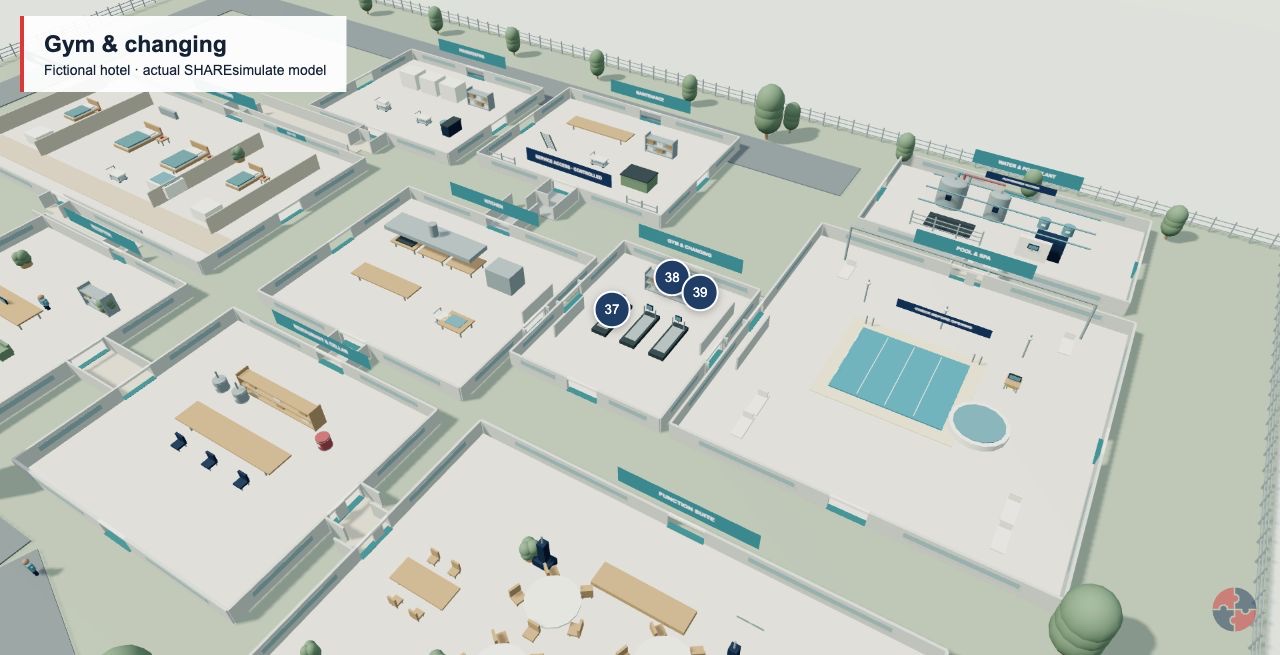
Actual fictional SHAREsimulate hotel model: Gym & changing. The stated case supplies the conditions; the image does not prove a defect or control state.
Test readiness before an emergency tests the team
An emergency plan must be usable at the time of the activity. Check the route to summon help, the people able to respond, the required equipment and access for the planned response. A training certificate supports one part of the arrangement; it does not prove that the person, equipment and communication are available now. Consider what happens during a break, an equipment defect or a simultaneous incident elsewhere.
Use briefings and appropriate practice to establish understanding. Ask staff what they would do if they cannot see a user, an alarm operates or a session exceeds the planned arrangement. Do not use a learning exercise to perform a real rescue or enter a hazardous plant space. The response must remain within the facility’s competent arrangements and each person’s role.
After a drill or incident, distinguish completion of the exercise from resolution of a finding. A missing device, unclear call route or unachievable staffing assumption needs an owner and verification before closure. Communicate any interim restriction to the people accepting bookings or allowing access. The aim is a workable response to the actual service, not a folder containing an exercise record.
How should first-aid cover work across shifts, sites and remote work?
First-aid cover should be available whenever people are working, not just when the usual first aider is on site.
Common failures occur during early starts, overtime, night shifts, holidays, off-site work, lone work, home work and contractor work. The needs assessment should test these periods rather than assuming office-hours cover is enough.
Remote or mobile work may need travel first-aid kits, communication checks, lone-worker escalation, location-sharing arrangements and clear instructions on emergency services access.
Coverage considerations - Coverage considerations
Situation
Risk
Control
Night shift
No trained first aider available.
Shift-specific cover plan.
Holiday absence
First-aid role temporarily vacant.
Deputy and rota review.
Remote work
Delayed emergency help.
Mobile kit and communication plan.
Multiple floors/buildings
Kit or first aider too far away.
Distributed kits and contacts.
Public events
More casualties and public interface.
Event-specific assessment.
Contractor work
High-risk tasks outside normal arrangements.
Pre-start agreement on first-aid cover.
A name on a notice is not cover if that person is absent or too far away. Test a late shift, a remote work location and a busy public event: can someone summon help, reach the kit and start care within the plan? If a high-risk activity depends on a missing responder, hold or change the activity until cover is restored. See HSE assess your first-aid needs.
Applied case
A drill record is signed, but the team reports that the pool’s emergency communication device is still unavailable.
Decision and explanation
Maintain the necessary interim restriction and verify a workable communication arrangement before relying on the response.
Maintain the necessary interim restriction and verify a workable communication arrangement before relying on the response. After a drill or incident, distinguish completion of the exercise from resolution of a finding. A missing device, unclear call route or unachievable staffing assumption needs an owner and verification before closure. Communicate any interim restriction to the people accepting bookings or allowing access. The aim is a workable response to the actual service, not a folder containing an exercise record.
Lesson 7
Defective gym equipment remains in service
Remove the defective item from service using a secure practical method, offer suitable alternatives and arrange competent repair. Checks and maintenance should follow the equipment's use and manufacturer guidance. After repair, verify function and authorise release rather than allowing a guest to act as the test user.
Actual fictional SHAREsimulate hotel model: Gym & changing. The stated case supplies the conditions; the image does not prove a defect or control state.
Understand the activity and how harm develops
A treadmill defect can cause an abrupt movement, fall or trapping injury. Users may be unfamiliar with controls or unable to react quickly. A visible fault report is not effective quarantine if the machine remains powered and available to guests arriving before a repair.
Remove the defective item from service using a secure practical method, offer suitable alternatives and arrange competent repair. Checks and maintenance should follow the equipment's use and manufacturer guidance. After repair, verify function and authorise release rather than allowing a guest to act as the test user.
Gym and changing areas may be used when hotel staffing is reduced. Check the real hours of use, access restrictions and route for assistance. The availability of a device or a maintenance record is only part of the evidence; verify the guest-facing arrangement and the people who make it work.
Recognise the evidence boundary
Question
Case evidence
What is observed?
A gym machine with a frayed cable has been tagged and physically taken out of use.
How can harm occur?
Unexpected cable failure can cause a fall or strike the user.
What information is needed?
Check the quarantine is effective and inspect the defect and maintenance record.
Protect, manage and verify
Purpose
Practical application
Immediate protection
Keep the machine unavailable until competent repair and checking.
Accountable work arrangement
Keep the machine unavailable until competent repair and checking. Provide pre-use defect reporting, effective quarantine, planned maintenance and a competent post-repair release for the actual equipment. Provide suitable guards, interlocks and equipment designed for the task. Agree the responsible person and safe interim arrangement for treadmill. Reopen or restart only when the relevant verification below has been accepted.
Release verification
A competent release confirms safe function and the equipment is reintroduced deliberately.
Apply this at work
Apply the same control test whenever the activity, users, product, staffing or conditions change. Provide pre-use defect reporting, effective quarantine, planned maintenance and a competent post-repair release for the actual equipment. Check connected areas: Exercise, changing, equipment defect reporting and emergency assistance.
How can a jam, clean or repair be handled safely?
Plan the intervention before opening protection. Stop the machine, identify and isolate every relevant energy source, secure against reconnection, verify the safe condition, and prevent other people starting or entering while work continues. Use a separately engineered and authorised mode if movement is genuinely needed.
An interlock or emergency stop alone can leave electrical power, air pressure, hydraulic pressure, gravity or a coasting part available. The competent isolation plan covers linked conveyors and upstream equipment, stored loads, trapped pressure and each person working in the danger area. Do not reach in to pull material while a motor is merely stopped. HSE Maintenance of work equipment; HSE Guarding in quarries.
Intervention hold points
Stage
Decision or evidence
Before access
Identify machine, task, hazard and authorised workers; agree whether it can be done with guards in place or from outside the danger zone.
Secure
Stop, isolate and lock the applicable sources under the site procedure; each exposed worker retains personal control. Release or restrain stored energy by a competent method.
Verify
Check the intended safe state by the authorised method, including linked equipment and coasting. If the state is uncertain, hold work and escalate.
Perform and change
Use the approved tools and route. If the jam, access or energy state differs from the plan, stop, withdraw and revise the method.
Hand back
Account for people and tools; restore guards, remove locks only through the agreed process, function-check protection and authorise restart with affected operators informed.
Applied case
A treadmill belt unexpectedly surges and staff put a small handwritten note on its display.
Decision and explanation
Keep the machine unavailable until competent repair and checking.
This controls the relevant exposure rather than relying on appearance or reassurance. Match the fault record to the machine, demonstrate guests cannot use it and obtain suitable evidence of corrected operation before reopening. Guest experience does not control an equipment defect. Prevent use until competent correction and verification. This deliberately uses a person to test a suspected dangerous fault. Use a controlled competent maintenance process.
Lesson 8
Emergency response cannot reach the gym user
Assess the gym's users, opening hours, staffing and communication. Arrange an achievable way to summon help and bring responders and emergency services to the casualty. Staff need suitable competence and clear roles; the lesson teaches response arrangements rather than attempting to replace practical first-aid training.
Actual fictional SHAREsimulate hotel model: Gym & changing. The stated case supplies the conditions; the image does not prove a defect or control state.
Understand the activity and how harm develops
A person exercising may become suddenly ill or injured in a room that staff cannot see. A call point, AED or first-aid kit is ineffective if locked away, unmonitored or too difficult to reach. Lone periods and restricted access can delay recognition and response even in a busy hotel.
Assess the gym's users, opening hours, staffing and communication. Arrange an achievable way to summon help and bring responders and emergency services to the casualty. Staff need suitable competence and clear roles; the lesson teaches response arrangements rather than attempting to replace practical first-aid training.
Gym and changing areas may be used when hotel staffing is reduced. Check the real hours of use, access restrictions and route for assistance. The availability of a device or a maintenance record is only part of the evidence; verify the guest-facing arrangement and the people who make it work.
Recognise the evidence boundary
Question
Case evidence
What is observed?
The gym assistance point is obscured by newly placed equipment.
How can harm occur?
A person in distress may be unable to summon timely help.
What information is needed?
Check visibility, reach, signal reliability and responder availability during opening hours.
Protect, manage and verify
Purpose
Practical application
Immediate protection
Restore access and a reliable assessed response arrangement.
Accountable work arrangement
Restore access and a reliable assessed response arrangement. Provide tested assistance communications, suitable first-aid and AED arrangements where indicated, and clear emergency access and location information. Provide reliable alarm, communication, access and other equipment appropriate to the emergency. Agree the responsible person and safe interim arrangement for emergency point. Reopen or restart only when the relevant verification below has been accepted.
Release verification
A planned test confirms the call reaches an available trained responder.
Apply this at work
Apply the same control test whenever the activity, users, product, staffing or conditions change. Provide tested assistance communications, suitable first-aid and AED arrangements where indicated, and clear emergency access and location information. Check connected areas: Exercise, changing, equipment defect reporting and emergency assistance.
How should first-aid cover work across shifts, sites and remote work?
First-aid cover should be available whenever people are working, not just when the usual first aider is on site.
Common failures occur during early starts, overtime, night shifts, holidays, off-site work, lone work, home work and contractor work. The needs assessment should test these periods rather than assuming office-hours cover is enough.
Remote or mobile work may need travel first-aid kits, communication checks, lone-worker escalation, location-sharing arrangements and clear instructions on emergency services access.
Coverage considerations - Coverage considerations
Situation
Risk
Control
Night shift
No trained first aider available.
Shift-specific cover plan.
Holiday absence
First-aid role temporarily vacant.
Deputy and rota review.
Remote work
Delayed emergency help.
Mobile kit and communication plan.
Multiple floors/buildings
Kit or first aider too far away.
Distributed kits and contacts.
Public events
More casualties and public interface.
Event-specific assessment.
Contractor work
High-risk tasks outside normal arrangements.
Pre-start agreement on first-aid cover.
A name on a notice is not cover if that person is absent or too far away. Test a late shift, a remote work location and a busy public event: can someone summon help, reach the kit and start care within the plan? If a high-risk activity depends on a missing responder, hold or change the activity until cover is restored. See HSE assess your first-aid needs.
Applied case
A guest collapses in the gym after reception has locked the internal access door for the night.
Decision and explanation
Restore access and a reliable assessed response arrangement.
This controls the relevant exposure rather than relying on appearance or reassurance. Run a planned response exercise from the gym using the actual shift, checking call receipt, access, equipment availability and ambulance directions. An equipment inventory does not establish timely access or a workable response. Test the complete route and staffing arrangement. This depends on someone being present and able to leave. Provide a reliable accessible assistance and response arrangement.
Lesson 9
Changing-room water reaches electrical equipment
Keep people clear and isolate the affected supply through a safe accessible means where competent and authorised to do so. Arrange competent investigation of the leak, equipment suitability and installation. Drying the visible surface does not establish internal safety or justify re-energisation.
Actual fictional SHAREsimulate hotel model: Gym & changing. The stated case supplies the conditions; the image does not prove a defect or control state.
Understand the activity and how harm develops
Water entering electrical equipment can create shock and burn hazards in a changing room where wet skin and contact with floors increase concern. A device that still runs may remain dangerous. Touching the equipment, plug or casualty while the source remains live can expose a second person.
Keep people clear and isolate the affected supply through a safe accessible means where competent and authorised to do so. Arrange competent investigation of the leak, equipment suitability and installation. Drying the visible surface does not establish internal safety or justify re-energisation.
Gym and changing areas may be used when hotel staffing is reduced. Check the real hours of use, access restrictions and route for assistance. The availability of a device or a maintenance record is only part of the evidence; verify the guest-facing arrangement and the people who make it work.
Recognise the evidence boundary
Question
Case evidence
What is observed?
Water from the changing area has reached a portable electrical device.
How can harm occur?
Water and damaged or unsuitable equipment can expose a person to electric shock.
What information is needed?
Inspect the affected area from a safe position and request competent electrical assessment.
Protect, manage and verify
Purpose
Practical application
Immediate protection
Keep people clear and arrange safe isolation without touching wet equipment.
Accountable work arrangement
Keep people clear and arrange safe isolation without touching wet equipment. Prevent water reaching electrical equipment, provide suitable equipment and installation protection, and use competent isolation, repair and release. Provide suitable installation, equipment and protective measures for the load and environment. Agree the responsible person and safe interim arrangement for changing electrics. Reopen or restart only when the relevant verification below has been accepted.
Release verification
Confirm electrical safety and correction of the water pathway before reuse.
Apply this at work
Apply the same control test whenever the activity, users, product, staffing or conditions change. Prevent water reaching electrical equipment, provide suitable equipment and installation protection, and use competent isolation, repair and release. Check connected areas: Exercise, changing, equipment defect reporting and emergency assistance.
How can the ISO 45001 hierarchy of controls prevent electrical contact during equipment fault diagnosis?
Use HSE’s hierarchy to eliminate or substitute a hazard where practicable, then apply engineering and administrative controls before relying on PPE. Check each chosen control against the actual task and stop when it fails.
Use HSE’s hierarchy of controls: eliminate or substitute the hazard where possible, then use engineering and administrative controls; PPE is the last resort. Apply the sequence to the task and verify that each chosen barrier works. HSE hierarchy of controls (official source).
Electrical safety is a strong example of why the hierarchy matters. The best control is often to remove the need for live work, design equipment so live parts cannot be touched, use reduced voltage in high-risk conditions and isolate securely before maintenance. PPE can be important for some tasks, but it should not be the first or only control.
The hierarchy should be applied at design, procurement, installation, use, maintenance and decommissioning. If the workplace keeps relying on signs, briefings and PPE while equipment is unsuitable or poorly protected, the risk is not being controlled well.
An electrical fault is assessed before access; use competent personnel, suitable information and a method that avoids exposed live work.
How can the ERICPD hierarchy of controls prevent electrical contact during equipment fault diagnosis?
ERICPD is a planning crossmap. Its prompts do not add a sixth rung or rank Isolate above engineering. Discipline verifies and sustains every control level.
Control level
Control for this activity
Owner and verification
Stop / restart decision
Eliminate
Use external diagnostics or remove the faulty equipment from use where that avoids exposed electrical work.
Task owner verifies that the proposed change removes the named hazardous step, including foreseeable cleaning, maintenance and work transferred elsewhere.
If the hazardous step remains, keep it within the task assessment and select the stronger feasible remaining controls.
Reduce, including substitution
Use a suitable off-line test or replaceable module where it safely proves the fault without exposed live conductors.
Competent task/process owner validates suitability, compatibility and new hazards against the actual operating requirements before the alternative is adopted.
Reject an alternative if its performance is unproved or its new hazards are unresolved.
Isolate
Securely isolate relevant supplies, prevent reconnection and prove dead using the approved safe-isolation method.
Release only after competent electrical owner accepts completed tests and safe reinstatement. Retain verification and unresolved restrictions at handover.
Keep the task on hold until required reinstatement evidence and unresolved defects are accepted by the responsible owner.
How can the ISO 45001 hierarchy of controls prevent electrical contact during equipment fault diagnosis?
The hierarchy of controls in ISO 45001:2018 comes under Clause 8.1.2 (Eliminating hazards and reducing OH&S risks), which is located within Clause 8 ("Operation").
Task owner verifies that the proposed change removes the named hazardous step, including foreseeable cleaning, maintenance and work transferred elsewhere.
If the hazardous step remains, keep it within the task assessment and select the stronger feasible remaining controls.
Engineering controls
Use a suitable off-line test or replaceable module where it safely proves the fault without exposed live conductors.
Competent task/process owner validates suitability, compatibility and new hazards against the actual operating requirements before the alternative is adopted.
Reject an alternative if its performance is unproved or its new hazards are unresolved.
Engineering controls
Securely isolate relevant supplies, prevent reconnection and prove dead using the approved safe-isolation method.
Release only after competent electrical owner accepts completed tests and safe reinstatement. Retain verification and unresolved restrictions at handover.
Keep the task on hold until required reinstatement evidence and unresolved defects are accepted by the responsible owner.
Applied case
A leak drips onto a powered hairdryer station and the manager suggests wiping the socket face dry.
Decision and explanation
Keep people clear and arrange safe isolation without touching wet equipment.
This controls the relevant exposure rather than relying on appearance or reassurance. Verify the water source is corrected and obtain appropriate electrical inspection and test evidence before returning the equipment to use. Internal moisture and electrical defects may remain, and wiping may expose the cleaner. Keep people clear and arrange safe competent isolation. Additional protection is not permission to continue a known hazardous condition. Remove exposure and correct the cause.
Lesson 10
Pool supervision does not match the activity
Determine supervision from the actual pool and activity, including children and non-swimmers. Avoid inventing a universal lifeguard ratio. The pool safety operating arrangements should define normal operation and emergency response, with competent people, suitable equipment and coverage when a responder is occupied.
Actual fictional SHAREsimulate hotel model: Pool & spa. The stated case supplies the conditions; the image does not prove a defect or control state.
Understand the activity and how harm develops
Drowning can develop without dramatic splashing. Pool layout, depth, glare, blind spots, bather ability and competing tasks affect whether a person in difficulty is noticed. A receptionist watching a remote display cannot automatically provide effective poolside supervision or the immediate rescue capability required by the assessment.
Determine supervision from the actual pool and activity, including children and non-swimmers. Avoid inventing a universal lifeguard ratio. The pool safety operating arrangements should define normal operation and emergency response, with competent people, suitable equipment and coverage when a responder is occupied.
Pool use changes with lessons, families, private functions and staff breaks. The applicable operating scheme should define acceptable conditions and responses to deviations for this pool. Use the model to ask questions about the actual activity; its geometry, water appearance and people are illustrative rather than measured performance evidence.
Recognise the evidence boundary
Question
Case evidence
What is observed?
The supervision plan is available, but the required competent cover is absent for this session.
How can harm occur?
A distressed swimmer may not be recognised or rescued promptly.
What information is needed?
Compare the actual activity and users with the assessed supervision and rescue arrangements.
Protect, manage and verify
Purpose
Practical application
Immediate protection
Do not start the affected session until required cover and response are available.
Accountable work arrangement
Do not start the affected session until required cover and response are available. Match competent supervision and rescue capability to assessed activities, occupancy and visibility; restrict activities that exceed the available arrangements. Maintain the system-specific treatment, circulation, outlet and physical safety design. Agree the responsible person and safe interim arrangement for supervision. Reopen or restart only when the relevant verification below has been accepted.
Release verification
Check the actual roster, duties, communication and rescue readiness before opening.
Apply this at work
Apply the same control test whenever the activity, users, product, staffing or conditions change. Match competent supervision and rescue capability to assessed activities, occupancy and visibility; restrict activities that exceed the available arrangements. Check connected areas: Pool and spa use, supervision, water monitoring and opening checks.
How should uncertainty be handled?
Uncertainty should be recorded, challenged and reduced before decisions rely on weak assumptions.
Risk assessment is not a guessing competition. If exposure levels are unknown, plant condition is uncertain, worker competence is unproven or the credible worst case is disputed, the assessment should say so and assign action. Sometimes the right decision is to stop the task until information improves.
Uncertainty can also come from change: new contractors, unusual weather, temporary equipment, production pressure, out-of-hours work, altered layout or maintenance backlogs.
Uncertainty
Why it matters
Action
Unknown exposure
Health risk cannot be judged reliably.
Commission monitoring or use a more protective control.
Unknown plant condition
Safeguards may not work when needed.
Inspect, test and verify before operation.
Unknown competence
People may not recognise loss of control.
Check training, authorisation and supervision.
Unknown interface
Two teams may create risk for each other.
Hold coordination meeting and agree control ownership.
Unknown emergency route
Response may fail under pressure.
Drill, test and update emergency plan.
Applied case
A private children's session is added while the assigned pool responder is also covering gym reception.
Decision and explanation
Do not start the affected session until required cover and response are available.
This controls the relevant exposure rather than relying on appearance or reassurance. Check scanning sight lines and a safe planned emergency exercise with the actual staff and activity, including breaks and simultaneous demands. Numbers alone do not establish adequate supervision. Ability, activity, sight lines and an immediately available competent response also matter. Parental involvement can support safety but does not automatically replace the operator's assessed supervision and emergency arrangements.
Lesson 11
Pool water clarity compromises safety
Use the visibility and water-quality criteria in the competent pool operating scheme. If the necessary visibility is not achieved, stop the affected use and investigate the cause. A satisfactory-looking controller display does not override a failed physical observation or authorise improvised chemical dosing.
Actual fictional SHAREsimulate hotel model: Pool & spa. The stated case supplies the conditions; the image does not prove a defect or control state.
Understand the activity and how harm develops
Poor clarity can hide a swimmer beneath the surface and delay rescue. It may also signal a problem with treatment, circulation or bather loading. Surface reflections and lighting can worsen observation even when the water looks acceptable from one angle. The camera cannot measure water clarity or establish treatment performance.
Use the visibility and water-quality criteria in the competent pool operating scheme. If the necessary visibility is not achieved, stop the affected use and investigate the cause. A satisfactory-looking controller display does not override a failed physical observation or authorise improvised chemical dosing.
Pool use changes with lessons, families, private functions and staff breaks. The applicable operating scheme should define acceptable conditions and responses to deviations for this pool. Use the model to ask questions about the actual activity; its geometry, water appearance and people are illustrative rather than measured performance evidence.
Recognise the evidence boundary
Question
Case evidence
What is observed?
The far pool floor cannot be seen clearly from the supervision position.
How can harm occur?
Poor visibility can delay recognition of a submerged person.
What information is needed?
Check visibility across the whole tank and the pool operating procedure.
Protect, manage and verify
Purpose
Practical application
Immediate protection
Restrict use and have competent personnel restore the required safe condition.
Accountable work arrangement
Restrict use and have competent personnel restore the required safe condition. Maintain treatment, circulation and lighting; apply the assessed closure and escalation criteria when visibility or water quality is unsatisfactory. Maintain the system-specific treatment, circulation, outlet and physical safety design. Agree the responsible person and safe interim arrangement for pool water. Reopen or restart only when the relevant verification below has been accepted.
Release verification
Verify effective visibility from working positions before authorised reopening.
Apply this at work
Apply the same control test whenever the activity, users, product, staffing or conditions change. Maintain treatment, circulation and lighting; apply the assessed closure and escalation criteria when visibility or water quality is unsatisfactory. Check connected areas: Pool and spa use, supervision, water monitoring and opening checks.
How should uncertainty be handled?
Uncertainty should be recorded, challenged and reduced before decisions rely on weak assumptions.
Risk assessment is not a guessing competition. If exposure levels are unknown, plant condition is uncertain, worker competence is unproven or the credible worst case is disputed, the assessment should say so and assign action. Sometimes the right decision is to stop the task until information improves.
Uncertainty can also come from change: new contractors, unusual weather, temporary equipment, production pressure, out-of-hours work, altered layout or maintenance backlogs.
Uncertainty
Why it matters
Action
Unknown exposure
Health risk cannot be judged reliably.
Commission monitoring or use a more protective control.
Unknown plant condition
Safeguards may not work when needed.
Inspect, test and verify before operation.
Unknown competence
People may not recognise loss of control.
Check training, authorisation and supervision.
Unknown interface
Two teams may create risk for each other.
Hold coordination meeting and agree control ownership.
Unknown emergency route
Response may fail under pressure.
Drill, test and update emergency plan.
Applied case
The deep end floor is difficult to see from the normal supervision position, although the controller shows normal values.
Decision and explanation
Restrict use and have competent personnel restore the required safe condition.
This controls the relevant exposure rather than relying on appearance or reassurance. Check visibility from operational supervision positions and compare treatment records, equipment condition and competent release evidence before reopening. Unassessed dosing can create additional harm and does not diagnose the failure. Use competent treatment and release arrangements. The actual visibility problem remains. Stop affected use and investigate under the pool operating procedure.
Lesson 12
Water-quality readings disagree
Follow the competent testing and exception procedure, using suitable maintained equipment and correct sampling. Record both results and investigate the reason for disagreement. Make restrictions and escalation decisions using the assessed operating criteria; do not change dosing simply to make one display match another.
Actual fictional SHAREsimulate hotel model: Pool & spa. The stated case supplies the conditions; the image does not prove a defect or control state.
Understand the activity and how harm develops
A disagreement between manual and automatic readings may reflect sampling technique, reagents, calibration, location or a genuine control problem. Averaging conflicting results can hide a critical deviation. An automatic display is one source of evidence rather than a guarantee that the whole pool is within its operating conditions.
Follow the competent testing and exception procedure, using suitable maintained equipment and correct sampling. Record both results and investigate the reason for disagreement. Make restrictions and escalation decisions using the assessed operating criteria; do not change dosing simply to make one display match another.
Pool use changes with lessons, families, private functions and staff breaks. The applicable operating scheme should define acceptable conditions and responses to deviations for this pool. Use the model to ask questions about the actual activity; its geometry, water appearance and people are illustrative rather than measured performance evidence.
Recognise the evidence boundary
Question
Case evidence
What is observed?
The controller is normal but the current manual water test disagrees.
How can harm occur?
An unresolved treatment fault can expose bathers to unsafe water or chemical conditions.
What information is needed?
Check sampling, test reliability, instrument checks and the approved treatment procedure.
Protect, manage and verify
Purpose
Practical application
Immediate protection
Hold affected opening and escalate to the authorised pool operator without guessed dosing.
Accountable work arrangement
Hold affected opening and escalate to the authorised pool operator without guessed dosing. Maintain instruments and reagents, train authorised testers and define how conflicting readings trigger restriction, investigation and release. Maintain the system-specific treatment, circulation, outlet and physical safety design. Agree the responsible person and safe interim arrangement for test station. Reopen or restart only when the relevant verification below has been accepted.
Release verification
Reconcile reliable readings and complete required corrective checks before release.
Apply this at work
Apply the same control test whenever the activity, users, product, staffing or conditions change. Maintain instruments and reagents, train authorised testers and define how conflicting readings trigger restriction, investigation and release. Check connected areas: Pool and spa use, supervision, water monitoring and opening checks.
How should uncertainty be handled?
Uncertainty should be recorded, challenged and reduced before decisions rely on weak assumptions.
Risk assessment is not a guessing competition. If exposure levels are unknown, plant condition is uncertain, worker competence is unproven or the credible worst case is disputed, the assessment should say so and assign action. Sometimes the right decision is to stop the task until information improves.
Uncertainty can also come from change: new contractors, unusual weather, temporary equipment, production pressure, out-of-hours work, altered layout or maintenance backlogs.
Uncertainty
Why it matters
Action
Unknown exposure
Health risk cannot be judged reliably.
Commission monitoring or use a more protective control.
Unknown plant condition
Safeguards may not work when needed.
Inspect, test and verify before operation.
Unknown competence
People may not recognise loss of control.
Check training, authorisation and supervision.
Unknown interface
Two teams may create risk for each other.
Hold coordination meeting and agree control ownership.
Unknown emergency route
Response may fail under pressure.
Drill, test and update emergency plan.
Applied case
A manual test and the pool controller disagree just before the next group is due to enter.
Decision and explanation
Hold affected opening and escalate to the authorised pool operator without guessed dosing.
This controls the relevant exposure rather than relying on appearance or reassurance. Check sampling method, reagent condition and instrument verification, then document the resolved discrepancy and the authorised operating decision. A mean does not establish which result is valid and may conceal an unsafe deviation. Retain the evidence and investigate. Automatic instruments can be faulty or unrepresentative. Resolve the discrepancy using the approved competent method.
Lesson 13
Spa load exceeds effective control
Use a spa-specific risk assessment and operating scheme rather than borrowing the swimming-pool approach unchanged. Control capacity, maintenance, testing, cleaning and exceptional events. Investigate deviations and use competent release criteria; do not prescribe a generic chemical dose or reopen solely because one sample is satisfactory.
Actual fictional SHAREsimulate hotel model: Pool & spa. The stated case supplies the conditions; the image does not prove a defect or control state.
Understand the activity and how harm develops
Warm aerated spa water, small volume and heavy bather loading can challenge microbial control. Aerosols create an inhalation route, while biofilm and poorly maintained components can sustain contamination. A spa looking clear does not establish that treatment, circulation and cleaning remain effective under the actual load.
Use a spa-specific risk assessment and operating scheme rather than borrowing the swimming-pool approach unchanged. Control capacity, maintenance, testing, cleaning and exceptional events. Investigate deviations and use competent release criteria; do not prescribe a generic chemical dose or reopen solely because one sample is satisfactory.
Pool use changes with lessons, families, private functions and staff breaks. The applicable operating scheme should define acceptable conditions and responses to deviations for this pool. Use the model to ask questions about the actual activity; its geometry, water appearance and people are illustrative rather than measured performance evidence.
Recognise the evidence boundary
Question
Case evidence
What is observed?
Spa use has increased while recovery and monitoring evidence is incomplete.
How can harm occur?
Aerosol-producing warm water can spread infection if treatment controls are ineffective.
What information is needed?
Compare actual use with the assessed design, treatment capability and monitoring record.
Protect, manage and verify
Purpose
Practical application
Immediate protection
Restrict use and obtain competent review of capacity and water controls.
Accountable work arrangement
Restrict use and obtain competent review of capacity and water controls. Keep bather loading within the validated operating arrangement and maintain treatment, circulation, cleaning and monitored corrective-action procedures. Maintain the system-specific treatment, circulation, outlet and physical safety design. Agree the responsible person and safe interim arrangement for spa. Reopen or restart only when the relevant verification below has been accepted.
Release verification
Verify the required operating conditions, monitoring and authorised release.
Apply this at work
Apply the same control test whenever the activity, users, product, staffing or conditions change. Keep bather loading within the validated operating arrangement and maintain treatment, circulation, cleaning and monitored corrective-action procedures. Check connected areas: Pool and spa use, supervision, water monitoring and opening checks.
How can the hierarchy of controls control Legionella growth and harmful aerosol exposure?
The written scheme explains how the risk assessment will be controlled in daily practice.
A written control scheme should be practical enough for the people using it. It should identify the system, responsible roles, control measures, monitoring, frequencies, action levels, cleaning, disinfection, sampling if needed, record keeping and escalation.
The scheme should also explain what to do when controls fail. For example, if hot water does not reach the required temperature, the issue should not sit as a note in a contractor report for three months. It needs risk assessment, interim controls, repair ownership and verification.
Use ERICPD with the five-level hierarchy to choose physical water-system controls. L8 requires a scheme of control where risk exists, while HSG274 gives system-specific technical advice. Every selected measure needs an owner, check, failure action and record; flushing alone does not compensate for a badly designed stagnant system.
Temperature, treatment or other performance criteria.
Defines what good looks like.
Monitoring frequency
Daily, weekly, monthly, quarterly or annual tasks as appropriate.
Keeps checks consistent.
Action levels
What triggers repair, cleaning, restriction or escalation.
Prevents passive logging.
Schematic
System layout and high-risk points.
Helps find stagnation and dead legs.
Contractor duties
Scope, reporting, escalation and competence.
Controls outsourced work.
Record retention
Which records are kept and for how long.
Supports audit and investigation.
How can the ERICPD hierarchy of controls control Legionella growth and harmful aerosol exposure?
ERICPD is a planning crossmap. Its prompts do not add a sixth rung or rank Isolate above engineering. Discipline verifies and sustains every control level.
Worked activity: Task application for Legionella Management
Activity and release context
The scheme should also explain what to do when controls fail. For example, if hot water does not reach the required temperature, the issue should not sit as a note in a contractor report for three months. It needs risk assessment, interim controls, repair ownership and verification.
Remove unused outlets and dead legs where feasible, or remove an unnecessary aerosol-producing system.
Water-system designer verifies drawings and commissioning; unidentified dead legs trigger survey and hold of affected use.
Reduce
Substitution
Replace a high-aerosol or stagnant arrangement with a lower-risk design where the service need permits.
Dutyholder and designer compare service and scald needs; unassessed replacement is not commissioned.
Isolate / Control
Engineering controls
Maintain circulation and temperature or a validated alternative treatment, and contain aerosol at the source.
Responsible person checks temperatures, treatment and equipment; loss of the defined barrier triggers access/use restrictions.
Control
Administrative controls
Map assets, flush low-use outlets as specified, clean/descale and record sentinel checks and corrective actions.
Competent operator signs actual checks; a missing or failed check goes to the responsible person the same day.
PPE
PPE
For specialist cleaning, specify task-suitable protection for residual aerosol and treatment chemicals.
Competent contractor checks the method and PPE; damaged kit or unplanned aerosol stops the task.
Discipline
Sustaining all levels
Audit records, trends and contractor work; review after system change, failed controls or suspected illness.
Dutyholder samples evidence and closes defects; repeat failure prompts redesign and competent review.
How can the ISO 45001 hierarchy of controls control Legionella growth and harmful aerosol exposure?
The hierarchy of controls in ISO 45001:2018 comes under Clause 8.1.2 (Eliminating hazards and reducing OH&S risks), which is located within Clause 8 ("Operation").
Worked activity: Task application for Legionella Management
Activity and release context
The scheme should also explain what to do when controls fail. For example, if hot water does not reach the required temperature, the issue should not sit as a note in a contractor report for three months. It needs risk assessment, interim controls, repair ownership and verification.
Remove unused outlets and dead legs where feasible, or remove an unnecessary aerosol-producing system.
Water-system designer verifies drawings and commissioning; unidentified dead legs trigger survey and hold of affected use.
Reduce
Substitution
Replace a high-aerosol or stagnant arrangement with a lower-risk design where the service need permits.
Dutyholder and designer compare service and scald needs; unassessed replacement is not commissioned.
Isolate / Control
Engineering controls
Maintain circulation and temperature or a validated alternative treatment, and contain aerosol at the source.
Responsible person checks temperatures, treatment and equipment; loss of the defined barrier triggers access/use restrictions.
Control
Administrative controls
Map assets, flush low-use outlets as specified, clean/descale and record sentinel checks and corrective actions.
Competent operator signs actual checks; a missing or failed check goes to the responsible person the same day.
PPE
PPE
For specialist cleaning, specify task-suitable protection for residual aerosol and treatment chemicals.
Competent contractor checks the method and PPE; damaged kit or unplanned aerosol stops the task.
Discipline
Sustaining all levels
Audit records, trends and contractor work; review after system change, failed controls or suspected illness.
Dutyholder samples evidence and closes defects; repeat failure prompts redesign and competent review.
Applied case
A wedding group doubles the planned spa use and the operator is struggling to maintain the required conditions.
Decision and explanation
Restrict use and obtain competent review of capacity and water controls.
This controls the relevant exposure rather than relying on appearance or reassurance. Compare actual usage with the operating scheme, review trends and exceptions, and verify maintenance and competent release after a failed control. Commercial entitlement does not demonstrate capacity to maintain safe operation. Restrict use to the assessed effective control arrangement. Appearance and improvised dosing do not establish control of a spa system. Follow competent treatment and release procedures.
Lesson 14
Pool suction protection is damaged
Stop affected use and have competent pool engineers assess the defect and system protection. Do not ask a swimmer to test the suction by hand or body. Repair and release must consider the complete arrangement, not merely whether a replacement cover appears to fit.
Actual fictional SHAREsimulate hotel model: Pool & spa. The stated case supplies the conditions; the image does not prove a defect or control state.
Understand the activity and how harm develops
A damaged or missing outlet grille may expose a swimmer to suction entrapment or contact with components. The consequences depend on the actual suction system and protective design. A warning cone on the pool deck cannot prevent a submerged person reaching an unsafe outlet.
Stop affected use and have competent pool engineers assess the defect and system protection. Do not ask a swimmer to test the suction by hand or body. Repair and release must consider the complete arrangement, not merely whether a replacement cover appears to fit.
Pool use changes with lessons, families, private functions and staff breaks. The applicable operating scheme should define acceptable conditions and responses to deviations for this pool. Use the model to ask questions about the actual activity; its geometry, water appearance and people are illustrative rather than measured performance evidence.
Recognise the evidence boundary
Question
Case evidence
What is observed?
A pool suction grille is loose and its maintenance status is unclear.
How can harm occur?
A swimmer may be trapped or injured at a suction opening.
What information is needed?
Check the outlet arrangement and protective condition through competent inspection.
Protect, manage and verify
Purpose
Practical application
Immediate protection
Prevent use of the affected facility and arrange suitable repair and isolation.
Accountable work arrangement
Prevent use of the affected facility and arrange suitable repair and isolation. Provide suitable secured outlet covers and the system's assessed protective design, with inspection, defect closure and competent reinstatement. Maintain the system-specific treatment, circulation, outlet and physical safety design. Agree the responsible person and safe interim arrangement for suction. Reopen or restart only when the relevant verification below has been accepted.
Release verification
Competent testing confirms effective suction protection before reopening.
Apply this at work
Apply the same control test whenever the activity, users, product, staffing or conditions change. Provide suitable secured outlet covers and the system's assessed protective design, with inspection, defect closure and competent reinstatement. Check connected areas: Pool and spa use, supervision, water monitoring and opening checks.
How can a jam, clean or repair be handled safely?
Plan the intervention before opening protection. Stop the machine, identify and isolate every relevant energy source, secure against reconnection, verify the safe condition, and prevent other people starting or entering while work continues. Use a separately engineered and authorised mode if movement is genuinely needed.
An interlock or emergency stop alone can leave electrical power, air pressure, hydraulic pressure, gravity or a coasting part available. The competent isolation plan covers linked conveyors and upstream equipment, stored loads, trapped pressure and each person working in the danger area. Do not reach in to pull material while a motor is merely stopped. HSE Maintenance of work equipment; HSE Guarding in quarries.
Intervention hold points
Stage
Decision or evidence
Before access
Identify machine, task, hazard and authorised workers; agree whether it can be done with guards in place or from outside the danger zone.
Secure
Stop, isolate and lock the applicable sources under the site procedure; each exposed worker retains personal control. Release or restrain stored energy by a competent method.
Verify
Check the intended safe state by the authorised method, including linked equipment and coasting. If the state is uncertain, hold work and escalate.
Perform and change
Use the approved tools and route. If the jam, access or energy state differs from the plan, stop, withdraw and revise the method.
Hand back
Account for people and tools; restore guards, remove locks only through the agreed process, function-check protection and authorise restart with affected operators informed.
Applied case
Staff find a loose outlet cover but suggest keeping bathers away from that corner.
Decision and explanation
Prevent use of the affected facility and arrange suitable repair and isolation.
This controls the relevant exposure rather than relying on appearance or reassurance. Obtain a system-specific engineering check of cover security, compatibility and protective functions before authorising the pool's return to use. This creates the very entrapment exposure being investigated. Use a safe competent engineering method. A sign does not control access to a submerged suction hazard. Stop affected use and obtain competent engineering assessment.
Lesson 15
Poolside slip controls fail during use
Assess the actual wet-use floor, drainage and cleaning method. Keep walking routes and transitions usable and deal with contamination promptly without introducing hoses or equipment across the route. Running rules and signs support the arrangement but cannot compensate for unsuitable flooring or standing water.
Actual fictional SHAREsimulate hotel model: Pool & spa. The stated case supplies the conditions; the image does not prove a defect or control state.
Understand the activity and how harm develops
Wet bare feet, body products, changing levels and hurried movement create a distinctive poolside slip problem. A surface can look clean while a film reduces grip, and unsuitable cleaning may leave residue. A fall close to the pool edge can become an immersion or head-injury event.
Assess the actual wet-use floor, drainage and cleaning method. Keep walking routes and transitions usable and deal with contamination promptly without introducing hoses or equipment across the route. Running rules and signs support the arrangement but cannot compensate for unsuitable flooring or standing water.
Pool use changes with lessons, families, private functions and staff breaks. The applicable operating scheme should define acceptable conditions and responses to deviations for this pool. Use the model to ask questions about the actual activity; its geometry, water appearance and people are illustrative rather than measured performance evidence.
Recognise the evidence boundary
Question
Case evidence
What is observed?
A cleaned poolside route is drying behind barriers, while users approach another wet section.
How can harm occur?
Wet surfaces and drainage problems can cause falls near water.
What information is needed?
Inspect slip conditions, drainage, cleaning and user movement during a session.
Protect, manage and verify
Purpose
Practical application
Immediate protection
Keep unsafe sections unavailable and restore effective drainage and surface controls.
Accountable work arrangement
Keep unsafe sections unavailable and restore effective drainage and surface controls. Provide suitable wet-use surfaces and drainage, control residues and water accumulation, and segregate cleaning with a safe accessible alternative. Provide suitable surfaces, drainage, matting and maintained lighting for actual use. Agree the responsible person and safe interim arrangement for poolside. Reopen or restart only when the relevant verification below has been accepted.
Release verification
Observe safe access under normal wet-use conditions before removing restrictions.
Apply this at work
Apply the same control test whenever the activity, users, product, staffing or conditions change. Provide suitable wet-use surfaces and drainage, control residues and water accumulation, and segregate cleaning with a safe accessible alternative. Check connected areas: Pool and spa use, supervision, water monitoring and opening checks.
How can the ISO 45001 hierarchy of controls remove slip and trip hazards from workplace routes?
Control classification: Classify the mechanism separately from its upkeep: physical floor repair, drainage, barriers, protected routes, compartmentation, fire doors and suitable disposal facilities are physical measures where specified. Cleaning schedules, inspections, policies, funding, supervision and verification are administrative arrangements maintaining them. A verbal instruction is not a physical barrier. Read this correction with the source table. Retained overview and stage artwork requires the matching classification update.
Remove or reduce the hazard before relying on procedures or personal protection.
For slips and trips, assess the actual task and first look for a way to remove the hazard. Where that is not possible, consider a safer substitute, engineered separation and then clear work procedures. PPE protects against remaining exposure; it does not make an uncontrolled task safe. HSE hierarchy of controls
The selected measures need a named owner, a usable stop point and a check that they still work when the task or conditions change. In Northern Ireland, verify the separate legal route and site instructions.
For the wet entrance, eliminate recurring water entry at source where practicable. Reduce contamination with suitable matting, drainage and a cleaning method that leaves the route safe; physically prevent access while unsafe and provide an alternative. Repair floor and route defects, then select footwear for residual risk and sustain checks. ERICPD (Eliminate, Reduce, Isolate, Control, PPE, Discipline) is a teaching prompt; Discipline means competent cleaning, supervision and defect closure. HSE slip and trip factors; HSE barriers and cleaning.
How can the ERICPD hierarchy of controls remove slip and trip hazards from workplace routes?
ERICPD is a planning crossmap. Its prompts do not add a sixth rung or rank Isolate above engineering. Discipline verifies and sustains every control level.
Worked activity: Wet leisure-centre entrance
Activity and exposure
Wet entrance at a public leisure centre during heavy rain.
Before work
Wet leaves and rainwater carried through an entrance onto a smooth floor; no mat change or drainage response.
During the activity
Close or physically separate the wet route, give a safe alternative, remove contamination and inspect matting and drainage.
Hold or stop
Do not reopen while the floor remains wet or the alternate route creates another hazard.
Hand-back and release
Repair the recurrent water source, choose suitable matting/flooring, brief cleaners and reopen after a dry-floor check.
Evidence to retain
Record weather trigger, barrier time, floor condition, repair owner, worker feedback and repeat incidents.
How can the ISO 45001 hierarchy of controls remove slip and trip hazards from workplace routes?
The hierarchy of controls in ISO 45001:2018 comes under Clause 8.1.2 (Eliminating hazards and reducing OH&S risks), which is located within Clause 8 ("Operation").
ESEAP mapping crosswalk: these are retained ERICPD source rows, mapped to the five ESEAP levels. Read the control-classification correction for mixed physical and administrative measures; six source rows do not mean six ESEAP levels.
Five-level control stage(s)
Topic-specific example
Source and full task context
Elimination
Remove recurring water entry at source where practicable.
Guests report a slippery patch near the spa where cleaning product residue has collected.
Decision and explanation
Keep unsafe sections unavailable and restore effective drainage and surface controls.
This controls the relevant exposure rather than relying on appearance or reassurance. Observe peak use and post-cleaning conditions, checking drainage, residue, transitions and how staff respond to a reported slippery area. Normal walking can still cause a slip on residue. Identify and remove contamination using the correct method. This can spread water and create hose trip hazards. Control access and restore safe conditions before reopening.
Lesson 16
A busy hotel shift: justify each release
Control gym, changing-room and poolside defects and verify a safe reopening decision.
Actual fictional SHAREsimulate hotel model: Pool & spa. The stated case supplies the conditions; the image does not prove a defect or control state.
Resolve the connected hotel case
Before a busy leisure session, the pool water is less clear than normal, two readings disagree and the planned supervision is unavailable. A gym emergency route is blocked by stored equipment. Decide what remains closed, who must resolve each issue and which evidence supports reopening.
Separate the affected activities before deciding what may proceed. For each, state the observed condition, people who could be harmed, mechanism of harm and the control actually available. Do not assume that resolving one concern releases a different task. Identify uncertainty explicitly and preserve the relevant restriction while the responsible competent person resolves it.
Compare the reasoning below with the facts in the combined case. These are teaching examples with their own stated conditions; they do not add unstated defects or measurements to the case. Use the same evidence questions to decide which controls matter and what must be verified.
In the fictional hotel, a private session is added while the responder is covering another area. Hold the affected session while a workable arrangement is established. Verify the people, equipment, communication and conditions before release, and make the restriction clear to booking and reception staff. A booking confirmation is a commercial record; it is not evidence that supervision and emergency capability are available.
After a report, verify the full result. Has the cause been addressed as well as the visible water? Is the alternative route usable and does it preserve emergency access? Who can reopen the affected area? Repeated reports should trigger review of the system, not simply repeated reminders to be careful. The model’s coloured floor is illustrative; judge the stated condition and supporting evidence.
In the fictional hotel, the spa’s record and display disagree before a busy session. Keep the relevant use restricted until the responsible competent person resolves the uncertainty and verifies the release conditions. Document the reason and hand it to reception so a booking or guest request cannot silently reopen the service. This course does not teach dosing, water-treatment design or a substitute operating limit.
After a drill or incident, distinguish completion of the exercise from resolution of a finding. A missing device, unclear call route or unachievable staffing assumption needs an owner and verification before closure. Communicate any interim restriction to the people accepting bookings or allowing access. The aim is a workable response to the actual service, not a folder containing an exercise record.
Build a release and handover decision for each issue. Name the responsible role, immediate protection, information still needed and objective condition for release. Explain what remains held to the people controlling the next use. A signed form, completed course or commercial deadline cannot manufacture the missing evidence. Where the relevant control has been verified, record precisely what that decision covers and what change would trigger another review.
Control and verification for the assigned activities
Defective gym equipment remains in service: Keep the machine unavailable until competent repair and checking. Verification: A competent release confirms safe function and the equipment is reintroduced deliberately.
Emergency response cannot reach the gym user: Restore access and a reliable assessed response arrangement. Verification: A planned test confirms the call reaches an available trained responder.
Changing-room water reaches electrical equipment: Keep people clear and arrange safe isolation without touching wet equipment. Verification: Confirm electrical safety and correction of the water pathway before reuse.
Pool supervision does not match the activity: Do not start the affected session until required cover and response are available. Verification: Check the actual roster, duties, communication and rescue readiness before opening.
Pool water clarity compromises safety: Restrict use and have competent personnel restore the required safe condition. Verification: Verify effective visibility from working positions before authorised reopening.
Water-quality readings disagree: Hold affected opening and escalate to the authorised pool operator without guessed dosing. Verification: Reconcile reliable readings and complete required corrective checks before release.
Spa load exceeds effective control: Restrict use and obtain competent review of capacity and water controls. Verification: Verify the required operating conditions, monitoring and authorised release.
Pool suction protection is damaged: Prevent use of the affected facility and arrange suitable repair and isolation. Verification: Competent testing confirms effective suction protection before reopening.
Poolside slip controls fail during use: Keep unsafe sections unavailable and restore effective drainage and surface controls. Verification: Observe safe access under normal wet-use conditions before removing restrictions.
How can a jam, clean or repair be handled safely?
Plan the intervention before opening protection. Stop the machine, identify and isolate every relevant energy source, secure against reconnection, verify the safe condition, and prevent other people starting or entering while work continues. Use a separately engineered and authorised mode if movement is genuinely needed.
An interlock or emergency stop alone can leave electrical power, air pressure, hydraulic pressure, gravity or a coasting part available. The competent isolation plan covers linked conveyors and upstream equipment, stored loads, trapped pressure and each person working in the danger area. Do not reach in to pull material while a motor is merely stopped. HSE Maintenance of work equipment; HSE Guarding in quarries.
Intervention hold points
Stage
Decision or evidence
Before access
Identify machine, task, hazard and authorised workers; agree whether it can be done with guards in place or from outside the danger zone.
Secure
Stop, isolate and lock the applicable sources under the site procedure; each exposed worker retains personal control. Release or restrain stored energy by a competent method.
Verify
Check the intended safe state by the authorised method, including linked equipment and coasting. If the state is uncertain, hold work and escalate.
Perform and change
Use the approved tools and route. If the jam, access or energy state differs from the plan, stop, withdraw and revise the method.
Hand back
Account for people and tools; restore guards, remove locks only through the agreed process, function-check protection and authorise restart with affected operators informed.
How can the ISO 45001 hierarchy of controls remove slip and trip hazards from workplace routes?
Control classification: Classify the mechanism separately from its upkeep: physical floor repair, drainage, barriers, protected routes, compartmentation, fire doors and suitable disposal facilities are physical measures where specified. Cleaning schedules, inspections, policies, funding, supervision and verification are administrative arrangements maintaining them. A verbal instruction is not a physical barrier. Read this correction with the source table. Retained overview and stage artwork requires the matching classification update.
Remove or reduce the hazard before relying on procedures or personal protection.
For slips and trips, assess the actual task and first look for a way to remove the hazard. Where that is not possible, consider a safer substitute, engineered separation and then clear work procedures. PPE protects against remaining exposure; it does not make an uncontrolled task safe. HSE hierarchy of controls
The selected measures need a named owner, a usable stop point and a check that they still work when the task or conditions change. In Northern Ireland, verify the separate legal route and site instructions.
For the wet entrance, eliminate recurring water entry at source where practicable. Reduce contamination with suitable matting, drainage and a cleaning method that leaves the route safe; physically prevent access while unsafe and provide an alternative. Repair floor and route defects, then select footwear for residual risk and sustain checks. ERICPD (Eliminate, Reduce, Isolate, Control, PPE, Discipline) is a teaching prompt; Discipline means competent cleaning, supervision and defect closure. HSE slip and trip factors; HSE barriers and cleaning.
How can the ERICPD hierarchy of controls remove slip and trip hazards from workplace routes?
ERICPD is a planning crossmap. Its prompts do not add a sixth rung or rank Isolate above engineering. Discipline verifies and sustains every control level.
Worked activity: Wet leisure-centre entrance
Activity and exposure
Wet entrance at a public leisure centre during heavy rain.
Before work
Wet leaves and rainwater carried through an entrance onto a smooth floor; no mat change or drainage response.
During the activity
Close or physically separate the wet route, give a safe alternative, remove contamination and inspect matting and drainage.
Hold or stop
Do not reopen while the floor remains wet or the alternate route creates another hazard.
Hand-back and release
Repair the recurrent water source, choose suitable matting/flooring, brief cleaners and reopen after a dry-floor check.
Evidence to retain
Record weather trigger, barrier time, floor condition, repair owner, worker feedback and repeat incidents.
How can the ISO 45001 hierarchy of controls remove slip and trip hazards from workplace routes?
The hierarchy of controls in ISO 45001:2018 comes under Clause 8.1.2 (Eliminating hazards and reducing OH&S risks), which is located within Clause 8 ("Operation").
ESEAP mapping crosswalk: these are retained ERICPD source rows, mapped to the five ESEAP levels. Read the control-classification correction for mixed physical and administrative measures; six source rows do not mean six ESEAP levels.
Five-level control stage(s)
Topic-specific example
Source and full task context
Elimination
Remove recurring water entry at source where practicable.
Before a busy leisure session, the pool water is less clear than normal, two readings disagree and the planned supervision is unavailable. A gym emergency route is blocked by stored equipment. Decide what remains closed, who must resolve each issue and which evidence supports reopening.
Decision and explanation
Separate the affected tasks, maintain necessary restrictions and verify each release with its responsible competent owner.
One resolved issue does not release another. Match actual controls and evidence to each task and preserve the restriction and release conditions through handover.
Lesson 17
Take a verified action into the workplace
Connect one actual task to an owner, evidence and a clear release or escalation decision.
Actual fictional SHAREsimulate hotel model: Pool & spa. The stated case supplies the conditions; the image does not prove a defect or control state.
Turn awareness into a practical question
Independent hotel, pool and leisure awareness using the fictional Riverside model. GB workplace guidance; apply corresponding NI and nation-specific arrangements. England-specific fire guidance is labelled. Learning does not establish practical competence, clinical advice, specialist work or operational authority.
Choose one relevant operation from the course. Describe the people at risk, the mechanism of harm and the exact condition that needs controlling. Separate an observation from a conclusion. A display, signature, badge or clean appearance answers only a limited question.
Use the included practice resources to prepare a fictional task brief, risk review or verification question. Decide which competent role owns the decision and which evidence must be available before the affected activity is released. Keep guest protection and staff protection as distinct decisions where both apply.
At work, use your actual approved arrangements. Report uncertainty and preserve the relevant hold, restriction or safe state while it is resolved. Confirm that the action addressed the original harm route and check whether another shift, product, cleaning task or maintenance change could reintroduce it.
Course completion records awareness learning. It does not establish practical competence, authorise pool operation, intrusive maintenance, chemical dosing or emergency entry.
How can a jam, clean or repair be handled safely?
Plan the intervention before opening protection. Stop the machine, identify and isolate every relevant energy source, secure against reconnection, verify the safe condition, and prevent other people starting or entering while work continues. Use a separately engineered and authorised mode if movement is genuinely needed.
An interlock or emergency stop alone can leave electrical power, air pressure, hydraulic pressure, gravity or a coasting part available. The competent isolation plan covers linked conveyors and upstream equipment, stored loads, trapped pressure and each person working in the danger area. Do not reach in to pull material while a motor is merely stopped. HSE Maintenance of work equipment; HSE Guarding in quarries.
Intervention hold points
Stage
Decision or evidence
Before access
Identify machine, task, hazard and authorised workers; agree whether it can be done with guards in place or from outside the danger zone.
Secure
Stop, isolate and lock the applicable sources under the site procedure; each exposed worker retains personal control. Release or restrain stored energy by a competent method.
Verify
Check the intended safe state by the authorised method, including linked equipment and coasting. If the state is uncertain, hold work and escalate.
Perform and change
Use the approved tools and route. If the jam, access or energy state differs from the plan, stop, withdraw and revise the method.
Hand back
Account for people and tools; restore guards, remove locks only through the agreed process, function-check protection and authorise restart with affected operators informed.
How can the ISO 45001 hierarchy of controls remove slip and trip hazards from workplace routes?
Control classification: Classify the mechanism separately from its upkeep: physical floor repair, drainage, barriers, protected routes, compartmentation, fire doors and suitable disposal facilities are physical measures where specified. Cleaning schedules, inspections, policies, funding, supervision and verification are administrative arrangements maintaining them. A verbal instruction is not a physical barrier. Read this correction with the source table. Retained overview and stage artwork requires the matching classification update.
Remove or reduce the hazard before relying on procedures or personal protection.
For slips and trips, assess the actual task and first look for a way to remove the hazard. Where that is not possible, consider a safer substitute, engineered separation and then clear work procedures. PPE protects against remaining exposure; it does not make an uncontrolled task safe. HSE hierarchy of controls
The selected measures need a named owner, a usable stop point and a check that they still work when the task or conditions change. In Northern Ireland, verify the separate legal route and site instructions.
For the wet entrance, eliminate recurring water entry at source where practicable. Reduce contamination with suitable matting, drainage and a cleaning method that leaves the route safe; physically prevent access while unsafe and provide an alternative. Repair floor and route defects, then select footwear for residual risk and sustain checks. ERICPD (Eliminate, Reduce, Isolate, Control, PPE, Discipline) is a teaching prompt; Discipline means competent cleaning, supervision and defect closure. HSE slip and trip factors; HSE barriers and cleaning.
How can the ERICPD hierarchy of controls remove slip and trip hazards from workplace routes?
ERICPD is a planning crossmap. Its prompts do not add a sixth rung or rank Isolate above engineering. Discipline verifies and sustains every control level.
Worked activity: Wet leisure-centre entrance
Activity and exposure
Wet entrance at a public leisure centre during heavy rain.
Before work
Wet leaves and rainwater carried through an entrance onto a smooth floor; no mat change or drainage response.
During the activity
Close or physically separate the wet route, give a safe alternative, remove contamination and inspect matting and drainage.
Hold or stop
Do not reopen while the floor remains wet or the alternate route creates another hazard.
Hand-back and release
Repair the recurrent water source, choose suitable matting/flooring, brief cleaners and reopen after a dry-floor check.
Evidence to retain
Record weather trigger, barrier time, floor condition, repair owner, worker feedback and repeat incidents.
How can the ISO 45001 hierarchy of controls remove slip and trip hazards from workplace routes?
The hierarchy of controls in ISO 45001:2018 comes under Clause 8.1.2 (Eliminating hazards and reducing OH&S risks), which is located within Clause 8 ("Operation").
ESEAP mapping crosswalk: these are retained ERICPD source rows, mapped to the five ESEAP levels. Read the control-classification correction for mixed physical and administrative measures; six source rows do not mean six ESEAP levels.
Five-level control stage(s)
Topic-specific example
Source and full task context
Elimination
Remove recurring water entry at source where practicable.