SHARE Knowledge Hub
Alcohol Use and Workplace Wellbeing
Alcohol can affect health, judgement and safe work, but an observed concern is not a diagnosis. If someone may be unfit for a safety-critical task, pause the task, protect people and arrange a private, factual conversation. Offer confidential support and NHS advice; use testing only where justified and governed. Severe suspected alcohol poisoning or withdrawal needs urgent medical help.
Understanding Alcohol Use and Workplace Wellbeing
Alcohol can affect health, judgement and safe work, but an observed concern is not a diagnosis. If someone may be unfit for a safety-critical task, pause the task, protect people and arrange a private, factual conversation. Offer confidential support and NHS advice; use testing only where justified and governed. Severe suspected alcohol poisoning or withdrawal needs urgent medical help.
Why this matters at work
Plan safe transport and any appropriate accommodation or duty changes before invitations and rostering, rather than leave individuals to improvise at the end. Respect people who do not drink and make the expected behaviour and support routes clear. Check the venue and who coordinates incidents or welfare. A nominal drink allowance cannot establish safe driving or morning task fitness for every person. Provide a way to report concern and review present capability before critical duties. After the event, assess any incident or failed arrangement and correct organisational factors such as late travel, shift timing or pressure to participate, while handling personal information discreetly.
Explain the temporary safety decision and allow the person to respond if able. Follow the published policy for any justified assessment or testing, rather than improvise. Arrange safe onward care and handover appropriate to condition and consent; do not simply send an unwell person away to drive or travel alone. Record necessary facts, restrictions, who received the person and the next review. Keep clinical details within protected records. A health referral, work fitness decision and any fair conduct process are separate matters. Review whether relief cover, trained support and safe transport are available on all shifts so that an immediate concern can be managed without leaving the task or person unsafe.
How organisations manage this in practice
Encourage appropriate GP, specialist alcohol service or occupational health help. An employee assistance service can be useful but may not provide assessment or treatment for dependence. Explain what information returns to management and consider time to obtain expert help. Managers normally need functional advice about restrictions, adjustments and review, rather than clinical notes. Do not advise a potentially dependent person to undertake abrupt withdrawal without clinical advice. Agree a coordinating owner and practical review points, including across shifts and locations. Support is compatible with a separate fair process for an evidenced conduct issue, but a disclosure or request for help should not be turned automatically into a presumed diagnosis or disciplinary outcome.
This table identifies the legal routes within the guide’s scope, with GB, NI, UK or function-specific and England/Wales boundaries. Selected official XML provisions were inspected; retained dates, original-made text and unapplied effects remain qualified. Contents targets are not claimed directly passed and no full current consolidation is implied. Check current applicability and amendments for an actual case.
Hold a private, factual and respectful conversation. Explain the work concern, ask for the person’s perspective and what support would help, and clarify confidentiality and its limits. Focus on function, risk and assistance rather than an unnecessary detailed drinking history. Assess immediate safety first and agree the next contact, referral, temporary duties or absence arrangements.
How should alcohol-related work risk and support be managed?
This guide explains workplace safety action and wellbeing support in Great Britain and Northern Ireland; it is not diagnosis, treatment or a site policy.
It covers staff, agency workers and contractors; routine and safety-critical work; self-referral, observed concern, testing and urgent medical escalation. Role restrictions must follow the actual task and risk. An employer alcohol policy, specialist advice, employment terms and local emergency arrangements still need to be checked.
Arrange safe cover and confidential follow-up
The immediate question is whether the person can safely do the assigned task, not whether a supervisor can diagnose dependence. Arrange cover for a safety-critical concern, check welfare and record factual observations. Follow the existing emergency route for an acute medical concern.
Support, testing and employment decisions proceed under different arrangements. Share only the functional restriction and safe cover with the team; keep personal disclosures and test information restricted. Agree who will review the work arrangement and what evidence is needed before return.
Morning pool cover cannot rely on reassurance
Illustrative example. A lifeguard raises an alcohol-related concern before the morning shift while minimum competent cover is needed.
Decision. Use replacement cover and a private conversation rather than ask the person to prove fitness through reassurance.
Evidence to check. Operational record identifies the covered duties and responsible manager; confidential follow-up records the agreed support.
Hold or escalation point. Do not operate without the required competent cover or treat a negative/unavailable test as a full fitness decision.
Follow-up. Review functional advice and the agreed support plan before the named manager decides the next duties.
Who acts on a concern and who decides the next step?
Workers report fitness concerns; supervisors make the task safe; HR and occupational health handle their own decisions; no manager diagnoses alcohol use.
| Role | Immediate action | Decision boundary |
|---|---|---|
| Worker or contractor | Report when a task may not be safe; seek support early and follow the local route. | A disclosure can be made without giving colleagues a diagnosis. |
| Supervisor or duty manager | Arrange cover, pause the affected task, observe facts, check welfare and escalate privately. | Does not diagnose, order withdrawal treatment or share a health history. |
| Employer and contractor lead | Define safety-critical tasks, policy, consultation, cover and interface responsibilities. | Host and contractor coordinate safety without indiscriminate sharing. |
| HR or employee relations | Apply policy, employment process, support and appeal fairly. | Safety action and conduct findings are separate decisions. |
| Occupational health or clinician | Advise on functional capability and clinical matters when properly referred. | Manager normally receives work-relevant recommendations, not full medical detail. |
| Privacy lead and auditor | Check testing necessity, lawful basis, special-category condition, access and retention. | A consent-to-sample form alone does not settle processing law. |
Where is the safety, health, HR and privacy boundary?
A possible fitness-for-work risk can require immediate task control; clinical diagnosis, treatment and employment findings require separate competent processes.
Separate present function from cause and support


Read this visual as text
- OBSERVATION: Record the work-related facts and the task demands. Avoid assumptions about the cause.
- SAFE ARRANGEMENT: Arrange cover, restrict the affected duty or obtain emergency help where needed.
- PRIVATE FOLLOW-UP: Offer health support and agree proportionate work arrangements and review.
A smell, missed shift, changed mood, poor coordination or disclosure can have several explanations. Record what was seen or said, the task risk and the action taken; avoid labels such as "alcoholic". Ask privately what support or immediate help is needed. A person can need healthcare without being unfit for every task, and someone can be unfit for a hazardous task without having alcohol-use disorder. A test result is one piece of evidence, not a diagnosis or automatic conclusion about current capability.
Use minimum necessary information, explain who will see it and why, and keep detailed health information with appropriately authorised people. Where immediate safety requires a restriction, share the restriction with the person arranging work, not the reason unless truly necessary.
What should everyone remember?
Make the task safe, speak respectfully, offer help and keep decisions proportionate and private.
| Situation | First response | Do not assume |
|---|---|---|
| Possible impairment in safety-critical work | Pause or cover the affected task and check welfare. | A condition or cause from observation alone. |
| Worker asks for help | Listen privately, signpost and assess any task restriction. | That self-referral is misconduct. |
| Testing proposed | Check purpose, role risk, consent-to-sample route, quality and UK GDPR basis. | A test is necessary for every worker. |
| Suspected poisoning or severe withdrawal | Call 999 and follow first-aid and dispatcher advice. | A manager can prescribe a detox plan. |
What is harmful alcohol use, dependence and present impairment?
Harmful use describes drinking that causes harm; dependence can involve cravings, tolerance and withdrawal; present impairment concerns whether a person can do a task safely now.
NHS describes alcohol-use disorder as drinking in a harmful way and explains that treatment and support are available. A person may struggle to reduce drinking, continue despite harm or have withdrawal symptoms. This is a healthcare issue, not a character judgement. Alcohol can affect judgement, coordination, reaction and sleep, but individual effects differ. A workplace conversation should focus on observable task capability and support needs, leaving diagnosis and treatment to qualified services.
| Term | Meaning | Workplace boundary |
|---|---|---|
| Harmful drinking | Alcohol use linked to health or other harm. | Signpost; do not infer an individual condition. |
| Dependence | Physical or psychological reliance may include craving and withdrawal. | Seek clinical advice before abrupt stopping if withdrawal occurs. |
| Impairment | Current ability to perform a task may be reduced. | Control task risk on facts; cause may be uncertain. |
| Recovery or treatment | Individual healthcare and support process. | Work may need reviewed restrictions or adjustments, not a manager-led treatment plan. |
How can alcohol use affect work and wellbeing?
Alcohol can affect work through impairment, health effects, absence, sleep, mood, judgement, relationships and recovery needs.
Attendance, mood or performance changes can reflect stress, illness or other factors. Discuss observed work impact and support privately rather than assuming alcohol use.
The same level of alcohol use will not affect every person in the same way. Body size, tolerance, health conditions, medication, fatigue, food intake, sleep, mental health and drinking pattern all influence how alcohol affects a person. That is why workplaces should avoid stereotypes and focus on functional impact and risk exposure.
At work, the practical concern is not moral judgement; it is whether the person can work safely, reliably and fairly with the duties they are being asked to perform. A private support conversation should explore work barriers, immediate safety risk, support routes and review, rather than interrogating private medical details.
The organisation should also look at its own contribution. A workplace that normalises heavy after-work drinking, client drinking, long shifts, poor breaks, bullying, isolation or unmanaged stress may increase risk while blaming individuals for the outcome.
| Impact pathway | How it may show at work | Management response |
|---|---|---|
| Immediate impairment | Reduced coordination, slower reaction, poor judgement, smell of alcohol, slurred speech or unsafe behaviour. | Remove from safety-critical work calmly, follow policy, arrange safe supervision and record facts. |
| Hangover and recovery effects | Fatigue, nausea, poor concentration, lateness, reduced tolerance of pressure or errors. | Manage fitness for work and performance facts; signpost support where a pattern is emerging. |
| Dependence and withdrawal | Morning drinking, shaking, sweating, anxiety, sickness, cravings or difficulty stopping. | Encourage medical support before sudden stopping and consider occupational-health referral. |
| Mental health connection | Alcohol may be used to cope with stress, depression, anxiety, trauma or sleep problems. | Address work stressors, signpost qualified support and avoid treating the issue only as misconduct. |
| Workplace culture | Client entertainment, after-work drinking, pressure to join in or alcohol-linked networking. | Review culture, events, expenses, expectations and inclusion for people who do not drink. |
| Safety-critical role conflict | A person seeking help may currently be in a role where impairment would create serious risk. | Temporarily move from risk-sensitive duties where necessary while support and assessment take place. |
How can the hierarchy of controls reduce alcohol-related risks at work?
Identify tasks where an error could seriously harm people, then define cover, reporting and temporary reassignment before a concern arises.
HSE examples include driving, machinery and work with electrical equipment or ladders. At Riverside, lifeguarding, pool-chemical handling, minibus driving and plant work require task-specific decisions. A job title alone is not enough: check the actual work, exposure, supervision and consequence. A worker seeking help may need a temporary transfer, but it should be proportionate, reviewed and paired with support.
For a pool-service driver whose alertness is uncertain before a journey, the immediate elimination decision is to keep that person off the driving task and arrange a competent replacement. It is a temporary task control, not a diagnosis. Redesigning the rota or moving the delivery to a staffed daytime route may substitute for avoidable late lone driving. A controlled dispatch or vehicle-key system can add an engineering or access layer only if the site actually has it and tests it. A supervisor conversation, welfare check, policy route and occupational-health referral are administrative layers; PPE cannot make an unfit driver safe. This is an adapted ERICPD/five-level cross-map: Eliminate the immediate exposure, Reduce or substitute the work pattern, Isolate the driving task, Control access and decisions, and reserve PPE for unrelated residual task hazards.
The duty manager records the observations, holds dispatch, checks the replacement’s role authority and arranges safe travel and care for the worker. The transport manager reviews the rota, key-control logs and near misses after the change. ERICPD Discipline means maintaining this cover and learning system, not assuming a conduct fault from appearance or a test result. A later return to driving needs a named decision owner, appropriate qualified advice and current task evidence. If cover is unavailable, the person remains unwell, or the key system is bypassed, the trip stays on hold; testing and employment processes are separate from immediate safety and support.
| Task | Potential harm | Hold and cover route |
|---|---|---|
| Lifeguarding | Delayed recognition or rescue can harm swimmers. | Provide competent cover before removing a lifeguard; no uncovered pool operation. |
| Driving and transport | Impaired driving can harm passengers and public. | Do not dispatch until a fit authorised driver is available. |
| Pool chemicals and plant | Handling or isolation error can expose workers and public. | Pause the task, make plant safe and use competent cover. |
| Ordinary desk or reception work | Capability and welfare still matter but consequences differ. | Assess the actual task and support need; do not apply blanket safety-critical restrictions. |
How can the ERICPD hierarchy of controls reduce alcohol-related risks at work?

| ERICPD control level | Topic-specific example | Source and full task context |
|---|---|---|
| Eliminate | Hold an unsafe driving task and arrange competent cover. | Read the full task example, checks and stop points on this page. |
| Reduce | Assess a staffed daytime route or safer rota. | Read the full task example, checks and stop points on this page. |
| Isolate | Control dispatch and vehicle access where a tested system exists. | Read the full task example, checks and stop points on this page. |
| Control | Use a proportionate welfare and occupational-health route. | Read the full task example, checks and stop points on this page. |
| PPE | PPE cannot make an unfit driver safe. | Read the full task example, checks and stop points on this page. |
| Discipline | Review cover, key controls and task fitness before return. | Read the full task example, checks and stop points on this page. |
How can the ISO 45001 hierarchy of controls reduce alcohol-related risks at work?

| ERICPD control level | Topic-specific example | Source and full task context |
|---|---|---|
| Eliminate | Hold an unsafe driving task and arrange competent cover. | Read the full task example, checks and stop points on this page. |
| Reduce | Assess a staffed daytime route or safer rota. | Read the full task example, checks and stop points on this page. |
| Isolate | Control dispatch and vehicle access where a tested system exists. | Read the full task example, checks and stop points on this page. |
| Control | Use a proportionate welfare and occupational-health route. | Read the full task example, checks and stop points on this page. |
| PPE | PPE cannot make an unfit driver safe. | Read the full task example, checks and stop points on this page. |
| Discipline | Review cover, key controls and task fitness before return. | Read the full task example, checks and stop points on this page. |
What are the before, during and after hold points when fitness is uncertain?
Before work, know the task and cover plan; during a concern, stop the affected task and check welfare; before return, make a fresh task-specific decision.
Fitness Concern During a Shift
Two linked parts · 6 questions. Open Part 2 to complete the route.

Continue to questions 4–6 · Part 2 of 2


Read this visual as text
- Start: A supervisor sees a work-performance or behaviour concern that could affect a task.
- Question 1: Is there immediate danger or emergency illness? Decision owner: Responsible manager with HR / occupational health.
- YES — STOP / REFER: Call 999 for serious illness and follow the emergency or first-aid plan. STOP / REFER → APPROPRIATE RESPONSE.
- NO: No such warning is identified; continue the remaining checks. CONTINUE → QUESTION 2.
- UNKNOWN — PROTECT FIRST: Protect people and hold the affected work. Obtain the responsible specialist’s assessment; do not assume the warning is absent. HOLD → OWNER RESOLVES BEFORE RESUMING.
- Question 2: Can the current task be made safe and competently covered? Decision owner: Responsible manager with HR / occupational health.
- YES: The required evidence or condition is confirmed. CONTINUE → QUESTION 3.
- NO / UNKNOWN — HOLD: Pause or stop the activity; no uncovered pool, vehicle or plant duty. HOLD → REPEAT QUESTION 2 AFTER CORRECTION.
- Question 3: Are the concern and restriction based on observable work facts? Decision owner: Responsible manager with HR / occupational health.
- YES: The required evidence or condition is confirmed. CONTINUE → QUESTION 4.
- NO / UNKNOWN — HOLD: Record function and behaviour without publicly accusing or diagnosing. HOLD → REPEAT QUESTION 3 AFTER CORRECTION.
- Question 4: Check welfare privately Decision owner: Responsible manager with HR / occupational health.
- ACTION: Listen and explain the task decision; consider health and non-alcohol causes. CONTINUE → QUESTION 5.
- Question 5: Are safe support and onward arrangements in place? Decision owner: Responsible manager with HR / occupational health.
- YES: The required evidence or condition is confirmed. CONTINUE → QUESTION 6.
- NO / UNKNOWN — HOLD: Do not assume the person can drive or leave without an appropriate welfare plan. HOLD → REPEAT QUESTION 5 AFTER CORRECTION.
- Question 6: Is a named later task-fitness review arranged? Decision owner: Responsible manager with HR / occupational health.
- YES: The required evidence or condition is confirmed. OUTCOME → RECORD AND HAND OVER.
- NO / UNKNOWN — HOLD: Keep the safety-sensitive duty held while relevant advice or controls are unresolved. HOLD → REPEAT QUESTION 6 AFTER CORRECTION.
- Outcome: Task safely covered; worker supported; factual record restricted; authorised, reviewed return or continued hold.
- Stop and escalation boundary: No uncovered pool, unsafe driving or plant operation while fitness is unresolved. No public accusation or compulsory sample.
| Stage | Action | Stop or hand-back point |
|---|---|---|
| Before shift | Explain fit-for-work and self-referral routes, map safety-critical roles, arrange cover. | No competent cover or unclear responsibility means do not start the dependent task. |
| Observed concern | Remove from the affected activity privately, check immediate medical risk, record observations. | No driving, lifeguarding or hazardous operation while fitness is unresolved. |
| Support and process | Offer NHS, GP, occupational-health or local support; HR decides any employment investigation. | Do not make a diagnosis or use support notes as a public conduct record. |
| Return and review | Confirm current task demands, restrictions, competent advice if needed, owner and review date. | A negative test, elapsed time or verbal assurance alone is not universal clearance. |
How does this work in real shifts and incidents?
These seven teaching cases separate immediate safety action, welfare support, testing governance and fair follow-up.
An observation is a work concern, not a diagnosis
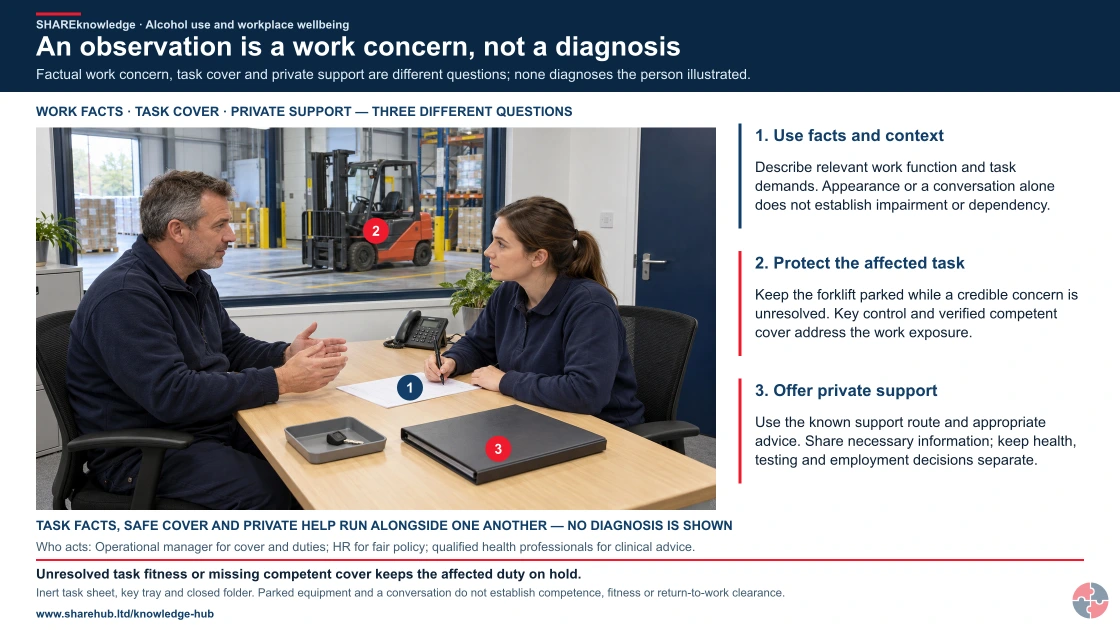
Full written explanation
An illustrative UK distribution-office scene connects the actual task discussion, a parked empty forklift behind a secure observation window, a separate key tray and a closed folder. Labels point to the inert task sheet, parked machine and closed folder rather than branding a person as the hazard. The three responsibilities remain parallel questions: use relevant work-function facts without diagnosing; protect the affected task with suitable cover and key-control arrangements; and offer private support through the known policy and appropriate advice. A normal colleague does not display intoxication, withdrawal, illness or a diagnostic sign. The picture is not a functional test, competence check, assessment of a key-control system or clearance to return to a task.
Factual work concern, task cover and private support are different questions; none diagnoses the person illustrated.
- What is observed?. Record relevant work function and task demands without assuming alcohol use or dependency.
- What work needs cover?. A credible safety-sensitive concern may require holding the task and arranging competent replacement cover.
- What help is appropriate?. Offer private support through the known policy and qualified advice; share only necessary information.
Change the pathway
- Use facts and context. Check the actual behaviour, work and immediate welfare concern; do not diagnose.
- Prevent the unsafe task. A parked forklift, safe key control and verified cover address the work exposure.
- Protect confidentiality. Separate operational restrictions, personal disclosures and any testing or employment process.
Evidence check: Task safety, private support and testing governance are separate decisions. No diagnosis is attributed to the people illustrated.
Primary references: HSE safety-critical work — task-specific temporary work arrangements · HSE supporting employees — known support route and confidential help
Open the complete HD image (new tab)Download image

Primary references: HSE safety-critical work — task-specific temporary work arrangements · HSE supporting employees — known support route and confidential help
Keep safe cover and private support on separate tracks
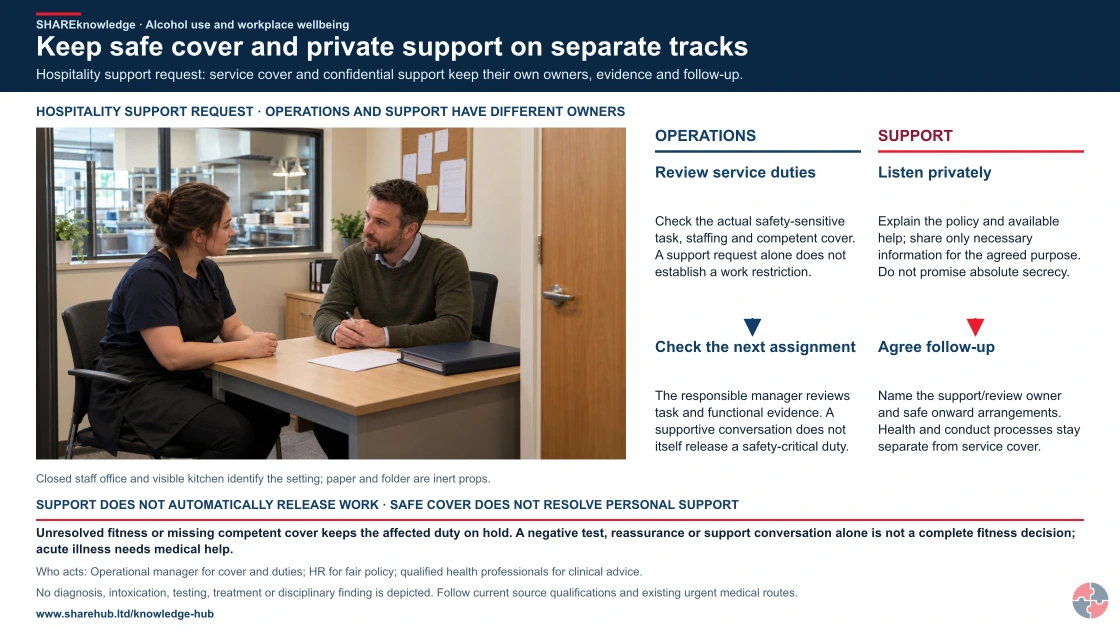
Full written explanation
An illustrative UK hospitality staff-office context shows a respectful private support conversation with an empty kitchen visible through glazing, plain paper and a closed folder. The original independent OPERATIONS and SUPPORT responsibilities are shown as two parallel tracks, with no arrow from help-seeking to diagnosis, misconduct, testing or automatic work release. Operations checks actual service duties, staffing, competent cover and the evidence relevant to the next assignment. Support listens privately, explains the known route, limits disclosure and agrees an owner, follow-up and safe onward arrangements. These decisions can proceed alongside one another and have different owners/evidence; neither substitutes for the other. The closed door illustrates a suitable discussion setting without proving acoustic/data security or promising absolute secrecy. No person is diagnosed, no alcohol or test equipment is shown, and no clinical/treatment/withdrawal/disciplinary or return-to-work rule is invented.
Hospitality support request: service cover and confidential support keep their own owners, evidence and follow-up.
- Pause the affected task. Address the actual safety concern and arrange suitable cover without requiring a diagnosis first.
- Review the assignment. The responsible manager checks competence, restrictions and the evidence needed for the next duties.
- Speak privately. Listen, explain the policy and offer appropriate support or health advice; do not promise absolute secrecy.
- Agree the follow-up. Record necessary arrangements, the review owner and safe onward plans; clinical and conduct decisions remain separate.
When the evidence does not fit: Unresolved fitness or missing competent cover keeps the affected duty on hold. A negative test, reassurance or support conversation alone is not a complete fitness decision; acute illness needs medical help.
Who acts: Operational manager for cover and duties; HR for fair policy; qualified health professionals for clinical advice.
Changed workplace
Distribution forklift: Keep the machine parked and arrange authorised cover while the observed work concern is resolved.
Hospitality support request: Listen privately, protect service safety and agree proportionate follow-up without treating help-seeking as proof of misconduct.
Evidence check: Task safety, private support and testing governance are separate decisions. No diagnosis is attributed to the people illustrated.
Primary references: HSE safety-critical work — task-specific temporary work arrangements · HSE supporting employees — known support route and confidential help
Open the complete HD image (new tab)Download image

Primary references: HSE safety-critical work — task-specific temporary work arrangements · HSE supporting employees — known support route and confidential help
Cover the duty and speak privately


Read this visual as text
- The immediate decision concerns safe work function. Another qualified lifeguard maintains cover while the worker is offered a private welfare conversation; a visible difficulty does not establish alcohol use or dependence.
- SAFE COVER
- PRIVATE CONVERSATION
- REVIEW THE TASK
Each case is a route to a local, task-specific decision, not a diagnosis, automatic test trigger or return-to-work clearance.
1. Lifeguard asks for help before a shift
Task material and setting: A Riverside Leisure Ltd lifeguard privately says drinking and poor sleep may affect concentration before a pool shift; the aim is to protect swimmers and enable help.
People and prerequisites: Swimmers, colleagues and the worker may be affected. The duty manager knows the pool coverage plan and support route; no manager needs to diagnose dependence.
Before: Move the worker away from lifeguarding pending a fit-for-task decision; arrange competent cover, a private conversation and NHS, GP or occupational-health signposting.
During: Agree temporary non-safety-critical duties only if the worker is fit for them; record functional restrictions, support owner and review date.
Hold or stop: Do not leave the pool without required cover or ask the worker to prove a diagnosis before protecting swimmers.
Completion and hand back: A named manager confirms staffing and any task restriction; later return to lifeguarding needs a task-specific decision and relevant professional advice.
Evidence: Coverage log, limited fitness decision, support referral and review, kept separately from detailed health information.
2. Apparent impairment at the pool
Task material and setting: A supervisor observes poor coordination and confusion while a lifeguard is on duty; the aim is immediate protection without assuming the cause is alcohol.
People and prerequisites: Swimmers, staff and the worker may be affected. A second authorised manager helps maintain safe coverage and checks whether urgent medical help is needed.
Before: Arrange cover, stop the affected duty and move the conversation to a private place; record objective observations and follow the policy.
During: Check immediate welfare and transport; refer testing decisions only to the authorised policy route, with quality and privacy safeguards.
Hold or stop: Do not leave the person supervising water, accuse them of a diagnosis or allow them to drive if they may be unfit.
Completion and hand back: A named manager controls return to safety-critical duty after the relevant assessment, support and procedural steps, not an arbitrary waiting period.
Evidence: Factual observation, task reassignment, welfare action, policy decision and authorised return.
3. Contractor minibus driver after a late event
Task material and setting: A contractor due to drive guests in the morning says they drank heavily at an event; the aim is safe transport without moral judgement.
People and prerequisites: Passengers, road users and the driver may be affected. The host duty manager and contractor supervisor know the transport contract and substitution route.
Before: Hold driving, arrange an authorised fit driver and tell the contractor supervisor only the operational restriction needed.
During: Use the agreed contractor interface and assess any other tasks separately; a statement about prior drinking alone is not a clinical finding.
Hold or stop: No vehicle departure while fitness is uncertain, no informal passenger ride to test ability and no disclosure of private details to guests.
Completion and hand back: Contractor confirms replacement, journey and later return under its own policy and legal duties; host verifies the service is safe.
Evidence: Vehicle allocation, host-contractor handover, factual restriction and replacement approval.
4. Staff social event and next-day work
Task material and setting: Riverside hosts a licensed evening event before an early public-opening shift; the aim is to avoid pressure to drink and protect next-day work.
People and prerequisites: Event staff, customers, lifeguards and drivers may be affected. The event lead plans alcohol-free choices, staffing and safe travel.
Before: Set clear event conduct and fit-for-work expectations; avoid making alcohol part of participation or reward.
During: Monitor customer behaviour, provide a non-stigmatising route to ask for help and plan adequate next-day cover.
Hold or stop: If an essential safety role has uncertain coverage or a worker reports unfitness, hold that task and arrange cover.
Completion and hand back: Review incidents, near misses and worker feedback; update the event and shift plan without collecting unnecessary personal drinking histories.
Evidence: Event plan, staff briefing, rota cover and aggregate learning.
5. Plant-room near miss and testing proposal
Task material and setting: A pool-chemical transfer nearly goes wrong after a maintenance shift; someone suggests alcohol testing; the aim is a fair safety investigation.
People and prerequisites: Maintainers, pool users and responders may be affected. The incident lead secures the plant, checks chemical and isolation conditions, and involves HR and data protection specialists if testing is considered.
Before: Stop the transfer, protect the area and capture equipment, instruction, fatigue and handover evidence as well as objective behaviour.
During: Only use testing if the approved purpose, threshold, selection and quality route fits the facts; investigate system causes regardless of result.
Hold or stop: Do not test everybody or use an old result to infer present impairment; do not let a sample delay emergency control.
Completion and hand back: A competent plant owner verifies controls and authorises restart; employment decisions follow a separate fair process.
Evidence: Incident and barrier record, proportionality decision, restricted test record if any, and plant release.
6. Worker declines a proposed test
Task material and setting: A safety-critical worker declines an alcohol test requested after recorded concerns; the aim is to protect work and apply the policy fairly.
People and prerequisites: The worker and public may be affected. A trained manager and HR check the consulted policy, applicable contract or agreed employment terms and GB or NI legal route before any test request or refusal consequence.
Before: Keep the worker away from the affected duty while fitness is unresolved; explain the test purpose, process, privacy and refusal route.
During: Record the decision and allow representation or appeal under the local process; consider less intrusive evidence and support needs.
Hold or stop: Do not force a bodily sample, assume refusal proves intoxication or use sample agreement as a substitute for a data-processing lawful basis. In NI, check agreed employment terms; policy publication alone cannot impose new screening terms on existing staff.
Completion and hand back: A named authority decides duties and later return after fair review of the facts, with a separate support conversation.
Evidence: Original observation, agreed terms, policy criterion, explanation, refusal, HR decision and minimum necessary record.
7. Severe symptoms in a changing room
Task material and setting: A colleague is confused, shaking and then has a seizure after telling a friend they recently stopped drinking; the aim is urgent medical help and scene safety.
People and prerequisites: The colleague and nearby people may be affected. A trained first aider and emergency services take the medical route; managers do not decide a withdrawal plan.
Before: Call 999, make the area safe and follow dispatcher and local first-aid instructions; keep bystanders clear and preserve dignity.
During: Stay with the person within the first-aid plan and pass known facts to responders without making a diagnosis.
Hold or stop: Do not ask them to work or drive, give improvised treatment or delay the call for a test or HR interview.
Completion and hand back: Emergency responders direct care; any later work plan follows medical advice, a private fitness discussion and task-specific review.
Evidence: Emergency call, time and relevant observations in restricted records; no public disclosure of suspected condition.
What should a workplace alcohol policy say?
A consulted policy should define safe-work expectations, role-specific restrictions, support, testing governance, privacy, fair process and review.
Explain how people can ask for help before an incident, what a supervisor does on observable concern, who may pause work, how contractors and call-outs are covered, and how an authorised return is reached. Rules on drinking at work or events are organisation rules unless a specific law applies. Consult workers or representatives and make the policy understandable to temporary and agency staff.
| Component | Operational question | Owner or evidence |
|---|---|---|
| Fit-for-work and task map | Which tasks need special control, and what is the cover route? | Risk assessment, role map, duty-manager brief. |
| Self-referral and support | Can a worker seek help privately without waiting for an incident? | Support route, occupational-health referral and communication. |
| Observed concern | Who records facts, checks welfare and holds work? | Supervisor procedure and escalation. |
| Testing | What purpose, role criteria, consent, quality, privacy, review and appeal apply? | Consulted policy, DPIA, HR and data-protection approval. |
| Fair process | How are safety action, conduct questions and support kept distinct? | HR route, representation and decision record. |
| Contractors and events | Who controls interface, travel, public-facing activity and late shifts? | Contract terms, event plan and duty roster. |
Three decisions after an alcohol-related concern
A workplace concern starts with observable function. In this pool-shift example, the duty, healthcare and return decisions have different owners. They can proceed alongside one another.
1. Cover the duty
- The duty manager records the observed difficulty, without naming a cause.
- Arrange genuinely competent cover or stop the affected activity under the operating plan.
- Check welfare and use the medical emergency route if needed.
2. Offer private support
- Listen privately and explain who needs which information.
- Offer appropriate healthcare or occupational-health support.
- Keep clinical details with the appropriate confidential service; managers need relevant functional advice.
3. Review the actual work
- The authorised manager considers the task, functional advice, restrictions and available controls.
- Record the agreed duties, limits, owner and review date.
- Check that the arrangement works before expanding duties.
Testing is a separate decision. A test needs a justified purpose, consent, reliable procedures and appropriate privacy arrangements. A result is one possible evidence input; it does not by itself diagnose dependence or authorise work. Medical discharge also does not settle fitness for a particular safety-critical duty. PPE cannot make an unfit person fit for that duty.
When, and on what basis, might alcohol testing be used?
Testing needs a justified safety purpose, consulted policy and applicable employment terms; agreement to provide a sample is distinct from the UK GDPR basis to process its result.
Proposed Alcohol Test
Two linked parts · 7 questions. Open Part 2 to complete the route.

Continue to questions 5–7 · Part 2 of 2


Read this visual as text
- Start: A manager proposes a test after an incident, reasonable suspicion or under a planned programme.
- Question 1: Is the proposed purpose necessary and documented? Decision owner: Responsible manager with HR / occupational health.
- YES: The required evidence or condition is confirmed. CONTINUE → QUESTION 2.
- NO / UNKNOWN — HOLD: Do not sample; maintain independent safety controls and seek HR/privacy advice. HOLD → REPEAT QUESTION 1 AFTER CORRECTION.
- Question 2: Do the role, trigger and applicable agreed terms cover screening? Decision owner: Responsible manager with HR / occupational health.
- YES: The required evidence or condition is confirmed. CONTINUE → QUESTION 3.
- NO / UNKNOWN — HOLD: Check consulted policy, employment terms and the GB or NI route. HOLD → REPEAT QUESTION 2 AFTER CORRECTION.
- Question 3: Have less intrusive routes been considered? Decision owner: Responsible manager with HR / occupational health.
- YES: The required evidence or condition is confirmed. CONTINUE → QUESTION 4.
- NO / UNKNOWN — HOLD: Use a proportionate alternative where it meets the purpose. HOLD → REPEAT QUESTION 3 AFTER CORRECTION.
- Question 4: Are sample consent and separate data-processing requirements addressed? Decision owner: Responsible manager with HR / occupational health.
- YES: The required evidence or condition is confirmed. CONTINUE → QUESTION 5.
- NO / UNKNOWN — HOLD: Resolve lawful basis, special-category condition, provider, access and retention before testing. HOLD → REPEAT QUESTION 4 AFTER CORRECTION.
- Question 5: Does the worker agree to the sample? Decision owner: Responsible manager with HR / occupational health.
- Yes: Explain procedure, interpretation and challenge rights; use the competent provider. CONTINUE → QUESTION 6.
- No: Do not force or treat refusal as proof; use a fair HR review of the justified policy. STOP / REFER → APPROPRIATE RESPONSE.
- Unclear: Clarify the request and keep any task restriction independently reviewed. HOLD → OWNER RESOLVES BEFORE RESUMING.
- Question 6: Is a qualified, contextual interpretation available? Decision owner: Responsible manager with HR / occupational health.
- YES: The required evidence or condition is confirmed. CONTINUE → QUESTION 7.
- NO / UNKNOWN — HOLD: Do not infer diagnosis or automatic misconduct from one screen. HOLD → REPEAT QUESTION 6 AFTER CORRECTION.
- Question 7: Record narrowly Decision owner: Responsible manager with HR / occupational health.
- ACTION: Protect results and continue investigation and task-fitness decisions separately. OUTCOME → RECORD AND HAND OVER.
- Outcome: Justified and governed test, or no test with a documented alternative; safety restriction remains independently reviewed.
- Stop and escalation boundary: No blanket testing of all workers, covert bodily sample, automatic diagnosis or open-access result.
HSE says workers cannot be forced to provide a sample, although a refusal where there are good grounds may lead to fair policy consequences. In Northern Ireland, HSENI says agreement to the principle of screening must be incorporated into employment terms and existing staff need not agree to changed terms. Check the actual contract or agreed terms, consulted policy and jurisdiction-specific route with HR before a request or consequence; publishing a policy alone does not create authority. Keep an immediate safety restriction separate from testing. ICO requires a recorded purpose, lawful basis and special-category condition, plus proportionality and data minimisation. Assess less intrusive options and use a reliable method with quality safeguards. Random testing of every worker is rarely justifiable where only particular roles create the risk. A result does not by itself diagnose dependence, explain an incident or prove fitness for every task. ICO notes its guidance is under review following the Data (Use and Access) Act; obtain current data-protection advice for a programme.
| Question | Required decision | Do not do |
|---|---|---|
| Why test? | Record the safety purpose and why a less intrusive approach will not meet it. | Test to learn private drinking habits without a justified purpose. |
| Who and when? | Check the consulted policy, actual contract or agreed employment terms and GB or NI route; use role and incident criteria communicated in advance. | Blanket test all staff or invent a trigger after the event. |
| What consent? | Explain and seek agreement for the physical sample; in NI check that the principle of screening is in the agreed employment terms. Separately document the data-processing basis. | Force a sample or equate sample consent with a UK GDPR lawful basis. |
| Which data safeguards? | Document lawful basis and special-category condition, minimisation, secure access, retention and any DPIA. | Store results in open team notes or use them for a new purpose silently. |
| What does the result mean? | Use quality assurance and a fair interpretation and appeal route. | Treat a positive, negative or refusal as an automatic diagnosis or complete fitness decision. |
How can a worker get support without losing the safety boundary?
Offer a private conversation and NHS, GP, local alcohol-service or occupational-health route, while separately managing any task that is not currently safe.
Worker Asks for Help
Two linked parts · 6 questions. Open Part 2 to complete the route.

Continue to questions 4–6 · Part 2 of 2


Read this visual as text
- Start: A worker voluntarily raises a concern about drinking, sleep or concentration.
- Question 1: Listen and check planned duties Decision owner: Responsible manager with HR / occupational health.
- ACTION: Ask about current work effects and the worker’s preferred support route. CONTINUE → QUESTION 2.
- Question 2: Is an immediate duty unsafe? Decision owner: Responsible manager with HR / occupational health.
- YES — STOP / REFER: Arrange competent cover, adjust or pause the duty before continuing the discussion. STOP / REFER → APPROPRIATE RESPONSE.
- NO: No such warning is identified; continue the remaining checks. CONTINUE → QUESTION 3.
- UNKNOWN — PROTECT FIRST: Protect people and hold the affected work. Obtain the responsible specialist’s assessment; do not assume the warning is absent. HOLD → OWNER RESOLVES BEFORE RESUMING.
- Question 3: Is there a serious medical or severe withdrawal concern? Decision owner: Clinical service.
- YES — STOP / REFER: Use the emergency route; for other withdrawal concerns seek qualified clinical advice before abrupt stopping. STOP / REFER → APPROPRIATE RESPONSE.
- NO: No such warning is identified; continue the remaining checks. CONTINUE → QUESTION 4.
- UNKNOWN — PROTECT FIRST: Protect people and hold the affected work. Obtain the responsible specialist’s assessment; do not assume the warning is absent. HOLD → OWNER RESOLVES BEFORE RESUMING.
- Question 4: Are support and temporary work changes agreed? Decision owner: Responsible manager with HR / occupational health.
- YES: The required evidence or condition is confirmed. CONTINUE → QUESTION 5.
- NO / UNKNOWN — HOLD: Offer suitable clinical, specialist or occupational-health support without prescribing treatment. HOLD → REPEAT QUESTION 4 AFTER CORRECTION.
- Question 5: Is necessary sharing limited to function and controls? Decision owner: Responsible manager with HR / occupational health.
- YES: The required evidence or condition is confirmed. CONTINUE → QUESTION 6.
- NO / UNKNOWN — HOLD: Explain who needs a restriction; do not promise absolute secrecy. HOLD → REPEAT QUESTION 5 AFTER CORRECTION.
- Question 6: Agree follow-up Decision owner: Responsible manager with HR / occupational health.
- ACTION: Record the work owner, review date and what changes require earlier reassessment. OUTCOME → RECORD AND HAND OVER.
- Outcome: Safe duties and credible support agreed, or a held task with named follow-up and appropriate clinical route.
- Stop and escalation boundary: Do not promise secrecy beyond a necessary safety disclosure, diagnose AUD, prescribe detox or treat help-seeking as automatic misconduct.
Ask what work is difficult and what temporary change would help; do not ask for an unnecessary drinking history. Review shift patterns, workload, conflict, isolation and social pressure as possible work contributors without assuming causation. A worker with withdrawal symptoms should obtain medical advice before suddenly stopping or reducing drinking. Occupational health can advise on functional restrictions and return planning; HR can coordinate fair policy action. Support does not automatically waive a serious conduct issue, and a conduct investigation does not cancel a support offer.
| Need | Route | Workplace action |
|---|---|---|
| Worried about drinking | NHS advice, GP or local alcohol service. | Provide private signposting and a support contact. |
| Work task uncertainty | Supervisor, occupational health and HR as appropriate. | Agree temporary task restriction or adjustment and review date. |
| Work stress or pressure | Worker consultation and HSE stress-risk process. | Address organisational causes, not only individual coping. |
| Severe symptoms | 999 or A&E according to NHS guidance. | Make the area safe and follow emergency instructions. |
When does this become a medical emergency?
Call 999 for suspected alcohol poisoning, a seizure, loss of consciousness or severe withdrawal symptoms; follow dispatcher and local first-aid instructions.
Medical Emergency and Later Return
Two linked parts · 6 questions. Open Part 2 to complete the route.

Continue to questions 4–6 · Part 2 of 2


Read this visual as text
- Start: A person has suspected alcohol poisoning, seizure, loss of consciousness or severe withdrawal symptoms.
- Question 1: Use the emergency response Decision owner: Responsible manager with HR / occupational health.
- ACTION: For suspected poisoning, seizure, unconsciousness or severe illness, call 999 and follow the dispatcher. CONTINUE → QUESTION 2.
- Question 2: Is the scene safe for the person and helpers? Decision owner: Responsible manager with HR / occupational health.
- YES: The required evidence or condition is confirmed. CONTINUE → QUESTION 3.
- NO / UNKNOWN — HOLD: Prevent a second casualty and keep the affected activity controlled. HOLD → REPEAT QUESTION 2 AFTER CORRECTION.
- Question 3: Hand over known facts Decision owner: Responsible manager with HR / occupational health.
- ACTION: Give signs, timing and known substances; no test, improvised medicine or detox delays care. CONTINUE → QUESTION 4.
- Question 4: Has later work return been reviewed separately from acute care? Decision owner: Responsible manager with HR / occupational health.
- YES: The required evidence or condition is confirmed. CONTINUE → QUESTION 5.
- NO / UNKNOWN — HOLD: Discharge alone does not authorise driving, machinery or another critical duty. HOLD → REPEAT QUESTION 4 AFTER CORRECTION.
- Question 5: Are functional advice, controls and responsible approval in place? Decision owner: Responsible manager with HR / occupational health.
- YES: The required evidence or condition is confirmed. CONTINUE → QUESTION 6.
- NO / UNKNOWN — HOLD: Maintain the affected restriction while HR/OH and the task owner resolve gaps. HOLD → REPEAT QUESTION 5 AFTER CORRECTION.
- Question 6: Review the supported plan Decision owner: Responsible manager with HR / occupational health.
- ACTION: Record only necessary restrictions and review with the worker. OUTCOME → RECORD AND HAND OVER.
- Outcome: Responder handover; restricted emergency record; later safe-work plan with competent input and review.
- Stop and escalation boundary: No delay for an alcohol test, no improvised medicine or detox, no self-driving, no automatic return after discharge.
NHS warns that alcohol poisoning and severe withdrawal can be life-threatening. Severe withdrawal may involve marked shaking, confusion, hallucinations or a seizure. Do not wait for an alcohol test or HR decision. Protect the scene, summon a trained first aider, avoid exposing the person to further danger and pass relevant observations to responders. Do not advise a dependent drinker to stop suddenly or attempt a workplace detox. A later work plan must be based on clinical advice and the actual task.
| Trigger | Immediate route | Boundary |
|---|---|---|
| Suspected poisoning, seizure, unconsciousness or stopped breathing | Call 999, summon first aid and follow dispatcher instructions. | No food, coffee, cold shower or forced vomiting as improvised treatment. |
| Severe withdrawal after reduction or stopping | Call 999 or use A&E as NHS advises; do not let the person drive. | No manager-led medication or abrupt-stopping instruction. |
| Concern without emergency signs | Make the task safe and arrange appropriate NHS, GP or alcohol-service advice. | Do not label the person or ignore deterioration. |
What can be recorded or shared about a worker?
Record the minimum facts needed for safety, support or fair process, and restrict detailed health or test information to authorised people.
Tell the worker the purpose, recipients and limits of confidentiality. An immediate operational instruction might be "not rostered for lifeguarding subject to verification"; the rota need not show a suspected diagnosis or test result. Keep occupational-health detail separate where possible, and give managers work-relevant advice. Identify a UK GDPR lawful basis and special-category condition for health or test data; do not assume that permission to take a sample is a general permission to store or disclose results. Set access, retention and correction routes, and avoid putting sensitive details in incident trend or search systems.
| Recipient | Usually needs | Usually does not need |
|---|---|---|
| Rota or task supervisor | Current task restriction, cover, review owner. | Drinking history or detailed test report. |
| HR case lead | Policy facts, support action, fair-process record. | Unrelated medical history. |
| Occupational health | Relevant work demands and referral question. | General team access to clinical record. |
| Incident investigator | Task facts, barrier state and relevant objective evidence. | Unjustified speculation or broad personal disclosure. |
Which Great Britain and Northern Ireland duties apply?
Use GB health-and-safety and equality law in Great Britain, NI safety and disability law in Northern Ireland, and UK data-protection duties where worker health data is processed.
Great Britain uses the Health and Safety at Work etc Act 1974 and Management Regulations 1999; Northern Ireland uses the Health and Safety at Work (NI) Order 1978 and Management Regulations (NI) 2000. Both routes require work risk assessment and suitable controls. Specific transport law may also apply to particular driving or guided-transport work; check the activity, not a generic workplace alcohol limit. In GB, the Equality Act 2010 route and its Disability Regulations generally exclude alcohol addiction alone, but an accompanying qualifying impairment may be protected. Northern Ireland uses its separate Disability Discrimination Act 1995 route and Equality Commission guidance. Do not assume either a protected disability or its absence from a disclosure; obtain case-specific advice. UK GDPR and the Data Protection Act 2018 govern health and testing data across the UK. A company alcohol rule is not itself a statutory blood-alcohol threshold.
| Jurisdiction or issue | Route | Practical boundary |
|---|---|---|
| Great Britain safety | Health and Safety at Work etc Act 1974; Management Regulations 1999. | Assess actual work and prevent impairment-related risk. Official source |
| Northern Ireland safety | Health and Safety at Work (NI) Order 1978; Management Regulations (NI) 2000. | Use NI citations and HSENI guidance. Official source |
| Great Britain disability | Equality Act 2010 and Disability Regulations 2010. | Addiction alone generally excluded; accompanying impairment may qualify. Official source |
| Northern Ireland disability | Disability Discrimination Act 1995 as applied in NI; Equality Commission NI guidance. | Different regime; take case-specific advice. Official source |
| Across the UK: worker data | UK GDPR and Data Protection Act 2018, with ICO guidance. | Document lawful basis, special-category condition and limited access. Official source |
| Driving and guided transport | Applicable road-traffic or Transport and Works Act duties where the task fits. | Do not import a road limit into every job or claim a negative test settles fitness. Official source |
What organisational evidence should remain?
Keep a role and task risk map, policy, training, cover and incident-learning evidence; keep identifiable health and test records separately and securely.
| Record | Purpose | Privacy boundary |
|---|---|---|
| Task and role map | Identify serious-consequence work and cover. | No individual diagnoses. |
| Policy and consultation | Show expectations, support, testing and fair process. | Publish rules, not cases. |
| Concern and action record | Show factual observations, task control and owner. | Restricted access and proportionate retention. |
| Health or test record | Support professional assessment and governed decisions. | Separate secure record, minimum recipients. |
| Trend and review | Check near misses, uptake, work pressure and policy understanding. | Aggregate where possible; avoid stigmatising individuals. |
How could Riverside Leisure Ltd manage alcohol use and workplace wellbeing?

Riverside Leisure Ltd protects public-facing and safety-critical tasks while offering confidential support and fair, proportionate follow-up.
In a suspected-impairment case, Riverside first ensures competent pool cover, records objective facts and checks welfare. A testing decision then follows the consulted policy and data-protection assessment; a support referral and any conduct decision run separately. A negative result or elapsed time does not automatically release a lifeguard back to duty.
Riverside Leisure Ltd is a leisure, events and hospitality business. It operates a swimming pool, gym, licensed cafe, seasonal events, outdoor activities and public-facing reception. Alcohol-related risk is relevant because some roles are safety critical, some staff work late shifts, customer alcohol can affect conflict risk, and social events could create pressure to drink.
The business starts by mapping safety-critical roles: lifeguards, duty managers, minibus drivers, maintenance staff, outdoor activity leaders, plant-room workers, pool-chemical handlers, event stewards and lone closers. It then writes clear fit-for-work rules into induction, manager training and contractor controls.
Riverside also treats the topic as wellbeing. A worker who asks for help is offered a confidential conversation, signposting to NHS or local alcohol support, occupational-health referral where work impact is unclear, and temporary adjustment away from safety-critical duties where needed. Managers are trained to record facts, protect dignity, avoid diagnosis and separate immediate safety control from any later investigation.
| Management area | How Riverside manages it | Evidence, oversight and improvement |
|---|---|---|
| Risk register and role mapping | Identifies safety-critical roles, customer-facing roles, lone work, driving, events, late shifts and contractor interfaces. | Risk register, role map, induction records, contractor rules and annual policy review. |
| Policy and expectations | Explains fit-for-work rules, alcohol at events, call-out, driving, testing triggers, disclosure routes and support. | Consulted policy, worker briefing, manager guidance and signed acknowledgement. |
| Immediate safety response | Duty managers can remove a person from lifeguarding, driving, plant work or public-safety duties if impairment is reasonably suspected. | Factual observation record, safe transport decision, HR escalation and return-to-duty review. |
| Confidential support | Workers can approach HR, a trained manager or wellbeing lead without the issue automatically becoming disciplinary. | Support pathway, privacy statement, occupational-health referral template and review plan. |
| Training and competence | All workers receive awareness; supervisors receive conversation and escalation training; duty managers receive safety-critical decision training. | Training matrix, scenario exercises, refresher triggers and case review learning. |
| Testing governance | Testing is limited to defined circumstances in safety-critical roles and uses consent, quality assurance and secure records. | Testing procedure, chain of custody, provider competence, data controls and appeal route. |
| Learning and improvement | Absence trends, customer incidents, late-event issues, near misses, worker feedback and support usage are reviewed together. | Quarterly wellbeing and safety review, action tracker, culture improvements and policy updates. |
What should workers and managers learn?
All workers need the policy, reporting and support route; supervisors need practical task-control, conversation and privacy skills; specialists need the competence their decision requires.
| Role and learning | Practice on the actual task | Competence evidence and record | Assessor and reassessment trigger |
|---|---|---|---|
| Workers and contractors: know fitness and support | Use the confidential self-referral route and stop safety-critical work when unfit. | Induction scenario demonstrating the correct task and help decision. | Supervisor checks after role or policy change. |
| Supervisors: manage observed risk fairly | Practise factual observation, safe task cover, a private conversation and support referral. | Observed scenario and a privacy-aware decision record. | Competent manager checks after incident or weak practice. |
| HR and privacy leads: apply proportionate process | Separate sample agreement from lawful data-processing basis, restrict records and review alternatives. | Case exercise, policy review and data-protection impact assessment where needed. | Legal/privacy specialist checks on testing, law or policy change. |
| Occupational-health and testing specialists | Use quality-assured methods, qualified interpretation and functional work advice within scope. | Competence, laboratory or provider quality and confidential case review. | Clinical or testing lead checks after method change or disputed result. |
| Senior leaders: assure support and safety | Resource support, consult workers and examine anonymised learning rather than personal diagnoses. | Resource decision and verified action closure. | Leadership review after trend, serious event or policy change. |
Record the demonstrated decision, assessor and limits of authority. Reassess when the task, material, equipment, policy or evidence changes, or after an incident; no universal certificate or fixed renewal period is claimed.
How can ISO 45001 support alcohol and wellbeing management?
ISO 45001 can help organise leadership, consultation, risk assessment, competence, operational control and improvement.
ISO 45001 is a voluntary management framework. It does not prescribe testing, decide disability status or replace the right GB or NI law.
ISO 45001 is not an alcohol-treatment framework, but its management-system clauses are useful because they force the business to turn intent into arrangements. Alcohol-related risk becomes easier to manage when the organisation has defined roles, consulted workers, assessed risks, trained people, controlled operations, monitored performance and improved after incidents.
The standard also supports a healthier balance between individual responsibility and organisational conditions. It prompts the business to consider work design, stressors, competence, communication and change rather than treating every issue as private conduct.
| Management-system theme | How it supports the topic | Evidence to look for |
|---|---|---|
| Leadership and commitment | Leaders set the tone for fair support, clear expectations and safety-critical control. | Policy approval, resources, communication, case review themes and visible non-stigma messaging. |
| Consultation and participation of workers | Worker consultation improves trust, practicality and reporting routes. | Consultation records, worker feedback, union engagement and policy review notes. |
| Hazard identification and assessment of OH&S risks and opportunities | Alcohol-related impairment, work stressors and safety-critical roles are identified and assessed. | Risk register, role map, stress assessment and action plan. |
| Competence | Managers and workers have the knowledge needed to follow policy and respond safely. | Training matrix, scenario training, supervisor competence and refresher triggers. |
| Communication | People know the policy, support routes, privacy expectations and safety-critical rules. | Briefings, induction, intranet material, posters and campaign records. |
| Operational planning and control | Controls are embedded in work planning, events, driving, contractors, lone work and safety-critical tasks. | Procedures, event plans, contractor rules, fit-for-work checks and testing governance. |
| Performance evaluation | Trends are monitored without breaching confidentiality. | Absence themes, incident trends, support usage, audit findings and management review. |
| Incident, nonconformity and corrective action | Incidents and weak signals trigger learning, not only individual blame. | Investigation reports, root cause analysis, action verification and policy improvement. |
The current ISO 45001 edition and amendments require an authorised copy before formal mapping. This voluntary framework does not prescribe treatment, testing or a legal fitness threshold.
What are the warning signs that arrangements are not working?
Weak arrangements show up when people hide problems, managers improvise, safety-critical roles are unclear or support is not trusted.
A culture of concealment, missing cover for safety-critical tasks, routine indiscriminate testing or widely shared health notes are warning signs too.
Warning signs should be treated as learning signals. They do not prove that a particular worker has an alcohol problem, but they may show that the workplace has not made expectations, support or safety controls clear enough.
The most serious failure route is delay: a concern appears, nobody wants to raise it, the person continues in safety-critical work, and the first formal action happens only after an accident, conflict or public incident.
| Warning sign | How it may show | How it can cause harm |
|---|---|---|
| No safety-critical role map | Managers disagree about which roles require immediate removal from risk. | Impaired work may continue in driving, machinery, public safety or supervision roles. |
| Policy known only to HR | Workers and supervisors do not know support routes, testing triggers or expectations. | People delay disclosure and managers respond inconsistently. |
| Manager diagnosis or gossip | Managers label someone as alcoholic or discuss concerns informally. | Trust collapses, disclosure reduces and discrimination or unfair treatment risk increases. |
| Testing used as the main control | The business relies on tests but has weak support, training and risk assessment. | Underlying risks continue and workers see the system as punitive. |
| Support route not trusted | Workers believe disclosure will lead directly to dismissal or humiliation. | Problems remain hidden until absence, incident or crisis. |
| Work culture normalises heavy drinking | Events, client entertainment or peer pressure make alcohol refusal difficult. | Inclusion, safety, wellbeing and reputation are harmed. |
| No review after incidents | Alcohol-related near misses are treated only as individual failures. | Work stressors, fatigue, supervision, policy gaps and culture issues remain unchanged. |
Standards named on this page are background context. Confirm the current edition, scope and exact requirements from an authorised copy before applying them. The open official sources below support the specific public-law and regulator guidance claims they are cited for.
What do the acronyms and key terms mean?
A support route, a clinical condition, a present safety restriction and a data-processing basis answer different questions.
| Term | Meaning | Boundary |
|---|---|---|
| AUD | Alcohol-use disorder. | Clinical condition; manager does not diagnose. |
| Impairment | Reduced present ability to perform a task safely. | Can be managed before its cause is known. |
| Withdrawal | Symptoms after reducing or stopping alcohol in a dependent person. | Can be dangerous; seek medical help. |
| OH | Occupational health. | Work-relevant professional advice, not an employer diagnosis. |
| EAP | Employee assistance programme, where provided. | A support offer, not a substitute for NHS care or risk control. |
| DPIA | Data protection impact assessment. | Helps assess intrusive testing and safeguards. |
| UK GDPR | UK General Data Protection Regulation. | Processing basis is separate from sample consent. |