SHARE Knowledge Hub
Stress
Stress explains how work-related stress should be assessed and controlled as a health and safety risk, using HSE's Management Standards: demands, control, support, relationships, role and change. It separates ordinary pressure from harmful sustained stress, explains team and individual warning signs, gives manager decision prompts, shows what a suitable and sufficient stress risk assessment looks like, and links actions to workload, staffing, supervision, change, bullying, return to work and evidence.
Understanding Stress
Work-related stress is the adverse reaction people have to excessive pressures or other demands placed on them at work. It can arise from how work is designed, organised, managed and experienced. HSE’s Management Standards examine six areas of work design: demands, control, support, relationships, role and change. These help an employer identify the causes of harmful pressure and make practical changes to the work.
Why this matters at work
Some roles encounter death, serious injury, abuse, disturbing material, emergencies or decisions that conflict with deeply held professional values. Harm may follow one event or cumulative exposure. Not everyone exposed develops PTSD, and requiring emotional disclosure or compulsory group recounting can itself cause harm.
Start with roles and groups exposed to particular work factors rather than asking who is vulnerable in the abstract. Consider high demand, low control, poor support, conflict, role ambiguity, major change, traumatic material, public aggression, isolated work, night work and insecure hours. Include new starters, managers and workers who rarely attend daytime meetings.
How organisations manage this in practice
A complete process follows familiar risk-management logic: identify stress risk factors; decide who may be harmed and how; evaluate risk through data and consultation; record findings and implement an action plan; then monitor and review. Preparation, leadership commitment and worker involvement are necessary before the five steps can produce reliable evidence.
Controls include psychosocial impact assessment before approval, worker and representative involvement, clear decision and communication plans, realistic transition resource, training, temporary demand reduction, fair selection, redeployment support and post-implementation review. Prepare managers who deliver difficult messages.
A stress action plan should convert each finding into a specific change. State the hazard and affected group, the Management Standard or other factor, root cause, action, owner, support, due date, intended result, progress evidence and review. Avoid actions such as 'raise awareness' unless the knowledge gap and expected behaviour are defined.
Controls include conduct standards modelled by leaders, early conflict resolution, independent reporting, prompt and fair investigation, interim protection, anti-retaliation, violence controls, team design and accountability for managers. Mediation is not appropriate where safety, serious misconduct or a major power imbalance requires another route.
Agree immediate controls, longer-term action, owner, timescale and review. Distinguish what the worker will do from what the employer must change. A stress action plan or wellness plan can support discussion, but it is not a waiver of the employer's duty and should not make the worker responsible for eliminating organisational hazards.
Turn each work-design factor into a practical change
Use all six HSE Management Standards areas to understand the job as a whole. Each area needs a practical organisational response and a check with workers, rather than a personal resilience score.
Look at the pattern of work
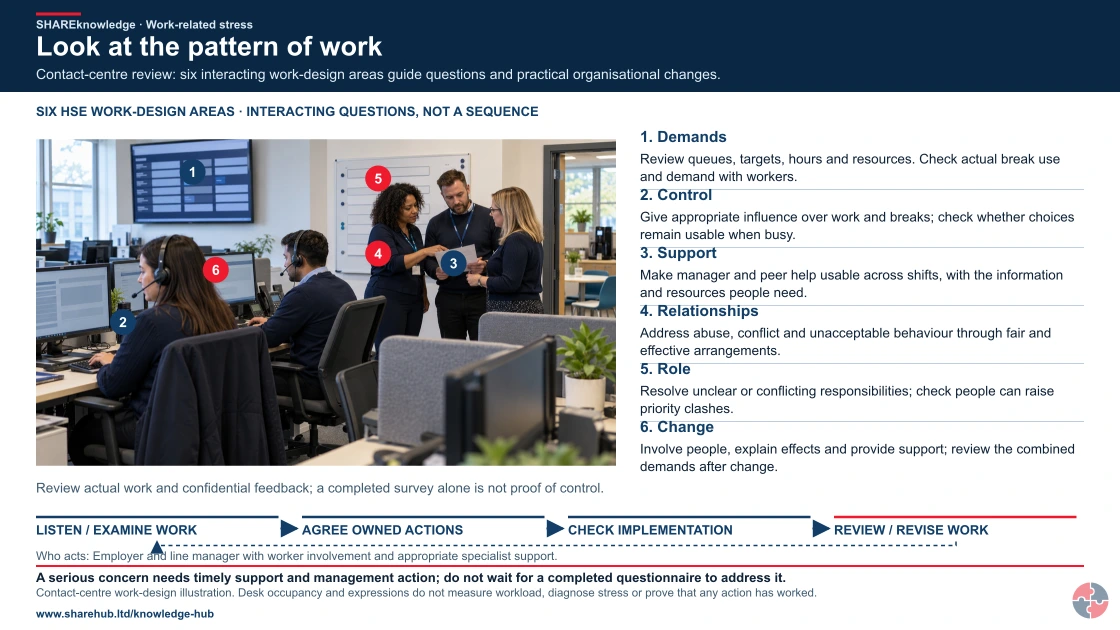
Full written explanation
A detailed realistic UK contact-centre scene shows advisers using headsets and screens while colleagues and a manager review a work sheet near a planning board and separate break-area doorway. Six numbered native labels map HSE Demands, Control, Support, Relationships, Role and Change to questions about the real work system. They are interacting areas, not ordered stages or a score. A complete feedback loop links listening to workers, owned organisational actions, checking implementation and reviewing actual effects. The original pathway remains that interacting work-design factors can create sustained harmful conditions and affect health and work; concerns must not be treated as weakness. The illustration neither measures queue pressure, staffing, missed breaks or personal stress nor establishes a diagnosis, treatment, fitness score, safe workload or successful outcome. Confidential worker input and relevant work evidence remain necessary.
Contact-centre review: six interacting work-design areas guide questions and practical organisational changes.
- Demands. Review queues, targets, hours and resources. Check actual break use and demand with workers.
- Control. Give appropriate influence over work and breaks; check whether choices remain usable when busy.
- Support. Make manager and peer help usable across shifts, with the information and resources people need.
- Relationships. Address abuse, conflict and unacceptable behaviour through fair and effective arrangements.
- Role. Resolve unclear or conflicting responsibilities; check people can raise priority clashes.
- Change. Involve people, explain effects and provide support; review the combined demands after change.
Change the pathway
- Understand with workers. Use consultation and relevant work evidence, with appropriate confidentiality.
- Improve work design. Agree practical organisational changes addressing the causes.
- Support and review. Offer suitable support and check whether changes help in real work.
Evidence check: Wellbeing signposting can support people but does not replace changes to harmful work conditions.
Read the full six-area work-design checks and source controls
Primary references: HSE: six Management Standards work-design areas · HSE: stress risk assessment and action · HSE: monitor actions and review effectiveness
Open the complete HD image (new tab)Download image

Read the full six-area work-design checks and source controls
Primary references: HSE: six Management Standards work-design areas · HSE: stress risk assessment and action · HSE: monitor actions and review effectiveness

Demands
Compare queue/workload, hours and resources with actual capacity; change staffing, targets or task allocation where needed. Check whether pressure and missed breaks reduce.
Control
Give people appropriate influence over how they do the work and use breaks, within necessary safety constraints. Check whether the agreed choices are real during busy periods.
Support
Provide usable manager, peer and organisational support, information and resources. Check response quality and access across shifts rather than only publishing contact details.
Relationships
Address unacceptable behaviour and conflict through fair, effective arrangements. Do not ask an individual to cope better with abuse that remains unresolved.
Role
Resolve conflicting or unclear responsibilities and expectations. Check that people understand their role and can raise conflicts without penalty.
Change
Involve people and explain changes, timing, effects, support and training. Review the combined demands and workers’ feedback after implementation.
Read the complete controls: ERICPD planning prompts
Discipline verifies and sustains all the controls; it is not a separate substitute for them.
| Prompt or level | Complete task-specific example |
|---|---|
| Eliminate | Remove conflicting or unrealistic targets. |
| Reduce | Adjust queues and call allocation to trained capacity. |
| Isolate | No separate physical hazard-isolation measure is specified here. Task reassignment, paired staffing, support and cover are work-organisation measures, addressed under Control. |
| Control | Use a safe route to end or transfer abusive interactions. Provide actual break cover and abusive-caller escalation. |
| PPE | PPE does not address harmful work demands. |
| Discipline | Verify changed workload with staff and maintain the controls. Read the accompanying source table for the framework distinctions. |
Read the complete controls: ESEAP effectiveness order
Compare stronger feasible controls while preserving the actual task, checks and release requirements.
| Prompt or level | Complete task-specific example |
|---|---|
| Elimination | Remove conflicting or unrealistic targets. |
| Substitution | No separate measure is specified in this example. |
| Engineering controls | No separate physical engineering measure is specified in this work-demand example. Queue allocation, resequencing, relief and recovery arrangements are administrative work-design controls. |
| Administrative controls | Adjust queues and call allocation to trained capacity. Use a safe route to end or transfer abusive interactions. Provide actual break cover and abusive-caller escalation. Verify changed workload with staff and maintain the controls. |
| PPE | PPE does not address harmful work demands. Read the accompanying source table for the framework distinctions. |
The six areas can interact. Review the actual job and worker feedback; a completed survey is not evidence that the organisational risk has been controlled.
What is work-related stress?
Work-related stress is the adverse reaction people may have to excessive work pressure or demands. The employer should assess and change harmful work factors—demands, control, support, relationships, role and change—using worker input and follow-up checks. Individual support, occupational health or an employee assistance programme can help, but does not replace reducing the work cause. Managers should ask about work impact and needed support without diagnosing a condition or collecting unnecessary medical detail.
Best-practice guide: Stress

What is work-related stress?
Work-related stress is the adverse reaction people may have to excessive work pressure or demands. The employer should assess and change harmful work factors—demands, control, support, relationships, role and change—using worker input and follow-up checks. Stress explains how work-related stress should be assessed and controlled as a health and safety risk, using HSE's Management Standards: demands, control, support, relationships, role and change.
Turn stress knowledge into a decision
Stress explains how work-related stress should be assessed and controlled as a health and safety risk, using HSE's Management Standards: demands, control, support, relationships, role and change. It separates ordinary pressure from harmful sustained stress, explains team and individual warning signs, gives manager decision prompts, shows what a suitable and sufficient stress risk assessment looks like, and links actions to workload, staffing, supervision, change, bullying, return to work and evidence. Team risk assessment, consultation, action owners, anonymised trends and minimal individual records.
Contact-centre workload and target conflict
Protect breaks, adjust targets and staffing, provide supervisor support and confidential individual routes. Review work factors and agreed adjustments at set dates; change controls if indicators do not improve.
Harmful demands can persist behind a support offer
Assess work-related stress through the actual work factors: demands, control, support, relationships, role and change. Individual support can help, but the employer must also address harmful working conditions. Managers should discuss work impact and support without diagnosing the person.
Change the work factors before adding coping advice
Use all six HSE Management Standards as work-design prompts. Protect actual breaks and review the changed workload with staff. PPE does not control harmful work demands. Personal support and occupational-health routes complement prevention and suitable individual adjustments.
Use the full stress lesson
Use the full topic for the decision points, practical examples, detailed control tables and source scope. HSE guidance applies to Great Britain; use HSENI for the Northern Ireland route and the source’s stated jurisdiction. A simplified guide does not change the page’s technical-review or approval status.

Read all six steps as text
1. What is work-related stress?
Work-related stress is the adverse reaction people may have to excessive work pressure or demands.
- Avoid / redesign: Resource plan, workload cap, demand triage and realistic deadlines.
- Control the task: Regular one-to-ones, trained supervisors and accessible help routes.
- Verify before release: Workload dashboard and action tracker.
Work-related stress is the adverse reaction people may have to excessive work pressure or demands. The employer should assess and change harmful work factors—demands, control, support, relationships, role and change—using worker input and follow-up checks. Stress explains how work-related stress should be assessed and controlled as a health and safety risk, using HSE's Management Standards: demands, control, support, relationships, role and change.
Apply it: Which part of this plan would you check at the workface before authorising the task?
2. Turn stress knowledge into a decision
Use the evidence to improve the actual work arrangement.
- Change at source: Resource plan, workload cap, demand triage and realistic deadlines.
- Make it observable: Workload dashboard and action tracker.
- Keep useful evidence: Team risk assessment, consultation, action owners, anonymised trends and minimal individual records.
Stress explains how work-related stress should be assessed and controlled as a health and safety risk, using HSE's Management Standards: demands, control, support, relationships, role and change. It separates ordinary pressure from harmful sustained stress, explains team and individual warning signs, gives manager decision prompts, shows what a suitable and sufficient stress risk assessment looks like, and links actions to workload, staffing, supervision, change, bullying, return to work and evidence. Team risk assessment, consultation, action owners, anonymised trends and minimal individual records.
Apply it: What evidence would show that the change improves this task, rather than only completing a record?
3. Contact-centre workload and target conflict
Example: a practical application of the existing topic lesson.
- Setting: Contact-centre work during vacancies and a new system; high targets, missed breaks, errors and turnover.
- Act: Consult staff, check workload, control, abusive callers, target design, role clarity and change support.
- Hold / review: Escalate immediate safety or crisis concerns through emergency/local support; pause unsafe safety-critical work.
Protect breaks, adjust targets and staffing, provide supervisor support and confidential individual routes. Review work factors and agreed adjustments at set dates; change controls if indicators do not improve.
Apply it: At which point would you hold this example, and what evidence would allow it to proceed?
4. Harmful demands can persist behind a support offer
Connect the task, the route to the person and the control that can fail.
- Work cause: Demand, conflicting targets and poor support exceed available capacity.
- Warning signs: Skipped breaks, errors, withdrawal and turnover prompt a work review.
- Health impact: Sustained harmful pressure can affect health, judgement and attendance.
Assess work-related stress through the actual work factors: demands, control, support, relationships, role and change. Individual support can help, but the employer must also address harmful working conditions. Managers should discuss work impact and support without diagnosing the person.
Apply it: Which work factor will change, and how will workers help judge whether it improves?
5. Change the work factors before adding coping advice
Start with the stronger practicable options and verify their effect.
- Demands: Match workload, staffing, priorities and deadlines to available capacity.
- Control and support: Give workers input, suitable supervision and access to practical help.
- Relationships: Act on bullying, conflict and abusive-caller risks.
- Role: Resolve conflicting responsibilities and decision rights.
- Change: Consult, communicate and support people through new systems.
Use all six HSE Management Standards as work-design prompts. Protect actual breaks and review the changed workload with staff. PPE does not control harmful work demands. Personal support and occupational-health routes complement prevention and suitable individual adjustments.
Apply it: Which change addresses the source of pressure, and what will the follow-up review check?
6. Use the full stress lesson
Follow the official sources below and retain the task-specific evidence.
- Official guidance: HSE six work-design standards
- Official guidance: HSE stress assessment and action
- Task decision: Team risk assessment, consultation, action owners, anonymised trends and minimal individual records.
Use the full topic for the decision points, practical examples, detailed control tables and source scope. HSE guidance applies to Great Britain; use HSENI for the Northern Ireland route and the source’s stated jurisdiction. A simplified guide does not change the page’s technical-review or approval status.
Apply it: Which official source and full-topic section will you use to resolve the next decision?
Stress is not simply being busy, having a challenging job or feeling pressure before a deadline. Pressure can be normal and sometimes motivating when it is proportionate, time-limited, supported and within a person's control. Stress becomes a workplace risk when demands exceed coping capacity for long enough, intensely enough or unpredictably enough to affect health, behaviour, attendance, judgement or safety.
HSE's approach treats work-related stress like other health and safety risks. Employers should identify the causes, decide who may be harmed, evaluate whether controls are good enough, act, record where required and review. The key risk factors are demands, control, support, relationships, role and change. These are work-design factors, not personality labels.
Stress management must lead to practical changes in work. It should not tell workers to become tougher while excessive workload, poor staffing, role conflict, bullying, isolated work, unclear priorities or badly communicated change remain untouched. Individual support matters, but it cannot substitute for preventing or reducing harmful work conditions.
| Standard | What it means in practice | Typical weak signal |
|---|---|---|
| Demands | Workload, work patterns, pace, deadlines and environment are realistic. | Long hours, skipped breaks, errors, fatigue and repeated overtime. HSE six work-design standards |
| Control | People have appropriate say over how and when work is done. | No flexibility, no prioritisation power and constant interruption. HSE six work-design standards |
| Support | Managers, peers, tools, training and resources help people do the work. | Workers feel abandoned, under-trained or unable to ask for help. HSE six work-design standards |
| Relationships | Conflict, bullying and unacceptable behaviour are prevented and managed. | Grievances, cliques, shouting, exclusion or unresolved friction. HSE six work-design standards |
| Role | People understand responsibilities, priorities and reporting lines. | Conflicting instructions, duplicated work or accountability gaps. HSE six work-design standards |
| Change | Change is planned, communicated and supported. | Rumours, anxiety, unclear timelines and people learning changes too late. HSE six work-design standards |
Start with HSE stress assessment and action and assess the actual work and nation.
How can I practise this topic in 3D?


Production pressure and fatigue
All related inspection points 1 across 1 location
Aerosystems Engineering 1 inspection point
Practice in the SHAREhub environment. Browser practice is separate from workplace competence and formal learning records.
How should stress be assessed as a health and safety risk?
A stress risk assessment should identify work-design causes, affected groups, existing controls, action owners, review dates and evidence.
A strong stress assessment is not a wellbeing survey on its own and not a private medical investigation into individuals. It examines how the work is organised and experienced. Useful evidence can include absence data, turnover, grievances, workload metrics, overtime, consultation, one-to-ones, worker voice, incident trends, complaints, performance pressure, exit interviews and team discussions.
The assessment may be team-based, role-based or individual where a concern has been raised. The key is to move from description to control: what exactly is causing harm or risk, what can be changed, who owns the action, how soon, and how will effectiveness be checked?
| Assessment step | Question | Evidence |
|---|---|---|
| Define the group or role | Which team, task, role or change is being assessed? | Organisation chart, rota, project plan or job profile. |
| Identify work stressors | Which Management Standards are weak? | Survey, workshop, one-to-one themes and operational data. |
| Identify who may be harmed | Which workers, shifts, locations or vulnerable groups may be affected? | Shift pattern, new starters, lone workers, remote workers and return-to-work cases. |
| Review existing controls | What already reduces pressure or supports work? | Staffing rules, supervision, escalation, breaks, training and support routes. |
| Set practical actions | What will change in workload, control, support, role clarity, behaviour or communication? | Action plan with owners and due dates. |
| Protect privacy | What health information is genuinely needed and who can see it? | Privacy note, OH referral boundary and confidential record route. |
| Review effectiveness | Have causes reduced, not just conversations increased? | Follow-up data, worker feedback and management review. |
Use HSE stress risk assessment for assessment and action; the table translates it into local questions rather than prescribed fields.
Illustrative action entry: staff identify a queue/target conflict; the operations owner agrees revised allocation and protected break cover, records a due date and checks actual break access and manageable demand with staff. If improvement fails, escalate staffing/targets and hold unsafe duties rather than adding a webinar. Review evidence of the work change, not just attendance.
What does a workplace stress scenario look like?
A stress scenario usually involves several work-design factors interacting over time, not one isolated bad day.
Change the work conditions that create harm
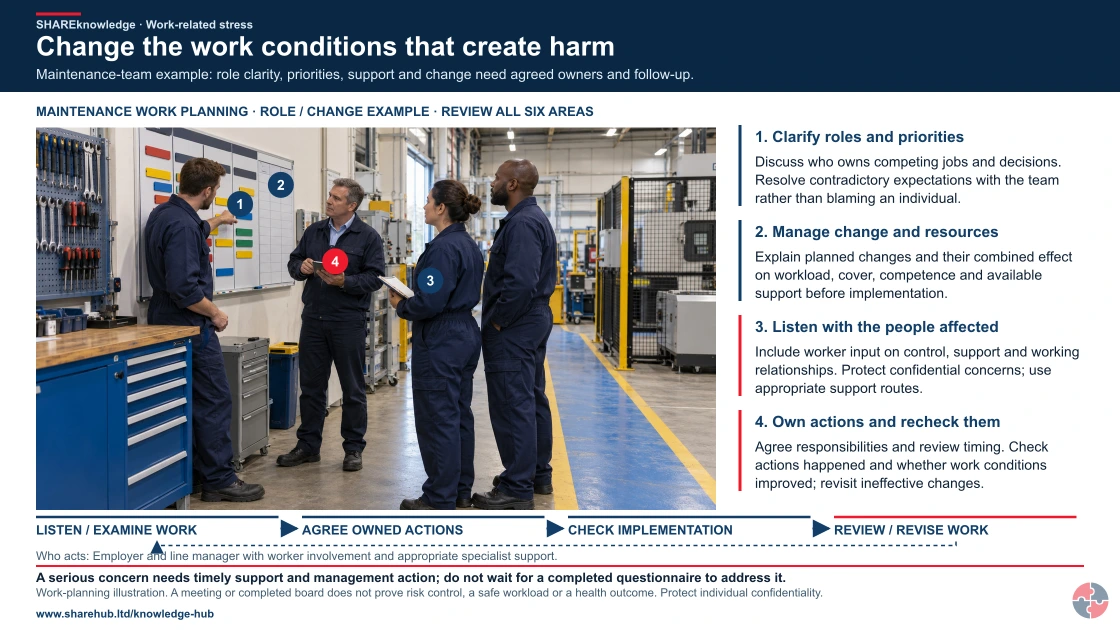
Full written explanation
A detailed realistic UK maintenance-team planning scene shows workers and a line manager discussing a work-allocation board and notes, with a closed guarded machine and separate walkway in the background. Four native annotations connect role/priorities, organisational change/resources, worker participation/support and owned actions/review. A full feedback loop retains the source checks: listen and examine the job, identify practical causes across the six HSE work-design areas, agree owned changes, and review with appropriate support. No machinery is being operated. The picture does not prove that roles are unclear, diagnose anybody, measure a safe workload or demonstrate an effective intervention. A completed meeting, survey or planning board is not evidence by itself that harmful work conditions have changed; timely support and management action do not wait for questionnaire completion.
Maintenance-team example: role clarity, priorities, support and change need agreed owners and follow-up.
- Listen and examine the job. Discuss concerns and review demands, control, support, relationships, role and change.
- Identify practical causes. Use worker input and relevant evidence; do not reduce the issue to a resilience score.
- Agree owned changes. Set realistic work-design actions, responsibilities and timescales with the people affected.
- Review and support. Check progress and effectiveness, protect confidentiality and arrange appropriate support.
When the evidence does not fit: A serious concern needs timely support and management action; do not wait for a completed questionnaire to address it.
Who acts: Employer and line manager with worker involvement and appropriate specialist support.
Changed workplace
Contact centre: Address workload, targets, vacancies and usable breaks rather than just coping advice.
Maintenance team: Resolve unclear responsibilities and poorly managed change; different factors may need different actions.
Evidence check: Wellbeing signposting can support people but does not replace changes to harmful work conditions.
Read the full six-area work-design checks and source controls
Primary references: HSE: six Management Standards work-design areas · HSE: stress risk assessment and action · HSE: monitor actions and review effectiveness
Open the complete HD image (new tab)Download image

Read the full six-area work-design checks and source controls
Primary references: HSE: six Management Standards work-design areas · HSE: stress risk assessment and action · HSE: monitor actions and review effectiveness
Contact-centre workload and target conflict
Task material and setting: Contact-centre work during vacancies and a new system; high targets, missed breaks, errors and turnover.
People and prerequisites: Team workers, manager, HR/safety lead and worker representatives; workload, staffing and feedback evidence.
Before: Consult staff, check workload, control, abusive callers, target design, role clarity and change support.
During: Protect breaks, adjust targets and staffing, provide supervisor support and confidential individual routes.
Hold or stop: Escalate immediate safety or crisis concerns through emergency/local support; pause unsafe safety-critical work.
Completion and hand back: Review work factors and agreed adjustments at set dates; change controls if indicators do not improve.
Evidence: Team risk assessment, consultation, action owners, anonymised trends and minimal individual records.
A contact-centre team has rising customer demand, vacancies, new software and a strict call-duration target. Workers skip breaks to clear queues. Complaints increase, quality drops, two experienced workers leave and a team member becomes withdrawn. The first weak management response is to offer a resilience webinar and remind people to use the EAP.
A stronger response reviews demand, staffing, targets, call complexity, break recovery, supervisor support, abusive-caller controls, change communication and role clarity. The team is consulted, immediate workload triage is introduced, target pressure is adjusted, supervisors are trained to spot early signs, and the risk assessment is reviewed after four and twelve weeks.
| Finding | What it indicates | Better control |
|---|---|---|
| Vacancies and queue pressure | Demands exceed available resource. | Recruitment plan, temporary support and demand triage. |
| Skipped breaks | Recovery controls are failing. | Protected breaks and supervisor monitoring. |
| Strict call-duration target | Performance metric may conflict with wellbeing and quality. | Balanced KPI including complexity and quality. |
| New software | Change and competence risk. | Training, floor walking and defect feedback. |
| Abusive calls | Relationship and violence/aggression interface. | Call escalation, refusal process and post-call support. |
| Withdrawal and absence | Possible early individual harm. | Private supportive conversation and GP/OH signposting if needed. |
This contact centre applies HSE six work-design standards. Staffing, targets, owners and review dates need the actual team assessment.
How should managers talk about stress without becoming intrusive?
Managers should discuss work impact, risk, support and adjustments, not demand private diagnosis detail.
A good conversation starts with observable work impact and care: changes in behaviour, absence, fatigue, conflict, performance strain or a worker raising a concern. The manager should ask what work factors are making things harder and what immediate support would help.
The manager should not diagnose, interrogate personal history or record unnecessary medical detail. Where health advice is needed, signpost to GP, occupational health or EAP, while keeping workplace actions focused on work design and safety.
| Situation | Helpful wording | Poor wording |
|---|---|---|
| Worker appears overwhelmed | I've noticed the workload has looked difficult this week. What is making the work harder and what can we change? | You seem stressed; are you coping or not? |
| Absence after stress | Let's plan what work needs adjusting for a sustainable return and agree a review date. | We need to know exactly what is wrong with you. |
| Team conflict | Let's look at the work pressures, roles and behaviours that are creating conflict. | People need thicker skin. |
| Safety-critical role | Until we understand the risk, we may need a temporary adjustment to protect you and others. | You are a liability. |
| Request for support | We can discuss work impact and support privately, and involve OH if useful. | Tell me all your medical details so I can decide. |
What controls should come before wellbeing add-ons?
Work-related stress control should first address the causes in work design before relying on individual coping measures.
Wellbeing initiatives can help, but they do not control a poorly designed job. If workload is excessive, bullying is tolerated, roles conflict or change is chaotic, yoga sessions and apps will not make the risk suitable and sufficient.
The strongest control package changes work: staffing, priorities, task design, breaks, job control, supervision, communication, behaviour standards and escalation. Individual support sits alongside these controls, not instead of them.
| Control level | Example | Evidence |
|---|---|---|
| Prevent excessive demand | Resource plan, workload cap, demand triage and realistic deadlines. | Workload dashboard and action tracker. HSE stress assessment and action |
| Increase control | Allow prioritisation, flexible sequencing and worker input. | Team agreement and supervisor observation. HSE stress assessment and action |
| Strengthen support | Regular one-to-ones, trained supervisors and accessible help routes. | Conversation records and feedback themes. HSE stress assessment and action |
| Protect relationships | Bullying response, respectful behaviour standard and conflict resolution. | Case trends and closure evidence. HSE stress assessment and action |
| Clarify role | Clear responsibilities, escalation and decision rights. | Role brief and reduced conflict reports. HSE stress assessment and action |
| Manage change | Consultation, communication plan, training and transition support. | Change risk assessment and review. HSE stress assessment and action |
| Support individuals | EAP, GP/OH signposting and temporary adjustments. | Confidential support route and review date. HSE stress assessment and action |
What should a stress dashboard show?
A stress dashboard should combine leading and lagging signals without exposing private medical detail.
A useful dashboard does not publish names or diagnoses. It shows whether the work system is creating pressure: workload, overtime, break loss, vacancies, turnover, complaints, grievances, team feedback, unresolved change actions and stress-related absence themes.
The dashboard should prompt decisions. If a team has high overtime, poor break recovery and rising conflict, leaders should adjust staffing or demand rather than wait for sickness absence to prove harm.
| Indicator | What it may reveal | Management question |
|---|---|---|
| Overtime and hours | Excessive demand or poor planning. | Is workload sustainable? |
| Break loss | Recovery is not protected. | Are supervisors allowing real recovery? |
| Vacancies and turnover | Demand/support imbalance. | Is resourcing creating health risk? |
| Grievances or conflict | Relationship weakness. | Are unacceptable behaviours controlled? |
| Change actions overdue | Change may be poorly managed. | Are people clear and supported? |
| Stress absence themes | Harm may already be occurring. | What work causes need action? |
| Worker voice | Early weak signals. | Are concerns acted on and fed back? |
The example four- and twelve-week checkpoints are local review choices, not HSE intervals or reasons to delay action. Review sooner when risk, symptoms, work or controls change. Use aggregated operational information and confidential feedback; suppress small groups and combinations that could identify someone. A survey score or absence label is not a diagnosis, clinical ranking or proof that controls work. HSE stress risk assessment.
Select indicators that test whether work has changed; HSE stress risk assessment does not prescribe these dashboard fields or clinical conclusions.
How do the Management Standards appear in day-to-day work?
The Management Standards become useful when they are translated into observable work conditions, supervisor decisions and evidence.
Demands, control, support, relationships, role and change are not abstract labels. They show up in rosters, queues, handovers, staffing decisions, target design, conflict handling, software rollouts, supervisor availability and whether people can pause work when pressure becomes unsafe.
A competent stress assessment should therefore look beyond whether individuals report feeling stressed. It should ask what in the system is creating pressure, how often it happens, who is exposed, what controls are already present and what evidence proves the controls are working.
| Standard | Operational example | Professional evidence |
|---|---|---|
| Demands | Warehouse pick rate rises while agency cover is short and breaks are missed. | Workload data, rota, overtime, break records and worker feedback. |
| Control | Call handlers cannot pause complex cases or vary task order. | Procedure review, supervisor discretion record and consultation notes. |
| Support | New starters work unsupervised during busy public-facing shifts. | Induction, buddy records, supervision plan and one-to-one themes. |
| Relationships | Repeated conflict between supervisors and contractors is treated as personality clash. | Complaint trends, respectful-behaviour actions and investigation outcomes. |
| Role | A site manager receives conflicting instructions from client, project lead and safety adviser. | Role matrix, escalation route and decision-rights record. |
| Change | New booking software is launched without training, defect route or temporary staffing. | Change plan, training record, transition risk assessment and post-change review. |
HSE six work-design standards defines the six areas; the operational examples show possible local responses, not fixed solutions.
How does a team stress risk assessment move from concern to control?
A team stress risk assessment should turn warning signs into work-design actions, owners, evidence and review dates.
A worked stress assessment is useful because it shows the difference between listening and controlling risk. Listening identifies what is happening; control changes workload, authority, support, behaviours or change management so the risk reduces.
For example, a facilities team covering sickness, complaints and refurbishment disruption may report exhaustion and conflict. The action plan should not simply remind people to speak up. It should address temporary cover, task prioritisation, contractor interface, manager availability, escalation and review.
| Stage | Example finding | Action and review |
|---|---|---|
| Concern raised | Team reports workload spike, conflict and uncertainty during refurbishment. | Manager records team-level concern and starts assessment. |
| Evidence gathered | Overtime, missed breaks, complaints, change actions and incident near misses are reviewed. | HSE/HR support worker consultation. |
| Management Standards mapped | Demands, support, relationships and change are weak. | Causes are listed separately from symptoms. |
| Immediate controls | Non-urgent work is paused and contractor queries get a named escalation route. | Review after two weeks. |
| System controls | Temporary cover, supervisor check-ins, conflict route and change briefings are introduced. | Owner and due date assigned. |
| Verification | Breaks, overtime, complaints and worker feedback are checked. | Assessment updated at four and twelve weeks. |
| Leadership escalation | Budget or staffing gap remains unresolved. | Senior decision recorded with risk rationale. |
Transfer the contact-centre learning to the refurbishment team: queue measures do not capture conflicting trades, changing permits or site access. Consult affected workers and contractors, reassess realistic sequencing and decision authority, and verify the controls at the workface. These are local examples of the six standards, not universal target values. HSE six work-design standards.
Review intervals in this case must fit actual risk; serious concerns and failed controls need prompt action rather than waiting for a scheduled checkpoint.
What does good stress-management evidence look like?
Good evidence shows that work-related stress risks have been assessed, controlled, reviewed and escalated where local managers cannot fix the cause.
A strong evidence pack does not collect unnecessary medical detail. It shows how the organisation identified work causes, involved workers, decided controls, assigned owners and verified whether workload, support, conflict, role clarity or change risks improved.
For professionals and learners, the evidence test is whether the record would help a manager make a better decision tomorrow. If the evidence only proves that a wellbeing poster was issued or a survey was completed, it is too weak.
| Evidence item | What good looks like | What weak evidence looks like |
|---|---|---|
| Stress risk assessment | Group, role or team assessment mapped to demands, control, support, relationships, role and change. | Generic statement that stress is covered by wellbeing policy. |
| Action plan | Specific work-design actions with owners, dates, resources and review method. | Vague instruction for staff to speak to managers. |
| Workload review | Overtime, vacancies, break loss, peaks, targets and workload priorities reviewed together. | Absence data reviewed without looking at causes. |
| Staffing/resource decision | Leadership decision records show what capacity was added, paused or reprioritised. | Manager told to manage pressure locally without resource decision. |
| Worker consultation | Team discussions, worker representatives and feedback themes are recorded and fed back. | Anonymous survey scores with no local action. |
| Change impact review | Change plan includes workload, communication, training and transition support. | New system or restructure launched without stress impact review. |
| OH/HR referral route | Confidential route exists for individual support and work-impact advice. | Manager stores diagnosis details in ordinary supervision notes. |
| Follow-up dates | Four-week, twelve-week or change-triggered reviews test whether controls worked. | Action closed because a meeting took place. |
Evidence must demonstrate implemented changes and worker feedback under HSE stress risk assessment; the illustrative records are not mandatory forms.
In GB, employers with five or more employees must record significant risk-assessment findings; all employers must assess and act. The scale of a dashboard is not a compliance minimum and does not replace prompt control of a serious concern.
How can the hierarchy of controls reduce harmful work demands and stress risks?
Control classification: Temporary duties, task stopping/reallocation, paired staffing, support and cover are administrative work arrangements. This example specifies no separate engineered measure; none should be invented merely to fill a tier. These actions retain the immediate safety and competent-release boundaries in the main lesson. Read this correction with the source table. Retained overview and stage artwork requires the matching classification update.
Address work-created hazards at source, then agree proportionate task controls and personal support.
For stress, assess the work itself: staffing, scheduling, exposure, equipment or interpersonal conditions as applicable. Remove or reduce hazards where possible, then agree practical procedures and review whether they work. A personal health condition calls for clinical advice and suitable work adjustments, not a generic control or diagnosis by a manager. HSE hierarchy of controls
Document who will act, what triggers a pause or referral, and when the arrangement will be reviewed. Apply the correct GB or NI duties and site instructions.
For the contact centre, remove conflicting or unrealistic targets, adjust queues and call allocation to available trained capacity, provide cover for actual breaks, and implement abusive-caller escalation. Verify the changed workload with staff; do not treat attendance at coping training as proof of control. PPE does not address harmful demands. HSE stress risk assessment; HSE six work-design standards. ERICPD is a teaching prompt (Eliminate, Reduce, Isolate, Control, PPE, Discipline); Discipline means maintaining and checking controls.
How can the ERICPD hierarchy of controls reduce harmful work demands and stress risks?

| ERICPD control level | Topic-specific example | Source and full task context |
|---|---|---|
| Eliminate | Remove conflicting or unrealistic targets. | Read the full task example, checks and stop points on this page. HSE hierarchy of controls · HSE stress risk assessment · HSE six work-design standards |
| Reduce | Adjust queues and call allocation to trained capacity. | Read the full task example, checks and stop points on this page. HSE hierarchy of controls · HSE stress risk assessment · HSE six work-design standards |
| Isolate | No separate physical hazard-isolation measure is specified here. Task reassignment, paired staffing, support and cover are work-organisation measures, addressed under Control. | Read the full task example, checks and stop points on this page. HSE hierarchy of controls · HSE stress risk assessment · HSE six work-design standards |
| Control | Use a safe route to end or transfer abusive interactions. Provide actual break cover and abusive-caller escalation. | Read the full task example, checks and stop points on this page. HSE hierarchy of controls · HSE stress risk assessment · HSE six work-design standards |
| PPE | PPE does not address harmful work demands. | Read the full task example, checks and stop points on this page. HSE hierarchy of controls · HSE stress risk assessment · HSE six work-design standards |
| Discipline | Verify changed workload with staff and maintain the controls. | Read the full task example, checks and stop points on this page. HSE hierarchy of controls · HSE stress risk assessment · HSE six work-design standards |
How can the ISO 45001 hierarchy of controls reduce harmful work demands and stress risks?

| Five-level control stage(s) | Topic-specific example | Source and full task context |
|---|---|---|
| Elimination | Remove conflicting or unrealistic targets. | Read the full task example, checks and stop points on this page. HSE hierarchy of controls · HSE stress risk assessment · HSE six work-design standards |
| Administrative controls | Adjust queues and call allocation to trained capacity. | Read the full task example, checks and stop points on this page. HSE hierarchy of controls · HSE stress risk assessment · HSE six work-design standards |
| Administrative controls | Use a safe route to end or transfer abusive interactions. | Read the full task example, checks and stop points on this page. HSE hierarchy of controls · HSE stress risk assessment · HSE six work-design standards |
| Administrative controls | Provide actual break cover and abusive-caller escalation. | Read the full task example, checks and stop points on this page. HSE hierarchy of controls · HSE stress risk assessment · HSE six work-design standards |
| PPE | PPE does not address harmful work demands. | Read the full task example, checks and stop points on this page. HSE hierarchy of controls · HSE stress risk assessment · HSE six work-design standards |
| Administrative controls | Verify changed workload with staff and maintain the controls. | Read the full task example, checks and stop points on this page. HSE hierarchy of controls · HSE stress risk assessment · HSE six work-design standards |
When should stress risk be escalated?
Escalate when there are signs of harm, safety-critical risk, bullying, repeated absence, crisis concerns, unmanageable workload or ineffective local controls.
Managers should act early. Waiting for a formal diagnosis or long absence is poor risk management. Escalation may involve HR, occupational health, senior management, employee representatives, safeguarding or emergency support depending on the risk.
Safety-critical work needs particular care. A worker who is exhausted, distressed, distracted or unwell may need temporary adjustment away from driving, plant operation, live electrical work, lone work, confined spaces or critical supervision while support and work factors are reviewed.
| Trigger | Immediate action | Who to involve |
|---|---|---|
| Worker reports unmanageable workload | Review priorities, demand and support quickly. | Line manager and senior manager if resource issue. |
| Signs of crisis or self-harm | If someone is in immediate danger, call 999 or go to A&E; otherwise seek urgent local clinical help. | Emergency services for immediate danger; in England, a local urgent clinical route for other urgent need. EAP/OH may support follow-up, not emergency triage. UK 999 and 112 emergency numbers |
| Bullying or harassment concern | Protect people and follow respectful conduct route. | HR and senior manager. |
| Safety-critical impairment | Temporarily review task allocation. | Manager, OH and competent adviser. |
| Team-wide symptoms | Assess work design, not only individuals. | HSE/HR and worker representatives. |
| Repeated failed actions | Escalate resource or governance barrier. | Leadership review. |
Use nidirect mental-health emergency routes for the NI care-plan, GP/out-of-hours and crisis-team pathways; other UK nations have their own local clinical access routes. 999 is the UK emergency number for immediate danger. Managers support access to help and safe task control rather than diagnosing or deciding clinical treatment.
Where do stress programmes commonly fail?
They fail when organisations offer support but leave harmful work design unchanged.
Common failure patterns include relying on resilience training, recording absence but not causes, treating stress as a private weakness, ignoring bullying, measuring survey scores without action, and making changes without consulting the people affected.
A mature programme tests whether the risk has reduced. It reviews workload, support, behaviour, role clarity and change controls, then checks whether people experience the difference.
| Failure or weak practice | How it develops | What good looks like |
|---|---|---|
| Survey-only programme | Run annual survey and publish averages. | Use data to create team action plans with owners. |
| Resilience substitution | Offer coping training instead of fixing work. | Redesign demand, control, support and change first. |
| Individual blame | Ask why the worker cannot cope. | Ask what in the work is creating excessive pressure. |
| Poor confidentiality | Manager records diagnosis details. | Record work impact, support and review only. |
| No verification | Close action after a meeting. | Check whether workload or conflict has actually reduced. |
| Safety-critical blind spot | Keep person in same role while concerns continue. | Review risk and temporary adjustment. |
What evidence shows stress is being managed?
Good evidence shows that controls are planned, used, checked, corrected and reviewed.
Evidence should be proportionate to the harm and task. Check whether the controls are used, work in practice, and trigger timely correction when conditions change.
| Evidence item | What it should show | Assurance question |
|---|---|---|
| Stress risk assessment | Management Standards, affected groups, controls, owners and review dates. | Does it identify work causes? |
| Worker consultation | Surveys, focus groups, one-to-ones and representative input. | Are actions fed back? |
| Action tracker | Workload, staffing, support, behaviour and change actions. | Are actions strong and verified? |
| Manager training | Spotting signs, conversations, privacy and escalation. | Can managers apply it? |
| Absence and turnover themes | Team-level data without unnecessary diagnosis detail. | Are trends prompting action? |
| OH/EAP route | Confidential signposting and referral where needed. | Are records protected? |
| Leadership review | Stress risk, resources, actions and weak signals. | Do senior decisions reduce causes? |
Adapt these evidence items to the actual work. They should show implemented controls, correction and review without unnecessary personal health detail.
How should stress be assured?
Assurance should test whether controls work in practice, not whether the page or procedure exists.
Assurance should include frontline checks, manager review and periodic independent sampling where risk warrants it. The purpose is to find weak signals early, close actions properly and update the risk assessment when work changes.
| Assurance level | What to check | What good looks like |
|---|---|---|
| Frontline | Managers review workload, breaks, support and concerns. | Early action occurs before absence. |
| Second line | HSE/HR sample assessments and action quality. | Controls target work design. |
| Worker voice | Representatives and teams confirm whether changes help. | Feedback is acted on. |
| Audit | Review evidence, confidentiality and management review. | Stress is integrated into H&S system. |
| Board | Top stress risks, resource decisions and trend learning. | Leaders see and address systemic causes. |
The assurance levels and sampling are local choices; verify what happens in practice and protect individual information.
Which UK duties and guidance apply?
Employers must assess and manage foreseeable work-related stress risks under GB health and safety law; Northern Ireland has separate work-health and management regulations. HSE and HSENI Management Standards identify six work-design areas and are practical guidance, not a duty to diagnose staff. Keep any health information proportionate and confidential; use clinical or occupational-health advice for health decisions.
| Jurisdiction | Route | Direct source | Decision supported |
|---|---|---|---|
| Great Britain | Work-health and risk assessment | Health and Safety at Work etc. Act 1974; Management of Health and Safety at Work Regulations 1999; Work-related stress: risk assessment | Assess work stressors and act on findings. |
| Northern Ireland | Separate work-health duties | Health and Safety at Work (Northern Ireland) Order 1978; Management of Health and Safety at Work Regulations (Northern Ireland) 2000; Roles and responsibilities for mental well-being | Use NI law and HSENI guidance. |
| Great Britain / Northern Ireland | Work-design guidance | Stress Management Standards; Management Standards for work-related stress | Check six risk factors and consult workers. |
| United Kingdom | Health-data privacy | UK GDPR Article 5 | Record minimum necessary support information. |
Collect only information needed for the work decision, limit access and retention, and explain its use. Health information needs an appropriate lawful basis under UK GDPR Article 6 as well as the Article 5 principles and a separate Article 9 condition. An employee agreeing a support plan does not by itself establish a valid processing basis; involve the responsible privacy/HR lead.
How should management check this work?
Use a defined plan, carry out the controls, check performance and correct what does not work.
For stress, assign a competent owner to set the work controls, check their use and review them after change, failure or new evidence. HSE managing health and safety
A management-system label or certificate is not approval of a site limit, procedure or individual work decision. Apply GB and NI duties to the correct location.
What training and competence are needed?
Demonstrate the decision each role must make in its actual task, including when to stop and seek specialist advice.
These assessment methods are illustrative SHARE implementation choices; the linked guidance supports the subject matter, not a prescribed training format.
| Role | Practice to demonstrate | Assessor and method | Evidence | Reassess when |
|---|---|---|---|---|
| Workers | Identify work stressors and use concern routes. | Supervisor tests scenario. | Briefing and response. | Role or workload change. HSE six work-design standards |
| Supervisors | Discuss work factors, protect privacy and escalate risk. | HR/safety lead observes role-play. | Case decision and actions. | Repeated concern. HSE stress assessment and action |
| Managers | Change demand, control, support and role conditions. | Senior leader reviews a team case. | Risk actions and trend. | Staffing or system change. HSE stress assessment and action |
| HR/OH advisers | Separate work adjustment from confidential clinical detail. | Privacy/clinical peer reviews case. | Minimised record and referral. | Health-data process change. UK GDPR Article 5 |
| Senior leaders | Test the risk profile and resource decisions. | Board peer review. | Action and assurance record. | Trend or major change. HSE stress assessment and action |
How could Riverside Leisure Ltd manage this in practice?

Riverside Leisure Ltd can manage stress by treating workload, public aggression, shift cover, role clarity and change as operational risk factors.
In this leisure business, reception teams face customer pressure, lifeguards manage vigilance demands, cleaners work early and late shifts, and managers juggle staffing, events and complaints.
| Management element | How the business would manage it | Evidence to review |
|---|---|---|
| Reception pressure | Review queue targets, abusive customers and escalation. | Incident and staffing review. |
| Lifeguard vigilance | Protect breaks, rotation and recovery. | Rota and supervision record. |
| Change | Consult workers before new booking system launch. | Change risk assessment. |
| Support | Train managers in early conversations. | Training and one-to-one records. |
| Assurance | Review absence, turnover, complaints and workload themes. | Quarterly wellbeing report. |
This example business illustrates applying the topic. Owners and records must fit its actual work, people and jurisdiction.
What do the acronyms and key terms mean?
Acronyms should be understood before they are used in assessments, briefings, audits or learning answers.
Acronyms can exclude newer readers if they are not explained. This section keeps the main terms available at the end of the page so the article stays readable while still supporting learners and audit users.
| Acronym | Meaning | Plain-English use |
|---|---|---|
| EAP | Employee Assistance Programme | Confidential support service offered by some employers. |
| HSE | Health and Safety Executive | Great Britain regulator and official guidance source. |
| HSWA | Health and Safety at Work etc. Act 1974 | Primary GB health and safety legislation; NI has a separate Order. |
| MHSWR | Management of Health and Safety at Work Regulations 1999 | Regulations requiring risk assessment, arrangements, competent advice and cooperation. |
| OH | Occupational Health | Competent clinical advice route focused on work and health. |
| UK GDPR | UK General Data Protection Regulation | UK data protection law framework relevant to worker health information. |
| ERICPD | Eliminate, Reduce, Isolate, Control, PPE, Discipline | Teaching prompt; sustain and check work controls. |
Which BuildOut documents support this topic?
Download individual editable BuildOut documents for this topic. Procedures and plans contain completed arrangements; forms, checklists, assessments, RAMS and permits are blank masters. Registers include separate worked examples.
| Document | Purpose and content | Editable download |
|---|---|---|
| Stress, fatigue, hours and workload assessment BOUK-RA-OCC-02 · Blank editable master · v1.0 | Assess foreseeable psychosocial and fatigue risks and agree work-design controls. | Download DOCX Read preview |
Review and adapt the documents for your organisation, activities and jurisdiction before approval and issue. Open the SHAREms management-system hierarchy to find each document under its parent policy.
Unlock another resource
You have used this month’s two free downloads. Publish a post in your own words to unlock one more resource, or choose SHARE Individual for 10 downloads per month.
You decide whether to share. If you do, use the relevant platform disclosure tools and do not make claims you do not genuinely hold.