SHARE Knowledge Hub
What should you know about depression and workplace wellbeing?
Depression can affect mood, energy, concentration, sleep, confidence, relationships, attendance and safe performance, so it belongs in workplace wellbeing and risk management rather than being treated as a purely private issue. A good employer does not diagnose depression or ask for unnecessary clinical detail; it designs work to reduce harmful psychosocial stressors, creates safe routes for confidential conversations, considers reasonable adjustments where a condition affects work, uses occupational health or HR advice where needed and keeps support under review. The practical aim is to prevent work from causing or worsening mental ill health, help people remain in or return to work where appropriate, and make sure managers act calmly, fairly and consistently.
Understanding What should you know about depression and workplace wellbeing?
Depression can affect mood, energy, concentration, sleep, confidence, relationships, attendance and safe performance, so it belongs in workplace wellbeing and risk management rather than being treated as a purely private issue. A good employer does not diagnose depression or ask for unnecessary clinical detail; it designs work to reduce harmful psychosocial stressors, creates safe routes for confidential conversations, considers reasonable adjustments where a condition affects work, uses occupational health or HR advice where needed and keeps support under review. The practical aim is to prevent work from causing or worsening mental ill health, help people remain in or return to work where appropriate, and make sure managers act calmly, fairly and consistently.
Why this matters at work
After the immediate emergency is handed over, agree respectful contact and practical support when appropriate. Review whether remote-working arrangements, location information, task handover and escalation worked for this person. Examine workload, isolation, scheduling and harassment concerns without declaring any one factor the proven cause of illness. Provide appropriate support to affected colleagues while protecting confidentiality. A policy containing a telephone number is not evidence that a mobile or night worker could obtain help. The post-event review should improve access and operational arrangements using the facts actually known.
Do not state that depression is caused by work without evidence, that it automatically means a person is unsafe or disabled, that disclosure is compulsory, that health information can be shared freely, or that resilience training alone controls workload or bullying. Do not recommend forced counselling, punishment for illness, public discussion of a condition or an unreviewed permanent adjustment.
How organisations manage this in practice
A suitable and sufficient stress assessment follows the ordinary risk-management logic: identify work hazards, decide who may be harmed and how, evaluate risks, select reasonably practicable preventive action, record significant findings, implement, monitor and review. For five or more employees the significant findings must be recorded, although the duty to control risk applies at every size.
Keep a proportionate record of the work difficulty, agreed measures, responsible manager, review arrangement and any task restriction. Restrict health information to those with a lawful need and give operational staff only what they need to implement the plan. Check actual implementation rather than counting completed wellbeing conversations. Review whether demand, support and recovery have improved, whether the worker can raise concerns and whether wider controls need changing. Avoid using low absence as proof of good health or a reason to remove a useful adjustment without discussion.
The review should distinguish timely support, implemented work changes and health outcomes. Managers can check whether agreed priorities, hours and relief are in place; they should not judge treatment or collect more clinical detail to satisfy a dashboard. Review any continuing critical-task restrictions against current demands and focused advice. The organisational audit should also check manager time, authority, competence and escalation. Where controls or adjustments are not working, agree a proportionate change and retain the reason, rather than re-dating the same plan or treating disclosure as a completed intervention.
Choose urgent help or workplace support
Use the existing urgent-help guidance when there is an immediate concern. For ongoing support, agree practical work changes with the person and assess workload or other workplace factors; a support conversation is not a diagnosis.
Reception cover changes after a support discussion
Illustrative example. A receptionist reports difficulty with repeated aggression and an overloaded queue.
Decision. Agree cover, escalation support and a manageable allocation of work with the person.
Evidence to check. What changes at the desk, who provides cover and what information the person agrees may be shared.
Hold or escalation point. Urgent concerns follow the existing help route without waiting for an HR appointment.
Follow-up. Ask whether the work changes help and revise them rather than measuring campaign attendance.
Keep immediate safety and chosen support distinct
A respectful conversation can lead to agreed work changes and information sharing. An immediate-safety concern uses the appropriate urgent route, independently of a routine review.

Immediate concern
Use the locally applicable urgent-help arrangements for an immediate safety concern; do not wait for a scheduled wellbeing meeting.
Chosen support
Ask what would help and agree what information may be shared, without requiring a disclosure of unnecessary clinical details.
Change the work
Review demands, support and other work factors the employer can change; name actions and review them with the worker.
The illustration cannot diagnose depression or substitute for clinical care.
What key facts should people know first about depression at work?
Depression at work should be handled as general workplace guidance, not medical, legal or HR advice.
This page explains workplace management principles. It does not diagnose depression, tell anyone what treatment to follow, determine disability status, decide disciplinary outcomes or replace qualified medical, legal, HR or occupational health advice.
If a person may be at immediate risk of serious harm, the issue must move out of ordinary line-management handling and into the organisation's emergency, first-aid, safeguarding or crisis arrangements. Managers should not leave a serious safety concern as an informal wellbeing chat.
Confidentiality is central from the first conversation. Depression can involve sensitive health information. The workplace normally needs to understand functional impact, safety implications, adjustments and review dates; it rarely needs detailed clinical history.
| Key fact | What it means in practice |
|---|---|
| Depression is more than sadness | It can involve persistent low mood, loss of interest, fatigue, sleep changes, poor concentration, hopelessness and reduced functioning. |
| Work can contribute or aggravate | HSE recognises that work can cause, worsen or reveal mental health problems, especially where stressors are unmanaged. |
| Managers should not diagnose | Their role is to ask about work impact, support needs, adjustments and safety implications. |
| Reasonable adjustments may be needed | If the condition may amount to a disability, the employer should consider changes that reduce disadvantage. |
| Health data must be protected | Only necessary information should be collected, shared narrowly and stored securely. |
| Prevention comes before resilience | Training and awareness are useful, but they cannot compensate for unmanageable workload, poor control or harmful relationships. |
What is depression and why does it matter in the workplace?
Depression is a mental health condition that can affect how a person feels, thinks, behaves, relates to others and manages daily tasks.
Depression can be mild, moderate or severe. Some people remain at work while struggling quietly; others experience absence, withdrawal, reduced concentration, low motivation, changes in sleep or appetite, tearfulness, irritability, reduced confidence or difficulty making decisions. The workplace should avoid stereotypes because two people with the same diagnosis may have very different work needs.
Work matters because it can be protective or harmful. Supportive work can provide routine, purpose, income, social connection and confidence. Poorly designed work can do the opposite: high demands, low control, bullying, weak support, unclear role and chaotic change can worsen mental health and make recovery harder.
For managers, the practical question is not 'does this person have depression?' but 'what work factors are making this harder, what safety or performance effects are visible, what support is reasonable, who needs to be involved and when will we review it?'
For this decision, use NHS depression overview for the applicable work and jurisdiction.
| Aspect | Workplace explanation |
|---|---|
| Emotional effects | Persistent low mood, anxiety, tearfulness, irritability, numbness or loss of interest can affect relationships and confidence. |
| Cognitive effects | Poor concentration, indecision, memory problems and negative thinking can affect quality, safety and deadlines. |
| Physical effects | Fatigue, sleep disruption, appetite changes, pain perception and slower movement can affect stamina and attendance. |
| Behavioural effects | Withdrawal, avoidance, lateness, presenteeism, reduced communication or increased conflict may be signs that support is needed. |
| Workplace boundary | These signs are prompts for support and review, not proof of a diagnosis or misconduct. |
How can the hierarchy of controls reduce risks while redesigning an overloaded reception shift?
Start by removing the hazard where practicable, then consider substitution, engineering controls and work-method controls. Use PPE for residual risk. These priorities follow HSE’s hierarchy of controls; the task-specific examples below must still be checked against the relevant HSE guidance and local conditions.
Discuss the work impact without diagnosing the person
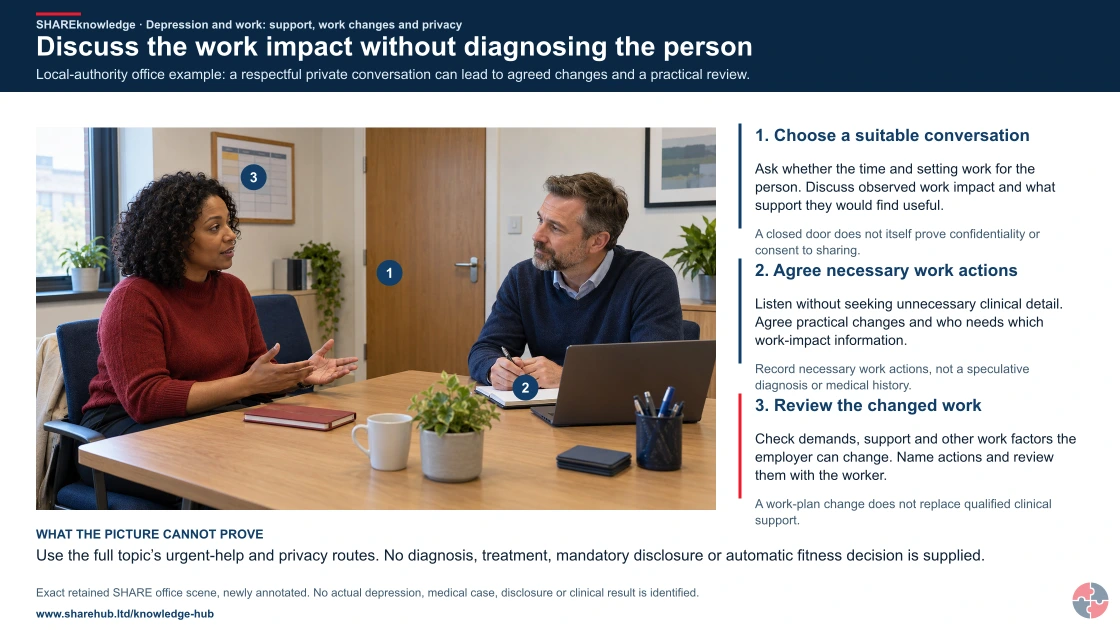
Full written explanation
Local-authority office example: a respectful private conversation can lead to agreed changes and a practical review.
- Choose a suitable conversation. Ask whether the time and setting work for the person. Discuss observed work impact and what support they would find useful.
- Agree necessary work actions. Listen without seeking unnecessary clinical detail. Agree practical changes and who needs which work-impact information.
- Review the changed work. Check demands, support and other work factors the employer can change. Name actions and review them with the worker.
Change the pathway
- Privacy needs agreement. A closed door does not itself prove confidentiality or consent to sharing.
- Keep information proportionate. Record necessary work actions, not a speculative diagnosis or medical history.
- Care and work review differ. A work-plan change does not replace qualified clinical support.
Evidence check: Use the full topic’s urgent-help and privacy routes. No diagnosis, treatment, mandatory disclosure or automatic fitness decision is supplied.
Supportive conversations, work changes and confidentiality boundaries
Primary references: HSE: mental health, work risks and support (GB) · NHS: depression overview and qualified support
Open the complete HD image (new tab)Download image

Supportive conversations, work changes and confidentiality boundaries
Primary references: HSE: mental health, work risks and support (GB) · NHS: depression overview and qualified support
The material work hazards are excessive demands and repeated abusive customer contact in a reception team; a worker’s depression is not a hazard. Pressure can disturb sleep, concentration and mood, while aggression can cause fear and sustained distress. The manager tests the work design before asking individuals to cope.
How can the ERICPD hierarchy of controls reduce risks while redesigning an overloaded reception shift?

| Control level | Control for this activity | Owner and verification | Stop / restart decision |
|---|---|---|---|
| Eliminate | Remove unnecessary simultaneous duties and avoidable lone closing; stop abusive contact through the agreed service policy. | Task owner verifies that the proposed change removes the named hazardous step, including foreseeable cleaning, maintenance and work transferred elsewhere. | If the hazardous step remains, keep it within the task assessment and select the stronger feasible remaining controls. |
| Reduce, including substitution | Use an alternative appointment or contact arrangement that reduces queues and confrontation, checking accessibility and any risk moved to another worker. | Competent task/process owner validates suitability, compatibility and new hazards against the actual operating requirements before the alternative is adopted. | Reject an alternative if its performance is unproved or its new hazards are unresolved. |
| Isolate | Separate public access from staff-only areas and provide an accessible retreat where the risk assessment requires it. | Supervisor checks the actual boundary, affected people and connected work; verify separation or isolation before allowing access. | Hold or stop for uncontrolled aggression, unavailable assistance, repeated missed breaks or workload beyond safe cover. |
| Control: physical safeguards | Provide a usable counter layout, suitable communication and tested assistance arrangements matched to the assessed aggression risk. | Competent equipment/process owner checks peak demand, staffing and break cover, assistance response and worker feedback. | Hold or stop for uncontrolled aggression, unavailable assistance, repeated missed breaks or workload beyond safe cover. |
| Control: work method and response | Agree staffing, manageable workload, breaks, escalation authority and private adjustment reviews with workers. An EAP supports people but does not reduce an excessive queue or unsafe lone shift. | Supervisor confirms the work limits, competent cover, communication and stop/restart authority with the people doing this activity. | Hold work when the agreed limits, competent cover or effective communication cannot be maintained. |
| PPE | No PPE controls excessive demands or treats depression. Assess any separate task-related contact protection on its own merits. | Assessor confirms whether personal protection is needed and checks suitability, condition, compatibility and any required fit evidence. | Do not use unsuitable protection or rely on PPE to continue after an essential source control fails. |
| Discipline | Review actual queues, incidents, missed breaks and worker feedback after the change; act when the revised cover cannot be provided. | Release only after service manager and affected workers accept the revised work arrangement and review date. Retain verification and unresolved restrictions at handover. | Keep the task on hold until required reinstatement evidence and unresolved defects are accepted by the responsible owner. |
How can the ISO 45001 hierarchy of controls reduce risks while redesigning an overloaded reception shift?

| Control level | Control for this activity | Owner and verification | Stop / restart decision |
|---|---|---|---|
| Elimination | Remove unnecessary simultaneous duties and avoidable lone closing; stop abusive contact through the agreed service policy. | Task owner verifies that the proposed change removes the named hazardous step, including foreseeable cleaning, maintenance and work transferred elsewhere. | If the hazardous step remains, keep it within the task assessment and select the stronger feasible remaining controls. |
| Administrative controls | Use an alternative appointment or contact arrangement that reduces queues and confrontation, checking accessibility and any risk moved to another worker. | Competent task/process owner validates suitability, compatibility and new hazards against the actual operating requirements before the alternative is adopted. | Reject an alternative if its performance is unproved or its new hazards are unresolved. |
| Engineering controls | Separate public access from staff-only areas and provide an accessible retreat where the risk assessment requires it. | Supervisor checks the actual boundary, affected people and connected work; verify separation or isolation before allowing access. | Hold or stop for uncontrolled aggression, unavailable assistance, repeated missed breaks or workload beyond safe cover. |
| Engineering controls | Provide a usable counter layout, suitable communication and tested assistance arrangements matched to the assessed aggression risk. | Competent equipment/process owner checks peak demand, staffing and break cover, assistance response and worker feedback. | Hold or stop for uncontrolled aggression, unavailable assistance, repeated missed breaks or workload beyond safe cover. |
| Administrative controls | Agree staffing, manageable workload, breaks, escalation authority and private adjustment reviews with workers. An EAP supports people but does not reduce an excessive queue or unsafe lone shift. | Supervisor confirms the work limits, competent cover, communication and stop/restart authority with the people doing this activity. | Hold work when the agreed limits, competent cover or effective communication cannot be maintained. |
| PPE | No PPE controls excessive demands or treats depression. Assess any separate task-related contact protection on its own merits. | Assessor confirms whether personal protection is needed and checks suitability, condition, compatibility and any required fit evidence. | Do not use unsuitable protection or rely on PPE to continue after an essential source control fails. |
| Administrative controls | Review actual queues, incidents, missed breaks and worker feedback after the change; act when the revised cover cannot be provided. | Release only after service manager and affected workers accept the revised work arrangement and review date. Retain verification and unresolved restrictions at handover. | Keep the task on hold until required reinstatement evidence and unresolved defects are accepted by the responsible owner. |
A logistics contact centre may substitute planned callback windows for an unbounded queue; a construction helpdesk may need an escalation route for aggressive callers. In each setting the manager checks real demand and worker feedback, and stops an unsafe lone or unsupported contact arrangement.
Which work factors can contribute to depression or make it harder to manage?
Work factors matter because depression is often affected by the demands, control, support, relationships, role and change built into the job.
HSE's Management Standards are a practical framework for controlling work-related stress. They do not diagnose depression, but they help employers identify the work design issues that can damage mental health or make an existing condition harder to manage.
The six areas should be treated as real operational controls. Demands are not just how busy people feel; they include staffing, deadlines, pace, emotional load, shift pattern and work environment. Control is not a slogan about empowerment; it is whether people have meaningful influence over how and when work is done. Support is not only kindness; it includes information, resources, training, supervision and recovery time.
Where depression is present, these factors can change the person's coping capacity. A task that was manageable before may become difficult during illness, treatment, bereavement, sleep disruption or relapse. That is why review, flexibility and early conversation are important.
For this decision, use HSE Management Standards and HSENI Management Standards for the applicable work and jurisdiction.
| HSE factor | How it can affect mental health | Practical improvement |
|---|---|---|
| Demands | Excessive workload, conflicting deadlines, emotional labour or poor staffing can overwhelm coping capacity. | Prioritise work, rebalance caseloads, review staffing, reduce unnecessary pressure and plan recovery time. |
| Control | Low control can increase helplessness and reduce confidence. | Give genuine say over sequencing, breaks, methods, rota preferences and task planning where possible. |
| Support | Weak support can leave people isolated and unsure what help is available. | Provide regular check-ins, clear supervision, peer support boundaries, EAP signposting and practical manager action. |
| Relationships | Conflict, bullying, harassment or exclusion can be major wellbeing hazards. | Act early on unacceptable behaviour, mediate where appropriate and enforce respectful workplace standards. |
| Role | Unclear duties or conflicting expectations can increase anxiety and failure feelings. | Clarify responsibilities, priorities, authority, escalation routes and success criteria. |
| Change | Poorly explained change can create insecurity and loss of trust. | Communicate early, consult workers, explain decisions and provide support during transition. |
How can early signs be recognised without making assumptions?
Early signs should trigger a private, respectful conversation about work impact and support, not a workplace diagnosis.
Managers may notice changes before a person discloses depression: withdrawal, lateness, fatigue, reduced output, more errors, missed deadlines, irritability, tearfulness, uncharacteristic conflict, lower confidence, poor appearance or increased absence. These patterns can have many causes, so the safest response is curiosity and support rather than judgement.
The conversation should focus on what is observable and what support may help. For example: 'I have noticed you seem under a lot of pressure and have missed a few deadlines. Is anything at work making things harder, and is there anything we can do to support you?' This avoids diagnosis while opening a route to practical action.
Workers may also report symptoms themselves. They should be listened to calmly and not made to repeat sensitive details unnecessarily. If the concern touches safety-critical work, lone working, driving, machinery, public safety, medication effects or risk of serious harm, the manager should escalate through the proper support route.
Visible changes are not a diagnosis. A worker who thinks they may be depressed should be directed to appropriate health care; a manager should discuss observed work effects and support. If someone is in immediate danger, use the emergency route. NHS 111 mental health advice cited here is an England route; people elsewhere in the UK need the local urgent service.
For this decision, use NHS urgent help in England and NI crisis signposts for the applicable work and jurisdiction.
| Signal | What it may indicate | Good first response |
|---|---|---|
| Change in attendance | Deteriorating wellbeing, fatigue, treatment needs, avoidance or wider life pressure. | Use return-to-work and support conversations rather than jumping straight to discipline. |
| Reduced concentration or errors | Cognitive load, poor sleep, overwhelm or unclear priorities. | Check safety impact, clarify priorities and review workload. |
| Withdrawal or conflict | Distress, loss of confidence, relationship strain or feeling unsupported. | Speak privately, listen and identify whether work relationships need action. |
| Disclosure of depression | The worker is sharing sensitive health information and may need support. | Thank them, explain confidentiality, ask about work impact and agree next steps. |
| Possible serious harm risk | Ordinary manager support may not be enough. | Follow emergency, safeguarding, first-aid or crisis arrangements and involve appropriate support. |
How should managers have a supportive conversation about depression?
A supportive conversation should be private, non-judgemental, work-focused and clear about confidentiality.
The aim is not to solve the medical condition. It is to understand how work is interacting with the person's current capacity and what practical support may reduce barriers. The manager should use open questions, listen properly and avoid turning the conversation into a cross-examination about diagnosis, medication or personal history.
Good conversations are specific. 'Let me know if you need anything' often places the burden back on the person. Better questions include: what parts of work are hardest at the moment; are there times of day that are better or worse; what adjustments have helped before; are any duties safety-critical; what can be shared with HR or supervisors; and when should this be reviewed?
The worker should be involved in decisions wherever possible. If a manager needs to share information to implement an adjustment, they should agree what will be said, who needs to know and what will remain private.
| Step | What the manager should do | What to avoid |
|---|---|---|
| Prepare | Choose a private time, check relevant policies and know the support routes. | Starting the conversation in public or while irritated by performance issues. |
| Open | Describe observable concerns calmly and ask how the person is. | Labelling the person as depressed or unfit. |
| Explore work impact | Ask what work tasks, hours, relationships or demands are making things harder. | Asking for unnecessary clinical detail. |
| Agree support | Discuss adjustments, occupational health, HR, EAP, workload changes and review dates. | Promising confidentiality that cannot be kept where serious risk exists. |
| Record proportionately | Record agreed work actions, owners and review dates. | Recording private diagnosis details that are not needed for the purpose. |
| Review | Check whether support is working and whether work factors have changed. | Leaving the plan open-ended with no owner. |
What reasonable adjustments and work supports may help?
Adjustments should reduce the disadvantage or barrier at work, not simply ask the worker to cope better.
Where depression has a substantial and long-term adverse effect on normal day-to-day activities, it may amount to a disability under the Equality Act 2010 in Great Britain or the Disability Discrimination Act 1995 in Northern Ireland. Employers should not wait for perfect medical wording before considering practical support. They should discuss barriers, consider reasonable adjustments, record decisions and review whether changes are working.
Adjustments must fit the individual and the job. A quiet space may help one person but isolate another. Reduced customer contact may be useful in one role but impossible in another without changing the job's essential purpose. The test is practical: will the adjustment remove or reduce the disadvantage, is it workable, and does it create unmanaged risk for others?
In Great Britain, Access to Work may help eligible people in England, Scotland or Wales; Northern Ireland has a separate Access to Work (NI) service. Neither scheme removes the employer’s responsibility to consider reasonable adjustments. See GB eligibility and NI service before signposting.
For this decision, use GB Acas adjustments and NI disability guidance for the applicable work and jurisdiction.
Separate the employer’s adjustment decision from the application for additional support. The GB Access to Work overview and NI programme guidance both say that the schemes do not pay for reasonable adjustments that an employer must make. Do not postpone a workable adjustment merely while a funding application is considered. As checked on 2 October 2026, GB eligibility guidance also says a person who has previously received its mental-health support cannot apply again for that support. That limitation does not describe every practical-support grant or the separate NI scheme. Check the current programme rules and identify another appropriate support route if this route is unavailable.
| Adjustment area | Possible examples | Review question |
|---|---|---|
| Hours and patterns | Flexible start times, temporary reduced hours, adjusted breaks, phased return or rota stability. | Is the pattern improving work capacity without creating unsustainable pressure later? |
| Workload and priorities | Reduced caseload, clearer priorities, short-term tasks, fewer conflicting deadlines or temporary redistribution. | Are expectations realistic and clearly communicated? |
| Communication | Written follow-up, predictable check-ins, one named contact or reduced unnecessary meetings. | Does the person understand what is expected and where to ask for help? |
| Role and duties | Temporary change to public-facing, high-conflict, safety-critical or emotionally demanding duties. | Is the change reasonable, safe and time-bound or clearly reviewed? |
| Environment | Quieter workspace, hybrid working, reduced noise, improved lighting or recovery space. | Does the environment reduce barriers without isolating the worker? |
| Support services | Occupational health, EAP, GB Access to Work or Access to Work (NI), wellbeing action plan or HR support. | Is specialist advice being used where manager judgement is not enough? |
How should confidentiality and worker health information be handled?
Health information should be collected only where necessary, used fairly, shared narrowly and kept secure.
Depression, occupational health advice, medical reports, adjustment discussions and sickness absence can involve special category health information. The workplace needs a lawful, fair and transparent reason for collecting it. In plain terms, managers should know what the person needs at work, not the full story of their private health.
Practical agreement about who hears an adjustment is separate from the organisation’s legal basis for handling health data. The employer needs an Article 6 lawful basis and an Article 9 special-category condition, with any further Data Protection Act condition where required. Worker consent is not automatically valid as a GDPR basis because the employment relationship can make refusal difficult. See ICO: workers’ health information.
A useful rule is to record function and action rather than diagnosis detail. 'Temporary reduced customer-facing duties and weekly review agreed until 30 September' is usually more appropriate than detailed notes about symptoms, medication or therapy. Occupational health reports should be requested with specific work questions and interpreted by people competent to do so.
Confidentiality is not absolute where there is serious risk, safeguarding concern or safety-critical impact. Managers should be honest about this: they will keep information private as far as possible, but may need to involve HR, occupational health, first aid, safeguarding or emergency support where necessary.
For this decision, use ICO worker-health guidance for the applicable work and jurisdiction.
| Control | What good practice looks like | Why it matters |
|---|---|---|
| Purpose limitation | Be clear why health information is needed before collecting it. | Prevents intrusive or irrelevant records. |
| Data minimisation | Collect only the information needed to manage work impact, support or safety. | Reduces privacy risk and stigma. |
| Need-to-know sharing | Tell only those who need information to implement support or manage risk. | Protects trust and confidentiality. |
| Secure records | Keep health information separate or access-controlled where appropriate. | Health information needs stronger protection. |
| Transparent process | Explain what will be recorded, who will see it and why. | Supports fairness and worker confidence. |
| Retention review | Do not keep sensitive health information longer than needed. | Supports lawful storage and proportionality. |
How should depression connect to risk assessment and management review?
Risk assessment should focus on work-related stressors, safety implications, support arrangements and evidence that actions are working.
Change the work while keeping chosen support available
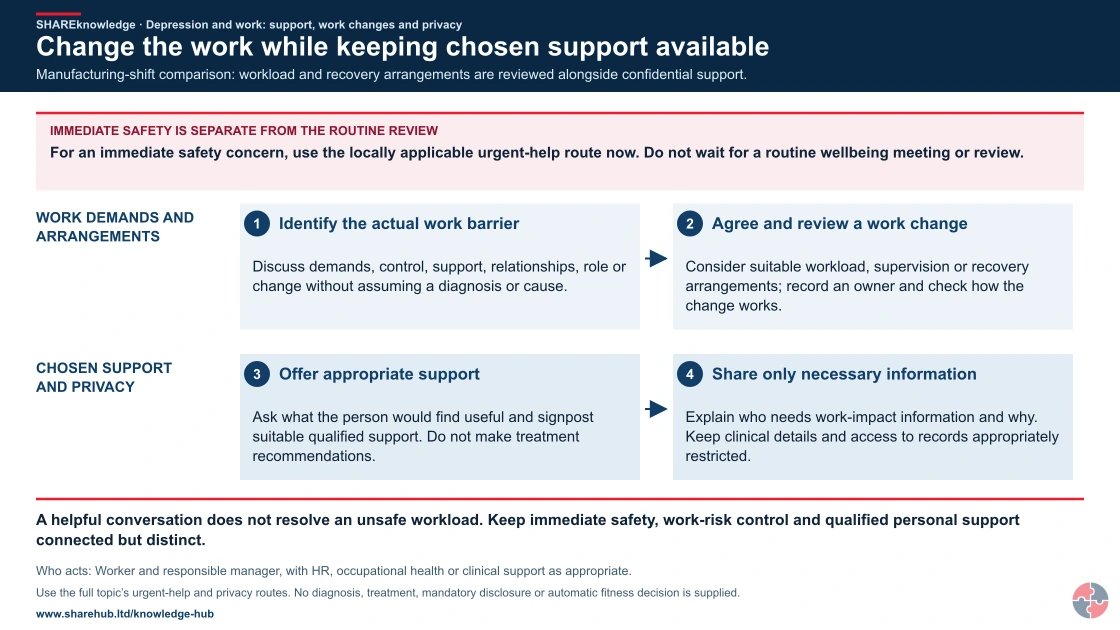
Full written explanation
For an immediate safety concern, use the locally applicable urgent-help route now. Do not wait for a routine wellbeing meeting or review.
An urgent-safety band is separate from two routine parallel lanes. The work lane identifies shift demands and agrees/reviews practical changes. The chosen-support lane offers access to suitable qualified support and limits sharing to necessary work-impact information. Personal support does not replace reducing work-related risks, and clinical care is not delayed by a routine work review.
Manufacturing-shift comparison: workload and recovery arrangements are reviewed alongside confidential support.
- Identify the actual work barrier. Discuss demands, control, support, relationships, role or change without assuming a diagnosis or cause.
- Agree and review a work change. Consider suitable workload, supervision or recovery arrangements; record an owner and check how the change works.
- Offer appropriate support. Ask what the person would find useful and signpost suitable qualified support. Do not make treatment recommendations.
- Share only necessary information. Explain who needs work-impact information and why. Keep clinical details and access to records appropriately restricted.
When the evidence does not fit: A helpful conversation does not resolve an unsafe workload. Keep immediate safety, work-risk control and qualified personal support connected but distinct.
Who acts: Worker and responsible manager, with HR, occupational health or clinical support as appropriate.
Changed workplace
Private office conversation: Agree what would help at work and what information may be shared.
Manufacturing shift: Review the actual demands and recovery opportunity with the person.
Evidence check: Use the full topic’s urgent-help and privacy routes. No diagnosis, treatment, mandatory disclosure or automatic fitness decision is supplied.
Supportive conversations, work changes and confidentiality boundaries
Primary references: HSE: mental health, work risks and support (GB) · NHS: depression overview and qualified support
Open the complete HD image (new tab)Download image

Supportive conversations, work changes and confidentiality boundaries
Primary references: HSE: mental health, work risks and support (GB) · NHS: depression overview and qualified support
Mental health risk assessment is not a form that asks every worker to disclose private conditions. It is an assessment of work design and foreseeable stressors, supported by worker consultation, absence trends, turnover, incident learning, workload data, exit interviews, engagement feedback and management observations.
Individual support plans may sit alongside the broader assessment where a worker has disclosed a need or returned from absence. Those plans should remain confidential and should not be used to blame the worker for hazards created by poor work design.
Management review should test whether the organisation is reducing risk, not just offering wellbeing content. Useful evidence includes timely adjustments, reduced repeated stress concerns, improved workload planning, manager training completion, OH referral quality, absence review themes and closure of actions from worker feedback.
| Area | What to check | Evidence |
|---|---|---|
| Work design | Are demands, control, support, relationships, role and change being assessed? | Stress risk assessment, worker consultation and action plan. |
| Individual support | Are agreed adjustments documented and reviewed? | Adjustment plan, OH advice, HR record and manager review notes. |
| Safety-critical work | Could symptoms, fatigue, medication or distraction affect safety-sensitive tasks? | Fitness-for-work advice, task restriction and supervision plan. |
| Manager competence | Can managers hold supportive conversations and escalate concerns? | Training records, guidance, quality checks and case reviews. |
| Data protection | Are health records proportionate and access-controlled? | Privacy notice, retention schedule, access permissions and audit findings. |
| Learning | Are trends used to improve work, not just to monitor absence? | Management review, action close-out, surveys and worker feedback. |
Which UK legal duties are relevant to depression and workplace wellbeing?
Workplace, equality and privacy duties depend on the site and the individual facts; GB and Northern Ireland use different instruments for several key duties.
Employers must manage risks to health, safety and welfare, including foreseeable work-related stress risks. Where depression or another mental health condition affects work, equality, employment and data protection duties may also be relevant. This is why line managers should use HR, occupational health and competent advice rather than improvising alone.
The legal table is not a substitute for legal advice. It shows the main routes that shape good management: prevent work-related harm, assess risks, consult and support workers, consider reasonable adjustments, protect sensitive information and record decisions proportionately.
GB occupational safety and Equality Act routes differ from NI Health and Safety Order, NI Management Regulations and Disability Discrimination Act. NHS urgent routes shown here are England-specific; follow the local crisis route elsewhere.
| Jurisdiction and duty | Practical meaning | Decision evidence |
|---|---|---|
| Great Britain — Health and Safety at Work etc. Act 1974 — instrument | Control foreseeable work-related health risks through actual work design and supervision. | Use the applicable source and retain proportionate evidence of the real decision. |
| Great Britain — Management of Health and Safety at Work Regulations 1999 — instrument | Assess work-related stressors and track preventive action. | Use the applicable source and retain proportionate evidence of the real decision. |
| Northern Ireland — Health and Safety at Work (Northern Ireland) Order 1978 — instrument | Apply NI general health, safety and welfare duties to work-related harm. | Use the applicable source and retain proportionate evidence of the real decision. |
| Northern Ireland — Management of Health and Safety at Work Regulations (Northern Ireland) 2000 — instrument | Assess stress risk and put preventive arrangements into practice. | Use the applicable source and retain proportionate evidence of the real decision. |
| Great Britain — Equality Act 2010 — instrument | Consider individual disability status and reasonable adjustments on the facts. | Use the applicable source and retain proportionate evidence of the real decision. |
| Northern Ireland — Disability Discrimination Act 1995 — authority guidance; instrument | Use the NI reasonable-adjustment route and Equality Commission guidance. | Use the applicable source and retain proportionate evidence of the real decision. |
| United Kingdom — UK GDPR and Data Protection Act 2018 — authority guidance | Limit collection and disclosure of health information to a lawful, necessary purpose. | Use the applicable source and retain proportionate evidence of the real decision. |
How could Riverside Leisure Ltd manage depression and workplace wellbeing?

Riverside Leisure Ltd shows how a service business could turn wellbeing principles into daily management, evidence and improvement.
Riverside Leisure Ltd
Riverside Leisure Ltd is a leisure and hospitality business with reception teams, instructors, lifeguards, maintenance workers, cleaners, events staff and seasonal public-facing demand. Depression and workplace wellbeing risks may arise from shift work, customer conflict, lone closing duties, workload peaks, role ambiguity, low control, emotional labour, financial pressure and poor recovery time.
Riverside starts with work design rather than posters. It maps higher-pressure roles and periods: early morning openings, late finishes, school-holiday peaks, event nights, customer complaints, pool incidents, lone maintenance call-outs and seasonal rota gaps. Those areas are added to the wellbeing risk register with named owners, controls, review dates and worker consultation notes.
Managers are trained to notice change, start private conversations, protect confidentiality and escalate concerns. They are not expected to diagnose depression. Their guidance contains plain prompts: what at work is harder right now, what adjustments might help, are any duties safety-critical, who can we involve with your agreement, what should remain private, and when will we review?
The company separates broad wellbeing data from individual health records. Absence trends, turnover, overtime, incident patterns and engagement feedback are reviewed by senior managers to identify work design problems. Individual OH reports and adjustment plans are kept access-controlled and record functional advice, restrictions, support and review dates rather than unnecessary clinical detail.
Riverside also builds improvement loops. If repeated stress concerns appear in the lifeguard team, it checks rota stability, rest periods, supervision, incident debriefing and staffing levels. If reception workers report anxiety after aggressive customers, it reviews conflict training, panic alarms, supervisor availability, customer behaviour standards and incident follow-up. This turns wellbeing into practical risk control, not a slogan.
Worked example: repeated pressure in a reception team
Task material and setting: Riverside Leisure has a six-person reception team covering a school-holiday surge. Two staff report distress, missed breaks and abusive customer encounters; one privately discloses depression. The manager must address the shared work risk and the individual’s needs without treating a diagnosis as proof of incapacity.
People and prerequisites: The operations manager owns staffing, queue and conflict controls; a line manager owns the confidential conversation; HR and occupational health advise on adjustments. Before the peak, the team reviews shift coverage, escalation for aggressive customers, rest and incident data, and how a worker can get help quickly.
Before: The line manager meets the worker privately, asks which duties are difficult and what support may help, explains what will be recorded and shared, and agrees a review date. The manager does not ask for treatment details. Separately, the operations manager consults the whole team on workload and breaks and records actions in the stress risk assessment.
During: Riverside adds trained cover at the busiest times, a supervisor response to aggression and reliable breaks. An agreed temporary duty mix and shorter check-ins support the worker, subject to review. If concentration or fatigue creates a safety concern in cash handling or lone closing, the manager pauses that duty and obtains competent advice rather than making a blanket judgement about depression.
Hold or stop: A disclosure of immediate serious self-harm risk moves to emergency help and the site crisis procedure. Persistent missed breaks, escalating abuse, a confidentiality breach or an adjustment that fails are hold points for the relevant owner; a wellbeing poster is not a substitute for changing the work.
Completion and hand back: After the peak, the operations manager checks queues, incidents, breaks and worker feedback. The individual and manager review whether the support reduces the barrier, what can be restored and whether occupational health input is needed. Only the functional plan is shared with people implementing it.
Evidence: Keep the team-level stress assessment and action close-out separate from restricted individual records. Record owner, date, agreed work changes, permitted disclosure and review outcome; avoid unnecessary diagnosis or treatment detail.
| Management area | How Riverside applies it | Evidence and improvement |
|---|---|---|
| Assessing | Uses HSE Management Standards to assess workload, control, support, relationships, role and change across facilities and teams. | Stress risk assessment, worker feedback, absence themes and action tracker. |
| Analysing | Looks for patterns by team, shift, season, incident type and manager area without exposing individual health details. | Dashboard, anonymised trend review and management meeting minutes. |
| Implementing | Changes rotas, staffing, break planning, customer conflict controls, task priorities and communication routes. | Updated rota rules, revised procedures and closed actions. |
| Training | Provides general awareness for all staff, deeper manager training and specialist HR/OH guidance for complex cases. | Training matrix, scenario exercises and manager quality checks. |
| Supporting | Uses EAP, occupational health, GB or NI Access to Work signposting, reasonable adjustments and return-to-work plans. See GB eligibility or NI service as applicable. | Referral records, adjustment review dates and worker-agreed support plans. |
| Checking | Audits whether actions are completed and whether managers are using supportive conversations consistently. | Case review, internal audit and worker representative feedback. |
| Learning | Uses incidents, absence patterns, survey comments and debriefs to improve work design. | Management review, lessons learned and policy updates. |
What training supports better management of depression and workplace wellbeing?
Training should be layered so everyone understands the basics and managers learn how to act within their role.
General awareness can be short and widely available. It should explain mental health, stigma, early reporting, support routes, confidentiality and the difference between personal coping and work design. It should not pretend that a short course turns workers into counsellors.
Managers need more practical, scenario-based training. They should practise supportive conversations, reasonable adjustment discussions, return-to-work planning, stress risk assessment, confidentiality wording and escalation for safety or serious harm concerns. The quality measure is not attendance; it is whether managers take timely, fair and well-recorded action.
Specialist training is needed for HR, wellbeing leads, HSE advisers and senior leaders who design policy, assess organisational stressors, commission occupational health, review sensitive data, lead investigations or make decisions about safety-critical duties.
Competence should be demonstrated in a realistic conversation or task decision, checked by a suitable owner and revisited after a material work change, incident, failed control or role change. Attendance alone does not qualify a manager to diagnose, prescribe or decide a specialist medical question.
| Role | Learning to test | Competence demonstration | Assessor and record | Reassessment trigger |
|---|---|---|---|---|
| Worker and representative | Recognise work barriers, report concerns and use support routes | Explain a realistic stop or support request | Supervisor; induction or briefing record | Work or support route changes |
| Supervisor | Plan cover, have respectful conversations, protect privacy and escalate | Practice the page’s worked case and identify hold points | Manager/HR; observed scenario and action record | Failed action, incident or changed team |
| HR, safety and occupational health | Assess jurisdiction, functional impact and work design within role boundaries | Review a de-identified case and quality of evidence | Competent specialist; scoped advice record | New law, clinical or task issue |
| Senior manager and facilities owner | Fund controls, assure access, sample action close-out | Challenge missed breaks, failed adjustments or unsafe work design | Governance lead; audit and improvement record | Trend or repeated defect |
How should the controls be managed and reviewed?
Assign owners to the significant risks, put the chosen controls into the work plan, check that they work in practice and change them when conditions or evidence change.
HSE describes this as a continuing plan, do, check and act process. For depression and workplace wellbeing, record who checks the controls, what evidence shows they are working, and which failure stops the work or triggers review. A formal management system is a choice, not a substitute for the applicable legal duties. Read HSE management guidance.
What are the warning signs that depression and wellbeing are not being managed well?
Poor management shows up when people are blamed, health information is mishandled, or work design problems repeat.
Warning signs matter because they show how harm can manifest in the workplace. If managers ignore workload concerns, people may keep attending while unwell, make more mistakes, withdraw from colleagues, lose trust or become absent for longer. If confidentiality is breached, workers may stop disclosing problems and support arrives too late.
A weak response often looks busy but achieves little: posters, apps and awareness weeks appear, while staffing, demands, conflict and poor change management remain untouched. Another warning sign is over-formalisation too early, where performance or absence processes start before anyone has asked what support or adjustments may be needed.
The strongest organisations investigate these warning signs as system signals. They ask what work design, supervision, policy, competence or culture issue allowed the pattern to continue.
| Warning sign | How harm can manifest | What to do |
|---|---|---|
| Repeated absence with no work review | Underlying work stressors remain and absence may lengthen or repeat. | Review work factors, support routes, OH input and adjustment options. |
| Managers ask for excessive medical detail | Trust reduces and sensitive health information may be mishandled. | Retrain managers on confidentiality and functional work questions. |
| Wellbeing activity replaces risk control | People are told to be resilient while workload, conflict or low control continue. | Use HSE Management Standards and fix work design issues. |
| No review of adjustments | Support may become unsuitable, unfair or forgotten. | Set owners, dates and worker-agreed review points. |
| Safety-critical impact ignored | Fatigue, distraction, medication effects or distress may affect safe work. | Seek competent advice and review duties promptly. |
| Bullying or conflict is normalised | Mental ill health can worsen and people may leave or become absent. | Investigate behaviour, enforce standards and support affected workers. |
What do the acronyms and key terms mean?
These acronyms are commonly used in workplace wellbeing, health and safety and employment support.
| Term | Full form or definition | Meaning here |
|---|---|---|
| OH | Occupational health | Advises on functional work impact without disclosing unnecessary diagnoses. |
| EAP | Employee assistance programme | An optional confidential support route for the individual; it does not remove harmful workload. |
| GP | General practitioner | A clinician who can assess personal health, outside line-manager competence. |
| HSE | Health and Safety Executive | GB regulator guidance is not an NI legal instrument. |
| HSENI | Health and Safety Executive for Northern Ireland | NI work health and safety regulator. |
| ICO | Information Commissioner’s Office | UK regulator guidance on collecting and sharing sensitive worker-health information. |
| UK GDPR | United Kingdom General Data Protection Regulation | Data-protection rules requiring a lawful basis and extra condition for processing health data. |
| CBT | Cognitive behavioural therapy | A clinical talking-therapy approach; managers do not prescribe or judge treatment. |
| AI | Artificial intelligence | The site’s question tool; it cannot make clinical or legal decisions. |
| GB | Great Britain | England, Scotland and Wales for the GB safety and equality routes used here. |
| NI | Northern Ireland | Northern Ireland, with separate work-safety and some employment instruments. |
| HR | Human resources | The organisational role that implements fair work support and privacy arrangements. |
| NHS | National Health Service | Clinical and public-health source, with service routes sometimes nation-specific. |
| HSWA | Health and Safety at Work etc. Act | The GB general work-safety Act; NI uses a separate Order. |
| PPE | Personal protective equipment | No personal protective item prevents this psychosocial work risk; stronger work-design controls are needed. |