NVQ Level 6 Diploma in OSH
Develop and implement health and safety emergency response systems and procedures
Prepare people, resources and communication for credible emergencies, then use exercises and genuine response evidence to improve the arrangements.
Understanding Develop and implement health and safety emergency response systems and procedures
Emergency response is a preparedness, command, response, recovery and learning system for credible abnormal events.
Why this matters at work
Plan for credible medical emergencies: life-threatening bleeding, cardiac event, asthma/anaphylaxis support as applicable, burns, eye injury, crush injury, electric shock, heat/cold illness, mental-health crisis and exposure-specific needs. Match equipment, facilities, trained first aiders, communication, access and emergency-service handover to the assessment. First aiders work within training and must not delay emergency services or attempt treatment outside competence.
Identify credible sources of emergency using risk assessments, hazardous substances, plant/process studies, fire assessment, first-aid needs assessment, security and weather information, utility layout, previous events, inspection, maintenance, worker knowledge, contractor plans, local geography and neighbouring risks. Include fire, explosion, release, serious injury, medical event, electric shock, confined-space emergency, structural failure, flood, severe weather, utility loss, violence/security threat and transport incident where credible.
How organisations manage this in practice
Restart is a management-of-change decision. Confirm the area/process is safe, damage and contamination are assessed, isolations and temporary controls are known, protective systems are reinstated/tested, procedures and drawings are current, people are briefed, roles are available and outstanding critical actions are closed or formally controlled. Use staged restart and heightened monitoring where risk justifies it.
A group operates one upper-tier establishment in GB and another in NI. A manager proposes copying the GB external emergency planning contact and treating a three-year review date as permission to defer testing after a major plant change. The emergency planning owner separates the site records. Confirm establishment scope, tier, inventory and plausible accident scenarios with competent process assessment; this example assumes upper-tier status and does not calculate threshold quantities.
Work from credible local emergencies and the people exposed. For each scenario, specify recognition, warning, immediate safe action, command, access, accountability, specialist help and recovery. Include nights, absent staff, contractors, visitors and people needing assistance. Confirm that the people and equipment relied on are actually available. A generic assembly-point sheet is inadequate for chemical release, plant isolation or rescue decisions. Give the plan an owner and test it safely after significant change, correcting weaknesses before treating the arrangement as dependable. The scenario review should draw on plant and process studies, substances, first-aid and fire assessments, previous events, workers' knowledge and neighbouring risks. Check whether utility failure, severe weather or absence removes a safeguard the response assumes. Distinguish evacuation from technical emergency tasks and specialist rescue so people know their limits. Suitable emergency equipment must be accessible and maintained, with competent people and a usable external-service handover. The recovery stage also needs a decision route; stopping the alarm or completing a drill does not restore damaged safeguards.
How can I turn study guidance into authentic workplace evidence?
Use the worked example below to understand the decision chain. Build your portfolio from your own authorised workplace activity, preserve its provenance and discuss evidence suitability with your assessor.

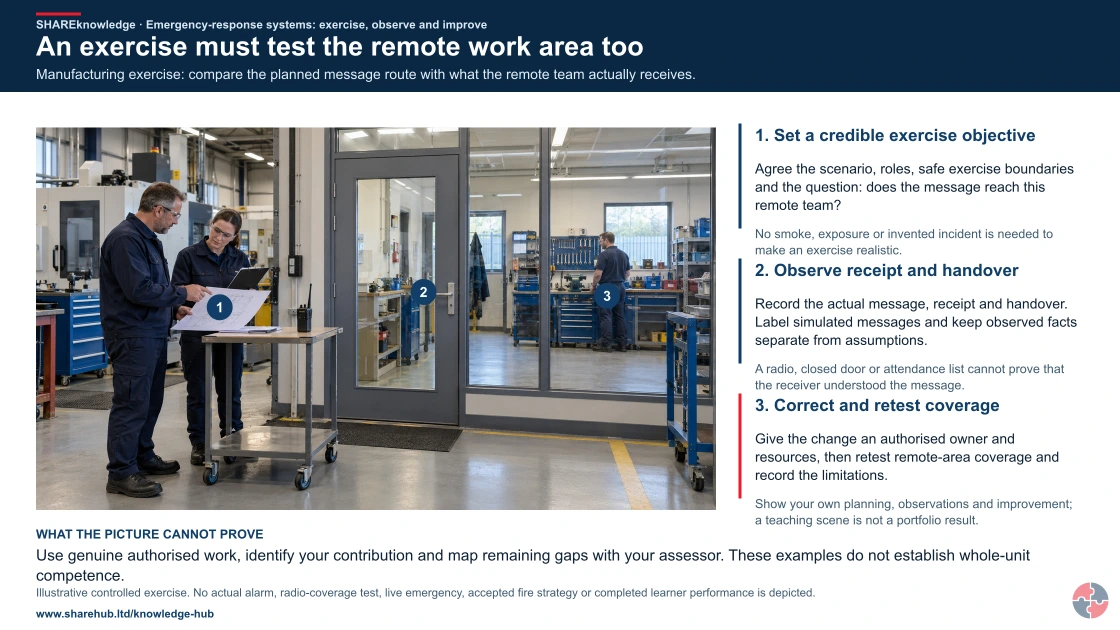
An exercise must test the remote work area too
Full written explanation
Manufacturing exercise: compare the planned message route with what the remote team actually receives.
- Set a credible exercise objective. Agree the scenario, roles, safe exercise boundaries and the question: does the message reach this remote team?
- Observe receipt and handover. Record the actual message, receipt and handover. Label simulated messages and keep observed facts separate from assumptions.
- Correct and retest coverage. Give the change an authorised owner and resources, then retest remote-area coverage and record the limitations.
Change the pathway
- Keep exercise and incident distinct. No smoke, exposure or invented incident is needed to make an exercise realistic.
- Do not infer reception from equipment. A radio, closed door or attendance list cannot prove that the receiver understood the message.
- Preserve genuine assessment evidence. Show your own planning, observations and improvement; a teaching scene is not a portfolio result.
Evidence check: Use genuine authorised work, identify your contribution and map remaining gaps with your assessor. These examples do not establish whole-unit competence.
Full emergency-planning scope, safe exercises and assistance boundaries
Primary references: HSE: planned and practised emergency arrangements (GB) · Home Office: residential-care fire risk assessment (England)
Open the complete HD image (new tab)Download image

Full emergency-planning scope, safe exercises and assistance boundaries
Primary references: HSE: planned and practised emergency arrangements (GB) · Home Office: residential-care fire risk assessment (England)
An exercise finding changes the response plan
Illustrative example. A labelled drill reveals an unclear call-out and delayed handover.
Decision. Assign the corrective change, resource it and retest the same weakness.
Evidence to check. Exercise plan, participant roles, observed timings, change owner and retest result.
Hold or escalation point. Keep drill evidence distinct from a real incident; do not invent an event to fill a portfolio gap.
Follow-up. Explain what the learner changed and use the workplace emergency guide for technical context.
How can an exercise test the emergency arrangements?
Scenario basis, accessible roles, observed performance and retest evidence need a connected trail. A completed drill is not automatic whole-unit competence.
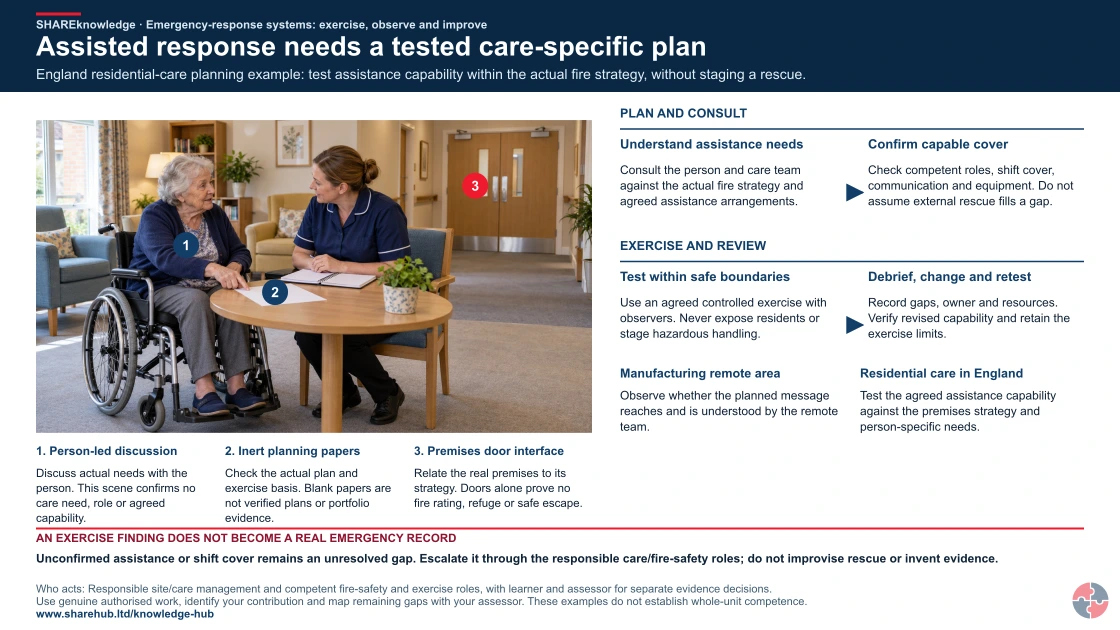
Assisted response needs a tested care-specific plan
Full written explanation
An illustrative normal care-planning conversation shows a stationary wheelchair-seated person and a colleague discussing inert papers at a table, with double doors visible behind. Picture key: 1 identifies the person-led discussion; 2 identifies the inert planning papers; 3 identifies the premises door interface. The substantial physical context supports questions about person-specific assistance and the actual premises strategy; nobody is moved, transferred, lifted, pushed, evacuated or rescued. The two independent native tracks retain all four full checks. PLAN AND CONSULT connects understanding assistance needs to confirming capable cover. EXERCISE AND REVIEW connects testing within safe boundaries to debriefing, change and retest. Only those two within-lane arrows appear; there is no cross-lane work or emergency-clearance gate. Independent check headings are unnumbered. The full band, AN EXERCISE FINDING DOES NOT BECOME A REAL EMERGENCY RECORD, unresolved assistance and shift-cover hold, responsible roles, evidence limitation and both manufacturing and England residential-care cases accompany the explanation. Appearance, age, a wheelchair, uniform, blank papers and visible doors establish no actual resident status, diagnosis, assistance need, professional role, staffing cover, agreed care or fire strategy, compartmentation, fire-door rating, refuge, route performance, exercise finding, verified capability, accepted portfolio evidence, competence or permission. The scene supplies no chair-operation, handling, transfer, evacuation, rescue, clinical, response, timing, staffing-ratio or other operating recipe. Use the actual fire strategy and person-specific consultation with competent care and fire-safety roles; external rescue cannot fill an unconfirmed staffing or capability gap. A controlled exercise never creates hazardous exposure or handling for realism and never becomes a real incident record. Actual emergency response remains independent of exercises, forms and portfolio review. Genuine authorised learner contribution, partial-unit coverage, exact M/616/9539 criterion mapping, investigation completion distinct from drill debrief, assessor and IQA decisions, confidentiality and the stated source and country qualifications remain separate. The residential-care example is scoped to England and is not a universal UK evacuation strategy or instruction that everyone should move together.
England residential-care planning example: test assistance capability within the actual fire strategy, without staging a rescue.
- Understand assistance needs. Consult the person and care team against the actual fire strategy and agreed assistance arrangements.
- Confirm capable cover. Check competent roles, shift cover, communication and equipment. Do not assume external rescue fills a gap.
- Test within safe boundaries. Use an agreed controlled exercise with observers. Never expose residents or stage hazardous handling.
- Debrief, change and retest. Record gaps, owner and resources. Verify revised capability and retain the exercise limits.
When the evidence does not fit: Unconfirmed assistance or shift cover remains an unresolved gap. Escalate it through the responsible care/fire-safety roles; do not improvise rescue or invent evidence.
Who acts: Responsible site/care management and competent fire-safety and exercise roles, with learner and assessor for separate evidence decisions.
Changed workplace
Manufacturing remote area: Observe whether the planned message reaches and is understood by the remote team.
Residential care in England: Test the agreed assistance capability against the premises strategy and person-specific needs.
Evidence check: Use genuine authorised work, identify your contribution and map remaining gaps with your assessor. These examples do not establish whole-unit competence.
Full emergency-planning scope, safe exercises and assistance boundaries
Primary references: HSE: planned and practised emergency arrangements (GB) · Home Office: residential-care fire risk assessment (England)
Open the complete HD image (new tab)Download image

Full emergency-planning scope, safe exercises and assistance boundaries
Primary references: HSE: planned and practised emergency arrangements (GB) · Home Office: residential-care fire risk assessment (England)

Plan
Define the scenario/risk basis, participants, safe exercise boundaries and relevant response arrangements.
Observe
Record what actually happened, including communications, coverage gaps and the learner’s own work.
Act and retest
Assign owners/deadlines, verify correction and retest the relevant capability; distinguish authorised decisions from learner proposals.
This is a evidence-planning example, not a completed portfolio, an assessment decision or evidence of whole-unit competence.
How can I demonstrate my workplace practice for unit 8?
Prepare people, resources and communication for credible emergencies, then use exercises and genuine response evidence to improve the arrangements. Unit reference: M/616/9539.
Plan a real activity with your assessor and identify the decisions, work products and witnesses that can show your own competence. The following suggestions are options to adapt, not mandatory document lists or model answers to submit.
What practical work should the evidence demonstrate?
Emergency readiness depends on credible scenarios and confirmed capability. Define the alarm, immediate protective action, safe withdrawal, assistance, handover and recovery. Consider people outside routine working hours and those needing assistance. Do not assign rescue or technical intervention to people who lack competence and equipment.
An exercise is a controlled learning activity. Set objectives, safe boundaries, observers and debrief arrangements; never create real exposure for realism. Label simulated messages and records accurately. Discuss their assessment use beforehand and agree another evidence route where actual performance is required.
External response cannot simply be assumed. Confirm liaison arrangements, site access and the information responders may need. Keep communications factual and authorised, especially when personal information or media attention is involved. Record exercise limitations and verify corrective actions before repeating the test.
What workplace project could I use to develop evidence?
A multi-tenant workshop needs a coordinated evacuation and chemical-spill response. Map credible scenarios, shift cover and assistance needs; agree responsibilities with tenants and competent responders. Run a safe, authorised exercise, record what happened, debrief participants and verify improvements. Clearly identify exercise records as exercises, never as actual emergencies.
This is an illustrative project, not an account to copy or a required template. Choose an activity you genuinely undertook and agree its scope with your assessor. If you advise rather than hold operational authority, evidence the recommendations, consultation and follow-up that were yours, alongside the decisions taken by authorised colleagues.
One project may cover only part of the unit. Check the full criterion map and plan additional genuine activities, knowledge evidence and professional development wherever the project leaves gaps. Do not treat an illustrative sample as proof of whole-unit coverage.
Build an evidence trail
- Explain the workplace, your role, the starting problem and the limits of your authority. Identify the activity dates and who can confirm your contribution.
- Keep the information you used, the options considered and your reasons for the decision. Identify specialist advice and distinguish what you knew from what you assumed.
- Show consultation and implementation: who agreed the action, what you personally delivered and how resources, ownership and deadlines were arranged.
- Include a follow-up check and an honest account of the result. Explain remaining gaps and what you would change; do not create outcomes that did not occur.
Prepare the evidence index
For unit 8, give each item an identifier, date, version, author, your contribution, relevant criterion references and exact page or paragraph locations. Record how authenticity can be checked. Cross-reference a genuinely relevant item to other units rather than creating duplicate copies, but explain separately how it supports each criterion.
Obtain permission before sharing workplace records. Redact names, commercial details and health information while preserving enough context for assessment. Arrange secure assessor access or an authenticated witness account where copying is inappropriate. Never upload identifiable incident or medical records to a public page or an unapproved AI tool.
How can I plan workplace evidence against each criterion?
The reference numbers below help you plan work and locate evidence. The activities, evidence suggestions and questions are original SHARE learning guidance, not the official criterion wording or a promise of acceptance. Use your assessor-issued assessment plan and the awarding-body specification for the exact requirements.
Open the ProQual qualification specificationOutcome 1: Build realistic emergency arrangements
1.1 · Use the site's risk profile to identify credible fire, injury, release, security and off-site scenarios.
Evidence you could select
Scenario register and site map. Keep the relevant extract and explain your personal contribution rather than submitting an unexplained file.
Discuss with your assessor
Which scenario is plausible but often overlooked? Refer to a specific decision, the information available at the time and what happened afterwards.
1.2 · Review response capacity, shift cover, first aid and external support against the scenarios rather than headcount alone.
Evidence you could select
Provision assessment. Keep the relevant extract and explain your personal contribution rather than submitting an unexplained file.
Discuss with your assessor
Where are the response gaps? Refer to a specific decision, the information available at the time and what happened afterwards.
1.3 · Check the relevant responders' training, practical capability, availability and authorisation.
Evidence you could select
Competence and coverage records. Keep the relevant extract and explain your personal contribution rather than submitting an unexplained file.
Discuss with your assessor
Who covers absence or a night shift? Refer to a specific decision, the information available at the time and what happened afterwards.
1.4 · Test proposed arrangements with managers, workers and representatives, including assistance needs.
Evidence you could select
Consultation notes and revisions. Keep the relevant extract and explain your personal contribution rather than submitting an unexplained file.
Discuss with your assessor
Which operational detail changed the plan? Refer to a specific decision, the information available at the time and what happened afterwards.
1.5 · Create scenario-specific response steps, escalation, communications and recovery arrangements; include applicable wider consequences.
Evidence you could select
Controlled response plan. Keep the relevant extract and explain your personal contribution rather than submitting an unexplained file.
Discuss with your assessor
What differs between evacuation and containment? Refer to a specific decision, the information available at the time and what happened afterwards.
1.6 · Make current plans, contact lists and responder records accessible while withdrawing obsolete copies.
Evidence you could select
Plan register and access test. Keep the relevant extract and explain your personal contribution rather than submitting an unexplained file.
Discuss with your assessor
Could staff locate the right plan quickly? Refer to a specific decision, the information available at the time and what happened afterwards.
1.7 · Agree an authorised liaison and information process for authorities, responders and external enquiries.
Evidence you could select
Contact and communication protocol. Keep the relevant extract and explain your personal contribution rather than submitting an unexplained file.
Discuss with your assessor
Who may release information? Refer to a specific decision, the information available at the time and what happened afterwards.
1.8 · Sequence resource checks, briefings and safe exercises before declaring arrangements ready.
Evidence you could select
Implementation plan. Keep the relevant extract and explain your personal contribution rather than submitting an unexplained file.
Discuss with your assessor
What must be in place before the drill? Refer to a specific decision, the information available at the time and what happened afterwards.
Outcome 2: Demonstrate readiness and response coordination
2.1 · Physically verify communications, access, emergency supplies and facilities against the plan.
Evidence you could select
Readiness check and corrective log. Keep the relevant extract and explain your personal contribution rather than submitting an unexplained file.
Discuss with your assessor
What happens if a critical resource fails? Refer to a specific decision, the information available at the time and what happened afterwards.
2.2 · Specify who is permitted to perform each response task and when untrained staff must withdraw.
Evidence you could select
Role and competence schedule. Keep the relevant extract and explain your personal contribution rather than submitting an unexplained file.
Discuss with your assessor
Where is the boundary of safe intervention? Refer to a specific decision, the information available at the time and what happened afterwards.
2.3 · Brief all affected shifts and contractors and check their understanding of alarms and routes.
Evidence you could select
Briefing records and comprehension checks. Keep the relevant extract and explain your personal contribution rather than submitting an unexplained file.
Discuss with your assessor
How are visitors and lone workers covered? Refer to a specific decision, the information available at the time and what happened afterwards.
2.4 · Establish appropriate liaison with external responders and site neighbours without making unconfirmed assumptions about support.
Evidence you could select
Authorised liaison record. Keep the relevant extract and explain your personal contribution rather than submitting an unexplained file.
Discuss with your assessor
What information do responders need on arrival? Refer to a specific decision, the information available at the time and what happened afterwards.
2.5 · Show your role in handling a genuine external request or agree appropriate alternative evidence with your assessor.
Evidence you could select
Authorised response record or gap plan. Keep the relevant extract and explain your personal contribution rather than submitting an unexplained file.
Discuss with your assessor
How did you ensure accuracy and confidentiality? Refer to a specific decision, the information available at the time and what happened afterwards.
2.6 · Verify that the relevant investigation procedure was carried out and retain its completion evidence. A drill debrief alone is not equivalent; agree any proposed alternative specifically with your assessor.
Evidence you could select
Investigation completion record and your verification. Keep the relevant extract and explain your personal contribution rather than submitting an unexplained file.
Discuss with your assessor
How did you establish that the required investigation took place? Refer to a specific decision, the information available at the time and what happened afterwards.
2.7 · Keep chronological response or exercise records, clearly identifying what was real and what was simulated.
Evidence you could select
Event log and controlled records. Keep the relevant extract and explain your personal contribution rather than submitting an unexplained file.
Discuss with your assessor
Can your assessor authenticate your role? Refer to a specific decision, the information available at the time and what happened afterwards.
Outcome 3: Explain response design and its limitations
3.1 · Explain how the arrangements reduce harm when prevention fails and why they cannot replace preventive controls.
Evidence you could select
Reflective scenario analysis. Keep the relevant extract and explain your personal contribution rather than submitting an unexplained file.
Discuss with your assessor
What residual risk remains? Refer to a specific decision, the information available at the time and what happened afterwards.
3.2 · Walk through the organisation's actual alarm, withdrawal, assistance and handover sequence.
Evidence you could select
Annotated plan and discussion. Keep the relevant extract and explain your personal contribution rather than submitting an unexplained file.
Discuss with your assessor
Which dependency could delay response? Refer to a specific decision, the information available at the time and what happened afterwards.
3.3 · Explain exercise objectives, safety controls, observers and debrief arrangements using a real drill.
Evidence you could select
Exercise design and evaluation. Keep the relevant extract and explain your personal contribution rather than submitting an unexplained file.
Discuss with your assessor
What can a drill not prove? Refer to a specific decision, the information available at the time and what happened afterwards.
3.4 · Discuss factual holding statements, authorised spokespeople and privacy using a prepared example.
Evidence you could select
Communication protocol and proposed statement. Keep the relevant extract and explain your personal contribution rather than submitting an unexplained file.
Discuss with your assessor
Why avoid speculation after an event? Refer to a specific decision, the information available at the time and what happened afterwards.
3.5 · Consider neighbouring operations, responders, weather and infrastructure when reviewing a scenario.
Evidence you could select
External dependency review. Keep the relevant extract and explain your personal contribution rather than submitting an unexplained file.
Discuss with your assessor
Which assumption needs confirmation? Refer to a specific decision, the information available at the time and what happened afterwards.
3.6 · Build an applicability matrix for response, first aid, fire, major hazards, radiation and environmental events; identify jurisdiction-specific duties and specialist support.
Evidence you could select
Requirement matrix and explanation. Keep the relevant extract and explain your personal contribution rather than submitting an unexplained file.
Discuss with your assessor
Which regimes actually apply at this site? Refer to a specific decision, the information available at the time and what happened afterwards.
4.1 · Evidence your professional development
Use a learning episode related to this unit: identify a gap in your capability, set a realistic objective, record the activity and explain how you applied the learning. Discuss an ethical decision, an inclusion issue and a contribution to professional discussion. Finish with a dated review of progress and the next priority. A list of courses attended is not a reflective development record.
Evidence options: a competence self-review, dated development plan, reflective CPD entry, an ethical or inclusive-practice example and a record of professional exchange. Cross-reference the same genuine portfolio across units where appropriate, adding a unit-specific reflection.
Which background reading supports this unit?
Use the linked SHARE topics to strengthen your understanding, then explain the decisions you made in your own organisation. Reading alone is not evidence that you performed the work.
What should I check before submitting evidence to my assessor?
Check that the evidence is authentic, relevant to the registered criteria and clear about your own decisions, actions and results. Resolve gaps with your assessor and protect personal or confidential information before submission.
- Performance: show work you actually did, not just what a practitioner ought to do. Explain your contribution to team-produced documents.
- Reasoning: answer explain, analyse, evaluate and justify questions with decisions, alternatives and limitations, not copied definitions.
- Coverage: map every reference to a precise piece of evidence. Discuss gaps early, including missing authority, specialist tasks or no genuine incident or external request.
- Authenticity and sufficiency: ask what observation, questioning or witness evidence the assessor needs. A job title, course certificate or large upload alone is not proof of competence.
- Exercises: label drills and simulated records accurately. Their acceptability depends on the assessment requirements and assessor agreement; never present them as genuine emergencies or incidents.
- Outcome: the assessor decides whether the evidence meets the requirements, subject to centre and awarding-body quality assurance. These learning pages do not award competence or replace assessment.