NVQ Level 6 Diploma in OSH
Develop and implement reactive monitoring systems for health and safety
Show how reporting, investigation and trend analysis lead to learning and verified corrective action, without inventing incidents or blaming people prematurely.
Understanding Develop and implement reactive monitoring systems for health and safety
Reactive monitoring is the organised learning process that follows an accident, incident, near miss, dangerous occurrence, occupational-health concern, control failure, complaint or other loss event. It records what happened, makes the situation safe, determines whether notification or reporting is required, gathers proportionate evidence, analyses immediate and underlying causes, improves controls, communicates learning and checks whether the change has worked. It is not an exercise in finding a person to blame.
Why this matters at work
Immediate causes are conditions or actions directly preceding the event. Underlying causes are the system, task, human, environmental or organisational conditions that allowed the immediate causes to occur. Root causes are the fundamental management or organisational weaknesses that, if addressed, can prevent recurrence. These labels help organise inquiry; they do not replace evidence or justify an oversimplified single cause.
Establish the territory, work connection, injury category and actual consecutive incapacity before choosing the route. Restricted attendance may still mean the worker cannot perform normal duties. For an ordinary GB incapacity case, five days calls for recording rather than the over-seven-day report, unless another reporting category applies. Reassess if incapacity continues and keep dates and rest days clear. NI retains a different over-three-day reporting framework. Do not wait on an incapacity count where a death, specified or major injury, disease or dangerous occurrence requires a separate decision.
How organisations manage this in practice
Separate immediate recovery controls from permanent prevention. After a lifting near miss, immediate action may be to stop lifting, quarantine equipment and brief the team. Permanent prevention may require eliminating the lift, changing load design, improving segregation, using a more suitable lifting method, competent examination, revised planning and verification. Record both, because an interim restriction is not proof that root cause has been addressed.
Reactive and proactive monitoring should reinforce each other. Reactive evidence reveals which controls failed, which hazards were underestimated, where work differs from procedure, and which data the proactive programme should examine. Proactive checks then test whether actions are implemented and controls remain effective. Feed lessons into risk assessment, policy, objectives, inspection schedules, maintenance, training, contractor control, emergency plans, procurement, change management and leadership review.
A good conclusion is specific, evidenced and connected to control. For example, 'worker failed to follow procedure' is seldom enough. A better conclusion may identify that the procedure was outdated after a layout change, the work could not be completed within the allotted time, the supervisor did not have visibility of the change, and the guard was not reinstated after maintenance. Each claim needs evidence and each action must address the relevant cause.
How can I turn study guidance into authentic workplace evidence?
Use the worked example below to understand the decision chain. Build your portfolio from your own authorised workplace activity, preserve its provenance and discuss evidence suitability with your assessor.
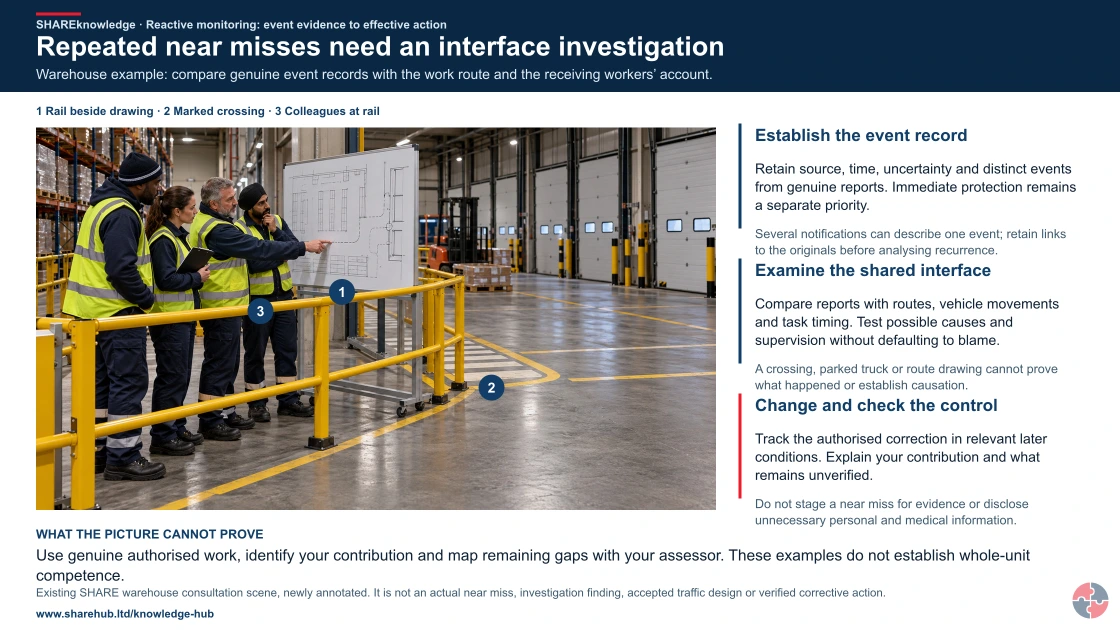
Repeated near misses need an interface investigation
Full written explanation
Picture key: 1 Rail beside drawing · 2 Marked crossing · 3 Colleagues at rail. The separate process headings are unnumbered.
Warehouse example: compare genuine event records with the work route and the receiving workers’ account.
- Establish the event record. Retain source, time, uncertainty and distinct events from genuine reports. Immediate protection remains a separate priority.
- Examine the shared interface. Compare reports with routes, vehicle movements and task timing. Test possible causes and supervision without defaulting to blame.
- Change and check the control. Track the authorised correction in relevant later conditions. Explain your contribution and what remains unverified.
Change the pathway
- Do not count one event twice. Several notifications can describe one event; retain links to the originals before analysing recurrence.
- Separate evidence and inference. A crossing, parked truck or route drawing cannot prove what happened or establish causation.
- Keep people and records protected. Do not stage a near miss for evidence or disclose unnecessary personal and medical information.
Evidence check: Use genuine authorised work, identify your contribution and map remaining gaps with your assessor. These examples do not establish whole-unit competence.
Full factual investigation, rate denominators, uncertainty and reporting boundaries
Primary references: HSE: investigating accidents and incidents (GB) · HSE: monitoring, review and learning (GB)
Open the complete HD image (new tab)Download image

Full factual investigation, rate denominators, uncertainty and reporting boundaries
Primary references: HSE: investigating accidents and incidents (GB) · HSE: monitoring, review and learning (GB)
Separate facts from inference in a learning case
Illustrative example. A clearly near miss contains an observation, a possible cause and a proposed corrective action.
Decision. Mark those categories separately and test the explanation before treating it as established.
Evidence to check. Original observations, uncertainty, contributing conditions and verification of the action.
Hold or escalation point. Do not invent incidents for assessment or present correlation as a proved cause.
Follow-up. Use authorised authentic evidence acceptable to the assessor and protect confidential information.
How can I trace an incident from facts to effective action?
An incident timeline should separate immediate care, source evidence, uncertainty, causal analysis and authorised actions. Learning continues beyond logging the event.
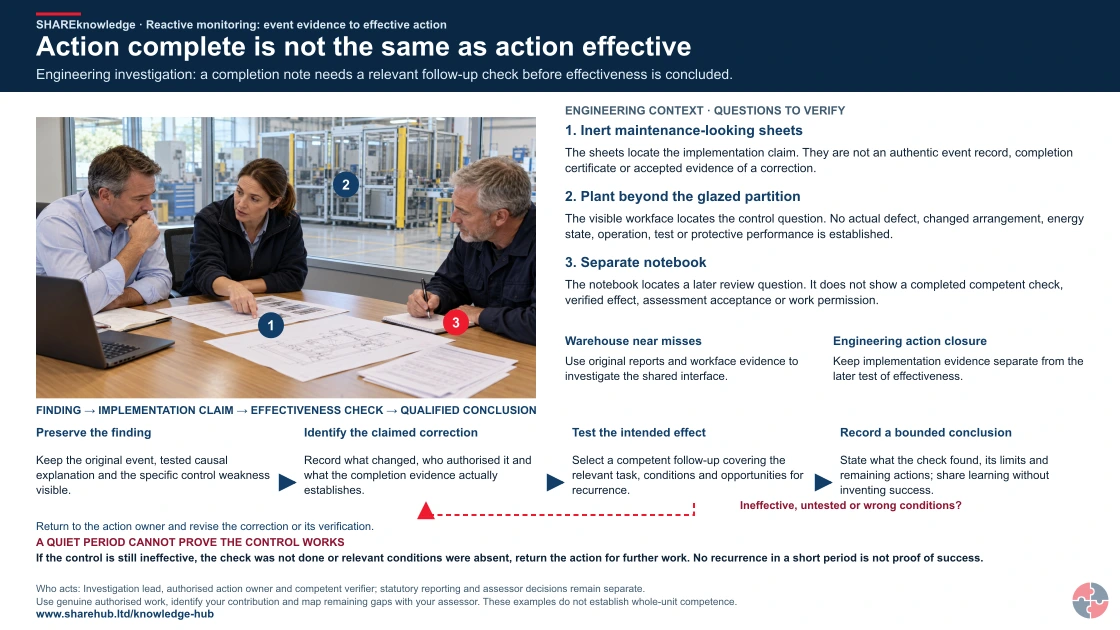
Action complete is not the same as action effective
Full written explanation
An illustrative engineering review shows three ordinary colleagues, inert maintenance-looking sheets, a separate notebook and guarded-looking plant beyond glazing. Picture key: 1 identifies the inert sheets; 2 identifies the plant beyond the glazed partition; 3 identifies the separate notebook. These features locate different evidence questions; the unchanged scene supplies no before-and-after comparison or actual event. The complete ordered analytical band reads FINDING → IMPLEMENTATION CLAIM → EFFECTIVENESS CHECK → QUALIFIED CONCLUSION. All four full checks retain their three forward connections. A separate conditional dashed return runs from Test the intended effect back to Identify the claimed correction: Ineffective, untested or wrong conditions? Return to the action owner and revise the correction or its verification. A QUIET PERIOD CANNOT PROVE THE CONTROL WORKS accompanies the full hold, responsible roles, evidence limitation and both warehouse-near-miss and engineering-action-closure cases. Independent analytical headings are unnumbered. No sheet, notebook, person or visible plant proves record authenticity, a defect or change, isolation, energy state, operation, test method, competent role, protective performance, causation, successful correction, assessor acceptance or permission. Immediate care and protection, applicable statutory reporting and assessor decisions remain separate from paperwork, investigation and closure. Use genuine authorised evidence, distinguish observation from inference, and retain the current uncertainty, reporting, source and confidentiality qualifications.
Engineering investigation: a completion note needs a relevant follow-up check before effectiveness is concluded.
- Preserve the finding. Keep the original event, tested causal explanation and the specific control weakness visible.
- Identify the claimed correction. Record what changed, who authorised it and what the completion evidence actually establishes.
- Test the intended effect. Select a competent follow-up covering the relevant task, conditions and opportunities for recurrence.
- Record a bounded conclusion. State what the check found, its limits and remaining actions; share learning without inventing success.
When the evidence does not fit: If the control is still ineffective, the check was not done or relevant conditions were absent, return the action for further work. No recurrence in a short period is not proof of success.
Who acts: Investigation lead, authorised action owner and competent verifier; statutory reporting and assessor decisions remain separate.
Changed workplace
Warehouse near misses: Use original reports and workface evidence to investigate the shared interface.
Engineering action closure: Keep implementation evidence separate from the later test of effectiveness.
Evidence check: Use genuine authorised work, identify your contribution and map remaining gaps with your assessor. These examples do not establish whole-unit competence.
Full factual investigation, rate denominators, uncertainty and reporting boundaries
Primary references: HSE: investigating accidents and incidents (GB) · HSE: monitoring, review and learning (GB)
Open the complete HD image (new tab)Download image

Full factual investigation, rate denominators, uncertainty and reporting boundaries
Primary references: HSE: investigating accidents and incidents (GB) · HSE: monitoring, review and learning (GB)

Immediate response
Make safe, provide care as needed and preserve relevant facts without creating further exposure.
Investigate
Separate source records and uncertainty from the learner’s analysis; identify control and organisational causes.
Verify learning
Track authorised corrective action, check its effect and share relevant learning. Check statutory reporting separately for the jurisdiction.
This is a evidence-planning example, not a completed portfolio, an assessment decision or evidence of whole-unit competence.
How can I demonstrate my workplace practice for unit 7?
Show how reporting, investigation and trend analysis lead to learning and verified corrective action, without inventing incidents or blaming people prematurely. Unit reference: K/616/9538.
Plan a real activity with your assessor and identify the decisions, work products and witnesses that can show your own competence. The following suggestions are options to adapt, not mandatory document lists or model answers to submit.
What practical work should the evidence demonstrate?
Reactive monitoring starts with genuine events but should finish with better prevention. Separate facts, witness accounts, assumptions and conclusions. Investigations should explore how equipment, task design, supervision and organisational conditions contributed instead of ending at an unsupported claim of worker carelessness.
For an illustrative calculation, 4 events across 20,000 hours is 20 per 100,000 hours; 6 across 50,000 hours is 12 per 100,000 hours. The larger count has a lower exposure-adjusted rate. These teaching figures are not organisational evidence. Explain the denominator, reporting completeness and uncertainty; small numbers do not establish a reliable trend.
Use a causal timeline to explore sequences and dependencies; a fault tree examines combinations leading to a defined unwanted event. Normal models suit suitable continuous data, whereas Poisson models can describe counts under assumptions including a stable rate and appropriate independence. Check those assumptions. Use histograms for distributions, line charts for time, pie charts cautiously for proportions and CUSUM for cumulative departures from a defined baseline. An attractive chart cannot repair poor data or demonstrate causation.
What workplace project could I use to develop evidence?
Repeated minor hand injuries occur during cleaning. Review report quality, investigate a genuine event within your authority, triangulate witness accounts with physical evidence and identify why existing arrangements allowed exposure. Analyse the pattern using meaningful denominators and test whether changes reduce recurrence. Protect personal and medical information throughout.
This is an illustrative project, not an account to copy or a required template. Choose an activity you genuinely undertook and agree its scope with your assessor. If you advise rather than hold operational authority, evidence the recommendations, consultation and follow-up that were yours, alongside the decisions taken by authorised colleagues.
One project may cover only part of the unit. Check the full criterion map and plan additional genuine activities, knowledge evidence and professional development wherever the project leaves gaps. Do not treat an illustrative sample as proof of whole-unit coverage.
Build an evidence trail
- Explain the workplace, your role, the starting problem and the limits of your authority. Identify the activity dates and who can confirm your contribution.
- Keep the information you used, the options considered and your reasons for the decision. Identify specialist advice and distinguish what you knew from what you assumed.
- Show consultation and implementation: who agreed the action, what you personally delivered and how resources, ownership and deadlines were arranged.
- Include a follow-up check and an honest account of the result. Explain remaining gaps and what you would change; do not create outcomes that did not occur.
Prepare the evidence index
For unit 7, give each item an identifier, date, version, author, your contribution, relevant criterion references and exact page or paragraph locations. Record how authenticity can be checked. Cross-reference a genuinely relevant item to other units rather than creating duplicate copies, but explain separately how it supports each criterion.
Obtain permission before sharing workplace records. Redact names, commercial details and health information while preserving enough context for assessment. Arrange secure assessor access or an authenticated witness account where copying is inappropriate. Never upload identifiable incident or medical records to a public page or an unapproved AI tool.
How can I plan workplace evidence against each criterion?
The reference numbers below help you plan work and locate evidence. The activities, evidence suggestions and questions are original SHARE learning guidance, not the official criterion wording or a promise of acceptance. Use your assessor-issued assessment plan and the awarding-body specification for the exact requirements.
Open the ProQual qualification specificationOutcome 1: Make reporting accessible and reliable
1.1 · Classify genuine events and near misses consistently, including ill-health signals and damage where relevant.
Evidence you could select
Event categories and worked records. Keep the relevant extract and explain your personal contribution rather than submitting an unexplained file.
Discuss with your assessor
What is included and why? Refer to a specific decision, the information available at the time and what happened afterwards.
1.2 · Design a report form that captures facts, immediate action and contact details without encouraging blame.
Evidence you could select
Form trial and feedback. Keep the relevant extract and explain your personal contribution rather than submitting an unexplained file.
Discuss with your assessor
What essential information was previously missing? Refer to a specific decision, the information available at the time and what happened afterwards.
1.3 · Set reporting responsibilities, urgency, escalation and privacy arrangements that workers can actually follow.
Evidence you could select
Procedure and tested reporting route. Keep the relevant extract and explain your personal contribution rather than submitting an unexplained file.
Discuss with your assessor
How does a night-shift worker report? Refer to a specific decision, the information available at the time and what happened afterwards.
1.4 · Roll out the process with managers and representatives, brief users and test a submission through the system.
Evidence you could select
Launch plan and process test. Keep the relevant extract and explain your personal contribution rather than submitting an unexplained file.
Discuss with your assessor
Where could a report stall? Refer to a specific decision, the information available at the time and what happened afterwards.
1.5 · Keep records controlled, retrievable and protected with an agreed retention approach.
Evidence you could select
Register and access-control evidence. Keep the relevant extract and explain your personal contribution rather than submitting an unexplained file.
Discuss with your assessor
Who should and should not see personal details? Refer to a specific decision, the information available at the time and what happened afterwards.
1.6 · Build an authorised decision route for external reporting, including relevant thresholds and deadlines for the jurisdiction.
Evidence you could select
Reporting decision protocol. Keep the relevant extract and explain your personal contribution rather than submitting an unexplained file.
Discuss with your assessor
Who is accountable for submission? Refer to a specific decision, the information available at the time and what happened afterwards.
Outcome 2: Investigate and follow through
2.1 · Use severity, potential harm and recurrence to decide which genuine events need a deeper investigation.
Evidence you could select
Triage record and rationale. Keep the relevant extract and explain your personal contribution rather than submitting an unexplained file.
Discuss with your assessor
Why was the chosen depth proportionate? Refer to a specific decision, the information available at the time and what happened afterwards.
2.2 · Plan investigator roles, evidence preservation, interviews and welfare support before starting.
Evidence you could select
Investigation plan. Keep the relevant extract and explain your personal contribution rather than submitting an unexplained file.
Discuss with your assessor
What could compromise reliable evidence? Refer to a specific decision, the information available at the time and what happened afterwards.
2.3 · Demonstrate your role putting the investigation procedure into use with appropriate competent support.
Evidence you could select
Implementation record and witness account. Keep the relevant extract and explain your personal contribution rather than submitting an unexplained file.
Discuss with your assessor
What did you do rather than merely observe? Refer to a specific decision, the information available at the time and what happened afterwards.
2.4 · Build a fact-based timeline and distinguish immediate causes from organisational weaknesses.
Evidence you could select
Investigation report and evidence index. Keep the relevant extract and explain your personal contribution rather than submitting an unexplained file.
Discuss with your assessor
Which conclusion remains uncertain? Refer to a specific decision, the information available at the time and what happened afterwards.
2.5 · Advise relevant managers and representatives on assessment revisions and possible compliance concerns without declaring liability.
Evidence you could select
Authorised advice and review actions. Keep the relevant extract and explain your personal contribution rather than submitting an unexplained file.
Discuss with your assessor
Where did you need specialist legal advice? Refer to a specific decision, the information available at the time and what happened afterwards.
2.6 · Track recommendations to implementation and check whether the corrective action works.
Evidence you could select
Action log and verification records. Keep the relevant extract and explain your personal contribution rather than submitting an unexplained file.
Discuss with your assessor
Why is completion not the same as effectiveness? Refer to a specific decision, the information available at the time and what happened afterwards.
2.7 · Preserve an auditable case file separating evidence, analysis, decisions and personal information.
Evidence you could select
Controlled investigation file. Keep the relevant extract and explain your personal contribution rather than submitting an unexplained file.
Discuss with your assessor
Can another reviewer follow your reasoning? Refer to a specific decision, the information available at the time and what happened afterwards.
Outcome 3: Analyse patterns responsibly
3.1 · Create numerical and graphical analysis using event and exposure data; examine ill-health patterns without assuming correlation proves causation.
Evidence you could select
Anonymised dataset, calculations and presentation. Keep the relevant extract and explain your personal contribution rather than submitting an unexplained file.
Discuss with your assessor
How do denominators and small numbers affect interpretation? Refer to a specific decision, the information available at the time and what happened afterwards.
3.2 · Keep the dataset definition, calculation method, revisions and chart sources with the results.
Evidence you could select
Analysis workbook and methodology note. Keep the relevant extract and explain your personal contribution rather than submitting an unexplained file.
Discuss with your assessor
Could someone reproduce the figures? Refer to a specific decision, the information available at the time and what happened afterwards.
Outcome 4: Communicate learning and required action
4.1 · Share appropriate findings with leadership, supervisors and worker representatives without exposing unnecessary personal detail.
Evidence you could select
Briefing records. Keep the relevant extract and explain your personal contribution rather than submitting an unexplained file.
Discuss with your assessor
What did each audience need to know? Refer to a specific decision, the information available at the time and what happened afterwards.
4.2 · Prepare both a written report and a verbal explanation that distinguish facts, uncertainty and actions.
Evidence you could select
Report and presentation notes. Keep the relevant extract and explain your personal contribution rather than submitting an unexplained file.
Discuss with your assessor
What decision were you asking for? Refer to a specific decision, the information available at the time and what happened afterwards.
4.3 · Explain a rate or chart in ordinary language and invite questions about its limits.
Evidence you could select
Plain-language learning brief. Keep the relevant extract and explain your personal contribution rather than submitting an unexplained file.
Discuss with your assessor
What would be misleading without context? Refer to a specific decision, the information available at the time and what happened afterwards.
4.4 · Choose corrective actions supported by the investigation rather than defaulting to retraining.
Evidence you could select
Options appraisal and recommendation. Keep the relevant extract and explain your personal contribution rather than submitting an unexplained file.
Discuss with your assessor
How does it address the system weakness? Refer to a specific decision, the information available at the time and what happened afterwards.
4.5 · Demonstrate authorised compliance with applicable external requests using genuine records, or agree an evidence-gap plan.
Evidence you could select
Submission or correspondence record. Keep the relevant extract and explain your personal contribution rather than submitting an unexplained file.
Discuss with your assessor
What remained outside your authority? Refer to a specific decision, the information available at the time and what happened afterwards.
Outcome 5: Explain investigation and analysis methods
5.1 · Evaluate whether the current reporting system encourages learning, captures the right information and drives closure.
Evidence you could select
System evaluation. Keep the relevant extract and explain your personal contribution rather than submitting an unexplained file.
Discuss with your assessor
What important events are under-reported? Refer to a specific decision, the information available at the time and what happened afterwards.
5.2 · Compare two real event types by harm potential, causal factors and investigation needs.
Evidence you could select
Comparative case discussion. Keep the relevant extract and explain your personal contribution rather than submitting an unexplained file.
Discuss with your assessor
Why should their investigation depth differ? Refer to a specific decision, the information available at the time and what happened afterwards.
5.3 · Walk through reporting from immediate response to retention and explain each role using your procedure.
Evidence you could select
Annotated process map. Keep the relevant extract and explain your personal contribution rather than submitting an unexplained file.
Discuss with your assessor
Where is the escalation point? Refer to a specific decision, the information available at the time and what happened afterwards.
5.4 · Compare fault trees and causal timelines; explain audience needs, normal and Poisson models, and histogram, pie, CUSUM and line charts using suitable data.
Evidence you could select
Worked method examples with assumptions. Keep the relevant extract and explain your personal contribution rather than submitting an unexplained file.
Discuss with your assessor
When would a distribution or chart mislead? Refer to a specific decision, the information available at the time and what happened afterwards.
5.5 · Discuss how external scrutiny, reporting duties and credible technical advice affect investigation independence and scope.
Evidence you could select
Reflective external-factor analysis. Keep the relevant extract and explain your personal contribution rather than submitting an unexplained file.
Discuss with your assessor
How would you protect evidence integrity? Refer to a specific decision, the information available at the time and what happened afterwards.
5.6 · Distinguish statutory obligations from civil-law issues in a case discussion, checking jurisdiction and avoiding unsupported legal conclusions.
Evidence you could select
Source-led discussion and escalation note. Keep the relevant extract and explain your personal contribution rather than submitting an unexplained file.
Discuss with your assessor
When is specialist advice required? Refer to a specific decision, the information available at the time and what happened afterwards.
6.1 · Evidence your professional development
Use a learning episode related to this unit: identify a gap in your capability, set a realistic objective, record the activity and explain how you applied the learning. Discuss an ethical decision, an inclusion issue and a contribution to professional discussion. Finish with a dated review of progress and the next priority. A list of courses attended is not a reflective development record.
Evidence options: a competence self-review, dated development plan, reflective CPD entry, an ethical or inclusive-practice example and a record of professional exchange. Cross-reference the same genuine portfolio across units where appropriate, adding a unit-specific reflection.
Which background reading supports this unit?
Use the linked SHARE topics to strengthen your understanding, then explain the decisions you made in your own organisation. Reading alone is not evidence that you performed the work.
What should I check before submitting evidence to my assessor?
Check that the evidence is authentic, relevant to the registered criteria and clear about your own decisions, actions and results. Resolve gaps with your assessor and protect personal or confidential information before submission.
- Performance: show work you actually did, not just what a practitioner ought to do. Explain your contribution to team-produced documents.
- Reasoning: answer explain, analyse, evaluate and justify questions with decisions, alternatives and limitations, not copied definitions.
- Coverage: map every reference to a precise piece of evidence. Discuss gaps early, including missing authority, specialist tasks or no genuine incident or external request.
- Authenticity and sufficiency: ask what observation, questioning or witness evidence the assessor needs. A job title, course certificate or large upload alone is not proof of competence.
- Exercises: label drills and simulated records accurately. Their acceptability depends on the assessment requirements and assessor agreement; never present them as genuine emergencies or incidents.
- Outcome: the assessor decides whether the evidence meets the requirements, subject to centre and awarding-body quality assurance. These learning pages do not award competence or replace assessment.