SHARE Knowledge Hub
What should you know about diabetes and workplace wellbeing?
Diabetes is a long-term health condition affecting blood glucose regulation, and at work it should be managed through practical support, confidentiality, fair adjustments and sensible risk assessment rather than assumptions about capability. Most people with diabetes can work safely and effectively, but some may need access to food, drink, medication, glucose monitoring, suitable breaks, private space, time for appointments, shift-work planning or review of safety-critical duties such as driving, lone work or machinery operation. Good workplace management separates clinical treatment from functional impact: managers do not diagnose or prescribe, but they should remove avoidable barriers, protect sensitive health information, involve occupational health where work risk is unclear and review support as the person's condition, treatment or work changes.
Understanding What should you know about diabetes and workplace wellbeing?
Diabetes is a long-term health condition affecting blood glucose regulation, and at work it should be managed through practical support, confidentiality, fair adjustments and sensible risk assessment rather than assumptions about capability. Most people with diabetes can work safely and effectively, but some may need access to food, drink, medication, glucose monitoring, suitable breaks, private space, time for appointments, shift-work planning or review of safety-critical duties such as driving, lone work or machinery operation. Good workplace management separates clinical treatment from functional impact: managers do not diagnose or prescribe, but they should remove avoidable barriers, protect sensitive health information, involve occupational health where work risk is unclear and review support as the person's condition, treatment or work changes.
Why this matters at work
Common failures are treating diabetes as a performance or lifestyle issue; collecting unnecessary clinical data; blanket exclusion from driving or critical work; providing a generic wellbeing poster while breaks are impossible; asking a worker to educate colleagues; using training records as proof of a usable response; giving inappropriate medical advice; and reviewing only after an incident. Each failure should be corrected at the work-system level as well as supporting the individual.
Assure workplace support by checking the lived experience, not the existence of a policy. Ask whether people can take agreed breaks at busy times, whether welfare facilities are available on every shift, whether supervisors can arrange safe cover, whether occupational-health referrals and adjustments are timely, whether confidential records are protected and whether first-aid and emergency plans function at remote locations. Consult workers and representatives without asking people to disclose personal health details in group settings.
How organisations manage this in practice
Focus on credible harm mechanisms. A missed break could disrupt glucose management; excessive heat or physical exertion may make symptoms harder to manage; lack of water or toilet access can worsen discomfort and delay self-care; a lone-worker arrangement can delay assistance; a driving role may need individual adherence to medical and licensing requirements (DVLA in GB or DVA in NI); and safety-critical work may need proportionate task restrictions or supervision. The appropriate control is often an adjustment to work design, not a blanket removal from all duties.
Start with elimination and reduction of work-created barriers. Redesign a shift, route, workload or task sequence before relying on the worker to absorb the risk. Use engineering or collective measures where possible, such as accessible welfare facilities, safe rest areas, voice or radio contact, vehicle route planning or work-position design. Management measures include individual plans, manager briefing, supervision and review. PPE may be relevant to the underlying task but is not a diabetes control.
Review after changes in symptoms, treatment or worker request; a move into a new task, shift or location; a driving or safety-critical role change; a recurring difficulty; an incident or near miss; new welfare arrangements; a major organisational change; or evidence that adjustments are not being used. Where a person is currently unwell, stabilise the immediate situation first. The later review should consider both work design and individual support, without attributing every issue to the health condition.
Plan breaks, relief and a safe handover
Separate routine agreed support, a suspected hypo and a driving-licence question. Individual treatment stays with the person’s clinical advice and trained response arrangements; managers organise the work and competent cover.

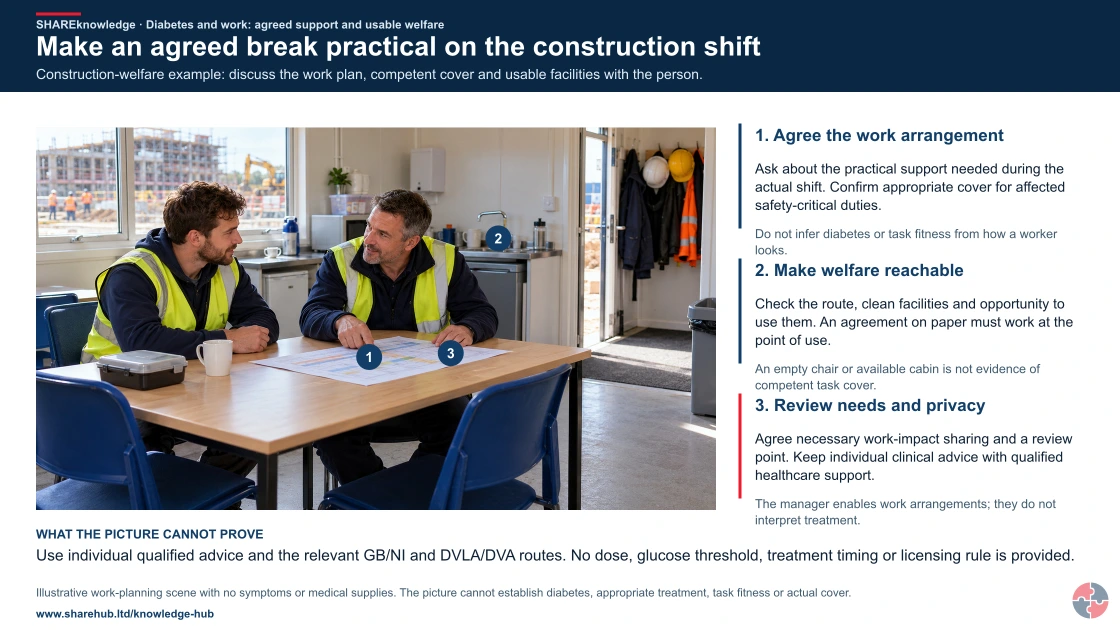
Make an agreed break practical on the construction shift
Full written explanation
Construction-welfare example: discuss the work plan, competent cover and usable facilities with the person.
- Agree the work arrangement. Ask about the practical support needed during the actual shift. Confirm appropriate cover for affected safety-critical duties.
- Make welfare reachable. Check the route, clean facilities and opportunity to use them. An agreement on paper must work at the point of use.
- Review needs and privacy. Agree necessary work-impact sharing and a review point. Keep individual clinical advice with qualified healthcare support.
Change the pathway
- No blanket assumptions. Do not infer diabetes or task fitness from how a worker looks.
- Cover needs verification. An empty chair or available cabin is not evidence of competent task cover.
- Keep the roles clear. The manager enables work arrangements; they do not interpret treatment.
Evidence check: Use individual qualified advice and the relevant GB/NI and DVLA/DVA routes. No dose, glucose threshold, treatment timing or licensing rule is provided.
Practical support, individual review and qualified clinical boundaries
Primary references: Diabetes UK: work arrangements and individual support · HSE: construction welfare facilities (GB)
Open the complete HD image (new tab)Download image

Practical support, individual review and qualified clinical boundaries
Primary references: Diabetes UK: work arrangements and individual support · HSE: construction welfare facilities (GB)
The same worker covers a pool and a driving duty
Illustrative example. A delayed relief shift threatens an agreed break and the next safety-critical assignment.
Decision. Arrange qualified relief and reassess the assignment rather than asking the worker to continue without the agreed support.
Evidence to check. Individual work-support plan, cover availability and the relevant task and licensing route.
Hold or escalation point. Hold the safety-critical duty when cover or fitness is uncertain; use the existing hypo response guidance if symptoms arise.
Follow-up. Review staffing and handover arrangements without recording unnecessary medical details.
Make the agreed break possible without losing safe cover
A poolside post needs a competent handover and practical access to the agreed welfare arrangement. The clinical details do not need to travel through the operational log.
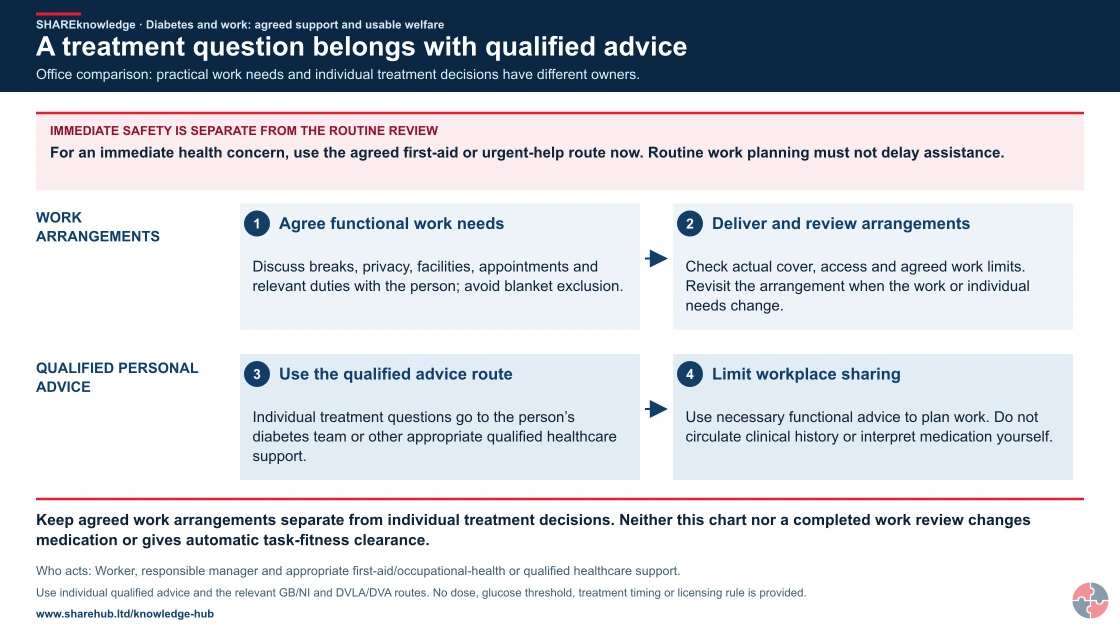
A treatment question belongs with qualified advice
Full written explanation
For an immediate health concern, use the agreed first-aid or urgent-help route now. Routine work planning must not delay assistance.
Two parallel lanes separate practical work arrangements from personal diabetes advice. The workplace agrees functional needs and verifies usable arrangements, while the worker uses their qualified healthcare team for treatment questions and shares only necessary work-impact advice. An immediate health concern uses the agreed first-aid or urgent-help route; no medicine, glucose or timing instruction is supplied.
Office comparison: practical work needs and individual treatment decisions have different owners.
- Agree functional work needs. Discuss breaks, privacy, facilities, appointments and relevant duties with the person; avoid blanket exclusion.
- Deliver and review arrangements. Check actual cover, access and agreed work limits. Revisit the arrangement when the work or individual needs change.
- Use the qualified advice route. Individual treatment questions go to the person’s diabetes team or other appropriate qualified healthcare support.
- Limit workplace sharing. Use necessary functional advice to plan work. Do not circulate clinical history or interpret medication yourself.
When the evidence does not fit: Keep agreed work arrangements separate from individual treatment decisions. Neither this chart nor a completed work review changes medication or gives automatic task-fitness clearance.
Who acts: Worker, responsible manager and appropriate first-aid/occupational-health or qualified healthcare support.
Changed workplace
Construction shift: Make agreed welfare access and competent cover usable in practice.
Office treatment question: Keep treatment interpretation with qualified support and work information proportionate.
Evidence check: Use individual qualified advice and the relevant GB/NI and DVLA/DVA routes. No dose, glucose threshold, treatment timing or licensing rule is provided.
Practical support, individual review and qualified clinical boundaries
Primary references: Diabetes UK: work arrangements and individual support · HSE: construction welfare facilities (GB)
Open the complete HD image (new tab)Download image

Practical support, individual review and qualified clinical boundaries
Primary references: Diabetes UK: work arrangements and individual support · HSE: construction welfare facilities (GB)

Request and cover
Use the agreed route to request relief and confirm competent cover before leaving a safety-critical post.
Welfare access
Make the agreed break/facilities actually reachable and usable during the shift.
Review and privacy
Agree hand-back and review changing needs; share only necessary work-impact information.
A general wellbeing plan is not a diabetes treatment or an automatic fitness decision.
What key facts should people know first about diabetes at work?
Diabetes at work should be managed as workplace guidance, not as medical, legal or HR advice.
This page does not diagnose diabetes, recommend treatment, decide fitness for work or replace GP, diabetes team, occupational health, HR or legal advice. It explains the workplace management issues that commonly arise when diabetes affects work.
Where someone appears seriously unwell, confused, unable to work safely or at risk during safety-critical activity, the situation should be moved into first-aid, emergency or competent medical support routes. Ordinary line management should not try to handle a possible acute health event on its own.
Diabetes should not be treated as a character issue or lifestyle blame topic. Genetics, age, medication, hormones, sleep, stress, work pattern, income, food environment and health inequalities can all influence risk and management. Workplace support should focus on barriers, safety and dignity.
| Key fact | What it means in practice |
|---|---|
| Diabetes affects blood glucose regulation | The condition can involve high or low blood glucose depending on type, treatment and circumstances. |
| People are affected differently | Some workers need few adjustments; others may need planned support, appointments or safety-critical review. |
| Hypos can affect safety | Low blood glucose can affect concentration, coordination, behaviour and driving or machinery safety. |
| Breaks and food access matter | Rigid schedules can make it harder for some people to manage medication, meals and glucose levels. |
| Health information is sensitive | Only necessary work-impact information should be collected and shared. |
| Most controls are simple | Planning breaks, private space, appointment flexibility and review often prevent avoidable problems. |
What is diabetes and why does it matter for workplace wellbeing?
Diabetes is a long-term condition where the body cannot regulate blood glucose in the usual way.
Type 1 diabetes is usually managed with insulin because the body cannot produce enough insulin. Type 2 diabetes is linked to insulin resistance and reduced insulin effectiveness, and may be managed through lifestyle measures, tablets, injections or insulin depending on the person. Some people also experience gestational diabetes during pregnancy.
For workplace purposes, the important point is not the label alone. The practical questions are whether the person needs time, space or flexibility to manage their condition; whether fatigue, vision, neuropathy, wounds, appointments or medication effects affect work; and whether any safety-critical task needs review.
Diabetes can be stable for long periods and then change because of treatment, illness, stress, shift changes, workload, travel, sleep, pregnancy, menopause, infection or altered routines. Reviewable support is therefore more useful than one-off assumptions.
For this decision, use NHS diabetes overview for the applicable work and jurisdiction.
| Aspect | Workplace explanation |
|---|---|
| Type 1 diabetes | May require insulin, glucose monitoring and readiness to manage low blood glucose. |
| Type 2 diabetes | May involve tiredness, appointments, medication, weight stigma, cardiovascular risk and variable treatment needs. |
| Hypoglycaemia | Low blood glucose, most relevant to insulin or some medication, can develop quickly and affect safe work. |
| Hyperglycaemia | High blood glucose can contribute to tiredness, thirst, urination, blurred vision and feeling unwell. |
| Complications | Longer-term effects may include vision, nerve, kidney, heart, circulation, wound healing and foot problems. |
| Workplace boundary | Managers should focus on work impact and support, not clinical decision-making. |
How can diabetes affect work tasks, attendance and wellbeing?
Diabetes can affect work through symptoms, treatment routines, appointments, fatigue, work pattern and the safety demands of the role.
Many people manage diabetes effectively without anyone at work needing to know. Problems arise when work design makes management harder: no predictable breaks, no private place for medication or glucose monitoring, long driving periods, hot work, lone work, high physical demand, night shifts, irregular meals or a culture where people feel embarrassed to carry supplies or ask for support.
Work can also support better health. Predictable breaks, healthier food availability, decent welfare facilities, flexible appointment arrangements and non-stigmatising manager behaviour can help people manage diabetes safely and stay in work.
For safety-critical work, the assessment should be specific. A blanket ban is rarely appropriate, but neither is ignoring the risk. Driving, plant operation, lone work, work at height, confined spaces, emergency response, security, rail, construction plant, live traffic, high heat and long shifts may need competent review if hypos, fatigue, vision or medication effects are relevant.
| Work factor | Possible issue | Practical support |
|---|---|---|
| Break timing | Medication, food and glucose monitoring may need predictable timing. | Allow planned breaks and a route for extra breaks when needed. |
| Private facilities | Some workers need privacy for insulin, medication or glucose checks. | Provide clean, private and dignified space; do not force use of toilets. |
| Shift work | Irregular hours can affect meals, sleep, medication routines and fatigue. | Review rota stability, night shifts, recovery time and access to food. |
| Physical work | High activity can affect glucose management for some people. | Plan pacing, hydration, breaks and worker-led monitoring. |
| Heat and cold | Temperature can affect comfort, hydration, energy and medication/device management. | Review thermal risk, welfare, storage and rest arrangements. |
| Appointments | Diabetes checks, education and treatment reviews may need time away from work. | Use fair appointment and absence arrangements with proportionate evidence. |
Why do hypos matter in workplace risk assessment?
Hypos matter because low blood glucose can affect concentration, coordination, behaviour, consciousness and safety-critical activity.
A hypo is not a disciplinary issue; it is a health event. It can happen quickly and symptoms vary between people. A worker may feel shaky, sweaty, hungry, anxious, irritable, dizzy, confused, weak or unable to concentrate. Some people lose clear warning symptoms, which makes competent advice especially important where safety-critical work is involved.
The workplace response should be agreed with the person where possible. Some workers will want selected colleagues or first aiders to know what to do; others may prefer only a manager or first aider to be informed. The agreement should cover where supplies are kept, how help is requested, when first aid is needed and what to do after an event.
This page does not give individual hypo treatment instructions. Workers should follow their diabetes team's advice and official NHS guidance. Managers should make sure local first aid arrangements are clear and that safety-critical work is paused where the person may not be safe to continue.
NHS guidance says severe low blood sugar can cause confusion, seizure or unconsciousness. If someone is unconscious, do not give food or drink because they cannot swallow safely; call emergency services and follow first-aid arrangements. Individual treatment, rescue medication and return-to-task decisions belong to trained people and the person’s clinical plan.
For this decision, use NHS low-blood-sugar advice for the applicable work and jurisdiction.
| Issue | Control | Evidence |
|---|---|---|
| Access to fast-acting carbohydrate | Worker can keep agreed supplies available where needed. | Individual support plan or first-aid note agreed with the worker. |
| First-aider awareness | First aiders know the agreed response route without unnecessary disclosure. | First-aid briefing and confidential emergency information where agreed. |
| Safety-critical pause | Driving, machinery or hazardous work stops if the person is not safe to continue. | Procedure, supervisor instruction and incident review. |
| Lone work | Contact arrangements consider the person's actual risk and preferences. | Lone-working assessment and review. |
| Post-event review | A hypo at work leads to support review, not blame. | Manager note, OH referral if needed and adjustment review. |
What reasonable adjustments may support diabetes at work?
Reasonable adjustments should reduce practical barriers so the person can work safely and fairly.
Diabetes may amount to a disability under the GB Equality Act 2010 or NI Disability Discrimination Act 1995 depending on the circumstances. Employers should consider reasonable adjustments where the condition places the worker at a disadvantage, and they should avoid assumptions about what the person can or cannot do.
The most effective adjustments are often simple: predictable breaks, flexibility for appointments, ability to carry food or glucose supplies, private space, modified shift patterns, temporary duty changes, support after illness, access to water and welfare facilities, and clear arrangements for safety-critical tasks.
Adjustments should be reviewed. A change that works during stable control may not be enough after a medication change, pregnancy, illness, new shift pattern, increased travel or return from absence.
For this decision, use GB Acas adjustments and NI disability guidance for the applicable work and jurisdiction.
| Adjustment area | Possible support | Review point |
|---|---|---|
| Breaks and meals | Flexible or protected breaks for food, medication or glucose checks. | Are breaks reliable during busy shifts and overtime? |
| Medication and monitoring | Clean private space and permission to carry supplies/devices. | Is the arrangement dignified and practical? |
| Appointments and education | Time for diabetes reviews, screening, education courses or treatment changes. | Is time handled fairly and consistently? |
| Shift and rota | More predictable shifts, reduced rapid rotation or adjusted nights where needed. | Is fatigue or glucose management improving? |
| Safety-critical duties | Temporary restriction, supervision or OH review where hypos, vision or fatigue affect safety. | Is competent advice current and task-specific? |
| Return to work | Phased return, workload review and follow-up after illness or complications. | Are duties increasing safely and at the right pace? |
How can the hierarchy of controls reduce risks while providing reliable cover for a lifeguard shift?
Start by removing the hazard where practicable, then consider substitution, engineering controls and work-method controls. Use PPE for residual risk. These priorities follow HSE’s hierarchy of controls; the task-specific examples below must still be checked against the relevant HSE guidance and local conditions.
The material work hazard is a safety-critical duty with no reliable break or immediate cover, so a possible acute health event can leave pool users unobserved or a driver unable to stop safely. The worker and diabetes are not hazards. The organisation controls staffing, task design and emergency cover; clinicians and licensing authorities decide medical matters.
How can the ERICPD hierarchy of controls reduce risks while providing reliable cover for a lifeguard shift?

| Control level | Control for this activity | Owner and verification | Stop / restart decision |
|---|---|---|---|
| Eliminate | Remove the combined lifeguard-and-driving duty where it prevents safe break cover and recovery. | Task owner verifies that the proposed change removes the named hazardous step, including foreseeable cleaning, maintenance and work transferred elsewhere. | If the hazardous step remains, keep it within the task assessment and select the stronger feasible remaining controls. |
| Reduce, including substitution | Choose an alternative roster or agreed temporary duty arrangement that maintains competent pool supervision and the worker’s functional needs. | Competent task/process owner validates suitability, compatibility and new hazards against the actual operating requirements before the alternative is adopted. | Reject an alternative if its performance is unproved or its new hazards are unresolved. |
| Isolate | Prevent an unattended pool or unplanned safety-critical handover by keeping cover arrangements separate from general reception staffing. | Supervisor checks the actual boundary, affected people and connected work; verify separation or isolation before allowing access. | Hold or stop for no competent cover, unsafe supervision gap or a worker reporting they cannot safely perform the task. |
| Control: physical safeguards | Provide accessible welfare, suitable communication and a reliable means of obtaining competent relief without abandoning the observation position. | Competent equipment/process owner checks competent relief availability, access to agreed breaks, communication and handover. | Hold or stop for no competent cover, unsafe supervision gap or a worker reporting they cannot safely perform the task. |
| Control: work method and response | Agree the individual work plan privately with the worker and appropriate advisers; brief supervisors only on the cover, restrictions and emergency actions they need to know. | Supervisor confirms the work limits, competent cover, communication and stop/restart authority with the people doing this activity. | Hold work when the agreed limits, competent cover or effective communication cannot be maintained. |
| PPE | No PPE prevents an acute health event or compensates for missing pool cover; assess any separate lifeguarding equipment requirements normally. | Assessor confirms whether personal protection is needed and checks suitability, condition, compatibility and any required fit evidence. | Do not use unsuitable protection or rely on PPE to continue after an essential source control fails. |
| Discipline | Test relief arrangements during a representative shift and review after a role, shift or functional-advice change; retain only necessary work-impact information. | Release only after duty manager confirms safe cover and the agreed functional work plan. Retain verification and unresolved restrictions at handover. | Keep the task on hold until required reinstatement evidence and unresolved defects are accepted by the responsible owner. |
How can the ISO 45001 hierarchy of controls reduce risks while providing reliable cover for a lifeguard shift?

| Control level | Control for this activity | Owner and verification | Stop / restart decision |
|---|---|---|---|
| Elimination | Remove the combined lifeguard-and-driving duty where it prevents safe break cover and recovery. | Task owner verifies that the proposed change removes the named hazardous step, including foreseeable cleaning, maintenance and work transferred elsewhere. | If the hazardous step remains, keep it within the task assessment and select the stronger feasible remaining controls. |
| Administrative controls | Choose an alternative roster or agreed temporary duty arrangement that maintains competent pool supervision and the worker’s functional needs. | Competent task/process owner validates suitability, compatibility and new hazards against the actual operating requirements before the alternative is adopted. | Reject an alternative if its performance is unproved or its new hazards are unresolved. |
| Administrative controls | Prevent an unattended pool or unplanned safety-critical handover by keeping cover arrangements separate from general reception staffing. | Supervisor checks the actual boundary, affected people and connected work; verify separation or isolation before allowing access. | Hold or stop for no competent cover, unsafe supervision gap or a worker reporting they cannot safely perform the task. |
| Engineering controls | Provide accessible welfare, suitable communication and a reliable means of obtaining competent relief without abandoning the observation position. | Competent equipment/process owner checks competent relief availability, access to agreed breaks, communication and handover. | Hold or stop for no competent cover, unsafe supervision gap or a worker reporting they cannot safely perform the task. |
| Administrative controls | Agree the individual work plan privately with the worker and appropriate advisers; brief supervisors only on the cover, restrictions and emergency actions they need to know. | Supervisor confirms the work limits, competent cover, communication and stop/restart authority with the people doing this activity. | Hold work when the agreed limits, competent cover or effective communication cannot be maintained. |
| PPE | No PPE prevents an acute health event or compensates for missing pool cover; assess any separate lifeguarding equipment requirements normally. | Assessor confirms whether personal protection is needed and checks suitability, condition, compatibility and any required fit evidence. | Do not use unsuitable protection or rely on PPE to continue after an essential source control fails. |
| Administrative controls | Test relief arrangements during a representative shift and review after a role, shift or functional-advice change; retain only necessary work-impact information. | Release only after duty manager confirms safe cover and the agreed functional work plan. Retain verification and unresolved restrictions at handover. | Keep the task on hold until required reinstatement evidence and unresolved defects are accepted by the responsible owner. |
A manufacturing machine operator may need a verified relief operator for treatment breaks; a logistics driver needs planned safe stops and the correct licensing authority. The same decision holds a task when cover, fitness or emergency access is unresolved.
How should diabetes be considered for driving, lone working and safety-critical duties?
Safety-critical duties should be reviewed against the actual work and the person's medical advice, not managed by blanket assumptions.
Driving at work needs particular care. For a GB driving licence, use current DVLA diabetes guidance; for an NI licence, use DVA guidance. Insulin treatment, hypoglycaemia, licence group and individual medical assessment may change notification and fitness requirements. The employer should confirm the correct authority route and task controls without setting its own medical licensing rules.
Machinery, work at height, confined spaces, hot work, lone work, emergency response, security work and high-risk construction or process tasks may need individual review if diabetes symptoms or treatment could affect safe performance. The review should be confidential, evidence-based and proportionate.
The aim is not to exclude people with diabetes. The aim is to make the work safe: clear breaks, monitoring opportunities, emergency arrangements, task restrictions if needed, and timely review when medication, symptoms or work pattern changes.
A licence authority determines licensing; a clinician advises medical fitness; the employer assesses the work journey and whether its duty can be performed safely. If the relevant notification or fitness position is unresolved, hold the driving assignment. Do not use a generic “diabetes cleared” note for all vehicle groups or jurisdictions.
For this decision, use GB DVLA medical guidance and NI DVA diabetes guidance for the applicable work and jurisdiction.
A glucose-monitoring device does not itself establish driving fitness. The current GB DVLA diabetes guidance permits suitable medically approved continuous glucose monitoring for Group 1 and Group 2 driving, requires a finger-prick meter as a backup, and explains that device alarms must supplement the driver’s own hypoglycaemia awareness. If a driver depends on alarms to recognise low glucose, that guidance requires them to stop driving and notify DVLA. The NI DVA guidance has its own current device, backup and vocational-licensing requirements. For an illustrative work review, confirm the applicable authority’s decision and whether the planned journey allows the person to follow their advised monitoring arrangements. Do not copy a GB rule into an NI clearance or treat a monitor as permission for every vehicle group.
| Activity | Question to ask | Possible control |
|---|---|---|
| Driving | Does DVLA or DVA guidance apply to the licence jurisdiction, and can the person take breaks, monitor safely and manage hypos? | Driving risk assessment, route planning, medical advice and DVLA or DVA licensing position. |
| Plant or machinery | Could hypo, fatigue, vision or medication effects affect control? | OH advice, task restriction, supervision and pause-work rules. |
| Lone work | Would the person be able to get support if suddenly unwell? | Check-in system, escalation route and worker-agreed emergency information. |
| Work at height or confined spaces | Could sudden impairment create serious consequences? | Permit controls, buddy system, rescue arrangements and competent review. |
| Shift/night work | Does the pattern affect meals, medication, sleep or glucose management? | Rota review, food access, rest periods and fatigue controls. |
How should diabetes-related health information be kept confidential?
Diabetes-related information should be handled as sensitive worker health information and shared only where necessary.
A worker may choose to disclose diabetes to a manager, first aider or colleagues, but that does not mean the information becomes general workplace knowledge. Managers should agree what can be shared, with whom and why. For example, a first aider may need to know the agreed response to a hypo, while a team member may only need to know that a colleague has protected break times.
Practical agreement about who hears an adjustment is separate from the organisation’s legal basis for handling health data. The employer needs an Article 6 lawful basis and an Article 9 special-category condition, with any further Data Protection Act condition where required. Worker consent is not automatically valid as a GDPR basis because the employment relationship can make refusal difficult. See ICO: workers’ health information.
Records should focus on functional impact and agreed support: breaks, facilities, restrictions, appointment arrangements, review dates and emergency arrangements. They should not include unnecessary details about blood readings, medication, weight, diet, complications or private medical history.
Occupational health can help translate medical information into work advice, but employers should ask specific work questions rather than requesting more clinical detail than they need.
For this decision, use ICO worker-health guidance for the applicable work and jurisdiction.
| Control | Good practice | Why it matters |
|---|---|---|
| Worker agreement | Agree what information can be shared and with whom. | Maintains trust and dignity. |
| Need-to-know sharing | Tell only those needed to implement support or manage safety. | Prevents gossip and discrimination. |
| Minimal records | Record adjustments and restrictions rather than unnecessary diagnosis detail. | Supports data minimisation. |
| Secure storage | Keep sensitive health information access-controlled. | Protects special category data. |
| OH referral questions | Ask about fitness, restrictions, adjustments and review, not full medical history. | Keeps advice work-focused. |
How can workplaces support diabetes prevention and metabolic wellbeing without stigma?
Workplaces can support healthier choices, but they should avoid blame, body shaming or intrusive health monitoring.
A good workplace environment can make healthier choices easier: decent breaks, access to drinking water, healthier food options, facilities for activity, supportive shift design, fatigue control, good welfare, fair workload and access to health checks where appropriate. These measures support everyone, including people at risk of type 2 diabetes.
Poor programmes can do harm. Weight-loss competitions, public weigh-ins, moralising posters or pressure to disclose medical information can increase stigma and reduce trust. Health promotion should be voluntary, inclusive and based on reliable sources.
The most useful approach is to remove barriers: people cannot manage food, medication, hydration, movement and recovery well if the work pattern gives them no time, privacy or control.
| Action | Good practice | Avoid |
|---|---|---|
| Food environment | Offer healthier options and predictable meal breaks. | Judging individual food choices. |
| Physical activity | Enable movement, active travel and breaks where practical. | Assuming exercise advice solves all risk. |
| Health checks | Signpost NHS Health Check or GP routes. | Pressuring workers to disclose results. |
| Shift design | Plan rotas to reduce fatigue and meal disruption. | Treating shift health as a personal discipline issue only. |
| Communication | Use respectful language about metabolic health. | Weight stigma, stereotypes or public comparison. |
Which UK legal duties are relevant to diabetes and workplace wellbeing?
Workplace, equality and privacy duties depend on the site and the individual facts; GB and Northern Ireland use different instruments for several key duties.
The law does not require a one-size-fits-all diabetes policy for every job. It requires sensible assessment, fair treatment, confidentiality, reasonable adjustment where required and proper control of safety risks. Where driving, safety-critical tasks or regulated work is involved, specific medical fitness requirements may also apply.
This table is a legal orientation only, not legal advice. Complex cases should involve HR, occupational health, insurers or legal advisers as appropriate.
GB occupational safety, equality and DVLA routes must not be applied as NI law. NI uses its Health and Safety Order, Management Regulations, Disability Discrimination Act and DVA licensing route. Medical fitness and treatment belong to clinicians and licensing authorities.
| Jurisdiction and duty | Practical meaning | Decision evidence |
|---|---|---|
| Great Britain — Health and Safety at Work etc. Act 1974 and Management Regulations 1999 — instrument; instrument | Assess task risks, emergency arrangements, breaks and welfare where relevant. | Use the applicable source and retain proportionate evidence of the real decision. |
| Northern Ireland — NI Health and Safety Order 1978 and Management Regulations 2000 — instrument; instrument | Apply NI risk assessment and prevention route to actual duties. | Use the applicable source and retain proportionate evidence of the real decision. |
| Great Britain — Equality Act 2010 — instrument | Assess disability and reasonable adjustments without blanket exclusions. | Use the applicable source and retain proportionate evidence of the real decision. |
| Northern Ireland — Disability Discrimination Act 1995 — authority guidance; instrument | Use the NI disability and reasonable-adjustment route. | Use the applicable source and retain proportionate evidence of the real decision. |
| United Kingdom — UK GDPR and Data Protection Act 2018 — authority guidance | Protect health information and share only functional support details needed. | Use the applicable source and retain proportionate evidence of the real decision. |
| Great Britain — DVLA medical licensing guidance — authority guidance | Check the current GB driver notification and fitness route for the actual licence and treatment. | Use the applicable source and retain proportionate evidence of the real decision. |
| Northern Ireland — DVA medical licensing guidance — authority guidance | Use NI DVA for NI licence notification and fitness decisions; DVLA is the GB agency. | Use the applicable source and retain proportionate evidence of the real decision. |
How could Riverside Leisure Ltd manage diabetes and workplace wellbeing?

Riverside Leisure Ltd shows how a public-facing business could support diabetes practically while protecting dignity and safety.
Riverside Leisure Ltd
Riverside Leisure Ltd is a leisure and hospitality business with reception staff, instructors, lifeguards, cleaners, maintenance workers, event teams and minibus drivers. Diabetes support may involve rota planning, access to food and drink, private facilities, first-aid arrangements, driving controls, heat exposure, lone closing duties and fair appointment handling.
Riverside starts by making its normal work easier to manage: staff can carry water and suitable supplies, breaks are protected during long shifts, supervisors know how to cover a post if someone needs an unscheduled break, and the welfare area includes clean private space for medication or glucose monitoring. The policy avoids asking workers to disclose diabetes publicly.
For roles with higher consequence, Riverside uses confidential occupational health advice. A lifeguard, minibus driver or maintenance worker doing lone plant-room checks may need a more specific review than a low-risk office role. The review considers duties, shift pattern, hypo risk, fatigue, medication effects, emergency arrangements and DVLA or DVA requirements for the actual licence where driving is part of work.
Riverside also reviews the wider wellbeing environment. Managers check whether split shifts, late finishes, summer heat, skipped breaks or customer pressure are making diabetes management harder. Findings feed into rota rules, training, first-aid arrangements, procurement of welfare supplies and the wellbeing risk register.
Worked example: a lifeguard and minibus driver with diabetes
Task material and setting: Riverside Leisure employs a lifeguard who also drives a minibus. The worker uses insulin and asks for predictable breaks and a way to carry glucose supplies. A missed break during a long swim session could affect safe self-management; driving adds a licensing decision that depends on where the licence is held.
People and prerequisites: The operations manager owns rota and emergency-cover design; the worker and treating team manage clinical care; occupational health advises on functional work impact. The transport lead checks the current DVLA route for a GB licence or DVA route for an NI licence. No supervisor decides driving fitness from the diagnosis alone.
Before: Before the shift, Riverside confirms cover for breaks, a place to keep supplies, the agreed first-aid response and who may know essential emergency information. The transport lead checks that any required medical licensing action and work-driving assessment are resolved before assigning the minibus duty. A confidential plan records duties, restrictions and review dates.
During: During a pool session the lifeguard reports possible low glucose. A colleague takes over observation immediately so the worker can follow their own care plan and first-aid arrangements. The supervisor does not leave the pool unsupervised or demand a blood reading for the personnel file. The worker does not resume a safety-critical task until fit to do so under competent advice.
Hold or stop: Confusion, inability to respond normally or loss of consciousness triggers emergency help. Do not give food or drink to someone who cannot swallow safely. A missed break, absent cover, severe hypo or unresolved licence condition holds the affected safety-critical or driving duty until competent review.
Completion and hand back: After the event, Riverside checks whether the rota and cover worked, offers health support, and reviews the task plan with the worker and occupational health. The transport lead follows any driver-notification or medical-fitness requirements for the actual jurisdiction and licence.
Evidence: Retain the restricted functional support plan, approved sharing, break-cover check, first-aid response record, task-risk review and transport licensing confirmation without copying detailed glucose readings into ordinary HR records.
| Management area | How Riverside applies it | Evidence and improvement |
|---|---|---|
| Assessing | Identifies roles where breaks, driving, lone work, heat, physical activity or safety-critical tasks may interact with diabetes. | Risk register, OH referral criteria and role-based assessment. |
| Analysing | Reviews absence trends, near misses, skipped breaks, rota pressures and worker feedback without exposing diagnosis details. | Anonymised wellbeing dashboard and management review. |
| Implementing | Provides protected breaks, private facilities, food/drink access, appointment flexibility and driving controls. | Updated procedures, rota guidance and supervisor checks. |
| Training | Gives all staff respectful awareness, managers practical support training and first aiders agreed emergency response information. | Training matrix, first-aid briefings and manager scenario practice. |
| Checking | Audits whether breaks are actually taken and whether agreed adjustments are reviewed. | Inspection findings, worker feedback and action close-out. |
| Learning | Uses incidents, feedback and OH themes to improve work design rather than blaming the worker. | Lessons learned, policy updates and revised rota controls. |
What training supports better management of diabetes at work?
Training should be role-based: broad awareness for everyone, practical competence for managers and specialist input for higher-risk decisions.
General awareness should explain diabetes in respectful, simple terms and make clear that people are affected differently. It should cover stigma, confidentiality, support routes, breaks, appointments and how to get first-aid help if someone becomes unwell.
Managers need more detail. They should know how to discuss work impact, document adjustments, avoid intrusive questions, consider safety-critical tasks, use occupational health and review support. They also need enough understanding of hypos to know when work should pause and first-aid arrangements should be followed.
Specialist training may be needed for first aiders, HR, occupational health, fleet managers, shift planners and supervisors in high-risk settings.
Competence should be demonstrated in a realistic conversation or task decision, checked by a suitable owner and revisited after a material work change, incident, failed control or role change. Attendance alone does not qualify a manager to diagnose, prescribe or decide a specialist medical question.
| Role | Learning to test | Competence demonstration | Assessor and record | Reassessment trigger |
|---|---|---|---|---|
| Worker and representative | Recognise work barriers, report concerns and use support routes | Explain a realistic stop or support request | Supervisor; induction or briefing record | Work or support route changes |
| Supervisor | Plan cover, have respectful conversations, protect privacy and escalate | Practice the page’s worked case and identify hold points | Manager/HR; observed scenario and action record | Failed action, incident or changed team |
| HR, safety and occupational health | Assess jurisdiction, functional impact and work design within role boundaries | Review a de-identified case and quality of evidence | Competent specialist; scoped advice record | New law, clinical or task issue |
| Senior manager and facilities owner | Fund controls, assure access, sample action close-out | Challenge missed breaks, failed adjustments or unsafe work design | Governance lead; audit and improvement record | Trend or repeated defect |
How should the controls be managed and reviewed?
Assign owners to the significant risks, put the chosen controls into the work plan, check that they work in practice and change them when conditions or evidence change.
HSE describes this as a continuing plan, do, check and act process. For diabetes and workplace wellbeing, record who checks the controls, what evidence shows they are working, and which failure stops the work or triggers review. A formal management system is a choice, not a substitute for the applicable legal duties. Read HSE management guidance.
What are the warning signs that diabetes and wellbeing are not being managed well?
Warning signs show up when basic work design prevents safe self-management or when health information is mishandled.
Poor diabetes support often looks ordinary on the surface: a worker misses breaks because the rota is tight, someone hides medication because there is no private space, a driver feels unable to stop, or a manager treats appointments as poor attendance. These are not minor inconveniences; they can increase health, safety and equality risk.
Another warning sign is stigma. If colleagues joke about food, weight or insulin, workers may stop disclosing needs and the business loses the opportunity to plan safe support. If managers share health details casually, trust is damaged and data protection risk increases.
A good organisation treats these warning signs as management system failures: rota planning, supervision, welfare, training, confidentiality, driving controls and review all need to improve.
| Warning sign | How harm can manifest | What to do |
|---|---|---|
| Skipped breaks | Medication, food or glucose monitoring routines may be disrupted. | Review staffing, break cover and supervisor accountability. |
| No private space | Workers may use unsuitable areas or avoid necessary management routines. | Provide clean, private and dignified facilities. |
| Stigma or jokes | Workers may hide needs and delay support. | Challenge behaviour and reinforce respectful standards. |
| Driving rules unclear | Worker or employer may miss DVLA or DVA or safety-risk duties. | Check DVLA or DVA guidance and update driving risk assessment. |
| Appointment penalties | Workers may miss essential reviews or education. | Review absence/appointment policy and reasonable adjustments. |
| Over-sharing health details | Trust, dignity and data protection are harmed. | Restrict access and retrain managers on confidentiality. |
What do the acronyms and key terms mean?
These acronyms are commonly used in diabetes, workplace wellbeing and employment support.
| Term | Full form or definition | Meaning here |
|---|---|---|
| DVLA | Driver and Vehicle Licensing Agency | GB driver licensing and fitness route; use DVA for an NI licence. |
| DVA | Driver and Vehicle Agency (Northern Ireland) | NI driver licensing and fitness route. |
| OH | Occupational health | Advises on functional work impact without disclosing unnecessary diagnoses. |
| GP | General practitioner | A clinician who can assess personal health, outside line-manager competence. |
| HSE | Health and Safety Executive | GB regulator guidance is not an NI legal instrument. |
| HSENI | Health and Safety Executive for Northern Ireland | NI work health and safety regulator. |
| UK GDPR | United Kingdom General Data Protection Regulation | Limits routine access to diabetes-related health information and requires lawful handling. |
| HbA1c | Glycated haemoglobin | Longer-term glucose marker used in clinical care; not a stand-alone work-fitness test. |
| AI | Artificial intelligence | The site’s question tool; it cannot make clinical or legal decisions. |
| GB | Great Britain | England, Scotland and Wales for the GB safety and equality routes used here. |
| NI | Northern Ireland | Northern Ireland, with separate work-safety and some employment instruments. |
| HR | Human resources | The organisational role that implements fair work support and privacy arrangements. |
| NHS | National Health Service | Clinical and public-health source, with service routes sometimes nation-specific. |
| PPE | Personal protective equipment | Does not prevent a hypo or provide competent relief for a safety-critical post. |