Flexible Working and Wellbeing
Flexible working can improve or harm wellbeing depending on workload, DSE, inclusion, privacy and support. GB and NI statutory request rules differ: GB has a day-one route and NI normally requires 26 weeks. Review work-design risks and adjustments separately from the request decision.
Understanding Flexible Working and Wellbeing
Flexible working can improve or harm wellbeing depending on workload, DSE, inclusion, privacy and support. GB and NI statutory request rules differ: GB has a day-one route and NI normally requires 26 weeks. Review work-design risks and adjustments separately from the request decision.
Why this matters at work
Offer non-office roles a fair discussion of feasible forms of flexibility such as agreed hours or task arrangements. Equality of process does not mean every role has identical options. Look for consequences at interfaces: a changed warehouse start may leave a delivery driver without a receiving contact; a remote process specialist may miss a handover. Consult the people who depend on that work and test the agreed contact and coverage arrangements. Specialist transport and process rules require their own assessment. A wellbeing policy cannot set safe driver hours, control-room staffing or emergency response.
Agree review points and triggers, including changed duties, repeated overtime, isolation, discomfort, absence or operational cover problems. Give actions accountable owners and verify the change in practice. Keep the request outcome, adjustment record and risk assessment current while protecting medical and home information. Ask workers whether expectations remain clear and whether flexibility has caused unintended burdens. Use suitable HR or occupational-health support where needed. Monitoring should support risk control and fair treatment, not become unnecessary surveillance. A review meeting or dashboard update is insufficient if critical findings remain unresolved; retain appropriate restrictions and an escalation route until effective arrangements are confirmed.
How organisations manage this in practice
Flexibility can move work into evenings, create repeated meetings across locations or conceal unpaid catch-up time. Assess actual demand, control, support, relationships, role clarity and change rather than assuming that choice of location prevents stress. Check whether one person's flexibility transfers unsustainable work to colleagues or leaves essential support unavailable. Agree contact hours, response expectations, handovers, meeting practices and a way to raise overload. Give managers authority to prioritise or remove work rather than offering wellbeing tips alone. Consider working-time and fatigue duties for the actual pattern, with the applicable national rules. Use confidential conversations, task information and representative feedback to identify uneven burdens. Survey averages can hide a high-risk team or individual; investigate concerns without using intrusive monitoring as the default. Record work-design actions and check whether they reduce excessive demand. Clinical treatment, employment decisions and operational risk control have different responsible roles, and none should be replaced by an assumption that remote workers can simply manage their own time.
Before changing a location policy, identify the people, equipment, access arrangements and team dependencies affected. Consultation should reveal risks and possible solutions early enough to influence decisions. Explain reasons and timings, check adjustment needs individually, and assign provision and review responsibilities. A trial should state what is being tested and how problems can be raised; its legal and contractual status must be agreed through the appropriate process. Measure actual work consequences after implementation. A communication sent to staff proves distribution, not understanding or a safe transition.
Discuss practical options such as suitable equipment, task variation, accessible communication, a different work location or revised hours. Confirm how support and defect reporting work outside the office. Review when tasks, equipment, location or circumstances change and after concerns. Keep the assessment proportionate to the work; a low-risk laptop task differs from hazardous practical activity. A signed hybrid agreement does not demonstrate that equipment was delivered, correctly set up or usable. Check implementation and effectiveness with the worker. Individual clinical concerns need qualified advice, and information security decisions may need specialist input alongside health and safety. Record outstanding actions rather than marking the arrangement safe because permission was granted.
Who should use this flexible working and wellbeing page?
This page is for people designing, requesting, approving, managing, supporting or reviewing flexible working arrangements.
Workers and applicants
People who want to understand flexible working options, wellbeing benefits, boundaries, request routes and support conversations.
Line managers
People who discuss requests, manage workload, coordinate teams, support wellbeing and review whether arrangements work in practice.
HR and people teams
People who design request processes, policies, records, appeals, privacy boundaries and fair employment relations.
Health, safety and wellbeing leads
People connecting flexibility to stress, fatigue, DSE, mental wellbeing, inclusion, absence, safety-critical work and risk assessment.
Senior leaders
People setting culture, trust, workload expectations, communication norms and investment in healthy work design.
Employee representatives
People supporting fair access, consultation, consistency, worker voice and early resolution of concerns.
Updated 2026-10-02.
Choose the jurisdiction and request route before testing the work arrangement
First identify whether the employment request falls under the GB or NI procedure. GB employees have a day-one statutory request route; the NI route has its own eligibility and process, including the 26-week qualification described in the legal guidance below. Keep a statutory request, an informal arrangement and a disability-adjustment decision separate: using a request entitlement does not settle the other questions.

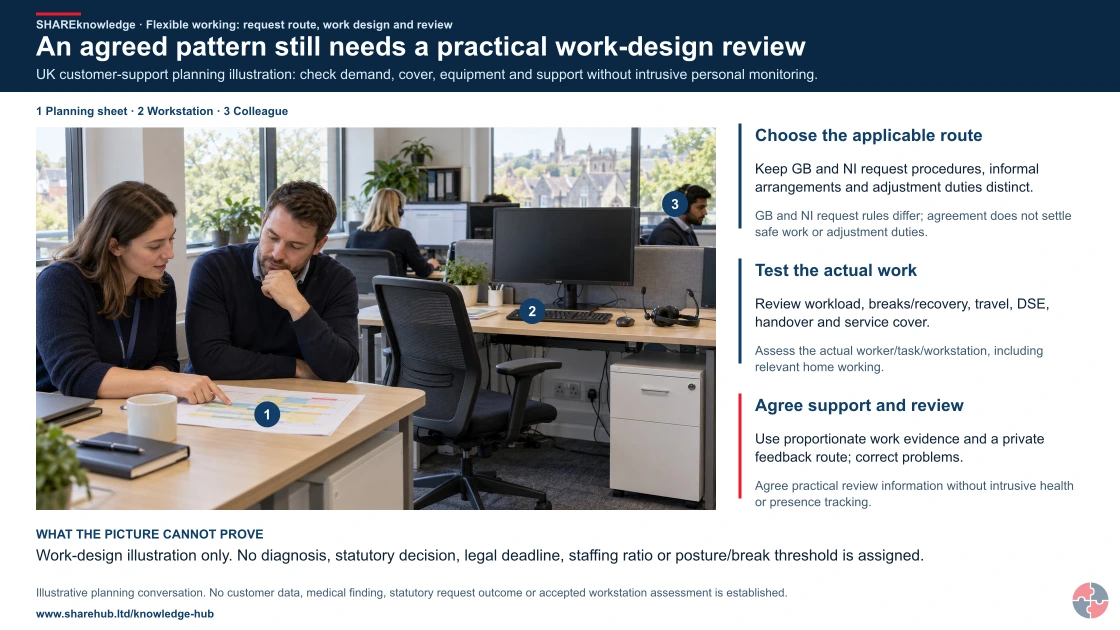
An agreed pattern still needs a practical work-design review
Full written explanation
A new realistic UK customer-support office illustration shows two colleagues reviewing an inert weekly rota, an empty adjustable workstation with separate keyboard/mouse and a headset, and other team members at separate desks. Numbered prompts distinguish the applicable employment request/adjustment route, actual task and cover, and accessible support/private feedback. It does not establish a worker medical condition, approval of a statutory request, legal compliance, sufficient staffing or a completed DSE assessment. An existing hybrid-office meeting-demand illustration is meaningfully retained for the separate home/office context. Picture key: 1 Planning sheet · 2 Workstation · 3 Colleague. The separate process headings are unnumbered.
UK customer-support planning illustration: check demand, cover, equipment and support without intrusive personal monitoring.
- Choose the applicable route. Keep GB and NI request procedures, informal arrangements and adjustment duties distinct.
- Test the actual work. Review workload, breaks/recovery, travel, DSE, handover and service cover.
- Agree support and review. Use proportionate work evidence and a private feedback route; correct problems.
Change the pathway
- An entitlement is not an outcome. GB and NI request rules differ; agreement does not settle safe work or adjustment duties.
- A spare chair is not DSE acceptance. Assess the actual worker/task/workstation, including relevant home working.
- Feedback is not surveillance. Agree practical review information without intrusive health or presence tracking.
Evidence check: Work-design illustration only. No diagnosis, statutory decision, legal deadline, staffing ratio or posture/break threshold is assigned.
Keep GB and NI request routes distinct and test the actual work arrangement
Primary references: GOV.UK flexible working overview: GB request route · nidirect flexible working: separate NI route · HSE participatory work-design review · HSE home-working DSE
Open the complete HD image (new tab)Download image

Keep GB and NI request routes distinct and test the actual work arrangement
Primary references: GOV.UK flexible working overview: GB request route · nidirect flexible working: separate NI route · HSE participatory work-design review · HSE home-working DSE
After agreement, test the work rather than assuming approval establishes wellbeing. A compressed-hours trial should consider actual workload, breaks, recovery, cover and travel; a home-work trial also needs suitable DSE and access to support. Agree review evidence and a private feedback route, then correct work demands or discuss alternatives if the trial exposes a problem. Do not turn the review into intrusive health or presence surveillance.
Riverside: an approved pattern still needs a safe-work trial
Illustrative example. An employee agrees compressed hours, but the longer days create missed breaks and a difficult final journey.
Decision. HR confirms the applicable request route while the manager and worker trial the pattern with realistic workload and recovery controls.
Evidence to check. The agreed arrangement, actual hours and breaks, cover, DSE where relevant and voluntary functional feedback.
Hold or escalation point. Do not assume request approval authorises an unsafe duty or use a quota decision to dismiss a separate adjustment issue.
Follow-up. Review the trial with the worker and agree changes or alternatives based on the observed work effects.
Keep the request route separate from the work-risk trial
An employment request, disability adjustment and current work-risk concern can need separate decisions. A trial should test actual demand and recovery, not just a new label for hours.

Clarify the route
Identify the applicable GB or NI request process and any separate adjustment or immediate risk-control need.
Consult on the work
Review workload, predictability, cover, handover and recovery with the worker and affected colleagues.
Trial an agreed arrangement
Name the owner, necessary resources, operational limits and evidence for review. A compressed pattern is not automatically a lower-risk substitution.
Check the outcome
Review actual workload and burden moved to others. A request decision does not close an unresolved hazard or adjustment duty.
Read the complete task-specific control examples
ERICPD is a planning cross-map: Discipline verifies and sustains every control. ESEAP compares effectiveness. A label does not authorise the task; retain the owner, evidence and stop or change decision.
Introducing compressed working hours · ERICPD
- Eliminate
- Remove unnecessary meetings, reporting and duplicated work before fitting the workload into longer days.
- Reduce
- Trial a suitable alternative pattern or staffing arrangement where compressed days would create excessive fatigue.
- Isolate
- Keep fatigue-sensitive activities away from periods when safe staffing or recovery cannot be maintained.
- Control
- Provide suitable workstations, equipment and safe workplace conditions throughout the extended working day.
- PPE
- No PPE makes excessive working hours safe; reduce the demand and control the underlying task risks.
- Discipline
- Review fatigue, errors and worker feedback after the trial; change the arrangement when breaks or recovery are not achievable.
Introducing compressed working hours · ESEAP
- Elimination
- Remove unnecessary meetings, reporting and duplicated work before fitting the workload into longer days.
- Substitution
- No separate approved substitution is specified; assess a genuinely safer material or process before relying on lower controls.
- Engineering controls
- Provide suitable workstations, equipment and safe workplace conditions throughout the extended working day.
- Administrative controls
- Trial a suitable alternative pattern or staffing arrangement where compressed days would create excessive fatigue.
- PPE
- No PPE makes excessive working hours safe; reduce the demand and control the underlying task risks.
Setting up a hybrid workstation · ERICPD
- Eliminate
- Remove duplicate screen entry and unnecessary prolonged desk tasks from the workflow.
- Reduce
- Replace laptop-only work with a suitable separate display and input arrangement after trying it with the user.
- Isolate
- Provide a usable work area separated from storage and trip hazards so the worker can change posture safely.
- Control
- Adjust chair, screen, keyboard and desk to the user and task; provide a suitable docking arrangement at both regular locations.
- PPE
- No PPE prevents posture-related back pain; suitable seating and task design belong to workplace controls.
- Discipline
- Check adjustments after location, equipment or workload changes and confirm that the agreed breaks remain possible.
Setting up a hybrid workstation · ESEAP
- Elimination
- Remove duplicate screen entry and unnecessary prolonged desk tasks from the workflow.
- Substitution
- No separate approved substitution is specified; assess a genuinely safer material or process before relying on lower controls.
- Engineering controls
- Replace laptop-only work with a suitable separate display and input arrangement after trying it with the user.
- Administrative controls
- Plan changes of activity and manageable meeting blocks; agree a route for reporting symptoms and reviewing adjustments.
- PPE
- No PPE prevents posture-related back pain; suitable seating and task design belong to workplace controls.
What are the key points for flexible working and wellbeing?
Flexible working can support wellbeing when workload, equipment, inclusion and boundaries are assessed and reviewed. Statutory request rules differ: Great Britain has a day-one right and up to two requests in 12 months; Northern Ireland retains a 26-week qualifying period and normally one statutory request in 12 months.
Flexibility is not only home working
It can include start and finish times, compressed hours, part-time work, job sharing, annualised hours, staggered hours, remote work and hybrid patterns.
Wellbeing gains come from good design
Autonomy, recovery, lower commute pressure and better caring fit can help wellbeing when workload and boundaries are realistic.
Poor design creates new risks
Isolation, poor workstation set-up, excessive availability, unclear expectations, monitoring pressure and unfair access can worsen stress and musculoskeletal discomfort.
The statutory request process matters
In Great Britain, employees can request statutory flexible working from day one; in Northern Ireland the statutory route normally requires 26 weeks. Use the applicable consultation and decision process.
Confidentiality and fairness matter
Health, caring, disability, pregnancy or domestic circumstances should be handled respectfully and shared only where needed.
Review is essential
Flexible arrangements should be checked after implementation because work demand, team impact, wellbeing and customer needs can change.
Check GOV.UK GB flexible working and NI flexible working and work-life balance before advising on a request.
What boundary should readers understand before using this page?
This is general workplace wellbeing guidance, not medical, legal or HR advice for an individual case.
Flexible working can involve employment rights, health information, disability, pregnancy, caring responsibilities, performance, monitoring and contractual change. Those areas should be handled with proper HR, legal, occupational health or data protection input where the case is complex or disputed.
Managers should not diagnose health conditions or ask for unnecessary medical detail. If someone may be unwell, in crisis, unsafe to work, experiencing discrimination, or unable to continue duties safely, the response should move from general information to the organisation's competent support routes.
| Situation | What this page can support | When to escalate |
|---|---|---|
| General flexible working interest | Explain options, wellbeing considerations and how requests are handled. | Escalate to HR if a statutory request or contract change is involved. |
| Health-related request | Explain functional impact, confidentiality and workplace support principles. | Escalate to occupational health, HR or medical advice where restrictions are unclear. |
| Disability-related barriers | Explain reasonable-adjustment thinking and fair review. | Escalate to HR/legal advice if refusal, discrimination risk or complex adjustment issues arise. |
| Remote monitoring | Explain transparency, proportionality and data protection principles. | Escalate to data protection lead/DPO before high-risk monitoring. |
| Mental health concern | Support a private, non-judgemental conversation and signposting. | Escalate immediately through competent routes if there is risk of harm or crisis. |
| Performance concern | Check whether workload, health, equipment, communication or clarity is contributing. | Escalate through fair HR process if formal action is being considered. |
What does flexible working and wellbeing mean?
Flexible working and wellbeing describes the relationship between work pattern, work location, work demands, autonomy, recovery and health.
The source material frames this well: flexible, hybrid, remote and work-life wellbeing topics concern the fit between work demands and the rest of life. They affect autonomy, recovery, caring, inclusion, isolation and boundaries. That means flexible working is not just an employment form; it is a work-design issue.
Good flexibility helps people work well without burning through recovery time, worsening symptoms or excluding those with caring or health needs. Poor flexibility shifts risk into the home, hides overwork, reduces support, makes some workers feel left behind and creates unclear expectations about availability.
| Concept | Meaning | Wellbeing question |
|---|---|---|
| Autonomy | The person has some control over when, where or how work is done. | Does the arrangement give real control or just move pressure elsewhere? |
| Recovery | The person has time away from work demand to rest and restore. | Are breaks, finish times and non-work time protected? |
| Inclusion | People can participate without avoidable barriers. | Does flexibility help people with caring, disability, health, travel or life constraints? |
| Boundaries | There are limits around availability and communication. | Are messages, meetings and expectations contained within reasonable working patterns? |
| Connection | The person remains part of the team and information flow. | Are remote or part-time workers included in decisions and development? |
| Workload fit | Work demand matches time, resources and role. | Has the work been redesigned, or has the same workload simply been squeezed into fewer hours? |
What types of flexible working may be considered?
Flexible working can change hours, timing, location, work pattern or how work is shared.
Different forms of flexibility solve different problems and create different risks. Home working may reduce commuting but increase isolation or DSE risk. Compressed hours may support life balance but increase fatigue if long days are poorly managed. Part-time work can support caring or recovery but may fail if workload is not genuinely reduced.
The best arrangement is not the most fashionable one. It is the one that fits the role, the person, the team, the customer, the risk profile and the organisation's ability to manage it fairly.
| Type | What it means | Wellbeing and management considerations |
|---|---|---|
| Flexitime | Variable start and finish times around agreed core hours. | Supports commuting, caring and energy patterns; needs meeting discipline. |
| Hybrid working | Work split between workplace and remote locations. | Needs clarity on attendance, communication, DSE, inclusion and supervision. |
| Home working | Work carried out from home for some or all of the time. | Needs DSE, boundaries, privacy, equipment, data security and connection controls. |
| Compressed hours | Full-time hours worked over fewer longer days. | Can support life balance but may increase fatigue and long-day risk. |
| Part-time work | Reduced working hours. | Workload, objectives and communication must be reduced or redesigned. |
| Job sharing | Two or more people share one full-time role. | Needs clear handover, accountability and decision ownership. |
| Staggered hours | Different start, finish or break times. | Supports travel, coverage and welfare; needs fairness and coordination. |
| Annualised hours | Hours are averaged across the year. | Useful for seasonal demand; requires fatigue, notice and predictability controls. |
How can flexible working affect wellbeing?
Flexible working can improve or harm wellbeing depending on workload, control, support, boundaries, equipment, inclusion and fairness.
The wellbeing effect is not automatic. A person may benefit from a shorter commute, better sleep, easier caring, more autonomy, possible reduction in sensory demands or better symptom management. Another person may become isolated, work longer hours, lose informal support, struggle with a poor workstation, feel watched by monitoring software or miss development opportunities.
Workplaces should look for the functional impact. The same arrangement can support one person and harm another. Review conversations should ask what is working, what is harder, what needs changing, and whether the arrangement is affecting the team or service.
| Area | Potential benefit | Potential risk |
|---|---|---|
| Commute | Less travel time, cost and stress. | Less movement, reduced separation between work and home. |
| Autonomy | Greater control over work pattern and energy. | Unclear expectations if managers do not define outcomes. |
| Caring and life fit | Better ability to manage caring, school, appointments or treatment. | Risk of hidden unpaid labour or constant interruptions. |
| Mental wellbeing | More recovery, lower stress and improved confidence. | Isolation, anxiety, overwork and reduced support. |
| Physical wellbeing | Better pacing and personalised set-up. | Poor DSE, sedentary time, pain or unsuitable home environment. |
| Inclusion | Can help disabled workers, carers, neurodivergent workers or people with health needs. | Can create resentment if access is inconsistent or poorly explained. |
| Team performance | Better retention and wider talent pool. | Communication gaps and handover failures if poorly designed. |
How does flexible working connect to work-related stress?
Flexible working affects several HSE Management Standards, especially demands, control, support, relationships, role and change.
Flexible working can reduce stress where it improves control, reduces unnecessary travel, supports recovery and allows work to be organised more realistically. It can increase stress where demands remain excessive, support becomes weaker, the role becomes unclear, team relationships deteriorate or change is introduced without consultation.
This is why flexible working should be integrated into stress risk assessment rather than treated as a perk. The arrangement should be assessed through the lens of demands, control, support, relationships, role and change.
| Standard | How flexibility can help | How it can fail |
|---|---|---|
| Demands | Travel reduction and better pacing may reduce pressure. | Same workload compressed into fewer hours increases pressure. |
| Control | Choice over timing/location can increase autonomy. | Rigid digital surveillance can reduce perceived control. |
| Support | Structured check-ins maintain guidance and connection. | Remote workers may become invisible or isolated. |
| Relationships | Clear communication reduces conflict. | Unfair access can create resentment. |
| Role | Outcome clarity helps people know what is expected. | Unclear availability and handover rules create confusion. |
| Change | Trials and review make change manageable. | Abrupt policy changes damage trust. |
Relevant official context: HSE Management Standards; check the actual worker and jurisdiction.
How should statutory flexible working requests be handled?
Identify whether the worker is in Great Britain or Northern Ireland before giving eligibility, request-frequency or deadline advice. Use a fair, documented discussion and consider work-design and adjustment duties separately from the statutory request.
In Great Britain, the 6 April 2024 reforms allow a request from day one, up to two statutory requests in 12 months, consultation before refusal and normally a two-month decision period including appeal unless extended. In Northern Ireland, official guidance still gives 26 weeks of continuous employment, normally one statutory request in 12 months and a distinct procedure that can take up to 14 weeks. A disability-related adjustment request is a separate route and must not be dismissed solely because the flexible-working request quota is used.
A good process is more than compliance. It explores the request, checks alternatives, considers business impact, avoids assumptions, records reasons, protects confidentiality and reviews the arrangement once implemented.
| Step | What should happen | Evidence |
|---|---|---|
| Receive request | Confirm whether it is statutory and whether required information is included. | Request record and acknowledgement. |
| Clarify need and proposal | Discuss what change is requested, start date, pattern and practical impact. | Meeting notes and agreed understanding. |
| Assess work impact | Consider service, staffing, performance, cost, quality, health and safety, customers and team effects. | Assessment record. |
| Consult before refusal | Discuss concerns and possible alternatives unless accepting in full. | Consultation notes. |
| Consider alternatives | Trial period, different days, hybrid pattern, phased change or temporary adjustment. | Options record. |
| Decide and communicate | Give clear decision, contract impact, reasons and appeal route where relevant. | Decision letter or email. |
| Implement and review | Set review date, equipment, DSE, workload and communication arrangements. | Action plan and review record. |
How should fairness and consistency be managed?
Fairness means using a transparent process while still considering individual circumstances and role differences.
Fairness does not mean every role can use the same flexible pattern. A lifeguard, maintenance engineer, receptionist, call handler, finance administrator and senior manager may have different operational constraints. Fairness means the decision route is clear, evidence-based, non-discriminatory and not based on favouritism or assumptions.
Managers should be careful with informal flexibility. If informal arrangements are granted only to favoured staff, resentment and discrimination risk follow. If all flexibility is banned because some roles are site-based, the organisation may miss reasonable alternatives such as shift swaps, staggered starts, predictable rosters, compressed hours or occasional admin time from home.
| Risk | What can go wrong | Control |
|---|---|---|
| Role inequality | Site-based workers feel flexibility is only for office staff. | Explain constraints and explore role-specific options. |
| Manager discretion | Different managers apply different standards. | Central policy, decision template and HR review. |
| Hidden health needs | Health or disability barriers are missed. | Private conversation and adjustment route. |
| Gender or caring bias | Requests from parents/carers are stereotyped or treated inconsistently. | Objective criteria and equality-aware review. |
| Remote promotion gap | Remote or part-time workers miss opportunities. | Inclusive meetings, development tracking and outcome review. |
| Unclear trials | Temporary arrangements drift without review. | Trial terms, measures and review date. |
What should be managed in home and hybrid working?
Home and hybrid working need clear expectations around equipment, DSE, communication, information security, workload, contact and emergency arrangements.
Home working changes the risk environment. The employer may not control the home, but it still needs proportionate arrangements for DSE, workload, stress, communication, equipment, privacy, incident reporting and support. Hybrid working adds coordination issues: when people attend, how decisions are made, how new starters learn, how team connection is maintained and how customer service is protected.
For longer-term home working, a written agreement should set out work pattern, equipment, expenses where relevant, DSE expectations, data security, working time, contact arrangements, review date and what happens if the arrangement stops working.
| Control area | What good looks like | Evidence |
|---|---|---|
| Work pattern | Clear days, hours, availability and expectations. | Hybrid agreement or team charter. |
| DSE and workstation | Assessment, suitable equipment and review if discomfort appears. | DSE assessment and action record. |
| Communication | Meeting norms, response expectations and channels are defined. | Team communication protocol. |
| Information security | Secure devices, privacy, confidential calls and data handling. | IT/security briefing. |
| Workload | Outcomes and workload match contracted hours and arrangement. | Work plan and review conversation. |
| Inclusion | Remote staff included in meetings, learning and social connection. | Meeting design and development review. |
| Emergency and support | Workers know how to report incidents, wellbeing concerns or equipment issues. | Reporting route and contact list. |
Relevant official context: HSE DSE at home; check the actual worker and jurisdiction.HSENI display screen equipment; check the actual worker and jurisdiction.
Assess the actual daily continuous-use pattern, both work locations and needed equipment. Plan suitable breaks or activity changes; there is no fixed statutory break interval. Ordinary workstation aids are equipment controls, not PPE.
How should DSE and workstation wellbeing be handled?
Assess screen work in home, hybrid and office settings using the applicable GB DSE 1992 or NI DSE 1992 regime. Plan equipment, posture, breaks or changes of activity and follow-up for the actual pattern of use.
Flexible working often increases screen time and sedentary work. Poor workstation set-up can contribute to neck, shoulder, back, wrist, eye strain and fatigue symptoms. DSE controls should cover screen height, chair, keyboard, mouse, lighting, glare, cables, breaks, posture variation and reporting discomfort early.
Check the actual daily duration and pattern of laptop work rather than treating a temporary label as an exemption. If home working becomes routine, employers should consider suitable equipment and a proportionate DSE assessment.
| Issue | What to check | Control |
|---|---|---|
| Screen height | Screen too low or too close. | Separate screen or laptop riser where needed. |
| Input devices | Laptop-only use causing shoulder, wrist or neck strain. | Separate keyboard and mouse. |
| Seating | Poor support or unsuitable chair. | Suitable chair, posture guidance or alternative workspace. |
| Lighting and glare | Eye strain, reflections or poor lighting. | Adjust screen, lighting, blinds and location. |
| Breaks and movement | Long static sessions and meeting overload. | Microbreaks, walking calls and meeting design. |
| Discomfort reporting | Pain ignored until absence or chronic symptoms. | Early reporting and review process. |
| Shared workstations | Hybrid desk users lack set-up consistency. | Hot-desk DSE guidance and adjustable equipment. |
Read HSE DSE at home for GB and HSENI display screen equipment for NI.
Assess the actual daily continuous-use pattern, both work locations and needed equipment. Plan suitable breaks or activity changes; there is no fixed statutory break interval. Ordinary workstation aids are equipment controls, not PPE.
How should boundaries and communication be set?
Boundaries protect recovery by making availability, meetings, messages and response expectations explicit.
Flexible working fails when it quietly becomes always-on working. People may start earlier, finish later, respond to messages during family time, work through breaks or feel guilty for being offline. Managers set the tone: what they send, when they send it, what they reward and what they question.
Good teams agree norms: core hours, response times, meeting-free blocks, handover methods, urgent channels, no-meeting lunch windows, camera expectations, out-of-hours rules and how to protect focus time.
| Control | Why it matters | Example |
|---|---|---|
| Core hours | Protects collaboration without requiring constant availability. | 10:00 to 15:00 shared availability. |
| Response standards | Reduces anxiety about instant replies. | Same-day for normal messages, phone for urgent issues. |
| Meeting design | Prevents overload and exclusion. | Agenda, clear purpose, inclusive timing and shorter defaults. |
| Out-of-hours norms | Protects recovery and sleep. | Delay-send emails and no routine evening messaging. |
| Handover | Supports part-time, job share and compressed-hour patterns. | Decision log or handover template. |
| Focus time | Protects deep work and mental load. | No-meeting blocks and notification controls. |
| Escalation route | Clarifies what is genuinely urgent. | Emergency contact channel separate from routine chat. |
How can flexible working support inclusion?
Flexible working may remove barriers, but disability-related adjustments need separate consideration. The Equality Act 2010 is the Great Britain route; Northern Ireland has a separate disability-law and Equality Commission guidance route.
The strongest wellbeing value often comes from inclusion. A flexible start time may help someone manage medication, school drop-off, symptoms, fatigue or accessible travel. Hybrid working may reduce sensory overload or commuting pain. Predictable rosters may support carers and financial planning.
However, flexibility must not become a hidden career penalty. Remote, part-time or adjusted workers should still have access to information, development, progression, consultation and team identity.
| Group or need | Possible support | Safeguard |
|---|---|---|
| Carers | Predictable hours, compressed hours, remote admin time or adjusted starts. | Avoid assumptions that caring reduces commitment. |
| Disabled workers | Home working, adjusted hours, equipment, reduced travel or phased changes. | Consider reasonable adjustments and functional impact. |
| Neurodivergent workers | Quiet work blocks, clearer communication, predictable routines or reduced sensory load. | Agree individual preferences and avoid stereotypes. |
| Long-term health conditions | Pacing, appointments, temporary flexibility or recovery time. | Use occupational health where restrictions are unclear. |
| Pregnancy or menopause | Temperature, fatigue, appointments, travel and comfort adjustments. | Handle confidentially and review as needs change. |
| Lower-paid/site-based roles | Shift swaps, rota predictability, staggered starts or admin flexibility. | Explore practical options, not only office-based flexibility. |
| New starters | Structured induction and contact pattern. | Avoid isolation and informal knowledge gaps. |
How should monitoring and privacy be handled?
Monitoring remote workers requires a defined lawful purpose, transparency, proportionality and care with health data. Judge work outcomes and hazards without collecting unnecessary private home or medical information.
Government workplace-monitoring guidance applies to flexible and home working, where monitoring can affect private life. Monitoring may include productivity tools, device logs, keystroke activity, webcams, location tracking, call recording, email review or wellbeing analytics. Some monitoring can be justified, but excessive monitoring can undermine trust and mental wellbeing.
Before monitoring is introduced, the organisation should define the purpose, lawful basis, necessity, proportionality, data minimisation, access, retention, worker information and whether a data protection impact assessment is needed.
| Issue | Risk | Control |
|---|---|---|
| Productivity monitoring | Workers feel surveilled rather than supported. | Explain purpose, limit scope and use outcomes not minute-by-minute tracking. Detailed legal implementation held for current evidence and specialist review. |
| Home environment capture | Private household information may be captured. | Avoid intrusive video/audio monitoring and assess privacy impact. Detailed legal implementation held for current evidence and specialist review. |
| Location tracking | Can reveal private routines outside work. | Use only where necessary and disable outside work purposes. Detailed legal implementation held for current evidence and specialist review. |
| Health/wellbeing data | Special category data may be mishandled. | Use clear lawful basis, necessity and strict access control. Detailed legal implementation held for current evidence and specialist review. |
| Automated decisions | Unfair decisions from incomplete or biased data. | Human review, transparency and challenge route. Detailed legal implementation held for current evidence and specialist review. |
| DPIA | High-risk monitoring introduced without risk assessment. | Complete and record a data protection impact assessment where needed. Detailed legal implementation held for current evidence and specialist review. |
| Communication | Workers do not understand what is collected. | Provide privacy information before monitoring begins. Detailed legal implementation held for current evidence and specialist review. |
UK government workplace monitoring basics support justified monitoring, worker information and a policy. Detailed lawful-basis, special-category, DPIA, retention and automated-decision implementation need current specialist evidence and approval.
The detailed DPIA, lawful-basis, special-category health information, automated decision, access and retention rows are review prompts. The government monitoring page supports basic justification and information; it does not approve those legal designs.
How should managers hold wellbeing conversations?
Managers should ask about work barriers, support and review, not diagnose the person or collect unnecessary clinical detail.
A good conversation is private, calm and practical. The manager should ask what is working, what is harder, whether work is affecting health or recovery, what support might help, what should remain confidential, what can be shared with others, and when the arrangement should be reviewed.
Managers should also be honest about operational needs. Supportive management does not mean saying yes to every request; it means exploring options properly, explaining constraints, considering alternatives and avoiding assumptions.
| Step | Helpful wording | Avoid |
|---|---|---|
| Open | How are you finding the current work pattern? | Starting with judgement or performance criticism. |
| Explore barriers | What is work making harder at the moment? | Asking for diagnosis or private medical detail. |
| Consider support | What changes would help you work safely and sustainably? | Promising changes before checking feasibility. |
| Clarify confidentiality | What are you comfortable with me sharing and with whom? | Discussing health details with the wider team. |
| Agree actions | Let's record the work changes, owner and review date. | Leaving support informal and untracked. |
| Review | Has this helped, and has anything changed? | Assuming one conversation fixes the issue. |
What should managers do and avoid?
Managers should make flexible working practical, fair and reviewable without turning the conversation into diagnosis, surveillance or favouritism.
The manager's role is to understand the work impact, explain operational constraints, explore workable options and agree reviewable actions. A good manager does not need to know every private detail of a person's home life, medical history or caring arrangement. They need enough information to make a fair work decision and provide support.
This section is useful for manager training because it turns the topic into behaviour: what to ask, what to record, what to protect, and what to avoid.
| Manager should | Manager should not | Why it matters |
|---|---|---|
| Ask what work barriers the person is experiencing. | Ask for unnecessary diagnosis or private family detail. | Support should focus on functional work impact. |
| Consult before refusing a statutory request unless accepting it in full. | Reject quickly because the current rota or habit is easier. | The process needs to be reasonable and evidence-based. GB current statutory applying guidance: up to two requests in12 months, written required details, discussion before refusal and decision within two months unless agreed longer. Northern Ireland statutory route: normally26 weeks continuous employment and one request in12 months; distinct request information/procedure can take up to14 weeks. Informal arrangements and applicable disability adjustments are separate. GB consultation before refusal is a GB procedural rule; NI uses its own procedure. GB applying for flexible working; GB flexible working decisions; NI flexible working and work-life balance |
| Consider alternatives such as trials, different hours or partial flexibility. | Treat the first proposal as the only possible option. | Alternatives can solve both wellbeing and business concerns. |
| Record agreed arrangements, owners and review dates. | Leave flexible working as an informal favour. | Informal arrangements create inconsistency and resentment. |
| Protect confidentiality and share only what others need to implement. | Tell the wider team about health or caring details. | Trust and data protection depend on narrow sharing. |
| Review workload and boundaries after implementation. | Assume flexibility automatically improves wellbeing. | Poorly designed flexibility can create stress, fatigue or isolation. |
| Use monitoring transparently and proportionately. | Use surveillance to replace trust or management skill. | Excessive monitoring can damage wellbeing and privacy. |
What examples show good and poor flexible working decisions?
Examples help managers see the difference between supportive flexibility and arrangements that quietly create new risk.
The strongest decisions consider the individual, role, team, customer, health and safety, equality and data protection factors together. A poor decision often looks efficient at first but creates fatigue, exclusion, unfairness, privacy risk or unmanaged workload.
Use examples like these in manager training, HR calibration and wellbeing campaigns so people learn how to apply the principles in real life.
| Scenario | Poor decision | Better decision |
|---|---|---|
| Compressed hours request | Approve four very long days without reviewing fatigue, breaks, travel or customer peaks. | Trial compressed hours with workload review, break protection, fatigue check and review date. |
| Hybrid work increasing isolation | Assume the worker is fine because output is still acceptable. | Agree structured check-ins, team connection, inclusion in meetings and wellbeing review. |
| Remote monitoring proposal | Install intrusive monitoring to check whether people are 'really working'. | Define the problem, assess proportionality, consult, complete DPIA if needed and measure outcomes fairly. UK government workplace monitoring basics support justified monitoring, worker information and a policy. Detailed lawful-basis, special-category, DPIA, retention and automated-decision implementation need current specialist evidence and approval. Detailed DPIA/legal design held. GOV.UK workplace monitoring |
| Menopause-related flexibility | Ask for private symptom detail and treat support as special treatment. | Discuss functional barriers, confidentiality, temperature, breaks, start times and review. |
| Long-term condition | Refuse home working because the team normally attends site five days a week. | Explore reasonable adjustments, partial remote work, phased arrangement or alternative controls. Equality Act2010 employment/adjustment context is Great Britain; do not apply it as NI employment law. NI government employment guidance identifies the Disability Discrimination Act1995 reasonable-adjustment route for actual known disability/disadvantage. This is distinct from GB Equality Act and statutory request quota. GB Equality Act2010; NI disability employment rights |
| Caring responsibilities | Treat caring as a personal problem outside work. | Consider predictable hours, staggered starts, compressed pattern, temporary arrangement or job design. |
| Part-time arrangement | Keep the full-time workload and expect catch-up on non-working days. | Redesign objectives, handovers, decision ownership and communication expectations. |
How should flexible working be risk assessed?
Risk assessment should focus on work design, not intrusive personal questioning.
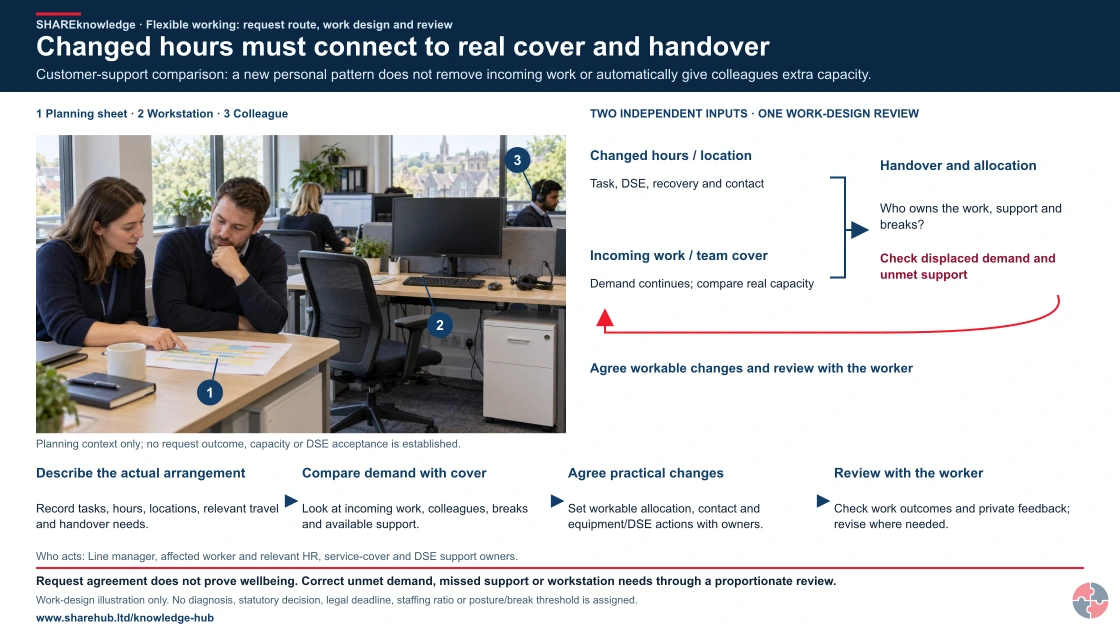
Changed hours must connect to real cover and handover
Full written explanation
An illustrative customer-support workplace shows two colleagues looking at an inert planning sheet, an empty workstation with keyboard, mouse and headset, and another colleague at a separate desk. Picture key: 1 Planning sheet · 2 Workstation · 3 Colleague. The scene does not establish changed hours, incoming workload, staffing capacity, health, an approved request or a completed DSE assessment. Beside it, two independent inputs join handover and allocation: changed hours or location with task, DSE, recovery and contact; and incoming work or team cover with continuing demand and actual capacity. The review asks who owns the work, support and breaks, and checks displaced demand and unmet support. A compact feedback connection links agreed workable changes and review with the worker back to the actual arrangement. Four unnumbered checks describe the arrangement, compare demand with cover, agree practical changes and review with the worker. Statutory requests, informal arrangements and adjustment duties remain separate from this work-design review. No diagnosis, legal outcome, staffing ratio, posture or break threshold, monitoring result or permission is supplied.
Customer-support comparison: a new personal pattern does not remove incoming work or automatically give colleagues extra capacity.
- Describe the actual arrangement. Record tasks, hours, locations, relevant travel and handover needs.
- Compare demand with cover. Look at incoming work, colleagues, breaks and available support.
- Agree practical changes. Set workable allocation, contact and equipment/DSE actions with owners.
- Review with the worker. Check work outcomes and private feedback; revise where needed.
When the evidence does not fit: Request agreement does not prove wellbeing. Correct unmet demand, missed support or workstation needs through a proportionate review.
Who acts: Line manager, affected worker and relevant HR, service-cover and DSE support owners.
Changed workplace
Hybrid professional work: Review meeting demand, home/office DSE and accessible support.
Customer-support pattern: Connect actual demand to cover, handover and colleagues’ workload.
Evidence check: Work-design illustration only. No diagnosis, statutory decision, legal deadline, staffing ratio or posture/break threshold is assigned.
Keep GB and NI request routes distinct and test the actual work arrangement
Primary references: GOV.UK flexible working overview: GB request route · nidirect flexible working: separate NI route · HSE participatory work-design review · HSE home-working DSE
Open the complete HD image (new tab)Download image

Keep GB and NI request routes distinct and test the actual work arrangement
Primary references: GOV.UK flexible working overview: GB request route · nidirect flexible working: separate NI route · HSE participatory work-design review · HSE home-working DSE
Flexible working risk assessment asks how the arrangement affects work demands, control, support, relationships, role, change, DSE, fatigue, lone working, travel, safety-critical tasks, supervision, data security, emergency response and inclusion. The assessment should be proportionate to the role and risk.
For many office-based roles, a simple flexible working assessment and DSE check may be enough. For safety-critical, lone, field, driving, public-facing or high-stress roles, a more detailed assessment may be needed.
| Question | Why it matters | Evidence |
|---|---|---|
| What work is being done? | Different tasks carry different controls. | Role/task summary. |
| Where will work happen? | Home, site, office and public spaces have different risks. | Work location record. |
| When will work happen? | Long days, night work and split shifts affect fatigue. | Working pattern and review. |
| How will support work? | Remote workers still need supervision and help. | Check-in plan. |
| What equipment is needed? | Poor equipment can create DSE and performance issues. | Equipment and DSE record. |
| How will communication work? | Teams need clarity on meetings, decisions and handover. | Communication protocol. |
| What could go wrong? | Identifies stress, isolation, security, safety-critical or customer issues. | Risk assessment and action plan. |
| When will it be reviewed? | Arrangements can drift or stop working. | Review date and owner. |
Relevant official context: HSE Management Standards; check the actual worker and jurisdiction.HSE DSE at home; check the actual worker and jurisdiction.
Which flexible-working and wellbeing duties apply in GB and NI?
Statutory request, equality and screen-work rules differ between Great Britain and Northern Ireland. Privacy duties and good work-design principles must be applied to the actual worker and task.
GB Equality Act 2010 and NI disability/equality law have different routes. For home work, assess DSE and stress in the relevant GB or NI health-and-safety system and handle health information under current data-protection rules.
GB flexible-working reforms from April 2024 permit day-one requests, two in 12 months and normally a two-month decision period. NI guidance retains a 26-week qualification, normally one request in 12 months and a distinct process up to 14 weeks. Both jurisdictions can consider informal requests and disability adjustments outside the ordinary request quota.
| Jurisdiction | Duty or framework | Where it is relevant | Practical implication |
|---|---|---|---|
| GB | Employment Relations (Flexible Working) Act 2023 | GB statutory request amendments. | Use GB eligibility, consultation and request-frequency rules. |
| NI | NI flexible working and work-life balance | NI 26-week and one-per-12-month route. | Use NI eligibility and request history. |
| GB | GB Equality Act2010 | GB discrimination and adjustment framework. | Assess GB disability and fair-treatment duties. |
| NI | NI disability employment rights | Separate NI disability and reasonable-adjustment route. | Assess NI barriers and adjustments. |
| GB | Health and Safety at Work etc. Act 1974 | GB work-health duties. | Assess work demands and locations. |
| NI | Health and Safety at Work (NI) Order 1978 | NI work-health duties. | Assess NI work demands and locations. |
| GB | GB Display Screen Equipment Regulations 1992 | GB screen-work duties. | Home/office DSE assessment and action. |
| NI | NI Display Screen Equipment Regulations 1992 | Separate NI screen-work duties. | NI home/office DSE assessment and action. |
For statutory requests compare GOV.UK GB flexible working with NI flexible working and work-life balance; for work design use HSE Management Standards and relevant NI guidance.
How can the hierarchy of controls reduce health and wellbeing risks in flexible work?
Apply ERICPD and the five-level hierarchy to work design: first remove unnecessary demand or travel, then reshape schedules and equipment before relying on wellbeing reminders or personal resilience. A flexible arrangement does not excuse an unsafe workload.
Flexible working is not a classic physical hazard, but the hierarchy of control still helps. The strongest controls redesign the work: remove unnecessary meetings, reduce excessive demand, improve role clarity, provide equipment, set boundaries and build inclusive routines before telling individuals to cope better.
Personal resilience, wellbeing apps and training can help, but they should not be used to mask poor workload design, weak management or unrealistic availability expectations.
Choose the activity
How can the ERICPD hierarchy of controls reduce risks while introducing compressed working hours?

| Control level | Control for this activity | Owner and verification | Stop / restart decision |
|---|---|---|---|
| Eliminate | Remove unnecessary meetings, reporting and duplicated work before fitting the workload into longer days. | Process owner verifies that the revised workflow achieves the required output and the hazardous step is genuinely removed. | If the hazardous step remains, retain a task assessment and select the stronger feasible remaining controls. |
| Reduce, including substitution | Trial a suitable alternative pattern or staffing arrangement where compressed days would create excessive fatigue. | Process/technical owner validates the alternative, its compatibility and any new risks before adoption. | Reject the alternative if suitability is unproved or its new hazards are unresolved. |
| Isolate | Keep fatigue-sensitive activities away from periods when safe staffing or recovery cannot be maintained. | Supervisor verifies the task boundaries and that the separation or isolation protects affected people and connected work. | Hold or stop for unmanageable workload, repeated missed breaks or impaired alertness. |
| Control: physical safeguards | Provide suitable workstations, equipment and safe workplace conditions throughout the extended working day. | Competent equipment/process owner checks actual workload, shift length, recovery and safety-critical coverage. | Hold or stop for unmanageable workload, repeated missed breaks or impaired alertness. |
| Control: work method and response | Agree breaks, contact boundaries, overtime limits, handover and review measures; check actual hours rather than contractual hours alone. | Supervisor confirms the limits, response, communication and restart authority with the people doing this activity. | Stop if the agreed method, communication, competent cover or task limits cannot be maintained. |
| PPE | No PPE makes excessive working hours safe; reduce the demand and control the underlying task risks. | Assessor confirms whether PPE is needed and checks selection, condition, compatibility and any required face-fit evidence. | Do not rely on unsuitable or defective protection, or use PPE to continue after an essential source control fails. |
| Discipline | Review fatigue, errors and worker feedback after the trial; change the arrangement when breaks or recovery are not achievable. | Release only after manager and workers agree a workable pattern and review point. Retain the checks and unresolved restrictions at handover. | Keep the activity on hold while defects or required reinstatement evidence remain unresolved. |
How can the ISO 45001 hierarchy of controls reduce risks while introducing compressed working hours?

| Control level | Control for this activity | Owner and verification | Stop / restart decision |
|---|---|---|---|
| Elimination | Remove unnecessary meetings, reporting and duplicated work before fitting the workload into longer days. | Process owner verifies that the revised workflow achieves the required output and the hazardous step is genuinely removed. | If the hazardous step remains, retain a task assessment and select the stronger feasible remaining controls. |
| Administrative controls | Trial a suitable alternative pattern or staffing arrangement where compressed days would create excessive fatigue. | Process/technical owner validates the alternative, its compatibility and any new risks before adoption. | Reject the alternative if suitability is unproved or its new hazards are unresolved. |
| Administrative controls | Keep fatigue-sensitive activities away from periods when safe staffing or recovery cannot be maintained. | Supervisor verifies the task boundaries and that the separation or isolation protects affected people and connected work. | Hold or stop for unmanageable workload, repeated missed breaks or impaired alertness. |
| Engineering controls | Provide suitable workstations, equipment and safe workplace conditions throughout the extended working day. | Competent equipment/process owner checks actual workload, shift length, recovery and safety-critical coverage. | Hold or stop for unmanageable workload, repeated missed breaks or impaired alertness. |
| Administrative controls | Agree breaks, contact boundaries, overtime limits, handover and review measures; check actual hours rather than contractual hours alone. | Supervisor confirms the limits, response, communication and restart authority with the people doing this activity. | Stop if the agreed method, communication, competent cover or task limits cannot be maintained. |
| PPE | No PPE makes excessive working hours safe; reduce the demand and control the underlying task risks. | Assessor confirms whether PPE is needed and checks selection, condition, compatibility and any required face-fit evidence. | Do not rely on unsuitable or defective protection, or use PPE to continue after an essential source control fails. |
| Administrative controls | Review fatigue, errors and worker feedback after the trial; change the arrangement when breaks or recovery are not achievable. | Release only after manager and workers agree a workable pattern and review point. Retain the checks and unresolved restrictions at handover. | Keep the activity on hold while defects or required reinstatement evidence remain unresolved. |
How can the ERICPD hierarchy of controls reduce back strain during hybrid screen work?

| Control level | Control for this activity | Owner and verification | Stop / restart decision |
|---|---|---|---|
| Eliminate | Remove duplicate screen entry and unnecessary prolonged desk tasks from the workflow. | Process owner verifies that the revised workflow achieves the required output and the hazardous step is genuinely removed. | If the hazardous step remains, retain a task assessment and select the stronger feasible remaining controls. |
| Reduce, including substitution | Replace laptop-only work with a suitable separate display and input arrangement after trying it with the user. | The user trials the actual display, keyboard, pointing device and docking arrangement at both regular locations; the manager checks that adjustments and task changes remain usable. | Reject the alternative if suitability is unproved or its new hazards are unresolved. |
| Isolate | Provide a usable work area separated from storage and trip hazards so the worker can change posture safely. | Supervisor verifies the task boundaries and that the separation or isolation protects affected people and connected work. | Hold or stop for worsening symptoms, unusable equipment or work patterns that prevent agreed adjustments. |
| Control: physical safeguards | Adjust chair, screen, keyboard and desk to the user and task; provide a suitable docking arrangement at both regular locations. | Competent equipment/process owner checks both workstation assessments, equipment adjustment and realistic activity changes. | Hold or stop for worsening symptoms, unusable equipment or work patterns that prevent agreed adjustments. |
| Control: work method and response | Plan changes of activity and manageable meeting blocks; agree a route for reporting symptoms and reviewing adjustments. | Supervisor confirms the limits, response, communication and restart authority with the people doing this activity. | Stop if the agreed method, communication, competent cover or task limits cannot be maintained. |
| PPE | No PPE prevents posture-related back pain; suitable seating and task design belong to workplace controls. | Assessor confirms whether PPE is needed and checks selection, condition, compatibility and any required face-fit evidence. | Do not rely on unsuitable or defective protection, or use PPE to continue after an essential source control fails. |
| Discipline | Check adjustments after location, equipment or workload changes and confirm that the agreed breaks remain possible. | Release only after worker and manager confirm a workable setup and review date. Retain the checks and unresolved restrictions at handover. | Keep the activity on hold while defects or required reinstatement evidence remain unresolved. |
How can the ISO 45001 hierarchy of controls reduce back strain during hybrid screen work?

| Control level | Control for this activity | Owner and verification | Stop / restart decision |
|---|---|---|---|
| Elimination | Remove duplicate screen entry and unnecessary prolonged desk tasks from the workflow. | Process owner verifies that the revised workflow achieves the required output and the hazardous step is genuinely removed. | If the hazardous step remains, retain a task assessment and select the stronger feasible remaining controls. |
| Engineering controls | Replace laptop-only work with a suitable separate display and input arrangement after trying it with the user. | The user trials the actual display, keyboard, pointing device and docking arrangement at both regular locations; the manager checks that adjustments and task changes remain usable. | Reject the alternative if suitability is unproved or its new hazards are unresolved. |
| Engineering controls | Provide a usable work area separated from storage and trip hazards so the worker can change posture safely. | Supervisor verifies the task boundaries and that the separation or isolation protects affected people and connected work. | Hold or stop for worsening symptoms, unusable equipment or work patterns that prevent agreed adjustments. |
| Engineering controls | Adjust chair, screen, keyboard and desk to the user and task; provide a suitable docking arrangement at both regular locations. | Competent equipment/process owner checks both workstation assessments, equipment adjustment and realistic activity changes. | Hold or stop for worsening symptoms, unusable equipment or work patterns that prevent agreed adjustments. |
| Administrative controls | Plan changes of activity and manageable meeting blocks; agree a route for reporting symptoms and reviewing adjustments. | Supervisor confirms the limits, response, communication and restart authority with the people doing this activity. | Stop if the agreed method, communication, competent cover or task limits cannot be maintained. |
| PPE | No PPE prevents posture-related back pain; suitable seating and task design belong to workplace controls. | Assessor confirms whether PPE is needed and checks selection, condition, compatibility and any required face-fit evidence. | Do not rely on unsuitable or defective protection, or use PPE to continue after an essential source control fails. |
| Administrative controls | Check adjustments after location, equipment or workload changes and confirm that the agreed breaks remain possible. | Release only after worker and manager confirm a workable setup and review date. Retain the checks and unresolved restrictions at handover. | Keep the activity on hold while defects or required reinstatement evidence remain unresolved. |
How should the selected controls be checked in practice?
Control the work-design risk before recommending resilience or an app. The legal request decision and the health-and-safety control decision are related but distinct.
Work-design and wellbeing examples require worker consultation and review; potential benefits are not promised clinical outcomes. Statutory requests and disability adjustments have separate GB/NI routes.
A worker requests four long days, but the original workload and safety-critical callouts would remain unchanged.
A hybrid worker reports poor home DSE, long online hours and loss of team support.
What evidence shows flexible working and wellbeing is managed well?
Good evidence shows requests, work design, DSE, stress controls, privacy and review actions are handled consistently and proportionately.
Evidence should not become intrusive. The organisation needs enough information to manage work and demonstrate fair process, but not unnecessary diagnosis, private family detail or excessive monitoring data. Records should focus on the request, decision, agreed working pattern, work-related barriers, controls, equipment, review dates and business reasons.
For wellbeing, trends matter: absence, turnover, workload, engagement, DSE discomfort, stress concerns, informal overtime, meeting overload, requests refused, appeals and inconsistent manager decisions.
| Evidence | What it shows | Privacy consideration |
|---|---|---|
| Request register | Requests received, status, decision date and outcome. | Avoid unnecessary personal detail. GB current statutory applying guidance: up to two requests in12 months, written required details, discussion before refusal and decision within two months unless agreed longer. GB decision period includes appeal unless agreed longer; consultation before refusal and stated statutory business reasons. Applicable contract change and disputed decisions require competent HR/legal review. Northern Ireland statutory route: normally26 weeks continuous employment and one request in12 months; distinct request information/procedure can take up to14 weeks. Informal arrangements and applicable disability adjustments are separate. Equality Act2010 employment/adjustment context is Great Britain; do not apply it as NI employment law. NI government employment guidance identifies the Disability Discrimination Act1995 reasonable-adjustment route for actual known disability/disadvantage. This is distinct from GB Equality Act and statutory request quota. GB applying for flexible working; GB flexible working decisions; NI flexible working and work-life balance; GB Equality Act2010; NI disability employment rights |
| Consultation notes | Employee was consulted before refusal or alternatives were explored. | Record work impact, not private speculation. GB current statutory applying guidance: up to two requests in12 months, written required details, discussion before refusal and decision within two months unless agreed longer. GB decision period includes appeal unless agreed longer; consultation before refusal and stated statutory business reasons. Applicable contract change and disputed decisions require competent HR/legal review. Northern Ireland statutory route: normally26 weeks continuous employment and one request in12 months; distinct request information/procedure can take up to14 weeks. Informal arrangements and applicable disability adjustments are separate. Equality Act2010 employment/adjustment context is Great Britain; do not apply it as NI employment law. NI government employment guidance identifies the Disability Discrimination Act1995 reasonable-adjustment route for actual known disability/disadvantage. This is distinct from GB Equality Act and statutory request quota. GB applying for flexible working; GB flexible working decisions; NI flexible working and work-life balance; GB Equality Act2010; NI disability employment rights |
| Arrangement agreement | Hours, location, communication, equipment and review date. | Share only with people who need to implement it. GB current statutory applying guidance: up to two requests in12 months, written required details, discussion before refusal and decision within two months unless agreed longer. GB decision period includes appeal unless agreed longer; consultation before refusal and stated statutory business reasons. Applicable contract change and disputed decisions require competent HR/legal review. Northern Ireland statutory route: normally26 weeks continuous employment and one request in12 months; distinct request information/procedure can take up to14 weeks. Informal arrangements and applicable disability adjustments are separate. Equality Act2010 employment/adjustment context is Great Britain; do not apply it as NI employment law. NI government employment guidance identifies the Disability Discrimination Act1995 reasonable-adjustment route for actual known disability/disadvantage. This is distinct from GB Equality Act and statutory request quota. GB applying for flexible working; GB flexible working decisions; NI flexible working and work-life balance; GB Equality Act2010; NI disability employment rights |
| DSE assessment | Home/hybrid workstation risks assessed and actions tracked. | Do not collect images unless necessary and explained. |
| Stress risk action plan | Demands, control, support and change issues addressed. | Use aggregate team data where possible. |
| Monitoring DPIA | Privacy risks considered before worker monitoring. | Keep lawful basis, proportionality and consultation evidence. UK government workplace monitoring basics support justified monitoring, worker information and a policy. Detailed lawful-basis, special-category, DPIA, retention and automated-decision implementation need current specialist evidence and approval. Detailed DPIA/legal design held. GOV.UK workplace monitoring |
| Review records | Arrangement is checked for health, performance and team impact. | Keep comments factual and respectful. |
| Manager training record | Managers understand process, wellbeing and confidentiality. | Track completion without personal case details. |
How could Riverside Leisure Ltd manage flexible working and wellbeing?

Riverside Leisure Ltd would manage flexibility differently for site-based leisure teams, seasonal workers, office staff and managers, while using one fair process.
Riverside Leisure Ltd
Riverside Leisure Ltd is a leisure and outdoor activity business used by SHARE to show how health, safety and wellbeing topics apply in a real business context.
Riverside operates leisure centres, outdoor activity sites and seasonal events. Many roles need physical presence: lifeguards, instructors, reception, catering, facilities, maintenance and event supervisors. Other roles, such as finance, marketing, HR and bookings, can sometimes work remotely or use flexible hours. Riverside therefore avoids a blanket promise and instead publishes a clear flexible working framework showing what options may work by role type.
The business uses a request register, decision template and review process. Managers are trained to discuss requests privately, avoid medical assumptions, consider alternatives and document business reasons. HR checks refusals for consistency and equality risk. Where a request is health-related, Riverside may seek occupational health advice focused on functional impact and adjustments, not diagnosis.
For home and hybrid workers, Riverside provides DSE self-assessment, equipment guidance, secure device rules, contact expectations and agreed core hours. Teams use meeting norms to include part-time and remote workers. Managers check workload so compressed hours or part-time arrangements do not simply squeeze the same volume of work into less time.
For site-based workers, Riverside looks for other forms of flexibility: predictable rotas, shift swaps, staggered starts, compressed patterns where safe, admin time from home where possible, annualised-hours planning for seasonal work, and fair access to development. Worker feedback, absence trends, DSE actions, stress concerns, overtime and request outcomes are reviewed quarterly by HR, operations and HSSE so the system keeps improving.
| Management element | How Riverside controls it | Evidence |
|---|---|---|
| Role mapping | Identifies which flexible options may be practical for each role type. | Role flexibility matrix. |
| Request handling | Uses one process, consultation, alternatives and HR review. | Request log and decision template. |
| Home/hybrid controls | DSE, secure devices, contact rules and review dates. | DSE records and hybrid agreements. |
| Site-based fairness | Explores rota predictability, shift swaps and staggered starts. | Rota review and worker feedback. |
| Wellbeing support | Managers use private conversations and refer to OH/EAP where needed. | Support plan and review dates. |
| Privacy | Health and monitoring data shared only where needed. | Privacy notice and access controls. |
| Continuous improvement | Reviews absence, turnover, feedback, DSE issues and request outcomes. | Quarterly wellbeing review and action tracker. |
Who needs competence to manage flexible working?
Test a GB and an NI case, including work design, adjustments and privacy, rather than relying on policy attendance.
| Role | Learning to test | Competence demonstration | Assessor and record | Reassessment trigger |
|---|---|---|---|---|
| Employees | Know GB/NI request route and report work-design barriers. | Explain request or informal support path. | HR records briefing and questions. | Location or role change. GB current statutory applying guidance: up to two requests in12 months, written required details, discussion before refusal and decision within two months unless agreed longer. GB decision period includes appeal unless agreed longer; consultation before refusal and stated statutory business reasons. Applicable contract change and disputed decisions require competent HR/legal review. Northern Ireland statutory route: normally26 weeks continuous employment and one request in12 months; distinct request information/procedure can take up to14 weeks. Informal arrangements and applicable disability adjustments are separate. Equality Act2010 employment/adjustment context is Great Britain; do not apply it as NI employment law. NI government employment guidance identifies the Disability Discrimination Act1995 reasonable-adjustment route for actual known disability/disadvantage. This is distinct from GB Equality Act and statutory request quota. GB applying for flexible working; GB flexible working decisions; NI flexible working and work-life balance; GB Equality Act2010; NI disability employment rights |
| Line managers | Discuss requests fairly and test workload/DSE impact. | Handle a GB and NI case without mixing rules. | HR observes case exercise. | Employment-law or policy change. GB current statutory applying guidance: up to two requests in12 months, written required details, discussion before refusal and decision within two months unless agreed longer. GB decision period includes appeal unless agreed longer; consultation before refusal and stated statutory business reasons. Applicable contract change and disputed decisions require competent HR/legal review. Northern Ireland statutory route: normally26 weeks continuous employment and one request in12 months; distinct request information/procedure can take up to14 weeks. Informal arrangements and applicable disability adjustments are separate. Equality Act2010 employment/adjustment context is Great Britain; do not apply it as NI employment law. NI government employment guidance identifies the Disability Discrimination Act1995 reasonable-adjustment route for actual known disability/disadvantage. This is distinct from GB Equality Act and statutory request quota. GB applying for flexible working; GB flexible working decisions; NI flexible working and work-life balance; GB Equality Act2010; NI disability employment rights |
| HR advisers | Screen statutory, adjustment and contract routes. | Audit a reasoned decision and review plan. | Senior HR signs sample case. | Dispute or rule change. GB current statutory applying guidance: up to two requests in12 months, written required details, discussion before refusal and decision within two months unless agreed longer. GB decision period includes appeal unless agreed longer; consultation before refusal and stated statutory business reasons. Applicable contract change and disputed decisions require competent HR/legal review. Northern Ireland statutory route: normally26 weeks continuous employment and one request in12 months; distinct request information/procedure can take up to14 weeks. Informal arrangements and applicable disability adjustments are separate. Equality Act2010 employment/adjustment context is Great Britain; do not apply it as NI employment law. NI government employment guidance identifies the Disability Discrimination Act1995 reasonable-adjustment route for actual known disability/disadvantage. This is distinct from GB Equality Act and statutory request quota. GB applying for flexible working; GB flexible working decisions; NI flexible working and work-life balance; GB Equality Act2010; NI disability employment rights |
| DSE and safety assessors | Assess home/office setup and stress demands. | Observe work and verify corrections. | Competent assessor records evidence. | Work location or equipment change. |
| Data/privacy leads | Minimise monitoring and health data. | Review a proposed remote-monitoring assessment. | DPO or privacy lead signs. | New tool or data purpose. |
How can BS EN ISO 45001 support flexible working and wellbeing management?
A voluntary occupational health and safety system can connect consultation, work-design risks, screen-work controls, competence, review and worker feedback while keeping statutory employment requests separate.
HSE public guidance supports practical management themes in Great Britain. ISO clause mapping, conformity and certification claims remain held for current licensed-text and specialist review; this page does not establish compliance or certification.
What are the warning signs that flexible working is not working well?
Warning signs include overwork, isolation, poor DSE, unfair access, weak communication, excessive monitoring and unresolved stress.
Warning signs should trigger review rather than blame. A flexible arrangement can drift: meetings creep into non-working time, work expands into evenings, remote workers lose connection, part-time workers carry full-time workloads, or managers start using monitoring data without context.
The best organisations treat these signals as design feedback. They ask whether the arrangement, workload, equipment, communication and support need changing.
| Warning sign | How harm can develop | Response |
|---|---|---|
| Always-on messaging | Sleep, recovery and family boundaries are undermined. | Set core hours and out-of-hours norms. |
| Missed breaks and long days | Fatigue, stress and musculoskeletal discomfort increase. | Review workload, meetings and compressed hours. |
| Remote isolation | Support, learning and belonging reduce. | Structured check-ins and inclusive team routines. |
| Poor workstation set-up | Pain, eye strain and discomfort develop. | DSE assessment and equipment action. |
| Unequal access | Resentment, discrimination risk and morale issues rise. | Role-based options and decision audit. |
| Excessive monitoring | Trust and mental wellbeing deteriorate. | Review necessity, DPIA and transparency. |
| Unclear expectations | Conflict, missed deadlines and anxiety increase. | Clarify outcomes, response times and handover. |
| Repeated refusals without alternatives | Workers disengage or challenge process fairness. | HR review and explore trial options. |
Flexible working and wellbeing FAQs - what do people ask?
People usually ask about request rights, refusal, wellbeing benefits, home working, DSE, monitoring, confidentiality and records.
Can every employee request flexible work from day one?
GB employees can use the statutory request route from day one. NI normally requires26 weeks continuous employment. A request right does not guarantee acceptance; informal flexibility and disability adjustments are separate.
How many statutory requests may I make in a year?
GB permits up to two statutory requests in12 months; NI normally one in12 months. Identify the jurisdiction and previous requests first.
Must an employer approve a request?
A statutory request is not an automatic right to the proposed arrangement. GB employers must discuss before refusal and use the statutory business reasons; NI has its own process. Consider disability adjustments separately.
Is a two-month decision period UK-wide?
No. It is the GB rule; NI has a different statutory procedure that can take up to 14 weeks.
Does home working remove DSE duties?
No. Assess relevant screen work at home and office under GB or NI DSE rules.
Can a manager require health details for a request?
Use only information needed for the particular purpose, with a private support conversation and competent HR/occupational-health input. The statutory request route is distinct from a health-related adjustment; detailed medical-data requirements need specialist review.
Can software monitoring replace manager support?
Monitoring cannot replace workload control, worker consultation and manager support. Explain any justified monitoring and its purpose; detailed data-law design and approval remain held.
What do the acronyms and key terms mean?
Acronyms should be explained so workers, managers, HR and wellbeing teams use the same language.
| Acronym | Meaning | Plain-English use |
|---|---|---|
| Acas | Advisory, Conciliation and Arbitration Service | Official employment relations body and flexible working Code source. |
| DPIA | Data Protection Impact Assessment | Privacy risk assessment used before higher-risk monitoring or data processing. |
| DPO | Data Protection Officer | Person with formal data protection advice role where required. |
| DSE | Display Screen Equipment | Screens and workstations used for computer-based work. |
| EAP | Employee Assistance Programme | Confidential employee support service where provided. |
| HSE | Health and Safety Executive | Great Britain workplace health and safety regulator. |
| HR | Human Resources | People function supporting employment process, absence, records and policy. |
| ICO | Information Commissioner's Office | UK regulator for data protection and information rights. |
| OH | Occupational Health | Specialist advice on functional impact, fitness for work and adjustments. |
| GB | Great Britain | Day-one statutory flexible-working route. |
| NI | Northern Ireland | Separate 26-week statutory route. |
| ERICPD | Eliminate, Reduce, Isolate, Control, PPE, Discipline | Work-design control and assurance teaching aid. |