SHARE Knowledge Hub
Non-Freezing Cold Injury
Non-freezing cold injury (NFCI), often called trench or immersion foot, can develop after prolonged wet-cold exposure without the tissue freezing. Prevent persistent nerve and vascular problems by keeping feet dry, changing exposure and responding early to numbness, pain, swelling or colour change.
Understanding Non-Freezing Cold Injury
Non-freezing cold injury, or NFCI, is damage associated with sustained cooling of hands or feet without tissue freezing.
Why this matters at work
Inspect footwear for leakage and fit, account for perspiration and plan what happens if the task lasts longer or conditions deteriorate. Consult the crew about wetness and numbness and allow reporting without pressure to continue. Define task-specific pause and exit criteria through the assessment rather than inventing a universal safe time or temperature. Keep the exposure and control record and review it after a symptom report or equipment failure. Above-freezing weather does not exclude non-freezing cold injury.
Persistent wetness increases local heat loss and can keep hands or feet chilled after rain ends. It may come from immersion, leaking boots, perspiration or condensation, so looking only at the weather forecast or the outside of footwear misses the exposure. Non-freezing cold injury does not require tissue to freeze. Observe the job and ask about the inside of boots and gloves, stationary periods and access to dry replacements. Check where kit is dried between shifts; putting damp items back on can carry exposure into the next day. Plan recovery and cover as part of the work rather than leaving them to individual endurance. Keep suitable task-specific controls for other risks such as slips, handling and rescue. Record conditions and worker reports and revise the arrangement if wetness persists or symptoms develop. A generic winter notice cannot demonstrate that the actual wet-cold task is controlled.
How organisations manage this in practice
Record selected controls, responsibilities, equipment and replacement arrangements, communication, first-aid access and the task-specific triggers for pause or exit. Consult workers about the conditions they actually experience and consider individual needs through an appropriate confidential route. Review after symptoms, leaking kit, a task extension or changing weather and location. Do not manufacture a universal exposure limit or regard a completed checklist score as permission to continue a failed critical control. Verify that planned breaks and cover happen in practice; a written recovery arrangement that cannot be used does not reduce exposure.
Describe who does the work, where, for how long and with what movement and recovery opportunities. Include rain, wind, water entry, surface contact, work rate, clothing and PPE, as well as air temperature. Assess nights, early mornings and foreseeable delays, including whether people can leave safely and obtain genuinely dry shelter and kit.
Not necessarily. Adding layers inside a fixed boot can compress insulation and create pressure, discomfort or restricted circulation. Boots also need to meet the task’s other protective requirements, including toe protection and slip resistance. A brief fitting at an issue desk may not reveal pressure after walking or swelling during a shift. Check toe room, pressure points, insoles, waterproof integrity and the complete sock-and-boot combination with the worker. Provide suitable size options and replace leaking or damaged items. Observe the arrangement in representative conditions and ask about wetness, numbness and mobility. Keep a replacement and drying system so apparently suitable footwear does not remain damp inside. Procurement should preserve the selected performance and fit requirements; an unreviewed cheaper substitute can invalidate the arrangement. Footwear is one barrier alongside task design, shelter, recovery and exposure reduction, not a guarantee of safe cold-work duration.
What should happen when feet become numb or painful?
Stop the wet-cold exposure, move to shelter, remove wet footwear, dry and protect the feet, arrange a safe exit and obtain prompt clinical advice.
What should happen when feet become numb or painful?


Read the complete visual as text
- Stop the wet-cold exposure, move to shelter, remove wet…: Stop the wet-cold exposure, move to shelter, remove wet footwear, dry and protect the feet, arrange a safe exit and obtain prompt clinical advice.
- Do not diagnose a worker by colour alone or…: Do not diagnose a worker by colour alone or encourage them to walk a long distance on an injured foot. If there is significant pain, swelling, blisters, colour change or reduced sensation, seek medical assessment promptly; severe systemic symptoms or confusion need emergency response for possible hypothermia. MOD cold-injury guide advises preventing further cooling and replacing wet clothing; MOD cold-injury assessment and referral directs suspected cases to clinical assessment. Arrange transport if the person cannot walk safely. Do not use direct artificial heat or an improvised return-to-work test; clinicians and the local first-aid protocol decide any rewarming method and further treatment. Sources: MOD cold injury prevention .
Do not diagnose a worker by colour alone or encourage them to walk a long distance on an injured foot. If there is significant pain, swelling, blisters, colour change or reduced sensation, seek medical assessment promptly; severe systemic symptoms or confusion need emergency response for possible hypothermia. MOD cold-injury guide advises preventing further cooling and replacing wet clothing; MOD cold-injury assessment and referral directs suspected cases to clinical assessment. Arrange transport if the person cannot walk safely. Do not use direct artificial heat or an improvised return-to-work test; clinicians and the local first-aid protocol decide any rewarming method and further treatment. Sources: MOD cold injury prevention.
Avoid prolonged wet-cold exposure and plan a dry exit
Wet-cold work needs a plan even when conditions do not feel exceptionally cold. Reduce immersion and provide dry access, changing, relief and safe exit rather than relying on winter clothing alone.

Wet-cold exposure
Assess water, wind, immobility, clothing and the actual time and conditions of work; do not read a safe exposure duration from a weather forecast.
Avoid immersion
Consider avoiding the wet route or changing the method before sending people into prolonged immersion.
Dry route and shelter
Provide assessed dry access, sheltered changing and a route to leave the task safely. Include transport and relief arrangements.
Check and change
Make dry clothing/footwear changes practicable during the shift; look at what happens when the job overruns.
Numb or painful: report
Stop and report numbness, pain or other concerning changes through the agreed route. Symptoms cannot be graded or diagnosed from a boot picture.
Safe exit and clinical advice
Arrange safe exit and appropriate clinical advice. Do not use a walk-out endurance test or an improvised warming method to decide whether someone can continue.
The civilian scene is a prevention aid, with no temperature/time clearance, injury grade or treatment prescription. Preserve the medical response and work-stopping arrangements on this page.
How does NFCI differ from frostbite?
NFCI is injury after prolonged damp cold without freezing; frostbite is tissue-freezing injury and needs a distinct urgent assessment.
Wet clothing loses insulation, and sustained cold provokes vascular changes, nerve dysfunction and inflammatory injury. Feet may first feel cold and numb; pain and swelling can become more obvious as they warm. Trench foot is the familiar foot form of NFCI, while hands can also be affected in prolonged damp cold. Frostbite involves actual tissue freezing; a worker may have both cold-related problems or hypothermia, so do not decide the diagnosis from a workplace checklist. IMEG’s 2022 NFCI review discusses the trench/immersion-foot terminology and persistent neuropathic pain in military cases; it is evidence context rather than a civilian treatment protocol. MOD cold-injury guide. Sources: MOD cold injury prevention.
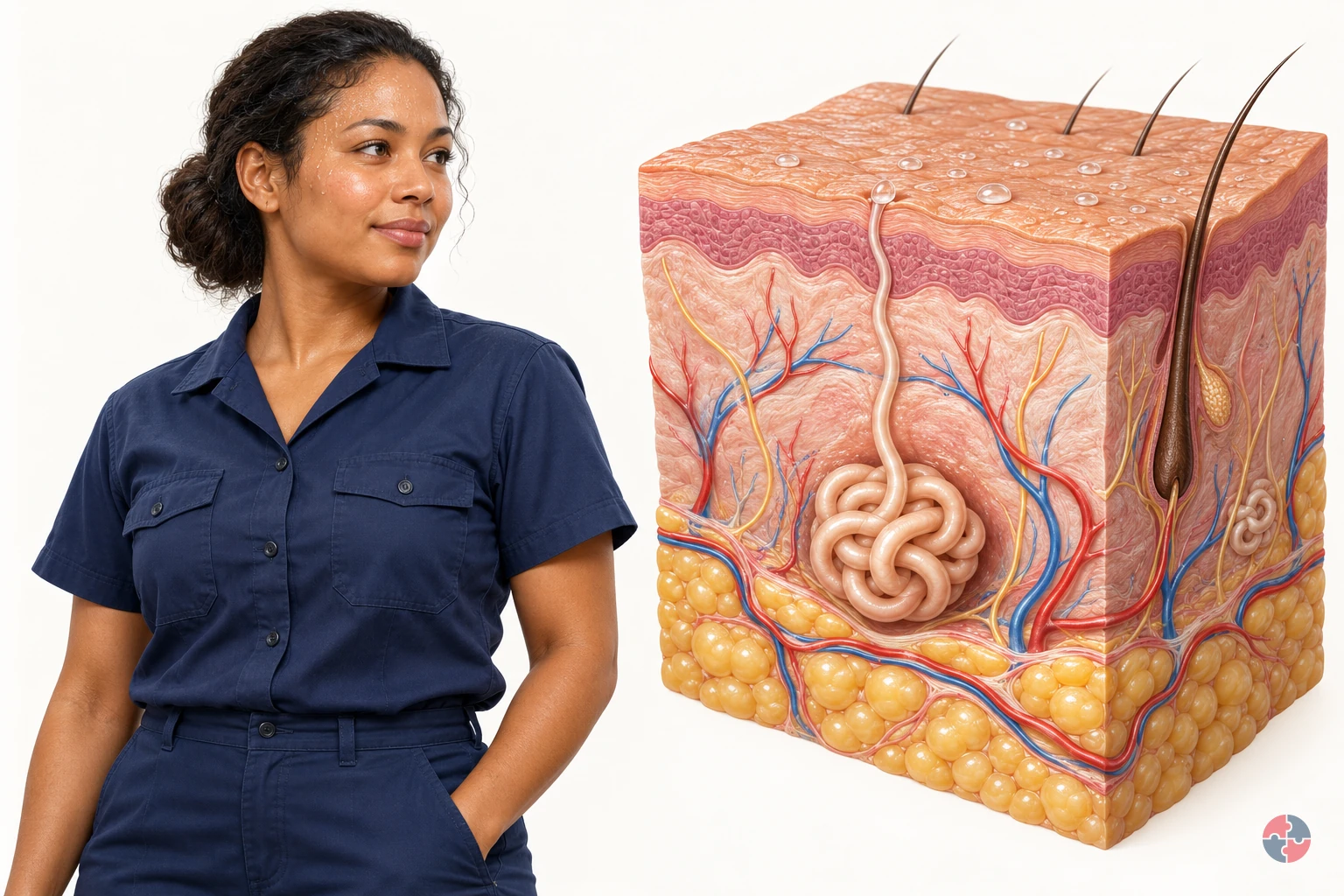

How do heat and cold affect the body, and what controls protect people during work?
Interactive anatomy · Heat balance, heat illness and cold injury · Updated 2026-10-23
Read all anatomy and process explanations without the viewer
Qualitative education about heat balance and separate harm mechanisms, not personal physiology simulation. Core-temperature, time-to-collapse, safe-duration or risk-percentage prediction Universal drinking quota or work/rest ratio Return-to-work decisions or clearance from a colour, timer or environmental card Removing required PPE and continuing hazardous work Local tissue freezing used as a model for every cold problem Heat illness, cold illness, chemical skin burns and eye irrigation each require distinct guidance. Heat and cold action is readable before interaction and scenario answers.
Working muscles
Physical work produces heat inside the body. The activity symbol represents metabolic heat production. It is not a measure of the person’s temperature. Health and Safety Executive: Temperature in the workplace: Heat stress · Health and Safety Executive: Thermal comfort
Body core
Internal temperature needs to stay within a workable range. The whole-body balance depends on heat production, gains and losses. This diagram displays no predicted core temperature. NHS Education for Scotland and University of Dundee: Core Clinical Assessment Skills Manual — temperature regulation
Skin
The skin exchanges heat with the surroundings. It forms an important surface in heat balance. Its separate barrier function is covered in the skin lesson. Health and Safety Executive: Thermal comfort · Health and Safety Executive: Structure and functions of the skin
Skin blood vessels
Changes in skin blood flow help regulate heat transfer. Skin blood vessels help regulate the transfer of heat between the body’s interior and its surface. Compare the warm and cold explanations to see the contrasting roles of skin blood flow. The vessel label identifies a physiological response; the illustrated width is not a measurement and cannot establish how effectively a person is maintaining temperature. NHS Education for Scotland and University of Dundee: Core Clinical Assessment Skills Manual — temperature regulation · NHS 111 Wales: Frostbite — causes
Sweat gland
Sweat reaches the surface; evaporation provides cooling. The gland supplies sweat to the skin surface. Cooling depends on water evaporating from that surface, so making sweat and successfully losing heat are related but different events. Follow the evaporation label outside the skin to complete the explanation. Neither a wet-looking surface nor the number of displayed droplets measures the body’s cooling. Health and Safety Executive: Thermal comfort · NHS Education for Scotland and University of Dundee: Core Clinical Assessment Skills Manual — temperature regulation · Health and Safety Executive: Structure and functions of the skin
Evaporation
Humidity and some clothing can restrict evaporation. Water vapour leaves the skin surface. These water symbols must not be mistaken for blood or a measured heat dose. Health and Safety Executive: Thermal comfort
Radiant heat
Sunlight and nearby hot surfaces can add heat load. The heat source stays outside the body. Its effect is not captured by air temperature alone. Health and Safety Executive: Thermal comfort
Clothing and PPE
Clothing changes insulation and heat loss. Required protection needs suitable work planning. Do not simply remove essential PPE and continue the hazardous task. Health and Safety Executive: Thermal comfort · Health and Safety Executive: Temperature in the workplace: Managing workplace temperatures
Shivering muscles
Shivering is a heat-producing response to cold. It does not guarantee safety. A cold, confused or unusually drowsy person needs help regardless of the animation. NHS: Hypothermia · NHS Education for Scotland and University of Dundee: Core Clinical Assessment Skills Manual — temperature regulation
Fingers and toes
Extremities can suffer local freezing injury in sufficiently cold conditions. Frostbite concerns local tissue. Hypothermia concerns whole-body temperature; neither requires the other. NHS: Hypothermia · NHS: Frostbite
Water loss
Sweating loses water, and dehydration can add to heat strain. The droplets explain loss; they do not generate a personalised drinking amount. Work must provide suitable access to water and rest. Health and Safety Executive: Temperature in the workplace: Heat stress · Health and Safety Executive: Temperature in the workplace: Dehydration
Open the complete process transcript
The process, step by step
Start with work
Working muscles release heat as they use energy. Follow the working-muscle label towards the body-core label, then look at the surrounding heat gains and losses. The important idea is balance: producing or receiving more heat than the body can lose can increase heat strain. Heat is energy, not a substance travelling along the illustrated blood vessels. This view introduces the parts of that balance; it does not calculate a temperature. Read each label in turn before comparing the work and environmental examples. Health and Safety Executive: Temperature in the workplace: Heat stress · NHS Education for Scotland and University of Dundee: Core Clinical Assessment Skills Manual — temperature regulation
What to watch: Locate the working-muscle and body-core labels, then follow their relationship to the whole-body balance rather than treating them as separate pictures.
Why it matters: A task can add heat from inside the body as well as from the surroundings. Understanding both sources helps explain why air temperature alone cannot describe the whole problem.
Explore this step: Compare the muscle and body-core labels, then describe which side of the heat balance each represents.
Separate sweat from evaporation
Sweat glands release liquid onto the skin. Cooling occurs when that liquid evaporates into water vapour, taking heat away from the surface. Follow the gland, the skin surface and the evaporation label as three connected parts of one explanation. A wet skin surface does not, on its own, show that sufficient cooling is happening. The water symbols identify the route being discussed; they do not measure sweat rate or heat loss. Pause on each label and explain the difference between making sweat and successfully losing heat. Health and Safety Executive: Thermal comfort · NHS Education for Scotland and University of Dundee: Core Clinical Assessment Skills Manual — temperature regulation
What to watch: Find the sweat gland beneath the surface, the skin above it and the evaporation label outside the body.
Why it matters: Sweating provides water at the surface; evaporation provides cooling. Keeping these roles separate explains why visible sweat is not a reliable measure of how well the body is losing heat.
Explore this step: Select the gland and evaporation labels in turn and explain what happens at each location.
Compare the context
Compare the examples with the stated air temperature held the same. Heavier work increases heat production; clothing and humidity can change how readily heat is lost. The examples are intended to separate these influences so that one temperature reading does not stand in for the whole assessment. Read the caption to identify what changed and what stayed constant, then return to the normal view. These are explanatory comparisons, not a calculation of safe working time, a prediction of body temperature or permission to remove essential protection. Health and Safety Executive: Temperature in the workplace: Heat stress · Health and Safety Executive: Thermal comfort
What to watch: Read the work, clothing and evaporation labels alongside the comparison caption, checking what changed and what remained the same.
Why it matters: Work rate, clothing and moisture in the air can alter the balance in different ways. A shared air temperature therefore does not mean that two work situations place the same demands on a person.
Explore this step: Choose two comparisons and name the different factor before explaining its place in heat production or heat loss.
Explore cold responses
In the cold example, reduced blood flow near the skin limits heat transfer from the warmer interior to the surface. Shivering adds heat through muscle activity. Find the skin-vessel label and then the shivering-muscle label so that conserving heat and producing heat remain distinct ideas. These are protective responses, but they can be insufficient. The illustration does not establish that a cold person is safe, nor does it measure core temperature. Use the normal and cold views to explain the responses without treating the model as a clinical check. NHS: Hypothermia · NHS Education for Scotland and University of Dundee: Core Clinical Assessment Skills Manual — temperature regulation · NHS 111 Wales: Frostbite — causes
What to watch: Locate the skin-vessel label near the surface and the separate muscle label used to explain heat production by shivering.
Why it matters: Conserving existing body heat and generating additional heat can both help the balance. Their presence does not prove that heat loss has been controlled or that further cooling cannot occur.
Explore this step: Compare the normal and cold labels and identify which response limits loss and which produces heat.
Choose the right comparison
Use the normal view as a reference, then compare the separate heat-illness, whole-body-cooling and local-freezing examples. Whole-body cooling concerns the temperature of the body as a whole; frostbite concerns freezing injury to a local area, often an extremity. One is not simply the next step after the other. Read the title and scope of each branch before looking at its highlighted region. The pictures help organise these different mechanisms; they cannot determine a person’s condition from skin colour, a selected label or the amount of visible movement. NHS: Hypothermia · NHS: Heat exhaustion and heatstroke · NHS: Frostbite
What to watch: Compare the body-core label with the extremity label, keeping the selected branch title visible as you examine each region.
Why it matters: Distinguishing the mechanisms prevents a local skin change being mistaken for a measure of the whole body. The selected branch is an explanation, not a sequence that every affected person follows.
Explore this step: Select each comparison and state whether it concerns heat balance, whole-body cooling or a local tissue injury.
Read the practice situations and all answer explanations
Sources and how the model is made
The opening images are AI-generated anatomical illustrations. The interactive 3D models and labelled SVG diagrams use original procedural artwork. These teaching images are not medical scans or diagnostic tools. Source references support the learner explanations and do not grant artwork rights.
- Health and Safety Executive: Temperature in the workplace: Heat stress — Work-generated heat, clothing/humidity, heat storage, water loss and work/environment controls. No universal hydration, exposure duration or clinical temperature prediction.
- Health and Safety Executive: Thermal comfort — Workload, radiant heat, air movement, humidity, clothing/PPE and evaporation. Air temperature alone insufficient. No occupational numerical thresholds imported.
- NHS: Hypothermia — Whole-body cooling, symptoms and immediate first aid/emergency escalation. Printed review due June 2026 is overdue; recheck at qualified first-aid sign-off.
- NHS: Heat exhaustion and heatstroke — Distinct heat-exhaustion and heatstroke explanations, emergency warning signs and cooling while waiting. No 30-minute delay imposed when emergency signs are already present.
- Aylesford Medical Centre — NHS GP practice: Heat-related Illness — Narrow corroboration that profuse sweating/wet skin can occur with exertional heatstroke. NHS-hosted clinical education article dated 18 June 2026; first-aid reviewer must reconcile this with simplified dry-skin descriptions. No treatment doses or prediction copied.
- NHS: Frostbite — Local freezing injury, extremities, coexistence with hypothermia and emergency signs. No diagnostic tissue depth or home rewarming programme simulated.
- Health and Safety Executive: Temperature in the workplace: Outdoor working — Work planning, weather and protection for outdoor hot/cold conditions. Replaces the brief’s US cold-work source.
- NHS Education for Scotland and University of Dundee: Core Clinical Assessment Skills Manual — temperature regulation — Normal heat-production/loss balance, sweat evaporation, skin-vessel responses and heat production by shivering, pages 13–14. July 2015 physiology reference only; no clinical assessment procedure or illustration copied.
- Health and Safety Executive: Structure and functions of the skin — Normal skin, sweat gland/duct and temperature regulation. Anatomy reference only.
- NHS 111 Wales: Frostbite — causes — Cold-related vessel narrowing and local tissue-freezing context only. Emergency wording uses current national NHS source TH6; no universal 111 route or bath-temperature protocol supplied.
- Health and Safety Executive: Temperature in the workplace: Managing workplace temperatures — Review process/work systems, suitable PPE and correct continued protection, rather than simply undoing essential protection.
- Health and Safety Executive: Temperature in the workplace: Dehydration — Sweat-related water loss and provision of suitable water access. No personal drinking prescription generated.
Which conditions make NFCI more likely?
Assess duration, moisture, temperature, wind, footwear fit, movement, ability to dry and individual vulnerability for the actual job.
The risk is the combined exposure, not an outdoor thermometer reading alone. Log when feet become wet, how long they remain wet, available changes of socks and boots, shelter, rest, work intensity, standing or immersion, and whether an exit route exists. Tight footwear or layers may restrict circulation. A previous cold injury, vascular or neurological condition may warrant confidential occupational-health advice without broad disclosure to supervisors. Reassess after weather, drainage, shift-length or work-method changes. HSE outdoor working advice and HSENI thermal assessment guidance set the GB/NI workplace context. Sources: HSE outdoor-work controls.
What failures create avoidable wet-cold injury?
Saturated boots, no dry change, uninterrupted exposure and symptom dismissal allow a preventable foot injury to progress.
A drainage crew starts in waterproof boots, but water enters through a split seam and the worker cannot change socks until the shift ends. The first numbness is mistaken for normal cold. Later swelling and pain make walking difficult. The control failures are footwear verification, spare dry kit, scheduled exit and a supervisor response to symptoms. A more insulated boot alone will not fix a leak or an unbreakable task. Review the actual route out of the wet area and transport for anyone who cannot safely walk. Sources: HSE outdoor-work controls, MOD cold injury prevention.
How can the hierarchy of controls reduce prolonged wet-cold exposure and non-freezing cold injury?
Eliminate unnecessary immersion, redesign for a dry task, then provide shelter, drying and reliable dry clothing before relying on time limits and symptom checks.
Which controls prevent wet-cold exposure?


Read the complete visual as text
- Eliminate unnecessary immersion, redesign for a dry task, then…: Eliminate unnecessary immersion, redesign for a dry task, then provide shelter, drying and reliable dry clothing before relying on time limits and symptom checks.
- HSE prioritises eliminating and substituting hazards before engineering controls,…: HSE prioritises eliminating and substituting hazards before engineering controls, administrative controls and PPE, as explained in its five-level hierarchy of controls . SHARE uses ERICPD as a task-planning prompt: Eliminate; Reduce, including substitution; Isolate through engineered separation; Control with other engineered or administrative measures; PPE; and Discipline, meaning continued verification and maintenance. ERICPD is not a sixth HSE level or a separate legal duty.
- A boot is a residual barrier; if it fills…: A boot is a residual barrier; if it fills with water, the work method has failed. Assess traction, dexterity and other hazards when changing footwear or work platforms. Have a dry change at the point where it can be used, and a transport/medical route for a worker who cannot walk comfortably. Sources: HSE outdoor working cold , HSE outdoor-work controls .
HSE prioritises eliminating and substituting hazards before engineering controls, administrative controls and PPE, as explained in its five-level hierarchy of controls. SHARE uses ERICPD as a task-planning prompt: Eliminate; Reduce, including substitution; Isolate through engineered separation; Control with other engineered or administrative measures; PPE; and Discipline, meaning continued verification and maintenance. ERICPD is not a sixth HSE level or a separate legal duty.
How can the ERICPD hierarchy of controls reduce prolonged wet-cold exposure and non-freezing cold injury?

| Five-level hierarchy | Task-specific feasibility and owner | Verification and stop point |
|---|---|---|
| Eliminate | Use remote inspection or redesign drainage so workers need not stand in cold water; designer verifies inspection quality and new hazards. | Approved trial and observed dry work; hold an unplanned immersion task. Sources: HSE; HSENI. |
| Substitution | Use a dry-access work method or lower-water-contact tool where feasible; task owner checks effectiveness and slip/electrical risks. | Field trial and worker feedback; reject a method that still soaks footwear. Sources: HSE; HSENI. |
| Engineering | Provide raised platforms, drainage, weather shelter and heated/drying facilities; engineer checks access and safe electrics. | Inspect drainage and shelter before shift; flooding or failed shelter stops exposure. Sources: HSE; HSENI. |
| Administrative | Schedule dry breaks, buddy symptom checks and spare kit with a named relief route; supervisor adapts to weather and tasks. | Observed change and symptom log; prolonged wet feet or numbness trigger withdrawal. Sources: HSE; HSENI. |
| PPE plus upkeep | Issue properly fitted waterproof boots, dry socks and suitable gloves; continuing checks mean inspecting, replacing and learning from failures, not accepting wet work. | Pre-use integrity and dry-change check; soaked boot or lost sensation triggers stop and care. Sources: HSE; HSENI. |
How can the ISO 45001 hierarchy of controls reduce prolonged wet-cold exposure and non-freezing cold injury?

| Five-level hierarchy | Task-specific feasibility and owner | Verification and stop point |
|---|---|---|
| Eliminate | Use remote inspection or redesign drainage so workers need not stand in cold water; designer verifies inspection quality and new hazards. | Approved trial and observed dry work; hold an unplanned immersion task. Sources: HSE; HSENI. |
| Substitution | Use a dry-access work method or lower-water-contact tool where feasible; task owner checks effectiveness and slip/electrical risks. | Field trial and worker feedback; reject a method that still soaks footwear. Sources: HSE; HSENI. |
| Engineering | Provide raised platforms, drainage, weather shelter and heated/drying facilities; engineer checks access and safe electrics. | Inspect drainage and shelter before shift; flooding or failed shelter stops exposure. Sources: HSE; HSENI. |
| Administrative | Schedule dry breaks, buddy symptom checks and spare kit with a named relief route; supervisor adapts to weather and tasks. | Observed change and symptom log; prolonged wet feet or numbness trigger withdrawal. Sources: HSE; HSENI. |
| PPE plus upkeep | Issue properly fitted waterproof boots, dry socks and suitable gloves; continuing checks mean inspecting, replacing and learning from failures, not accepting wet work. | Pre-use integrity and dry-change check; soaked boot or lost sensation triggers stop and care. Sources: HSE; HSENI. |
A boot is a residual barrier; if it fills with water, the work method has failed. Assess traction, dexterity and other hazards when changing footwear or work platforms. Have a dry change at the point where it can be used, and a transport/medical route for a worker who cannot walk comfortably. Sources: HSE outdoor working cold, HSE outdoor-work controls.
Read the practical categories separately: elimination removes the hazardous task/source; substitution replaces it with a suitable safer alternative; physical separation, containment and capture are engineering decisions. Duration/access/briefing are administrative measures, PPE covers residual exposure, and continued inspection, maintenance and verified action closure sustain the controls. Exposure monitoring or dosimetry measures exposure rather than protecting a person. The detailed text and records below distinguish these decisions; an overview illustration is not task authorisation.
What do GB and NI employers need to decide?
Both jurisdictions require a risk assessment and practical protection from cold-related harm; indoor comfort figures are not an NFCI exposure limit.
The Management of Health and Safety at Work Regulations 1999 underpin GB workplace risk assessment; see HSE explanation of GB risk-assessment duties. HSE advises assessment and outdoor cold controls in Great Britain, including suitable equipment, warm shelter, rest and rescheduling where feasible. HSENI says Northern Ireland has no legal minimum outdoor working temperature, so employers rely on thermal risk assessment and controls. The often quoted 16°C or 13°C figures concern normal indoor workrooms and have exceptions; they are not a diagnosis or safe outdoor exposure time. HSE temperature context and HSENI indoor/outdoor distinction should be read for the work location. Defence JSP 375 is a useful detailed cold-injury system but is not civilian workplace law. Sources: NI management regulations, MOD cold injury prevention.
What should a supervisor check before, during and after a shift?
Check forecast and ground conditions, footwear and spare dry kit, accessible shelter, symptom route and a named stop/restart decision.
Before: inspect boot integrity, drainage, routes, spare sizes and the ability to dry wet kit. During: ask about numbness, tingling, pain and reduced dexterity; ensure breaks are genuinely warm and dry, and stop if boots soak or shelter fails. After: record exposure and symptoms, refer suspected injury, replace failed equipment and verify the redesign. A clinician assesses the condition and advises on fitness and restrictions; the employer and worker agree suitable duties taking that advice into account, and the employer verifies exposure controls; an absence of visible blisters is not clearance. Sources: HSE outdoor working cold, MOD cold-injury guide, MOD cold injury prevention.
For example, the clinician may advise no wet-cold exposure while the employer and worker agree a sheltered stock-checking duty. The supervisor verifies dry access, shelter and suitable work against those restrictions, records work-relevant acceptance evidence and escalates any uncertainty. Replacement boots alone do not establish fitness; keep personal clinical detail outside the shared work-control log. DWP fit-note guidance for employers
How could a flood-response crew avoid trench foot?
A crew uses raised access, timed dry changes and a withdrawal route, then holds work when a worker reports numb feet.
How could a flood-response crew avoid trench foot? — part 1 of 2


Read the complete visual as text
- A crew uses raised access, timed dry changes…: A crew uses raised access, timed dry changes and a withdrawal route, then holds work when a worker reports numb feet.
- Before. The manager checks water depth, work duration, forecast…: Before. The manager checks water depth, work duration, forecast and nearby warm shelter. The engineer sets a stable raised route so most inspections stay dry. Workers receive correctly fitted waterproof boots, spare dry socks and a named relief point. Sources: HSE outdoor working cold .
- During. After a seam fails, a worker reports numbness.…: During. After a seam fails, a worker reports numbness. The supervisor stops that person’s wet task, arranges a sheltered dry change and clinical advice rather than asking them to finish the route. The crew rechecks the platform and other boots. Sources: MOD cold-injury guide , MOD cold-injury assessment and referral .
How could a flood-response crew avoid trench foot? — part 2 of 2


Read the complete visual as text
- After. The manager records the failed seam and exposure…: After. The manager records the failed seam and exposure duration, replaces footwear, tests the raised route under actual conditions and updates the method. Return to wet work follows professional advice and a verified prevention plan, not simply a warmer foot. Sources: MOD cold injury prevention , HSENI temperature and work .
- Transfer to field maintenance: A utility crew must inspect…: Transfer to field maintenance: A utility crew must inspect a wet rural installation while a driver can provide a dry return route. The manager raises or reroutes access where possible, arranges correctly fitted waterproof footwear, dry spares and shelter, and names the worker who checks conditions during the shift. Numb or painful feet trigger immediate withdrawal and suitable transport instead of a walk back through water; the supervisor holds the route until drainage, kit and the return plan are verified. HSE outdoor-working guidance and MOD cold-injury assessment and referral support the work and care boundaries.
Before. The manager checks water depth, work duration, forecast and nearby warm shelter. The engineer sets a stable raised route so most inspections stay dry. Workers receive correctly fitted waterproof boots, spare dry socks and a named relief point. Sources: HSE outdoor working cold.
During. After a seam fails, a worker reports numbness. The supervisor stops that person’s wet task, arranges a sheltered dry change and clinical advice rather than asking them to finish the route. The crew rechecks the platform and other boots. Sources: MOD cold-injury guide, MOD cold-injury assessment and referral.
After. The manager records the failed seam and exposure duration, replaces footwear, tests the raised route under actual conditions and updates the method. Return to wet work follows professional advice and a verified prevention plan, not simply a warmer foot. Sources: MOD cold injury prevention, HSENI temperature and work.
Transfer to field maintenance: A utility crew must inspect a wet rural installation while a driver can provide a dry return route. The manager raises or reroutes access where possible, arranges correctly fitted waterproof footwear, dry spares and shelter, and names the worker who checks conditions during the shift. Numb or painful feet trigger immediate withdrawal and suitable transport instead of a walk back through water; the supervisor holds the route until drainage, kit and the return plan are verified. HSE outdoor-working guidance and MOD cold-injury assessment and referral support the work and care boundaries.
Which role must demonstrate what?
Workers need early-recognition and dry-change skills; supervisors need exposure and stop decisions; specialists and managers own design, clinical advice and verification.
Training is task-specific: workers rehearse reporting without penalty; supervisors observe wet-kit changes and withdrawal; engineers verify the platform and footwear under real use. A manager checks resources and action closure. A clinician assesses suspected injury and return-to-work advice; a supervisor should not diagnose or prescribe treatment. Sources: HSE outdoor working cold, MOD cold injury prevention.
| Role | Practical task | Evidence | Assessor and record | Reassess when |
|---|---|---|---|---|
| Worker | Recognise numbness, change wet kit and report early | Observed dry-change and symptom report | Supervisor; task observation | Wet boot, new symptom or changed route |
| Supervisor | Assess exposure and hold/restart work | Dry-break log and demonstrated withdrawal | Operations manager; field review | Weather, water or shelter change |
| Engineer / buyer | Design dry access and suitable kit | Field trial, boot integrity and shelter checks | Engineering lead; acceptance record | Leak or recurring wet task |
| Occupational health | Evaluate symptoms and fitness within clinical scope | Confidential assessment and work advice | Clinical lead; health record | Persistent symptoms or re-exposure plan |
| Manager | Resource exposure controls and verify closure | Owned risk assessment and corrective evidence | Senior dutyholder; audit | Repeated cases or failed controls |
How should NFCI prevention be recorded?
Record the wet-cold task, conditions, exposure duration, dry-access method, kit, symptom response, owner and verification trigger.
HSE explains that a formal health and safety management system is optional. The employer must still plan, control, check and improve the measures for this task. Review actual wet-kit failures, time to a dry change and symptom withdrawals, then verify drainage, shelter, spare-kit access and the named safe-exit decision before closing an action.
What happens when the planned dry return route fails?
Reassess or hold the wet-cold task; dry spares and a shelter help only when the worker can actually reach and use them safely.
Consider a utility inspection with raised access and a vehicle available for a dry return. A change in water conditions cuts off the agreed route. The supervisor must review how people can leave, where they can change wet kit and how a person with painful or numb feet can be assisted. A spare pair of socks in a distant store does not repair the failed access barrier. See HSE outdoor working cold.
Do not extend an exposure simply because the air is above freezing or the job is almost finished. Review moisture, duration, kit failure, shelter and symptoms together. Keep people within the assessed safe method and obtain clinical assessment for suspected injury; do not ask a worker to prove recovery by walking a wet route. See MOD cold-injury guide. Also see MOD cold-injury assessment and referral.
The manager should record the changed condition, the held task and the owner of the access or shelter remedy. After repair, verify the route and usable dry change under the expected work conditions before task acceptance. The MOD sources provide Defence prevention and referral evidence; civilian workplace duties remain with the page's separate HSE and HSENI routes. See MOD cold-injury assessment and referral. Also see HSE outdoor working cold. Also see HSENI temperature and work.
Decision basis: HSE outdoor working cold. MOD cold-injury guide. MOD cold-injury assessment and referral. The scenario and suggested records are illustrative; apply the source within its stated jurisdiction and the assessed work.
Dry-exit example: when the usual route floods, the named supervisor holds wet-cold work. The agreed raised alternative access must reach the usable spare-kit store, sheltered relief point and transport pickup. Check the route is actually passable before restart and name who accepts it. A dry kit store that cannot be reached does not provide an effective control. This original text sequence is a planning aid, not a skin-colour or fitness test.
How does the same prevention logic apply to wet hands?
Identify sustained damp-cold contact, provide a safer dry method and usable dry gloves, and stop when symptoms or kit failure defeat the assessed protection.
In an illustrative field-maintenance variation, gloves become wet while connectors are handled in damp cold. The task owner considers whether work can move to a sheltered dry position or use a suitable method that reduces contact. Glove selection must also preserve the grip and dexterity needed for the actual task; more insulation alone does not settle every safety question. See MOD cold-injury guide.
Arrange a dry change and relief point that the worker can use before protection fails. Numbness, tingling, pain or reduced function should trigger withdrawal and the appropriate health route, not an informal trial using direct heat. Clinical treatment and return advice belong with professionals; this example is not a temperature-time limit or an adaptation of the MOD assessment scoring tool. See HSE outdoor working cold. Also see MOD cold-injury assessment and referral. Also see MOD cold-injury guide.
Decision basis: MOD cold-injury guide. HSE outdoor working cold. The scenario and suggested records are illustrative; apply the source within its stated jurisdiction and the assessed work.
Can you separate medical recovery from a repaired work method?
A clinician advises on the person's condition; the employer must independently verify the exposure controls, route and resources for the task.
Learning check: a foot looks warmer and the worker is sent back to the same leaking boot and flooded route. The correct response is to arrange appropriate clinical advice and repair the exposure barriers. An improvement in appearance is not a workplace clearance test, and the original control failure still exists. See MOD cold-injury guide.
Learning check: new boots are delivered but the crew still cannot leave for a dry break. The manager must consider the work design and relief arrangements, not close the action on the purchase alone. Demonstrate the actual dry-change and withdrawal route safely during competence assessment. See MOD cold-injury assessment and referral.
Keep the operational record to exposure conditions, failed kit, response, remedy and accepted work arrangements. Protect personal health details. Reassess after changed weather, drainage, duration, staffing or symptoms. A safe hand-back needs both appropriate advice for the person and a verified method for the work; neither can be inferred from the other. See HSE outdoor working cold.
Decision basis: MOD cold-injury guide. MOD cold-injury assessment and referral. HSE outdoor working cold. The scenario and suggested records are illustrative; apply the source within its stated jurisdiction and the assessed work.
Which terms should a team use consistently?
Keep local wet-cold injury distinct from freezing injury and whole-body hypothermia.
| Term | Meaning | Use here |
|---|---|---|
| NFCI | Non-freezing cold injury | Wet-cold injury without tissue freezing. |
| Trench foot | Immersion foot | Common foot form of NFCI. |
| Frostbite | Freezing cold injury | Different mechanism requiring separate urgent assessment. |
| Cold stress | Physiological strain in cold conditions | Can coexist with local injury and hypothermia. |
| PPE | Personal protective equipment | Footwear/gloves as residual protection. |
| HSE | Health and Safety Executive | Great Britain workplace regulator; use its guidance within scope. |
| HSENI | Health and Safety Executive for Northern Ireland | Northern Ireland workplace regulator; NI duties have separate instruments. |
| GB | Great Britain | England, Scotland and Wales; distinguish the NI legal route. |
| NI | Northern Ireland | Use the Northern Ireland legislation and regulator route. |
| ERICPD | Eliminate; Reduce; Isolate; Control; PPE; Discipline | SHARE planning prompt; Discipline means maintaining controls, not blame. |
| MOD | Ministry of Defence | Defence guidance is not general civilian workplace law. |
| IMEG | Independent Medical Expert Group | Military scientific review context; not a treatment protocol. |
| JSP | Joint Service Publication | Defence publication series; apply its stated Defence scope, not as general civilian workplace law. |