Early hearing change
- Weak response
- Individual told to wear defenders.
- Better response
- Review noise controls, exposure groups and surveillance trends.

All teaching and equivalent model explanations. Reading this document does not record an assessed course pass.
L01
Learning step 1 of 9
Occupational health considers both the effects of work on health and the effects of health on safe, sustainable work. A sprayer becoming sensitised, a packer developing upper-limb pain and a worker returning after treatment need different decisions. The employer retains responsibility for controlling work; an occupational health referral does not transfer it.
Learning step 2 of 9
Exposure assessment asks what reaches the person. Health surveillance looks for early adverse effects in people at a defined work-related risk. Fitness-for-work assessment considers capacity for an actual role and possible adjustments. Voluntary wellbeing screening supports wider health. The same appointment may contain more than one element, but each needs a clear purpose and appropriate information handling.
Learning step 3 of 9
Identify tasks and similarly exposed groups, prevent or reduce exposure, verify the controls, arrange appropriate surveillance, respond to findings and review the whole system. A reassuring test cannot authorise uncontrolled work. Consider contractors, agency workers, maintenance, cleaners and adjacent people, with explicit coordination of responsibilities.
Learning step 4 of 9
Three different workshop health signals should prompt three exposure-control checks while each worker receives private support.
An engineering workshop has three separate OH contacts in six months: one worker has early hearing changes, another has dermatitis from cutting fluid and a third reports wheeze after soldering. Each case is handled privately, but the manager sees them as unrelated personal health issues.
The manager assigns the noise, fluid and soldering owners to verify exposure groups, enclosure and extraction performance, fluid condition and worker feedback. OH reports only work-relevant restrictions and anonymised trends. Failed capture or rising symptoms pauses the affected process; the controls are retested before restarting.
Learning step 5 of 9
For a hearing-change signal, the manager first checks the affected noise task and who else shares that exposure, then asks the occupational-health provider for work-relevant advice. The control owner checks enclosure, maintenance and exposure practice; issuing defenders alone does not explain why the hearing result changed. For the skin and breathing signals, the same feedback loop tests cutting-fluid contact and solder-fume capture respectively. Each person receives a private response while the group-level control review is recorded separately.
Learning step 6 of 9
 Enlarge schematic ↗
Learning step 7 of 9
 Enlarge schematic ↗
Learning step 8 of 9
For the GB COSHH employer health record, the minimum 40-year period runs from the last entry, not the first test or date of hire. On ceasing trade, the regulation provides for notifying HSE and making records available. Keep this employer record distinct from confidential clinical records and exposure-monitoring records. Verify the separate NI counterpart before using a combined retention or closure instruction.
Health records are employer-held surveillance outcome records; medical records are confidential clinical records held by occupational health professionals.
This distinction is fundamental. An employer needs enough information to manage exposure, restrictions, review dates and legal duties. The employer does not normally need clinical notes, diagnosis history or detailed test results.
For COSHH health surveillance, HSE guidance says health records must be kept for at least 40 years. Where a regulation sets a retention period, follow it. Where it does not, retain records at least while the worker is employed and design the record so it remains understandable if the worker leaves, the provider changes or the business restructures.
Learning step 9 of 9
For COSHH health surveillance, check the applicable GB or NI regulation before using the at-least-40-year health-record period. The employer health record records fitness and follow-up needed for risk management; confidential clinical details stay with the occupational-health professional. Other regimes can have different periods.
Place each activity in the right part of the system
Sort twelve fictional activities into exposure measurement, health surveillance, fitness assessment or optional wellbeing. Explain an ambiguous example rather than forcing a label.
| Evidence | Compare the matched purpose |
|---|---|
| Personal dust sampling | Exposure assessment |
| Risk-based hearing surveillance | Health surveillance |
| Advice on adjusted duties after surgery | Fitness for work |
| Optional general lifestyle discussion | Voluntary wellbeing |
Match the evidence to its purpose. Exposure, health effects, fitness and wider wellbeing require distinct decisions and records.
Control the exposure and investigate the failed extraction
A health result concerns the person at a time; it does not verify the extraction or remove the employer’s control duty.
Can this person do the actual role with suitable adjustments?
Fitness advice relates function and actual job demands. Exposure assessment and engineering verification answer different questions.
A one-page role-and-decision map with the employer’s control actions kept separate from confidential clinical decisions.
HSE: selecting the right health-surveillance approach · HSE: COSHH health surveillance ·
L02
Learning step 1 of 5
Follow a substance from the process through air, contaminated skin, clothing or food to the worker. Eye contact is an important local exposure route. Injection through sharps or high-pressure equipment has distinct hazards. An absence of visible contamination or a noticeable smell is not evidence of no exposure.
 View full detail ↗
Locate the lungs, branching airways and diaphragm below them. The cutaway reveals structures normally hidden by the chest wall.
Trace the source-to-breathing-zone route in this lesson. Which change would prevent the contaminant reaching the person?
educational illustration · healthy anatomy; enlarged details and teaching colours. View full detail ↗
Explore an enlarged section of hair-bearing skin, with a hand and forearm for context. Layers, glands, nerves and vessels are enlarged for clarity.
Use the task in this lesson to identify contact, repeated wet work or contamination. Which change reduces contact before relying on gloves?
educational illustration · healthy anatomy; enlarged details and teaching colours.Learning step 2 of 5
The airways conduct air towards gas-exchange surfaces; skin provides a protective barrier; blood can transport an absorbed substance to other organs. Absorption, distribution, metabolism and elimination affect the dose reaching target tissues. Some substances harm at the contact point, others affect organs such as the nervous system, liver, kidneys or blood.
Learning step 3 of 5
Intensity, duration, frequency, route, substance form and individual circumstances influence effect. A short high exposure can cause acute harm; repeated exposure can cause cumulative effects or disease with long latency. Sensitisation and irritancy are different mechanisms. The anatomy models illustrate selected pathways rather than calculating an individual’s absorbed dose or diagnosis.
Learning step 4 of 5
Simple route examples show that the same job can expose different parts of the body in different ways.
Routes of exposure are often easier to learn through tasks than definitions. A construction worker cutting concrete may inhale dust, get dust on hands and transfer it to the mouth at break time. A mechanic degreasing parts may breathe vapour and absorb solvent through skin. A cleaner handling sharps may face an injection route that has nothing to do with air monitoring.
This is why COSHH assessments should not stop at the product label. They should describe how people actually work, how contamination moves, what body route is credible and what control blocks that route.
 Enlarge schematic ↗
Learning step 5 of 5
The form changes the control because it changes how the substance travels, contacts the body and spreads through the workplace.
A beginner may ask whether a substance is harmful. A stronger assessor asks what form it is in during the work. The same material can be a low-risk solid in storage, a respirable dust when cut, a fume when heated, a splash hazard when mixed with water or a contamination hazard when carried into welfare areas.
This matters because control measures are not interchangeable. General room ventilation may help dilute vapour but will not capture dust at the cutting point. Gloves help with liquid contact but do not protect the lungs. A dust mask does nothing for skin burns from wet cement. The form tells the assessor which route must be interrupted.
For this decision, consult the current direct authority and apply it to the actual substance and setting.
Trace the route from source to person
Use the respiratory and skin models to trace a paint-mixing exposure. Add a hand-to-mouth route and identify why a respirator alone cannot control the whole scenario.
| Evidence | Compare the matched purpose |
|---|---|
| Breathing airborne solvent vapour | Inhalation |
| Liquid contaminating bare hands | Skin absorption/contact |
| Eating with contaminated hands | Ingestion |
| An injury from a contaminated sharp | Injection |
Match the evidence to its purpose. Exposure, health effects, fitness and wider wellbeing require distinct decisions and records.
Airway narrowing affects the passage for air; fibrosis changes lung tissue and function. Use this distinction to understand prevention and referral. The model does not establish diagnosis or personal exposure.
Absorption may allow distribution to a target organ
Some chemicals cross skin and enter systemic circulation. The actual substance, dose and conditions determine the risk.
It illustrates a mechanism, not an individual diagnosis or dose
A simplified model helps explain routes and tissues. Measurements and clinical assessment require their own evidence.
A source-to-person pathway diagram and a control for each route.
L03
 READ THE LABEL · UNDERSTAND THE TASK
Recognise the symbol. Read the full label. Assess the actual task.
Examples illustrate possible uses of a symbol, not the classification of every formulation. A product can carry several pictograms. Check its current label, hazard statements and matching safety data sheet (SDS).
| Pictogram and hazard | What it can mean | Example and question before work |
|---|---|---|
 Explosive | Explosion, blast or projection hazards; also certain self-reactive substances and organic peroxides. | |
 Flammable | Can ignite; also used for certain self-heating, pyrophoric or water-reactive hazards. | |
 Oxidising | Can cause or intensify fire; some strong oxidisers present an explosion hazard. | |
 Gas under pressure | Pressurised gas may burst if heated; refrigerated gas can cause cold burns. | |
 Corrosive | May damage metals, cause severe skin burns or cause serious eye damage; read the stated hazard. | |
 Acute toxicity | Can be toxic or fatal after short exposure through the stated route. | |
 Harmful / irritant | May indicate harmful acute toxicity, irritation, skin sensitisation, drowsiness or dizziness; also ozone-layer hazards. | |
 Serious health hazard | Can indicate cancer, genetic or reproductive harm, organ damage, respiratory sensitisation or aspiration hazard. | |
 Hazardous to the environment | Hazardous to aquatic life, potentially with long-lasting effects. |
Read beyond the picture · Open a prompt to compare the explanation.
Supply pictograms communicate hazards. They do not replace transport labels, a compatibility assessment, task controls or the site emergency plan. GB CLP applies in Great Britain; EU CLP applies in Northern Ireland. Asbestos, lead and radioactive substances have separate specific regulatory arrangements.

Learning step 1 of 7
Irritants and corrosives damage tissue; sensitisers can produce an acquired allergic response; some agents cause systemic toxicity, reproductive harm, mutation or cancer. Examples include solvents affecting the nervous system, lead affecting several organs and carbon monoxide interfering with oxygen transport. An oxygen-displacing gas can create an asphyxiation hazard without being chemically poisonous.
Learning step 2 of 7
Read the current product label and safety data sheet, including relevant health hazards, exposure controls and emergency information. H334 flags respiratory sensitisation and H317 skin sensitisation, but a label is not a complete risk assessment. Processes also generate hazardous material, such as welding fume, thermal decomposition products and dust not supplied in a labelled container.
Learning step 3 of 7
Assess cleaning, mixing, hot work, maintenance and foreseeable breakdowns, including adjacent workers. Consider interactions and co-exposures through competent assessment; a generic mixture score is insufficient. Control contact and release at source. Strong fumes, suspected oxygen deficiency, acute symptoms or an unknown atmosphere require a safe withdrawal and the appropriate emergency route, not an improvised rescue.
Learning step 4 of 7
Controls should be selected by substance form, exposure route, health effect and task conditions.
A control that works for one form may fail for another. General ventilation may dilute vapour but will not control respirable silica at the cutting point. Gloves may protect against splashes but will not stop inhalation. RPE may reduce breathing exposure but will not prevent contaminated hands transferring lead dust to food.
The hierarchy should start with elimination, substitution and safer form. If powder can be supplied as pellets or liquid can be brushed rather than sprayed, exposure may drop before engineering controls are even considered.
For this decision, consult the current direct authority and apply it to the actual substance and setting.
Learning step 5 of 7
A container label communicates identity and hazards. A safety data sheet supports the assessment, but neither describes all conditions of the local task.
 Enlarge schematic ↗
Learning step 6 of 7
Check product, supplier and hazard information on the actual container; resolve an unlabelled or mismatched product before use.
Obtain the relevant safety data sheet and check the revision and applicability. Select the correct GB or NI supply-rule route.
Match concentration, method, duration, release and people affected to suitable controls and emergency arrangements.
A safety data sheet is an input to the assessment, not a completed COSHH assessment or automatic work authorisation.
Learning step 7 of 7
This bridge links the practical dust problem to the clinical health-effect problem.
Lead poisoning rarely starts as one dramatic moment in ordinary maintenance work. It often develops as a chain of small failures: a lead-containing coating is not identified, a dusty method is used, welfare is poor, contaminated gloves are worn into the van, workers do not understand ingestion, and no one reviews exposure trends. Over time, lead absorbed into the body may show as rising blood-lead results before obvious illness is recognised.
This is why the response to an abnormal result or symptom report should not be limited to the individual. A competent employer asks which task, area, method, contractor, tool or hygiene arrangement could have caused uptake, who else is in the same exposure group and whether the controls have been verified since the concern was raised.
Separate chemical mechanisms
Compare a fictional SDS, the mixing task and a maintenance activity. Identify hazards missing from the product-only assessment and explain the next competent advice needed.
| Evidence | Compare the matched purpose |
|---|---|
| Tissue damage at the contact point | Irritation/corrosion |
| An acquired immune response to later exposure | Sensitisation |
| Absorbed substance affecting an internal target organ | Systemic toxicity |
| An atmosphere that does not support adequate oxygen supply | Asphyxiation |
Match the evidence to its purpose. Exposure, health effects, fitness and wider wellbeing require distinct decisions and records.
Sensitisation can make later small exposures trigger a response
Irritant and immune mechanisms differ. Sensitisation changes future risk; odour is not a reliable exposure or safety test.
Prevent entry and use a competent confined-space system
Particle filters do not supply oxygen. Entry and rescue require a separate competent system; never attempt an unprotected rescue.
A task-specific chemical health profile stating routes, effects, exposed groups, control failures and escalation.
HSE: workplace exposure limits and exposure routes · HSE: appointed-doctor guidance on lead medical surveillance ·
L04
Learning step 1 of 8
Dust is generated as solid particles; fume commonly forms as very fine particles after heating; mist is liquid droplets; vapour is the gaseous form of a substance normally liquid or solid at the conditions concerned. Aerosol is a general suspension of particles or droplets. Bioaerosols can contain biological material. These terms help select controls and sampling methods.
View full detail ↗Locate the lungs, branching airways and diaphragm below them. The cutaway reveals structures normally hidden by the chest wall.
Trace the source-to-breathing-zone route in this lesson. Which change would prevent the contaminant reaching the person?
educational illustration · healthy anatomy; enlarged details and teaching colours.Learning step 2 of 8
Respirable crystalline silica can cause silicosis, COPD and lung cancer; wood and flour dust can cause asthma, while some dusts have additional cancer risks. Welding fume, diesel exhaust, asbestos fibres and composite dust need their own assessment. Organic dust and mould can also be associated with hypersensitivity pneumonitis. Not all dust produces the same disease, and harmful respirable particles can be invisible.
Learning step 3 of 8
Bag tipping, dry sweeping, filter changes, emptying collectors and compressed-air cleaning can produce high exposures. Plan enclosure, suppression or capture appropriate to the material and safe cleaning. Separate occupational infection risk from chemical sensitisation. Assess combustible-dust fire and explosion hazards alongside, rather than confusing them with respiratory dose.
Learning step 4 of 8
Dust controls should prevent the dust being created or inhaled before relying on respiratory protection.
The best dust controls are upstream. Order pre-cut materials, use lower-dust products, change the process, isolate the work or use wet methods. Once a dust cloud has formed around the worker's breathing zone, the control battle is already harder.
Engineering controls include enclosure, local exhaust ventilation, on-tool extraction, water suppression, automated transfer, sealed conveyors and suitable industrial vacuum systems. They need design, commissioning, user checks, maintenance and thorough examination.
The same source-control decision transfers to a woodworking shop sanding MDF: capture at the sander, segregate bystanders, maintain extraction and stop on a blocked collector. In a bakery, flour tipping needs enclosure and capture, with combustible-dust assessment as well as inhalation control; a silica RPE choice or monitoring result cannot be copied across materials.
RPE can be important, but it is a final layer. It must be suitable for the dust, provide enough assigned protection factor, be face-fit tested where tight-fitting, worn correctly, maintained, stored properly and supported by clean-shaven requirements where needed. See .
 Enlarge schematic ↗
Learning step 5 of 8
ERICPD is a planning crossmap. Its prompts do not add a sixth rung or rank Isolate above engineering. Discipline verifies and sustains every control level.
The hierarchy of controls in ISO 45001:2018 comes under Clause 8.1.2 (Eliminating hazards and reducing OH&S risks), which is located within Clause 8 ("Operation") .
ESEAP: Elimination, Substitution, Engineering controls, Administrative controls and PPE. Control order: and .
 Enlarge schematic ↗
Learning step 6 of 8
Assess the material, task energy, duration, enclosure, people exposed, controls and evidence before work starts.
Relevant direct sources: .
A silica assessment should be task-specific enough to change the work. 'Cutting concrete' is not enough. The assessor needs to know how much cutting, which tool, whether it is indoors or outside, whether water or extraction is fitted, whether the extraction unit is suitable, who stands nearby, how dust is cleaned up and whether any tight-fitting RPE has been face-fit tested for that wearer, while all selected RPE meets the task’s protection, compatibility and use requirements.
The strongest assessments look at both planned and foreseeable poor conditions. What if water cannot be used because of electrics? What if the vacuum filter blocks? What if a subcontractor brings a dry-cutting tool? What if the task moves indoors? What if a worker has stubble that breaks the mask seal? These practical questions turn silica assessment into risk control.
Relevant direct sources: , .
Learning step 7 of 8
Avoid or reduce dust generation, enclose and capture at source, segregate people, then clean using at least Class M vacuum equipment or an assessed LEV suction-hose alternative; use suitable, fit-confirmed RPE only for residual risk or defined non-routine work. Class M alone does not establish contaminant or explosion suitability.
Examples include off-site prefabrication, pre-cut or pre-finished material, lower-dust methods, effective machine enclosure, integrated LEV, on-tool extraction, segregation, planned vacuum cleaning and controlled waste handling. PPE cannot compensate for an avoidable dusty method or failed extraction.
Avoid or reduce. Wood-dust application: Pre-cut, pre-finished or less dusty process.; Evidence: Method decision.
Enclose and extract. Wood-dust application: Integrated hood or on-tool capture.; Evidence: Commissioning and use benchmark.
Organise and clean. Wood-dust application: Segregation plus at least Class M vacuum equipment or assessed LEV suction-hose cleaning.; Evidence: Task record plus separate contamination and combustible-dust suitability.
RPE for residual risk. Wood-dust application: Selected for hazard, wearer, task and environment.; Evidence: Fit, training, use and maintenance evidence.
Learning step 8 of 8
Compare the complete job, not only the tool: material, finish, generation rate, enclosure, extraction compatibility, duration, access, other hazards and cleaning burden all affect the choice.
A slower tool that creates fine dust for much longer may not reduce total exposure. Wet methods may be unsuitable for wood, electrics or product quality. Trial the intended method under representative conditions and involve workers before standardising it.
Can cutting be avoided?. Check: Pre-cut or factory-finished supply.; Boundary: Confirm logistics and other risks.
Can dust be enclosed?. Check: Machine hood, booth or isolated cell.; Boundary: Keep access and maintenance safe.
Can capture be integrated?. Check: Compatible port, hose and extractor.; Boundary: Verify flow and capture at the tool.
Does the change create another hazard?. Check: Noise, vibration, kickback, electricity or quality.; Boundary: Use the full task assessment.
Select every useful control for the collector-emptying task
Inspect the dry-cutting and sanding scenes. Build a control sequence covering the operator, nearby worker, cleaner and maintenance person.
Include secondary tasks and people. Blowing contamination from clothing can spread respirable dust.
Airway narrowing affects the passage for air; fibrosis changes lung tissue and function. Use this distinction to understand prevention and referral. The model does not establish diagnosis or personal exposure.
Fine airborne particles formed during a hot process
Airborne form matters to control and sampling. Fume is not interchangeable with vapour, mist or dust.
Dry sweeping and waste handling can expose people after cutting
Risk follows exposure, including cleaning, maintenance and nearby workers. Use suitable capture/suppression and safe cleaning.
An exposure map identifying material, fraction where relevant, task, route, affected groups and verification.
HSE: RCS surveillance guidance, amended May 2026 · HSE: wood-dust controls and surveillance · HSE: workplace exposure limits and exposure routes ·
L05
Learning step 1 of 8
Occupational asthma can be caused by respiratory sensitisers such as isocyanates, flour, enzymes or wood dust; irritant mechanisms also need consideration. Work can aggravate pre-existing asthma. A latency period and symptoms changing away from work can be useful clues, but a manager cannot diagnose the cause from a pattern.
View full detail ↗Locate the lungs, branching airways and diaphragm below them. The cutaway reveals structures normally hidden by the chest wall.
Trace the source-to-breathing-zone route in this lesson. Which change would prevent the contaminant reaching the person?
educational illustration · healthy anatomy; enlarged details and teaching colours.Learning step 2 of 8
After sensitisation, further small exposures may provoke symptoms. Prompt reporting and professional assessment matter; do not wait for the annual appointment. A normal single spirometry result does not exclude asthma. Serial peak-flow or other specialist investigation belongs within a clinically directed plan, never a manager-led exposure experiment.
Learning step 3 of 8
Use effective process controls and suitable respiratory protection where required by the task assessment. Plan an OH-led respiratory surveillance scheme where indicated, with a baseline, appropriate recall and access between checks. If symptoms arise, review the exposure and obtain clinical advice; the absence of sickness absence is not evidence of successful prevention.
Learning step 4 of 8
Name the actual respiratory sensitiser and every task that releases it. A COSHH assessment that says only “dust” or “chemical” cannot distinguish flour, wood dust, isocyanate mist or an enzyme. Identify workers and others nearby, routine and maintenance work, skin and inhalation routes, control failures, symptoms and the product information needed to choose a safer method.
Use control hierarchy as a planning sequence, not a statute: eliminate the harmful step where feasible, reduce or substitute it, isolate it, then use engineering controls before administrative rules and RPE. For a bakery, lower-dust flour and enclosed transfer can prevent a cloud at source; a disposable mask alone does not correct open tipping or dry sweeping. For isocyanate spraying, a properly designed booth, clearance control and air-fed protection are task-specific requirements that need competent verification.
Learning step 5 of 8
Health surveillance can detect early signs when workers remain exposed or likely to be exposed to asthmagens, but it does not capture airborne material. Work-linked symptoms, an abnormal surveillance finding or a control defect require an exposure and clinical response together. A competent occupational hygienist should decide whether sampling is needed and how results affect the control plan.
For the actual task hazard, HSE places elimination first, then substitution, engineering controls, administrative controls and suitable PPE for residual risk. Record why a higher control is not practicable and how the chosen measure is checked in use.
Use the HSE hierarchy for this task: eliminate the hazard where possible, substitute, use engineering controls, organise the work and use suitable PPE for residual risk. The exact choices require a task-specific assessment and competent verification.
Learning step 6 of 8
Each row applies elimination, substitution, engineering, administrative checks and residual personal protection to the work hazard. The five HSE levels are elimination, substitution, engineering controls, administrative controls and PPE; supervision and inspection support the administrative arrangements. A higher control may be infeasible only after the specific task and alternative have been assessed.
Learning step 7 of 8
Controls should eliminate or minimise aerosol and skin exposure before relying on behaviour.
Start with product and task assessment. Remove isocyanate spraying where feasible; otherwise combine verified booth extraction and clearance with protected spraying and exposure checks. The hierarchy table distinguishes engineering control from air-fed RPE. HSG276 - Isocyanate paint spraying .
In a two-pack vehicle-paint job, the first choice is whether the finish can be achieved without isocyanate spray. If spraying remains necessary, the technical lead confirms the product and booth specification; the sprayer checks extraction and air supply before entry, keeps others out during the measured mist-clearance period and uses the specified air-fed protection. A failed booth test, unknown product or symptom report stops the task and triggers exposure review. explains the spray-booth control approach.
Learning step 8 of 8
A secure health-records system should separate clinical information from management action, protect access and keep enough evidence to prove surveillance is risk-led.
For SHARE-style secure health-records management, the page needs to be clear about the operating model. The employer-held record should be an occupational health and safety management record: who is in the exposure group, what surveillance applies, whether they attended, what fitness or restriction advice was given, when the next review is due and what workplace action was required.
The clinical record should stay with the occupational health provider or appointed doctor. Managers should not use a health-record system as a general medical filing cabinet, performance tool or informal absence database. The strongest design uses role-based access, audit trails, retention rules, worker information, provider controls and a clear route from surveillance results into exposure-control improvement.
Put the new respiratory-symptom response in a sensible sequence
In the spray-booth and chest-tightness scenarios, identify the exposure controls, immediate work decision, confidential referral and action for others with similar exposure.
Routine recall must not delay response. Do not deliberately re-expose a symptomatic person to prove causation.
Airway narrowing affects the passage for air; fibrosis changes lung tissue and function. Use this distinction to understand prevention and referral. The model does not establish diagnosis or personal exposure.
Prompt clinical/OH advice and review of exposure and work arrangements
Do not wait for routine recall or arrange a manager-led re-exposure experiment. Severe breathing difficulty needs emergency help.
No; history and clinically directed investigation may still be needed
A normal single result is not a diagnosis or exclusion test for every respiratory problem.
A respiratory symptom-response pathway with explicit restrictions, owners and review triggers.
HSE G402: occupational asthma surveillance · HSE: representative isocyanate biological monitoring ·
L06
Learning step 1 of 8
Repeated wet work, friction, cleaning agents and contamination can impair the skin barrier. Irritant contact dermatitis differs from allergic contact dermatitis, which involves sensitisation. Redness, itching, cracking or soreness need early attention. Skin appearance alone cannot establish the diagnosis or the responsible agent.
View full detail ↗Explore an enlarged section of hair-bearing skin, with a hand and forearm for context. Layers, glands, nerves and vessels are enlarged for clarity.
Use the task in this lesson to identify contact, repeated wet work or contamination. Which change reduces contact before relying on gloves?
educational illustration · healthy anatomy; enlarged details and teaching colours.Learning step 2 of 8
Avoid contact through substitution, closed systems or tools before relying on gloves. Glove material, breakthrough, degradation, dexterity, contamination and the rest of the PPE matter. Occlusion and wet gloves may add problems. Skin creams support care; they are not a replacement for suitable gloves or source controls.
Learning step 3 of 8
In an appropriate OH-led scheme, use relevant questionnaires and inspection of potentially exposed skin. Train and support any responsible person; their role is recognition and referral, not diagnosis or patch testing. Provide confidential reporting between checks, act on professional advice and review exposure controls for the group.
Learning step 4 of 8
Skin damage develops when contact, duration, frequency and susceptibility exceed the skin's ability to repair.
describes exposure routes and the controls needed to protect the skin barrier.
The exposure pathway is not always a dramatic splash. Many occupational skin diseases develop through small repeated contacts: wet hands during cleaning, detergent residue after washing, cement on wrists, oil under gloves, solvent wipes used without the right gloves, abrasive dust in cuffs or sweaty gloves worn for hours.
Skin risk assessment should therefore look at contact route, contact time, frequency, substance properties, glove breakthrough, handwashing, drying, moisturising, seasonal effects, pre-existing vulnerability and whether the worker can realistically avoid contact during the task.
Learning step 5 of 8
Chemical burns and inflammation can be prevented by eliminating or substituting hazardous products, reducing contact, enclosing or automating tasks, preventing splash and using suitable PPE with strong hygiene and supervision.
ERICPD keeps the control strategy in the right order. Eliminate the chemical or task where possible. Reduce hazard by using a less corrosive product, lower concentration, pre-diluted solution or automated dosing. Isolate workers using barriers, closed systems and restricted areas. Control exposure through splash guards, transfer pumps, ventilation, safe containers, clear labelling and spill arrangements. PPE then protects against residual risk. Discipline makes sure the controls are used correctly.
For skin inflammation, prevention also means skin-care discipline: avoid unnecessary wet work, use tools instead of hands, choose suitable gloves, wash contamination promptly, dry hands thoroughly and moisturise where appropriate.
The best control is one workers can use under real conditions. Gloves that dissolve, goggles that mist, eyewash hidden behind stored materials or procedures that require people to improvise are not effective controls.
 Enlarge schematic ↗
Learning step 6 of 8
ERICPD is a planning crossmap. Its prompts do not add a sixth rung or rank Isolate above engineering. Discipline verifies and sustains every control level.
The hierarchy of controls in ISO 45001:2018 comes under Clause 8.1.2 (Eliminating hazards and reducing OH&S risks), which is located within Clause 8 ("Operation") .
ESEAP: Elimination, Substitution, Engineering controls, Administrative controls and PPE. Control order: and .
 Enlarge schematic ↗
Learning step 7 of 8
Remove avoidable contamination and provide reliable facilities first; use task-specific barriers, cleaning and behaviour checks for the remaining routes.
ERICPD is a practical six-stage planning aid, not a statute. It maps to the HSE hierarchy: eliminate the source, substitute or reduce it, isolate people, use engineering and administrative controls, then add suitable personal protection where needed. “Discipline” means supervision and follow-through on a workable method, never blame. Cleaning products can introduce chemical or skin risks, so their own assessment and instructions matter.
Choose the activity that matches the work. Each has its own controls, verification and stop/restart decisions; ERICPD and ISO 45001 are alternative views of that same activity.
 Enlarge schematic ↗
Learning step 8 of 8
A bathroom is taken out of use after vomiting; an authorised cleaner uses the site’s infection-control and cleaning procedure.
ERICPD is a planning crossmap. Its prompts do not add a sixth rung or rank Isolate above engineering. Discipline verifies and sustains every control level.
The hierarchy of controls in ISO 45001:2018 comes under Clause 8.1.2 (Eliminating hazards and reducing OH&S risks), which is located within Clause 8 ("Operation") .
ESEAP: Elimination, Substitution, Engineering controls, Administrative controls and PPE. Control order: and .
A support worker collects correctly classified bagged clinical waste; prevent leaks, concealed sharps and transfer of contamination.
For an ordinary office, the immediate decision may be restoring soap and allowing an ill worker to stay away. For body fluids or a deliberate biological-agent process, stop and use the specialist risk assessment and response plan. .
 Enlarge schematic ↗
Build a skin-protection plan
Compare the skin model’s irritation and sensitisation mechanisms, then inspect wet-work and adhesive scenarios. Explain why simply issuing more gloves may fail.
Skin care supports control, but does not replace prevention. Clinical assessment and responsible-person recognition are distinct.
Irritant and allergic contact dermatitis involve different mechanisms. Contact prevention, suitable protection and early reporting matter; glove contamination and occlusion also need review. Appearance alone cannot diagnose the cause.
Reduce contact, choose task-suitable gloves and enable early reporting
Contact prevention comes first. Glove suitability, contamination, welfare and prompt professional advice also matter.
Recognise changes and refer under the OH-supported scheme
Recognition and referral are distinct from clinical diagnosis. Confidential information needs appropriate handling.
A skin-exposure control plan including glove selection evidence, practical welfare and an early-reporting route.
L07
Learning step 1 of 7
Sound can damage the inner-ear sensory system and contribute to permanent hearing loss or tinnitus. Noise also masks warnings and communication. Teach the ear pathway with the hub’s existing hearing material and the workshop noise scene; the inspected anatomy collection does not contain a dedicated auditory 3D model.
 View full detail ↗
Locate the visible outer ear before considering the hearing pathway and the lesson’s noise-control decisions.
Locate the outer ear, then connect the lesson to the hearing pathway. What would reduce noise exposure at source?
educational illustration · healthy anatomy; enlarged details and teaching colours.Learning step 2 of 7
Distinguish task LAeq, daily or weekly exposure and C-weighted peak sound pressure. GB daily/weekly action values are 80 and 85 dB(A); the exposure limit is 87 dB(A). The separate C-weighted peak action values are 135 and 137 dB(C), with a 140 dB(C) peak limit. The action-value comparison excludes hearing-protector attenuation; the limit assessment takes effective protection into account. Logarithmic levels cannot be averaged arithmetically.
Learning step 3 of 7
Eliminate or reduce noise through process, purchasing, enclosure, isolation and maintenance. Select hearing protection competently, including communication and compatibility, without simply subtracting an SNR from any measured level. Arrange audiometry for eligible at-risk groups and act on OH recommendations; a hearing test neither measures today’s noise exposure nor repairs hearing damage.
Learning step 4 of 7
Sound exposure can damage inner-ear structures and cause permanent hearing loss and tinnitus; loud work can also mask speech and alarms.
Risk depends on the sound energy reaching the worker over time and on impulsive peaks. A three-decibel increase represents approximately twice the sound energy, so a short louder task can matter disproportionately. . Feeling accustomed to a machine does not show that hearing is safe. . Sources: .
Sound quantities. Sound pressure is the local pressure fluctuation measured at a position; sound intensity describes energy flow through an area. Frequency, measured in hertz, describes pitch and affects both perceived sound and which enclosure or protector performs well. The A-weighting used for daily exposure approximates hearing sensitivity; the C-weighted peak captures impulsive pressure. Beyond permanent hearing injury, noise can interfere with communication and warning recognition; these safety effects should be assessed alongside hearing damage.
HSE noise measurement overview
Learning step 5 of 7
A-weighting is used for daily or weekly exposure, C-weighting for peak sound pressure, and L_EX,8h is an energy-equivalent daily exposure.
Do not average decibels arithmetically. For equal-duration tasks, an 88 dB(A) task contributes twice the sound energy of an 85 dB(A) task. An illustrative eight-hour day with four hours at 88 dB(A) and four at 82 dB(A) is about 86.0 dB(A); this is a teaching estimate, not a site measurement. The louder four-hour task dominates the energy total; four quieter hours cannot cancel it. Record the measured task levels and times before choosing the source-control priority. On these assumptions, 86.0 dB(A) exceeds the 85 dB(A) upper action value: the employer needs a planned technical or organisational reduction, suitable protection and zoning where needed during control work, and indicated hearing surveillance. The C-weighted peak and measurement uncertainty still need assessment. . A high impulse still needs its separate C-weighted peak assessment. Use a competent assessor and for the actual calculation. Sources: .
 Enlarge schematic ↗
Learning step 6 of 7
This original calculation table uses energy contributions, not arithmetic averaging of decibels. The companion calculator rounds task points separately to a total of 125; the energy result remains about 86.0 dB(A). Open the existing calculator with its peak, method and uncertainty limits, and use the NIHL concern pathway for clinical escalation.
A-weighting is used for daily or weekly exposure, C-weighting for peak sound pressure, and L_EX,8h is an energy-equivalent daily exposure.
Learning step 7 of 7
Excessive sound can injure inner-ear sensory hair cells and related auditory structures, producing sensorineural loss that cannot be reversed by ordinary rest.
The pattern is often gradual with repeated exposure, especially trouble hearing speech in background noise; a very intense impulse may cause acute injury. Tinnitus can occur with or without an obvious audiometric loss. Other conditions, medication and age can contribute to hearing difficulty, so a clinician interprets an individual result. explains the hair-cell mechanism and other possible causes. Sources: .
Excessive sound can injure inner-ear sensory hair cells and related auditory structures, producing sensorineural loss that cannot be reversed by ordinary rest.
 Enlarge schematic ↗
Noise energy workshop: calculate and redesign
Use the worked noise calculator for 2 hours at 92 dB(A) and 6 at 82 dB(A). Compare a redesigned task, identify missing peak data and choose an eligible surveillance group.
Required workshop: combine 2 hours at 92 dB(A) with 6 hours at 82 dB(A) by energy summation, giving 87.12 dB(A) unprotected daily exposure. Do not average logarithmic levels arithmetically. Reduce noise and apply the action-value requirements; compare the exposure limit with effective protection competently, and assess peaks separately.
Use logarithmic energy addition. These fictional levels are unprotected task exposures; peak noise and competent protector assessment remain separate.
80 and 85 dB(A)
The daily/weekly action values are 80 and 85 dB(A); 87 dB(A) is the exposure limit. Peak values are a separate comparison.
Combine sound energy with the exposure duration
Use logarithmic energy summation. Action-value comparisons exclude protector attenuation; effective protection matters to the limit assessment.
A daily exposure calculation, source-control proposal and hearing-surveillance decision with its rationale.
HSE: noise action and limit values · HSE: hearing health surveillance and example recall intervals · HSE: noise calculators and ready-reckoners ·
L08
Learning step 1 of 8
Hand-arm vibration can affect circulation, sensation and hand function and may be associated with carpal tunnel syndrome. Tingling, numbness, reduced dexterity or finger blanching deserve prompt reporting. A calculator estimates exposure; it does not diagnose HAVS or prove that a symptomatic person is fit to continue.
 View full detail ↗
Locate the index finger in the whole hand. The separate cutaway enlarges skin, bones, vessels and nerves; colours distinguish the structures.
Keep circulation, sensation and movement distinct. Which tool or work-method change would reduce the exposure described here?
educational illustration · healthy anatomy; enlarged details and teaching colours.Learning step 2 of 8
Use representative in-use vibration magnitude and actual contact or trigger time, including all tools over the day. Manufacturer emission data, catalogue screening values and measured task data have different limitations. The inspected SHARE catalogue has tool-family profiles for initial assessment; it is not a guarantee for a particular tool, accessory, material or operator.
Learning step 3 of 8
Combine partial exposures using squared magnitudes. HAV action and limit values are 2.5 and 5 m/s² A(8), equivalent to 100 and 400 points. These are not safe working targets. Eliminate or reduce exposure, maintain equipment and arrange suitable OH-led surveillance for workers regularly above the action value or at risk for other reasons. Gloves and warmth do not cancel vibration dose.
Learning step 4 of 8
Baseline monitoring should capture real tasks, actual trigger time, vibration data and daily exposure patterns before the management plan is fixed.
Baseline monitoring is the practical starting point for a serious HAVS programme. The aim is to understand normal and peak exposure from the work as it is really done. This means observing representative activities, timing actual tool contact, recording the tool and accessory used, noting the material being worked, and identifying whether the same worker uses more than one vibrating tool during the day.
The baseline should include ordinary work, busy days and non-routine work. A refurbishment team may have low exposure during setting out, then much higher exposure during chasing, drilling, cutting, breaking out, scabbling or snagging. A maintenance worker may use short bursts across many tools. If those tools’ exposure points are not added together, the assessment can look safer than the real day.
Learning step 5 of 8
Baseline monitoring should be proportionate. It may involve timed observations, short sampling periods, task counts, tool logs, supervisor checks, electronic timers or a planned monitoring campaign. It should not become a daily paperwork exercise unless the work genuinely needs that level of control.
Learning step 6 of 8
A useful vibration system joins three responsibilities: assess the exposure, control the work and obtain appropriate occupational health advice. Each needs clear evidence and a route for change; individual medical information stays confidential.
List the actual tools and tasks, representative magnitude sources, trigger times and cumulative HAV exposure. Use a separate assessment for WBV. Record uncertainty so it can be resolved, rather than converting a weak estimate into a precise safe-time promise.
Specify elimination or lower-vibration methods, tool and consumable condition, maintenance, task changes and realistic time controls. Explain what the supervisor must check and when work must stop for reassessment.
Provide appropriate health surveillance where indicated and a prompt route to report symptoms. Clinical assessment and individual advice belong with competent occupational health professionals; an exposure calculator or symptom traffic light is not a diagnosis or fitness decision.
 Enlarge schematic ↗
Learning step 7 of 8
Occupational health can advise on relevant restrictions, adjustments and review needs. Give supervisors the information necessary to organise safe work without circulating clinical details. Reassess exposure and controls after changes; do not wait for a health finding to fix an uncontrolled task.
Do not use anatomy illustrations, absence of symptoms or a surveillance appointment as proof that current exposure is controlled.
Learning step 8 of 8
First avoid or mechanise vibrating hand work; then choose a task-suitable lower-vibration process and maintain tool, accessory and workpiece so both magnitude and trigger time fall.
Use excavator attachments, off-site fabrication or non-vibrating methods when practicable. Select a tool that completes the real task efficiently; a small low-emission tool can cause more total exposure if it takes much longer. Keep bits sharp, discs balanced and parts sound. Support the tool or workpiece, use manufacturer-recommended technique and avoid unnecessary grip force. Breaks and rotation can reduce an individual's exposure only if work is genuinely redistributed and no one else exceeds their plan. See .
HAVS calculation workshop: three required exercises
Calculate the fictional grinder-and-sander day, redesign the process and compare results. Then decide separately what to do when a worker reports numb fingers below the action value.
Required workshop: 6 m/s² × 30 min plus 4 m/s² × 120 min gives 100 points and A(8) 2.50 m/s². A breaker at 10 m/s² for 120 min gives 400 points and A(8) 5.00 m/s². A redesigned 3 m/s² × 30 min plus 3 m/s² × 60 min gives 27 points and about 1.30 m/s². Explain the action/limit decision and why symptoms require a route regardless of the total. The interactive player requires your data entry, calculation, numerical interpretation and work decision for each case.
Use representative vibration magnitude and actual trigger time for each tool. Points add; A(8) values do not add directly. Symptoms still need prompt reporting below the action value.
Blood flow and nerve signalling are different systems. Tingling, numbness, altered function and colour changes need an appropriate response. The model and exposure calculator cannot diagnose or stage HAVS.
The actual time the hands are exposed to vibration
Observe representative use and add exposures from each relevant tool/process. Time at work is not automatically trigger time.
Report promptly and obtain appropriate OH advice while reviewing exposure
Action values are control triggers, not a guarantee against harm. Symptoms need a prompt route regardless of the calculated total.
A transparent multi-tool calculation, evidence-quality statement and a control-and-referral decision.
HSE: HAV calculator, A(8) and exposure points · HSE: HAV action and limit values · HSE: HAV health-surveillance guidance for OH professionals ·
L09
Learning step 1 of 7
Whole-body vibration reaches a seated or standing person through a vehicle or platform, often with shocks. It can contribute to back pain alongside posture, manual handling and other demands. Do not apply HAV exposure points or its tiered questionnaire pathway to a whole-body vibration task.
 View full detail ↗
The worker locates the lower back; the separate side view enlarges its bones, discs, nerve roots and nearby muscle.
Locate the lower back. How could the load, reach, route, equipment or work pattern be changed for the task in this lesson?
educational illustration · healthy anatomy; enlarged details and teaching colours.Learning step 2 of 7
Assess surface condition, speed, suspension, seat adjustment, vehicle suitability and time, including loading and getting in and out. An expensive seat does not fix a rough route or an inappropriate vehicle. Use competent assessment for quantitative WBV decisions rather than adapting the HAV calculator.
Learning step 3 of 7
Provide an early reporting route and review the job and individual needs with appropriate OH advice. Investigate shocks, damaged seats and symptoms before continuing unsafe work. A general annual back examination is not automatically a statutory requirement for every driver.
Learning step 4 of 7
Reduce the need to drive and the jolts at source: improve routes and ground, select suitable vehicles, maintain suspension, tyres and seats, and train drivers to use appropriate speed and posture.
Fill potholes, grade routes, avoid steps and repeated crossings, and place material to reduce travel. Match plant to surface and load; maintain seat suspension and adjust it for the operator. Reduce speeds where jolts occur, without creating other traffic hazards. Time sharing and breaks may support control after the source has been improved, but there is no WBV personal protective equipment that substitutes for these measures. See .
Learning step 5 of 7
Redesign the repeated box lift before teaching technique.
At a dispatch station a worker transfers 12 kg boxes from a floor pallet to shoulder-height shelving 120 times per shift. helps screen lifting risk factors but is not a complete assessment by itself. Observe the lowest pallet layer and busiest period, then ask whether the transfer can be eliminated, mechanically assisted or moved to a better height.
The control order is the five-level hierarchy: eliminate, substitute, engineer, administer, then use personal protective equipment for residual hazards. The ERICPD shorthand expands to Eliminate, Reduce, Isolate, Control, Personal protective equipment and Discipline. The supervisor raises the source pallet, lowers storage height, stages boxes at waist level and keeps a suitable trolley at the point of use. says training alone cannot make poor task design safe. Stop the old method when the aid is blocked or the load changes; re-assess and observe the next peak shift.
Choose an activity to compare its ERICPD and ISO 45001 controls .
Learning step 6 of 7
The examples below show how controls, supervision and evidence fit together. They are SHARE learning examples for adaptation to the actual task, people, equipment and jurisdiction; they do not authorise a lift or a return to work.
The first example follows a delivery through several handling stages. The second shows why equipment and work routine need to be considered together. Both require someone to own unresolved actions and verify the result.
Driving and unloading: assess road or site shocks, seat condition and the unloading operation together. A safe journey plan cannot clear an uncontrolled unloading area. Moving a person: use the current individual handling plan and specified compatible equipment; changed condition, staffing or distress requires review before an improvised transfer.
Non-routine or unknown load: stop to establish its characteristics, contents, centre of gravity and suitable method. A supplier or contractor must agree the interface with the receiving team. Aid failure: isolate the defect and arrange a suitable alternative; extra effort or extra people is not an automatic substitute.
 Enlarge schematic ↗
Learning step 7 of 7
Symptoms during safety-critical work: park or make equipment safe without exposing others. Apply the emergency and urgent routes above, and review the task separately. Back pain after a serious accident: raise the alarm, call 999, avoid unnecessary movement and follow the call handler and first-aid arrangements. Preserve incident evidence when safe and obtain relevant functional advice before a workplace return decision.
 Enlarge schematic ↗
HSE L23: Manual Handling Operations Regulations - Guidance
HSE: Manual handling assessment charts (MAC tool)
HSE: Risk assessment of pushing and pulling (RAPP) tool
HSE: Working safely with display screen equipment
HSENI: Display Screen Equipment
Select changes that address vehicle jolting and back loading
Inspect the rough-haul-road scene and the back anatomy model. Compare repairing the route, changing speed and changing only the seat.
Whole-body vibration and manual handling need appropriate assessment. A seat purchase alone is not proof of control.
Muscles, ligaments, discs and nerves have distinct roles. A simplified animation cannot identify the cause of an individual’s pain. Prevent loading risks and act on appropriate functional advice.
Review route, vehicle, task, speed and seat setup together
HAV and whole-body vibration use different assessments. Prevent jolts and loading through work and vehicle/route design.
It illustrates loading and anatomy but cannot diagnose the cause
Pain has multiple possible causes. Match preventive work design and individual advice to the actual situation.
A route-and-vehicle improvement plan and a reasoned distinction between HAV and WBV follow-up.
L10
Learning step 1 of 8
Muscles produce force, tendons transmit it and nerves carry signals. Repetition, forceful grip, awkward or static posture, contact stress, vibration, duration and inadequate recovery can combine to cause or aggravate problems. Examples include carpal tunnel syndrome, De Quervain’s tenosynovitis, elbow tendinopathy and shoulder disorders. Their mechanisms and causes differ; a checklist cannot identify a person’s diagnosis or prove work causation.
 View full detail ↗
The palm-side cutaway reveals tendons, a nerve and the band across the wrist. The enlarged detail helps distinguish the structures discussed in this lesson.
Locate the tendons and nerve at the wrist. Which force, repetition, reach or recovery demand should the task assessment examine?
educational illustration · healthy anatomy; enlarged details and teaching colours. View full detail ↗
The local cutaway reveals tendons passing along the thumb side of the wrist, keeping their route distinct from the palm-side wrist structures.
Locate the thumb-side tendons. Connect the illustration to the lesson’s task demands; symptoms need an appropriate assessment.
educational illustration · healthy anatomy; enlarged details and teaching colours. View full detail ↗
A bent-elbow cutaway shows bone, tendon and nearby forearm muscle at the outside of the elbow.
Locate the forearm muscle and tendon attachment at the elbow. How could the task reduce concentrated force or repetition?
educational illustration · healthy anatomy; enlarged details and teaching colours.Learning step 2 of 8
Use the HSE Assessment of Repetitive Tasks (ART) tool where it fits upper-limb repetitive work. Consider task variety, pace, breaks, worker control and the environment. Manual handling may require MAC or RAPP methods; office work also needs DSE assessment. Choose the method for the task rather than applying one score to everything.
Learning step 3 of 8
Improve tools, fixtures, reach distances, work height, process sequence and workload. Rotation helps only if the alternative genuinely changes tissue demand; moving between equally forceful repetitive tasks is not effective recovery. Respond early to pain, tingling or weakness, obtain advice and trial suitable adjustments without discouraging reporting.
Learning step 4 of 8
Remove the hazard where reasonably practicable. If it remains, consider a safer method, engineering controls and safe work arrangements before personal protective equipment for residual risk.
HSE places elimination, substitution, engineering, administrative controls and personal protective equipment in that order. Verify that the chosen controls work on the actual task.
ERICPD (Eliminate, Reduce including substitution, Isolate, Control, personal protective equipment, Discipline) is a SHARE decision prompt cross-mapped to HSE’s five-level hierarchy. For upper-limb risk, the measure must change force, repetition, posture or recovery in the actual task. Assess non-DSE work and display-screen work separately; gloves or training cannot compensate for a harmful cycle.
ERICPD is a planning crossmap. Its prompts do not add a sixth rung or rank Isolate above engineering. Discipline verifies and sustains every control level.
The hierarchy of controls in ISO 45001:2018 comes under Clause 8.1.2 (Eliminating hazards and reducing OH&S risks), which is located within Clause 8 ("Operation") .
ESEAP: Elimination, Substitution, Engineering controls, Administrative controls and PPE. Control order: and .
 Enlarge schematic ↗
Learning step 5 of 8
Assess repetition, force, posture, duration, recovery, vibration, environment and individual needs. For qualifying screen, keyboard or mouse work in Northern Ireland, apply the and assess the workstation and work routine; the ART tool for repetitive tasks does not replace that DSE assessment.
A good assessment starts with observation of work as done, not just a job description. Watch the hands, wrists, elbows, shoulders and neck. Look at cycle time, peak force, grip type, reach, wrist angle, shoulder elevation, tool vibration, work height, lighting, temperature, pace, breaks and whether workers can vary the task.
HSE points to tools such as the ART tool for repetitive upper-limb tasks and DSE assessment for screen work. These tools support judgement but do not replace a suitable and sufficient risk assessment, especially where individual factors, symptoms or task variation matter.
 Enlarge schematic ↗
Learning step 6 of 8
A packing line requires thousands of forceful wrist twists per shift and a separate screen workstation has prolonged mouse use. Assess the two exposure routes by task. ERICPD (Eliminate, Reduce including substitution, Isolate, Control, Personal Protective Equipment, Discipline) and the HSE five levels lead from task removal through redesign and engineered support to residual work rules; PPE means personal protective equipment and is not a primary tendon-load control. and support the control order; the scenario needs local feasibility and effectiveness checks.
On a narrow screen, scroll this table sideways to see the owner, check and stop decision.
ERICPD is a planning crossmap. Its prompts do not add a sixth rung or rank Isolate above engineering. Discipline verifies and sustains every control level.
The hierarchy of controls in ISO 45001:2018 comes under Clause 8.1.2 (Eliminating hazards and reducing OH&S risks), which is located within Clause 8 ("Operation") .
ESEAP: Elimination, Substitution, Engineering controls, Administrative controls and PPE. Control order: and .
 Enlarge schematic ↗
Learning step 7 of 8
CTS risk is prevented by reducing vibration, force, awkward wrist posture, repetition, duration and poor recovery.
Control should follow ERICPD. Eliminate the high-risk task where possible, reduce force and vibration, isolate workers from repeated exposure through mechanisation or rotation, control posture and pacing, use PPE carefully, and maintain discipline through supervision, maintenance and early reporting.
The best controls often come from tool and task redesign: lower-vibration tools, sharp consumables, suspended tools, jigs, clamps, improved handles, trigger changes, powered assistance, better work height and balanced workload.
Gloves and wrist supports do not fix a badly designed job. Gloves may protect against cold or contact hazards, but they do not provide reliable protection against hand-arm vibration and can increase grip force if poorly selected. Reduce vibration at the tool and task instead.
ERICPD is a planning crossmap. Its prompts do not add a sixth rung or rank Isolate above engineering. Discipline verifies and sustains every control level.
The hierarchy of controls in ISO 45001:2018 comes under Clause 8.1.2 (Eliminating hazards and reducing OH&S risks), which is located within Clause 8 ("Operation") .
 Enlarge schematic ↗
Learning step 8 of 8
ESEAP: Elimination, Substitution, Engineering controls, Administrative controls and PPE. Control order: and .
 Enlarge schematic ↗
Design out a repetitive task risk
Use the upper-limb model to compare tendon and median-nerve examples. Analyse a fictional packing task with force, repetition and bent wrists, then test whether the proposed rotation changes the exposure.
Use ART where appropriate. Rotation must change the actual exposure; two equally demanding tasks may provide little recovery.
Repetitive task exposures can involve muscles, tendons, sheaths and nerves in different ways. Force, posture, repetition and recovery need assessment. ART supports task assessment, not clinical diagnosis.
Repetition combined with force, awkward posture and insufficient recovery
Assess the combination and duration of exposures. Symptoms and functional changes need early reporting and appropriate assessment.
ART
ART assesses repetitive tasks. MAC addresses lifting/carrying and team handling; RAPP addresses pushing/pulling. None diagnoses a condition.
A task observation, method choice and before/after redesign explaining the structures and demands affected.
HSE: Assessment of Repetitive Tasks (ART) · HSE: musculoskeletal disorders ·
L11
Current DSE model · learning reference
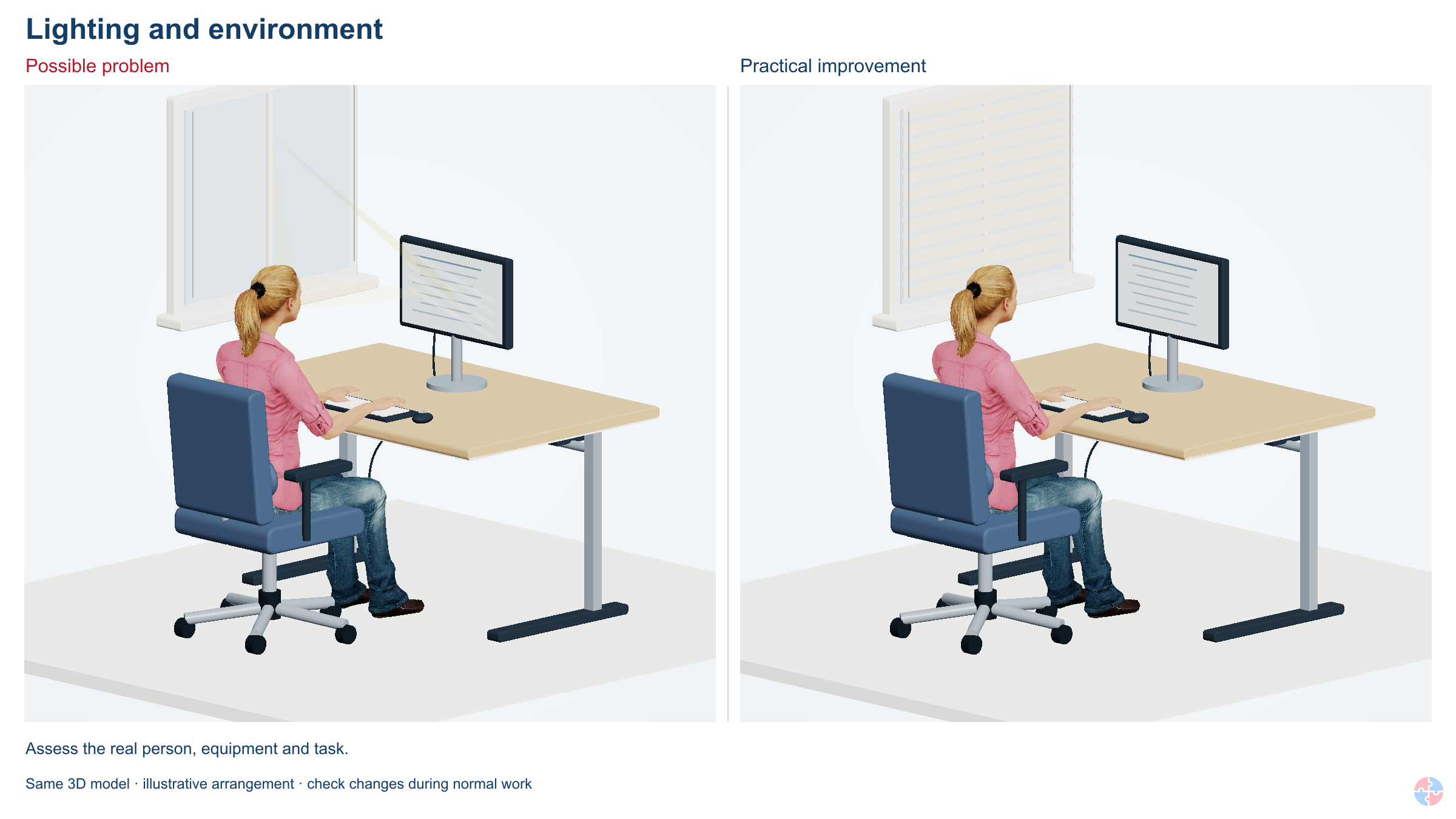
A reflected bright patch crosses the display; the source and reflected path are shown. Screen reflections can make detail harder to see and encourage an awkward head position. This represents visual discomfort, not eye damage. Reposition the screen relative to windows and lights, adjust blinds and check the screen again at different times.
Explore this setup in the interactive workstation (new tab)
Try the change in the actual task. The illustration does not diagnose discomfort or approve a workstation.
Learning step 1 of 7
Chemical splash, particles and optical radiation can injure the eye, while visual tasks can create discomfort or reveal an existing sight problem. Use the eye model to explain the surface, focusing and visual pathway. Do not suggest that ordinary DSE use permanently damages the eyes or that normal sight makes protection unnecessary.
 View full detail ↗
Compare the visible eye with its enlarged side cutaway. Locate the clear front, lens and inner rear lining before following light and visual signals.
Distinguish the protective eye surface from the internal visual pathway. What task-specific protection or workstation change does this lesson require?
educational illustration · healthy anatomy; enlarged details and teaching colours.Learning step 2 of 7
GB DSE users are entitled to an employer-funded eye and eyesight test if requested; repeat timing follows professional advice and relevant circumstances rather than a universal annual rule. Driving and specialist jobs have their own visual standards. Colour discrimination, depth perception or other tests need a role-based justification, not blanket exclusion.
Learning step 3 of 7
Choose protection for the real hazard and compatibility with corrective lenses and other PPE. Check lighting, contrast, glare and task demand. New or sudden visual loss, a serious eye injury or chemical exposure requires the appropriate urgent clinical response. A workplace vision screen is not a complete eye examination.
Learning step 4 of 7
In the mixed leisure-centre example, a splash interrupts chemical work: first aid, urgent care and control of the hazard come first. The supervisor keeps the affected task held until splash protection, eyewash and transfer controls are restored and verified. A requested DSE eye test follows its own route and does not replace injury assessment.
For eligible DSE users, retain the requested eye-test arrangements and the limits on special corrective appliances needed for screen work. Do not promise ordinary spectacles universally or treat them as chemical protection. Record only the functional adjustment and review information needed by the manager.
Content amended 19 October 2026 by the SHARE Knowledge Hub editorial team. This records an editorial content change; the existing technical-review and approval status still applies.
SHARE Knowledge Hub
Learning step 5 of 7
Start by removing avoidable repetitive screen work and redesigning the task, then provide adjustable equipment and a workable activity pattern; individual symptoms and needs govern the final setup.
In a call centre, automate duplicate entry where safe, adjust workstation and schedule non-screen tasks. A reception team may need a different approach because the screen and customer interface cannot be removed; verify the actual desk and shift pattern. Neither ordinary glasses nor PPE is a substitute for an effective workstation assessment.
A worker alternates between home and office screen work; assess both setups and agree adjustments without requesting a diagnosis.
ERICPD is a planning crossmap. Its prompts do not add a sixth rung or rank Isolate above engineering. Discipline verifies and sustains every control level.
The hierarchy of controls in ISO 45001:2018 comes under Clause 8.1.2 (Eliminating hazards and reducing OH&S risks), which is located within Clause 8 ("Operation") .
ESEAP: Elimination, Substitution, Engineering controls, Administrative controls and PPE. Control order: and .
 Enlarge schematic ↗
Learning step 6 of 7
ERICPD keeps chemical eye-injury control focused on removing and reducing splash risk before relying on PPE and behaviour.
Eye protection is important, but it is rarely the first control. The stronger approach is to eliminate unnecessary chemicals, buy safer products, dilute automatically, use closed transfer, lower the work height, reduce pressure, avoid sprays, fit splash guards, improve container design and keep faces out of the line of fire.
PPE then protects against residual risk. If goggles are the only meaningful control, the system is fragile: goggles may mist, be removed, fit poorly over prescription glasses, become scratched or fail to protect the face from a pressurised jet. Discipline, training and supervision are needed, but they should support a well-designed task.
Choose the activity that matches the work. Each has its own controls, verification and stop/restart decisions; ERICPD and ISO 45001 are alternative views of that same activity.
 Enlarge schematic ↗
Learning step 7 of 7
A treatment operator replenishes an identified hypochlorite system; prevent contact with acids or other incompatible products.
ERICPD is a planning crossmap. Its prompts do not add a sixth rung or rank Isolate above engineering. Discipline verifies and sustains every control level.
The hierarchy of controls in ISO 45001:2018 comes under Clause 8.1.2 (Eliminating hazards and reducing OH&S risks), which is located within Clause 8 ("Operation") .
ESEAP: Elimination, Substitution, Engineering controls, Administrative controls and PPE. Control order: and .
A worker charges cement into a mixer and handles wet mortar; both airborne powder and alkaline splashes can reach the eyes.
Use to choose stronger measures before PPE. ERICPD is a useful six-part teaching mnemonic; it is not a separate legal test. The example maps both approaches to the real task. Apply for a Northern Ireland workplace. Emergency washing and evacuation limit consequences; they do not prevent the original contact or mixing.
 Enlarge schematic ↗
Choose the correct eye-related response
Sort four requests: a DSE test, a chemical-splash event, a driving-standard check and difficulty reading an inspection mark. Identify the route and immediate work decision for each.
| Evidence | Compare the matched purpose |
|---|---|
| A DSE user asks for an eye test | DSE eye-test duty |
| A worker opens a pressurised splash-risk line | Exposure protection |
| A safety-critical task has a defined visual demand | Task-specific visual assessment |
Match the evidence to its purpose. Exposure, health effects, fitness and wider wellbeing require distinct decisions and records.
Visual performance and injury prevention answer different questions. The eye surface can be injured even when vision was previously normal. Use the actual substance/task assessment and appropriate emergency arrangements.
When requested, with repeat timing advised by the professional
DSE duties apply to qualifying users. Ordinary spectacles are not automatically employer-funded; special appliances are a task-specific issue.
No; assess exposure, task-specific protection and emergency arrangements
An eyesight test and protection against splash, particles or radiation answer different questions.
A visual-demand and eye-protection plan that states who tests what and why.
L12
Learning step 1 of 8
Consider blood and body fluids, contaminated waste, animals, water aerosols, heat, cold and solar UV where the task creates a risk. Exposure route and setting determine controls. Vaccination decisions need an exposure-based occupational-health assessment; vaccination does not replace engineering controls, hygiene or sharps prevention.
 View full detail ↗
A worker and a separate enlarged skin section introduce sweating and the skin’s blood supply. Connect these structures to the work and environment described in the lesson.
Locate the sweat gland and skin vessels in the enlarged view. How should conditions, workload, clothing and recovery be managed together?
educational illustration · healthy anatomy; enlarged details and teaching colours.Learning step 2 of 8
Ionising radiation and some optical radiation or electromagnetic-field work need specialist risk assessment and controls. Classified radiation workers, compressed-air workers and some other groups have specific medical arrangements. Do not generalise a specialist medical certificate to the rest of the workforce.
Learning step 3 of 8
Heat, restrictive PPE, heavy work and medicine or health-related needs can combine. Plan suitable work, welfare, staffing and individual support. Screening cannot make an unsuitable task safe. Use competent advice when the hazard or work capacity exceeds local knowledge.
Learning step 4 of 8
Biological agent exposure is controlled by preventing contact with the source, interrupting transmission and supporting susceptible people.
Control should follow the hierarchy, but biological hazards often need a bundle of controls: containment, hygiene, cleaning, ventilation, vaccination, waste management, PPE, training and rapid response.
The strongest controls remove or contain the source. For example, closed waste systems, engineered sharps safety, controlled water systems and restricted access are stronger than relying only on gloves or reminders.
Discipline remains important because hygiene and reporting depend on people. However, discipline works best when the workplace provides time, facilities, equipment and supervision to make the safe method realistic.
Eliminate. Remove the biological source or avoid the task. Use closed systems, outsource specialist handling or remove contaminated material safely. Not always possible in care, waste, water or animal work.
Reduce. Reduce exposure frequency, people exposed or contamination level. Limit access, reduce aerosol-generating tasks and minimise waste handling. Residual exposure may remain.
Isolate. Separate people from the source. Containment cabinets, segregated rooms, barriers and clean/dirty zones. Breaches occur during maintenance or cleaning.
Learning step 5 of 8
Control. Use engineering, hygiene and procedural controls. Ventilation, disinfection, handwashing, sharps containers, water treatment and waste segregation. Needs maintenance and verification.
PPE. Protect against residual contact or inhalation. Gloves, eye protection, aprons, masks or RPE depending on route. Can fail through poor selection, removal or contamination.
Discipline. Use training, supervision, reporting and behaviour controls. Hand hygiene, vaccination uptake, incident reporting and exclusion rules. Relies on good culture and adequate facilities.
Describe the remaining exposure routes when an area is handed back after contamination work. “Cleaned” can mean visible material was removed; it does not by itself establish that an infectious source has been stopped, the chosen treatment was suitable or later work will avoid aerosolising residue. Agree the intended next use and the evidence needed for that use before the contractor starts.
Learning step 6 of 8
For an illustrative sewage leak in a service room, the site owner and competent contractor establish which surfaces, equipment and access routes are affected, stop the source safely and use an assessed containment and cleaning method. Hand-back identifies what was treated, any inaccessible or untreated area, waste removed, remaining restrictions and who will decide whether the next task can proceed. If a later contractor needs to open contaminated equipment or use a different cleaning method, assess that activity separately. Keep worker exposure and clinical follow-up information in the appropriate private process rather than including medical details in a general area handover.
Guidance and scope: Original SHARE contractor example applying HSE GB incidental-infection guidance and COSHH. Agent-specific treatment, contact conditions and reopening evidence require competent selection; no universal disinfection method or laboratory clearance criterion is proposed.
Learning step 7 of 8
Assessment should consider environment, task, clothing/PPE, work rate, duration, worker feedback, symptoms, vulnerable groups and evidence.
The assessment starts with the work, not the weather. Ask what the person is doing, how hard they are working, what clothing or PPE they must wear, how long exposure lasts, what recovery is available and what happens if they become impaired.
For complex heat stress, HSE notes that measurement may need occupational health or competent support and may involve techniques such as wet-bulb globe temperature (WBGT), metabolic-rate estimation, clothing insulation values, heart-rate measurement or physiological monitoring where other controls cannot be implemented.
Neither the GB indoor guidance of normally 16°C, or 13°C for rigorous work, nor the similar Northern Ireland guidance is an outdoor work limit or a universal stop-work threshold. There is no legal maximum temperature. Any local work/rest or entry criteria must come from the actual task assessment, PPE and competent advice, then be checked against worker response. ; HSENI temperature guidance .
Learning step 8 of 8
Act on the affected room and its work pattern. The following example shows why a building-wide average and a new fan are both inadequate evidence of control.
The values are teaching examples, not observations about Riverside or a calculation of personal dose. A new basement use, extra contractor visits or a ventilation change reopens the assessment even if the earlier result was acceptable.
 Enlarge schematic ↗
HSE work requiring notification
Ionising Radiations Regulations 2017 (IRR17)
HSENI supplies the NI notification route
HSE ionising-radiation guidance
L121 explains the ionising-radiation control hierarchy
HSE optical-radiation guidance
Health and Safety Executive: Industrial radiography – managing radiation risks (IRP1)
UK government training reference: time, distance and shielding
Office for Nuclear Regulation: Criticality safety assessment of transport packages (NS-TAST-GD-097)
IOSH hierarchy of control guidance
Select the risk-based response
Compare a waste-handling task, an outdoor maintenance day and a specialist radiation role. State why their controls and health checks differ.
Other exposures have distinct controls and clinical/statutory arrangements. Do not substitute general screening for prevention or emergency response.
Confusion or collapse in heat needs emergency action. Sweating does not rule out heatstroke. The model explains thermal mechanisms and does not measure core temperature or give clearance to continue work.
Assess the task, source and routes, then prevent or control exposure
Controls, hygiene, work arrangements and specialist advice depend on the actual agent and task. Vaccination is risk-specific.
Control the heat/workload and plan acclimatisation, rest, hydration and response
Thermal strain depends on work, environment, clothing and individual factors. A model is educational, not a physiological monitor.
A gap check showing which specialist exposures are present and who must advise.
HSE: when an appointed doctor is required · HSE: workplace temperature assessment ·
L13
Learning step 1 of 7
Consider elimination, substitution, enclosure, capture, separation and safe work organisation before dependence on personal protection. Verify actual LEV capture, make-up air, maintenance and the way the job is performed. A fan running or an in-date certificate does not prove contaminants are kept out of a breathing zone.
Learning step 2 of 7
Personal air sampling, noise dosimetry, vibration assessment and some biological monitoring assess exposure. Static area measurements may not represent a person’s task. Use competent occupational-hygiene input for sampling strategy, uncertainty and interpretation; compare relevant periods and units, not arbitrary single numbers.
Learning step 3 of 7
GB WELs are published in current EH40 and may use an eight-hour time-weighted average and/or a short-term reference period. A result below a WEL does not cover every skin route, mixture, peak or sensitisation risk. For carcinogens, mutagens and asthmagens, additional ALARP control duties apply. Isocyanate urine monitoring shows uptake, not asthma or general fitness.
Learning step 4 of 7
LEV is an engineering control after elimination and substitution have been considered; the actual task still needs verification.
treats the hood, source, worker and airflow as one system. For a body-filler sanding task, ERICPD below links the five-level hierarchy to the owner and failure decision. A capture test should observe the actual sanding position and cross-draught, not only a fan reading.
If the contaminant crosses the breathing zone or the tool position changes beyond the designed capture zone, stop sanding, adjust the method and verify capture before restart. RPE may be needed for residual exposure but does not repair a failed source control.
 Enlarge schematic ↗
Learning step 5 of 7
LEV works as a complete system: source, hood, duct, air cleaner where needed, air mover and safe discharge. The test is whether it controls exposure during the real task; a running fan or an examination certificate alone does not prove this.
Identify where the dust, mist, fume or vapour is generated, its direction and how the worker carries out the task. Keep the worker’s breathing zone out of the contaminant route; an attractive hood position in a photograph is not evidence of capture.
Check the hood, enclosure, work position, make-up air and indicator against the commissioned benchmark and user instructions. There is no universal safe hood distance or airflow for all substances and processes.
Look for changes, damaged ducts, blocked filters, failed indicators and discharge or recirculation concerns. General room air and make-up air have different functions from capture at source. Retain fire, explosion and non-inhalation exposure assessments where relevant.
 Enlarge schematic ↗
Learning step 6 of 7
Stop or make the emitting task safe using the agreed procedure if capture fails. Arrange competent investigation, repair and task-based verification before restart. Maintain user checks, maintenance and the required examination and test records.
Do not keep working solely because the fan sounds normal. The actual emission, hood position, air movement and benchmark evidence must support the decision.
At
Learning step 7 of 7
Start with the substance and task, then prevent or reduce release at source. Monitoring tests a defined question about exposure and control; it cannot make a weak process safe by producing one passing number.
An exposure limit does not replace the hierarchy. Eliminate or substitute a harmful substance where feasible, contain and capture release, organise the work and use suitable RPE for residual risk. Record the sampling question and who may hold or release work.
A competent monitoring plan defines similar exposure groups, tasks, shift and peak variability, sampling location and duration, analytical method, detection limits and interpretation. Include cleaning, maintenance and abnormal but foreseeable operation. Compare with current EH40 in the correct units and consider other routes, combined exposures and health surveillance separately. Repeat or redesign measurement after a material change or control failure.
Use the HSE hierarchy for this task: eliminate the hazard where possible, substitute, use engineering controls, organise the work and use suitable PPE for residual risk. The exact choices require a task-specific assessment and competent verification.
Verify a failed LEV control
Inspect the existing LEV model, identify the release and capture route, and decide what evidence is needed before accepting the control. Compare an air sample, spirometry and an isocyanate urine result.
User checks, maintenance, thorough examination/testing and representative exposure assessment have different roles.
Representative sampling, task peaks, skin routes and the required level of control
A WEL is not a boundary between all safe and unsafe circumstances. COSHH control requirements and the actual exposure pattern still apply.
It is a user check within a wider maintained and examined control system
Check hood position, process, maintenance, defects and competent testing. A single indicator is limited evidence.
A verification plan naming the question, competent method, acceptance basis and response to failure.
HSE: workplace exposure limits and exposure routes · HSE G408: isocyanate urine monitoring · HSE: representative isocyanate biological monitoring ·
L14
Learning step 1 of 8
Occupational hygienists assess and control exposure; occupational-health nurses and physicians advise on health surveillance, work effects and fitness; trained technicians can perform specified tests under suitable oversight. Some statutory medical surveillance requires an HSE-appointed doctor or the applicable NI route. Ordinary GP registration does not by itself demonstrate competence for every OH service.
Learning step 2 of 8
Supply the task description, hazards, exposure assessment, control information, similarly exposed groups and relevant shift arrangements. Agree the required tests, baseline timing, recall basis, referral thresholds, reporting and urgent-contact route. Avoid buying a generic annual test bundle without a defined exposure question.
Learning step 3 of 8
Ask about test competence, calibration and quality assurance, clinical interpretation, accessibility, confidentiality and business continuity. Confirm who chases missed appointments and implements advice. A mobile clinic visit is only one part of a managed programme.
Learning step 4 of 8
A good referral asks answerable work questions and gives enough job-demand information for useful advice.
Poor referrals ask OH to decide whether someone is safe without explaining the work. Good referrals describe the role, hazards, safety-critical tasks, hours, travel, PPE, exposures, emergency demands and proposed adjustments. GOV.UK personal data an employer may keep
The worker should understand the reason for referral, what information will be shared and what type of advice the employer will receive.
Learning step 5 of 8
Learning step 6 of 8
Learning step 7 of 8
Explain the referral questions, who will receive the functional report and what happens if disclosure is withheld. Consent to assessment/report release does not by itself establish the employer’s health-data processing basis; use the lawful basis and special-category condition already described below. Refusal alone is not evidence of unfitness: discuss the information gap, safe interim duties and fair review with the worker and OH/HR.
Before sharing an anonymised trend, assess whether small groups, rare tasks or the combination of cases could identify a person. Aggregate further or restrict the audience where needed; the control owner needs exposure learning, not recognizable individual health histories.
Learning step 8 of 8
The key points are risk, suitability, confidentiality, competent interpretation and action on results. Health surveillance is repeated, risk-specific checking for early signs of work-related ill health; biological monitoring measures chemical uptake and is not a diagnosis by itself.
Apply it: Which part of this plan would you check at the workface before authorising the task?
The key points are risk, suitability, confidentiality, competent interpretation and action on results.
The key points are risk, suitability, confidentiality, competent interpretation and action on results.
HSE health surveillance (Great Britain)
Choose the useful items for an OH service brief
Compare two fictional OH quotations: an annual all-staff package and a hazard-based service linked to the risk assessment. Identify the missing specifications in each.
Specify decisions and follow-through while protecting confidential clinical information. Throughput alone does not show effectiveness.
Actual job demands, exposures, required decisions, reporting and escalation arrangements
Commission for the risks and decisions, with competence, confidentiality, quality assurance and follow-through built in.
The employer, informed by competent advice and consultation
Advice must be translated into work controls, responsibilities, review dates and checks that adjustments are effective.
A provider brief stating cohort, purpose, competence, tests, reporting boundaries and response times.
HSE: selecting the right health-surveillance approach · HSE: when an appointed doctor is required ·
L15
Learning step 1 of 7
In Great Britain, Equality Act restrictions limit health and disability enquiries before a job offer, subject to specified exceptions. A broad health questionnaire at application is not the default route. Post-offer pre-placement assessment should be proportionate to intrinsic job demands, hazards and adjustments; Northern Ireland has its own employment framework.
Learning step 2 of 7
A baseline before exposure or a change into an exposed role helps later comparison. It is not a certificate that a person can never develop disease, nor a reason to tolerate poor controls. Include existing staff when introducing a scheme and record uncertainty about earlier exposure rather than inventing a pre-exposure result.
Learning step 3 of 7
OH should design or approve relevant questions and receive clinical answers confidentially. The manager normally needs work capacity, restrictions, actions and review timing, not every diagnosis or raw test. Make the process accessible, explain its purpose and explore appropriate adjustments with the person.
Learning step 4 of 7
Assurance should test whether controls work in practice, not whether the page or procedure exists.
Assurance should include frontline checks, manager review and periodic independent sampling where risk warrants it. The purpose is to find weak signals early, close actions properly and update the risk assessment when work changes. Fit note checklist for employers
Learning step 5 of 7
Learning step 6 of 7
Learning step 7 of 7
Health surveillance is repeated, risk-specific checking for early signs of work-related ill health; biological monitoring measures chemical uptake and is not a diagnosis by itself. Employers need to control exposure first, choose a suitable scheme with competent advice, act on results and keep employer health records separate from confidential clinical medical records. COSHH assessments, noise survey, exposure group register and contractor task review.
Apply it: What evidence would show that the change improves this task, rather than only completing a record?
Use the evidence to improve the actual work arrangement.
HSE five-level hierarchy (Great Britain)
Plan a fair baseline and placement process
An employer sends an extensive medical questionnaire with every application and stores answers in a supervisor’s shared folder. Redesign the timing, purpose, recipient and decision route.
This sequence is planning guidance. GB pre-offer health-question restrictions have specific exceptions; apply the correct legal framework, including separate NI arrangements.
The actual role and exposure risks, with fair and lawful information use
Separate recruitment fairness from post-offer, job-related assessment. Consider reasonable adjustments and the correct jurisdiction.
To establish a useful starting comparison and identify appropriate advice
A baseline supports comparison; it is not permission to expose or a substitute for prevention and recall.
A fair pre-placement and baseline pathway, including current workers moving to a new exposure.
Equality Act explanatory notes: section 60 health enquiries · ICO: workers’ health information ·
L16
Learning step 1 of 6
Use exposure evidence and the criteria for an identifiable work-related health effect, a reasonable likelihood and a valid low-risk detection method. Noise, HAV and COSHH schemes have different triggers. Contractors and agency arrangements require coordination so people are neither missed nor subjected to unexplained duplicate tests.
Learning step 2 of 6
For each cohort, specify hazard, basis, baseline, method, professional oversight, routine interval, early review triggers and employer action. The matrix below shows typical HSE approaches and explicit limits. Annual reviews are common in some schemes; they are not a universal legal timetable. New symptoms, high exposure or changed work require action between recalls.
Learning step 3 of 6
Arrange appointments in workable time, manage missed checks with OH, give workers their results and implement fitness advice. Review controls and similarly exposed colleagues when a concern is identified. Keep surveillance distinct from diagnosis, statutory specialist medicals, air monitoring, face-fit testing and voluntary wellness screening.
Learning step 4 of 6
Assessing: Map substances, routes of entry, task duration, abnormal work, PPE reliance, noise areas, maintenance cleaning and emergency exposure scenarios. Evidence / response: COSHH assessments, noise survey, exposure group register and contractor task review. Analysing: Compare air monitoring, biological monitoring, symptoms, missed surveillance, PPE defects and maintenance findings. Evidence / response: Exposure-control dashboard and grouped OH trend report.
Apply it: At which point would you hold this example, and what evidence would allow it to proceed?
Fictional example: a practical application of the existing topic lesson.
HSE health surveillance (Great Britain)
Learning step 5 of 6
A health check does not remove a harmful workplace exposure. Assess and control the work risk first; use health surveillance only where the exposure and applicable rules call for it.
A competent occupational-health and legal review must define the test, referral and confidential record route before use.
ERICPD (Eliminate, Reduce including substitution, Isolate, Control, personal protective equipment (PPE), Discipline) is a SHARE decision prompt cross-mapped to HSE’s five-level hierarchy. Choose stronger feasible controls first, verify them in the actual task and record why a stronger option cannot be used. Discipline means sustaining controls through maintenance, supervision and learning. Apply this proportionately to the actual work risk; body size, distress or a health result is not itself a control hierarchy. Organisational rules are administrative controls, and support services do not replace prevention.
ERICPD is a planning crossmap. Its prompts do not add a sixth rung or rank Isolate above engineering. Discipline verifies and sustains every control level.
 Enlarge schematic ↗
Learning step 6 of 6
The hierarchy of controls in ISO 45001:2018 comes under Clause 8.1.2 (Eliminating hazards and reducing OH&S risks), which is located within Clause 8 ("Operation") .
ESEAP: Elimination, Substitution, Engineering controls, Administrative controls and PPE. Control order: and .
Occupational Health
 Enlarge schematic ↗
Control of Substances Hazardous to Health Regulations 2002
HSE Health surveillance under COSHH
HSE Health surveillance overview
Control of Substances Hazardous to Health Regulations (Northern Ireland) 2003
HSENI Health and medical surveillance
| Risk | Eligibility | Baseline | Recall | Response |
|---|---|---|---|---|
| Noise / hearing | Workers regularly above upper noise action values, or otherwise at risk. | Ideally audiometry before exposure or as soon as practicable; retain a valid comparison baseline. | Usually annual checks for the first two years, then three-yearly; more often where risk or findings justify. | OH-led programme with competent testing; act on changes and review noise controls. |
| Hand-arm vibration | Workers regularly above the HAV action value despite controls, or otherwise at risk. | Initial pre-exposure questionnaire and higher-tier assessment if indicated. | Annual screening questionnaire is the usual routine tier; positive reports require timely review, not waiting a year. | OH oversight; tiered clinical assessment and fitness advice where needed. A points total is not a diagnosis. |
| Respiratory sensitisers / occupational asthma | Task and substance risks indicate surveillance, including relevant isocyanate, flour, enzyme or wood-dust exposure. | Respiratory baseline ideally before exposure; HSE gives within six weeks as an example if not done beforehand. | Usually annual; earlier or more frequent assessment for new workers and relevant risks. A fixed 6/12-week schedule is not universal law. | Questionnaire and spirometry as advised; an OH-approved questionnaire-only route can be suitable in specified lower-risk circumstances. |
| Skin irritants, sensitisers and wet work | Residual work-related skin risk meets surveillance criteria. | Questionnaire and relevant skin inspection before exposure or promptly afterwards; six weeks is an HSE example. | OH sets an appropriate frequency; annual is an example, not a reason to ignore earlier symptoms or necessary interim checks. | Suitable inspection and questionnaire; a trained responsible person works within OH support and referral limits. |
| Respirable crystalline silica | Regular RCS exposure with a reasonable likelihood of silicosis. | Respiratory questionnaire, spirometry and clinician-led consideration of imaging under current silica guidance. | Periodic surveillance, commonly annual questionnaire and lung-function testing; imaging timing and higher-risk pathways require OH judgement under current guidance. | Chest X-ray or CT is not a blanket annual test. Normal spirometry cannot exclude early silicosis. Use the May 2026-amended HSE guidance. |
| Isocyanate biological monitoring | Check uptake and the effectiveness of controls for relevant work, particularly vehicle paint spraying. | Plan representative sampling, correct analyte and timing; obtain informed consent. | HSE recommends annual sampling for vehicle spray painters; other G408 contexts may use once or twice yearly and retesting after corrective action. | End-of-task/shift samples are timing-sensitive. Results indicate uptake, not asthma, diagnosis or future fitness. |
| Lead | Exposure is or is liable to be significant under the applicable lead regime. | Initial assessment and biological tests arranged through the relevant appointed doctor. | Periodic medical and biological monitoring determined by the regime and doctor, with earlier action when indicated. | A generic annual blood test is insufficient. Follow current doctor-led restrictions and action requirements. |
| Asbestos medical surveillance | Depends on whether the work is licensable or notifiable non-licensed, not merely being near an asbestos register. | Required medical evidence before the relevant work; the correct doctor and certificate must be established. | GB licensable work: at least every two years; NNLW: at least every three years, or earlier if advised. | Different from a general lung check. Ordinary non-licensed work does not automatically have the same medical requirement; classification needs competent assessment. |
| Repetitive tasks / MSDs / whole-body vibration | Use task assessment, symptom reporting and appropriate individual OH referral. | Job-demand and relevant functional information, proportionately obtained. | Review after symptoms, task or equipment changes and as professionally advised. | No universal statutory annual joint exam or generic MSD test for all workers. ART, MAC, RAPP and WBV assessments measure different task risks. |
| DSE / eyesight | DSE user requests an eye and eyesight test; specialist roles may have separate visual standards. | Arrange the appropriate optometric test when requested; use role-based assessment for safety-sensitive visual demands. | Further testing follows professional advice and relevant symptoms or circumstances; no blanket annual test for every employee. | Acuity screening is not a full eye examination. Assess visual demands, glare and corrective-lens/PPE compatibility separately. |
| Night work | Offer the required free health assessment to night workers under the applicable working-time rules. | Offer before starting night work. | Offer regular assessments; interval depends on the individual assessment. Workers do not have to accept. | This is an offer-based scheme with its own records and response requirements, not a universal annual medical. |
| Safety-sensitive role / return to work | The specific job, sector rules, condition and professional advice determine the need. | Post-offer pre-placement or role-change review where proportionate and lawful. | Relevant role standards, symptoms, treatment change, absence or review date set by competent advice. | Driving, rail, aviation and other sectors can differ; do not reuse a generic certificate or invent a universal recall. |
| Ionising radiation and other specialist medical regimes | Specific classified persons or work defined by the relevant regulations. | Establish the correct specialist or appointed-doctor route before designated work. | Follow the actual regime and doctor-directed periodic review. | Separate medical surveillance and exposure/dosimetry records; a general screening contractor may not be authorised. |
| General wellbeing screening | Optional, proportionate health-promotion offer with a clear purpose and privacy arrangements. | Explain the test, choice, limits, follow-up and data use. | A clinician or programme design sets any justified interval; annual testing is not automatically required. | Blood pressure, cholesterol, glucose, BMI and lifestyle questionnaires do not replace occupational surveillance or guarantee fitness. |
Match the surveillance situation to its next step
Choose a surveillance pathway for the five fictional work groups in the capstone. Reject at least three irrelevant tests and explain the early-referral triggers.
| Evidence | Compare the matched purpose |
|---|---|
| Eligible hand-arm vibration exposure | Baseline and usual annual questionnaire with escalation |
| At-risk noise exposure | Baseline then usually annual first two years, then three-yearly, adjusted |
| Respiratory sensitiser exposure | OH-directed respiratory scheme, usually annual with earlier checks as indicated |
| Isocyanate urine sample | Separate uptake monitoring; not an asthma diagnosis |
Match the evidence to its purpose. Exposure, health effects, fitness and wider wellbeing require distinct decisions and records.
By hazard, applicable duties, OH advice, risk and previous findings
There is no single yearly medical requirement covering every exposure. Planned recall needs a symptom route between appointments.
An annual questionnaire with prompt escalation of positive findings
HAV surveillance is tiered and OH-led. Screening is not a points calculation or a universal imaging programme.
A hazard-to-surveillance matrix with named responsibilities, review rules and control follow-through.
HSE: COSHH health surveillance · HSE: hearing health surveillance and example recall intervals · HSE G402: occupational asthma surveillance · HSE G403: dermatitis surveillance · HSE: HAV health-surveillance guidance for OH professionals · HSE: RCS surveillance guidance, amended May 2026 ·
L17
Learning step 1 of 8
Audiometry measures hearing thresholds under controlled conditions. Suitable equipment, test environment, trained personnel and clinical oversight matter. Compare valid results with baseline and previous tests; interpret changes through the professional pathway. An audiogram is not a noise survey and cannot by itself identify the cause of every hearing change.
Learning step 2 of 8
Spirometry measures volumes and flow, including FEV1, FVC and their relationship. Acceptable effort, repeatability, equipment quality and suitable reference interpretation are essential. A low-quality trace can mislead; a normal trace does not rule out asthma. Clinical staff decide contraindications, repeat testing and referral. Managers must not diagnose from a single percentage or graph.
Learning step 3 of 8
A basic visual-acuity screen, a full optometric eye examination and a role-specific vision assessment have different scope. Blood pressure, glucose or cholesterol checks answer other questions and are not substitutes for hazard-specific surveillance. Teach how to commission, understand the purpose of, and act on advice from testing—not how to perform unsupervised clinical examinations.
 View full detail ↗
See the layered vessel wall around the space blood travels through. Blood cells and tissue details are enlarged; this is a structural illustration, not a pressure reading.
Locate the vessel wall and lumen. Explain why a blood-pressure check and exposure-specific health surveillance answer different questions.
educational illustration · healthy anatomy; enlarged details and teaching colours.Learning step 4 of 8
Surveillance list does not match risk assessment: Workers at risk are missed or low-risk workers are included without purpose. Results are filed without review: Control failure continues until disease appears. Medical details circulate: Trust is damaged and privacy law may be breached.
Apply it: Who could be exposed, including other trades, cleaners, maintainers and people nearby?
Connect the task, the route to the person and the control that can fail.
Learning step 5 of 8
Rank source removal, quieter substitution and engineering ahead of time limits and hearing protectors; name an owner and acceptance measure.
HSE prioritises eliminating and substituting hazards before engineering controls, administrative controls and PPE, as explained in its . SHARE uses ERICPD as a task-planning prompt: Eliminate; Reduce, including substitution; Isolate through engineered separation; Control with other engineered or administrative measures; PPE; and Discipline, meaning continued verification and maintenance. ERICPD is not a sixth HSE level or a separate legal duty. The example below is a feasibility test for this work, not a universal prescription.
ERICPD is a planning crossmap. Its prompts do not add a sixth rung or rank Isolate above engineering. Discipline verifies and sustains every control level.
The hierarchy of controls in ISO 45001:2018 comes under Clause 8.1.2 (Eliminating hazards and reducing OH&S risks), which is located within Clause 8 ("Operation") .
ESEAP: Elimination, Substitution, Engineering controls, Administrative controls and PPE. Control order: and .
 Enlarge schematic ↗
Learning step 6 of 8
Select hearing protection for the measured spectrum and task. Fit, compatibility with other PPE, comfort, speech and warnings matter. An SNR shortcut is limited, especially for low-frequency noise; specialist frequency-band assessment may be needed. Record the residual risk and verify the source controls before relaxing zones or surveillance. Sources: , .
Read the practical categories separately: elimination removes the hazardous task/source; substitution replaces it with a suitable safer alternative; physical separation, containment and capture are engineering decisions. Duration/access/briefing are administrative measures, PPE covers residual exposure, and continued inspection, maintenance and verified action closure sustain the controls. Exposure monitoring or dosimetry measures exposure rather than protecting a person. The detailed text and records below distinguish these decisions; an overview illustration is not task authorisation.
 Enlarge schematic ↗
Learning step 7 of 8
A splash, foreign body, injury or sudden concerning change needs its appropriate immediate first-aid/medical route. Routine screen-work support is a separate assessment and adjustment process.
Use the relevant immediate first-aid and medical arrangements for injury or sudden concerning symptoms; do not wait for a routine eyesight appointment.
Assess source controls and the actual splash, particle or other eye hazard before selecting appropriate protection.
Use the applicable eyesight/DSE assessment and private work-adjustment process, checking equipment, task and usability.
The anatomy is explanatory, not a diagnostic test, treatment method or statement of an individual’s fitness.
 Enlarge schematic ↗
Learning step 8 of 8
Strong chemical in an eye: start gentle rinsing immediately with plenty of clean, non-hot water, holding the eye open, for at least 20 minutes. Go to A&E or call 999; keep rinsing while waiting for help. High-speed impact or a pierced eye: get emergency assessment; do not rub it or remove a pierced object. Sight changes or severe eye pain after injury also need emergency help. Do not drive yourself.
The rinsing instruction is for chemical contamination, not a generic timer for penetration, skin chemical injury or thermal burns. Twenty minutes is a minimum instruction, not proof that the eye is unharmed.
Select valid testing and interpretation principles
Review three fictional provider summaries with missing quality information. Identify which result needs clarification and what the employer is entitled to receive.
Test quality, context and trend matter. No single hearing, vision or lung result can verify every workplace control.
Poor-quality manoeuvres can make comparison and interpretation unreliable
Competent testing, quality assurance and professional interpretation are essential. The right comparison and symptom context matter.
Annually for the first two years, then usually three-yearly, adjusted to risk/findings
Baseline is ideally before exposure or as soon as practicable. OH may specify more frequent checks for risk or changes.
A test-quality and interpretation question list for the OH provider, without clinical cut-off scoring by learners.
HSE: hearing health surveillance and example recall intervals · HSE G402: occupational asthma surveillance · HSE: DSE eye and eyesight testing ·
L18
Learning step 1 of 4
A respiratory, skin or HAV questionnaire should be appropriate to the hazard, accessible and backed by a response pathway. A yes answer prompts appropriate review; it is not a diagnosis or an automatic failure. The examples below are fictional teaching prompts, not validated forms to deploy or complete with real medical information.
Learning step 2 of 4
The employer’s health record documents relevant exposures, surveillance and fitness advice. Clinical notes and detailed test information belong in the OH medical record under medical confidentiality. Consent to examination, consent to release a clinical report and data-protection lawful bases are separate questions. Apply current ICO guidance and competent advice; do not assume employee consent alone resolves all processing requirements.
Learning step 3 of 4
Use the applicable regime: COSHH health records commonly require at least 40 years from the last entry; other regimes differ. Do not apply a single destruction date to every OH, wellbeing and employment record. Agree secure access, transfer to a new provider, worker access and business-closure arrangements without publishing individual results in small-team dashboards.
Learning step 4 of 4
Eliminate: Specify a coating and finish that avoids spray isocyanate where performance permits. Reduce: Test lower-hazard compatible product and method; assess new exposure and quality risks. Isolate: Keep spraying inside a suitable enclosed booth away from other workers. Control: Maintain booth extraction and verified capture for the actual spray task. Control: Restrict access; measure, display and follow booth clearance time before entering or removing respiratory protection. Read the full control table for qualifications, ownership and verification. Use the actual task and applicable jurisdiction; existing technical approval remains unchanged.
Apply it: Which stronger option can be used here, and who will verify it before accepting the remaining risk?
Start with the stronger practicable options and verify their effect.
OH receives and interprets the clinical answers. New symptoms prompt advice and exposure review; do not arrange a deliberate re-exposure test.
Use relevant inspection and competent advice. A supervisor does not diagnose an allergy or perform patch testing.
Use an approved initial/annual questionnaire in the real scheme. These prompts are illustrative, not a substitute for the validated OH process or tiered assessment.
Seek clinical or OH advice where needed; the form does not prove diagnosis, causation or fitness.
Choose optometric, clinical or role-standard advice appropriately. Do not label a vision problem from a workplace checklist.
Route the information appropriately
Sort a fictional record pack into employer operational information and confidential OH material. Redact a management report to the minimum necessary work advice.
| Evidence | Compare the matched purpose |
|---|---|
| Detailed symptom and treatment history | Confidential clinical record held through the clinical service |
| Work restriction, required adjustment and review date | Employer work-relevant health/fitness record |
| A pattern of deterioration without identifying individuals | Anonymised group trend for prevention review |
Match the evidence to its purpose. Exposure, health effects, fitness and wider wellbeing require distinct decisions and records.
Work-relevant functional advice, restrictions and review requirements
Employer health records and confidential clinical records are different. Use lawful, proportionate, need-to-know information.
Some COSHH health records require 40 years; determine the rule for each record type
Purpose, statutory requirements, confidentiality and retention schedule differ by record. Do not apply one number indiscriminately.
A data-flow map showing collection purpose, recipient, access, retention rule and action owner.
HSE: employer health records and confidential medical records · ICO: workers’ health information ·
L19
Learning step 1 of 10
Consider stamina, dexterity, breathing, vision, hearing, alertness and other relevant functions against the job. Medication, long-term conditions and psychosocial demands can affect work without justifying blanket exclusion. Use OH advice and reasonable adjustments, with an appropriate recruitment or employment process.
Learning step 2 of 10
New wheeze, numb fingers, skin breakdown or reduced function needs a timely work decision and clinical or OH referral. Serious acute illness needs emergency help. Review exposure controls and affected colleagues. Symptoms alone do not automatically establish a RIDDOR disease; the diagnosis and specified work link must be checked under the correct GB or NI rules.
Learning step 3 of 10
Agree suitable duties, hours, control improvements, support and review dates with the person. A fit note or surveillance certificate does not release a failed extraction system or authorise an uncontrolled task. Verify the work arrangements and the relevant clinical advice before returning to the exposure.
Learning step 4 of 10
A worker is returning to a packing task with functional advice. Assess the real loads and work pattern with them, agree suitable aids or duties and review the outcome; managers do not infer capacity from a diagnosis alone.
Learning step 5 of 10
 Enlarge schematic ↗
Learning step 6 of 10
 Enlarge schematic ↗
Learning step 7 of 10
Learning step 8 of 10
Learning step 9 of 10
Use a pathway from absence contact to functional assessment, work plan, adjustment, review and learning.
A practical pathway is: absence reported -> supportive contact agreed -> fit-note or health advice considered -> return meeting planned -> work ability and task risk reviewed -> adjustments agreed -> phased return or modified duties started -> review dates set -> risk assessment and workload updated.
The process should be tailored. A short flu absence may need a simple check-in. A long-term condition, serious injury, mental ill health, surgery, fatigue condition or safety-critical role may need occupational health advice and a staged plan.
Learning step 10 of 10
The Management Standards provide a practical structure for identifying and controlling the main work-design factors associated with work-related stress.
Health and Safety Executive (HSE)'s Management Standards cover six areas of work design: demands, control, support, relationships, role and change. They are not a questionnaire exercise on their own. They are a way to gather evidence, consult workers, identify underlying causes and agree practical improvements. Sources: ;
A suitable stress risk assessment should use what the organisation already knows, such as absence data, workload pressure, overtime, turnover, grievances, violence reports, exit interviews, complaints, project delays and supervisor feedback. It should also involve workers and representatives because stressors are often hidden in work as done, not in the organisation chart. Sources: ;
The standard of control is not met by telling workers to be resilient while leaving excessive workload, conflict, role ambiguity or poor change management untouched. Prevention comes from better work design, better management and proper resourcing. Sources: ;
HSE work-related stress and mental health
Make a return-to-work recommendation effective
A worker has normal spirometry but reports chest tightness after spraying. Another has a low HAV point total but new finger symptoms. Decide the next actions without diagnosing either person.
Do not circulate unnecessary diagnoses. A plan on file is not evidence that the shift roster or task allocation implements it.
Actual tasks, agreed adjustments, owners, restrictions and review triggers
Use functional advice and consult the worker. Adjustments must be feasible, implemented and checked.
When the relevant medical diagnosis, work link and RIDDOR criteria are met
Investigate symptoms promptly, but symptoms alone are not an automatic occupational disease RIDDOR report.
A symptom-to-action and safe-return pathway that includes competent review and control verification.
HSE: reportable occupational diseases · Acas: reasonable adjustments in Great Britain · HSE G402: occupational asthma surveillance ·
L20
Learning step 1 of 14
Use the fictional mixed-workshop project below. It combines chemical spraying, grinding and sanding, dust-producing work, wet cleaning, repetitive packing and screen work. Different hazards can affect one person, but that does not justify every test for every worker. The job and exposure evidence drive selection.
Learning step 2 of 14
Inspect the linked 3D scenes, use the HAV and noise exercises, review the actual SHARE database starting points and choose relevant audit or checklist evidence. Database templates support thinking; they do not establish that a real workplace is compliant. Explain missing evidence and a stop or hold decision.
Learning step 3 of 14
The proposed delivery assessment combines a case portfolio and a separate knowledge check. An 80% knowledge threshold plus all designated critical decisions is a proposed design rule, not an existing award. Model launches, page views and points must not substitute for correct decisions, practical competence or clinical authority.
Learning step 4 of 14
Use the full topic for the decision points, practical examples, detailed control tables and source scope. HSE guidance applies to Great Britain; use HSENI for the Northern Ireland route and the source’s stated jurisdiction. A simplified guide does not change the page’s technical-review or approval status.
Apply it: Which official source and full-topic section will you use to resolve the next decision?
Follow the official sources below and retain the task-specific evidence.
HSE health surveillance (Great Britain)
Learning step 5 of 14
ERICPD (Eliminate, Reduce including substitution, Isolate, Control, Personal Protective Equipment, Discipline) below is a practical teaching structure for comparing controls against this one crush pathway; it is not a statutory checklist. The competent assessor and operations owner must select and verify the actual site design. The source hierarchy and HSE risk steps still govern the judgement.
The orders elimination, substitution, engineering, administrative control and PPE. ERICPD teaching prompt cross-maps to those levels but does not treat Reduce, Isolate or Discipline as identical statutory stages. Use the to check actual people, routes, residual risk and review triggers.
On a narrow screen, scroll this table sideways to see feasibility, verification and stop decisions.
ERICPD is a planning crossmap. Its prompts do not add a sixth rung or rank Isolate above engineering. Discipline verifies and sustains every control level.
The hierarchy of controls in ISO 45001:2018 comes under Clause 8.1.2 (Eliminating hazards and reducing OH&S risks), which is located within Clause 8 ("Operation") .
ESEAP: Elimination, Substitution, Engineering controls, Administrative controls and PPE. Control order: and .
 Enlarge schematic ↗
Learning step 6 of 14
Work the control hierarchy through an actual harm path. A forklift reversing into a pedestrian could cause a fatal crush injury. First test removing the crossing by route redesign and use fixed barriers and protected crossings for remaining conflicts. Separating delivery times is an administrative arrangement: verify bookings and deviations and suspend conflicting movement if timing fails. Only after these source and engineering controls should the assessor rely on speed rules, banksman instructions, training or high-visibility PPE. The operations manager owns the changed layout; the supervisor checks barriers and actual crossings before release, observes use during a live shift and records defects and worker feedback. Stop vehicle movement when segregation is absent, a barrier is damaged or the intended route is unavailable; do not treat a signed briefing as evidence of an effective physical barrier. and its support this worked method; the precise layout is an illustrative application that needs site-specific competent assessment.
 Enlarge schematic ↗
Learning step 7 of 14
A suitable and sufficient assessment identifies hazards, who may be harmed and how, actual exposure and controls, further controls, accountable owners and review triggers. HSE and HSENI each describe identify, assess, control, record and review; select the GB or NI law for the work location.
A suitable and sufficient assessment should be specific enough to control the real risk, but not so bureaucratic that no one uses it. It should consider routine work, non-routine work, maintenance, cleaning, contractors, visitors, vulnerable workers, emergency situations and change.
The assessment should also be honest about uncertainty. If the assessor does not know the exposure level, structural capacity, chemical hazard, ground condition or machine safety requirement, the output should be competent advice or further assessment, not a guess hidden in a green box.
Learning step 8 of 14
Choose measures during Plan, collect credible evidence during Do and Check, and use it for decisions during Act. Management review should ask what is not working and what needs resources, rather than merely receive a dashboard.
 Enlarge schematic ↗
Learning step 9 of 14
Understand the activities and people affected, identify hazards, assess risks and opportunities, establish applicable requirements and set owned OH&S objectives. Risk profiling informs planning as well as implementation.
Evidence to connect: Activity review; risk and legal registers; worker input; objectives, owners, resources and measures of success.
Learning step 10 of 14
Provide competent people, usable current information and suitable resources. Operate the agreed controls and manage procurement, contractors, change and emergencies with worker involvement.
Evidence to connect: Current policies and procedures; competence evidence; maintenance and operational records; contractor, change and emergency arrangements.
Learning step 11 of 14
Evaluate reliable monitoring and measurement, relevant compliance evidence, internal audits and management review. Routine checks and independent audit serve different purposes; low accident numbers alone cannot show that controls work.
Evidence to connect: First-line checks; exposure and control-performance information; compliance evaluations; audit samples and management-review decisions.
Learning step 12 of 14
Respond to incidents, nonconformities and ineffective controls. Protect people, address the causes, assign action and verify effectiveness, then update affected risks, arrangements and competence requirements.
Evidence to connect: Corrective actions with owners and dates; cause analysis; verified changes; revised documents and feedback into the next plan.
Learning step 13 of 14
Leaders own the effectiveness of the OH&S system, set priorities and provide resources. Context defines what the system must address; worker consultation and participation inform decisions throughout the cycle, not just at the centre.
Evidence to connect: An accurate system scope; policy commitments; clear authority and responsibilities; worker participation; resource and review decisions followed through.
Read the picture as a learning aid, not an official ISO clause diagram. Its risk-profiling label sits under Do; ISO planning also addresses hazards, risks, opportunities and relevant obligations before work begins. Likewise, formal ISO management review is part of performance evaluation, with its decisions feeding subsequent improvement. Activities can span more than one stage.
In the SHAREhub environment: link the risk or objective, its current arrangement, monitoring evidence and any improvement action. Retain a responsible owner, relevant dates and evidence that the change worked; a link between records is not proof of effectiveness.
Learning step 14 of 14
The cycle can organise a management system, but the diagram, a document library or a completed checklist does not establish conformity, certification or legal compliance. Use the authorised applicable standard and actual workplace evidence. Do not wait for the next audit or annual review to address an ineffective control.
Two-pack spraying and paint mixing; one fictional report of chest tightness.
Inspect spray controls and clearance arrangements; arrange prompt clinical/OH review and appropriate temporary work advice. Define respiratory surveillance and representative isocyanate uptake monitoring separately.
Grinder 6 m/s² for 30 minutes plus sander 4 m/s² for two hours; noise 92 dB(A) for two hours and 82 dB(A) for six.
Calculate 100 HAV points / A(8) 2.5 and noise exposure about 87.1 dB(A). Propose source controls, verify inputs and peak data, and select hearing and HAV surveillance on risk.
Dust from cutting, sanding and collector maintenance; material identity varies.
Identify actual material and health hazards, inspect capture and cleaning, specify competent exposure assessment and justify the respiratory-surveillance decision.
Repeated wet work, detergents and contaminated gloves; one fictional skin concern.
Avoid contact, improve tools and glove/welfare arrangements, provide early referral and an OH-led skin-surveillance plan where indicated.
Forceful repetitive hand work, poor reach and visual checks; mixed DSE use.
Use ART where suitable, redesign demands and recovery, arrange symptom support and DSE eye-test access. Reject automatic annual spirometry or HAV testing without exposure.
Capstone: assign the strongest lead action
Submit an exposure register, a justified surveillance matrix, two calculations, three control improvements and a response to a new symptom report. Explain a rejected test and a failed-control hold point.
| Evidence | Compare the matched purpose |
|---|---|
| Bodyshop: spraying and new chest tightness | Respiratory advice plus source control and separate uptake monitoring |
| Cleaning team: wet gloves and cracking skin | Skin-contact prevention and appropriate skin review |
| Press shop: high noise exposure | Noise control and hearing surveillance |
| Maintenance team: vibrating tools and tingling | HAV exposure redesign and prompt symptom route |
| Packing line: forceful repetition and shoulder pain | Task redesign, ergonomic assessment and functional advice |
Match the evidence to its purpose. Exposure, health effects, fitness and wider wellbeing require distinct decisions and records.
Investigate exposure/control failure and act on professional advice
Attendance is process evidence. Trends can reveal ineffective prevention; protect individuals while learning from group-level results.
Verified control improvements and follow-through on restrictions and surveillance
Good management connects prevention, measurement, surveillance, individual action and system review. Course completion does not authorise hazardous work.
A fictional employer action plan with owners, verification and review dates, plus a justified list of matters requiring specialist advice.
HSE: selecting the right health-surveillance approach · HSE: COSHH health surveillance · HSE: reportable occupational diseases ·
READ THE LABEL · UNDERSTAND THE TASKRecognise the symbol. Read the full label. Assess the actual task.
Examples illustrate possible uses of a symbol, not the classification of every formulation. A product can carry several pictograms. Check its current label, hazard statements and matching safety data sheet (SDS).
| Pictogram and hazard | What it can mean | Example and question before work |
|---|---|---|
| Explosive | Explosion, blast or projection hazards; also certain self-reactive substances and organic peroxides. | |
| Flammable | Can ignite; also used for certain self-heating, pyrophoric or water-reactive hazards. | |
| Oxidising | Can cause or intensify fire; some strong oxidisers present an explosion hazard. | |
| Gas under pressure | Pressurised gas may burst if heated; refrigerated gas can cause cold burns. | |
| Corrosive | May damage metals, cause severe skin burns or cause serious eye damage; read the stated hazard. | |
| Acute toxicity | Can be toxic or fatal after short exposure through the stated route. | |
| Harmful / irritant | May indicate harmful acute toxicity, irritation, skin sensitisation, drowsiness or dizziness; also ozone-layer hazards. | |
| Serious health hazard | Can indicate cancer, genetic or reproductive harm, organ damage, respiratory sensitisation or aspiration hazard. | |
| Hazardous to the environment | Hazardous to aquatic life, potentially with long-lasting effects. |
Read beyond the picture · Open a prompt to compare the explanation.
Supply pictograms communicate hazards. They do not replace transport labels, a compatibility assessment, task controls or the site emergency plan. GB CLP applies in Great Britain; EU CLP applies in Northern Ireland. Asbestos, lead and radioactive substances have separate specific regulatory arrangements.
Open assessed course in the library Open browser-only practice
Free training. A free Moodle account is required for recorded assessment, completion and a named certificate. Browser practice remains separate.
Workplace occupational health awareness and management decisions. This course does not qualify a learner to diagnose disease, conduct clinical tests or certify medical fitness. Apply the correct UK jurisdiction and competent specialist advice.