Full public teaching and readers are free without an account. A free learner account is required for saved LMS progress and recorded assessment. Completion and any course-completion certificate depend on the configured LMS conditions. Full course outline and access routes.
Lesson 1
Make escape work before routine entry
Check the complete cold-store escape and response arrangement without trapping a test subject.
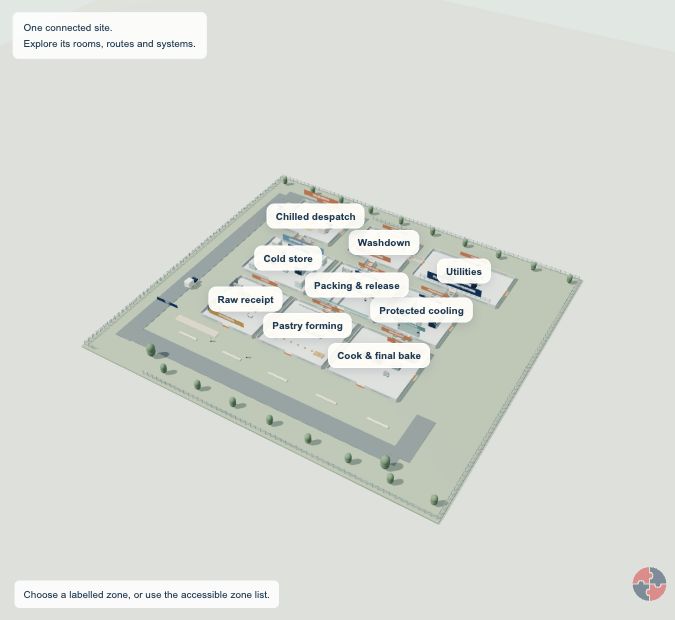
Actual whole-site SHAREsimulate pie factory model. This overview supplies layout context; inspect the lesson schematic and stated case for this zone.
Make escape work before routine entry
Cold-store entry depends on a way out as well as a way in. A closed walk-in unit must allow a person to find and operate the inside release. Lighting or another suitable means needs to make the door and opening device identifiable when closed. The task assessment determines additional arrangements, which may include a trapped-person alarm. A device on the wall does not prove that anyone outside will receive the signal or know how to respond.
The fictional store has a sticking inside release. Keep the defective area unavailable through the agreed arrangements and use the approved alternative. Do not prop the door open as an unassessed long-term solution, send one person inside to see whether it fails again or rely on a colleague remembering to return. A makeshift fix can compromise product control, create ice or allow the door to close unexpectedly. Competent correction must address the actual defect and the intended operating conditions.
Check the chain from recognition to assistance: usable release, visible route, any specified alarm, reliable reception, staffing and a response that does not expose another person. Include quieter shifts, contractors, visitors and work when ordinary production noise masks a signal. A mobile phone may support communication but cannot automatically replace the assessed arrangement; reception, gloves, battery and the ability to reach it all matter. The worker needs understandable instructions and a clear route for reporting faults before entry.
Verification must be safely planned so nobody is deliberately trapped or exposed to the unresolved defect. Competent people can demonstrate equipment and response under controlled conditions and record limitations. Confirm that normal storage does not block the door or alarm and that staff know what a failed check means. The exercise output is a readiness decision and a specific missing-evidence question, not a door-repair method. A course score, good visibility from outside or a recent delivery does not establish reliable escape.
How should emergency procedures and first-aid arrangements be tested?
Testing should prove that people, alarms, equipment, communication and cover work in realistic conditions.
Testing can include evacuation drills, first-aid response scenarios, kit audits, radio checks, emergency contact tests, disabled-person evacuation checks, out-of-hours drills and tabletop exercises. Drills should not be treated as a pass because everyone eventually reached the assembly point.
Useful debriefs ask what was slow, confusing, missing, unsafe or dependent on one person. Actions should be tracked to verified closure.
Testing options - Testing options
Test
What it proves
Action evidence
Evacuation drill
People know routes and assembly.
Drill report and improvements.
First-aid scenario
Help can be summoned and equipment found.
Response time and debrief.
Kit check
Equipment is available and in date.
Checklist and restock record.
Out-of-hours check
Cover works beyond office hours.
Shift test results.
Emergency call test
Contact details are correct.
Contact verification.
Post-incident review
Learning improves arrangements.
Action tracker.
Applied case
An inside release sticks and the supervisor proposes leaving the door on a loose wedge while someone works alone.
Decision and explanation
Keep the defective area out of service and obtain competent correction and a safe verification of escape and assistance.
A known escape defect needs correction and safe testing. Improvised props and deliberate entrapment do not establish reliable protection.
Lesson 2
A cold room must protect people as well as food
Separate worker thermal arrangements from the product temperature plan.
A worker and a separate enlarged skin section introduce sweating and the skin’s blood supply. Connect these structures to the work and environment described in the lesson.
Locate the sweat gland and skin vessels in the enlarged view. How should conditions, workload, clothing and recovery be managed together?
educational illustration · healthy anatomy; enlarged details and teaching colours.
Actual whole-site SHAREsimulate pie factory model. This overview supplies layout context; inspect the lesson schematic and stated case for this zone.
A cold room must protect people as well as food
Food temperature and the worker's thermal exposure are related but different control questions. A room cold enough for the intended product can still make prolonged work difficult or unsafe. Time in the environment, workload, clothing, dampness, grip, access and individual needs affect the worker. A product temperature record cannot demonstrate that a person's hands remain effective or that suitable recovery is available. Likewise, comfortable workers do not prove that stored food has remained within its validated conditions.
Before entry, consider whether the task can be performed from a suitable warmer location or with local protection and appropriate handling aids. Where cold work remains, use the assessed clothing, work pattern and access to recovery. Protection must suit the real task: gloves that are warm but prevent operation of a door release or a safe grip need review. Dry replacement items and usable rest facilities matter. Do not create a universal exposure time or clothing rule from an illustration; the actual assessment must establish the arrangement.
In the fictional exercise, a picker reports numb hands while stock is being moved. Pause the affected handling safely and obtain the agreed support. Do not require a faster picking run to finish the cold exposure or ask colleagues to diagnose whether the symptoms are serious. Appropriate health advice may be needed, particularly for persistent or worsening concerns. The supervisor should also review whether relief cover and recovery can actually be used under the normal workload, rather than only listed in a procedure.
Changes to door use, storage layout or ventilation need coordination. An unassessed door prop can change humidity and ice formation as well as product control and escape. Check the whole revised arrangement with the relevant facilities, production and food-safety people. Verification should establish a usable task, reliable access, appropriate recovery and a route for reporting deterioration. Do not turn a clean floor, a normal display or a worker's willingness to continue into permission to ignore an unresolved cold-work problem.
What controls should be considered before relying on behaviour?
Thermal risk is best managed by changing the environment, source, task and recovery before relying on personal coping.
Telling workers to drink more or wear a coat is not enough if the job design creates excessive heat or cold exposure. Controls should remove or reduce the thermal load wherever practicable.
Personal adaptation still matters, but only within a system that gives people real choices: access to water, shade, warm areas, dry clothing, recovery time, suitable PPE and the authority to stop.
For heat, remove the hot operation where possible, then insulate or shield radiant surfaces and verify ventilation at the work position. For cold, move a task out of the freezer when practicable, or use heated, enclosed workstations and insulated access doors without compromising escape. Changing the shift pattern or asking people to drink water supports these source controls but cannot replace them.
Protective clothing must be assessed alongside the task: a suit may worsen heat load, while wet gloves can sharply reduce cold protection. The supervisor checks the real work rate, recovery space and worker feedback, then holds the task if a physical control fails or symptoms appear. The worked five-level and ERICPD example sets out feasibility, owners, evidence and stop points for a hot plant room and chilled loading area.
Applied case
The food display is within its stated condition, but a picker has numb hands and cannot reach the warming area during the shift.
Decision and explanation
Only its own reading; worker protection and usable recovery still need review.
Product-control information does not establish safe personal exposure, dexterity or escape.
Lesson 3
Resolve a temperature disagreement without releasing uncertainty
Use reliable monitoring, product history and authorised food-safety decisions.
Actual whole-site SHAREsimulate pie factory model. This overview supplies layout context; inspect the lesson schematic and stated case for this zone.
Resolve a temperature disagreement without releasing uncertainty
A refrigeration display gives information about a particular sensor and location. It is not automatically the temperature of every product or a complete history of the load. Sensor position, calibration, damage, maintenance, loading and airflow can affect interpretation. A normal-looking number can persist when independent checks disagree. In the fictional model, the contradiction is supplied evidence; the appearance of a fridge or pie cannot establish a safe product temperature.
When readings conflict, follow the approved food-safety plan: identify the equipment and affected lots, preserve the available history and keep uncertain product on hold. Arrange suitable reliable monitoring and competent equipment assessment. Do not replace the disputed value with a convenient number, average away the disagreement or move food into despatch so the problem becomes somebody else's. A reset may clear an alarm without explaining what happened. Keep the original records and document corrections transparently.
The responsible food-safety team needs to understand product identity, relevant time and storage history, validated requirements, instrument reliability and any earlier processing or exposure. Limits and corrective actions depend on the actual food, process and applicable jurisdiction. This course deliberately supplies no universal temperature or elapsed-time release rule. Smell, appearance and tasting cannot clear a lot whose safety history is uncertain. Moving food to a suitable alternative store may protect it from further deterioration where the plan allows, but does not erase its previous history.
Separate three close-out decisions. Competent maintenance establishes that the equipment and monitoring are ready for their intended use. The food-safety process decides each affected lot's disposition on suitable evidence. Production/despatch coordinators communicate the resulting restrictions and prevent held stock being selected. For the exercise, build a fictional timeline from the last reliable evidence to discovery and the protective action. Mark gaps explicitly and identify who must resolve them. A new working sensor provides future information; it cannot reconstruct missing past conditions by itself.
Why does temperature control matter for food safety?
Set validated cooking, chilling, cooling, hot-holding and reheating controls for the food and jurisdiction. Avoid treating one temperature as a universal UK legal rule: Scottish commercial reheating law has a distinct 82°C route with exceptions, while other nations use different requirements and guidance.
Temperature control is one of the most familiar food safety topics, but it is often misunderstood. The question is not only whether a fridge number was written down. The question is whether the food was received, stored, cooked, cooled, reheated and served in a way that prevents harmful microbial growth.
Equipment reliability matters. Fridges, freezers, hot cupboards, probes and dishwashers should be checked, cleaned, calibrated where required and repaired promptly.
Temperature control examples
Control point
What can go wrong
Good practice evidence
Control pointDelivery
What can go wrongHigh-risk food arrives warm or damaged.
Good practice evidenceSupplier approval, delivery check and rejection record.
Control pointChilled storage
What can go wrongFridge overloaded, door left open or failed unit ignored.
Good practice evidenceTemperature log, action note and maintenance response.
Control pointCooking
What can go wrongCentre of food does not reach safe temperature.
Good practice evidenceProbe checks, cooking record and trained staff.
Control pointCooling
What can go wrongLarge containers cool too slowly.
Good practice evidencePortioning, blast chilling or timed cooling record.
Control pointReheating
What can go wrongFood reheated unevenly or repeatedly.
Good practice evidenceReheat standard, probe evidence and discard rule.
Control pointHot holding
What can go wrongFood drops below safe holding temperature.
Good practice evidenceHot-hold checks and time limits.
The wall display is normal, an independent check disagrees and two lots have already been staged for despatch.
Decision and explanation
Identify and hold the affected lots while reliable history and monitoring support the authorised food-safety decision.
Resolve current reliability and past product history separately. Repairing an instrument does not retrospectively establish lot safety.
Lesson 4
Treat a refrigeration alarm as a protective decision
Use the designated emergency plan without approaching a suspected release.
Actual whole-site SHAREsimulate pie factory model. This overview supplies layout context; inspect the lesson schematic and stated case for this zone.
Treat a refrigeration alarm as a protective decision
The fictional utilities area includes a proposed ammonia refrigeration plant and a fixed alarm. That is an exercise condition, not a claim that every pie factory uses ammonia. A release can cause serious inhalation and contact injury and may create other dangerous conditions. The ordinary worker's role is to recognise the alarm, protect people and communicate through the actual emergency arrangements. The course does not teach investigation, valve operation, breathing-apparatus selection or atmospheric clearance.
Follow the specified alarm response and move to the designated safe place by the planned route, warning others without entering the affected area. Restrict access through the responsible emergency process and summon the designated competent responders. Do not open a plant-room door to confirm the smell, follow a missing colleague inside, silence an alarm because no vapour is visible or attempt an unfamiliar isolation. An absence of smell is not a safe re-entry test. Product protection and production continuity must not delay the protective response for people.
Useful information can be passed from a safe location: alarm identity, location, time, last known occupancy and other reliable observations. Keep assumptions separate. Do not walk back to collect a photograph or read a gauge. Supervisors need a plan that covers staff, contractors, different shifts and people who need assistance. Warning reception, routes and assembly arrangements must remain usable when the normal entrance or utilities route is affected. If a route is unsafe, follow the planned alternative and emergency instructions rather than improvising an investigation.
Re-entry and equipment restart require the designated competent process, using suitable evidence and authorised control of the scene. A stopped alarm alone does not establish the cause, atmosphere or repaired equipment condition. Drills should test communication, access restriction and accountability without releasing refrigerant or exposing people. Afterwards, verify that corrective actions are closed and the plan remains understood. In the exercise, your result is a clear protective decision and factual message; it is not a technical operating sequence or a substitute for the site's actual emergency plan.
What should emergency procedures tell people to do?
Emergency procedures should tell each role how to raise the alarm, protect people, call help, reach safety and hand over without improvisation.
Procedures should avoid long paragraphs at the moment of need. People need to know how to raise the alarm, leave or shelter, call emergency services, find first aid, account for people, keep access clear, stop unsafe work, support visitors and prevent re-entry until authorised.
Where activities have specific hazards, procedures should include details such as isolating electricity, using spill kits, decontamination, rescue restrictions, chemical SDS information, lock-off, emergency shutoffs or escalation to specialist responders.
Test instructions on the late shift and with a blocked normal route. Identify who controls the incident, who meets responders and who confirms that the area is safe before restart.
Applied case
The ammonia alarm activates and a worker offers to open the restricted room because no smell is noticeable from the corridor.
Decision and explanation
Follow the alarm plan, warn and withdraw, restrict access and summon the designated competent response.
Protect people without investigation. No smell, no visible cloud or a reset cannot establish a safe atmosphere.
Lesson 5
A sump task starts with avoiding entry
Identify why informal access and improvised rescue are unacceptable.
Actual whole-site SHAREsimulate pie factory model. This overview supplies layout context; inspect the lesson schematic and stated case for this zone.
A sump task starts with avoiding entry
An effluent sump can present atmosphere, flooding and access hazards that are not visible from the opening. Whether a space falls within confined-space requirements depends on its enclosure and reasonably foreseeable specified risks, not simply its name or depth. A normal-looking surface or a colleague who entered before cannot establish that this task is safe. The fictional exercise begins with a worker arriving with a ladder to inspect a blockage without entry arrangements.
Prevent informal entry and ask whether the required result can be obtained safely from outside. A suitable remote inspection or external intervention may avoid exposure, but also needs assessment for pressure, chemicals, moving equipment and disturbance. Avoiding entry is a planning decision before a permit is considered. Do not tell a worker to lean farther into the opening as a compromise. Do not use the model as a drawing of real connections or as a record of which services can introduce material.
If entry cannot reasonably be avoided, it belongs to the designated competent confined-space process. The actual safe system must address the task, relevant isolation and changing conditions, communication, supervision and effective emergency arrangements. A ladder, a portable fan or a person standing at the top is not the complete system. Calling public emergency services alone is not a sufficient planned rescue arrangement. The required capability must be established before anyone is exposed, using people and equipment suitable for the actual space.
If somebody is already in difficulty, summon the planned emergency response from a safe position and prevent further unplanned entry. Do not follow them in; rescuers can become additional casualties. This course provides no entry, gas-testing or retrieval technique. For the learning task, prepare a fictional request stating the objective, no-entry alternatives, unknown connections and who must assess the work. Keep the opening protected and the task restricted until the responsible team resolves it. Work urgency and a familiar ladder do not supply missing competence or rescue capability.
How can the organisation avoid entry?
Make no-entry a design and work-planning decision, with a recorded reason before any permit is considered.
For drain inspection, use a remote camera and external cleaning point if a competent assessment confirms that method is safe. For tanks, provide fixed gauges, sampling points or clean-in-place systems where practicable. Check that pressure, chemical use or jetting does not create a new uncontrolled exposure. The manager signs the selected method; if entry remains necessary, the confined-space lead records why alternatives cannot safely achieve the task. This is the elimination level of the five-level hierarchy and ERICPD, ahead of isolation, engineering, procedures and PPE.
Applied case
A colleague approaches the sump with a ladder, saying the obstruction will take only a minute to inspect.
Decision and explanation
Prevent informal entry, examine assessed no-entry alternatives and obtain the designated competent process.
Duration and companionship do not resolve atmosphere, flooding, isolation or rescue needs. Avoid entry first and keep any unavoidable entry within the competent system.
Lesson 6
Recovery has separate people, plant and product gates
Plan drills, handover and reopening without treating one all-clear as universal.
Actual whole-site SHAREsimulate pie factory model. This overview supplies layout context; inspect the lesson schematic and stated case for this zone.
Recovery has separate people, plant and product gates
After an alarm or serious equipment defect, normal production cannot be restored by one reassuring sign. The emergency controller may establish that an area can be re-entered under stated conditions, while refrigeration equipment still needs correction and product history remains unresolved. People, plant and food have different evidence needs. A learner should be able to describe those gates without claiming the technical competence or authority to release them.
For people, check the emergency arrangements, appropriate assistance for affected individuals and any continuing access restrictions. For equipment, obtain the required competent investigation, correction and handback for the intended service. For food, preserve traceability and let the authorised food-safety process decide lot status from reliable history and suitable evidence. A repaired sensor cannot show what happened during an unrecorded interval. A silent gas alarm cannot prove that a cold-store door release works. Do not let one successful check erase an unrelated outstanding defect.
Drills should make the response usable across the real work pattern. Test who receives a trapped-person alarm at a quiet time, how a missing contractor is accounted for and what happens if the ordinary assembly route is affected. Use controlled simulations that do not trap a person, release gas or involve unplanned entry. Debrief specific weaknesses and assign actions with evidence needed for closure. Attendance and eventual arrival at an assembly point do not prove that all arrangements worked adequately.
The fictional shift handover should state which areas and equipment are unavailable, which lots remain held, who owns each decision and how to escalate deterioration. Use clear status information that picking and despatch staff can act on; avoid a technical report filed where they never see it. Before authorised reopening, verify that staff understand the revised plan and that the necessary response and recovery facilities are actually available. The learning outcome is a coordinated recommendation with explicit remaining restrictions, not a claim of rescue competence or a guarantee that emergencies cannot occur.
How should emergency procedures and first-aid arrangements be tested?
Testing should prove that people, alarms, equipment, communication and cover work in realistic conditions.
Testing can include evacuation drills, first-aid response scenarios, kit audits, radio checks, emergency contact tests, disabled-person evacuation checks, out-of-hours drills and tabletop exercises. Drills should not be treated as a pass because everyone eventually reached the assembly point.
Useful debriefs ask what was slow, confusing, missing, unsafe or dependent on one person. Actions should be tracked to verified closure.
Testing options - Testing options
Test
What it proves
Action evidence
Evacuation drill
People know routes and assembly.
Drill report and improvements.
First-aid scenario
Help can be summoned and equipment found.
Response time and debrief.
Kit check
Equipment is available and in date.
Checklist and restock record.
Out-of-hours check
Cover works beyond office hours.
Shift test results.
Emergency call test
Contact details are correct.
Contact verification.
Post-incident review
Learning improves arrangements.
Action tracker.
Applied case
The gas alarm is quiet after response, but the cold-store release remains defective and the affected lots lack reliable temperature history.
Decision and explanation
Re-entry, equipment readiness, escape and product disposition still require their own relevant evidence and authorised decisions.
One cleared condition cannot close unrelated escape, equipment or food-history gaps.
Lesson 7
Worker trapped inside walk-in cold store
Explain the decision using the observed condition, the harm route and the evidence needed for release.
Actual whole-site SHAREsimulate pie factory model. This overview supplies layout context; inspect the lesson schematic and stated case for this zone.
Understand the activity and how harm develops
A walk-in cold store needs a usable means to get out and obtain assistance if someone is trapped.
Verify the internal release and alarm under a safe controlled test, including who receives the signal during reduced staffing. Do not create a trapped-person test. Frost, blocked access or an unacknowledged alarm can defeat the intended protection.
Match the response to the credible event, wind, access, available responders and people needing assistance. Keep untrained people outside hazardous areas. Silence or the end of a visible release is not an all-clear; assess the remaining atmosphere, equipment and environmental conditions.
Recognise the evidence boundary
Question
Case evidence
What is observed?
The internal release sticks while a worker is inside the cold store.
How can harm occur?
Entrapment can lead to prolonged cold exposure and delayed help.
What information is needed?
Check the door release, alarm and the site's occupancy and response arrangements.
Protect, manage and verify
Purpose
Practical application
Immediate protection
Keep the defective area out of service and provide the approved alternative.
Accountable work arrangement
The designated incident controller uses the site plan and emergency services as appropriate. Competent specialists inform controlled re-entry and recovery decisions. If the described protection is absent, defective or cannot be verified, keep the affected activity restricted while the responsible person resolves it. Use the current inspection evidence; the title alone is not the verdict.
Release verification
Competent checks and a safe response test must verify reliable escape and assistance.
Apply this at work
Explain the decision using the observed condition, the harm route and the evidence needed for release.
How should emergency procedures and first-aid arrangements be tested?
Testing should prove that people, alarms, equipment, communication and cover work in realistic conditions.
Testing can include evacuation drills, first-aid response scenarios, kit audits, radio checks, emergency contact tests, disabled-person evacuation checks, out-of-hours drills and tabletop exercises. Drills should not be treated as a pass because everyone eventually reached the assembly point.
Useful debriefs ask what was slow, confusing, missing, unsafe or dependent on one person. Actions should be tracked to verified closure.
Testing options - Testing options
Test
What it proves
Action evidence
Evacuation drill
People know routes and assembly.
Drill report and improvements.
First-aid scenario
Help can be summoned and equipment found.
Response time and debrief.
Kit check
Equipment is available and in date.
Checklist and restock record.
Out-of-hours check
Cover works beyond office hours.
Shift test results.
Emergency call test
Contact details are correct.
Contact verification.
Post-incident review
Learning improves arrangements.
Action tracker.
Applied case
The internal release sticks while a worker is inside the cold store. The next production or dispatch step is waiting for a decision.
Decision and explanation
Keep the defective area out of service and provide the approved alternative.
It leaves the trapped person dependent on someone noticing and reaching the door in time. Recording alone leaves this harm route active: Entrapment can lead to prolonged cold exposure and delayed help. This retains control of the affected work or product while the required evidence is established. Competent checks and a safe response test must verify reliable escape and assistance.
Lesson 8
Cold-store sensor gives false reassurance
Explain the decision using the observed condition, the harm route and the evidence needed for release.
Actual whole-site SHAREsimulate pie factory model. This overview supplies layout context; inspect the lesson schematic and stated case for this zone.
Understand the activity and how harm develops
One air sensor may not represent the warmest product or an unmonitored part of the cold store.
Use a suitable temperature-mapping and monitoring basis, calibrated instruments and defined response. Review load, doors and air circulation. Replacing a suspect reading with a convenient nearby reading conceals the uncertainty rather than resolving it.
Control follows the food through receipt, storage, preparation, processing and dispatch. Monitoring tells the operator whether a defined control is being met; an uncertain lot needs an authorised disposition. Appearance, smell or a commercial deadline cannot demonstrate food safety.
Recognise the evidence boundary
Question
Case evidence
What is observed?
The wall display looks normal but an independent check disagrees.
How can harm occur?
An unreliable reading can hide product temperature abuse.
What information is needed?
Review sensor reliability and product and storage history under the approved plan.
Protect, manage and verify
Purpose
Practical application
Immediate protection
Hold uncertain lots and arrange reliable monitoring and competent equipment correction.
Accountable work arrangement
The food-safety lead and authorised production or intake manager decide lot disposition using the approved specification, traceability and control records. If the described protection is absent, defective or cannot be verified, keep the affected activity restricted while the responsible person resolves it. Use the current inspection evidence; the title alone is not the verdict.
Release verification
Reconcile reliable evidence and an authorised product decision before release.
Apply this at work
Explain the decision using the observed condition, the harm route and the evidence needed for release.
Why does temperature control matter for food safety?
Set validated cooking, chilling, cooling, hot-holding and reheating controls for the food and jurisdiction. Avoid treating one temperature as a universal UK legal rule: Scottish commercial reheating law has a distinct 82°C route with exceptions, while other nations use different requirements and guidance.
Temperature control is one of the most familiar food safety topics, but it is often misunderstood. The question is not only whether a fridge number was written down. The question is whether the food was received, stored, cooked, cooled, reheated and served in a way that prevents harmful microbial growth.
Equipment reliability matters. Fridges, freezers, hot cupboards, probes and dishwashers should be checked, cleaned, calibrated where required and repaired promptly.
Temperature control examples
Control point
What can go wrong
Good practice evidence
Control pointDelivery
What can go wrongHigh-risk food arrives warm or damaged.
Good practice evidenceSupplier approval, delivery check and rejection record.
Control pointChilled storage
What can go wrongFridge overloaded, door left open or failed unit ignored.
Good practice evidenceTemperature log, action note and maintenance response.
Control pointCooking
What can go wrongCentre of food does not reach safe temperature.
Good practice evidenceProbe checks, cooking record and trained staff.
Control pointCooling
What can go wrongLarge containers cool too slowly.
Good practice evidencePortioning, blast chilling or timed cooling record.
Control pointReheating
What can go wrongFood reheated unevenly or repeatedly.
Good practice evidenceReheat standard, probe evidence and discard rule.
Control pointHot holding
What can go wrongFood drops below safe holding temperature.
Good practice evidenceHot-hold checks and time limits.
The wall display looks normal but an independent check disagrees. The next production or dispatch step is waiting for a decision.
Decision and explanation
Hold uncertain lots and arrange reliable monitoring and competent equipment correction.
The discrepancy may identify a real warm area or measurement failure affecting stock decisions. Recording alone leaves this harm route active: An unreliable reading can hide product temperature abuse. This retains control of the affected work or product while the required evidence is established. Reconcile reliable evidence and an authorised product decision before release.
Lesson 9
Refrigerant leak at the proposed ammonia plant
Explain the decision using the observed condition, the harm route and the evidence needed for release.
Actual whole-site SHAREsimulate pie factory model. This overview supplies layout context; inspect the lesson schematic and stated case for this zone.
Understand the activity and how harm develops
The proposed ammonia refrigeration plant introduces a hazardous gas release scenario needing its own response arrangements.
Confirm the actual refrigerant, quantity and system rather than importing assumptions from another plant. Prevention, detection, ventilation, isolation and specialist emergency response must fit the design. Odour is not a safe concentration measurement.
A low area can accumulate a hazardous atmosphere without a visible warning. Do not enter or send a colleague in to investigate an unresolved alarm. Prevent exposure, summon the planned specialist response and use gas-specific assessment, detection and rescue arrangements where required.
Recognise the evidence boundary
Question
Case evidence
What is observed?
A fixed ammonia alarm activates near the restricted refrigeration room.
How can harm occur?
A release can cause toxic exposure, chemical burns and a dangerous atmosphere.
What information is needed?
Use remote alarm information and the emergency plan without entering to investigate.
Protect, manage and verify
Purpose
Practical application
Immediate protection
Withdraw people, restrict access and call the designated competent emergency response.
Accountable work arrangement
The duty manager secures access and calls the competent emergency response. Entry or rescue requires the planned specialist capability, not an improvised attempt. If the described protection is absent, defective or cannot be verified, keep the affected activity restricted while the responsible person resolves it. Use the current inspection evidence; the title alone is not the verdict.
Release verification
Only the designated competent process may clear the area and equipment for re-entry.
Apply this at work
Explain the decision using the observed condition, the harm route and the evidence needed for release.
How should rescue capability be governed?
Rescue capability should be treated as a controlled emergency function with defined people, equipment, maintenance, drills and review.
Rescue arrangements need the same discipline as entry controls. The organisation should know which types of entry require non-entry retrieval, internal rescue, breathing apparatus, specialist contractors, external emergency-service liaison or a combination. The plan should match the geometry of the space and the likely condition of the casualty.
Drills should test credible scenarios, not comfortable ones. A good drill asks whether communications work, whether equipment reaches the casualty, whether the casualty can be extracted through the access point, whether rescuers are protected and whether the response time is realistic.
Rescue capability governance
Capability
Management requirement
Evidence
Rescue plan library
Plans matched to space classes and tasks.
Task-specific rescue sheets.
People
Competent rescue personnel available during entry.
Training, authorisation and rota.
Equipment
Suitable and maintained retrieval, BA/RPE, communication and first-response kit.
Inspection and maintenance records.
Drills
Scenario-based practice and debrief.
Drill report and action close-out.
External liaison
Emergency services know site access and hazards where relevant.
Emergency plan and liaison notes.
Review
Weaknesses escalated and resourced.
Management review and improvement plan.
Applied case
A fixed ammonia alarm activates near the restricted refrigeration room. The next production or dispatch step is waiting for a decision.
Decision and explanation
Withdraw people, restrict access and call the designated competent emergency response.
Recording alone leaves this harm route active: A release can cause toxic exposure, chemical burns and a dangerous atmosphere. The investigation exposes a person to unknown conditions and does not create a capable rescue system. This retains control of the affected work or product while the required evidence is established. Only the designated competent process may clear the area and equipment for re-entry.
Lesson 10
Unplanned entry into the effluent sump
Explain the decision using the observed condition, the harm route and the evidence needed for release.
Actual whole-site SHAREsimulate pie factory model. This overview supplies layout context; inspect the lesson schematic and stated case for this zone.
Understand the activity and how harm develops
An effluent sump can contain a dangerous atmosphere even when entry looks brief and straightforward.
Avoid entry where possible. If entry is necessary, the assessment must determine the actual confined-space risks, isolation, gas testing, communication and preplanned competent rescue. A normal reading at the opening does not establish every location or future condition.
A low area can accumulate a hazardous atmosphere without a visible warning. Do not enter or send a colleague in to investigate an unresolved alarm. Prevent exposure, summon the planned specialist response and use gas-specific assessment, detection and rescue arrangements where required.
Recognise the evidence boundary
Question
Case evidence
What is observed?
A worker approaches the enclosed sump with a ladder and no entry arrangements.
How can harm occur?
A hazardous atmosphere, flooding or difficult rescue can cause fatal injury.
What information is needed?
Assess whether entry is avoidable and request the confined-space assessment and rescue arrangements.
Protect, manage and verify
Purpose
Practical application
Immediate protection
Prevent informal entry and obtain the designated competent confined-space response.
Accountable work arrangement
The duty manager secures access and calls the competent emergency response. Entry or rescue requires the planned specialist capability, not an improvised attempt. If the described protection is absent, defective or cannot be verified, keep the affected activity restricted while the responsible person resolves it. Use the current inspection evidence; the title alone is not the verdict.
Release verification
Entry remains prohibited until the required safe system and rescue capability are verified.
Apply this at work
Explain the decision using the observed condition, the harm route and the evidence needed for release.
How should rescue capability be governed?
Rescue capability should be treated as a controlled emergency function with defined people, equipment, maintenance, drills and review.
Rescue arrangements need the same discipline as entry controls. The organisation should know which types of entry require non-entry retrieval, internal rescue, breathing apparatus, specialist contractors, external emergency-service liaison or a combination. The plan should match the geometry of the space and the likely condition of the casualty.
Drills should test credible scenarios, not comfortable ones. A good drill asks whether communications work, whether equipment reaches the casualty, whether the casualty can be extracted through the access point, whether rescuers are protected and whether the response time is realistic.
Rescue capability governance
Capability
Management requirement
Evidence
Rescue plan library
Plans matched to space classes and tasks.
Task-specific rescue sheets.
People
Competent rescue personnel available during entry.
Training, authorisation and rota.
Equipment
Suitable and maintained retrieval, BA/RPE, communication and first-response kit.
Inspection and maintenance records.
Drills
Scenario-based practice and debrief.
Drill report and action close-out.
External liaison
Emergency services know site access and hazards where relevant.
Emergency plan and liaison notes.
Review
Weaknesses escalated and resourced.
Management review and improvement plan.
Applied case
A worker approaches the enclosed sump with a ladder and no entry arrangements. The next production or dispatch step is waiting for a decision.
Decision and explanation
Prevent informal entry and obtain the designated competent confined-space response.
This retains control of the affected work or product while the required evidence is established. Entry remains prohibited until the required safe system and rescue capability are verified. An improvised rescue can expose the second person to the same fatal conditions. Recording alone leaves this harm route active: A hazardous atmosphere, flooding or difficult rescue can cause fatal injury.
Lesson 11
An alarm, a missing picker and an uncertain load
Prioritise protection and preserve separate release decisions during a connected incident.
Actual whole-site SHAREsimulate pie factory model. This overview supplies layout context; inspect the lesson schematic and stated case for this zone.
An alarm, a missing picker and an uncertain load
The fictional despatch shift is moving finished pies from the cold store when the built-in temperature display and an independent check disagree. The last fully reliable record is unclear. The inside door release has been sticking, and one picker has not returned when expected. A fixed ammonia alarm then activates near the restricted refrigeration room. At the utilities yard, a contractor with a ladder is preparing to inspect a sump blockage informally. A waiting driver asks whether the load can leave before the incident delays the route. All these facts are exercise evidence; the model image does not measure atmosphere, temperature or occupancy.
Start with people. Follow the actual alarm and accountability plan from a safe position, warn others and prevent further access. Pass the picker's last known location and the sticking-release information to the designated emergency controller. Do not send a colleague into the store or plant room to investigate a missing person where the incident may affect access or atmosphere. Do not use absence of smell as clearance. Prevent the contractor's informal sump entry and obtain the designated competent response. A second person with a phone is not an effective confined-space rescue system.
Then protect information and product without delaying emergency action. Identify the affected lots and keep them from despatch through the approved traceability and hold process. Record reliable times, readings, instrument identities and movements; preserve the discrepancy rather than replacing it with the more convenient value. A driver deadline does not determine safe storage history. Moving a lot to a suitable alternative place may prevent further deterioration where authorised, but cannot erase a past unknown interval. The food-safety decision must use the actual validated requirements and suitable evidence for each lot.
Equipment recovery needs its own owners. Competent people must resolve the refrigeration event and any requirements for safe re-entry and plant operation. The cold-store door and any specified alarm/response chain need correction and safe verification. Sensor reliability needs investigation, but a replacement instrument only provides future evidence. The sump task begins again with an assessed no-entry option; any unavoidable entry remains within its complete competent system. Do not join these items under one generic maintenance-complete signature or treat a silent alarm as a universal all-clear.
For the final exercise, build a fictional decision board containing people/accountability, area access, plant and escape, product status and the suspended sump work. Each item needs the current protective action, responsible decision role, missing evidence and the condition that permits its authorised close-out. Review communication across despatch, production, facilities and contractors so a restriction cannot disappear during shift change. A controlled drill or review should test real reception, routes and escalation without exposing a person to the original hazards. The learner's output is a reasoned recommendation and factual handover. It does not authorise a rescue, plant intervention, product release or actual restart.
How should emergency procedures and first-aid arrangements be tested?
Testing should prove that people, alarms, equipment, communication and cover work in realistic conditions.
Testing can include evacuation drills, first-aid response scenarios, kit audits, radio checks, emergency contact tests, disabled-person evacuation checks, out-of-hours drills and tabletop exercises. Drills should not be treated as a pass because everyone eventually reached the assembly point.
Useful debriefs ask what was slow, confusing, missing, unsafe or dependent on one person. Actions should be tracked to verified closure.
Testing options - Testing options
Test
What it proves
Action evidence
Evacuation drill
People know routes and assembly.
Drill report and improvements.
First-aid scenario
Help can be summoned and equipment found.
Response time and debrief.
Kit check
Equipment is available and in date.
Checklist and restock record.
Out-of-hours check
Cover works beyond office hours.
Shift test results.
Emergency call test
Contact details are correct.
Contact verification.
Post-incident review
Learning improves arrangements.
Action tracker.
Applied case
A driver and production manager ask for one all-clear while the person, access, equipment and product questions remain distinct.
Decision and explanation
Maintain people/access protections and product holds while the designated roles resolve each separate gate with suitable evidence.
Protect people without unplanned entry, preserve lot history and require relevant authorised evidence for each reopening or release decision.
Lesson 12
Take a verified action into the workplace
Connect one actual task to an owner, evidence and a clear release or escalation decision.
Actual whole-site SHAREsimulate pie factory model. This overview supplies layout context; inspect the lesson schematic and stated case for this zone.
Turn awareness into a practical question
Great Britain food-production awareness: cold-store escape, uncertain temperature records, refrigeration alarms and avoidance of informal sump entry. The proposed ammonia installation is a fictional model condition. No refrigerant operation, gas testing, confined-space entry, rescue technique, clinical assessment or product-release authority is taught.
Choose one relevant operation from the course. Describe the person or product at risk, the mechanism of harm and the exact condition that needs controlling. Separate an observation from a conclusion. A display, signature, badge or clean appearance answers only a limited question.
Use the included practice resources to prepare a fictional task brief, risk review or verification question. Decide which competent role owns the decision and which evidence must be available before work or product is released. Keep food disposition and worker protection as distinct decisions where both apply.
At work, use your actual approved arrangements. Report uncertainty and preserve the relevant hold, restriction or safe state while it is resolved. Confirm that the action addressed the original harm route and check whether another shift, product, cleaning task or maintenance change could reintroduce it.
Course completion records awareness learning. It does not establish practical competence, certify a food business, validate a recipe, extend shelf life or authorise maintenance, chemical work or emergency entry.
How should emergency procedures and first-aid arrangements be tested?
Testing should prove that people, alarms, equipment, communication and cover work in realistic conditions.
Testing can include evacuation drills, first-aid response scenarios, kit audits, radio checks, emergency contact tests, disabled-person evacuation checks, out-of-hours drills and tabletop exercises. Drills should not be treated as a pass because everyone eventually reached the assembly point.
Useful debriefs ask what was slow, confusing, missing, unsafe or dependent on one person. Actions should be tracked to verified closure.
Testing options - Testing options
Test
What it proves
Action evidence
Evacuation drill
People know routes and assembly.
Drill report and improvements.
First-aid scenario
Help can be summoned and equipment found.
Response time and debrief.
Kit check
Equipment is available and in date.
Checklist and restock record.
Out-of-hours check
Cover works beyond office hours.
Shift test results.
Emergency call test
Contact details are correct.
Contact verification.
Post-incident review
Learning improves arrangements.
Action tracker.
Applied case
The shift action log says “training completed, issue closed”. It records no condition check, product disposition or task owner.
Decision and explanation
The accountable person verifies the task-specific control and records the justified decision.
Learning supports the decision; evidence that the relevant control works is needed before the responsible person closes the action.