
Chilled pie production and food safety / Cold stores, refrigeration and emergency response
Chilled pie production and food safety · SH-PIE-08Cold stores, refrigeration and emergency response
Free online training · Approximate learning time: 90–140 minutes · Self-paced
Protect people first, then resolve equipment and product decisions separately
Full public teaching and readers are free without an account. A free learner account is required for saved LMS progress and recorded assessment. Completion and any course-completion certificate depend on the configured LMS conditions.
Who this course is for
Cold-store and despatch staff, production supervisors, facilities coordinators and people who brief contractors within their authorised roles.
Cold-store escape, unreliable temperature information and refrigeration alarms can turn routine work into an emergency. Practise protective decisions through original fictional cases, then distinguish safe re-entry, equipment handback and product disposition. The course keeps specialist refrigerant work and confined-space rescue with the designated competent teams.
Great Britain food-production awareness: cold-store escape, uncertain temperature records, refrigeration alarms and avoidance of informal sump entry. The proposed ammonia installation is a fictional model condition. No refrigerant operation, gas testing, confined-space entry, rescue technique, clinical assessment or product-release authority is taught.
Learning outcomes
- Check that escape, assistance and cold-work arrangements are usable before routine entry.
- Hold uncertain product and distinguish reliable temperature history from a reassuring display.
- Respond to refrigeration alarms and sump-entry requests without entering a dangerous atmosphere or improvising a rescue.
Course outline
Plan cold-store escape and assistance
- Make escape work before routine entryCheck the complete cold-store escape and response arrangement without trapping a test subject.
- A cold room must protect people as well as foodSeparate worker thermal arrangements from the product temperature plan.
Separate temperature evidence from product release
- Resolve a temperature disagreement without releasing uncertaintyUse reliable monitoring, product history and authorised food-safety decisions.
- Treat a refrigeration alarm as a protective decisionUse the designated emergency plan without approaching a suspected release.
Respond to a refrigeration alarm
- A sump task starts with avoiding entryIdentify why informal access and improvised rescue are unacceptable.
- Recovery has separate people, plant and product gatesPlan drills, handover and reopening without treating one all-clear as universal.
- Worker trapped inside walk-in cold storeExplain the decision using the observed condition, the harm route and the evidence needed for release.
- Cold-store sensor gives false reassuranceExplain the decision using the observed condition, the harm route and the evidence needed for release.
Avoid entry and protect responders
- Refrigerant leak at the proposed ammonia plantExplain the decision using the observed condition, the harm route and the evidence needed for release.
- Unplanned entry into the effluent sumpExplain the decision using the observed condition, the harm route and the evidence needed for release.
Coordinate recovery and verified reopening
- An alarm, a missing picker and an uncertain loadPrioritise protection and preserve separate release decisions during a connected incident.
- Take a verified action into the workplaceConnect one actual task to an owner, evidence and a clear release or escalation decision.
Activities, model practice and assessment
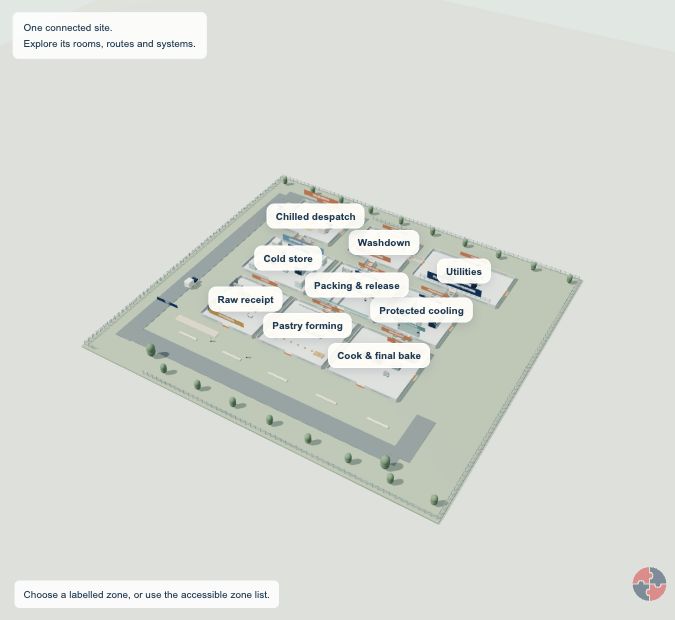
Work through 5 required applied activities and 3 model-practice pauses, with explanatory feedback and independent lesson decisions. Complete 4 distinct model mission sequences across those pauses. Use the actual fictional pie factory model or its equivalent accessible route to complete the required decision sequences; launching the model alone does not complete practice.
The 20-question assessment requires at least 80% plus every designated critical safety answer. Complete the required activities, practice and lesson checks. Points and badges cannot offset a critical safety error.
Use the LMS for confirmed save/resume and recorded results. Any certificate follows its configured passed-completion and grade conditions.
Open the public interactive practice copy; public practice is separate from the LMS record.
Sources and learning provenance
Original fictional cases are paired with public SHAREhub teaching and structured topic records. Use the applicable jurisdiction and primary guidance for live work.
- HSE: chilled/frozen workrooms and escape
- HSE: confined-space introduction
- HSE: common food-industry risks including refrigeration
- HSE: A recipe for safety, HSG252
- FSA: chilled storage and display checks
- Government/FSA: food safety management systems
Topic sections, source identities and versions
| Public topic | Chunk and version | Jurisdiction and sources |
|---|---|---|
| emergency-procedures-and-first-aid-needs · testing | emergency-procedures-and-first-aid-needs--testing 2.2 | Great Britain, Northern Ireland hse-firstaid-needs, hse-firstaid-employer, hse-emergency |
| thermal-environments-heat-stress-and-cold-stress · controls-hierarchy | thermal-environments-heat-stress-and-cold-stress--controls-hierarchy 2.4 | GB, NI source-hse_heat, an-th11, an-th7, source-hseni_temperature |
| food-safety · temperature | food-safety--temperature 20261016-letter-review-1 | England, Wales, Scotland, Northern Ireland govuk-food-hygiene-businesses-chilling-and-freezing, foodstandards-downloads-guidance-on-temperature-control-legislation-pdf |
| emergency-procedures-and-first-aid-needs · procedures | emergency-procedures-and-first-aid-needs--procedures 2.2 | Great Britain, Northern Ireland hse-firstaid-needs, hse-firstaid-employer, hse-emergency, share-hierarchy-hse |
| confined-spaces-risk-management · design-out | confined-spaces-risk-management--design-out 20261016-letter-review-1 | Great Britain, Northern Ireland source-csrm-hse-l101, source-csrm-ni-law |
| confined-spaces-risk-management · rescue-governance | confined-spaces-risk-management--rescue-governance 20261016-letter-review-1 | Great Britain, Northern Ireland source-csrm-hse-l101, source-csrm-hse-law, source-csrm-ni-law, source-csrm-ni-acop |
Course SH-PIE-08 · version 2026.10.20.1. .
Questions about this course
Is this training free?
Full public teaching and readers are free without an account. A free learner account is required for saved LMS progress and recorded assessment. Completion and any course-completion certificate depend on the configured LMS conditions.
How long should I allow?
Approximately 90–140 minutes, including teaching, lesson checks, required activities, model or accessible practice and one assessment attempt. Individual pace, review and retries vary. Save and resume in the LMS.
Can I learn without a 3D-capable browser?
Yes. The complete HTML reader provides the teaching. Required model practice has an equivalent accessible decision route in the interactive course. Use the LMS route for recorded learning.
What is required to pass?
Complete the required learning, activities, practice and lesson decisions. The 20-question final assessment requires at least 80% plus every designated critical safety answer. Points cannot compensate for a critical safety error. Follow the feedback before retrying.
Does this authorise factory operations?
Great Britain food-production awareness: cold-store escape, uncertain temperature records, refrigeration alarms and avoidance of informal sump entry. The proposed ammonia installation is a fictional model condition. No refrigerant operation, gas testing, confined-space entry, rescue technique, clinical assessment or product-release authority is taught. This independent course does not award an external qualification or replace competent task assessment, practical training or site authorisation.