Independent SHAREhub process-safety awareness. Selected learning maps to a numbered process-safety syllabus topic; this is not the NEBOSH qualification, approved provision, specialist design instruction or work authorisation. GB guidance is distinguished from corresponding NI requirements; establish applicability for the actual jurisdiction and establishment.
This reader supplies the complete teaching. Use the interactive LMS course for assessed activities, saved progress and completion.
LESSON 1
Start with the unwanted event
Distinguish a process-safety event from an injury statistic.
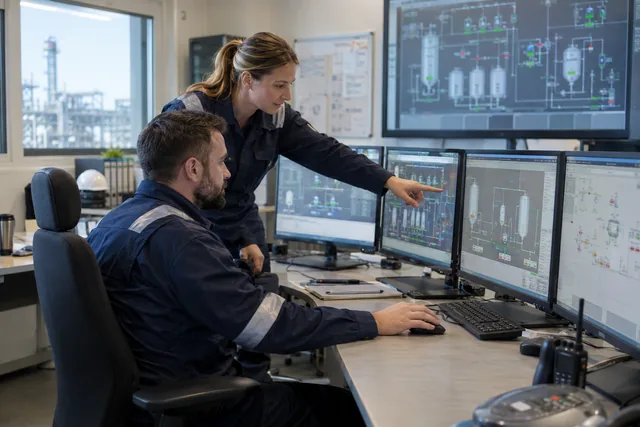
Existing SHAREhub photographic illustration. The written fictional case supplies the condition and decision evidence.
Start with the unwanted event
Process safety concerns the prevention and control of events such as a large release, fire, explosion or harmful reaction. Start by asking what material or energy could escape its intended control, then follow the resulting pathway. An injury count describes one set of outcomes; it does not show whether a tank can overfill or an isolation arrangement is reliable.
A useful description names an activity and mechanism: a transfer continues into a full vessel because a protective function fails. That is more informative than “chemical risk”. Personal safety still matters, and an event can harm an individual, but neither a tidy site nor an injury-free month establishes control of the release scenario.
What is process safety management?
Process safety management is the organised control of credible major accidents involving hazardous substances or stored energy through sound design, reliable barriers, competent people, disciplined operation, emergency preparedness and evidence-based assurance across the lifecycle.
Best-practice guide · six simple steps
Best-practice guide: What Process Safety Management Is
Start with the key actions, then explore value, a workplace example, harm, stronger controls and further help. Choose a step or use Previous and Next; the guide does not advance automatically.
Keep one card or the full set for social sharing, team briefings and learning. Each PDF contains one card per page. Read the full topic for explanations, questions and source links.
Read all six steps as text
1. What is process safety management?
Process safety management is the organised control of credible major accidents involving hazardous substances or stored energy through sound design, reliable barriers, competent people, disciplined operation, emergency preparedness and evidence-based assurance across the lifecycle.
Avoid / redesign: Remove an unnecessary hazardous transfer, inventory or manual process step through an approved design change.
Control the task: Specify containment, separation and independent safeguards for the credible release scenario.
Verify before release: Process technical owner verifies the updated scenario and process information.
Process safety management is the organised control of credible major accidents involving hazardous substances or stored energy through sound design, reliable barriers, competent people, disciplined operation, emergency preparedness and evidence-based assurance across the lifecycle. Process safety management is the coordinated prevention and control of major accidents involving dangerous substances or stored energy.
Apply it: Which part of this plan would you check at the workface before authorising the task?
2. Turn what process safety management is knowledge into a decision
Use the evidence to improve the actual work arrangement.
Change at source: Remove an unnecessary hazardous transfer, inventory or manual process step through an approved design change.
Make it observable: Process technical owner verifies the updated scenario and process information.
Keep useful evidence: Event timeline, plant state, gas-test record, repair and accepted tests, scenario review, action disposition and operating-authority release.
Process safety management is the coordinated prevention and control of major accidents involving dangerous substances or stored energy. It connects credible release, fire, explosion and toxic-exposure scenarios to sound design, reliable barriers, competent operation, controlled change and emergency readiness. Event timeline, plant state, gas-test record, repair and accepted tests, scenario review, action disposition and operating-authority release.
Apply it: What evidence would show that the change improves this task, rather than only completing a record?
3. Pump seal leak with impaired gas detection and overdue action
Fictional example: a practical application of the existing topic lesson.
Setting: Stop the transfer through the approved site procedure, move the plant to its defined safe state, raise the alarm to the control room and shift operating authority, isolate remotely only where the approved response allows and keep unneeded people out.
Act: Confirm transfer route, inventory, ignition controls, remote isolation, drainage, detection coverage and the overdue action; keep unneeded people out.
Hold / review: Do not continue transfer or approach for routine inspection while containment, atmosphere, ignition risk or detection coverage is uncertain.
Stop transfer and move to the defined safe state, raise the alarm route, isolate remotely if safe, use portable monitoring under the approved response and assess the affected scenarios and common causes. Repair the seal, restore and function-test fixed detection, inspect comparable equipment, close or re-plan the overdue action and brief operations.
Apply it: At which point would you hold this example, and what evidence would allow it to proceed?
Connect the task, the route to the person and the control that can fail.
Corroded transfer line releases flammable liquid: Vapour reaches an ignition source, causing fire, burns and possible escalation to adjacent equipment.
Overfill with impaired high-level trip: Tank overflow forms a hazardous pool or vapour cloud; fire, exposure or off-site impact may follow.
Unreviewed process change causes runaway: Unexpected heat or pressure exceeds the operating envelope, with vessel failure and toxic or flammable release possible.
Corroded transfer line releases flammable liquid: Vapour reaches an ignition source, causing fire, burns and possible escalation to adjacent equipment. Overfill with impaired high-level trip: Tank overflow forms a hazardous pool or vapour cloud; fire, exposure or off-site impact may follow. Unreviewed process change causes runaway: Unexpected heat or pressure exceeds the operating envelope, with vessel failure and toxic or flammable release possible.
Apply it: Who could be exposed, including other trades, cleaners, maintainers and people nearby?
Control summary. Read the complete task-specific controls and checks in the linked topic.
Elimination: Remove an unnecessary hazardous transfer, inventory or manual process step through an approved design change.
Substitution: Test a less hazardous material or lower-inventory process for the actual chemistry and operating conditions.
Engineering controls: Specify containment, separation and independent safeguards for the credible release scenario.
Administrative controls: Define the safe operating envelope, usable operating and maintenance arrangements, competent roles, change control and emergency response.
PPE: PPE cannot prevent loss of containment, prove a safety-critical barrier or authorise entry to an uncontrolled release.
Eliminate: Remove an unnecessary hazardous transfer, inventory or manual process step through an approved design change. Reduce, including substitution: Test a less hazardous material or lower-inventory process for the actual chemistry and operating conditions. Isolate: Specify containment, separation and independent safeguards for the credible release scenario. Control: Define the safe operating envelope, usable operating and maintenance arrangements, competent roles, change control and emergency response. PPE: Select compatible protective equipment for the assessed residual exposure; emergency response needs the approved plan and competent team. Read the full control table for qualifications, ownership and verification. Use the actual task and applicable jurisdiction; existing technical approval remains unchanged.
Apply it: Which stronger option can be used here, and who will verify it before accepting the remaining risk?
6. Use the full what process safety management is lesson
Follow the official sources below and retain the task-specific evidence.
Official guidance: HSE HSG254 Developing process safety indicators
Official guidance: HSE Control of Major Accident Hazards (COMAH) 2015 duties
Task decision: A qualitative trend needs labelled time and process-variable axes. Actual operating limits come from the assessed design basis, not this unscaled illustration.
Use the full topic for the decision points, practical examples, detailed control tables and source scope. HSE guidance applies to Great Britain; use HSENI for the Northern Ireland route and the source’s stated jurisdiction. A simplified guide does not change the page’s technical-review or approval status.
Apply it: Which official source and full-topic section will you use to resolve the next decision?
Simplified learning guide. Use the full topic, current official guidance and the actual work arrangements. Workplace scenarios labelled fictional are illustrative examples.
It asks how a loss of containment, fire, explosion, toxic release, runaway reaction or other major event could develop and whether prevention and mitigation will perform when demanded. The term is a management description, not one universal UK statutory duty. See HSE Control of Major Accident Hazards (COMAH) 2015 duties.
Hazard. Question: What major event is credible?; Evidence: Scenario and consequence basis.
Control. Question: What prevents or limits it?; Evidence: Barrier functions and standards.
Operation. Question: How is the safe state maintained?; Evidence: Limits, procedures and competence.
Assurance. Question: How do we know controls work?; Evidence: Tests, indicators, audit and learning.
How is process safety different from personal safety?
Personal safety controls frequent injuries and occupational harm; process safety controls lower-frequency events that can affect many people, the environment, assets and communities. Both matter, but their evidence is not interchangeable.
A low lost-time injury rate cannot show that relief systems, shutdown valves, containment, operating limits or emergency arrangements are healthy. Equally, major-hazard attention does not remove ordinary workplace duties.
Does every workplace need a COMAH process-safety system?
No. Every employer needs proportionate risk control, but COMAH, pipeline, offshore and other major-hazard duties apply only within their legal scope. Establish applicability before naming a statutory deliverable.
Inventory, substance classification and quantity, activity, location, installation type and exclusions matter. A site below COMAH thresholds may still need strong process-safety controls under Dangerous Substances and Explosive Atmospheres Regulations (DSEAR), general law, permits, licences or its risk profile.
Question
Possible route
Boundary
Threshold dangerous substances at an establishment?
Explain why one indicator cannot stand in for another.
Existing SHAREhub photographic illustration. The written fictional case supplies the condition and decision evidence.
Read personal and process indicators together
Different measures answer different questions. A minor-injury trend can help identify handling or access problems. A failed protective-system test, an overdue integrity task or a release report may reveal a weakness in control of a much larger event. Keep both sets visible and connect a measure to the scenario it is meant to represent.
Avoid treating every number as an equally reliable signal. Check what was counted, which equipment or tasks it covers and whether missing records distort the picture. A low reported-event count might reflect successful controls or poor reporting. Interpretation needs operating evidence, not an automatic favourable conclusion.
What is the difference between process safety and personal safety?
Personal safety usually prevents individual harm from work tasks; process safety prevents high-consequence loss-of-control events.
Personal safety matters. Slips, trips, falls, manual handling injuries, cuts, burns, vehicle strikes and occupational ill health can cause serious harm. But process safety asks a different question: could hazardous inventory, energy or plant failure escalate into multiple fatalities, community harm, environmental damage, asset loss or business interruption?
A fuel terminal can have no lost-time injuries while overfill protection is bypassed. A refinery can have good PPE compliance while alarm management, start-up procedures and siting are weak. The two safety domains should reinforce each other, but one must not be used as a proxy for the other.
Slip, cut, manual handling injury, fall, contact with moving part.
Loss of containment, fire, explosion, toxic release, runaway or overpressure.
Frequency/severity
Often more frequent and visible.
Often rarer but potentially catastrophic.
Core evidence
Inspections, training, observations, injury trends and task controls.
Barrier health, MOC, alarms, trips, relief, integrity and emergency readiness.
Common metric
Accident frequency, near misses, task observations.
Leading/lagging process safety indicators and high-potential events.
Failure risk
Immediate task harm.
Escalation across plant, people, public, environment and assets.
A slip hazard has a direct task path to an individual injury. A major-accident path can accumulate silently: hazardous inventory, an initiating event, multiple degraded safeguards, then loss of containment and fire, blast or toxic exposure. The site should not trade one risk domain against the other. Personal injury measures help manage routine work; process-safety measures need to test the control systems for credible high-consequence scenarios.
A low injury rate does not interrupt the process harm chain: overdue relief examination plus a bypassed alarm and unclosed change can allow pressure or level to exceed limits, followed by containment failure, fire, blast or hazardous exposure. These outcomes differ from slips or cuts and require scenario-specific barrier evidence and stop rules. Source: HSE developing process safety indicators HSG254
Process-safety learning also includes small releases, protective-function demands and control failures. The low-frequency/high-consequence description explains major-accident potential; it does not exclude lesser events or shared controls protecting the same people.
Applied case
Fictional exercise: A monthly dashboard combines first-aid cases and overdue safety-critical tests into one “green” score.
One green score
An average can conceal the protective function needing attention.
A low count
Fewer reports can reflect control or a reporting weakness; examine the context.
Test your decision
What is the strongest challenge to the dashboard?
Remove overdue tests because they are maintenance data.
Separate the measures and explain the scenario and evidence behind each.
Average the numbers across more departments.
Compare the explanation
Separate the measures and explain the scenario and evidence behind each.
Combining unlike measures can hide an important control weakness. Preserve their meaning and evidence.
Connect hazardous inventory to credible mechanisms of harm.
Photorealistic illustrative UK workplace scene. Review checks: Avoid / redesign: Remove an unnecessary hazardous transfer, inventory or manual process step through an approved design change. Control the task: Specify containment, separation and independent safeguards for the credible release scenario. Verify before release: Process technical owner verifies the updated scenario and process information.
Trace material and energy
The hazard is not limited to a label on a container. Material quantity, physical form, pressure, temperature, compatibility and confinement can change what happens after control is lost. Stored energy may injure people or propel material; released vapour may travel before finding an ignition source. An apparently small opening can connect a person to a much larger process inventory.
The awareness task is to recognise those connections and obtain reliable process information. It is not to infer safe conditions from appearance or to calculate an operating limit without the required expertise. Follow the defined plant boundary and identify where the available information ends.
How can a major accident develop?
A major accident develops when an initiating event defeats prevention, hazardous material or energy escapes control, and detection, isolation or mitigation fails or arrives too late. A release can become a fire, explosion, toxic exposure or environmental event; credible escalation and off-site effects must be considered. Identify the exposed people and environment, then test the actual barriers and their shared failure modes. Management of change (MOC) prevents an unreviewed modification from bypassing these barriers.
Trace inventory and energy, initiating event, top event, escalation, outcome, preventive and mitigative barriers. A clean injury record says nothing about an untested shutdown valve, a disabled alarm or an overdue inspection. See HSE COMAH 2015 duties.
Scenario path and live barrier check
Initiator and top event
Escalation and possible harm
Barrier and stop decision
Corroded transfer line releases flammable liquid
Vapour reaches an ignition source, causing fire, burns and possible escalation to adjacent equipment.
Verify containment inspection, leak detection, isolation and ignition control; stop transfer if the release or an essential barrier cannot be controlled.
Overfill with impaired high-level trip
Tank overflow forms a hazardous pool or vapour cloud; fire, exposure or off-site impact may follow.
Confirm level indication, independent trip, operator response and bund capacity; hold receipt when the trip or response basis is impaired.
Unreviewed process change causes runaway
Unexpected heat or pressure exceeds the operating envelope, with vessel failure and toxic or flammable release possible.
Use competent hazard review, relief and shutdown design, MOC and pre-startup verification; do not start until the change and safeguards are accepted.
Identify a credible event without inventing case facts.
Existing SHAREhub photographic illustration. The written fictional case supplies the condition and decision evidence.
Make the scenario specific
A scenario connects a hazardous source, an initiating cause, a loss of control and a consequence. Describe enough detail to test safeguards: which transfer, which receiving equipment, what could initiate the deviation and who might be affected. Vague statements such as “plant failure” do not show which controls matter.
Credibility is different from certainty. A review may identify a possible pathway that requires further examination; it should not present an unconfirmed equipment failure as an observed fact. Keep the distinction between the stated condition, a reasonable hypothesis and the evidence needed to decide. This makes both immediate restrictions and further assessment easier to justify.
How does a major accident develop?
A major accident follows a credible path from an initiating fault to loss of containment, escalation and harm when preventive or mitigating barriers fail or are unavailable.
For a fuel tank, inflow can continue after a level instrument fails; an independent high-level shutdown may also be impaired. Overflow can create vapour, which may find ignition and affect workers or neighbours. A leader should ask about both the initiating event and the common cause that could defeat supposedly separate safeguards. HSE large-tank overfill safety alert, HSE Buncefield investigation and learning and HSE COMAH control systems.
Recognise escalation and people outside the immediate task.
Photorealistic illustrative UK workplace scene. Review checks: Avoid / redesign: Engineering and logistics evaluate removing the storage or transfer step, or redesigning the operation so the identified tank-overfill scenario cannot occur. Control the task: Competent designers specify prevention and mitigation for the actual plant, including suitable overfill protection, separation and containment where the scenario requires them. Verify before release: Record the credible scenario and whether the change truly removes it.
Look beyond the fence
A release can affect neighbouring work, emergency access, drainage, the environment and people beyond the establishment. The relevant footprint depends on the material, event and surroundings; the operator’s position is not the limit of the consequence. Consider possible escalation to other equipment as well as the immediate exposure.
An awareness discussion should identify these pathways for competent assessment and emergency planning. Do not choose an evacuation distance or declare off-site effects impossible from a general photograph. The lesson is to ask whose exposure or response has been omitted, while using the actual site’s assessed arrangements for action.
How should off-site and environmental consequences shape leadership decisions?
A release may affect neighbours and the environment as well as people on site. Leaders need a credible footprint, receptors, communication route and emergency interfaces.
Fictional exercise: A transfer review lists only the driver. The pack shows an adjacent maintenance task and a drainage connection, but gives no consequence assessment.
Who is missing?
Adjacent workers and response access may be affected by the same event.
No invented distance
Use assessed site arrangements, not a distance inferred from an image.
Test your decision
What is missing from the review?
A universal exclusion distance chosen by the learner.
Consideration of those adjacent people and environmental pathways within the assessed scenario.
A claim that every neighbour will certainly be harmed.
Compare the explanation
Consideration of those adjacent people and environmental pathways within the assessed scenario.
The visible interfaces need consideration. The case does not establish an outcome or a safe distance.
Describe what a barrier is meant to do in the event chain.
Photorealistic illustrative UK workplace scene. Review checks: Change at source: Engineering and logistics evaluate removing the storage or transfer step, or redesigning the operation so the identified tank-overfill scenario cannot occur. Make it observable: Record the credible scenario and whether the change truly removes it. Keep useful evidence: Retain scenario and inventory, barrier standard, test history, impairment assessment, decision record, field checks, emergency interface and signed release.
Separate prevention from mitigation
Prevention reduces the chance of losing control; mitigation limits consequences after the event begins. For an overfill scenario, controlling the receipt and detecting the relevant condition are different functions from containing an escaped liquid. State each function rather than treating every item labelled “safety” as interchangeable.
A useful barrier claim also needs a performance basis, availability and verification. The existence of a device does not demonstrate its condition, independence or suitability. At awareness level, ask who owns that evidence and what happens if the function is unavailable. Do not assign engineering credit or assume that two items are independent merely because they have separate names.
Follow the release, then test each barrier
Prevention acts before loss of containment; mitigation limits consequences after it. A low injury count does not establish either function.
Fictional learning example
Separate the evidence from the decision
Part of the picture
What the example establishes
Observed
A transfer pump seal has leaked twice; no one was injured.
Prevention question
Why did the seal leak, and what evidence supports the integrity and operating controls?
Mitigation question
Would detection, drainage, isolation and the emergency response limit this particular release?
Pause and decide: Does the absence of injury justify closing the process-safety concern?
Compare the reasoning
No. Preserve the actual outcome and assess the credible release scenario separately. Identify each barrier, its required function, current condition and owner. Check effectiveness before closing an action; a favourable personal-safety result is not that evidence.
Which barriers should a leader be able to name?
Identify the controls that prevent the event, detect its onset and limit its consequences. Each credited barrier needs a defined function, owner, test and response when impaired.
A level alarm, independent trip, bund, emergency isolation valve and fire response are different layers; their shared power, instrument or maintenance arrangements may make them less independent than they look. Ask for the specified response, acceptance criterion, last effective test, open defect and operating restriction. HSE COMAH control systems and HSE COMAH emergency isolation.
Compare inherent risk reduction with controls that depend on continuing action.
Photorealistic illustrative UK workplace scene. Review checks: Change at source: Remove an unnecessary hazardous transfer, inventory or manual process step through an approved design change. Make it observable: Process technical owner verifies the updated scenario and process information. Keep useful evidence: Event timeline, plant state, gas-test record, repair and accepted tests, scenario review, action disposition and operating-authority release.
Reduce the hazard deliberately
Removing an unnecessary hazardous step or reducing inventory through a reviewed design can change the underlying risk. This differs from adding a warning or asking someone to be more careful around the same hazard. The comparison should still consider chemistry, operability and other affected systems; a proposed substitution can introduce new hazards.
Operators should not make an unreviewed change because an option sounds inherently safer. The useful awareness contribution is to identify the opportunity and the questions that the authorised design and change process must answer. Stronger risk reduction requires a justified application, not a slogan or a bypass of competent review.
Where should the control hierarchy begin?
Where reasonably practicable, eliminate or reduce hazardous inventory and conditions, substitute less hazardous materials, moderate pressure or temperature, simplify the process and avoid error-prone complexity before relying on add-on barriers.
Inherent measures can remove a scenario or reduce consequence, but design changes still require hazard review and MOC. PPE and emergency response are important but sit late in the control hierarchy for major accidents.
Minimise. Example: Reduce hazardous hold-up or batch size.; Verification: Inventory and consequence basis.
Substitute. Example: Use a less hazardous material or route.; Verification: Full chemistry and compatibility review.
Moderate. Example: Lower pressure, temperature or concentration.; Verification: Revalidated operating and relief basis.
Simplify. Example: Remove unnecessary transfer or manual alignment.; Verification: Operability and failure review.
What is a process-safety barrier?
A barrier is a specific preventive or mitigative function that interrupts a defined scenario, such as containment, an independent trip, relief, isolation, drainage, detection, fire protection or emergency action.
Hardware, instrumented, procedural, organisational and emergency barriers can all matter. Treat a claimed barrier as credible only when its function, demand, independence, performance and current availability are understood.
What should a barrier performance standard contain?
State the function, required availability, capacity, response time, reliability, survivability, independence, inspection or proof-test method, acceptance criteria, owner and impairment response.
The standard should be measurable and linked to the scenario. A maintenance task marked complete without an accepted result does not show the barrier will perform.
Explain why design intent must survive operation, maintenance and change.
Photorealistic illustrative UK workplace scene. Review checks: Setting: Stop the transfer through the approved site procedure, move the plant to its defined safe state, raise the alarm to the control room and shift operating authority, isolate remotely only where the approved response allows and keep unneeded people out. Act: Confirm transfer route, inventory, ignition controls, remote isolation, drainage, detection coverage and the overdue action; keep unneeded people out. Hold / review: Do not continue transfer or approach for routine inspection while containment, atmosphere, ignition risk or detection coverage is uncertain.
Follow controls through the lifecycle
A design assumption can be lost during later work. A protective function may depend on correct settings, maintained equipment, competent response or a service that another department changes. Process safety therefore connects design, commissioning, normal use, intervention and eventual decommissioning.
At a handover between these stages, ask which assumptions remain valid and which evidence demonstrates the actual condition. A successful commissioning test describes a point in time and a defined configuration. It is not an unlimited promise that later modifications or maintenance cannot affect the function. Maintain the connection between current plant, controlled information and verification.
Where does process safety apply in the lifecycle?
Control starts at concept and design and continues through construction, commissioning, operation, maintenance, change, shutdown, emergency, recovery and decommissioning.
Startup, shutdown, trips, utility loss, temporary equipment, intrusive maintenance and organisational change often have different risk from steady operation. Each transition needs defined readiness and authority.
Design. Primary decision: Can hazard or inventory be eliminated or reduced?; Evidence: Option and design review.
Commissioning or restart. Primary decision: Is plant ready and as designed?; Evidence: Pre-startup verification.
Operation and maintenance. Primary decision: Are limits and barriers maintained?; Evidence: Logs, tests, permits and actions.
Decommissioning. Primary decision: Are residual inventories and energies controlled?; Evidence: Isolation, cleaning and closure record.
How is process safety built into design and construction?
Set hazard-reduction requirements early, maintain design authority and traceability, review constructability and human factors, verify materials and installation, control deviations and prove safety functions before hazardous commissioning.
Late add-on protection cannot always recover a poor layout, excessive inventory or weak segregation. Construction quality and commissioning tests are part of the safety evidence.
Construction. Control: Material, welding, installation and deviation control.; Evidence: Quality and inspection record.
Commissioning. Control: Function test and safe introduction of inventory.; Evidence: Approved procedure and pre-startup safety review (PSSR).
What process-safety controls apply to decommissioning?
Identify residual substances and stored energy, isolate from live systems, drain, purge and clean, manage temporary configurations and structural change, control waste and verify the final safe state.
A plant that is shut down can still contain pressure, contamination, unstable chemicals or connected services. MOC, permits, emergency arrangements and information control continue until hazards are removed or transferred.
Inventory removal. Major hazard: Trapped or reactive residue.; Evidence: Drain, purge and analysis.
Disconnection. Major hazard: Backflow from live systems.; Evidence: Positive isolation and test.
Dismantling. Major hazard: Ignition, collapse or contaminated waste.; Evidence: Plan, permit and monitoring.
Closure. Major hazard: Unknown residual liability.; Evidence: Final condition and handover record.
Identify when an unresolved barrier condition needs an authorised decision.
Existing SHAREhub 2D teaching schematic. Use alongside the explanation and fictional case in this lesson.
Recognise a degraded operating basis
A process can remain within an observed operating value while its protection against a future deviation is degraded. Normal appearance alone does not settle whether operation is permissible. The operating basis includes the controls and conditions required for the task, not only the value currently shown on a display.
Use the site’s defined restrictions, escalation and authorised decision route. A production target or an individual’s confidence does not replace that decision. Where the case gives no accepted temporary arrangement, keep that absence explicit. Awareness training does not authorise a learner to invent a compensating control, change a limit or override a protective function.
What is the safe operating envelope?
It is the approved range and configuration within which the process and its barriers remain valid, including key limits, alarm and trip points, required utilities, response actions and authority for deviation.
Limits must come from the design and hazard basis; this page cannot supply generic numbers. Crossing or approaching a limit requires the approved abnormal-response route, not an improvised return to target.
Operating limit. Define: Normal and safe boundary.; Evidence: Design or hazard-study basis.
Alarm or trip. Define: Action point and response time.; Evidence: Set point, test and procedure.
Required configuration. Define: Valves, utilities and safeguards in service.; Evidence: Line-up and availability check.
Deviation authority. Define: Who can hold, stop or approve recovery?; Evidence: Named decision record.
Why do abnormal operation, startup and shutdown need special control?
Transient states can change inventories, flows, compositions, ignition potential and barrier availability, so they need specific procedures, staffing, limits, monitoring and escalation.
Repeated alarm floods, trips, unstable operation and manual workarounds are not normal simply because people have managed them before. Stabilise or stop according to the approved route.
Startup. Control focus: Sequencing, permissives, line-up and utilities.; Stop signal: Unknown valve position or untested trip.
Shutdown. Control focus: Inventory removal, thermal change and isolation.; Stop signal: Uncontrolled pressure or residual material.
Upset. Control focus: Recognise, stabilise and escalate within time.; Stop signal: Outside envelope or response uncertain.
Utility loss. Control focus: Defined safe state and emergency power.; Stop signal: Required safeguard cannot function.
What makes an operating procedure usable?
A procedure describes the verified plant configuration, prerequisites, steps, limits, expected indications, abnormal responses, communication, handover and stop points in language usable at the job.
Field-check procedures against current plant and involve users. Do not rely on memory, unofficial notes or a document that omits what to do when conditions differ.
Prerequisites. Requirement: People, plant and barriers ready.; Evidence: Signed check or system status.
Steps and verification. Requirement: Critical actions independently checked where needed.; Evidence: Initials, log or control record.
Limits and response. Requirement: Clear hold and emergency actions.; Evidence: Observed exercise or drill.
Handover. Requirement: State, deviations and open actions transferred.; Evidence: Shift or job handover record.
Relate small deviations to possible control weaknesses.
Photorealistic illustrative UK workplace scene. Review checks: Setting: the process operator, a fictional fuel terminal, plans a high-volume tank transfer while the high-level trip has an overdue proof test and the gauge has shown intermittent faults. Act: The site manager holds the transfer, asks a competent technical authority to assess independent protection and common-cause failures, and records any safer alternative or reduced-risk plan. Hold / review: Stop if level indication is unreliable, independent shutdown cannot be proven, containment is impaired, a transfer path differs from the approved plan or a new leak appears.
Use weak signals constructively
A repeated seep, an unclear label, a difficult handover or a recurring alarm may expose a weakness before a major event occurs. The signal’s significance depends on its relationship to the scenario and barriers. Record enough context to make that relationship examinable: place, task, condition and what remains unresolved.
Reporting should lead to proportionate investigation and a visible response. Simply counting more reports does not prove a worsening plant, and counting fewer does not prove improvement. Ask whether people can raise concerns and whether the resulting action removes or controls the underlying weakness. Avoid encouraging unauthorised inspection or entry to obtain better evidence.
Which weak signals should reach the board?
Repeated leaks, bypasses, overdue tests, nuisance alarms, open study actions and competence gaps can signal degrading major-accident controls before a large event.
Ask whether data are grouped by scenario and barrier rather than by department. Review the age and consequence of open work, repeated exceptions, temporary repairs and near misses. A rising completion percentage can hide smaller test scope or poor-quality closure; verify selected cases in the field. HSE HSG254 Developing process safety indicators and HSE Leadership for the major hazard industries.
Leading and lagging leader indicators
Critical control
Leading evidence
Lagging evidence
Overfill protection
Specified independent trip tested and defects closed.
Illustrative paired indicator: the engineering barrier owner reports scheduled trip tests completed to the specified scope and all overdue/failed exceptions for the monthly reporting window; separately report operational demands, failures on demand and releases. Challenge a scope reduction or open dangerous failure and apply the scenario’s hold rule. No numerical target is inferred.
Applied case
Fictional exercise: A pump-area odour has been mentioned informally on several shifts. No one knows whether the concern reached the responsible team.
A useful signal
Location, recurring condition and unresolved status make a report actionable.
Safe evidence
Do not enter a suspected release area to prove its cause.
Test your decision
What is the useful next contribution?
Investigate the source alone by entering the suspected release area.
Assume repeated informal discussion proves the matter is controlled.
Use the safe reporting route to connect the recurring observation with its location and unresolved status.
Compare the explanation
Use the safe reporting route to connect the recurring observation with its location and unresolved status.
Make the signal actionable while staying within the safe role and response arrangements.
Distinguish useful participation from specialist approval.
Photorealistic illustrative UK workplace scene. Review checks: Avoid / redesign: Remove an unnecessary hazardous transfer, inventory or manual process step through an approved design change. Control the task: Specify containment, separation and independent safeguards for the credible release scenario. Verify before release: Process technical owner verifies the updated scenario and process information.
Know the boundary of awareness
An awareness learner can recognise a concern, ask a better question and use the correct escalation route. Specialist process design, consequence assessment, functional-safety decisions and legal applicability require the appropriate expertise and authority. A course pass does not establish those capabilities.
Make that boundary practical rather than vague. Identify the task that requires a competent owner, the information missing and the decision the learner can legitimately make. Avoid both extremes: remaining silent because the subject is technical, or making an engineering approval because a diagram seems understandable. Useful participation makes a decision better informed without pretending to replace its responsible owner.
How should process-safety governance work?
Name accountable operating owners, barrier owners, technical authorities, emergency owners and independent assurance, with written decision rights and escalation for degraded or uncertain safeguards.
Production, cost or schedule pressure must not silently transfer risk. The person authorising continued operation or restart needs the competence, authority and evidence to own that decision.
Operating authority. Authority: Hold, stop and restart plant.; Accountability: Current operating risk.
Barrier owner. Authority: Maintain performance and escalate impairment.; Accountability: Health and test evidence.
Technical authority. Authority: Accept engineering basis and deviations.; Accountability: Design integrity and MOC.
Senior accountable leader. Authority: Resource and accept material residual risk.; Accountability: Assurance and overdue action decisions.
What process safety information must be controlled?
Keep current information on substances, reactions, inventories, equipment, materials, relief and disposal, control logic, operating limits, utilities, layouts, hazardous areas and safety-critical functions.
Information must match the plant in the field and be usable by the people making decisions. Unknown line identity, obsolete drawings, unexplained set points or missing chemical data are reasons to pause the affected work.
Substance and reaction data. Decision supported: Hazards, incompatibility and relief basis.; Failure signal: Unknown composition or decomposition.
Piping and instrumentation information. Decision supported: Isolation, flow and control path.; Failure signal: Field does not match drawing.
Equipment and materials basis. Decision supported: Integrity and operating envelope.; Failure signal: Unverified substitution or repair.
Control and trip logic. Decision supported: Response and independence.; Failure signal: Uncontrolled software or set-point change.
Integrate scenario, barrier status and an honest release question.
Existing SHAREhub 2D teaching schematic. Use alongside the explanation and fictional case in this lesson.
Build a connected decision pack
A useful process-safety discussion links the activity, the credible unwanted event, the functions that control it and the evidence of their condition. A folder containing those documents is not enough if the information refers to different equipment or an earlier configuration. Check the connections, not just the number of attachments.
Finish with a decision that says what is established, what is still unknown and who must resolve it. Different issues can have different owners and timescales; closing a paperwork action does not necessarily restore a physical safeguard. Explain the remaining restriction to the next person controlling the task. The product of this learning exercise is a defensible question and handover, not an operating permission.
What should a leader do when overfill protection is uncertain?
Hold the transfer until the credited protection and operating state are understood. A senior leader owns the risk decision and resources; a competent technical authority establishes whether operation can meet the safety basis.
Crownway tank-transfer decision
Task, material and setting: Crownway Fuels Ltd, a fictional fuel terminal, plans a high-volume tank transfer while the high-level trip has an overdue proof test and the gauge has shown intermittent faults.
People and prerequisites: Operators, engineering, emergency coordinators and senior managers need the tank identity, inventory, transfer rate, overfill scenario and status of every credited barrier.
Before: The site manager holds the transfer, asks a competent technical authority to assess independent protection and common-cause failures, and records any safer alternative or reduced-risk plan.
During: Only after protection is restored and verified, or a separately engineered, time-limited operating state meets the safety basis under the impairment process with independent technical challenge, named restrictions and withdrawal triggers, operators use defined limits, verified monitoring, communications and stop authority; no unapproved bypass or solo workaround is allowed.
Hold or stop: Stop if level indication is unreliable, independent shutdown cannot be proven, containment is impaired, a transfer path differs from the approved plan or a new leak appears.
Completion and hand back: Prove the trip and gauge to specification, close defects, remove restrictions only under named authority and review the backlog decision.
Evidence: Retain scenario and inventory, barrier standard, test history, impairment assessment, decision record, field checks, emergency interface and signed release.
Fictional exercise: A receipt pack contains a current route drawing, an old protective-system test and a note saying “maintenance informed”. It does not identify a current safeguard condition.
Connections
Drawings and tests must concern the actual equipment and configuration.
Handover
State what is resolved and name the question still awaiting a decision.
Test your decision
Which conclusion is justified?
The route information is useful, but current safeguard availability remains unresolved and needs the responsible decision.
Three documents are sufficient evidence to proceed.
The old test proves the safeguard has failed.
Compare the explanation
The route information is useful, but current safeguard availability remains unresolved and needs the responsible decision.
Assess what each item establishes. The stated pack neither demonstrates current availability nor proves failure.