SHARE Knowledge Hub
What Process Safety Management Is
Process safety management is the coordinated prevention and control of major accidents involving dangerous substances or stored energy. It connects credible release, fire, explosion and toxic-exposure scenarios to sound design, reliable barriers, competent operation, controlled change and emergency readiness. The test is whether those barriers work now, including during abnormal operation, maintenance and restart, rather than whether a policy or low personal-injury rate looks reassuring.
Understanding What Process Safety Management Is
Process safety management is the coordinated system used to prevent major accidents involving hazardous substances or stored energy and to limit their consequences if prevention fails. It integrates engineering design, process knowledge, operations, maintenance, human factors, competence, management of change, emergency arrangements, leadership and assurance across the full asset lifecycle. The central question is whether credible high-consequence scenarios are understood and whether the barriers relied on to control them are demonstrably healthy now.
Why this matters at work
Personal safety focuses on events such as slips, manual-handling injuries and local task harm. Occupational health manages exposure and work-related disease. Process safety focuses on infrequent but potentially catastrophic loss of containment, fire, explosion, toxic effects, environmental harm and escalation. The disciplines overlap but use different hazard models, indicators and timescales.
Consequence analysis estimates how hazardous effects may develop and whom or what they could harm. It can include toxic dispersion, thermal radiation, overpressure, projectiles, oxygen depletion, environmental pathways and domino escalation. Source terms, weather, terrain, congestion, buildings, drainage and response assumptions should match the decision.
How organisations manage this in practice
The MAPP states the operator's aims and principles for controlling major-accident hazards. It should be concise but must connect to the live safety management system that implements it. A signed policy without plant procedures, competence, maintenance, change control, emergency arrangements, monitoring, audit and review is not evidence of delivery.
Use a disciplined decision model: know the substances, energy and process; identify credible initiating events and escalation; eliminate or reduce hazards where practicable; define preventive and mitigative barriers with performance standards; operate inside the safe envelope; control work and change; monitor degradation and weak signals; intervene when barriers are impaired; learn from events; and obtain independent assurance. If critical information or barrier status is unknown, the answer is not reassurance but restriction, safe shutdown or escalation proportionate to the possible consequence.
Establish the cause of the upset, present plant condition and the status of containment, protective systems and utilities before considering restart. Make the plant safe through the actual operating and isolation procedures, with competent response and emergency escalation where needed. A reset alarm or returned instrument reading does not prove the initiating fault has disappeared. Check whether the event damaged equipment, exhausted a safeguard or left material in an unsafe condition. Complete the required investigation, engineering checks and management-of-change review for any repair or alteration. Verify procedures, staffing, competence, emergency arrangements and handover information against the actual restart conditions. Record outstanding limitations and the separate authorised decision to resume, through the site's system. Involve operators and maintainers and communicate to contractors or neighbouring operations where affected. Do not use a generic checklist as permission to restart. Retain event evidence and assign preventive actions even where immediate restoration is straightforward, because recurrent small upsets may reveal a deteriorating major-accident barrier.
Follow one transfer and prove each barrier
Process safety connects hazardous inventory and energy to credible major-accident scenarios. Personal injury performance cannot demonstrate the health of protective barriers.

Locate the functions
Identify containment, level indication, claimed shutdown, receipt isolation, bund or drainage and emergency response on the actual system.
Challenge independence
Trace shared utilities and instruments before treating two protective functions as independent.
Keep evidence and authority
Each claimed barrier needs a function, owner, relevant accepted test and impairment decision; technical acceptance is separate from operating release.
Use real operating limits
A qualitative trend needs labelled time and process-variable axes. Actual operating limits come from the assessed design basis, not this unscaled illustration.
Read the complete task-specific control examples
ERICPD is a planning cross-map: Discipline verifies and sustains every control. ESEAP compares effectiveness. A label does not authorise the task; retain the owner, evidence and stop or change decision.
What Process Safety Management Is · ERICPD
- Eliminate
- Remove an unnecessary hazardous transfer, inventory or manual process step through an approved design change.
- Reduce
- Test a less hazardous material or lower-inventory process for the actual chemistry and operating conditions.
- Isolate
- Specify containment, separation and independent safeguards for the credible release scenario.
- Control
- Define the safe operating envelope, usable operating and maintenance arrangements, competent roles, change control and emergency response.
- PPE
- PPE cannot prevent loss of containment, prove a safety-critical barrier or authorise entry to an uncontrolled release.
- Discipline
- Maintain safety-critical equipment, track degraded barriers, investigate weak signals and verify action effectiveness.
What Process Safety Management Is · ESEAP
- Elimination
- Remove an unnecessary hazardous transfer, inventory or manual process step through an approved design change.
- Substitution
- Test a less hazardous material or lower-inventory process for the actual chemistry and operating conditions.
- Engineering controls
- Specify containment, separation and independent safeguards for the credible release scenario.
- Administrative controls
- Define the safe operating envelope, usable operating and maintenance arrangements, competent roles, change control and emergency response.
- PPE
- PPE cannot prevent loss of containment, prove a safety-critical barrier or authorise entry to an uncontrolled release.
How can I practise this topic in 3D?
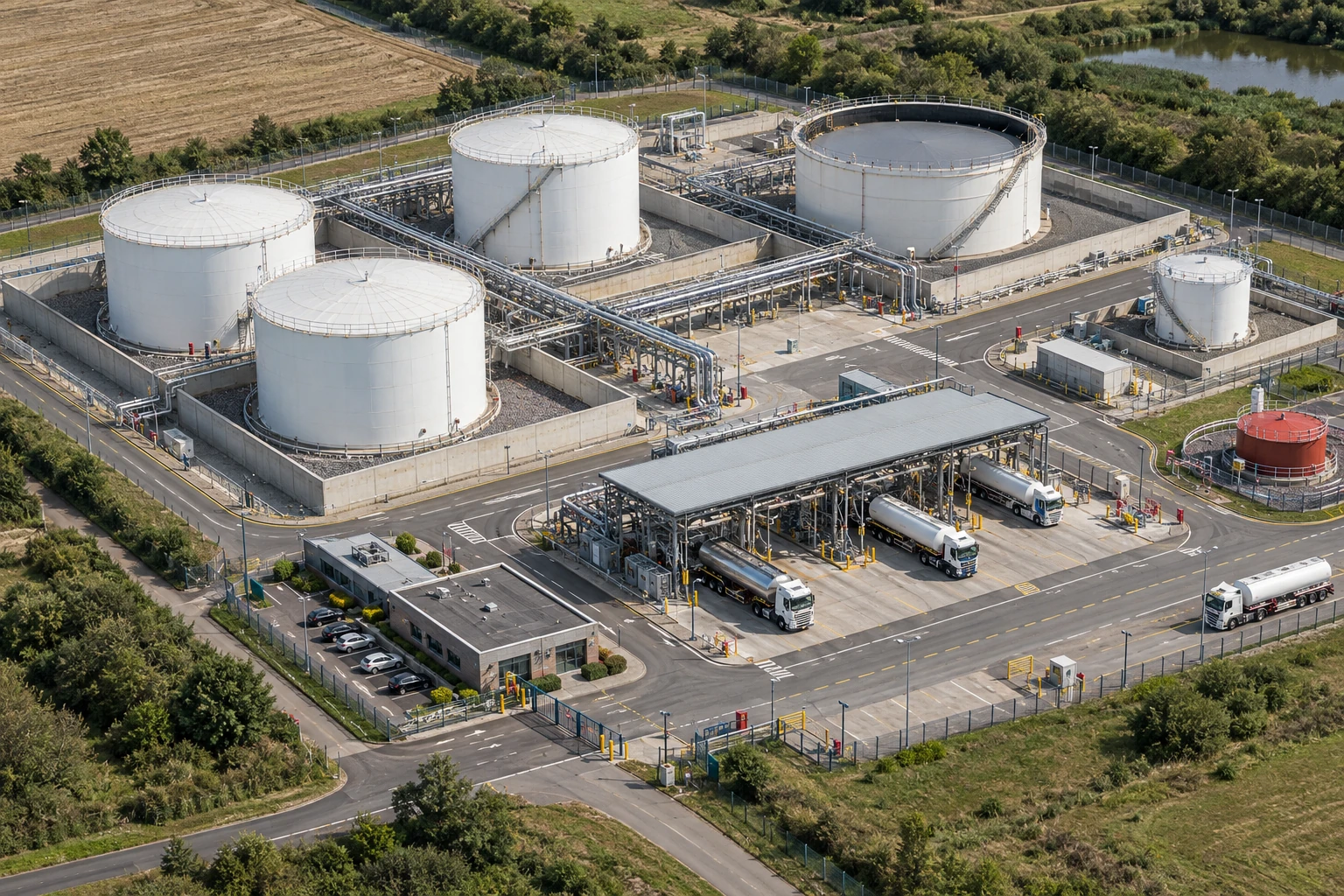

The dashboard counts injuries but misses failing barriers
All related inspection points 1 across 1 location
Crown Fuels terminal 1 inspection point
Practice in the SHAREhub environment. Browser practice is separate from workplace competence and formal learning records.
What is process safety management?
Process safety management is the organised control of credible major accidents involving hazardous substances or stored energy through sound design, reliable barriers, competent people, disciplined operation, emergency preparedness and evidence-based assurance across the lifecycle.
Best-practice guide: What Process Safety Management Is
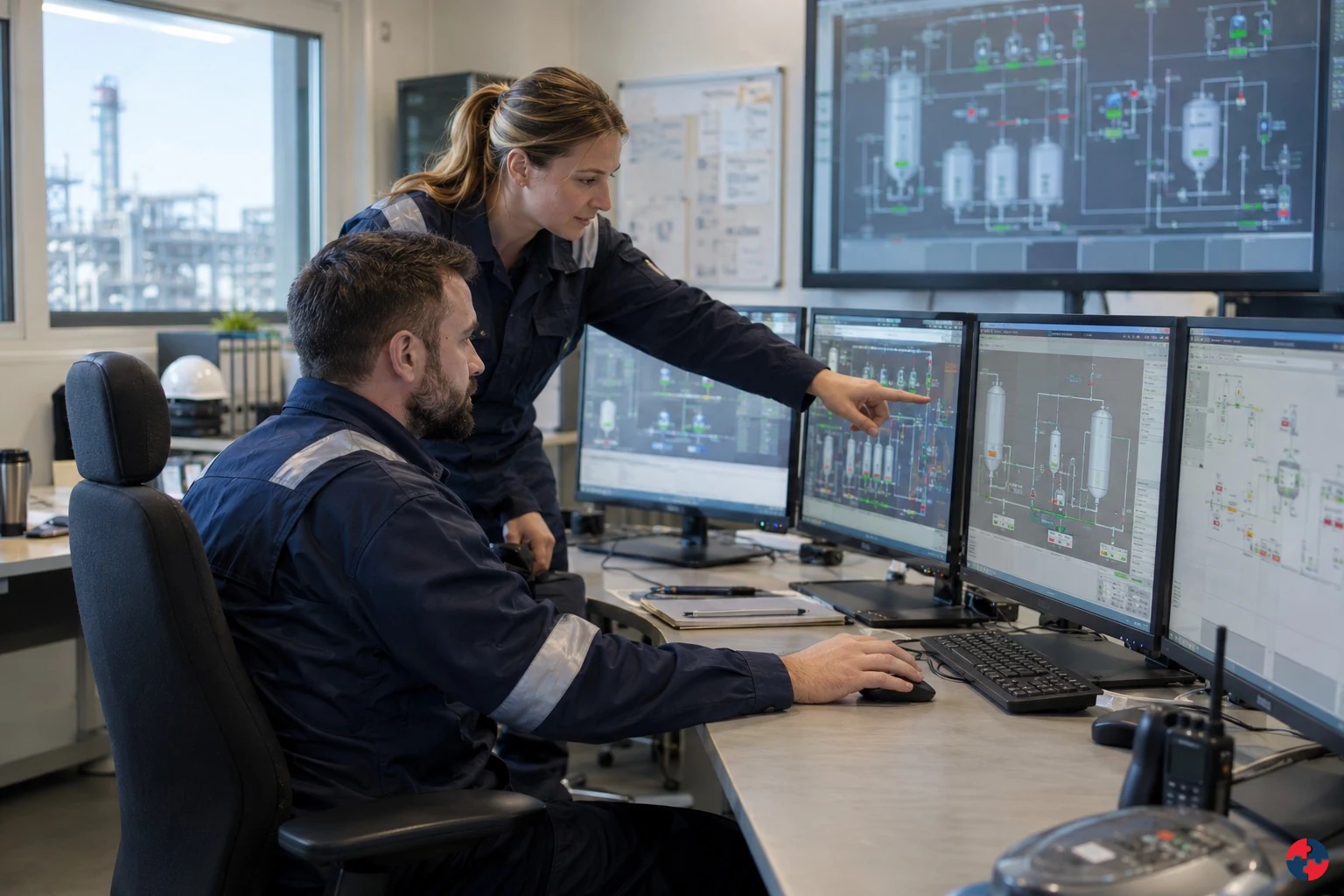
What is process safety management?
Process safety management is the organised control of credible major accidents involving hazardous substances or stored energy through sound design, reliable barriers, competent people, disciplined operation, emergency preparedness and evidence-based assurance across the lifecycle. Process safety management is the coordinated prevention and control of major accidents involving dangerous substances or stored energy.
Turn what process safety management is knowledge into a decision
Process safety management is the coordinated prevention and control of major accidents involving dangerous substances or stored energy. It connects credible release, fire, explosion and toxic-exposure scenarios to sound design, reliable barriers, competent operation, controlled change and emergency readiness. Event timeline, plant state, gas-test record, repair and accepted tests, scenario review, action disposition and operating-authority release.
Pump seal leak with impaired gas detection and overdue action
Stop transfer and move to the defined safe state, raise the alarm route, isolate remotely if safe, use portable monitoring under the approved response and assess the affected scenarios and common causes. Repair the seal, restore and function-test fixed detection, inspect comparable equipment, close or re-plan the overdue action and brief operations.
Scenario path and live barrier check
Corroded transfer line releases flammable liquid: Vapour reaches an ignition source, causing fire, burns and possible escalation to adjacent equipment. Overfill with impaired high-level trip: Tank overflow forms a hazardous pool or vapour cloud; fire, exposure or off-site impact may follow. Unreviewed process change causes runaway: Unexpected heat or pressure exceeds the operating envelope, with vessel failure and toxic or flammable release possible.
Choose controls for the actual task
Eliminate: Remove an unnecessary hazardous transfer, inventory or manual process step through an approved design change. Reduce, including substitution: Test a less hazardous material or lower-inventory process for the actual chemistry and operating conditions. Isolate: Specify containment, separation and independent safeguards for the credible release scenario. Control: Define the safe operating envelope, usable operating and maintenance arrangements, competent roles, change control and emergency response. PPE: Select compatible protective equipment for the assessed residual exposure; emergency response needs the approved plan and competent team. Read the full control table for qualifications, ownership and verification. Use the actual task and applicable jurisdiction; existing technical approval remains unchanged.
Use the full what process safety management is lesson
Use the full topic for the decision points, practical examples, detailed control tables and source scope. HSE guidance applies to Great Britain; use HSENI for the Northern Ireland route and the source’s stated jurisdiction. A simplified guide does not change the page’s technical-review or approval status.

Read all six steps as text
1. What is process safety management?
Process safety management is the organised control of credible major accidents involving hazardous substances or stored energy through sound design, reliable barriers, competent people, disciplined operation, emergency preparedness and evidence-based assurance across the lifecycle.
- Avoid / redesign: Remove an unnecessary hazardous transfer, inventory or manual process step through an approved design change.
- Control the task: Specify containment, separation and independent safeguards for the credible release scenario.
- Verify before release: Process technical owner verifies the updated scenario and process information.
Process safety management is the organised control of credible major accidents involving hazardous substances or stored energy through sound design, reliable barriers, competent people, disciplined operation, emergency preparedness and evidence-based assurance across the lifecycle. Process safety management is the coordinated prevention and control of major accidents involving dangerous substances or stored energy.
Apply it: Which part of this plan would you check at the workface before authorising the task?
2. Turn what process safety management is knowledge into a decision
Use the evidence to improve the actual work arrangement.
- Change at source: Remove an unnecessary hazardous transfer, inventory or manual process step through an approved design change.
- Make it observable: Process technical owner verifies the updated scenario and process information.
- Keep useful evidence: Event timeline, plant state, gas-test record, repair and accepted tests, scenario review, action disposition and operating-authority release.
Process safety management is the coordinated prevention and control of major accidents involving dangerous substances or stored energy. It connects credible release, fire, explosion and toxic-exposure scenarios to sound design, reliable barriers, competent operation, controlled change and emergency readiness. Event timeline, plant state, gas-test record, repair and accepted tests, scenario review, action disposition and operating-authority release.
Apply it: What evidence would show that the change improves this task, rather than only completing a record?
3. Pump seal leak with impaired gas detection and overdue action
Example: a practical application of the existing topic lesson.
- Setting: Stop the transfer through the approved site procedure, move the plant to its defined safe state, raise the alarm to the control room and shift operating authority, isolate remotely only where the approved response allows and keep unneeded people out.
- Act: Confirm transfer route, inventory, ignition controls, remote isolation, drainage, detection coverage and the overdue action; keep unneeded people out.
- Hold / review: Do not continue transfer or approach for routine inspection while containment, atmosphere, ignition risk or detection coverage is uncertain.
Stop transfer and move to the defined safe state, raise the alarm route, isolate remotely if safe, use portable monitoring under the approved response and assess the affected scenarios and common causes. Repair the seal, restore and function-test fixed detection, inspect comparable equipment, close or re-plan the overdue action and brief operations.
Apply it: At which point would you hold this example, and what evidence would allow it to proceed?
4. Scenario path and live barrier check
Connect the task, the route to the person and the control that can fail.
- Corroded transfer line releases flammable liquid: Vapour reaches an ignition source, causing fire, burns and possible escalation to adjacent equipment.
- Overfill with impaired high-level trip: Tank overflow forms a hazardous pool or vapour cloud; fire, exposure or off-site impact may follow.
- Unreviewed process change causes runaway: Unexpected heat or pressure exceeds the operating envelope, with vessel failure and toxic or flammable release possible.
Corroded transfer line releases flammable liquid: Vapour reaches an ignition source, causing fire, burns and possible escalation to adjacent equipment. Overfill with impaired high-level trip: Tank overflow forms a hazardous pool or vapour cloud; fire, exposure or off-site impact may follow. Unreviewed process change causes runaway: Unexpected heat or pressure exceeds the operating envelope, with vessel failure and toxic or flammable release possible.
Apply it: Who could be exposed, including other trades, cleaners, maintainers and people nearby?
5. Choose controls for the actual task
Control summary. Read the complete task-specific controls and checks in the linked topic.
- Elimination: Remove an unnecessary hazardous transfer, inventory or manual process step through an approved design change.
- Substitution: Test a less hazardous material or lower-inventory process for the actual chemistry and operating conditions.
- Engineering controls: Specify containment, separation and independent safeguards for the credible release scenario.
- Administrative controls: Define the safe operating envelope, usable operating and maintenance arrangements, competent roles, change control and emergency response.
- PPE: PPE cannot prevent loss of containment, prove a safety-critical barrier or authorise entry to an uncontrolled release.
Eliminate: Remove an unnecessary hazardous transfer, inventory or manual process step through an approved design change. Reduce, including substitution: Test a less hazardous material or lower-inventory process for the actual chemistry and operating conditions. Isolate: Specify containment, separation and independent safeguards for the credible release scenario. Control: Define the safe operating envelope, usable operating and maintenance arrangements, competent roles, change control and emergency response. PPE: Select compatible protective equipment for the assessed residual exposure; emergency response needs the approved plan and competent team. Read the full control table for qualifications, ownership and verification. Use the actual task and applicable jurisdiction; existing technical approval remains unchanged.
Apply it: Which stronger option can be used here, and who will verify it before accepting the remaining risk?
6. Use the full what process safety management is lesson
Follow the official sources below and retain the task-specific evidence.
- Official guidance: HSE HSG254 Developing process safety indicators
- Official guidance: HSE Control of Major Accident Hazards (COMAH) 2015 duties
- Task decision: A qualitative trend needs labelled time and process-variable axes. Actual operating limits come from the assessed design basis, not this unscaled illustration.
Use the full topic for the decision points, practical examples, detailed control tables and source scope. HSE guidance applies to Great Britain; use HSENI for the Northern Ireland route and the source’s stated jurisdiction. A simplified guide does not change the page’s technical-review or approval status.
Apply it: Which official source and full-topic section will you use to resolve the next decision?
It asks how a loss of containment, fire, explosion, toxic release, runaway reaction or other major event could develop and whether prevention and mitigation will perform when demanded. The term is a management description, not one universal UK statutory duty. See HSE Control of Major Accident Hazards (COMAH) 2015 duties.
Hazard. Question: What major event is credible?; Evidence: Scenario and consequence basis.
Control. Question: What prevents or limits it?; Evidence: Barrier functions and standards.
Operation. Question: How is the safe state maintained?; Evidence: Limits, procedures and competence.
Assurance. Question: How do we know controls work?; Evidence: Tests, indicators, audit and learning.
How is process safety different from personal safety?
Personal safety controls frequent injuries and occupational harm; process safety controls lower-frequency events that can affect many people, the environment, assets and communities. Both matter, but their evidence is not interchangeable.
A low lost-time injury rate cannot show that relief systems, shutdown valves, containment, operating limits or emergency arrangements are healthy. Equally, major-hazard attention does not remove ordinary workplace duties.
| Measure | Useful for | Cannot prove |
|---|---|---|
| Slips, trips or injury rate | Personal injury trends. | Major-accident barriers are effective. |
| Loss-of-containment events | Lagging process-safety signal. | All preventive barriers are healthy. |
| Safety-critical test compliance | Leading barrier-health evidence. | No scenario or design weakness exists. |
| Worker reports and weak signals | Early operating insight. | Cause without investigation. |
Does every workplace need a COMAH process-safety system?
No. Every employer needs proportionate risk control, but COMAH, pipeline, offshore and other major-hazard duties apply only within their legal scope. Establish applicability before naming a statutory deliverable.
Inventory, substance classification and quantity, activity, location, installation type and exclusions matter. A site below COMAH thresholds may still need strong process-safety controls under Dangerous Substances and Explosive Atmospheres Regulations (DSEAR), general law, permits, licences or its risk profile.
| Question | Possible route | Boundary |
|---|---|---|
| Threshold dangerous substances at an establishment? | GB or NI COMAH tier assessment. | Do not infer tier from industry name. |
| Major-accident-hazard pipeline? | GB PSR or NI pipeline rules. | Not a COMAH document by default. |
| Offshore installation or well? | Relevant safety-case regime. | Waters and jurisdiction matter. |
| Dangerous substance at work? | GB or NI DSEAR and general duties. | Does not automatically make the site COMAH. |
How can a major accident develop?
A major accident develops when an initiating event defeats prevention, hazardous material or energy escapes control, and detection, isolation or mitigation fails or arrives too late. A release can become a fire, explosion, toxic exposure or environmental event; credible escalation and off-site effects must be considered. Identify the exposed people and environment, then test the actual barriers and their shared failure modes. Management of change (MOC) prevents an unreviewed modification from bypassing these barriers.
One loss-of-containment scenario, owned barriers


Read the complete visual as text
- PREVENT THE TOP EVENT: Hazardous inventory and energy meet an initiating event. Sound containment, corrosion control and a defined high-high trip can prevent the relevant loss-of-containment scenario; verify the actual function and scope.
- LIMIT ESCALATION: After loss of containment, scenario-specific remote isolation, bund/drainage, detection, firewater and emergency command can limit consequences to people, environment and assets. A safeguard must fit its scenario.
- PROVE THE FUNCTION: Barrier owner supplies performance standard, current accepted test and impairment route. Shared power, instrument or utility can defeat apparent independence. Unknown detector condition is a hold.
- SEPARATE PERSONAL SAFETY: Slips, PPE and injury-rate measures still matter, but cannot prove containment, relief, trip, integrity or emergency-barrier health. Operating authority decides hold, restrict, restore or release from scenario evidence.
Trace inventory and energy, initiating event, top event, escalation, outcome, preventive and mitigative barriers. A clean injury record says nothing about an untested shutdown valve, a disabled alarm or an overdue inspection. See HSE COMAH 2015 duties.
| Initiator and top event | Escalation and possible harm | Barrier and stop decision |
|---|---|---|
| Corroded transfer line releases flammable liquid | Vapour reaches an ignition source, causing fire, burns and possible escalation to adjacent equipment. | Verify containment inspection, leak detection, isolation and ignition control; stop transfer if the release or an essential barrier cannot be controlled. |
| Overfill with impaired high-level trip | Tank overflow forms a hazardous pool or vapour cloud; fire, exposure or off-site impact may follow. | Confirm level indication, independent trip, operator response and bund capacity; hold receipt when the trip or response basis is impaired. |
| Unreviewed process change causes runaway | Unexpected heat or pressure exceeds the operating envelope, with vessel failure and toxic or flammable release possible. | Use competent hazard review, relief and shutdown design, MOC and pre-startup verification; do not start until the change and safeguards are accepted. |
Where does process safety apply in the lifecycle?
Control starts at concept and design and continues through construction, commissioning, operation, maintenance, change, shutdown, emergency, recovery and decommissioning.
Startup, shutdown, trips, utility loss, temporary equipment, intrusive maintenance and organisational change often have different risk from steady operation. Each transition needs defined readiness and authority.
Design. Primary decision: Can hazard or inventory be eliminated or reduced?; Evidence: Option and design review.
Commissioning or restart. Primary decision: Is plant ready and as designed?; Evidence: Pre-startup verification.
Operation and maintenance. Primary decision: Are limits and barriers maintained?; Evidence: Logs, tests, permits and actions.
Decommissioning. Primary decision: Are residual inventories and energies controlled?; Evidence: Isolation, cleaning and closure record.
How is process safety built into design and construction?
Set hazard-reduction requirements early, maintain design authority and traceability, review constructability and human factors, verify materials and installation, control deviations and prove safety functions before hazardous commissioning.
Late add-on protection cannot always recover a poor layout, excessive inventory or weak segregation. Construction quality and commissioning tests are part of the safety evidence.
Concept selection. Control: Inherent safety and option comparison.; Evidence: Decision record.
Detailed design. Control: Hazard study, layout and performance standards.; Evidence: Approved design basis.
Construction. Control: Material, welding, installation and deviation control.; Evidence: Quality and inspection record.
Commissioning. Control: Function test and safe introduction of inventory.; Evidence: Approved procedure and pre-startup safety review (PSSR).
What process-safety controls apply to decommissioning?
Identify residual substances and stored energy, isolate from live systems, drain, purge and clean, manage temporary configurations and structural change, control waste and verify the final safe state.
A plant that is shut down can still contain pressure, contamination, unstable chemicals or connected services. MOC, permits, emergency arrangements and information control continue until hazards are removed or transferred.
Inventory removal. Major hazard: Trapped or reactive residue.; Evidence: Drain, purge and analysis.
Disconnection. Major hazard: Backflow from live systems.; Evidence: Positive isolation and test.
Dismantling. Major hazard: Ignition, collapse or contaminated waste.; Evidence: Plan, permit and monitoring.
Closure. Major hazard: Unknown residual liability.; Evidence: Final condition and handover record.
How does the same process-safety logic transfer across sectors?
The same scenario–barrier–assurance method applies to different hazardous systems, but the applicable law and technical controls depend on inventory, activity and location. A refinery transfer, chemical batch, fuel pipeline and offshore platform each need a specific safe state, barrier owner and release authority.
These are transfer examples, not a claim that every site falls under COMAH. Confirm the GB or NI regime, pipeline or offshore boundary and competent technical authority before using any example operationally.
| Setting and people | Credible harm route | Strongest feasible control and stop check |
|---|---|---|
| Fuel storage and transfer operators | Overfill or seal leak creates a flammable cloud and fire risk. | Control inventory and transfer rate, independent high-level protection, isolation and ignition sources; hold transfer on a disabled critical trip. |
| Chemical batch plant operators | Wrong charge or cooling failure can cause runaway, overpressure and toxic release. | Use inherently safer chemistry where feasible, verified recipe, cooling, relief and shutdown; stop before charging when basis or safeguard is uncertain. |
| Pipeline controllers and field teams | Damage or corrosion can release hazardous fluid across a wide area. | Apply line-integrity inspection, pressure control, leak detection and sectional isolation; stop or isolate on unexplained loss of containment. |
| Offshore installation crew and contractors | Well or process containment failure can escalate through ignition and impaired emergency systems. | Verify independent barriers, simultaneous-work control and emergency capacity; suspend work when required barriers cannot be demonstrated. |
How should process-safety governance work?
Name accountable operating owners, barrier owners, technical authorities, emergency owners and independent assurance, with written decision rights and escalation for degraded or uncertain safeguards.
Production, cost or schedule pressure must not silently transfer risk. The person authorising continued operation or restart needs the competence, authority and evidence to own that decision.
Operating authority. Authority: Hold, stop and restart plant.; Accountability: Current operating risk.
Barrier owner. Authority: Maintain performance and escalate impairment.; Accountability: Health and test evidence.
Technical authority. Authority: Accept engineering basis and deviations.; Accountability: Design integrity and MOC.
Senior accountable leader. Authority: Resource and accept material residual risk.; Accountability: Assurance and overdue action decisions.
What process safety information must be controlled?
Keep current information on substances, reactions, inventories, equipment, materials, relief and disposal, control logic, operating limits, utilities, layouts, hazardous areas and safety-critical functions.
Information must match the plant in the field and be usable by the people making decisions. Unknown line identity, obsolete drawings, unexplained set points or missing chemical data are reasons to pause the affected work.
Substance and reaction data. Decision supported: Hazards, incompatibility and relief basis.; Failure signal: Unknown composition or decomposition.
Piping and instrumentation information. Decision supported: Isolation, flow and control path.; Failure signal: Field does not match drawing.
Equipment and materials basis. Decision supported: Integrity and operating envelope.; Failure signal: Unverified substitution or repair.
Control and trip logic. Decision supported: Response and independence.; Failure signal: Uncontrolled software or set-point change.
How are major-accident hazards identified?
For each credible scenario, identify hazardous inventory or energy, initiating event, top event, consequences, escalation, exposed people and environment, prevention and mitigation barriers, assumptions and uncertainty.
Methods such as HAZID, HAZOP, what-if, bowtie and fault or event analysis can help. Choose competent, proportionate methods; no named technique automatically proves completeness. See HSE COMAH technical measures.
Source. Prompt: What substance or energy can be released?; Output: Inventory and condition.
Initiator and top event. Prompt: What fails and what control is lost?; Output: Credible pathway.
Consequence and escalation. Prompt: Who or what could be harmed and how could it worsen?; Output: People, environment and domino effects.
Controls and assumptions. Prompt: What must work and under which conditions?; Output: Barrier and verification needs.
How should a major-accident pathway be described?
Connect the initiating cause to loss of control, the top event, possible escalation and outcomes, then place preventive and mitigative barriers at the point where they act.
Avoid a generic hazard register that lists fire or toxic release without the equipment, substance, conditions and pathway. Different scenarios may rely on different barriers and emergency actions.
| Pathway step | Example question | Decision use |
|---|---|---|
| Initiation | Corrosion, overfill, wrong material or utility loss? | Prevention priorities. |
| Top event | Loss of containment or runaway reaction? | Barrier demand point. |
| Escalation | Ignition, dispersion, vessel heating or domino effect? | Mitigation and emergency route. |
| Outcome | On-site, off-site or environmental harm? | Planning and response scope. |
How should major-accident risk be evaluated?
Use competent qualitative and, where needed, quantitative analysis to test scenario credibility, consequence, frequency, barrier dependence and whether further reasonably practicable control is required.
A risk matrix, bowtie or calculation is a decision aid, not proof by itself. Record data quality, uncertainty, dependencies, common causes, human factors and who accepted the conclusion.
Qualitative ranking. Use: Prioritise and screen scenarios.; Boundary: Sensitive to assumptions and categories.
LOPA or quantitative analysis. Use: Test frequencies and risk contribution.; Boundary: Needs valid independence and data.
Consequence modelling. Use: Emergency and siting insight.; Boundary: Model conditions and uncertainty matter.
as low as reasonably practicable (ALARP) demonstration where applicable. Use: Show further controls considered.; Boundary: Cannot be replaced by a green matrix cell.
Where should the control hierarchy begin?
Where reasonably practicable, eliminate or reduce hazardous inventory and conditions, substitute less hazardous materials, moderate pressure or temperature, simplify the process and avoid error-prone complexity before relying on add-on barriers.
Inherent measures can remove a scenario or reduce consequence, but design changes still require hazard review and MOC. PPE and emergency response are important but sit late in the control hierarchy for major accidents.
Minimise. Example: Reduce hazardous hold-up or batch size.; Verification: Inventory and consequence basis.
Substitute. Example: Use a less hazardous material or route.; Verification: Full chemistry and compatibility review.
Moderate. Example: Lower pressure, temperature or concentration.; Verification: Revalidated operating and relief basis.
Simplify. Example: Remove unnecessary transfer or manual alignment.; Verification: Operability and failure review.
What is a process-safety barrier?
A barrier is a specific preventive or mitigative function that interrupts a defined scenario, such as containment, an independent trip, relief, isolation, drainage, detection, fire protection or emergency action.
Hardware, instrumented, procedural, organisational and emergency barriers can all matter. Treat a claimed barrier as credible only when its function, demand, independence, performance and current availability are understood.
| Barrier type | Example | Key challenge |
|---|---|---|
| Physical | Vessel wall or bund. | Degradation and capacity. HSE COMAH technical measures. |
| Instrumented | High-high trip or shutdown. | Independence, proof test and bypass. HSE COMAH technical measures. |
| Procedural | Verified line-up or response. | Time, clarity and human reliability. HSE COMAH technical measures. |
| Emergency | Detection, alarm, isolation and response. | Availability under accident conditions. HSE COMAH technical measures. |
What should a barrier performance standard contain?
State the function, required availability, capacity, response time, reliability, survivability, independence, inspection or proof-test method, acceptance criteria, owner and impairment response.
The standard should be measurable and linked to the scenario. A maintenance task marked complete without an accepted result does not show the barrier will perform.
| Field | Question | Evidence |
|---|---|---|
| Function | What must the barrier do and for which scenario? | Clear success criterion. |
| Performance | How much, how fast and how reliably? | Design and test basis. |
| Assurance | How is degradation found? | Inspection, proof test and trend. |
| Impairment | What happens if unavailable? | Hold, compensating controls and restoration plan. |
How can the hierarchy of controls guide prevention of major process accidents?
Remove the hazard where reasonably practicable. If it remains, consider a safer method, engineering controls and safe work arrangements before personal protective equipment for residual risk.
HSE places elimination, substitution, engineering, administrative controls and personal protective equipment in that order. Verify that the chosen controls work on the actual task.
ERICPD (Eliminate, Reduce including substitution, Isolate, Control, personal protective equipment (PPE), Discipline) is a SHARE decision prompt cross-mapped to HSE’s five-level hierarchy. Choose stronger feasible controls first, verify them in the actual task and record why a stronger option cannot be used. Discipline means sustaining controls through maintenance, supervision and learning.
How can the ERICPD hierarchy of controls guide prevention of major process accidents?

| ERICPD prompt | HSE relation | Actual measure | Owner, evidence and stop point |
|---|---|---|---|
| Eliminate | Elimination | Remove an unnecessary hazardous transfer, inventory or manual process step through an approved design change. Examine the whole lifecycle so removing one release opportunity does not introduce an uncontrolled reaction or maintenance hazard. | Process technical owner verifies the updated scenario and process information. Hold change until the hazard review establishes safe design and operating conditions. Basis: HSE COMAH technical measures; HSE COMAH safety-report assessment criteria |
| Reduce, including substitution | Substitution or safer design | Test a less hazardous material or lower-inventory process for the actual chemistry and operating conditions. Check reaction behaviour, compatibility and downstream effects instead of assuming a substitute is inherently safe. | Competent engineering team records the design basis and hazard-review evidence. Reject a change that transfers risk to pressure, cleaning, storage or another process. Basis: HSE COMAH technical measures; Control of Major Accident Hazards Regulations 2015; Control of Major Accident Hazards Regulations Northern Ireland 2015 |
| Isolate | Engineering where physical or technical separation is feasible | Specify containment, separation and independent safeguards for the credible release scenario. Verify performance, independence and condition; operator engagement helps identify practical failures but is not itself an engineered barrier. | Engineering and asset owners verify commissioning and proof-test evidence against the required performance. Hold operation when credited containment or safeguards are unavailable or unverified. Basis: HSE COMAH technical measures; HSE COMAH safety-report assessment criteria |
| Control | Administrative or organisational controls | Define the safe operating envelope, usable operating and maintenance arrangements, competent roles, change control and emergency response. Align permits and handovers with actual plant state rather than rely on a completed form. | Operations owner checks the current state and availability of required controls before start or restart. Escalate unknown conditions, unassessed changes or a response that cannot be performed. Basis: HSE Control of Major Accident Hazards (COMAH) 2015 duties; HSE L111 A guide to the COMAH Regulations 2015 |
| PPE | Personal protective equipment for residual exposure | Select compatible protective equipment for the assessed residual exposure; emergency response needs the approved plan and competent team. PPE cannot prevent loss of containment, prove a safety-critical barrier or authorise entry to an uncontrolled release. | Competent task owner verifies suitability, fit, condition and limitations. Hold the task if exposure or protection cannot be established. Basis: HSE hierarchy of control; HSE Control of Major Accident Hazards (COMAH) 2015 duties |
| Discipline | Sustain and improve all levels | Maintain safety-critical equipment, track degraded barriers, investigate weak signals and verify action effectiveness. Leading and lagging indicators should test the scenario barriers, not just personal-injury performance. | Asset and senior operations owners review test results, repeated defects and overdue critical actions. Reopen the risk decision when barrier performance cannot be demonstrated. Basis: HSE HSG254 Developing process safety indicators; HSE HSG65 Managing for health and safety |
How can the ISO 45001 hierarchy of controls guide prevention of major process accidents?

| ERICPD prompt | HSE relation | Actual measure | Owner, evidence and stop point |
|---|---|---|---|
| Eliminate | Elimination | Remove an unnecessary hazardous transfer, inventory or manual process step through an approved design change. Examine the whole lifecycle so removing one release opportunity does not introduce an uncontrolled reaction or maintenance hazard. | Process technical owner verifies the updated scenario and process information. Hold change until the hazard review establishes safe design and operating conditions. Basis: HSE COMAH technical measures; HSE COMAH safety-report assessment criteria |
| Reduce, including substitution | Substitution or safer design | Test a less hazardous material or lower-inventory process for the actual chemistry and operating conditions. Check reaction behaviour, compatibility and downstream effects instead of assuming a substitute is inherently safe. | Competent engineering team records the design basis and hazard-review evidence. Reject a change that transfers risk to pressure, cleaning, storage or another process. Basis: HSE COMAH technical measures; Control of Major Accident Hazards Regulations 2015; Control of Major Accident Hazards Regulations Northern Ireland 2015 |
| Isolate | Engineering where physical or technical separation is feasible | Specify containment, separation and independent safeguards for the credible release scenario. Verify performance, independence and condition; operator engagement helps identify practical failures but is not itself an engineered barrier. | Engineering and asset owners verify commissioning and proof-test evidence against the required performance. Hold operation when credited containment or safeguards are unavailable or unverified. Basis: HSE COMAH technical measures; HSE COMAH safety-report assessment criteria |
| Control | Administrative or organisational controls | Define the safe operating envelope, usable operating and maintenance arrangements, competent roles, change control and emergency response. Align permits and handovers with actual plant state rather than rely on a completed form. | Operations owner checks the current state and availability of required controls before start or restart. Escalate unknown conditions, unassessed changes or a response that cannot be performed. Basis: HSE Control of Major Accident Hazards (COMAH) 2015 duties; HSE L111 A guide to the COMAH Regulations 2015 |
| PPE | Personal protective equipment for residual exposure | Select compatible protective equipment for the assessed residual exposure; emergency response needs the approved plan and competent team. PPE cannot prevent loss of containment, prove a safety-critical barrier or authorise entry to an uncontrolled release. | Competent task owner verifies suitability, fit, condition and limitations. Hold the task if exposure or protection cannot be established. Basis: HSE hierarchy of control; HSE Control of Major Accident Hazards (COMAH) 2015 duties |
| Discipline | Sustain and improve all levels | Maintain safety-critical equipment, track degraded barriers, investigate weak signals and verify action effectiveness. Leading and lagging indicators should test the scenario barriers, not just personal-injury performance. | Asset and senior operations owners review test results, repeated defects and overdue critical actions. Reopen the risk decision when barrier performance cannot be demonstrated. Basis: HSE HSG254 Developing process safety indicators; HSE HSG65 Managing for health and safety |
What is the safe operating envelope?
It is the approved range and configuration within which the process and its barriers remain valid, including key limits, alarm and trip points, required utilities, response actions and authority for deviation.
Approved operating envelope, then abnormal response


Read the complete visual as text
- 1. KNOW THE BASIS: Operating owner confirms approved limits, configuration, safeguards, response time and authority from the design and hazard basis. A trend line alone is insufficient.
- 2. RECOGNISE AND RESPOND: Control-room and field teams recognise the trend and use the actual approved abnormal procedure. Stop or reduce feed only as specified; escalate before margin is lost.
- 3. VERIFY PLANT RESPONSE: Verify cooling, feed isolation, alarms, trips, relief and emergency readiness separately. Instrument-validity uncertainty triggers a hold and competent escalation.
- 4. STABILISE BEFORE DIAGNOSIS: Reach the defined safe state before close access, sampling or recovery. Do not suppress alarms, reset trips or resume feed by improvisation.
- 5. CHOOSE A NAMED END STATE: Operating authority records verified return within envelope, continued investigation hold or emergency response. A lower displayed value does not itself authorise restart.
Limits must come from the design and hazard basis; this page cannot supply generic numbers. Crossing or approaching a limit requires the approved abnormal-response route, not an improvised return to target.
Operating limit. Define: Normal and safe boundary.; Evidence: Design or hazard-study basis.
Alarm or trip. Define: Action point and response time.; Evidence: Set point, test and procedure.
Required configuration. Define: Valves, utilities and safeguards in service.; Evidence: Line-up and availability check.
Deviation authority. Define: Who can hold, stop or approve recovery?; Evidence: Named decision record.
Why do abnormal operation, startup and shutdown need special control?
Transient states can change inventories, flows, compositions, ignition potential and barrier availability, so they need specific procedures, staffing, limits, monitoring and escalation.
Repeated alarm floods, trips, unstable operation and manual workarounds are not normal simply because people have managed them before. Stabilise or stop according to the approved route.
Startup. Control focus: Sequencing, permissives, line-up and utilities.; Stop signal: Unknown valve position or untested trip.
Shutdown. Control focus: Inventory removal, thermal change and isolation.; Stop signal: Uncontrolled pressure or residual material.
Upset. Control focus: Recognise, stabilise and escalate within time.; Stop signal: Outside envelope or response uncertain.
Utility loss. Control focus: Defined safe state and emergency power.; Stop signal: Required safeguard cannot function.
What makes an operating procedure usable?
A procedure describes the verified plant configuration, prerequisites, steps, limits, expected indications, abnormal responses, communication, handover and stop points in language usable at the job.
Field-check procedures against current plant and involve users. Do not rely on memory, unofficial notes or a document that omits what to do when conditions differ.
Prerequisites. Requirement: People, plant and barriers ready.; Evidence: Signed check or system status.
Steps and verification. Requirement: Critical actions independently checked where needed.; Evidence: Initials, log or control record.
Limits and response. Requirement: Clear hold and emergency actions.; Evidence: Observed exercise or drill.
Handover. Requirement: State, deviations and open actions transferred.; Evidence: Shift or job handover record.
How is asset integrity managed?
Identify safety-critical equipment and degradation mechanisms, set inspection and maintenance strategies, use competent examination and testing, control defects and temporary repairs, and verify restoration before return.
Overfill barrier impairment and restoration


Read the complete visual as text
- 1. STOP RECEIPT: Operating authority holds affected receipt in the defined safe state when high-high shutdown is degraded. Unknown or overdue evidence is not healthy status.
- 2. ASSESS THE SCENARIO: Technical authority checks level measurement, high alarm/operator response, shutdown, receipt isolation, containment and emergency response; evaluate common utilities and independent protection.
- 3. BOUND ANY RESTRICTION: Only an approved impairment route can accept temporary operation: specified controls, actual limits, monitoring, owner, expiry and restoration plan. Production pressure cannot approve risk.
- 4. RESTORE AND VERIFY: Repair and proof-test against performance standard; accept results, remove bypass and temporary measures, update records and brief operators.
- 5. RELEASE WITH AUTHORITY: Plant manager and technical authority accept restoration evidence; named operating owner records release. Change, expiry or further impairment returns to assessment.
Restore barrier and authorise release


Read the complete visual as text
- Start: Emergency phase ended or impairment is controlled; named recovery authority owns restoration.
- Question 1: Is repair/restoration complete within the accepted scope? Decision owner: Barrier owner / maintenance authority.
- YES: Proof-test against the actual performance standard. Owner: Barrier owner / maintenance authority. CONTINUE → QUESTION 2.
- NO / UNKNOWN — HOLD: Remain held; correct, redesign or extend investigation. Owner: Barrier owner / maintenance authority. HOLD → REPEAT QUESTION 1 AFTER CORRECTION.
- Question 2: Are proof-test results accepted and cause addressed? Decision owner: Technical authority.
- YES: Remove bypass and temporary controls as authorised; reconcile settings and records. Owner: Technical authority. CONTINUE → QUESTION 3.
- NO: Remain held; investigate or redesign and repeat accepted tests. Owner: Technical authority. HOLD → REPEAT QUESTION 2 AFTER CORRECTION.
- UNKNOWN: Hold; obtain representative test evidence and competent acceptance. Owner: Technical authority. HOLD → REPEAT QUESTION 2 AFTER CORRECTION.
- Question 3: Are drawings, records, restrictions and operating-team briefings current? Decision owner: Operating authority.
- YES: Review all scenario dependencies and cumulative impairments. Owner: Operating authority. CONTINUE → QUESTION 4.
- NO / UNKNOWN — HOLD: Keep release held; communicate plant state and correct handover gaps. Owner: Operating authority. HOLD → REPEAT QUESTION 3 AFTER CORRECTION.
- Question 4: Has the named operating owner accepted every release condition? Decision owner: Named operating owner.
- YES: Issue recorded authorised release and review effectiveness. Owner: Named operating owner. OUTCOME → RECORD AND HAND OVER.
- NO / UNKNOWN — HOLD: No routine restart; secure accepted technical, emergency and operating evidence. Owner: Named operating owner. HOLD → REPEAT QUESTION 4 AFTER CORRECTION.
- Outcome: Authorised release with restored evidence and communicated plant state.
- Stop and escalation boundary: Maintenance completion, incident stand-down or paperwork closure alone is not release.
Corrosion, erosion, fatigue, vibration, embrittlement, fouling, seal failure and instrument drift can erode protection without an injury event. Inspection intervals and acceptance criteria need an engineering basis. See HSE COMAH technical measures.
Identify. Question: Which equipment prevents or limits the scenario?; Evidence: Criticality and design basis.
Degradation. Question: How can it fail over time?; Evidence: Damage mechanism review.
Inspect and test. Question: Will the method find the defect in time?; Evidence: Plan, result and trend.
Respond. Question: Is repair, monitoring or shutdown required?; Evidence: Engineering disposition and release.
How should alarms, interlocks and trips be managed?
Define their role in each scenario, set rational priorities and response times, control access and change, proof-test required functions and prevent alarm floods or bypasses from hiding loss of protection.
An alarm that depends on the same failed instrument as a trip may not be independent. Operator response is not credible unless detection, time, information, workload and action are realistic.
Alarm. Assurance question: Can the operator detect, diagnose and act in time?; Failure signal: Nuisance alarm or flood.
Interlock or trip. Assurance question: Is it independent and proof-tested?; Failure signal: Bypass, failed test or shared cause.
Set point. Assurance question: Does it preserve margin to the limit?; Failure signal: Unapproved or unexplained change.
Override control. Assurance question: Is purpose, owner and expiry clear?; Failure signal: Permanent temporary bypass.
What should happen when a barrier is impaired or overridden?
Enter a controlled impairment process immediately: identify affected scenarios, stop or reduce risk, define compensating controls, obtain named approval, set an expiry and restoration plan, and communicate the condition.
Compensating controls must be specific, available and verified. Continued operation is not justified by production need or by adding several weak administrative checks.
| Decision | Minimum action | Evidence |
|---|---|---|
| Immediate hold | Make state safe and identify scenario impact. | Plant status and notification. HSE COMAH technical measures. |
| Evaluate | Test remaining independent protection and consequence. | Competent impairment assessment. HSE COMAH technical measures. |
| Approve temporary operation | Bound conditions, monitoring and expiry. | Named risk owner and technical authority. HSE COMAH technical measures. |
| Restore and release | Test barrier and remove temporary measures. | Accepted result and authorised handback. HSE COMAH technical measures. |
How should safety-critical maintenance backlog be controlled?
Prioritise by scenario and barrier consequence, not age alone; escalate overdue tests and defects, assess cumulative impairments, provide resources and record the decision to repair, restrict, shut down or temporarily continue.
Repeated deferral can turn a nominal barrier into an assumption. Leadership should see both individual high-risk items and patterns across common utilities or protection layers.
Single item. Question: Which scenario and performance standard are affected?; Action: Repair or assessed impairment.
Cumulative. Question: Do several defects share a scenario or utility?; Action: Integrated risk review.
Deferral. Question: Is the basis still current and time-bounded?; Action: Reapproval or stop.
Closure. Question: Did repair restore required performance?; Action: Test result and handback.
How do permits and isolations support process safety?
A permit coordinates a defined job; it does not create isolation. Verify plant identity, contents, energy sources, depressurisation, draining, purging, lock or control points and zero-energy or safe-condition evidence before intrusive work.
Line breaking, hot work and confined-space entry need hazard-specific controls and interface management. Ambiguous labels, leaking valves or changed process conditions trigger a stop and reassessment.
Plant identification. Question: Is this the correct equipment and line?; Evidence: Field walkdown and drawing match.
Isolation. Question: Are all energy and material paths controlled?; Evidence: Isolation scheme and locks.
Prove safe condition. Question: Has pressure, content and atmosphere been verified?; Evidence: Gauge, drain, vent and gas test.
Handback. Question: Is work complete and plant restored correctly?; Evidence: Inspection, removal and release record.
What are simultaneous operations?
simultaneous operations (SIMOPS) are activities whose interaction can create or worsen risk, such as hot work near transfer, lifting over live plant, testing during commissioning or maintenance that disables detection during operation.
Plan the combined state, not each permit in isolation. Name the coordinating authority, incompatible combinations, communication route and immediate stop conditions.
What overlaps?. Control: Integrated schedule and plant status.; Stop trigger: Unplanned work or changed timing.
What common barrier is affected?. Control: Shared impairment assessment.; Stop trigger: Detection, firewater or escape unavailable.
Who coordinates?. Control: One named operating authority.; Stop trigger: Conflicting instructions or no owner.
How is state handed over?. Control: Joint briefing and closeout.; Stop trigger: Shift cannot verify live configuration.
How are contractors and interfaces controlled?
Select competent contractors, share relevant hazards and design information, agree permit, isolation, supervision, emergency and handover responsibilities, and verify the work in the field.
The operator or dutyholder cannot assume a contract transfers legal control. Contractor knowledge and the host process basis must meet at one named interface owner.
Scope and competence. Joint decision: Can the contractor perform this safety-critical task?; Evidence: Selection and assessment.
Hazards and SIMOPS. Joint decision: How can each activity affect the other?; Evidence: Coordination plan.
Control of work. Joint decision: Who owns permit, isolation and stop?; Evidence: Written roles and briefing.
Handback. Joint decision: Who verifies completion and plant state?; Evidence: Joint inspection and release.
What changes need management of change?
Control permanent, temporary and emergency changes to equipment, chemistry, feedstock, control logic, software, operating limits, procedures, staffing, organisation, contractors and knowledge before implementation.
Change: define, review and control implementation


Read the complete visual as text
- Start: Permanent, temporary or emergency change, maintenance, new feedstock, logic or organisational change may affect major-accident controls.
- Question 1: Is the proposed state genuinely unchanged and verified like for like? Decision owner: Change owner / technical authority.
- YES: Record the equivalence basis; still complete readiness checks. Owner: Change owner / technical authority. CONTINUE → QUESTION 2.
- NO: Open management of change. Owner: Change owner / technical authority. CONTINUE → QUESTION 2.
- UNKNOWN: Open management of change; do not assume equivalence. Owner: Change owner / technical authority. CONTINUE → QUESTION 2.
- Question 2: Are scope, reason, duration, owner and affected scenarios/dependencies defined? Decision owner: Change owner.
- YES: Include process information, envelope, barriers, procedures, competence, spares, emergency and regulatory submissions. Owner: Change owner. CONTINUE → QUESTION 3.
- NO / UNKNOWN — HOLD: Hold change until affected scope and owner are explicit. Owner: Change owner. HOLD → REPEAT QUESTION 2 AFTER CORRECTION.
- Question 3: Is proportionate hazard review complete and design basis approved? Decision owner: Technical authority.
- YES: Implement under controlled work and deviation management with required actions. Owner: Technical authority. CONTINUE → QUESTION 4.
- NO / UNKNOWN — HOLD: Hold change; complete competent review and acceptance. Owner: Technical authority. HOLD → REPEAT QUESTION 3 AFTER CORRECTION.
- Question 4: Are drawings, logic, procedures, maintenance, training and emergency information updated? Decision owner: Change owner / operating authority.
- YES: Determine startup requirement in the readiness guide. Owner: Change owner / operating authority. OUTCOME → RECORD AND HAND OVER.
- NO / UNKNOWN — HOLD: Hold handback/startup until information and competence reflect the actual plant. Owner: Change owner / operating authority. HOLD → REPEAT QUESTION 4 AFTER CORRECTION.
- Outcome: Verified implementation proceeds to startup or non-startup handback decision.
Restart readiness and monitored introduction
2 linked parts. Follow the question numbers and complete the applicable route.
Part 1 of 2 · Questions 1–3

Continue · Part 2 of 2 · Questions 4–5


Read the complete visual as text
- Start: A change or intervention is complete and implementation evidence is ready.
- Question 1: Will hazardous inventory be introduced or plant restarted? Decision owner: Startup operating owner.
- YES: Conduct pre-startup safety review. Owner: Startup operating owner. CONTINUE → QUESTION 2.
- NO: Verify work, record controlled handback and monitor the change. No startup permission is created. Owner: Startup operating owner. OUTCOME → RECORD AND HAND OVER.
- UNKNOWN: Hold introduction; clarify plant state and inventory before choosing the route. Owner: Startup operating owner. HOLD → REPEAT QUESTION 1 AFTER CORRECTION.
- Question 2: Do plant, barriers, utilities, procedures, competence and emergency arrangements pass accepted tests? Decision owner: Startup owner / technical authorities.
- YES: Check safety-critical punch items and temporary measures. Owner: Startup owner / technical authorities. CONTINUE → QUESTION 3.
- NO / UNKNOWN — HOLD: No start: close or formally resolve readiness items with competent evidence. Owner: Startup owner / technical authorities. HOLD → REPEAT QUESTION 2 AFTER CORRECTION.
- Question 3: Any open safety-critical punch item or unbounded temporary control? Decision owner: Startup operating owner.
- YES: No start; close the safety-critical gap. Owner: Startup operating owner. HOLD → REPEAT QUESTION 3 AFTER CORRECTION.
- NO: Brief operating and contractor teams; confirm startup limits and hold points. Owner: Startup operating owner. CONTINUE → QUESTION 4.
- UNKNOWN: No start; reconcile readiness status and temporary-control scope. Owner: Startup operating owner. HOLD → REPEAT QUESTION 3 AFTER CORRECTION.
- Question 4: Has the named startup authority authorised inventory introduction? Decision owner: Startup operating authority.
- YES: Introduce only under approved procedure and monitor expected indications/deviations. Owner: Startup operating authority. CONTINUE → QUESTION 5.
- NO / UNKNOWN — HOLD: Keep plant held; no production-led release. Owner: Startup operating authority. HOLD → REPEAT QUESTION 4 AFTER CORRECTION.
- Question 5: Is operation stable within the approved envelope? Decision owner: Shift operating authority.
- YES: Formal operations handover and post-start review. Owner: Shift operating authority. OUTCOME → RECORD AND HAND OVER.
- NO: Stop or use the approved abnormal/emergency procedure. Owner: Shift operating authority. STOP / REFER → APPROPRIATE RESPONSE.
- UNKNOWN: Hold or follow approved abnormal response; verify indication and plant state. Owner: Shift operating authority. HOLD → REPEAT QUESTION 5 AFTER CORRECTION.
- Outcome: Verified stable operation with formal handover, or controlled abnormal/emergency stop.
- Stop and escalation boundary: No invented valve position, set point or universal startup method.
Screening should identify affected scenarios, documents, competence, spares, maintenance, emergency plans and regulatory submissions. Replacing in kind still requires confirmation that it is truly equivalent. See HSE COMAH 2015 duties.
| MOC stage | Decision | Evidence |
|---|---|---|
| Describe and screen | What changes and which hazards may move? | Scope and affected-system review. HSE COMAH 2015 duties. |
| Assess and approve | Are risks controlled and design authority satisfied? | Hazard review and signatures. HSE COMAH 2015 duties. |
| Implement and communicate | Are documents, training and field work aligned? | Updated records and briefing. HSE COMAH 2015 duties. |
| Verify and close | Does the change perform as intended? | PSSR, testing and post-change review. HSE COMAH 2015 duties. |
What must be checked before startup or restart?
Use a pre-startup safety review to confirm construction and plant match the approved design, critical actions are resolved, barriers and utilities are tested, procedures and training are ready, and emergency arrangements work.
Open punch items need explicit safety classification and ownership. A schedule milestone or mechanical-completion certificate alone does not authorise hazardous inventory.
Plant and design. Release question: Built and reinstated as approved?; Evidence: Walkdown, drawings and completion record.
Barriers. Release question: Tested with accepted results?; Evidence: Proof and function tests.
People and procedures. Release question: Competent and briefed for the state?; Evidence: Assessment and current procedure.
Actions and emergency. Release question: Safety-critical items closed and response ready?; Evidence: Punch-list disposition and drill/check.
What does competence mean in process safety?
Competence combines relevant knowledge, skill, experience and behaviour, assessed for the actual safety-critical role and maintained through practice, supervision and reassessment.
Training attendance alone is not proof. Define who may operate, isolate, override, approve change, accept impairment, command an emergency and authorise restart, including deputies and limits of authority.
Role profile. Evidence: Tasks, hazards and authority defined.; Failure signal: Generic job title only.
Assessment. Evidence: Observed performance and scenario questions.; Failure signal: Attendance certificate only.
Maintenance. Evidence: Practice, drills and change briefing.; Failure signal: Long gap or changed plant.
Authorisation. Evidence: Named scope and expiry or review.; Failure signal: Person acts outside authority.
What must each process-safety role learn and demonstrate?
Competence must match the decision and the consequence of error. Operators need to recognise limits and stop conditions; engineers and technical authorities need to justify design and change; managers need to resource barriers and accept risk only within their authority. Attendance or a card alone does not establish competence.
Use site scenarios, observed tasks and evidence reviews. Reassess after a process, equipment, procedure, role or emergency-plan change and after a significant error, impairment or incident.
| Role | Knowledge and demonstrated decision | Assessor and reassessment trigger |
|---|---|---|
| Operator and supervisor | Read the safe operating envelope, check barrier status, respond to alarms and stop or isolate an unsafe transfer. | Competent operations assessor observes scenario and shift handover; reassess after change or abnormal event. |
| Maintainer and contractor | Prove line identity, isolation, energy state and handback; report barrier defects without bypass. | Maintenance and host assessor samples permit and field verification; reassess after equipment or task change. |
| Process engineer or technical authority | Explain credible scenarios, design basis, barrier independence, MOC and pre-startup acceptance. | Independent technical reviewer challenges a hazard study and change file; reassess when basis or technology changes. |
| Plant manager and senior leader | Set stop and release authority, resource integrity work, challenge overdue actions and risk acceptance. | Senior competent reviewer samples a barrier decision and incident response; reassess after major change or repeat weak signal. |
| Emergency team | Recognise scenario, protect responders, communicate, isolate and coordinate with external responders. | Emergency lead observes a scenario drill and handover; repeat after inventory, plan or team change. |
What does process-safety emergency preparedness include?
Plan against credible scenarios for detection, alarm, shutdown and isolation, incident command, evacuation or shelter, firefighting or spill control, responder safety, communications, off-site interfaces, recovery and restart.
Test realistic loss of utilities, unavailable routes, night staffing and escalation. COMAH tier, pipeline and offshore regimes have specific requirements, so use the applicable route rather than one generic plan. See HSE COMAH 2015 duties.
Alarm and communication. Test: Can all exposed groups receive and understand it?; Evidence: Exercise and fault follow-up.
Command and isolation. Test: Who decides and can systems be operated?; Evidence: Scenario drill and authorisation.
People and environment. Test: Evacuation, shelter, containment and monitoring?; Evidence: Plan and coordinated exercise.
Recovery. Test: Who declares safe re-entry and restart?; Evidence: Assessment and formal release.
What should happen during a loss of control?
Raise the alarm, move to the defined safe state, protect people, use trained incident command and emergency services, account for personnel, control escalation where safe and preserve reliable information.
Do not delay emergency action to complete routine reporting or improvise a restart. Regulatory and environmental notifications depend on the event and regime and should follow the approved route.
Recognise and alarm. Action: Use site alarm and emergency route.; Boundary: Do not investigate alone in danger.
Protect and isolate. Action: Shutdown or remote isolation if trained and safe.; Boundary: No heroics or unplanned entry.
Coordinate. Action: Incident commander and external services.; Boundary: One operational picture.
Recover. Action: Assess stability, contamination and barrier state.; Boundary: No re-entry or restart without authority.
How should process-safety events and near misses be investigated?
Secure immediate safety, preserve evidence, examine technical, human and organisational causes, test the relevant hazard study and barriers, and convert findings into owned, verified improvements.
Avoid stopping at operator error. Include weak signals, decisions, workload, supervision, design, maintenance, contractor interfaces, change and leadership conditions. Share learning where it changes similar scenarios.
Scope. Question: What scenario and barriers were involved?; Output: Terms and competent team.
Evidence. Question: What actually happened and was expected?; Output: Timeline and field facts.
Analysis. Question: Why did controls fail or appear adequate?; Output: System causes and uncertainty.
Action and learning. Question: What prevents recurrence and where else?; Output: Prioritised actions and verified transfer.
Which process-safety indicators are useful?
Use a small, scenario-led set of leading indicators for critical control performance and lagging indicators for losses, demands and consequences, with thresholds that trigger investigation and action.
HSG254 provides a method, not a universal list. Avoid rewarding under-reporting or filling a dashboard with counts unrelated to the major-accident controls that matter.
Leading. Examples: Proof-test success, overdue integrity work, impairment duration.; Decision: Find deterioration before failure.
Demand. Examples: Trips, relief lifts, high-high alarms, emergency shutdowns.; Decision: Investigate stress on controls.
Lagging. Examples: Loss of containment, fire or environmental release.; Decision: Learn and prevent recurrence.
Context. Examples: Injury rate or audit count.; Decision: Useful elsewhere; not barrier proof.
What should a barrier-health dashboard show?
Show each critical barrier against its performance standard, current availability, latest accepted test, open defect, impairment controls, restoration date, owner and decision status.
Use red, amber and green only with text labels and drill-down evidence. Aggregation must not hide one unavailable high-consequence barrier or several degraded barriers on the same scenario.
Available and verified. Meaning: Current accepted evidence exists.; Escalation: Routine monitoring.
Degraded. Meaning: Function reduced or uncertainty material.; Escalation: Assess and bound operation.
Unavailable. Meaning: Cannot perform required function.; Escalation: Hold or stop unless authorised basis exists.
Overdue or unknown. Meaning: Evidence not current or cannot be found.; Escalation: Treat as uncertainty, not green.
What evidence gives process-safety assurance?
Combine design and hazard-study records, current plant information, field observation, barrier tests, integrity results, competence checks, MOC and startup records, emergency exercises, indicators and verified action closure.
Documentation must correspond to reality. Independent assurance should challenge assumptions, sample difficult cases and report unresolved risk to someone with authority to act.
Front line. Purpose: Confirm current operating state.; Evidence: Checks, rounds and handover.
Management. Purpose: Verify systems and actions.; Evidence: Review, observation and trend.
Independent. Purpose: Challenge design and control claims.; Evidence: Audit or technical review.
Leadership. Purpose: Resource and accept material decisions.; Evidence: Recorded action and risk response.
How should audit and management review be used?
Audit whether arrangements work in practice; management review then decides priorities, resources, design or operating changes and whether continued risk acceptance remains justified.
A generic management-system audit cannot replace scenario and barrier verification. Track recurring themes, ageing actions, common utilities, organisational change and evidence that previous corrections worked.
Audit findings. Question: Are controls implemented and effective?; Decision: Correct system weakness.
Barrier and event trends. Question: Where is deterioration or repeated demand?; Decision: Resource and restrict risk.
Change and competence. Question: Has the operating context moved?; Decision: Revalidate or retrain.
External learning. Question: Could another event occur here?; Decision: Gap assessment and action.
When is a process-safety action closed?
Close only when the intended risk reduction is implemented, technically accepted, reflected in documents and competence, verified in the field and shown effective for the relevant scenario.
Administrative completion, purchase order placement or photo evidence alone may not show function. Temporary actions need expiry, review and conversion or removal.
Implemented. Question: Is the change physically and organisationally complete?; Evidence: Field check.
Accepted. Question: Does it meet design and performance requirements?; Evidence: Technical sign-off.
Embedded. Question: Are procedures, training and spares aligned?; Evidence: Updated controlled records.
Effective. Question: Did it reduce the scenario risk as intended?; Evidence: Test, observation or indicator.
When must work or operation be held, stopped or released?
Hold or stop when hazard information is unclear, a critical barrier is degraded or unknown, plant is outside its envelope, change is unassessed, isolation is ambiguous, SIMOPS conflict, an emergency route is unavailable or decision authority is absent.
First move to the defined safe state and escalate. Release only when the condition is understood, safeguards are restored or defensibly compensated, tests are accepted, temporary controls have an owner and expiry, affected people are briefed and a named authorised owner records the decision.
| Decision | Minimum condition | Owner |
|---|---|---|
| Hold | Prevent exposure while uncertainty is resolved. | Any authorised stop role; notify operating authority. |
| Stop or shutdown | Risk cannot be controlled within approved basis. | Operating authority under emergency or shutdown procedure. |
| Temporary restricted operation | Specific assessed controls and limits are verified. | Plant manager with technical authority and risk owner. |
| Release or restart | Barriers, plant state, people and emergency readiness verified. | Named authorised operating owner. |
What does COMAH 2015 require in Great Britain?
GB COMAH applies to establishments where dangerous substances meet Schedule 1 scope and thresholds. All operators take necessary measures; lower-tier sites prepare a MAPP and safety-management arrangements, while upper-tier sites have additional safety-report and emergency duties.
The Competent Authority comprises HSE, or the Office for Nuclear Regulation (ONR) for nuclear establishments, acting jointly with the appropriate environment regulator: EA in England, NRW in Wales and SEPA in Scotland. Use current L111 and regulator advice for the actual establishment.
| Tier or issue | Core route | Boundary |
|---|---|---|
| Below threshold or excluded: Control of Major Accident Hazards Regulations 2015. | Other duties may still apply. | Do not label COMAH. |
| Lower tier: HSE COMAH 2015 duties. | Notification, MAPP and proportionate SMS. | No upper-tier safety report by default. |
| Upper tier: HSE COMAH 2015 duties. | Safety report and specified emergency/public information duties. | Acceptance does not transfer operator responsibility. |
| Land-use planning: Control of Major Accident Hazards Regulations 2015. | Hazardous-substances and planning interface. | Separate from day-to-day PSM governance. |
What does COMAH 2015 require in Northern Ireland?
Northern Ireland has separate COMAH 2015 regulations with threshold-based lower and upper-tier duties. The joint Competent Authority is HSENI and the Northern Ireland Environment Agency.
Use the NI instrument and HSENI route, including local emergency and planning interfaces. GB guidance can be technical background only when its legal scope is checked.
| Tier or issue | NI route | Boundary |
|---|---|---|
| Applicability: Control of Major Accident Hazards Regulations Northern Ireland 2015. | Schedule 1 substance and quantity assessment. | Do not import a GB notification decision. |
| Lower tier: Control of Major Accident Hazards Regulations Northern Ireland 2015. | MAPP and safety-management arrangements. | Proportionate to NI establishment hazards. |
| Upper tier: Control of Major Accident Hazards Regulations Northern Ireland 2015. | Safety report and specified emergency duties. | Use NI regulation numbers and authority. |
| Planning: HSENI Control of Major Accident Hazards Regulations. | PADHI and hazardous-installation planning advice. | Separate planning decision interface. |
How do pipeline major-hazard duties differ?
In Great Britain, the Pipelines Safety Regulations 1996 cover relevant pipeline lifecycle duties and add notification, a major accident prevention document and emergency arrangements for major-accident-hazard pipelines conveying dangerous fluids. Northern Ireland uses its separate 1997 regulations.
The pipeline operator retains responsibility and needs competence, authority and control even where work is contracted. Confirm pipeline type, fluid, location, operator and emergency-planning route.
Great Britain and specified offshore scope. Primary instrument: Pipelines Safety Regulations 1996.; Key distinction: Additional dangerous-fluid major-accident provisions.
Northern Ireland. Primary instrument: Pipelines Safety Regulations NI 1997.; Key distinction: Separate NI instrument and regulator route.
Operator and contractor. Primary instrument: Written interface and retained control.; Key distinction: Contract cannot remove operator duty.
Emergency planning. Primary instrument: Applicable operator and local-authority route.; Key distinction: Not automatically a COMAH plan.
How do offshore safety-case regimes differ?
Offshore installations and wells use safety-case and related integrity, verification, release-prevention and emergency regimes rather than treating COMAH as the default.
GB external waters use the 2015 Offshore Safety Directive safety-case regulations; the 2005 regulations continue for relevant internal waters. Northern Ireland has separate 2016 and 2007 instruments whose interaction and scope must be checked for the activity.
GB external waters. Route: SCR 2015 with HSE and OPRED competent-authority arrangements.; Boundary: Accepted case and current operation required.
GB internal waters. Route: Relevant SCR 2005 route.; Boundary: Confirm location and installation.
Northern Ireland offshore. Route: NI 2016 and 2007 safety-case instruments as applicable.; Boundary: Do not assume GB SCR governs.
Verification. Route: Safety-critical elements and specified plant.; Boundary: Independent scheme is not operator outsourcing.
Current applicability example: CCUS and offshore hydrogen
From 6 April 2026, HSE identifies amended duties for CCUS installations, CO₂ pipelines used in CCUS and offshore hydrogen production. The competent legal and engineering owners must establish the actual installation, fluid and activity scope; this example does not extend a GB instrument to Northern Ireland.
How do DSEAR and fire-safety duties connect?
GB DSEAR 2002 and NI DSEAR 2003 require assessment and control of fire, explosion and similar risks from dangerous substances at work, including hazardous-area and emergency arrangements where applicable.
DSEAR can apply below COMAH thresholds and does not by itself create a COMAH establishment. General premises fire-safety regimes differ across England and Wales, Scotland and Northern Ireland and do not replace process fire and explosion analysis.
GB DSEAR. Focus: Dangerous substances and explosive atmospheres at work.; Boundary: GB instrument.
NI DSEAR. Focus: Equivalent NI workplace route.; Boundary: Separate NI instrument.
Premises fire safety. Focus: Life safety, evacuation and responsible-person duties.; Boundary: Nation-specific; not a process-safety case.
Process fire protection. Focus: Scenario detection, isolation, relief, drainage and mitigation.; Boundary: Needs engineering and emergency basis.
How do general occupational-safety duties fit?
GB HSWA and MHSWR, and the separate NI Order and Management Regulations, provide broad duties for safe systems, risk assessment, arrangements, cooperation, emergency planning and capability.
They remain important alongside major-hazard regimes. Personal injury controls and occupational-health programmes must continue, but their metrics cannot stand in for process-safety evidence.
Great Britain. General framework: HSWA 1974 and MHSWR 1999.; Process-safety use: Organisation, assessment and coordination.
Northern Ireland. General framework: HSW NI Order 1978 and MHSWR NI 2000.; Process-safety use: Separate NI general route.
Overlap. General framework: Several regimes may apply to one activity.; Process-safety use: Map duties without duplicate or missing control.
Evidence. General framework: Risk and management records.; Process-safety use: Add scenario-specific barrier assurance.
How should management arrangements be checked?
Assign responsibility, assess the actual risk, implement controls, monitor whether they work and review after change or failure.
HSE’s Plan, Do, Check, Act guidance supports management review. It does not replace topic-specific law, technical assessment or competent sign-off.
Which weak signals require attention?
Repeated small leaks, nuisance trips, alarm floods, temporary repairs, expired overrides, overdue safety-critical work, workarounds, unstable operation, weak handovers and paper-only action closure can precede a major event.
Weak signal: safe state and bounded impairment decision


Read the complete visual as text
- Start: A leak, alarm flood, trip, failed proof test, overdue critical task, bypass or workaround is identified.
- Question 1: Active release, fire, toxic atmosphere, runaway, overpressure or immediate danger? Decision owner: Operating authority / incident command.
- YES: Raise alarm and follow approved emergency response; trained safe shutdown/remote isolation only as permitted. Evacuate or shelter as directed. No re-entry or restart. Owner: Operating authority / incident command. STOP / REFER → APPROPRIATE RESPONSE.
- NO: Place affected operation in its defined safe state; notify operating authority and barrier owner. Owner: Operating authority / incident command. CONTINUE → QUESTION 2.
- UNKNOWN: Treat potential immediate danger conservatively; use approved emergency escalation and keep people clear. Owner: Operating authority / incident command. STOP / REFER → APPROPRIATE RESPONSE.
- Question 2: Are affected credible scenarios and barrier functions known? Decision owner: Barrier owner / technical authority.
- YES: Check current tests, independence, common causes and remaining prevention and mitigation. Owner: Barrier owner / technical authority. CONTINUE → QUESTION 3.
- NO / UNKNOWN — HOLD: Hold operation; obtain current plant information and competent technical review. Owner: Barrier owner / technical authority. HOLD → REPEAT QUESTION 2 AFTER CORRECTION.
- Question 3: Can risk be controlled within the approved basis while stopped or restricted? Decision owner: Operating authority / technical authority.
- YES: Define compensating controls, actual limits, monitoring, owner, expiry and restoration plan. Owner: Operating authority / technical authority. CONTINUE → QUESTION 4.
- NO: Stop or shut down under approved procedure; repair or redesign. Owner: Operating authority / technical authority. STOP / REFER → APPROPRIATE RESPONSE.
- UNKNOWN: Hold; no operation on ambiguous hazard information or unproved remaining protection. Owner: Operating authority / technical authority. HOLD → REPEAT QUESTION 3 AFTER CORRECTION.
- Question 4: Have all required technical, plant-manager, senior or regulatory approvals been accepted? Decision owner: Named operating authority.
- YES: Record bounded decision and communicate state to operators, maintenance, contractors and emergency owner. Continue to restoration guide. Owner: Named operating authority. OUTCOME → RECORD AND HAND OVER.
- NO / UNKNOWN — HOLD: Hold; obtain named approvals before operation. No extension beyond expiry without reassessment. Owner: Named operating authority. HOLD → REPEAT QUESTION 4 AFTER CORRECTION.
- Outcome: Shutdown/hold or approved bounded state proceeds to restoration; changed condition reopens assessment.
- Stop and escalation boundary: No informal override, generic compensating-control equivalence or universal operating limit.
Treat patterns and combinations seriously even when no one was injured. Encourage reporting and investigate the system conditions that make deviations routine.
Small recurring leak. Why it matters: Containment degradation or normalised loss.; Immediate route: Control, inspect and review similar equipment.
Nuisance trip or alarm flood. Why it matters: Protection demand or unusable information.; Immediate route: Stabilise and investigate cause.
Temporary repair or bypass. Why it matters: Reduced margin and hidden permanence.; Immediate route: Check approval, expiry and restoration.
Repeated workaround. Why it matters: Procedure or design no longer fits reality.; Immediate route: Hold unsafe practice and use MOC.
How do process-safety decisions work in the field?
Six example scenario summaries identify critical holds and owners; seal leakage and interlock bypass are developed below into two full worked examples with starting conditions, actions, evidence and release authority.
Crownway Fuels links each credible storage and transfer scenario to owned barriers, current operating limits, maintenance and test evidence, change control, contractor interfaces and emergency decisions.
How could Crownway Fuels Ltd manage process safety?
Its control room can see barrier impairments and open actions by scenario. Operators may stop transfer; technical authorities approve engineering basis; the plant manager controls release; senior leaders resource integrity and review cumulative risk. Personal injury performance is reported separately.
Hazards. Crownway practice: Scenario register tied to inventories and receptors.; Leadership evidence: Current hazard studies.
Barriers. Crownway practice: Owners, standards, tests and impairment route.; Leadership evidence: Health dashboard and defects.
Operations. Crownway practice: Envelope, procedures, MOC and PSSR.; Leadership evidence: Deviations and release records.
Learning. Crownway practice: Events, drills, indicators and verified actions.; Leadership evidence: Trend and resource decisions.
They are training examples, not approved site procedures. The real substance, plant, hazard study, safe operating envelope, emergency plan and jurisdiction determine the action.
Seal leak with impaired detection. Critical hold: Stop transfer and control the area.; Release owner: Operating authority with technical review.
Interlock bypass. Critical hold: No production continuation on an informal override.; Release owner: Plant manager and technical authority.
Contractor line break. Critical hold: No opening until identity and zero energy are proved.; Release owner: Permit and operating authorities.
Turnaround restart. Critical hold: No hazardous inventory with unresolved readiness.; Release owner: Startup operating owner.
Temperature excursion. Critical hold: No improvised recovery outside envelope.; Release owner: Shift and plant operating authority.
Major release. Critical hold: No re-entry or restart during uncontrolled emergency.; Release owner: Incident command then formal recovery owner.
Pump seal leak with impaired gas detection and overdue action
Task material and setting: Stop the transfer through the approved site procedure, move the plant to its defined safe state, raise the alarm to the control room and shift operating authority, isolate remotely only where the approved response allows and keep unneeded people out. Do not approach or continue while containment, atmosphere, ignition risk or detection coverage is uncertain. Release requires seal repair, restored and function-tested fixed detection, comparable-equipment review, disposition of the overdue action and accepted records; the shift operating authority releases with maintenance and process-safety evidence. Crownway scenario: the actual plant, substance, jurisdiction, limits and emergency procedure govern.
People and prerequisites: Control-room operator, field operator, shift supervisor, maintenance, process-safety adviser and operating authority; approved leak and emergency procedures.
Before: Confirm transfer route, inventory, ignition controls, remote isolation, drainage, detection coverage and the overdue action; keep unneeded people out.
During: Stop transfer and move to the defined safe state, raise the alarm route, isolate remotely if safe, use portable monitoring under the approved response and assess the affected scenarios and common causes.
Hold or stop: Do not continue transfer or approach for routine inspection while containment, atmosphere, ignition risk or detection coverage is uncertain.
Completion and hand back: Repair the seal, restore and function-test fixed detection, inspect comparable equipment, close or re-plan the overdue action and brief operations.
Evidence: Event timeline, plant state, gas-test record, repair and accepted tests, scenario review, action disposition and operating-authority release.
Temporary high-level interlock bypass proposed to maintain production
Task material and setting: Stop the affected receipt or reduce to the approved safe inventory state and escalate to the operating authority, instrument specialist and process technical authority. Use the impairment and management-of-change routes; do not accept an informal bypass or an unverified control sharing the failed instrument. Continued operation needs verified independent protection, bounded conditions, monitoring, owner and expiry. Release requires repair and proof test, bypass removal, reconciled settings and records, operator briefing and signatures from the plant manager and technical authority. Crownway scenario: actual design, procedure and legal scope govern.
People and prerequisites: Control-room operator, instrument technician, operations manager, tank engineer or technical authority and process-safety owner; current overfill scenario and test history.
Before: Stop the affected receipt or reduce to a safe inventory state; confirm instrument failure, independence of remaining alarms and trips, response time, bund and emergency arrangements.
During: Use the impairment and MOC routes, define any verified independent compensating controls, receiving limits, staffing, monitoring, communication, expiry and restoration plan.
Hold or stop: Do not bypass informally, rely on the same failed instrument, or continue where remaining protection and operator response cannot be demonstrated.
Completion and hand back: Repair and proof-test the shutdown, remove the bypass, reconcile settings and records, brief operators and verify the temporary controls are removed.
Evidence: Impairment assessment, MOC, test results, time-bounded approval, operating log, restoration check and release signed by plant manager and technical authority.
Other interfaces: A line break must be stopped when simultaneous hot work defeats the isolation plan; a start-up waits for independent checks of any temporary repair or relief-system impairment; leadership treats repeated leaks and alarm floods as barrier warnings, not routine housekeeping.
What do the acronyms and key terms mean?
Use these terms consistently when tracing a major-accident scenario and deciding who can hold or release an operation.
| Term | Meaning | Boundary |
|---|---|---|
| Major accident | Serious event involving dangerous substances or energy with significant consequences. | Legal definitions vary by regime. |
| Top event | Point where control over the hazard is lost. | Not necessarily the final consequence. |
| Barrier | Function that prevents or limits a defined scenario. | Needs performance and evidence. |
| Safe operating envelope | Approved limits and configuration preserving design and barriers. | Numbers are plant specific. |
| Impairment | Reduced, unavailable or uncertain barrier function. | Requires controlled decision route. |
| MOC | Structured control of technical, procedural and organisational change. | Includes temporary change. |
| PSSR | Pre-startup safety review before hazardous operation or restart. | Not a schedule sign-off. |
| Assurance | Evidence and challenge that controls work as intended. | Not paperwork volume. |
| COMAH | Control of Major Accident Hazards: threshold-based GB or separate NI major-accident regime. | Confirm substance, quantity, activity and jurisdiction. |
| DSEAR | Dangerous Substances and Explosive Atmospheres Regulations, with separate GB and NI instruments. | Flammable or explosive-atmosphere route; not all process safety. |
| HAZID and HAZOP | Hazard identification and hazard and operability study: structured ways to identify scenarios and deviations. | Competent scope and assumptions matter. |
| LOPA | Layers of protection analysis: a method for testing scenario frequency and independent protection layers. | Do not credit a barrier without independence and evidence. |
| MAPP and SMS | Major accident prevention policy and safety management system. | COMAH duties depend on tier and jurisdiction. |
| MOC | Management of change: formal review and approval before technical, procedural or organisational change. | Include temporary changes and restart. |
| PSSR | Pre-startup safety review in this lesson. | Do not confuse with Pressure Systems Safety Regulations 2000, which share the abbreviation. |
| ALARP | As low as reasonably practicable, a GB risk-reduction principle used within applicable duties. | Does not mean a generic numerical safe threshold. |
| SIMOPS | Simultaneous operations: interacting work activities that may defeat one another’s controls. | Assess interfaces before authorising work. |
| ERICPD | Eliminate, Reduce including substitution, Isolate, Control, personal protective equipment, Discipline. | A SHARE decision prompt; sustain effective controls and learning. |
| PPE | Personal protective equipment. | Use for assessed residual exposure; it does not replace stronger feasible controls. |
Unlock another resource
You have used this month’s two free downloads. Publish a post in your own words to unlock one more resource, or choose SHARE Individual for 10 downloads per month.
You decide whether to share. If you do, use the relevant platform disclosure tools and do not make claims you do not genuinely hold.