Focused awareness learning based on SHAREhub pages. Apply the actual workplace arrangements and your role; completion is not practical competence or permission for specialist work.
This reader supplies the complete teaching. Use the interactive LMS course for assessed activities, saved progress and completion.
LESSON 1
Start before appointment
Define work, hazards and interfaces before choosing a supplier.
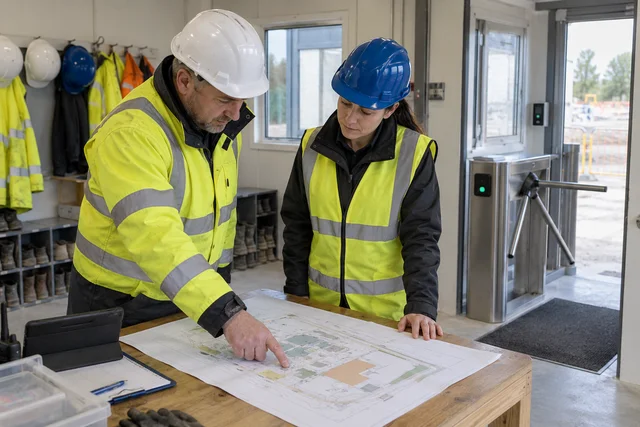
Existing SHAREhub photographic illustration. The written fictional case supplies the condition and decision evidence.
Start before appointment
Plan the job, select and brief the contractor, check the work and hand-back, then review performance. The HSENI five-step guide begins when the need for work is known. The host specifies hazards; the contractor explains capability, people and method; both agree supervision and changes. On site, test the actual workface and nearby activities. After completion, verify equipment, guards, services and permits before normal use. HSE HSG159 gives a parallel GB lifecycle. HSG159 second edition 2011 provides a contractor lifecycle for the chemical industry that can inform proportionate practice elsewhere. Check its older law references against the current GB or NI legal route; construction duties use CDM 2015 in GB and the separate CDM 2016 rules in NI.
Applied case
Fictional case: A client selects the lowest quote before defining the work boundary. The contractor assumes the adjacent operation will stop, but the client has made no such arrangement.
Two sources of risk
The site creates conditions the contractor must understand. The contractor’s work can also affect others; both directions belong in planning and coordination.
Test your decision
What needs resolution?
The commercial award as acceptance of the unresolved site-work boundary.
An assumption that outsourcing removes the host’s role.
The actual scope, site hazards and interface responsibilities before work is authorised.
Compare the explanation
The actual scope, site hazards and interface responsibilities before work is authorised.
Contractor control begins with a clear job and shared information.
Distinguish general credentials from relevant readiness.
Photorealistic illustrative UK workplace scene. Review checks: Unknown people on site: Subcontracting or access control has failed. Generic RAMS: The contractor has not understood the task or site. Permits copied forward: Controls may not match current conditions.
Select capability for this task
Contractor competence should be checked against the actual task, risk level, environment and supervision arrangements. Competence is not a single certificate. It is the combination of skills, knowledge, experience, training, supervision, equipment, resources and organisational capability needed to complete the work safely. The check should ask whether the contractor understands the hazards they bring and the hazards they will meet on the client site. Where the work is safety-critical, the client should know which individuals will attend, what authorisations they hold, who supervises them, what equipment they bring, whether medical or fitness requirements apply, and how competence is maintained. This matters for confined spaces, electrical work, lifting, work at height, asbestos, hot work, pressure systems and process plant.
Applied case
Fictional case: An approved company sends a replacement team. Its general certificates are available, but nobody has established the people’s relevant task capability or the proposed supervision arrangement.
Company and person
Company selection supports one decision. The people who arrive still need the relevant capability, information and role boundaries for the actual task they will perform.
Test your decision
What should be checked?
A belief that every certificate covers every task.
The actual team’s competence, authority and supervision for this work.
The approved-company listing without checking the replacement people and supervision.
Compare the explanation
The actual team’s competence, authority and supervision for this work.
Supplier approval is not automatic readiness for each assignment.
Use a task-specific method and consistent work authority.
Existing SHAREhub 2D teaching schematic. Use alongside the explanation and fictional case in this lesson.
Connect method and site conditions
Scope, RAMS and planning should translate the job into a safe sequence that fits the actual site, people, plant and interfaces. Poor contractor safety often begins with a vague scope: “fix the roof”, “service the tank”, “remove old pipework”, “install new cabling”. A good scope defines the area, equipment, standards, exclusions, known hazards, operational constraints, services, access, waste, emergency requirements and handback expectations. RAMS should then show how the contractor will do that specific work. They should not be generic documents with copied hazards. A useful RAMS review checks sequence, tools, materials, substances, isolations, permits, lifting, work at height, traffic, fire, electrical safety, occupational health risks, welfare and emergency arrangements. The review should involve people who understand the work, not only an administrator.
Applied case
Fictional case: The method describes one work area while the site pack identifies another. Both are signed, but no shared equipment identity or control boundary has been agreed.
A pack is not the control
Documents support a safe task when their scope, conditions and responsibilities agree. Their quantity cannot reconcile a conflict about what work is authorised.
Test your decision
What should happen?
Resolve the task and control mismatch before relying on the work pack.
Treat two signatures as stronger than the conflict.
Choose the location nearest the tools.
Compare the explanation
Resolve the task and control mismatch before relying on the work pack.
A method must fit the actual job and site controls.
Identify conflicts across location, time and services.
Photorealistic illustrative UK workplace scene. Review checks: Eliminate: Remote camera/clean-in-place if safe and effective. Substitute: Lower inventory and safer cleaning method after compatibility check. Engineering: Lock feeds/agitation, verify zero energy, ventilate/test atmosphere, enable retrieval. Administrative: Task permit, site induction, entrant count, standby and rescue drill. PPE: Suitable residual task equipment for trained people.
Review interacting work
Coordination should make sure contractors, hosts and other work groups understand who is doing what, where, when and under which controls. Contractor incidents often occur at interfaces: a delivery enters a pedestrian area, a cleaning contractor works below maintenance work, a hot-work contractor is unaware of flammable storage, an excavation team finds an unknown service, or two contractors rely on each other for isolations. Coordination should make these overlaps visible before the work starts. Communication must be practical and repeated. Pre-start meetings, daily coordination meetings, shift handovers, permit boards, exclusion zone briefings and supervisor walkdowns all have a role. The method should fit the risk and the pace of change. A named host contact and contractor lead share changing hazards, protect adjacent people and stop when the agreed boundary fails.
Applied case
Fictional case: A maintenance crew plans work beside a delivery route while another team changes access. Each method is complete alone, but nobody has reviewed their combined effects.
The interface is real
Follow how one task can change another’s route, environment or protective arrangement. A company boundary does not necessarily separate the hazards.
Test your decision
What is needed?
Only separate signatures from each crew.
An assumption that different employers cannot affect each other.
A coordinated decision about shared exposure, access and controls.
Compare the explanation
A coordinated decision about shared exposure, access and controls.
Individual plans can miss a combined harm pathway.
Respond to changes rather than only initial paperwork.
Existing SHAREhub photographic illustration. The written fictional case supplies the condition and decision evidence.
Check the work that actually happens
Contractor performance should be monitored through planned checks that test whether controls are working at the point of risk. Monitoring is not hovering over competent contractors. It is proportionate assurance. Low-risk work may need occasional checks. High-risk work needs frequent field verification, permit checks, supervisor engagement and sometimes independent audit. A strong system uses three levels. First-line checks are done by supervisors and work owners at the workface. Second-line checks are done by health and safety, facilities or operational leaders reviewing the quality of controls and records. Third-line assurance may include internal audit, external specialists, CDM audits, ISO audits or topic-specific reviews for high-risk work. Findings should be ranked and assigned to named owners with due dates.
Applied case
Fictional case: The agreed team and method were suitable at briefing. Later, a new activity appears outside the accepted scope, but the supervisor checks only induction attendance.
Accepted and actual
An accepted plan describes the basis for work. Monitoring checks whether people, conditions and activities still match it and sends differences for responsible review.
Test your decision
What should monitoring examine?
Whether the new activity can finish before anyone notices.
The actual work, changed scope and continued suitability of controls.
Only whether induction signatures exist.
Compare the explanation
The actual work, changed scope and continued suitability of controls.
Photorealistic illustrative UK workplace scene. Review checks: Risk-based approval: Approves contractors by work type and risk level. Procurement controls: Tender packs state health, safety, welfare and supervision expectations. Pre-start planning: Client and contractor exchange site and task hazards.
Accept the completed state on evidence
Handback and review confirm that work is complete, hazards are controlled, systems are safe to return and learning is captured. Many contractor failures happen at the end of the job: guards are not replaced, isolations are removed incorrectly, temporary openings remain, alarms are left impaired, waste is left behind, drawings are not updated or latent defects are introduced. Handback should be formal where the work affects plant, services, structure, fire protection or process safety. Post-job review should ask whether the contractor performed safely, whether the scope was realistic, whether client information was accurate, whether monitoring was adequate and whether the contractor remains approved. Lessons should feed into procurement, planning and future RAMS review. Plan the job, select and brief the contractor, check the work and hand-back, then review performance.
Applied case
Fictional case: The contractor leaves after fitting equipment. Required test information and the status of temporary arrangements are missing, while the client wants to close the job immediately.
Return to the host
The receiving role needs the actual condition, remaining restrictions and relevant evidence. Capture useful learning without treating commercial completion as operational acceptance.
Test your decision
What remains open?
The required configuration, verification and authorised hand-back decision.
Commercial completion without the required test and configuration evidence.
Nothing because the vehicles have left.
Compare the explanation
The required configuration, verification and authorised hand-back decision.