Focused awareness learning based on SHAREhub pages. Apply the actual workplace arrangements and your role; completion is not practical competence or permission for specialist work.
This reader supplies the complete teaching. Use the interactive LMS course for assessed activities, saved progress and completion.
LESSON 1
Find every route to dangerous parts
Find every route to dangerous parts.
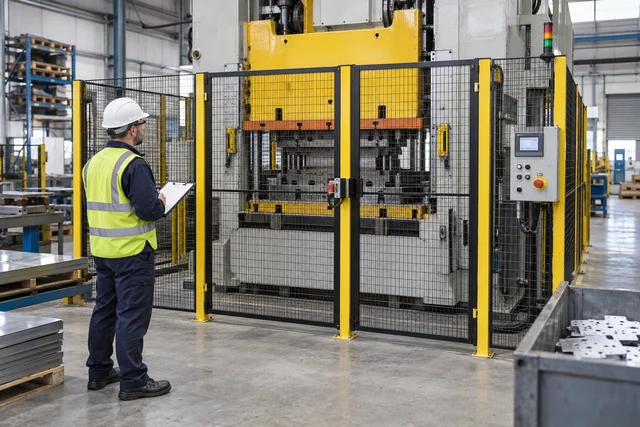
Existing SHAREhub photographic illustration. The written fictional case supplies the condition and decision evidence.
Find every route to dangerous parts
Machinery can entangle, draw in, crush, cut or strike a person. A guard should prevent reaching dangerous parts through, over, under or around it, not simply cover the most visible side. Access during cleaning, adjustment and jam response matters as much as the normal operator position. Ejected material and linked equipment can create additional pathways. An incident-free period does not demonstrate that a reachable hazard is controlled.
Observe the actual task without approaching or challenging the danger. Report missing panels, loose fixings, new openings or changes that could invalidate the access assessment. Include cleaners, maintainers and other people with different reach or access needs. Engineering dimensions and safe distances require the competent machine-specific basis; a course photograph cannot establish whether a particular gap is acceptable.
Applied case
A machine has a front cover, but a new opening at the side allows access towards a nip point. The operator says the main working position remains guarded.
Look beyond the label
A guard is effective because it interrupts a route to danger. A new opening or changed task can defeat that function while the original panel still appears complete.
Test your decision
What must the review cover?
All credible access routes to the dangerous condition.
Only the front view of the machine.
Only whether the operator has been injured before.
Compare the explanation
All credible access routes to the dangerous condition.
Physical separation must work for the actual access routes, not just the most obvious operating view.
Photorealistic illustrative UK workplace scene. Review checks: Feeding rollers or conveyors: An in-running nip draws clothing, hair or a hand into moving surfaces; crush injury, fracture, degloving or amputation can follow. Power press, mixer or driven gate: A moving part closes against another surface or unexpectedly restarts; crushing, shearing or entrapment may cause major injury or death. Saw, cutter or ejected workpiece: Contact cuts or severs tissue; fragments can penetrate an eye or strike a person.
Reduce entry and choose effective safeguarding
Reduce the need for dangerous access by correcting jam causes and designing suitable feed, adjustment and cleaning arrangements. Prevent access using suitable fixed guarding where practicable. Where necessary access needs a different arrangement, competent selection may include an interlocked guard or other protective device. Tools, information and supervision support the chosen system; an emergency stop or warning sign is not equivalent to practicable physical protection.
The safeguard must suit the access frequency, foreseeable misuse and hazard behaviour. If workers remove protection because visibility or cleaning is difficult, investigate that work-system failure. Do not solve production inconvenience by defeating the device. A competent review should provide a usable protected method rather than rely on people working carefully beside dangerous movement or repeatedly tolerating nuisance trips.
Applied case
Cleaning is awkward behind a fixed cover, so workers remove it for production and keep a warning sign nearby. The proposed improvement is another briefing with no access redesign.
Look beyond the label
Protection that obstructs ordinary work can invite defeat. Investigate the task and design the safe route; do not turn predictable access needs into a permanent unprotected workaround.
Test your decision
Which action addresses the stronger control need?
Accept the sign as an equivalent cover.
Keep the cover off whenever production is busy.
Review the task and provide effective usable physical safeguarding.
Compare the explanation
Review the task and provide effective usable physical safeguarding.
Usable design and effective separation need resolution; instruction cannot make the open hazard equivalent to a suitable guard.
Existing SHAREhub 2D teaching schematic. Use alongside the explanation and fictional case in this lesson.
Understand the complete safety function
An interlocked guard connects access to a protective function so dangerous operation is prevented or stopped when access opens. The protection must act before a person can reach the danger. If movement takes time to cease, the competent design must prevent access during that dangerous period. Closing a guard should not itself restart the machine. A door-position switch alone does not establish these behaviours.
The function can depend on the sensor, wiring, control system, output devices, drive, brake and mechanical stopping performance. Some arrangements need guard locking or means to prevent a person being trapped. Requirements depend on the actual machine and risk. Users recognise and report a concern; they should not defeat a switch or reach inside to discover whether the system reacts quickly enough.
Applied case
An access gate opens and the motor command stops, but a coasting part remains reachable. A colleague says the switch light proves the entire protective function has passed.
Look beyond the label
A switch indication is one part of evidence. The protective function must control the real access and stopping behaviour, including the time during which motion or another hazard remains dangerous.
Test your decision
What must be established?
Whether a worker can withdraw quickly enough after reaching in.
That access is prevented until the dangerous condition has ceased through the appropriate design.
Only that the switch changes its indicator.
Compare the explanation
That access is prevented until the dangerous condition has ceased through the appropriate design.
The safety function concerns actual danger and access, not just an electrical indication or user reaction.
Photorealistic illustrative UK workplace scene. Review checks: Elimination: Design out an unnecessary powered step or the need to reach into a danger zone for the task. Substitution: Replace the remaining operation or equipment with a suitable less hazardous process. Reducing force alone is not automatically substitution. Engineering controls: Fixed or interlocked separation, suitable guard locking, the complete sensor–logic–output–drive/brake–stop safety function, and engineered energy-control provisions provide physical protection. Administrative controls: Authorise tasks; coordinate workers, linked plant and contractors; plan isolation, competence, inspection scheduling, change management and hand-back. PPE: Use suitable protection only for assessed residual hazards; it cannot prevent access to a dangerous nip.
Do not confuse guarded access with isolation
Cleaning, adjustment or repair can require a different safe system from normal operation. An interlock or emergency stop may leave electrical supply, pressure, gravity, coasting parts or linked equipment available. The authorised intervention plan must identify the actual boundary and relevant stored energy, protect everyone involved and verify the required safe condition. A normal stop is not automatically an isolation, even if no movement is visible.
Keep the work outside the danger until that plan is established and implemented by the competent authorised roles. Do not reach into a blockage because the gate is open or ask another person to hold a button. Where movement is genuinely needed during work, a separately engineered and authorised arrangement is required. An awareness course cannot specify that mode or provide a universal lockout sequence.
Applied case
A cleaner opens an interlocked gate and prepares to reach into the machine. Pressure and an upstream feed remain outside the work plan, although the main drive has stopped.
Look beyond the label
Access control in normal running and isolation for intervention are different safeguards. Match the plan to the work point, linked equipment and every person exposed before relying on a stopped drive.
Test your decision
What is required before the intervention?
A complete authorised safe system covering relevant energy, feed and verification.
The open gate as proof that all sources are isolated.
A colleague watching the start button.
Compare the explanation
A complete authorised safe system covering relevant energy, feed and verification.
Guard operation does not establish the isolation needed for intrusive work.
Existing SHAREhub photographic illustration. The written fictional case supplies the condition and decision evidence.
Stop defeat and report the actual fault
Stop and keep the affected machine out of use when a required guard is missing, dangerous movement is reachable or an interlock is defeated or ineffective. Tell the supervisor and keep others clear through the site arrangements. A designed movable guard can open during intended safe access, but the hazardous condition must remain prevented. The concern is the protective function, not a rule that every open door is automatically defective.
Do not use spare actuators, magnets, wedges or repeated resets to keep production running. A useful report identifies the machine, affected safeguard, observed condition, exposed people and immediate restriction. Competent people assess, repair and verify the function safely. Investigate the reason for bypassing, including work access and production pressure, so the defect does not return after a warning or temporary fix.
Applied case
A spare actuator is used to make the control system think the gate is closed. Operators describe it as a temporary solution until a busy production run finishes.
Look beyond the label
A temporary bypass can become the normal method if its causes remain. Correct both the protective fault and the conditions encouraging defeat, then verify the actual function before release.
Test your decision
What should happen?
Accept the spare actuator as another guard.
Continue if an operator promises to watch the opening.
Stop the unsafe use and obtain competent resolution of the defeat and its causes.
Compare the explanation
Stop the unsafe use and obtain competent resolution of the defeat and its causes.
A bypass removes the intended access protection; a promise or production deadline does not restore it.
Accept the restored function, not only the repair entry
Accept the restored function, not only the repair entry.
Photorealistic illustrative UK workplace scene. Review checks: Setting: Cartons jam at a packaging transfer point. Act: Stop and hold production, keep others clear and reject the tape holding the side gate. Hold / review: Hold the line: do not start or reach in while the interlock is defeated, the drive can coast into reach, the linked feed remains energised, the air pressure is uncertain, or the task differs from the agreed method.
Accept the restored function, not only the repair entry
Handback needs evidence that the required safeguard works on the actual machine, with competent testing and acceptance appropriate to the risk. The check should address the specified access, stopping and restart behaviour and any changed method. Do not invent a universal test interval or engineering performance value. A modification or reported fault can require review before further use even when a routine inspection date has not arrived.
Account for people and tools, restore guards and protective arrangements, and communicate the accepted condition to the machine owner and users. A service invoice or completed work order is not the same as functional verification. Use a planned safe test method that prevents exposure; never challenge a guard with a person. Keep restrictions open until the responsible authorised handback is complete.
Applied case
A switch has been replaced and the work order is closed, but stopping behaviour and restart prevention have not been verified. The team asks to resume because the new switch lights correctly.
Look beyond the label
Follow the original fault to verified closure. Replacing a component is an action; demonstrated protection and a clear accepted handback are the evidence needed before users rely on it.
Test your decision
What supports return to service?
A completed invoice as automatic release.
Competent verification of the complete protective function and authorised handback.
The switch light alone.
Compare the explanation
Competent verification of the complete protective function and authorised handback.
The replacement component must work within the complete safety function; its indicator does not prove that function.