
Construction emergencies and work near water
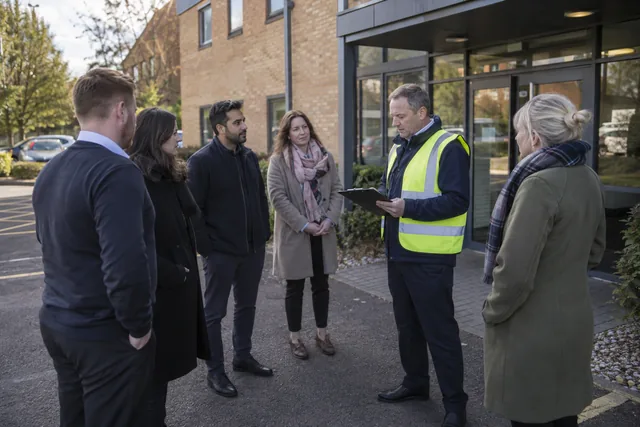

Prepare construction emergency responses, first aid and work-near-water controls.
Full public teaching and readers are free to read without an account. A free learner account is required for confirmed saved assessment, completion and certificate records in the LMS.
What you will work through
Fictional Quay Point project: an upper-floor workface and an outfall beside moving water test whether response arrangements match the current shift and site. Use fictional decisions; operational response and specialist rescue remain with trained authorised people.
The course has 5 modules and 18 lessons, with teaching, applied activities, feedback and a check of understanding throughout. There are 3 practice pauses in the actual construction model, with an equivalent accessible text route. Public interactive practice is separate from confirmed LMS assessment and completion records.
Explore the interactive practice copy. Return to the LMS route for recorded learning.
Learning outcomes
- Connect site alarms, access, first-aid needs and communication to credible emergencies.
- Identify drowning prevention and suitable planned rescue for work near water.
- Explain safe escalation and recovery without creating an unplanned rescue exposure.
Course outline
Plan the response system
- Emergencies change with the construction phaseEmergency arrangements must match the current site and be workable from the actual casualty location.
- Identify credible events and affected peopleScenario selection must follow actual hazards, people and location, including task-specific rescue needs.
- Command, roles and authority to stopRoles must be practical under the real emergency conditions, with suitable cover and authority.
- Make responder access and casualty access workableA call for help cannot replace practical escape, rescue and responder access.
Provide practical coverage
- Assess first-aid needs for this projectFirst-aid needs must reflect real hazards, people, location and all working periods.
- Coverage, absences and shared sitesShared arrangements need explicit practical agreement and verified availability.
- Equipment, facilities and communicationsEquipment must be suitable, maintained and accessible to the people authorised to use it when needed.
- First-aid roles and limits of interventionFirst-aid and rescue intervention must remain within training, competence and safe conditions.
Prevent drowning and plan recovery
- Work near water: prevent the fall firstPreventing the fall has priority; buoyancy and rescue address residual consequences.
- Edges, access and changing water conditionsCurrent water and access conditions can invalidate both fall prevention and rescue assumptions.
- Personal buoyancy and equipment compatibilityBuoyancy types and performance differ; selection and use must suit the real residual risk.
- Make water rescue and recovery achievableRescue readiness means capable people and a workable safe method for the actual casualty and conditions.
Exercise and learn
- Alarm, accountability and assistanceWarning, assistance and accountability must reflect the actual people and safe response limits.
- Handover to professional respondersA useful handover lets professional responders act on a clear accurate picture of people, hazards and access.
- Design a useful emergency exerciseExercises must test readiness without creating the emergency they are intended to prevent.
- Debrief, corrective action and safe recoveryExercise findings must become effective corrections and current workable arrangements.
Prove the decision
- Capstone: an upper-floor casualty and changed accessReadiness requires the entire workable response chain, including prevention and specialist arrangements where needed.
- Your emergency-readiness improvement planVerification must be realistic, safe and linked to accountable improvements.
Assessment and completion
Complete the required lessons and activities, then take the 20-question final assessment. The pass threshold is 80% plus every designated critical safety answer. Points and badges cannot compensate for a critical error.
Use the LMS to save and resume confirmed progress. Certificate availability follows its passed-completion and grade conditions. Browser practice and printed learning pages do not issue the official LMS record.
Independent construction learning. Completion records learning within the course scope; competent site assessment, practical training and task authorisation remain necessary. It does not confer a NEBOSH qualification.
Sources and learning provenance
The teaching draws on public SHAREhub topic pages and structured source records, with original fictional workface cases. Use the linked primary guidance and the applicable jurisdiction when planning a live task.
Topic records, source IDs and versions
| Public topic section | Chunk and version | Jurisdiction and source IDs |
|---|---|---|
| emergency-procedures-and-first-aid-needs · response-system | emergency-procedures-and-first-aid-needs--response-system Version 2.2 | Great Britain, Northern Ireland hse-firstaid-needs, hse-firstaid-employer, hse-emergency |
| emergency-procedures-and-first-aid-needs · emergencies | emergency-procedures-and-first-aid-needs--emergencies Version 2.2 | Great Britain, Northern Ireland hse-firstaid-needs, hse-firstaid-employer, hse-emergency, ew-fire, scot-fire, ni-fire |
| emergency-response-drills-and-incident-command · command | emergency-response-drills-and-incident-command--command Version 2.2 | Great Britain, Northern Ireland hse-comah15, hse-comah-emergency |
| emergency-procedures-and-first-aid-needs · procedures | emergency-procedures-and-first-aid-needs--procedures Version 2.2 | Great Britain, Northern Ireland hse-firstaid-needs, hse-firstaid-employer, hse-emergency, share-hierarchy-hse |
| emergency-procedures-and-first-aid-needs · first-aid-assessment | emergency-procedures-and-first-aid-needs--first-aid-assessment Version 2.2 | Great Britain, Northern Ireland hse-firstaid-needs, hse-firstaid-employer, hse-emergency, hseni-firstaid, ni-firstaid |
| emergency-procedures-and-first-aid-needs · coverage | emergency-procedures-and-first-aid-needs--coverage Version 2.2 | Great Britain, Northern Ireland hse-firstaid-needs, hse-firstaid-employer, hse-emergency, hseni-firstaid |
| emergency-procedures-and-first-aid-needs · equipment | emergency-procedures-and-first-aid-needs--equipment Version 2.2 | Great Britain, Northern Ireland hse-firstaid-needs, hse-firstaid-employer, hse-emergency |
| emergency-procedures-and-first-aid-needs · roles | emergency-procedures-and-first-aid-needs--roles Version 2.2 | Great Britain, Northern Ireland hse-firstaid-needs, hse-firstaid-employer, hse-emergency, hseni-firstaid |
| emergency-procedures-and-first-aid-needs · controls | emergency-procedures-and-first-aid-needs--controls Version 2.2 | Great Britain, Northern Ireland hse-firstaid-needs, hse-firstaid-employer, hse-emergency, share-hierarchy-hse, share-activity-emergency-procedures-and-first-aid-needs-1, share-activity-emergency-procedures-and-first-aid-needs-2, share-hierarchy-iosh |
| emergency-response-drills-and-incident-command · responder-safety | emergency-response-drills-and-incident-command--responder-safety Version 2.2 | Great Britain, Northern Ireland hse-comah15, hse-comah-emergency, share-hierarchy-hse, share-activity-emergency-response-drills-and-incident-command-1, share-hierarchy-iosh |
| emergency-response-drills-and-incident-command · handover | emergency-response-drills-and-incident-command--handover Version 2.2 | Great Britain, Northern Ireland hse-comah15, hse-comah-emergency |
| emergency-response-drills-and-incident-command · exercise-design | emergency-response-drills-and-incident-command--exercise-design Version 2.2 | Great Britain, Northern Ireland hse-comah15, hse-comah-emergency |
| emergency-response-drills-and-incident-command · debrief | emergency-response-drills-and-incident-command--debrief Version 2.2 | Great Britain, Northern Ireland hse-comah15, hse-comah-emergency |
| emergency-procedures-and-first-aid-needs · testing | emergency-procedures-and-first-aid-needs--testing Version 2.2 | Great Britain, Northern Ireland hse-firstaid-needs, hse-firstaid-employer, hse-emergency |
| emergency-procedures-and-first-aid-needs · training | emergency-procedures-and-first-aid-needs--training Version 2.2 | Great Britain, Northern Ireland hse-firstaid-needs, hse-firstaid-employer, hse-emergency |
Course version 2026.10.20.4 · SH-EMR-01. Factual source identity and jurisdiction are retained in the .
Questions about this course
Is this course free?
Yes. The training is £0. Full public teaching and readers can be used without an account. A free learner account is required for confirmed saved assessment, completion and certificate records in the LMS.
How long should I allow?
Approx. 1h 40m–2h 30m: approximately 100–150 minutes of self-paced learning, including required activities and one final-assessment attempt. Your pace, review and retries may increase the time. Save and resume in the LMS.
Can I study without a 3D-capable browser?
Yes. The complete learning reader is available in ordinary HTML. Where this course includes model practice, an accessible text route provides the same decision sequence. Use the interactive LMS course to complete its assessed requirements.
What do I need to pass?
Complete the required learning and achieve at least 80% in the final assessment, with every critical safety answer correct. Follow the feedback and review the relevant lesson before retrying.
Where is my completion record?
The LMS holds confirmed grades, completion and certificate records for your learner account. Public browser practice has its own separate progress and is not an official completion record.
Does completion authorise construction work?
Independent construction learning. Completion records learning within the course scope; competent site assessment, practical training and task authorisation remain necessary. It does not confer a NEBOSH qualification.
Presentation and model workshop
Use the same course imagery, worked decisions and source case in a 28-slide teaching companion. Practise classification, compare explained choices and inspect the linked model case.
Open the interactive presentation workshop · Download PowerPoint
This optional companion does not replace the required course activities or final assessment.