SHARE Knowledge Hub
Emergency response drills and incident command
A credible emergency drill tests decisions under changing conditions, not just assembly-point attendance. Set a scenario from the site’s major hazards; test who declares the incident, who commands, how responders stay safe, what information reaches emergency services and whether failed actions are corrected and retested.
Understanding Emergency response drills and incident command
Emergency response drills and incident command are assurance controls. Drills test whether an emergency plan is accurate, complete and practicable; incident command provides decision authority, information discipline, coordination and safe transfer between response and recovery. They do not replace prevention, engineered safeguards, competent emergency services or the controlled site emergency plan.
Why this matters at work
Rank a finding by the barrier affected and potential consequence, not by how easy it is to fix or how senior the owner is. A wrong radio label may be minor if an independent route worked; an unavailable toxic-release alarm may require immediate operating restriction. Document the scenario, observed failure, remaining barriers, current exposure and interim decision.
The repair may require engineering change, commissioning and an end-to-end test under representative noise and occupancy conditions. The drill then checks whether people recognise the signal and act. Close the action with both technical and human evidence. If the scenario is high consequence, leadership should review why earlier tests missed the gap. Sources: Exercise design and evaluation; HSE management.
How organisations manage this in practice
An exercise is about response, but its scenario map should show the preventive and mitigating barriers that led to the event. This stops the team treating emergency competence as a substitute for prevention. Identify what normally prevents initiation, what detects escalation, what limits exposure and what aids recovery. The drill may deliberately assume one failure, but the real site must still manage any actual impairment.
Where an exercise reveals that the emergency response is carrying too much of the safety case, revisit the hazard controls. A delayed toxic alarm may point to detector coverage and maintenance; repeated evacuation confusion may point to building layout or occupancy control. Use the finding to strengthen upstream barriers as well as the emergency plan. Sources: Exercise design and evaluation; HSE management.
Review after exercises, incidents, near misses, changed hazards, new equipment/layout, altered staffing or shift coverage, impaired emergency functions, changed external resources, new technical information, contractor change, communication failure or emergency-service feedback. A plan is only current when it reflects current people and plant.
Maintain a controlled scenario register, plans, contact lists, maps, substance information, role cards, training records, exercise designs, observations, actions and closure evidence. Name an owner and review trigger for each high-change item. Test access when the network or control room is down. Remove obsolete copies or mark them clearly so responders are not presented with competing instructions.
Trace a protective decision from inject to retest
For Crownway’s tank-fire exercise, the safety controller marks messages as exercise traffic and prevents simulated instructions from operating live plant. Radio loss is injected; the controller uses the planned alternative channel and confirms command succession. A blocked access or downwind muster route requires a revised protective decision under the site plan.
- Design a safe exercise — Set objectives, safety controller, simulation boundaries and abort criteria.
- Command and succession — Name the controller and deputy and record protective decisions.
- Handover and evidence — Pass current facts and uncertainties to the receiving responder.
- Correct and retest — Close gaps through demonstrated performance, not attendance alone.
The receiving responder repeats back the current product, people, route and barrier status. Observers record a missed handover or unheard instruction; the exercise owner assigns a named correction and retest, with readiness unresolved until the gap is demonstrated closed. Stop an unsafe drill immediately. Speed and attendance alone cannot show successful protection.
Content amended 19 October 2026 by the SHARE Knowledge Hub editorial team. This records an editorial content change; the existing technical-review and approval status still applies.
Make the exercise failure lead to a retest
A failed-radio inject can reveal an alternative-communication gap. Record what the team actually did, what remains unproven and who owns the correction.
A simulated radio failure must test the command handover

Full written explanation
Fuel-depot release exercise: keep simulated traffic distinct from real emergency messages and observe the response.
- Set safe exercise limits. Make simulated messages distinguishable from real traffic. A failed-radio inject must not disable a live protective function.
- Keep command explicit. Observe who receives changed information, who makes the site decision and how a deputy or handover is made clear.
- Record limits and retest. Capture the action actually taken and what remains unproven. Give corrections an owner and verify them in a relevant retest.
Change the pathway
- No fault is proved. The pictured radio is a prop for a question, not evidence of failed coverage.
- Avoid conflicting commands. The site coordinates its response; emergency services command their own response.
- Attendance is incomplete proof. A completed tabletop cannot prove every route, resource or emergency barrier.
Evidence check: Information-flow teaching only. No universal fire tactic, command authority, exercise interval, protective-function bypass or return permission is supplied.
Explicit command handover, simulated traffic and observed communication
Primary references: HSE: emergency practice, responsibilities and shared workplaces · HSE: emergency-arrangements exercise guidance — check current legal context
Open the complete HD image (new tab)Download image

Explicit command handover, simulated traffic and observed communication
Primary references: HSE: emergency practice, responsibilities and shared workplaces · HSE: emergency-arrangements exercise guidance — check current legal context

Exercise boundary
Define safe exercise limits and make simulated messages distinguishable from real emergency traffic.
Observe the decision
Record command, communication, accountability and any workaround, including what it did not demonstrate.
Correct and retest
Assign a practicable action and verify it in a relevant retest. Technical proof testing is a separate authorised activity.
Do not disable a live protective function to make an exercise realistic. A completed drill does not prove every emergency barrier.
What must an emergency drill prove?
A drill must show that the command team can recognise a credible scenario, choose protection, communicate changing facts and stop an unsafe action.
Best-practice guide: Emergency response drills and incident command

What must an emergency drill prove?
A drill must show that the command team can recognise a credible scenario, choose protection, communicate changing facts and stop an unsafe action. A credible emergency drill tests decisions under changing conditions, not just assembly-point attendance.
Turn emergency response drills and incident command knowledge into a decision
A credible emergency drill tests decisions under changing conditions, not just assembly-point attendance. Set a scenario from the site’s major hazards; test who declares the incident, who commands, how responders stay safe, what information reaches emergency services and whether failed actions are corrected and retested. Scenario, controller log, exercise observation, agency handover and verified action closure.
A field decision from start to hand-back
Inject the changed conditions, test command succession and record each protection and handover decision. Debrief, assign owners and retest failed command or communications actions before readiness sign-off.
Warning signs and consequences
Same easy drill every year: Does not test credible emergency pressure. No named incident controller: People duplicate or delay decisions. No injects: The drill misses uncertainty and degraded barriers.
Choose controls for emergency response drills and incident command
Elimination: Plan the test during a safe shutdown wherever practicable so testing does not leave operating plant dependent on the function being withdrawn. Engineering controls: Use an approved off-line test or simulation for the portions it can validly prove; record which sensor, logic and final-element functions remain untested. Engineering controls: Place affected equipment in the required safe state and control energy, inventory and access around moving shutdown equipment. Engineering controls: Use the approved test facilities and verify the required sensor, logic, alarm and final-element actions against the safety-function specification. Administrative controls: Coordinate every test step with the control room; distinguish simulated signals from genuine gas alarms, control authorised inhibits and define abort/shutdown actions. Read the full control table for qualifications, ownership and verification. Use the actual task and applicable jurisdiction; existing technical approval remains unchanged.
Use the full emergency response drills and incident command lesson
Use the full topic for the decision points, practical examples, detailed control tables and source scope. HSE guidance applies to Great Britain; use HSENI for the Northern Ireland route and the source’s stated jurisdiction. A simplified guide does not change the page’s technical-review or approval status.

Read all six steps as text
1. What must an emergency drill prove?
A drill must show that the command team can recognise a credible scenario, choose protection, communicate changing facts and stop an unsafe action.
- Avoid / redesign: Plan the test during a safe shutdown wherever practicable so testing does not leave operating plant dependent on the function being withdrawn.
- Control the task: Place affected equipment in the required safe state and control energy, inventory and access around moving shutdown equipment.
- Verify before release: If the hazardous step remains, keep it within the task assessment and select the stronger feasible remaining controls.
A drill must show that the command team can recognise a credible scenario, choose protection, communicate changing facts and stop an unsafe action. A credible emergency drill tests decisions under changing conditions, not just assembly-point attendance.
Apply it: Which part of this plan would you check at the workface before authorising the task?
2. Turn emergency response drills and incident command knowledge into a decision
Use the evidence to improve the actual work arrangement.
- Change at source: Plan the test during a safe shutdown wherever practicable so testing does not leave operating plant dependent on the function being withdrawn.
- Make it observable: If the hazardous step remains, keep it within the task assessment and select the stronger feasible remaining controls.
- Keep useful evidence: Scenario, controller log, exercise observation, agency handover and verified action closure.
A credible emergency drill tests decisions under changing conditions, not just assembly-point attendance. Set a scenario from the site’s major hazards; test who declares the incident, who commands, how responders stay safe, what information reaches emergency services and whether failed actions are corrected and retested. Scenario, controller log, exercise observation, agency handover and verified action closure.
Apply it: What evidence would show that the change improves this task, rather than only completing a record?
3. A field decision from start to hand-back
Example: a practical application of the existing topic lesson.
- Setting: the process operator drills a tank release with a failed radio and downwind muster point.
- Act: Declare exercise boundaries and safety controller; confirm that simulation cannot trigger live plant action.
- Hold / review: Stop an unsafe drill immediately; during a real event stop unprotected entry and escalate missing facts.
Inject the changed conditions, test command succession and record each protection and handover decision. Debrief, assign owners and retest failed command or communications actions before readiness sign-off.
Apply it: At which point would you hold this example, and what evidence would allow it to proceed?
4. Warning signs and consequences
Connect the task, the route to the person and the control that can fail.
- Same easy drill every year: Does not test credible emergency pressure.
- No named incident controller: People duplicate or delay decisions.
- No injects: The drill misses uncertainty and degraded barriers.
Same easy drill every year: Does not test credible emergency pressure. No named incident controller: People duplicate or delay decisions. No injects: The drill misses uncertainty and degraded barriers.
Apply it: Who could be exposed, including other trades, cleaners, maintainers and people nearby?
5. Choose controls for emergency response drills and incident command
Start with the stronger practicable options and verify their effect.
- Elimination: Plan the test during a safe shutdown wherever practicable so testing does not leave operating plant dependent on the function being withdrawn.
- Engineering controls: Use an approved off-line test or simulation for the portions it can validly prove; record which sensor, logic and final-element functions remain untested.
- Engineering controls: Place affected equipment in the required safe state and control energy, inventory and access around moving shutdown equipment.
- Engineering controls: Use the approved test facilities and verify the required sensor, logic, alarm and final-element actions against the safety-function specification.
- Administrative controls: Coordinate every test step with the control room; distinguish simulated signals from genuine gas alarms, control authorised inhibits and define abort/shutdown actions.
Elimination: Plan the test during a safe shutdown wherever practicable so testing does not leave operating plant dependent on the function being withdrawn. Engineering controls: Use an approved off-line test or simulation for the portions it can validly prove; record which sensor, logic and final-element functions remain untested. Engineering controls: Place affected equipment in the required safe state and control energy, inventory and access around moving shutdown equipment. Engineering controls: Use the approved test facilities and verify the required sensor, logic, alarm and final-element actions against the safety-function specification. Administrative controls: Coordinate every test step with the control room; distinguish simulated signals from genuine gas alarms, control authorised inhibits and define abort/shutdown actions. Read the full control table for qualifications, ownership and verification. Use the actual task and applicable jurisdiction; existing technical approval remains unchanged.
Apply it: Which stronger option can be used here, and who will verify it before accepting the remaining risk?
6. Use the full emergency response drills and incident command lesson
Follow the official sources below and retain the task-specific evidence.
- Official guidance: HSE COMAH 2015 duties and emergency planning
- Official guidance: HSE COMAH emergency arrangements inspector guidance
- Task decision: Scenario, controller log, exercise observation, agency handover and verified action closure.
Use the full topic for the decision points, practical examples, detailed control tables and source scope. HSE guidance applies to Great Britain; use HSENI for the Northern Ireland route and the source’s stated jurisdiction. A simplified guide does not change the page’s technical-review or approval status.
Apply it: Which official source and full-topic section will you use to resolve the next decision?
A tank-fire drill should inject a blocked muster route and radio loss. The controller must choose a safe alternative, confirm accountability, hand current hazards to emergency services and record the corrective retest.
Who needs to understand emergency response drills and incident command?
People who may lead, support, audit or rely on emergency response need to understand how drills and command work.
Who needs to understand emergency response drills and incident command? — part 1 of 3


Read the complete visual as text
- People who may lead, support, audit or rely on…: People who may lead, support, audit or rely on emergency response need to understand how drills and command work.
- Operators and supervisors: Need to understand alarms, shutdown, muster, isolation, escalation and first response roles.
- Incident controllers: Need to make decisions under uncertainty, keep a command log and coordinate information.
Who needs to understand emergency response drills and incident command? — part 2 of 3


Read the complete visual as text
- Emergency response teams: Need to protect themselves, work within competence and communicate changing risk.
- Engineering and technical authorities: Need to advise on inventory, isolation, relief, firewater, containment and escalation.
Who needs to understand emergency response drills and incident command? — part 3 of 3


Read the complete visual as text
- Contractors: Need to know site alarms, muster, permit interfaces, rescue limits and command handover.
- Senior leaders and auditors: Need to review drill evidence, action closure and whether major accident scenarios are being tested.
Operators and supervisors
Need to understand alarms, shutdown, muster, isolation, escalation and first response roles.
Incident controllers
Need to make decisions under uncertainty, keep a command log and coordinate information.
Emergency response teams
Need to protect themselves, work within competence and communicate changing risk.
Engineering and technical authorities
Need to advise on inventory, isolation, relief, firewater, containment and escalation.
Contractors
Need to know site alarms, muster, permit interfaces, rescue limits and command handover.
Senior leaders and auditors
Need to review drill evidence, action closure and whether major accident scenarios are being tested.
How can I practise this topic in 3D?


The emergency plan cannot reach the upper floors
An emergency plan lists contacts but no command or accountability
All related inspection points 3 across 2 locations
Construction site 1 inspection point
Crown Fuels terminal 2 inspection points
Practice in the SHAREhub environment. Browser practice is separate from workplace competence and formal learning records.
What are the key facts about drills and incident command?
The key facts are that drills should test credible scenarios, command decisions, communication, responder safety and verified learning.
What are the key facts about drills and incident command? — part 1 of 3


Read the complete visual as text
- The key facts are that drills should test credible…: The key facts are that drills should test credible scenarios, command decisions, communication, responder safety and verified learning.
- A drill is not a performance: It should expose weaknesses so the organisation can improve before a real event.
- Command needs authority: The incident controller must know what they can decide, who supports them and when to escalate.
What are the key facts about drills and incident command? — part 2 of 3


Read the complete visual as text
- Responder safety comes first: No exercise or real response should encourage untrained rescue or unsafe intervention.
- Injects create realism: Missing personnel, blocked access, failed radios or impaired firewater test decision quality.
What are the key facts about drills and incident command? — part 3 of 3


Read the complete visual as text
- Handover matters: Emergency services need accurate information on hazards, access, people, isolation and site layout.
- Learning must be closed: A debrief without verified action closure is weak assurance.
A drill is not a performance
It should expose weaknesses so the organisation can improve before a real event.
Command needs authority
The incident controller must know what they can decide, who supports them and when to escalate.
Responder safety comes first
No exercise or real response should encourage untrained rescue or unsafe intervention.
Injects create realism
Missing personnel, blocked access, failed radios or impaired firewater test decision quality.
Handover matters
Emergency services need accurate information on hazards, access, people, isolation and site layout.
Learning must be closed
A debrief without verified action closure is weak assurance.
What do emergency response drills and incident command mean?
Emergency response drills test the plan; incident command controls the response when the plan meets reality.
A fire drill that only times evacuation is useful but limited. A response exercise for a higher-risk site should test whether people can recognise a credible emergency, raise the alarm, take command, protect people, account for personnel, isolate hazards, communicate with responders, manage uncertainty and recover safely.
Incident command is the disciplined way of handling information and decisions. It avoids everyone acting independently, prevents unsafe rescue attempts, gives emergency services a single point of contact and makes sure important facts are recorded.
| Concept | Plain English meaning | Evidence |
|---|---|---|
| Scenario-led drill | Exercise built around a credible emergency, not a generic evacuation. | Scenario brief and objectives. |
| Incident command | Defined control structure for decisions, information and coordination. | Command procedure and controller training. |
| Exercise inject | Planned complication added during a drill. | Exercise timeline and inject log. |
| Muster | Accounting for people to identify who may be missing. | Muster report and missing-person escalation. |
| Handover | Structured transfer of information to emergency services or senior command. | Handover sheet or command log. |
Which scenarios should emergency drills test?
Drills should test scenarios that could produce serious harm, major accident consequences or difficult decisions.
Scenario-led drill examples — part 1 of 2


Read the complete visual as text
- Fuel tank overfill and vapour release: What the drill tests: Detection, alarm, isolation, ignition control, muster and emergency services liaison. Barrier focus: Level control, alarms, shutdown, bunding and emergency command.
- LPG release with fire impingement: What the drill tests: Responder exclusion, cooling strategy, evacuation and technical advice. Barrier focus: Isolation, separation, firewater, thermal protection and command.
- Toxic gas release: What the drill tests: Shelter, evacuation decision, wind direction, detection and public interface. Barrier focus: Gas detection, ventilation control, muster and off-site liaison.
Scenario-led drill examples — part 2 of 2


Read the complete visual as text
- Confined-space casualty: What the drill tests: Rescue limitations, emergency call, permit interface and responder safety. Barrier focus: Rescue plan, training, equipment and supervision.
- Blocked emergency access: What the drill tests: Alternative routes, security control and emergency services information. Barrier focus: Site access, signage, route inspections and command communication.
Scenario choice should come from the risk register, COMAH safety report where applicable, fire risk assessment, DSEAR assessment, hazard studies, incident history and emergency plan. The aim is to test the response to events that would stretch the organisation.
For process safety, the scenario should identify the initiating event, hazardous inventory, top event, consequences, barriers, command decisions and assumptions. Examples include tank overfill, loss of containment, vapour cloud explosion, BLEVE risk, toxic release, runaway reaction, loss of firewater, failed isolation, confined-space casualty or domino escalation. See HSE COMAH 2015 duties and emergency planning.
| Scenario | What the drill tests | Barrier focus |
|---|---|---|
| Fuel tank overfill and vapour release | Detection, alarm, isolation, ignition control, muster and emergency services liaison. | Level control, alarms, shutdown, bunding and emergency command. |
| LPG release with fire impingement | Responder exclusion, cooling strategy, evacuation and technical advice. | Isolation, separation, firewater, thermal protection and command. |
| Toxic gas release | Shelter, evacuation decision, wind direction, detection and public interface. | Gas detection, ventilation control, muster and off-site liaison. |
| Confined-space casualty | Rescue limitations, emergency call, permit interface and responder safety. | Rescue plan, training, equipment and supervision. |
| Blocked emergency access | Alternative routes, security control and emergency services information. | Site access, signage, route inspections and command communication. |
What types of emergency drill can be used?
Different drill types test different levels of decision-making, practical response and organisational resilience.
A mature programme uses a mix of drill types. A simple evacuation drill checks behaviour and routes. A tabletop exercise tests command thinking. A functional exercise tests communication and selected teams. A full live exercise tests the interaction between people, plant, equipment and external responders.
The drill type should fit the risk and maturity of the site. A new plan may need tabletop testing before a live exercise, while a high-hazard site should not rely only on desktop discussion.
| Drill type | Best use | Limitations |
|---|---|---|
| Evacuation drill | Testing alarm response, routes, wardens and roll call. | Does not test command complexity by itself. |
| Tabletop exercise | Testing decisions, information flow and command assumptions. | May miss practical equipment or route failures. |
| Communication drill | Testing radios, phones, PA, contact lists and escalation. | Needs realistic noise, distance and failure assumptions. |
| Functional exercise | Testing a specific part of response such as muster or spill team. | May not test whole-site coordination. |
| Live exercise | Testing people, equipment, routes, command and timing. | Needs careful planning to avoid creating risk. |
| Multi-agency exercise | Testing emergency services, local authority and site handover. | Requires more planning and shared objectives. |
How should incident command be structured?
Incident command should define who is in control, how information is logged and how decisions are escalated.
The command structure should be simple enough to work under pressure. For a small site, this may be a duty manager with deputies. For a process site, it may include site incident controller, technical adviser, emergency response leader, communications lead, security/access lead, muster coordinator and senior strategic command.
The command role should not be given to someone only because they are senior. Command requires site knowledge, calm decision-making, authority, communication discipline and training in the emergency plan.
| Role | Command responsibility | Evidence of readiness |
|---|---|---|
| Site incident controller | Sets priorities, directs response and coordinates handover. | Training, rota, exercises and command log. |
| Technical adviser | Explains plant, substances, isolation, escalation and safe shutdown. | Competence record and emergency information pack. |
| Emergency response team leader | Controls trained responders and equipment. | Team training and equipment checks. |
| Muster coordinator | Accounts for people and escalates missing-person information. | Muster drill and roll-call record. |
| Communications lead | Manages internal updates, emergency contacts and external messages. | Contact list tests and message templates. |
| Strategic manager | Supports business, regulatory, recovery and resource decisions. | Crisis exercise and leadership review. |
The site incident controller manages the operator response and handover. Emergency services command their own response on arrival; the site must keep an accurate shared picture rather than issuing conflicting instructions. See HSE COMAH emergency arrangements inspector guidance.
How should drills test communication?
Drills should test whether information is accurate, timely, understood and still available when systems fail.
Many emergency failures are communication failures: people do not know the meaning of an alarm, radio channels are overloaded, the emergency services receive poor site information, muster information is late, or senior managers make decisions using incomplete facts.
A drill should deliberately test message flow: who calls 999, who contacts the control room, who updates assembly points, who briefs emergency services, who communicates with neighbouring businesses and who records decisions.
| Communication route | What to test | Good evidence |
|---|---|---|
| Alarm and PA | Audibility, visibility and understood action. | Alarm test and worker feedback. |
| Radio network | Coverage, channels, battery and message discipline. | Radio check and dead-zone map. |
| Emergency contact list | Correct numbers and deputies. | Contact test log. |
| Command log | Decisions, timings, assumptions and handover notes. | Completed exercise log. |
| Muster reporting | Accuracy and speed of accountability. | Muster report and missing-person drill. |
| External communication | Emergency services, neighbours, local authority and regulators where relevant. | Handover checklist and call script. |
How should handover to emergency services work?
Handover should give emergency services a concise, accurate picture of the hazard, people, access and actions already taken.
Emergency services should not have to discover the site while the incident is escalating. A good handover includes site layout, access route, isolation points, hazardous substances, quantity, location, missing people, casualties, firefighting water, drainage risks, wind direction, utility controls and what the site has already done.
For COMAH and major hazard sites, the interface should be built before the incident through emergency planning, exercises and shared understanding of credible scenarios. See HSE COMAH emergency arrangements inspector guidance.
| Information | Why it matters | Prepared evidence |
|---|---|---|
| Exact location and access | Reduces delay and prevents blocked routes. | Site map and gate plan. |
| Hazard inventory | Informs responder tactics and exclusion zones. | Substance list and SDS summary. |
| People at risk | Supports rescue and casualty priorities. | Muster record and visitor list. |
| Isolation and shutdown status | Shows what barriers remain effective. | Isolation map and shutdown log. |
| Environmental risks | Prevents contaminated water or chemical spread. | Drainage plan and containment map. |
| Command contact | Creates one clear site interface. | Named controller and deputy. |
How can the hierarchy of controls control plant and communication risks during a shutdown response test?
Use the stronger source and work-design controls first; response or individual support does not replace prevention.
Drills should teach people where intervention stops. Workers should not enter a confined space, approach a toxic cloud, fight a developed fire, isolate live electrical equipment or recover property unless they are trained, equipped and authorised for that task.
Responder safety controls include exclusion zones, dynamic risk assessment, PPE suited to the hazard, communications, buddy systems, withdrawal criteria, medical support, wind direction, heat stress controls and command permission before entering hazardous areas.
How can the ERICPD hierarchy of controls control plant and communication risks during a shutdown response test?

| Control level | Control for this activity | Owner and verification | Stop / restart decision |
|---|---|---|---|
| Eliminate | Plan the test during a safe shutdown wherever practicable so testing does not leave operating plant dependent on the function being withdrawn. | Task owner verifies that the proposed change removes the named hazardous step, including foreseeable cleaning, maintenance and work transferred elsewhere. | If the hazardous step remains, keep it within the task assessment and select the stronger feasible remaining controls. |
| Reduce, including substitution | Use an approved off-line test or simulation for the portions it can validly prove; record which sensor, logic and final-element functions remain untested. | Competent task/process owner validates suitability, compatibility and new hazards against the actual operating requirements before the alternative is adopted. | Reject an alternative if its performance is unproved or its new hazards are unresolved. |
| Isolate | Place affected equipment in the required safe state and control energy, inventory and access around moving shutdown equipment. | Supervisor checks the actual boundary, affected people and connected work; verify separation or isolation before allowing access. | Hold or stop for unexpected plant action, real gas alarm, communication failure or a test result outside the required performance. |
| Control: physical safeguards | Use the approved test facilities and verify the required sensor, logic, alarm and final-element actions against the safety-function specification. | Competent equipment/process owner checks approved test scope, expected cause-and-effect, control-room communication and final-element response. | Hold or stop for unexpected plant action, real gas alarm, communication failure or a test result outside the required performance. |
| Control: work method and response | Coordinate every test step with the control room; distinguish simulated signals from genuine gas alarms, control authorised inhibits and define abort/shutdown actions. | Supervisor confirms the work limits, competent cover, communication and stop/restart authority with the people doing this activity. | Hold work when the agreed limits, competent cover or effective communication cannot be maintained. |
| PPE | Use task-assessed protection and personal gas detection where required; neither substitutes for essential automatic protection or safe plant conditions. | Assessor confirms whether personal protection is needed and checks suitability, condition, compatibility and any required fit evidence. | Do not use unsuitable protection or rely on PPE to continue after an essential source control fails. |
| Discipline | Remove test equipment and authorised inhibits, reconcile the panel/register and prove normal protection before the operations return-to-service decision. | Release only after instrument and operations owners accept complete results, restored protection and reconciled inhibits. Retain verification and unresolved restrictions at handover. | Keep the task on hold until required reinstatement evidence and unresolved defects are accepted by the responsible owner. |
How can the ISO 45001 hierarchy of controls control plant and communication risks during a shutdown response test?

| Control level | Control for this activity | Owner and verification | Stop / restart decision |
|---|---|---|---|
| Elimination | Plan the test during a safe shutdown wherever practicable so testing does not leave operating plant dependent on the function being withdrawn. | Task owner verifies that the proposed change removes the named hazardous step, including foreseeable cleaning, maintenance and work transferred elsewhere. | If the hazardous step remains, keep it within the task assessment and select the stronger feasible remaining controls. |
| Engineering controls | Use an approved off-line test or simulation for the portions it can validly prove; record which sensor, logic and final-element functions remain untested. | Competent task/process owner validates suitability, compatibility and new hazards against the actual operating requirements before the alternative is adopted. | Reject an alternative if its performance is unproved or its new hazards are unresolved. |
| Engineering controls | Place affected equipment in the required safe state and control energy, inventory and access around moving shutdown equipment. | Supervisor checks the actual boundary, affected people and connected work; verify separation or isolation before allowing access. | Hold or stop for unexpected plant action, real gas alarm, communication failure or a test result outside the required performance. |
| Engineering controls | Use the approved test facilities and verify the required sensor, logic, alarm and final-element actions against the safety-function specification. | Competent equipment/process owner checks approved test scope, expected cause-and-effect, control-room communication and final-element response. | Hold or stop for unexpected plant action, real gas alarm, communication failure or a test result outside the required performance. |
| Administrative controls | Coordinate every test step with the control room; distinguish simulated signals from genuine gas alarms, control authorised inhibits and define abort/shutdown actions. | Supervisor confirms the work limits, competent cover, communication and stop/restart authority with the people doing this activity. | Hold work when the agreed limits, competent cover or effective communication cannot be maintained. |
| PPE | Use task-assessed protection and personal gas detection where required; neither substitutes for essential automatic protection or safe plant conditions. | Assessor confirms whether personal protection is needed and checks suitability, condition, compatibility and any required fit evidence. | Do not use unsuitable protection or rely on PPE to continue after an essential source control fails. |
| Administrative controls | Remove test equipment and authorised inhibits, reconcile the panel/register and prove normal protection before the operations return-to-service decision. | Release only after instrument and operations owners accept complete results, restored protection and reconciled inhibits. Retain verification and unresolved restrictions at handover. | Keep the task on hold until required reinstatement evidence and unresolved defects are accepted by the responsible owner. |
Worked control decision: one scenario through the hierarchy
Illustrative upper-tier fuel-storage drill: a tank overfills, vapour travels towards an occupied gate, and a detector becomes unavailable. The site must adapt decisions to its actual safety report, plan and responder agreements.
| Level | Barrier and location | Pre-use and continuing check | Failure and residual risk | Stop decision |
|---|---|---|---|---|
| Eliminate | Test whether the hazardous transfer or on-site inventory can be removed from this operation. | Process owner documents feasibility in the hazard study and reviews it after process change. | A different transfer may move risk elsewhere; residual inventory may remain. | Do not accept an unexamined process change as risk reduction. |
| Reduce / substitute | Where the transfer is needed, assess smaller batches and a lower-hazard material if technically possible. | Engineering checks compatibility and consequence modelling before trial and after changes. | Smaller inventory may still form a dangerous vapour cloud. | Hold the trial until the new hazard study is approved. |
| Isolate | Keep occupied gate and command post beyond modelled release zones with controlled access routes. | Site lead checks plans and physical routes before the drill and at each shift handover. | Wind change or blocked access can defeat separation. | Move command and exclude entry when the zone or route becomes unsafe. |
| Control — physical | At the tank, test independent high-level shutdown, remote isolation, detection and backup communications. | Maintainer verifies proof-test records before exercise; controller tracks impairments live. | Detector or shutdown failure increases release duration; residual major-accident risk remains. | Stop transfer on critical impairment and activate the site escalation plan. |
| Control — method | Command card requires wind-aware shelter/evacuation decision, exclusion zone and fire-service handover. | Controller rehearses succession and communication checks before exercise; observers log decisions. | Conflicting reports can delay warning and off-site coordination. | Escalate and withdraw responders when conditions or facts are uncertain. |
| PPE | Only trained, authorised responders use hazard-rated protection inside a defined safe operating envelope. | Response lead checks fit, air supply, buddy and rescue capability before any entry. | PPE cannot make an unknown toxic or fire zone safe. | No entry without verified protection, backup and command approval. |
| Discipline / assurance | Inject detector failure and a wind shift, then retest corrective actions with the agencies involved. | Exercise lead compares objectives, command log and actions at debrief and retest. | Paper closure may hide an untested command weakness. | Keep the affected response capability restricted until the failed action is demonstrated. |
How should an emergency exercise be designed?
An emergency exercise should have clear objectives, credible injects, observers, safety controls and learning outputs.
Exercise design should begin with one or two clear questions: what are we testing and what evidence would prove it works? The answer may be muster accuracy, command handover, responder safety, emergency shutdown, shelter decision, communication to neighbours, emergency services access or action closure.
Good exercises use injects to create uncertainty. Examples include a blocked access road, failed radio channel, missing contractor, injured responder, changing wind direction, unavailable firewater, conflicting alarm information or media enquiry. Injects should stretch the system without creating real danger. See HSE COMAH emergency arrangements inspector guidance.
| Design element | What to define | Why it matters |
|---|---|---|
| Objectives | The specific capability being tested. | Prevents vague drills with weak learning. |
| Scenario basis | Hazard, initiating event, consequence and barriers. | Keeps the exercise realistic. |
| Injects | Complications introduced during the exercise. | Tests decisions under uncertainty. |
| Observers | People who record facts without interfering. | Provides evidence for debrief. |
| Exercise safety | Controls to avoid creating real risk. | Protects people during live exercises. |
| Success criteria | What good performance looks like. | Makes findings fair and useful. |
How should drill learning be captured and closed?
Drill learning should be captured quickly, analysed properly and tracked until improvements are verified.
A hot debrief immediately after the exercise captures obvious issues while memories are fresh. A cold debrief can then examine logs, timings, observer notes, communications, photographs and feedback. The result should be ranked findings, owners, due dates and evidence of completion.
Learning should be connected to HSG245-style thinking: gather information, analyse what happened, identify better controls and implement the action plan. The most important question is whether the action will make the next response safer and more effective.
| Step | What to do | Evidence |
|---|---|---|
| Hot debrief | Capture immediate observations and safety issues. | Notes and attendance. |
| Evidence review | Check logs, timings, radio records and observer notes. | Exercise evidence pack. |
| Analysis | Identify underlying causes, not only visible symptoms. | Findings and cause analysis. |
| Action planning | Assign owner, due date, priority and verification method. | Action tracker. |
| Close-out | Verify the improvement has been made and communicated. | Completion evidence. |
| Retest | Repeat part of the exercise if the weakness was significant. | Retest record. |
Which legal duties apply to emergency drills and incident command?
Select the instrument for the site and activity; Great Britain and Northern Ireland have distinct work-safety and equality rules.
| Where | Instrument or authority | Practical duty boundary |
|---|---|---|
| Great Britain | Control of Major Accident Hazards Regulations 2015 | GB COMAH duties, including upper-tier internal and external emergency planning |
| Northern Ireland | Control of Major Accident Hazards Regulations (Northern Ireland) 2015 | NI COMAH emergency-planning duties |
| Great Britain | Management of Health and Safety at Work Regulations 1999 | GB risk assessment and serious/imminent danger arrangements |
| Northern Ireland | Management of Health and Safety at Work Regulations (Northern Ireland) 2000 | NI risk assessment and emergency arrangements |
| Great Britain | Health and Safety at Work etc. Act 1974 | GB general work-safety duties |
| Northern Ireland | Health and Safety at Work (Northern Ireland) Order 1978 | NI general work-safety duties |
Specialist duties apply only to the activities and establishments within their scope; a guidance page does not replace the legal instrument.
How should drills and command appear in a risk register?
The risk register should treat emergency response as a mitigative barrier with owners, performance standards and evidence.
A risk register entry should not simply say 'emergency drill completed'. It should identify the credible scenario, the consequence being limited, the emergency barriers relied on, the evidence that those barriers work and the weaknesses found during exercises.
For major accident hazards, emergency response is not a replacement for prevention, but it is still a critical mitigation layer. A weak emergency plan can turn a controllable loss of containment into a much larger event.
| Scenario | Emergency response barrier | Assurance evidence |
|---|---|---|
| Tank overfill and vapour cloud | Alarm response, ignition control, muster and emergency services handover. | Scenario drill and command log. |
| LPG fire impingement | Exclusion zone, cooling strategy and responder withdrawal criteria. | Tabletop exercise and technical review. |
| Confined-space casualty | Rescue plan, trained rescue provision and command escalation. | Rescue drill and permit review. |
| Toxic release | Shelter/evacuation decision, wind direction and communication. | Exercise debrief and contact test. |
| Emergency services access blocked | Alternative access and security control. | Access drill and site map review. |
How could Crownway Fuels Ltd manage drills and incident command?

Crownway Fuels Ltd would use a safely designed exercise to test credible emergency decisions, communication and handover, then verify improvements before relying on the revised plan.
Crownway Fuels Ltd · practical example
Use a depot exercise to test decisions and command handover
The key lesson An exercise tests whether planned functions and decisions work; a smooth rehearsed performance is not proof that every emergency is covered.
The situation: Crownway plans a simulated fuel-release exercise at a depot. The scenario includes an unavailable route, a contractor not yet accounted for and the arrival of external responders. No actual fuel release or hazardous live demonstration is needed.
Why this matters: A plan can look complete while unclear command, missing information or an impractical access arrangement delays protective action.
How Crownway Fuels Ltd would manage it
- Define the scenario and scope — Health and Safety Lead. Select credible events from the site's assessment and identify the functions to test. Confirm the applicable establishment and emergency-planning duties rather than assuming every depot has the same COMAH status.
- Set safe exercise controls — Site Manager. Agree the exercise boundaries, observers, communications and stop arrangements. Coordinate external participants and prevent simulated messages or restrictions being mistaken for actual operating instructions.
- Test the important decisions — Shift Supervisor. Demonstrate the planned alarm, protective actions, accountability and escalation within the role's limits. Keep uncertainty visible instead of inventing a missing contractor's location to make the exercise progress.
- Check the handover — Site Manager. Test how relevant site information, hazards, missing-person status and access restrictions reach the incident command and external responders. Confirm authority interfaces without assuming company staff direct emergency-service tactics.
- Verify the improvements — Operations Director. Assign observed weaknesses to owners and provide resources. Update and brief the relevant plan, then use suitable checks or a further exercise to demonstrate that the critical gaps have been resolved.
When the conditions change
- Recognise the trigger
- An exercise or real change reveals an essential emergency function cannot be delivered.
- Make the immediate decision
- Keep the affected activity restricted where emergency readiness is inadequate; stop the exercise if its own safety controls fail.
- Verify the next step
- The Site Manager checks that the critical communication, accountability and command-handover weaknesses have verified corrections and have been briefed or retested as appropriate.
What good looks like
Observers can trace decisions to available information, command responsibilities are understood and significant exercise failures have verified corrective actions.
Evidence to look for: Scenario rationale, safe exercise plan, observer records, command-handover checks and effectiveness evidence.
Common mistake to avoid: Scoring only evacuation time while ignoring missing people, hazardous access or command confusion.
Apply this to your work: What important uncertainty should your next exercise expose instead of scripting away?
Guidance behind the management approach: HSE: emergency procedures and rehearsed responsibilities. Use the topic's legal and technical guidance for the applicable work and location.
Share changed fire information across the multi-tenant workplace

Full written explanation
A complete four-stage information loop connects tenant status reporting, the named building coordination role, a revised message under the actual plan, and confirmation of receipt with feedback. It shows information and acknowledgement, not a universal incident-command hierarchy. Emergency services retain command of their own response. Real emergency action does not wait for an exercise log or administrative sign-off.
Multi-tenant exercise: reports, coordinated instructions and observed receipt must form a shared current picture.
- Report changed tenant status. Pass the location, people/assistance status, route concern and uncertainty to the agreed coordination point.
- Coordinate a current picture. The named role uses the actual plan and current information. Make deputy or command handover explicit; avoid competing instructions.
- Send the revised instruction. Use the assessed communication route to reach affected groups. Do not assume one tenant’s message reached all occupiers.
- Confirm receipt and learn. Observe whether the instruction was received and understood. Report gaps, assign corrections and retest the relevant interface.
When the evidence does not fit: A real emergency uses the actual arrangements immediately. A drill does not authorise a route, responder entry or restart, and a message sent is not proof that it was received.
Who acts: Tenant representatives, named building/site coordination roles and responders within the actual agreed responsibilities.
Changed workplace
Depot release exercise: Test a simulated communication failure and explicit handover.
Multi-tenant fire exercise: Join changing status, coordinated messages and observed receipt.
Evidence check: Information-flow teaching only. No universal fire tactic, command authority, exercise interval, protective-function bypass or return permission is supplied.
Explicit command handover, simulated traffic and observed communication
Primary references: HSE: emergency practice, responsibilities and shared workplaces · HSE: emergency-arrangements exercise guidance — check current legal context
Open the complete HD image (new tab)Download image

Explicit command handover, simulated traffic and observed communication
Primary references: HSE: emergency practice, responsibilities and shared workplaces · HSE: emergency-arrangements exercise guidance — check current legal context
Crownway Fuels Ltd
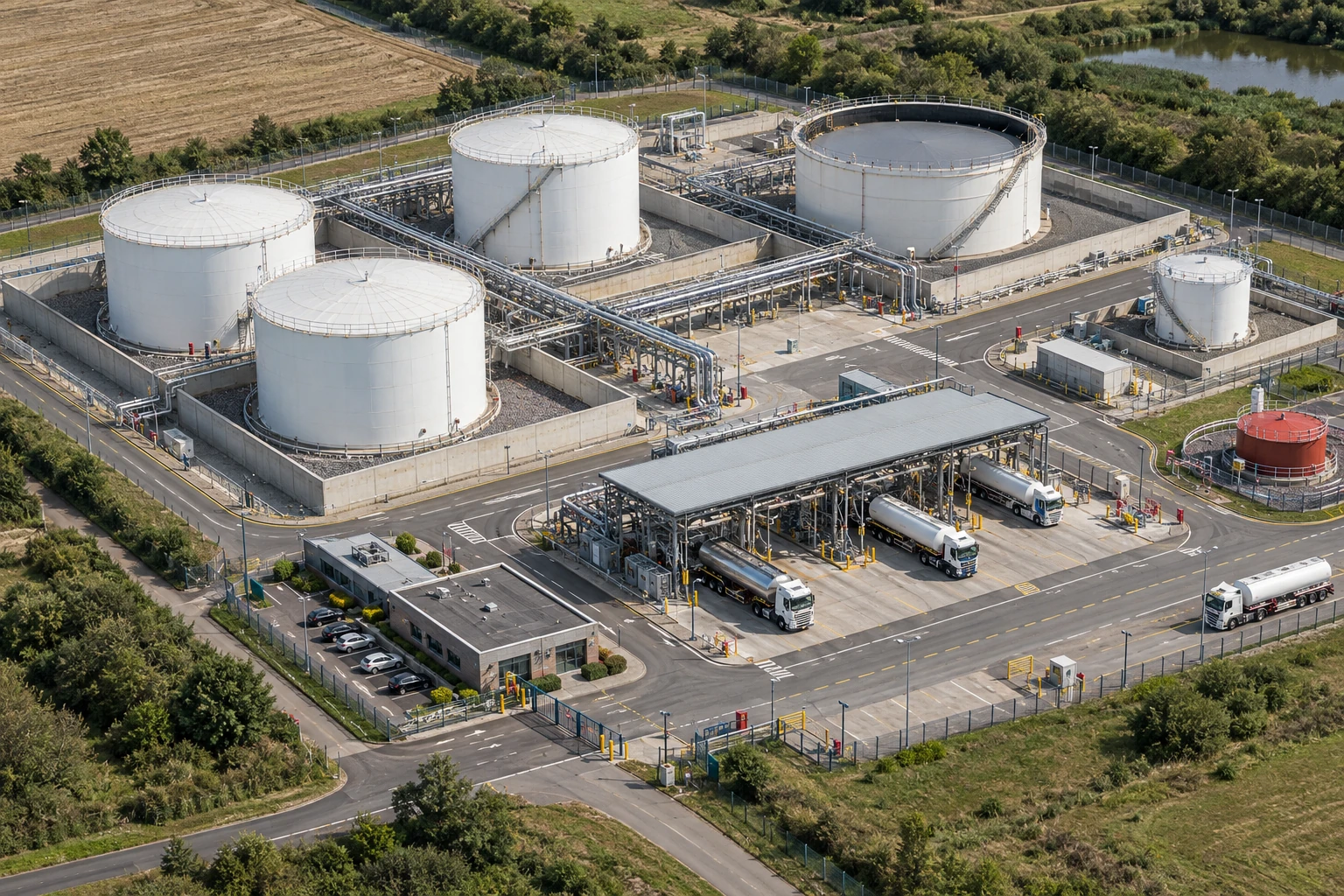
Crownway Fuels Ltd is a make-believe fuel storage and distribution business with bulk tanks, road tanker loading, hazardous area controls, contractors and neighbouring premises.
Crownway builds its drill programme from its major accident hazard register. The register identifies credible scenarios such as tank overfill, bund fire, road tanker loading hose failure, vapour release, lightning-related ignition, fuel spill to drainage, missing contractor during muster and loss of site access during an emergency.
The site defines command roles for each shift: site incident controller, deputy, technical adviser, muster lead, communications lead, security/access lead and emergency response team leader. Contractors receive emergency rules during induction and are included in muster tests when they work on site. The emergency services information pack includes tank layouts, product inventory, isolation points, hydrants, drainage, access gates, hazardous areas and contact numbers.
Crownway runs a layered programme: monthly communication checks, quarterly tabletop exercises, annual live exercises and periodic multi-agency exercises where appropriate. Exercise injects include failed radio channel, blocked access road, missing tanker driver, impaired firewater, changing wind direction and conflicting level alarm information. Each exercise has observers and a hot debrief followed by a formal action tracker.
Senior leaders review drill findings alongside barrier health: overdue actions, alarm defects, impaired fire systems, staffing gaps, contractor observations and emergency equipment defects. Actions are not closed until the improvement is physically verified, briefed and, where needed, retested.
| Management area | How Crownway manages it | Evidence |
|---|---|---|
| Assess | Uses a major accident hazard register to select drill scenarios. | Scenario register and emergency plan. |
| Plan | Defines objectives, injects, observers and exercise safety controls. | Exercise plan and briefing pack. |
| Train | Trains command roles, responders, contractors and shift teams. | Competence matrix and drill attendance. |
| Implement | Maintains emergency equipment, site maps and responder information. | Equipment checks and emergency services pack. |
| Check | Runs tabletop, communication, live and multi-agency exercises. | Exercise reports and command logs. |
| Improve | Ranks findings and verifies action closure through retest or inspection. | Action tracker and leadership review. |
A field decision from start to hand-back
Task material and setting: Crownway Fuels drills a tank release with a failed radio and downwind muster point.
People and prerequisites: Operator, controller, liaison and responders; inventory, weather, isolation and alternative shelter are known.
Before: Declare exercise boundaries and safety controller; confirm that simulation cannot trigger live plant action.
During: Inject the changed conditions, test command succession and record each protection and handover decision.
Hold or stop: Stop an unsafe drill immediately; during a real event stop unprotected entry and escalate missing facts.
Completion and hand back: Debrief, assign owners and retest failed command or communications actions before readiness sign-off.
Evidence: Scenario, controller log, exercise observation, agency handover and verified action closure.
What should a fuel-site emergency exercise examine?
Use the scene to discuss access, communications, roles and changing conditions. A selected route or marker is not a verified muster point or incident-command plan.
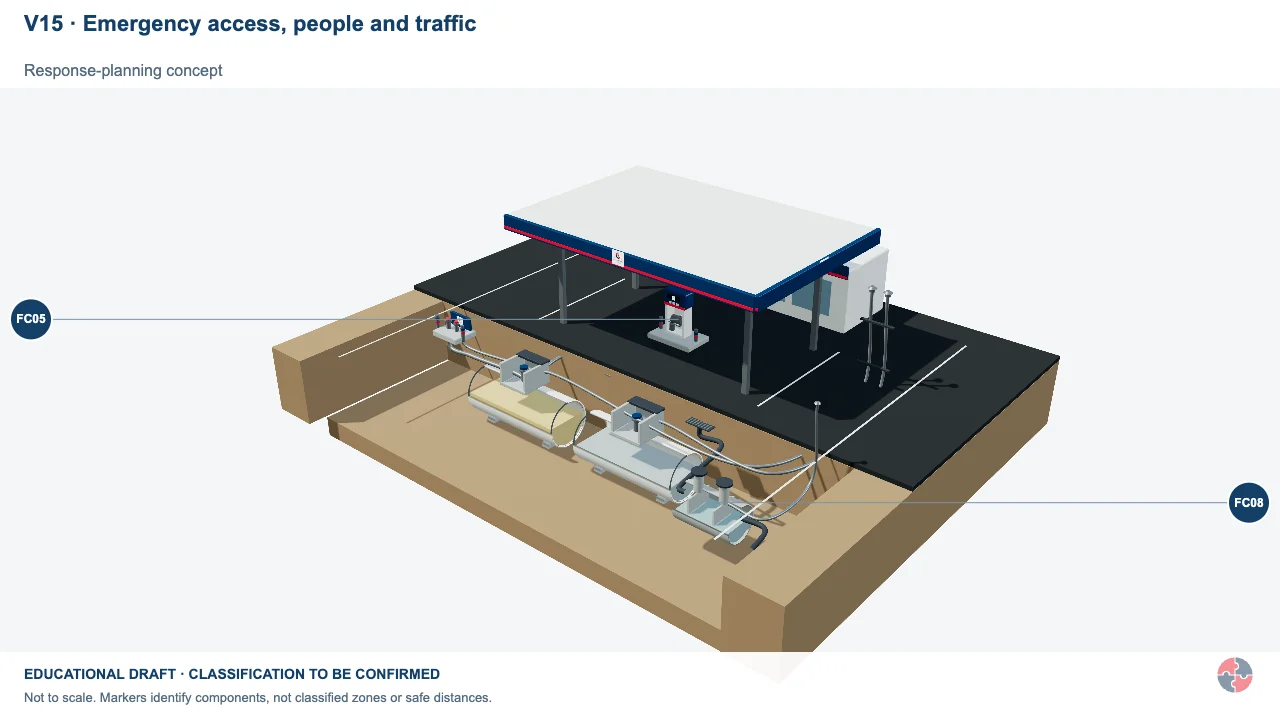
Emergency access, people and traffic
Delivery hoses, the movable refuelling interface and drainage sources can affect access and response. Plan routes around the incident and people involved rather than using a coloured zone as a muster boundary.
Activity focus: Inspect the tanker working area, hose route, nozzle/filler positions, separator covers and vent. Check communication, control of dispensing and traffic, and access for the response plan.
Contextual workplace scene. Use the task, control and evidence checks in this section; appearance alone does not establish safe conditions, individual health or approval.
Educational illustration, not to scale. Coloured zones are teaching examples, not a site-specific hazardous-area classification.
What competence does emergency incident command need?
Train each role to demonstrate decisions under changing conditions, not only attendance at an exercise.
| Role | Learning | Demonstration | Assessor | Record | Reassess when |
|---|---|---|---|---|---|
| Operators | Recognise abnormal condition and alarm | Demonstrate declaration trigger | Process lead | Drill observation | Plant change |
| Incident controller | Set priorities, command and succession | Lead failed-route scenario | Senior emergency lead | Decision log | Failed drill |
| Response team | Protect responders and use equipment | Show entry boundary and checks | Qualified trainer | Competence record | Kit change |
| Communications lead | Maintain factual common picture | Test radio loss and handover | Controller | Message log | Contact change |
| Emergency service liaison | Hand current hazards to agencies | Joint information exercise | Site lead | Handover record | Scenario change |
| Leaders and auditors | Close and retest weaknesses | Sample action evidence | Independent reviewer | Assurance record | Repeat gap |
Attendance alone does not establish competence; observe the role and reassess after a changed task, failed exercise or incident.
How does this topic support NEBOSH Process Safety Management study?
This topic supports PSM Element 4 by showing how emergency arrangements are tested, commanded and improved for major accident scenarios.
For NEBOSH PSM learners, drills and incident command should be explained as emergency-response barriers. The learner should be able to describe why exercises must be based on credible loss-of-containment, fire, explosion or toxic-release scenarios, and why simple evacuation drills do not prove command capability.
Scenario-based questions may ask what should be tested, who should be involved, what information emergency services need, how responder safety is protected, how debriefs should be recorded or what evidence demonstrates continual improvement.
| Study area | What to know | Scenario application |
|---|---|---|
| Credible scenarios | Select drills from major accident hazards, not generic assumptions. | Tank overfill, toxic release or BLEVE risk. |
| Command structure | Define decision rights and communication channels. | Who orders evacuation or shutdown? |
| Responder safety | Know intervention limits and withdrawal criteria. | Do not create secondary casualties. |
| Emergency services handover | Provide hazards, access, people and actions taken. | Use site maps and inventory information. |
| Learning | Capture, analyse and close findings. | Turn exercise failures into verified improvements. |
How can management arrangements support this topic?
HSE’s Plan–Do–Check–Act guidance helps assign ownership, deliver controls, check evidence and improve weak arrangements. Apply the relevant legal duties and task-specific technical evidence separately.
Official management guidance: HSE Managing for health and safety (HSG65)
Which major accidents show why drills and incident command matter?
Major accidents show that poor alarm, command, communication, responder briefing and firefighting strategy can turn a serious event into a catastrophe.
At Feyzin in 1966, an LPG release escalated after valve problems, delayed alarm raising and firefighting decisions that did not control the burning sphere. The event is a strong exercise-design lesson: responders need prior briefing on the hazard, exclusion zones, cooling strategy, escalation potential and when withdrawal is safer than intervention. See HSE Feyzin case record.
At Buncefield in 2005, the explosions and large fire required major evacuation, multi-agency response and long-duration firefighting. The learning for drills is that tank-storage sites need credible vapour cloud, fire, overpressure, public communication, emergency services access and environmental protection scenarios, not only routine fire alarms. See HSE Buncefield case record.
| Event | What failed or was challenged | Drill learning |
|---|---|---|
| Feyzin LPG fire and BLEVE | Alarm, responder briefing, firefighting strategy and thermal escalation. | Test LPG release, exclusion, cooling, withdrawal and emergency services handover. |
| Buncefield fuel storage incident | Large explosion, evacuation, prolonged fire and off-site consequences. | Test vapour cloud, muster, public interface, firewater and environmental response. |
| Piper Alpha offshore disaster — HSE offshore emergency guidance | Emergency command and evacuation were challenged under escalating fire. | Test command succession, refuge viability, communications and abandonment decisions. |
What are the warning signs that drill and command arrangements are weak?
Warning signs include easy drills, unclear command, unclosed actions, poor communication tests and responder safety assumptions that are not challenged.
Weak arrangements often look comfortable. The site does the same drill every year, everyone knows it is coming, no injects are used, no one checks night shift, and the action log contains the same findings as last year. That does not prove readiness.
The harm mechanism is delay and confusion: people wait for permission, responders enter unsafe areas, emergency services receive poor information, missing people are not identified, isolation is missed and escalation is not recognised until it is too late.
| Warning sign | Why it matters | Improvement |
|---|---|---|
| Same easy drill every year | Does not test credible emergency pressure. | Use a scenario-based exercise programme. |
| No named incident controller | People duplicate or delay decisions. | Define command roles and deputies. |
| No injects | The drill misses uncertainty and degraded barriers. | Introduce realistic complications. |
| Unclosed drill actions | Known weaknesses remain live. | Track and verify action closure. |
| Emergency services never involved or briefed | Handover may fail during a real event. | Provide site information and joint exercises where appropriate. |
| Responder safety not discussed | Workers may attempt unsafe rescue or firefighting. | Set intervention limits and withdrawal criteria. |
What do the acronyms and key terms mean?
Acronyms and terms should be clear because emergency response involves operators, contractors, emergency services, managers and learners.
| Term | Full expansion | Meaning here |
|---|---|---|
| BLEVE | Boiling liquid expanding vapour explosion | Boiling Liquid Expanding Vapour Explosion. |
| COMAH | Control of Major Accident Hazards | Control of Major Accident Hazards. |
| DSEAR | Dangerous Substances and Explosive Atmospheres Regulations | Dangerous Substances and Explosive Atmospheres Regulations. |
| ERP | Emergency response plan | Emergency Response Plan. |
| HSG | HSE guidance publication | Health and Safety Guidance published by HSE. |
| Muster | Assembly and accounting for people | Accounting for people at designated locations. |
| PSM | Process safety management | Process Safety Management. |
| SDS | Safety data sheet | Safety Data Sheet. |
| SIMOPS | Simultaneous operations | Simultaneous Operations. |