
Crown Fuels and process safety / DSEAR, vapour, ignition and fire/explosion
Crown Fuels and process safety · SH-FUEL-07DSEAR, vapour, ignition and fire/explosion
Free online training · Approximate learning time: 100–160 minutes · Self-paced
Follow a fuel release, challenge ignition assumptions and choose safe first actions
Full public teaching and readers are free without an account. A free learner account is required for saved LMS progress and recorded assessment. Completion and any course-completion certificate depend on the configured LMS conditions.
Who this course is for
Fuel-terminal staff, supervisors, contractors and delivery-interface coordinators who need flammable-atmosphere awareness.
Use fictional petrol-vapour, vent-change and floating-roof cases to understand how release conditions, atmosphere, ignition and exposure connect. Compare pool, spray and cloud events without treating every fuel installation as LPG storage. Model practice strengthens observation and response decisions; specialist classification, lightning design and firefighting remain outside course authorisation.
Flammable-fuel terminal and relevant delivery interfaces; hazardous-area classification, lightning design and firefighting remain competent specialist functions.
Learning outcomes
- Explain how a release can create an unseen hazardous atmosphere and why sight, smell or an arbitrary distance cannot establish safety.
- Identify when equipment use, vent changes and tank-roof work require competent hazardous-area or engineering assessment.
- Distinguish credible fire and explosion mechanisms and select alarm, withdrawal and planned-response actions within personal authority.
Course outline
Understand fuel release and ignition
- A liquid release can create a much larger exposureTrace substance, release conditions, atmosphere and people as one scenario.
- Hazardous-area controls must match the location and the taskChallenge an equipment proposal using release and ignition evidence.
Follow vapour and atmosphere pathways
- A small vent or roof change can alter the hazard pathwayExplain why mechanical access improvements need connected engineering review.
- Different events require different prevention and response assumptionsCompare pool, pressured-release, cloud and rim-fire scenarios without prescribing firefighting.
- Hazardous-area equipment: suitability comes from the actual assessmentZoning informs ignition control; it does not contain vapour or replace a task-specific safe system of work.
- Invisible vapour: the spill edge is not the hazard boundaryAn invisible hazard needs planned evidence and controlled access; it cannot be cleared by visual inspection or smell.
Manage ignition and hazardous-area interfaces
- A tidy vent extension can move the riskA modification is safer only when the whole affected system and the new exposure have been assessed.
- Pool, jet, cloud and BLEVE: choose the correct physical mechanismName the mechanism, trace the event and match the barrier. A hazard label alone does not establish a control strategy.
Distinguish credible fire and explosion events
- Roof repair: preserve the complete lightning and static-protection designVerify protection against its intended electrical duty, not merely against the existence of a wire.
- Rim fire: recognise an escalating tank scenarioFlame size is an observation; inventory, escalation and responder capability determine the response.
Select safe first actions and competent review
- The shortcut, the lamp and the revised ventConnect release, ignition, change and response evidence in one decision.
- Turn the learning into a verified workplace actionChoose a bounded action, owner, task-specific evidence and escalation trigger within your role.
Activities, model practice and assessment
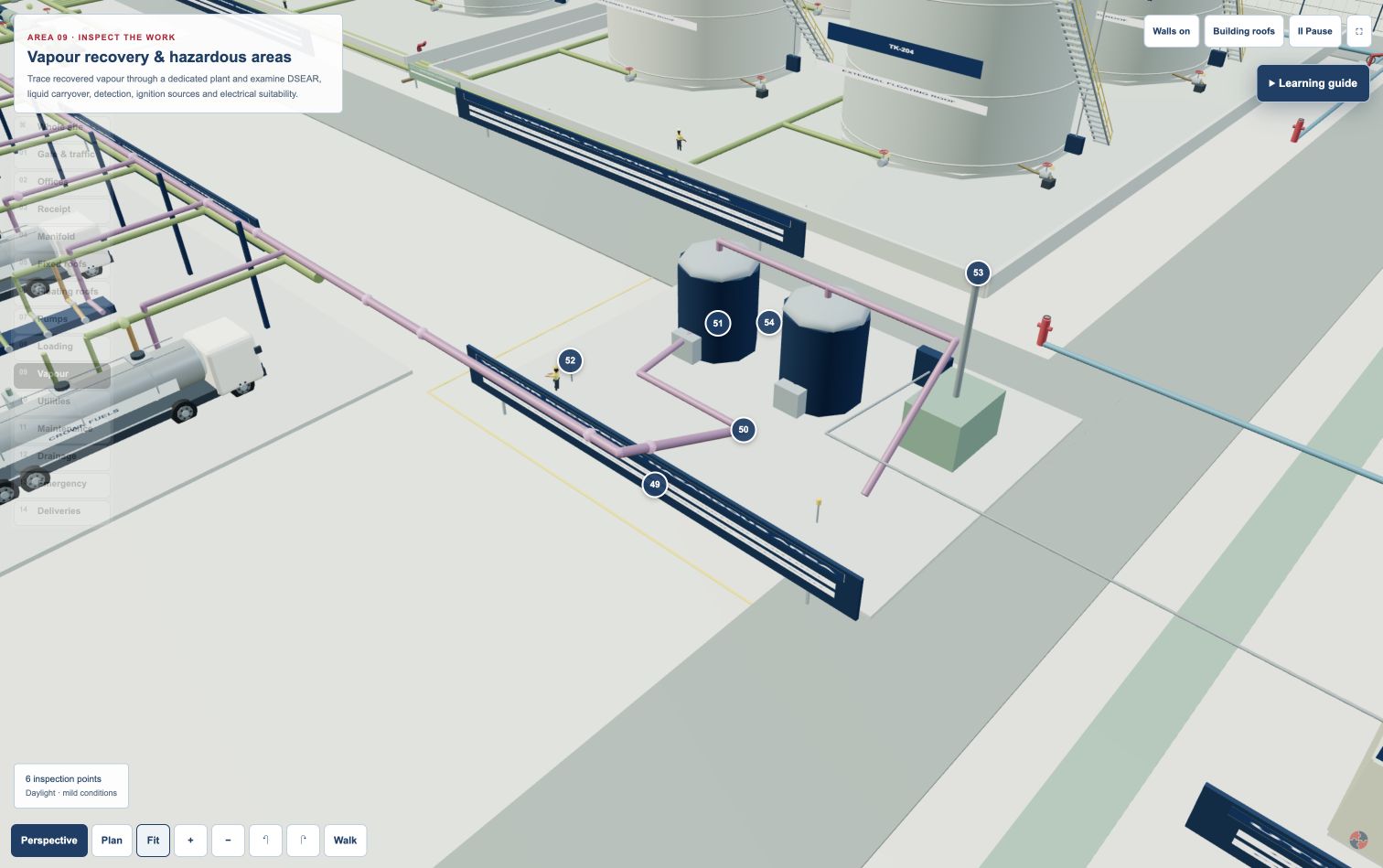
Work through 4 required applied activities and 3 model-practice pauses, with explanatory feedback and independent lesson decisions. Complete 6 distinct model mission sequences across those pauses. Use the actual fictional Crown Fuels model or its equivalent accessible route to complete the required decision sequences; launching the model alone does not complete practice.
The 20-question assessment requires at least 80% plus every designated critical safety answer. Complete the required activities, practice and lesson checks. Points and badges cannot offset a critical safety error.
Use the LMS for confirmed save/resume and recorded results. Any certificate follows its configured passed-completion and grade conditions.
Open the public interactive practice copy; public practice is separate from the LMS record.
Sources and learning provenance
Original fictional cases are paired with public SHAREhub teaching and structured topic records. Use the applicable jurisdiction and primary guidance for live work.
- HSE: DSEAR
- HSE: hazardous-area classification and ignition sources
- HSE: safe use and handling of flammable liquids, HSG140
- HSE: work-process fire safety
- HSE: active and passive fire protection
Topic sections, source identities and versions
| Public topic | Chunk and version | Jurisdiction and sources |
|---|---|---|
| flammability-limits-and-vapour-cloud-behaviour · cloud-formation | flammability-limits-and-vapour-cloud-behaviour--cloud-formation 20261016-letter-review-1 | Great Britain hse-comah-buncefield |
| electrical-hazards-in-process-plants · area-classification | electrical-hazards-in-process-plants--area-classification 2.2 | Great Britain, Northern Ireland hse-eci-explosive, hse-area-class, hse-explosive |
| management-of-change-in-process-safety · types | management-of-change-in-process-safety--types 2.0 | Great Britain, Northern Ireland hse-moc, hse-orgchange, hse-controls |
| fire-science-for-process-safety · technical-basics | fire-science-for-process-safety--technical-basics 20261016-letter-review-1 | Great Britain hse-fireandexplosion-about-htm, hse-safety-hazards-dustexplosion-htm, hse-books-hsg103-htm |
| electrical-hazards-in-process-plants · ex-equipment | electrical-hazards-in-process-plants--ex-equipment 2.2 | Great Britain, Northern Ireland hse-eci-explosive, hse-area-class, hse-explosive |
| flammability-limits-and-vapour-cloud-behaviour · dispersion | flammability-limits-and-vapour-cloud-behaviour--dispersion 20261016-letter-review-1 | Great Britain hse-fireandexplosion-dsear-background-htm |
| management-of-change-in-process-safety · harm-chain | management-of-change-in-process-safety--harm-chain 2.0 | Great Britain, Northern Ireland hse-flixborough, hse-moc |
| static-electricity-and-electrostatic-ignition · evidence-pack | static-electricity-and-electrostatic-ignition--evidence-pack | Great Britain static-electricity-and-electrostatic-ignition--earthing |
| active-fire-protection · design-basis | active-fire-protection--design-basis 20261016-letter-review-1 | Great Britain, Northern Ireland source-afp-technical, source-hsg176 |
| fire-science-for-process-safety · checks | fire-science-for-process-safety--checks 20261016-letter-review-1 | Great Britain hse-books-hsg103-htm, hse-fireandexplosion-dsear-background-htm |
| flammability-limits-and-vapour-cloud-behaviour · evidence | flammability-limits-and-vapour-cloud-behaviour--evidence 20261016-letter-review-1 | Great Britain, Northern Ireland hse-fireandexplosion-dsear-background-htm, hseni-publications-l138-dangerous-substances-and-explosive-atmospheres-gb-acop-approved-us |
Course SH-FUEL-07 · version 2026.10.20.1. .
Questions about this course
Is this training free?
Full public teaching and readers are free without an account. A free learner account is required for saved LMS progress and recorded assessment. Completion and any course-completion certificate depend on the configured LMS conditions.
How long should I allow?
Approximately 100–160 minutes, including teaching, lesson checks, required activities, model or accessible practice and one assessment attempt. Individual pace, review and retries vary. Save and resume in the LMS.
Can I learn without a 3D-capable browser?
Yes. The complete HTML reader provides the teaching. Required model practice has an equivalent accessible decision route in the interactive course. Use the LMS route for recorded learning.
What is required to pass?
Complete the required learning, activities, practice and lesson decisions. The 20-question final assessment requires at least 80% plus every designated critical safety answer. Points cannot compensate for a critical safety error. Follow the feedback before retrying.
Does this authorise fuel operations?
Flammable-fuel terminal and relevant delivery interfaces; hazardous-area classification, lightning design and firefighting remain competent specialist functions. This independent course does not award a NEBOSH qualification or replace competent task assessment, practical training or site authorisation.