SHARE Knowledge Hub
Fire science for process safety
Process-fire science follows a dangerous inventory through release, air mixing, ignition, fire or explosion, heat and smoke to people and adjacent plant. Solvent transfer and combustible-dust scenarios need different product data and engineered barriers, each with an owner, functional test and stop rule. GB DSEAR, qualifying COMAH and separate NI regimes sit alongside premises fire duties.
Understanding Fire science for process safety
Process-fire science follows a dangerous inventory through release, air mixing, ignition, fire or explosion, heat and smoke to people and adjacent plant. Solvent transfer and combustible-dust scenarios need different product data and engineered barriers, each with an owner, functional test and stop rule. GB DSEAR, qualifying COMAH and separate NI regimes sit alongside premises fire duties.
Why this matters at work
A liquid pool can produce sustained radiant heat; a pressurised burning release can create a directional jet; a flammable cloud can expose people over its extent; and ignition in congested or confined conditions can create damaging pressure. Combustible dust can involve deposits and secondary events. These are scenario descriptions, not a prediction that every release produces every outcome. Smoke, toxic decomposition and oxygen depletion can cause harm beyond the visibly burning area. Identify which outcomes are credible for the actual substance, state, release and surroundings. Check heat exposure of adjacent equipment, vulnerable supports, escape routes, occupied buildings and emergency systems. Prevention, containment, isolation and separation should be considered before reliance on response. Firewater and suppression design need suitable specialist input, including supply resilience and drainage or environmental consequences. Keep the assessment's boundaries explicit: a generic consequence sketch does not establish a safe distance, an acceptable occupancy or a firefighting tactic. Escalate uncertain high-consequence scenarios for competent technical assessment.
Decision point: Coating damaged; Evidence to retain: Exposure/function and condition review; Failure to avoid: Visible layer proves fire protection Decision point: Utility changed; Evidence to retain: Dependency and survivability basis; Failure to avoid: Protection assessed in isolation Decision point: Interim state; Evidence to retain: Authorised restrictions and owner; Failure to avoid: PPE justifies unreviewed operation Decision point: Repair completed; Evidence to retain: Verified technical handback; Failure to avoid: Work order is restart clearance.
How organisations manage this in practice
Use fire science to build a credible event sequence: what inventory can escape, in what state, at what rate, where it can travel, how it might ignite and who or what could be affected. A pool fire, pressurised jet, flash fire and explosion impose different demands on isolation, separation, detection and emergency protection. The fire triangle is a useful introduction but cannot specify a safe separation distance or validate a process design. Start by avoiding unnecessary inventory and release-prone work, then assess containment and suitable engineered controls. Record the scenario assumptions, operating envelope, barrier purpose, dependencies and evidence of performance. DSEAR addresses relevant physical safety risks in GB; COSHH addresses health exposure, and major-hazard duties may add requirements where applicable. Northern Ireland has its own legal route. Ask a competent process specialist to resolve release, dispersion or consequence questions outside the available evidence. A learning diagram or this answer cannot provide plant operating or restart permission.
Use current process and substance data, including mixtures and abnormal states. Check loss-of-containment locations, drainage, low areas, enclosures, nearby ignition sources and people. Confirm what ventilation can actually achieve in the credible release, including failure or obstruction. Changes in duty, solvent, pressure, batch size or enclosure need review before use. Retain calculations and assumptions with their technical owner and uncertainty. Do not extrapolate a laboratory flammability limit into a universal site threshold or treat a single atmospheric sample as evidence of the whole release field.
Decision point: Changed solvent; Evidence to retain: Actual material and current task facts; Failure to avoid: Old sheet treated as proof Decision point: Introduced ignition; Evidence to retain: Coordinated assessment and authority; Failure to avoid: Permit treated as complete barrier Decision point: Required function; Evidence to retain: Evidence and restriction owner; Failure to avoid: PPE substituted for prevention Decision point: Handback; Evidence to retain: Verified state and updated information; Failure to avoid: Routine schedule treated as permission.
How should fire science support process safety barrier decisions?
Fire science should be translated into credible scenarios, barriers, escalation controls and emergency response evidence.
| Control point | Expert detail | Evidence |
|---|---|---|
| Cause | Loss of containment, ignition, runaway reaction, static or hot surface. | Scenario register. |
| Top event | Ignited release, pool fire, jet fire, flash fire or vapour cloud explosion. | Bow-tie or LOPA record. |
| Consequence | Escalation, overpressure, burns, toxic smoke or domino effects. | Major accident risk assessment. |
| Prevention barrier | Containment, isolation, inerting, grounding, ignition control. | Barrier performance standard. |
| Mitigation barrier | Detection, shutdown, deluge, foam, firewater, emergency response. | Proof tests and impairment logs. |
| ALARP record | Risk reduction decisions are documented and reviewed. | ALARP decision file. |
Updated 2026-10-02.
Whether a detector, isolation or shutdown function prevents escalation or limits consequences depends on its scenario and timing. Credit only a function with a defined performance requirement, full-loop test and demonstrated independence from other credited barriers; a component label does not establish a LOPA reduction factor. Detailed calculations and design remain held for specialist review.
How can I practise this topic in 3D?
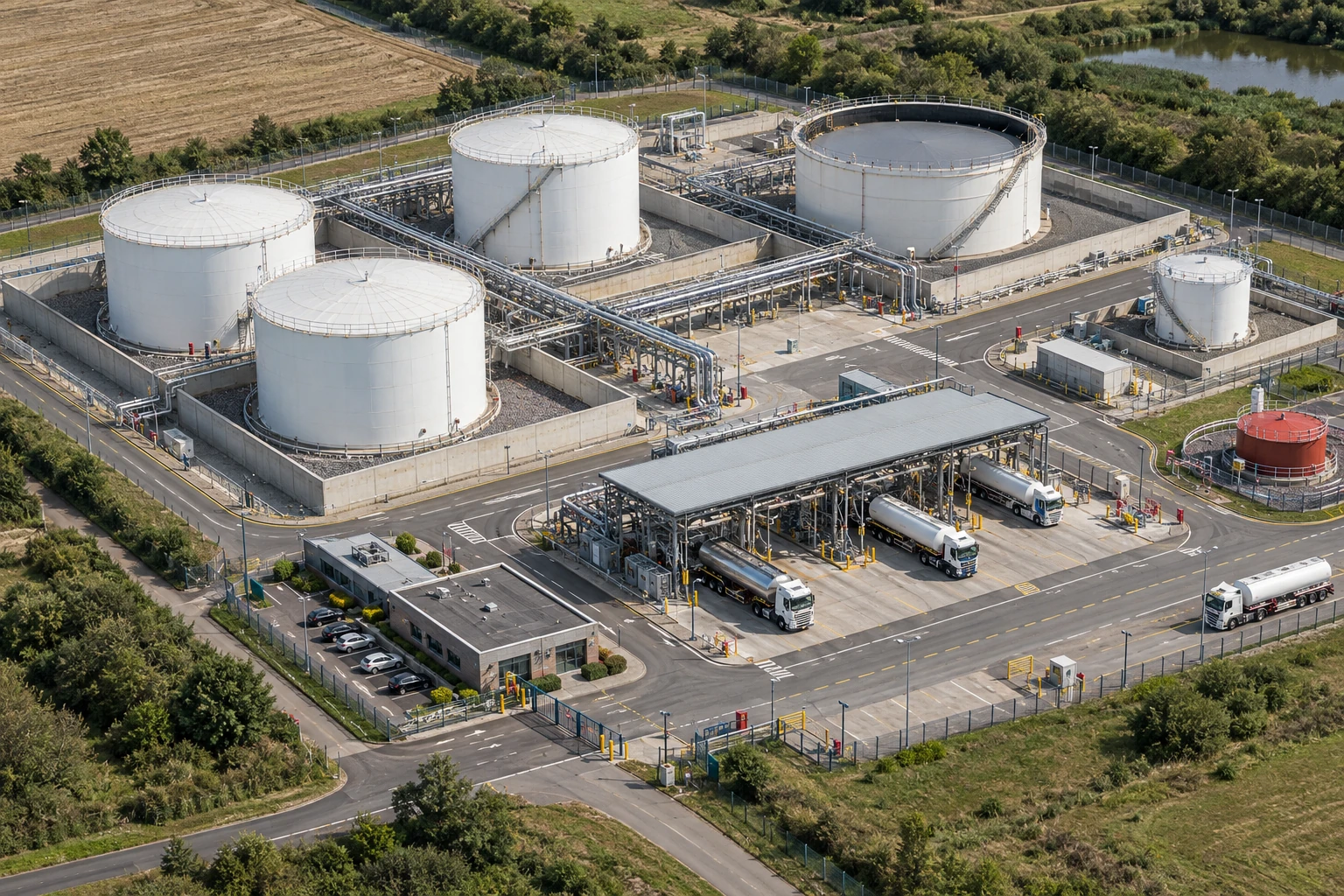

A low-level release is judged only by what can be seen
All related inspection points 3 across 1 location
Crown Fuels terminal 3 inspection points
Practice in the SHAREhub environment. Browser practice is separate from workplace competence and formal learning records.
Compare the release before selecting the process-fire barriers
A solvent-transfer hose failure and a combustible-dust release both create fire scenarios, but not the same material behaviour or barriers. Identify the inventory, physical form, credible release, mixing, ignition and possible escalation to adjacent equipment. Use current product and process evidence; do not transfer a detector, layout or extinguishing prescription from one scenario to the other.
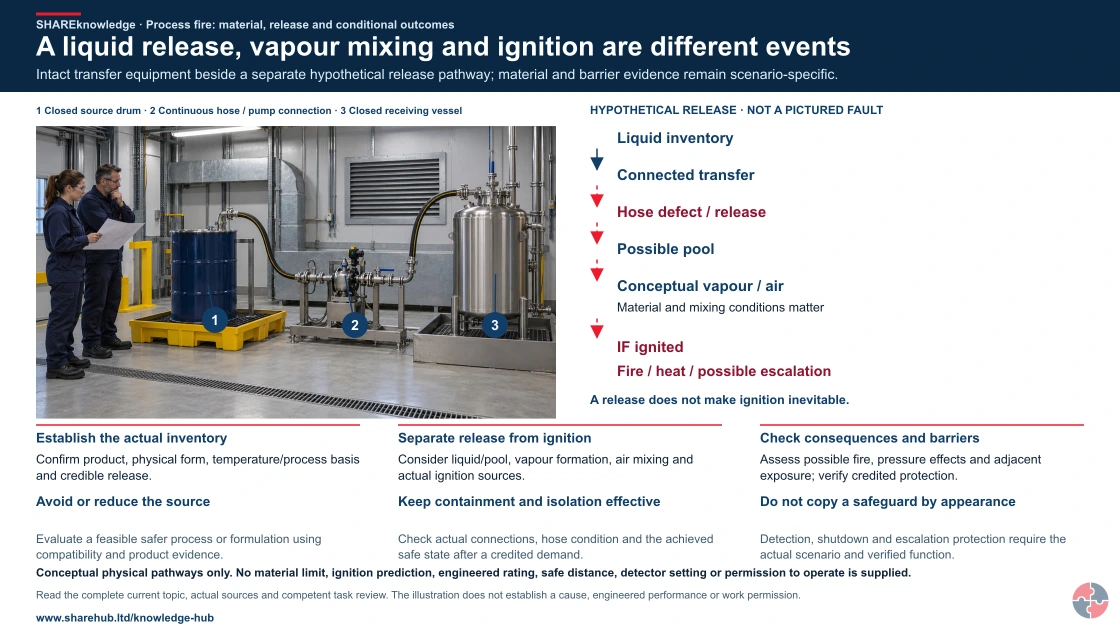
A liquid release, vapour mixing and ignition are different events
Full written explanation
An illustrative inactive transfer scene shows a closed source drum, continuous hose and pump connection, and closed receiving vessel. Picture key: 1 Closed source drum · 2 Continuous hose / pump connection · 3 Closed receiving vessel. A separate hypothetical explanation reads Liquid inventory → Connected transfer → Hose defect / release → Possible pool → Conceptual vapour / air, with Material and mixing conditions matter before IF ignited → Fire / heat / possible escalation. A release does not make ignition inevitable. The hypothetical defect and outcomes are outside the intact scene;they do not diagnose its hose or show a photographed loss, pool, vapour, flame or smoke. Three inventory/release/consequence questions sit with their matching source, containment/isolation and credited-protection checks. The scene establishes no product, operating state, flow, ventilation, containment, isolation, engineered performance or permission. Material-specific and specialist evidence remains necessary.
Intact transfer equipment beside a separate hypothetical release pathway; material and barrier evidence remain scenario-specific.
- Establish the actual inventory. Confirm product, physical form, temperature/process basis and credible release.
- Separate release from ignition. Consider liquid/pool, vapour formation, air mixing and actual ignition sources.
- Check consequences and barriers. Assess possible fire, pressure effects and adjacent exposure; verify credited protection.
Change the pathway
- Avoid or reduce the source. Evaluate a feasible safer process or formulation using compatibility and product evidence.
- Keep containment and isolation effective. Check actual connections, hose condition and the achieved safe state after a credited demand.
- Do not copy a safeguard by appearance. Detection, shutdown and escalation protection require the actual scenario and verified function.
Evidence check: Conceptual physical pathways only. No material limit, ignition prediction, engineered rating, safe distance, detector setting or permission to operate is supplied.
Read the inventory-specific process scenario and keep the existing interactive fire model
Primary references: HSE: DSEAR source-control context · HSE: process-fire precautions · HSE: food-industry dust-explosion scope
Open the complete HD image (new tab)Download image

Read the inventory-specific process scenario and keep the existing interactive fire model
Primary references: HSE: DSEAR source-control context · HSE: process-fire precautions · HSE: food-industry dust-explosion scope
Follow the transfer chain from avoiding or reducing the inventory through compatible containment, release detection, effective isolation and protection of exposed inventory. A damaged hose, changed product or failed dust collector changes the release basis and can require the operation to stop. Detection and emergency response mitigate parts of a scenario; they cannot justify an uncontrolled release.
Crownway: a hose failure threatens adjacent stock
Illustrative example. Solvent escapes from a transfer hose and may reach an ignition source or expose nearby inventory if ignited.
Decision. The process owner holds transfer, secures the assessed safe state and checks prevention, isolation and escalation barriers with competent support.
Evidence to check. Actual product data, hose compatibility/condition, release pathways, functioning detection/isolation and protection of exposed inventory.
Hold or escalation point. Do not restart after a product change or collector failure before its release and barrier implications are assessed.
Follow-up. Verify the repaired system and revise inventory, maintenance and change controls from the failure learning.
Release form changes the fire scenario
A pool, a pressurised release and an unignited drifting mixture present different questions. A conceptual plant image cannot supply design distances or emergency tactics.

Identify release form
Consider the actual substance, pressure, containment and process conditions through the scenario assessment.
Prevent loss of containment
Examine compatible containment, integrity, process control and change management first.
Check protective functions
Identify detection, isolation and escalation protection with their dependencies and verification evidence.
Keep limits visible
Treat component markers as identifiers and illustrative pathways as hypotheses; use the assessed emergency response, not a generic fire-size or distance prediction.
Read the complete task-specific control examples
ERICPD is a planning cross-map: Discipline verifies and sustains every control. ESEAP compares effectiveness. A label does not authorise the task; retain the owner, evidence and stop or change decision.
Fire science for process safety · ERICPD
- Eliminate
- Remove the transfer by using a pre-mixed product or process redesign where product performance permits.
- Reduce
- Select a technically suitable less volatile or non-flammable formulation and minimise transfer quantity; test quality, compatibility and downstream hazards.
- Isolate
- Use compatible closed transfer, containment, local ventilation, earthing/bonding where indicated, suitable electrical equipment, detection and emergency isolation.
- Control
- Define operating envelope, connection check, shift monitoring, permit for maintenance, isolation and emergency evacuation actions.
- PPE
- Choose chemical and flame protection for authorised spill-response tasks from the substance assessment; PPE cannot make a flammable atmosphere safe.
- Discipline
- Trend small leaks and overrides, inspect the hose history and revalidate barrier independence after modifications.
Fire science for process safety · ESEAP
- Elimination
- Remove the transfer by using a pre-mixed product or process redesign where product performance permits.
- Substitution
- Select a technically suitable less volatile or non-flammable formulation and minimise transfer quantity; test quality, compatibility and downstream hazards.
- Engineering controls
- Use compatible closed transfer, containment, local ventilation, earthing/bonding where indicated, suitable electrical equipment, detection and emergency isolation.
- Administrative controls
- Define operating envelope, connection check, shift monitoring, permit for maintenance, isolation and emergency evacuation actions.
- PPE
- Choose chemical and flame protection for authorised spill-response tasks from the substance assessment; PPE cannot make a flammable atmosphere safe.
What process-fire science changes the decision?
A credible process-fire case starts with inventory and release, then asks where fuel meets air and ignition, how the event grows, which people or plant are exposed, and which independent barriers interrupt it.
Fire triangle or tetrahedron language helps identify fuel, oxygen, heat and sustained reaction, but it does not predict consequences by itself. Release rate, confinement, congestion, weather, drainage, exposure and inventory determine whether a leak becomes a flash fire, pool fire, jet fire, vapour-cloud explosion or escalation. Record the assumed case and its limits before selecting safeguards.
This page addresses work-process fire and explosion hazards. A premises fire risk assessment must still consider the resulting warning and escape, while DSEAR and, only where threshold inventories bring a site into scope, COMAH add separate process duties. Northern Ireland uses its own corresponding instruments.
HSE explains dangerous substances and ignition; work-process precautions; COMAH 2015 scope for qualifying GB establishments.
How do fuel, ignition and heat create different fire events?
A liquid leak is not itself a vapour-cloud explosion: it needs sufficient flammable vapour mixed with air, ignition, and conditions that allow rapid pressure development.
Flash point describes the test temperature at which a liquid gives off enough vapour for momentary ignition; it is not an ignition temperature or a safe-use temperature. Autoignition concerns ignition without a separate spark or flame under defined conditions. Flammable limits describe an ignitable gas or vapour mixture in air; do not apply a vapour LEL/UEL number to a dust cloud. Vapour density and ventilation affect where a release may travel. Use product-specific safety data and competent testing, not a generic number.
Heat moves by conduction through materials, convection with hot gases and radiation across space. In a process area, radiation from a pool or jet fire can heat nearby vessels, while hot smoke can defeat a protected route and combustion products can cause toxic exposure. Ask whether detection and isolation act before the assumed escalation; do not invent a safe exposure time.
Combustible dust has its own cloud ignition and pressure problem. An initial event in a collector can disturb layers of settled dust and create a larger secondary explosion. Dust identity, particle size, moisture, confinement and actual process conditions need specialist assessment; there is no universal safe dust layer or vent size.
Read HSE dangerous-substance explanations for liquid vapour, gases and dust; HSE food-industry dust guidance for secondary-explosion prevention, and HSG103 for specialist dust prevention and mitigation.
How can interactive fire-science examples clarify workplace controls?
Compare six original visual lessons on combustion, fuel properties, local mixtures, static charge, hot fragments and compartment heat feedback. Each connects a different mechanism to the evidence needed for effective controls.

Explore the six fire-science pilot lessons
Original 3D geometry, matching stills, eight explanations and four illustrative states. Scientific and editorial review pending; no process prediction or work authorisation.
Which scenario and barrier details must an engineer establish?
Specify the actual substance and physical state, temperature, pressure, release and ignition scenarios before crediting detection, isolation, ventilation, drainage or explosion protection.
For a solvent transfer, obtain the safety data sheet, transfer inventory, hose and coupling design, overfill route, likely vapour path, ignition sources and occupied positions. A vapour detector only helps if placement, alarm response, final isolation element and safe state are designed and tested for that release; the emergency plan must protect people if isolation fails.
For a flour mill, obtain material test data and dust extraction design, then inspect deposits, likely primary ignition, connected duct paths and collector siting. Explosion venting, suppression or isolation needs a competent design based on the actual equipment and a safe discharge direction; a generic housekeeping procedure cannot replace it.
The control sequence follows HSE DSEAR priorities; HSE flammable-liquid storage guidance; and HSE dust-explosion guidance.
How can the hierarchy of controls guide control of process-fire hazards?
Use ERICPD and the five-level HSE hierarchy as related decision aids. Begin with removal and substitution, then verify engineered barriers before relying on procedures or PPE.
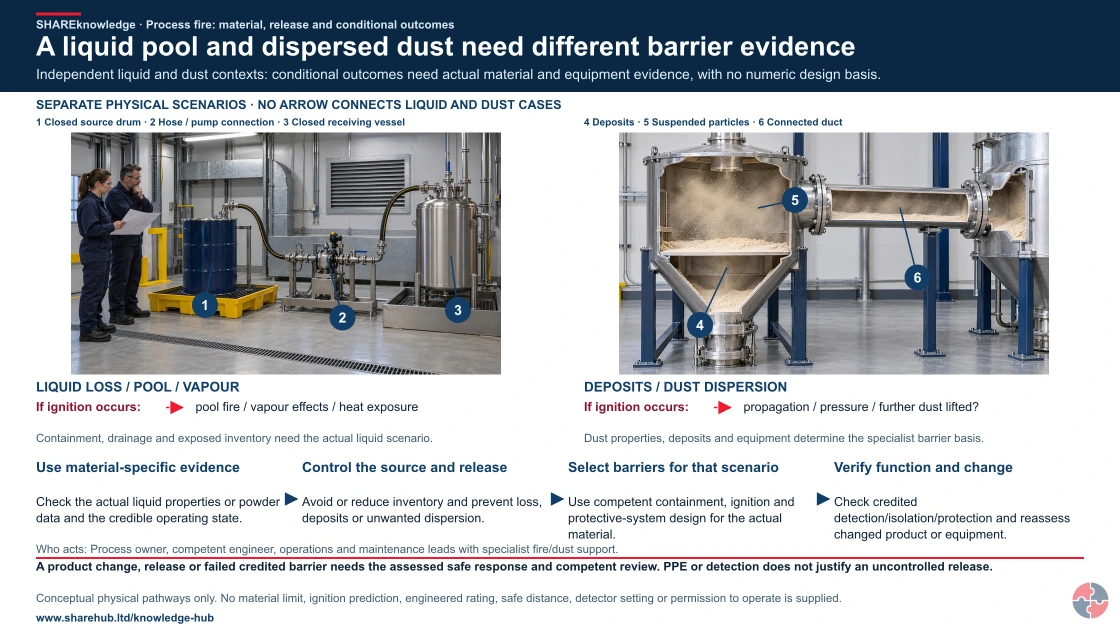
A liquid pool and dispersed dust need different barrier evidence
Full written explanation
Two separate illustrative physical contexts compare liquid transfer equipment with a connected powder-equipment cutaway. Picture key: 1 Closed source drum · 2 Continuous hose / pump connection · 3 Closed receiving vessel · 4 Deposits · 5 Suspended particles · 6 Connected duct. The liquid scenario distinguishes liquid loss, pool and vapour;IF ignition occurs, pool fire, vapour effects and heat exposure depend on the actual liquid scenario. The dust scenario distinguishes deposits and dispersion;IF ignition occurs, propagation, pressure and further dust lifted remain conditional questions requiring the actual dust properties, deposits and equipment. No arrow connects the liquid and dust scenarios. The intact liquid scene shows no release or operating state;the powder cutaway supplies no substance identity, concentration, flow or engineered rating. Four separate unnumbered checks progress from actual material evidence to source/release control, scenario-specific barriers and verified function/change. No test limit, detector setting, relief size, isolation rating, extinguishing action or permission to operate is supplied.
Independent liquid and dust contexts: conditional outcomes need actual material and equipment evidence, with no numeric design basis.
- Use material-specific evidence. Check the actual liquid properties or powder data and the credible operating state.
- Control the source and release. Avoid or reduce inventory and prevent loss, deposits or unwanted dispersion.
- Select barriers for that scenario. Use competent containment, ignition and protective-system design for the actual material.
- Verify function and change. Check credited detection/isolation/protection and reassess changed product or equipment.
When the evidence does not fit: A product change, release or failed credited barrier needs the assessed safe response and competent review. PPE or detection does not justify an uncontrolled release.
Who acts: Process owner, competent engineer, operations and maintenance leads with specialist fire/dust support.
Changed workplace
Solvent transfer: Distinguish liquid loss, vapour/mixing, ignition and possible exposure of adjacent inventory.
Combustible powder: Assess deposits, dispersion, ignition and propagation using the actual dust and equipment.
Evidence check: Conceptual physical pathways only. No material limit, ignition prediction, engineered rating, safe distance, detector setting or permission to operate is supplied.
Read the inventory-specific process scenario and keep the existing interactive fire model
Primary references: HSE: DSEAR source-control context · HSE: process-fire precautions · HSE: food-industry dust-explosion scope
Open the complete HD image (new tab)Download image

Read the inventory-specific process scenario and keep the existing interactive fire model
Primary references: HSE: DSEAR source-control context · HSE: process-fire precautions · HSE: food-industry dust-explosion scope
Task matrices are illustrations; premises-specific suitability, implementation and specialist design approval remain held for competent review.
A hose failure releases solvent vapour; delayed ignition can create a flash fire or, if congested/constrained, an explosion and escalation to nearby inventory.
A primary ignition in a collector can disperse settled flour dust, causing a larger secondary explosion and burn/overpressure harm.
How can the ERICPD hierarchy of controls guide control of process-fire hazards?

| Hazard and harm route | ERICPD → five-level control | Task measure and feasibility | Owner, test and evidence | Failure and stop decision |
|---|---|---|---|---|
| Flammable-liquid transfer at a mixing plant | Eliminate → Elimination | Remove the transfer by using a pre-mixed product or process redesign where product performance permits. Source: official guidance. | Process engineer validates recipe and inventory; do not introduce solvent until design approval. | Product redesign is unvalidated: do not introduce solvent on the assumed safer basis. |
| Same scenario | Reduce → Substitution | Select a technically suitable less volatile or non-flammable formulation and minimise transfer quantity; test quality, compatibility and downstream hazards. Source: official guidance. | Chemist and operations owner approve change; reject an unverified flashpoint assumption. | Alternative formulation lacks compatibility or fire-property data: reject substitution. |
| Same scenario | Isolate → Engineering | Use compatible closed transfer, containment, local ventilation, earthing/bonding where indicated, suitable electrical equipment, detection and emergency isolation. Source: official guidance. | Engineer commissions seals, ventilation and instrumented functions to the design basis; stop if leak or credited barrier is impaired. | Hose, extraction, detection or isolation function is impaired: stop transfer and secure the plant. |
| Same scenario | Control → Administrative | Define operating envelope, connection check, shift monitoring, permit for maintenance, isolation and emergency evacuation actions. Source: official guidance. | Supervisor samples the transfer and alarm response; stop on smell, leak, abnormal pressure or unknown classification. | Leak, smell, abnormal pressure or unknown classified area: stop pump, isolate as trained and withdraw. |
| Same scenario | PPE → PPE | Choose chemical and flame protection for authorised spill-response tasks from the substance assessment; PPE cannot make a flammable atmosphere safe. Source: official guidance. | EHS lead checks compatibility, fit, condition and replacement; withdraw for unassessed release. | Flammable atmosphere remains credible despite PPE: prohibit entry and escalate. |
| Same scenario | Discipline → Administrative assurance | Trend small leaks and overrides, inspect the hose history and revalidate barrier independence after modifications. Source: official guidance. | Asset owner reviews tests and deferrals; suspend transfer if safety-critical evidence is overdue. | Overdue test, recurring leak or unreviewed override: suspend transfer until barrier health is proven. |
| Combustible flour dust in a milling line | Eliminate → Elimination | Use a process that avoids generating dispersible dust where the product and design allow; prevent exposed manual transfer where feasible. Source: official guidance. | Process designer verifies throughput and dust generation before approval. | Dust-free design lacks process validation: do not commission on the assumed elimination. |
| Same scenario | Reduce → Substitution | Choose a less dusty form or closed feed where compatible, and reduce dust inventory in ducts and rooms; do not assume all powders behave alike. Source: official guidance. | Engineer checks test data and revised dust hazard study. | Alternative product still generates hazardous dust: repeat dust study before start. |
| Same scenario | Isolate → Engineering | Enclose extraction and collectors; control ignition and specify explosion relief/isolation or containment for the actual dust and equipment, venting to a safe location. Source: official guidance. | Specialist verifies material data, vent design, installation and inspection; stop on failed extraction or isolation. | Extraction or explosion isolation fails: stop mill and keep people clear. |
| Same scenario | Control → Administrative | Apply validated cleaning that does not disperse dust, control hot work and inspect accumulations including concealed surfaces. Source: official guidance. | Milling supervisor logs condition and investigates recurring deposits; stop on uncontrolled dust cloud or ignition source. | Visible dust cloud, deposits beyond site limit or ignition source: stop and clean safely. |
| Same scenario | PPE → PPE | Task respiratory or protective clothing may address routine dust exposure, but cannot substitute for explosion prevention or mitigation. Source: official guidance. | Occupational-hygiene lead specifies fit and maintenance from separate exposure assessment. | PPE is being credited against blast harm: reject control case and engineer protection. |
| Same scenario | Discipline → Administrative assurance | Trend filter faults, dust deposits and near misses; test credited barriers and reassess after product or collector change. Source: official guidance. | Asset owner signs evidence review and suspends use for degraded safety-critical protection. | Degraded collector protection or recurring deposits: suspend use pending competent review. |
How can the ISO 45001 hierarchy of controls guide control of process-fire hazards?

| Hazard and harm route | ERICPD → five-level control | Task measure and feasibility | Owner, test and evidence | Failure and stop decision |
|---|---|---|---|---|
| Flammable-liquid transfer at a mixing plant | Eliminate → Elimination | Remove the transfer by using a pre-mixed product or process redesign where product performance permits. Source: official guidance. | Process engineer validates recipe and inventory; do not introduce solvent until design approval. | Product redesign is unvalidated: do not introduce solvent on the assumed safer basis. |
| Same scenario | Reduce → Substitution | Select a technically suitable less volatile or non-flammable formulation and minimise transfer quantity; test quality, compatibility and downstream hazards. Source: official guidance. | Chemist and operations owner approve change; reject an unverified flashpoint assumption. | Alternative formulation lacks compatibility or fire-property data: reject substitution. |
| Same scenario | Isolate → Engineering | Use compatible closed transfer, containment, local ventilation, earthing/bonding where indicated, suitable electrical equipment, detection and emergency isolation. Source: official guidance. | Engineer commissions seals, ventilation and instrumented functions to the design basis; stop if leak or credited barrier is impaired. | Hose, extraction, detection or isolation function is impaired: stop transfer and secure the plant. |
| Same scenario | Control → Administrative | Define operating envelope, connection check, shift monitoring, permit for maintenance, isolation and emergency evacuation actions. Source: official guidance. | Supervisor samples the transfer and alarm response; stop on smell, leak, abnormal pressure or unknown classification. | Leak, smell, abnormal pressure or unknown classified area: stop pump, isolate as trained and withdraw. |
| Same scenario | PPE → PPE | Choose chemical and flame protection for authorised spill-response tasks from the substance assessment; PPE cannot make a flammable atmosphere safe. Source: official guidance. | EHS lead checks compatibility, fit, condition and replacement; withdraw for unassessed release. | Flammable atmosphere remains credible despite PPE: prohibit entry and escalate. |
| Same scenario | Discipline → Administrative assurance | Trend small leaks and overrides, inspect the hose history and revalidate barrier independence after modifications. Source: official guidance. | Asset owner reviews tests and deferrals; suspend transfer if safety-critical evidence is overdue. | Overdue test, recurring leak or unreviewed override: suspend transfer until barrier health is proven. |
| Combustible flour dust in a milling line | Eliminate → Elimination | Use a process that avoids generating dispersible dust where the product and design allow; prevent exposed manual transfer where feasible. Source: official guidance. | Process designer verifies throughput and dust generation before approval. | Dust-free design lacks process validation: do not commission on the assumed elimination. |
| Same scenario | Reduce → Substitution | Choose a less dusty form or closed feed where compatible, and reduce dust inventory in ducts and rooms; do not assume all powders behave alike. Source: official guidance. | Engineer checks test data and revised dust hazard study. | Alternative product still generates hazardous dust: repeat dust study before start. |
| Same scenario | Isolate → Engineering | Enclose extraction and collectors; control ignition and specify explosion relief/isolation or containment for the actual dust and equipment, venting to a safe location. Source: official guidance. | Specialist verifies material data, vent design, installation and inspection; stop on failed extraction or isolation. | Extraction or explosion isolation fails: stop mill and keep people clear. |
| Same scenario | Control → Administrative | Apply validated cleaning that does not disperse dust, control hot work and inspect accumulations including concealed surfaces. Source: official guidance. | Milling supervisor logs condition and investigates recurring deposits; stop on uncontrolled dust cloud or ignition source. | Visible dust cloud, deposits beyond site limit or ignition source: stop and clean safely. |
| Same scenario | PPE → PPE | Task respiratory or protective clothing may address routine dust exposure, but cannot substitute for explosion prevention or mitigation. Source: official guidance. | Occupational-hygiene lead specifies fit and maintenance from separate exposure assessment. | PPE is being credited against blast harm: reject control case and engineer protection. |
| Same scenario | Discipline → Administrative assurance | Trend filter faults, dust deposits and near misses; test credited barriers and reassess after product or collector change. Source: official guidance. | Asset owner signs evidence review and suspends use for degraded safety-critical protection. | Degraded collector protection or recurring deposits: suspend use pending competent review. |
At a tank farm, pool-fire drainage and radiant escalation replace the flour-dust secondary explosion route; at a hydrogen filling operation, gas dispersion and high-pressure release need a different design basis. A competent engineer must reselect and verify barriers instead of copying a table.
Where can the process-fire assumptions fail?
The most dangerous drift is a credited barrier that exists on a drawing but does not work during the release being assessed.
A detector can be poorly positioned, overridden or untested; an isolation valve can fail to close; ventilation can send vapour toward ignition; an explosion vent can discharge toward people; a dust collector can be connected to the building without suitable isolation. Check the full function and common-cause dependence, not a component label.
A small leak, recurring high-level alarm, temporary bypass or growing dust deposit should trigger a scenario review. If the release or accumulation cannot be bounded, stop the transfer or mill, secure the area and escalate to a competent process-safety authority.
HSE identifies prevention and mitigation priorities and dust explosion controls relevant to these failures.
Which process and premises fire duties apply by jurisdiction?
GB DSEAR controls work-process dangerous-substance risk; the E&W Fire Safety Order and Scottish premises law address general fire precautions. NI uses corresponding but distinct process and premises regulations. COMAH applies only to establishments meeting its qualifying inventory criteria.
Identify the establishment, substance inventory and enforcing authority before using an article or notice. HSE or a local authority generally enforces GB process precautions, while the relevant fire authority generally enforces premises precautions. One hazard can affect both assessments, but their legal routes are not interchangeable.
| Jurisdiction | Duty or regulation | Why it matters | What good management should show |
|---|---|---|---|
| E&W | Fire Safety Order 2005 | E&W general fire precautions, assessment, warning and escape. | Full FRA, plan and working premises barriers. |
| Scotland | Fire (Scotland) Act 2005 | Scottish non-domestic fire framework. | Premises assessment and effective fire precautions. |
| NI | Fire and Rescue Services (NI) Order 2006 | NI premises fire framework and appropriate-person route. | NI assessment, warning and escape evidence. |
| GB | DSEAR 2002 | GB dangerous-substance work-risk controls and emergencies. | Release, ignition, mitigation and training evidence. |
| NI | DSEAR (NI) 2003 | Separate NI work-process dangerous-substance route. | NI release and explosion assessment and controls. |
| GB | COMAH Regulations 2015 | GB major-accident duties only where qualifying thresholds apply. | Operator inventory and major-accident prevention evidence. |
| NI | COMAH Regulations (NI) 2015 | Separate NI major-accident regime at qualifying establishments. | NI operator inventory and major-accident prevention evidence. |
See HSE process-fire guidance for the GB boundary; HSE COMAH 2015 guidance for thresholds and operator duties, and HSENI COMAH guidance for Northern Ireland.
What evidence proves the fire barriers still work?
Trace one credible scenario from its current inventory and release model to the installed barrier, its owner, performance requirement, field test and stop rule.
For solvent transfer, sample actual hose and coupling condition, earthing or bonding design where relevant, ventilation checks, detector-to-valve tests, bypass logs and operator response. For dust, sample deposits, extraction performance, ignition controls, collector inspection and any designed vent or isolation evidence. The review must include abnormal operation, maintenance and modification, not only a normal shift.
If a credited barrier is unavailable, the owner must choose a documented safe state or restriction, not merely record an overdue action. A repeat defect should change the design, maintenance or operating plan before restart.
What should the risk or assurance register include for fire science for process safety?
The register should describe credible events, the controls relied on and the evidence that proves those controls are alive.
| Event or issue | Risk route | Preventing controls | Response or mitigation | Evidence to check |
|---|---|---|---|---|
| Fire science for process safety not identified in real work | People, plant or operations are exposed because the assessment does not reflect the task, environment or people affected. | Task-specific risk assessment, worker involvement, competent review and clear ownership. | Pause the work, reassess the activity, brief affected people and close immediate gaps. | Risk assessment, briefing records, supervisor checks and action close-out. |
| Controls degrade or are bypassed | Controls that were suitable become ineffective through wear, change, pressure, poor maintenance or normalisation of shortcuts. | Inspection, maintenance, monitoring, stop-work authority, defect reporting and management review. | Escalate defects, apply temporary controls, investigate recurrence and check similar areas. | Inspection findings, maintenance records, defect logs, audit results and management review. |
| Weak competence or communication | Workers, supervisors or contractors do not understand the risk, limits, controls or escalation route. | Role-based training, authorisation where needed, supervision, contractor control and refresher triggers. | Re-brief the team, stop unsafe work and update competence records or supervision plans. | Training matrix, authorisations, toolbox talks, observation records and incident learning. |
How would a solvent-transfer incident be prevented and contained?
Crownway Coatings transfers a flammable solvent from a delivery container to a mixing vessel. A damaged hose releases liquid into a bund; vapour can travel to an ignition source. If ignited, a flash or pool fire can burn the operator, radiate heat to adjacent inventory and send smoke across the evacuation route. These are scenario possibilities, not a prediction for a particular product or site.
Before the transfer, the process engineer checks whether a pre-mixed product removes the task, then whether a lower-risk formulation and smaller quantity are technically suitable. If transfer remains necessary, the engineer specifies compatible closed connections, containment, ventilation, ignition control and any detection-to-isolation function against the actual substance data. The operations manager verifies installation and the operator performs a witnessed connection check.
During transfer, a leak, unexplained alarm or failed extraction stops the pump and triggers the site isolation and withdrawal plan; staff do not improvise a spill response through vapour. The emergency lead accounts for people and shares inventory and shutoff information with responders. After repair, a competent person tests the full barrier function, reviews the release cause, updates DSEAR and the premises fire assessment, and signs hand-back before restart.
The DSEAR priority order and HSE liquid-vapour explanation support the scenario; actual specifications require site-specific engineering.
How can fuel storage help explain fire science for process safety?
Compare the fuel properties with storage and transfer conditions. Keep the physical behaviour of the fuel distinct from the protective controls and any separately assessed consequences.
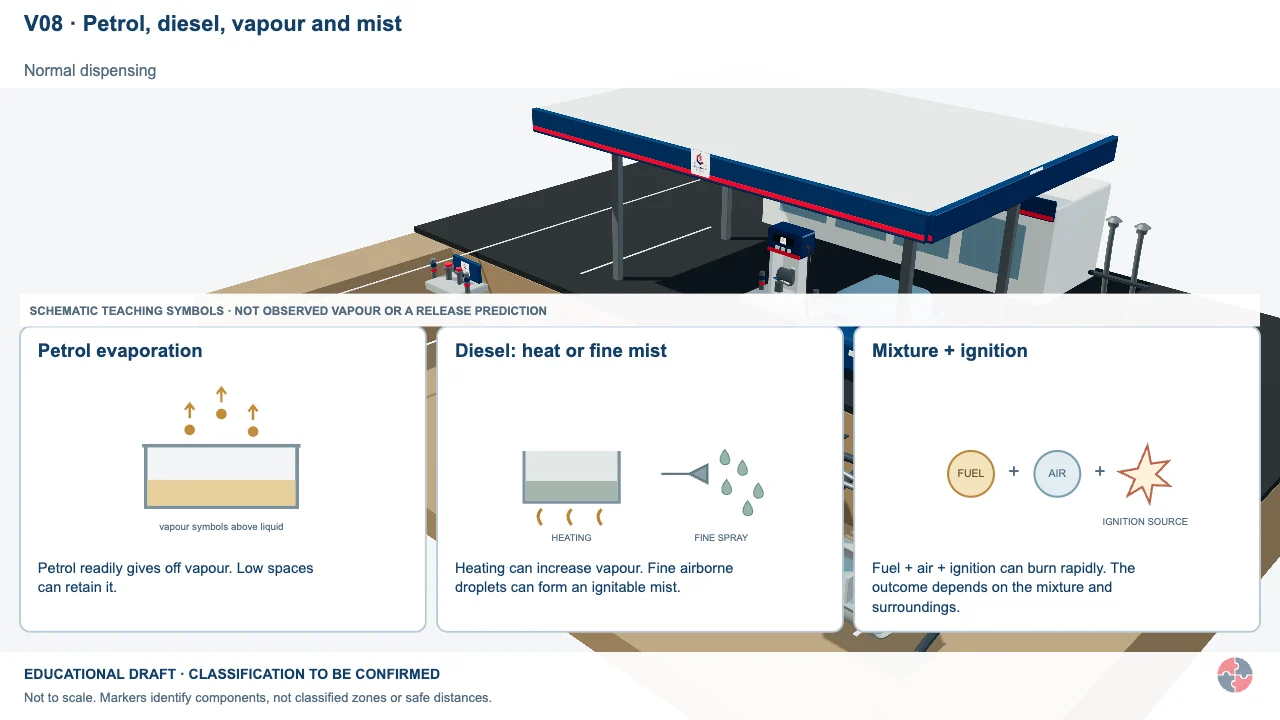
Petrol, diesel, vapour and mist
Compare petrol evaporation, diesel conditions and fine droplets. Petrol carried into a separator can remain a vapour source after the visible forecourt spill has passed.
Activity focus: Identify the actual product and release mechanism. For drainage, ask whether petrol could reach or remain in the separator; for refuelling, confirm the stated Stage II recovery arrangement.
Contextual illustration. The image alone does not establish equipment state, effective controls, individual health or authorisation; use the task-specific checks and competent evidence.
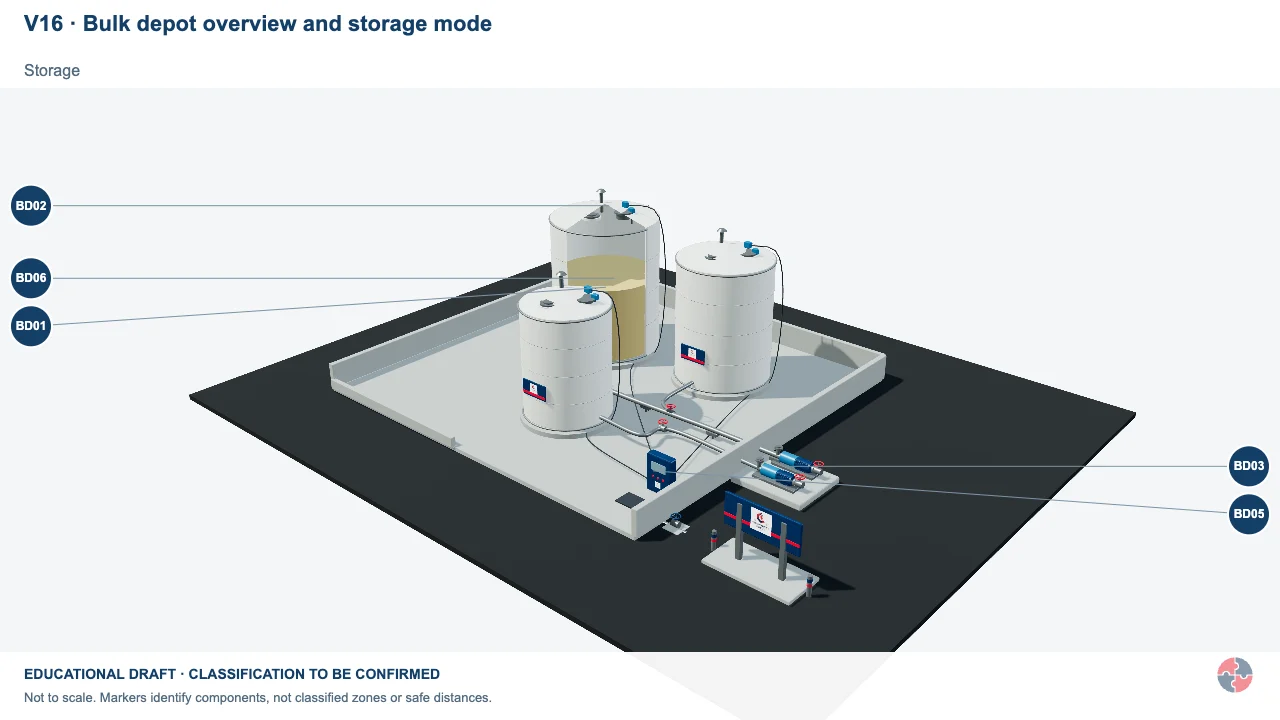
Bulk depot overview and storage mode
Explore the bulk depot system and compare selectable Zone 0, Zone 1 and Zone 2 teaching volumes around its petrol example.
Activity focus: Use cutaway for the internal vapour spaces, then compare the rounded vent, pump and mode-dependent connection envelopes.
Contextual illustration. The image alone does not establish equipment state, effective controls, individual health or authorisation; use the task-specific checks and competent evidence.
Educational illustration, not to scale. Coloured zones are teaching examples, not a site-specific hazardous-area classification.
Who must demonstrate process-fire competence?
Test each role against a real release, impaired barrier or restart decision, not attendance alone.
| Role | Learning to test | Competence demonstration | Assessor and record | Reassessment trigger |
|---|---|---|---|---|
| Operators | Identify actual solvent/dust hazard and stop on leak, dust cloud or barrier fault. | Demonstrate shutdown and withdrawal on a scenario. | Shift supervisor witnesses and records. | Product, alarm or task change. |
| Maintainers and contractors | Protect isolation, ignition and safety-critical equipment during work. | Show permit, isolation, bypass control and functional hand-back. | Maintenance lead and process owner sign test. | Repair or temporary modification. |
| Process engineers | Define substance data, credible events and barrier performance. | Review release/dust scenario and test basis. | Independent technical authority approves design. | Inventory, process or layout change. |
| Emergency leaders | Protect people, communicate inventory and safe isolation, coordinate responders. | Rehearse release-to-fire escalation and withdrawal. | Site dutyholder records exercise and actions. | Plan or response-resource change. |
| Operators and dutyholders at COMAH sites | Where COMAH applies, maintain major-accident prevention and assurance. | Trace a high-consequence case to independent barrier evidence. | Relevant operator leadership reviews. | Threshold or major-accident scenario change. |
Use safe simulations and controlled demonstrations for abnormal releases, isolation and restart decisions. Do not create a live solvent release, dust cloud or ignition to test a response. Site authorisation and competent task planning are required.
How can BS EN ISO 45001 support fire science for process safety management?
A voluntary occupational health and safety system can support workers, competence, change control and verification. Process major-accident barriers also need the applicable process-safety legal and engineering basis.
HSE public guidance supports practical management themes. Exact ISO clause mapping requires authorised licensed text and specialist review; no clause-level compliance or certification is asserted.
What are the warning signs of weak management of fire science for process safety?
Weak management is usually visible before harm occurs if supervisors and leaders look for practical warning signs.
- The risk assessment mentions fire science for process safety but does not describe the actual work, people, equipment or environment.
- Controls rely mainly on people remembering rules rather than removing, reducing or isolating the hazard.
- Training records exist, but supervisors cannot explain what good control looks like at the point of work.
- Inspections repeatedly find the same defects or unsafe behaviours without lasting improvement.
- Incidents, symptoms, complaints or near misses are treated as isolated events rather than management-system learning.
- Senior managers receive activity numbers but not evidence that controls are effective.
What do the acronyms and key terms mean?
Define the science and legal terms before using them to select a control.
| Term | Meaning | Decision use |
|---|---|---|
| DSEAR | Dangerous Substances and Explosive Atmospheres Regulations | GB work-process dangerous-substance duties; separate NI rules. |
| COMAH | Control of Major Accident Hazards | Major-accident regime only at qualifying establishments; GB and NI rules differ. |
| Flash point | Test property of a liquid | Temperature under specified test conditions for momentary vapour ignition; not autoignition. |
| LEL/UEL | Lower/upper explosive limits | Gas or vapour concentration range in air; do not apply the same values to dust. |
| Secondary dust explosion | Escalated dust-cloud event | Primary event disturbs settled dust and feeds a larger explosion. |
| Barrier | Preventive or mitigative function | Needs owner, performance standard and proof it works in the relevant scenario. |
Unlock another resource
You have used this month’s two free downloads. Publish a post in your own words to unlock one more resource, or choose SHARE Individual for 10 downloads per month.
You decide whether to share. If you do, use the relevant platform disclosure tools and do not make claims you do not genuinely hold.