SHARE Knowledge Hub
Static Electricity and Electrostatic Ignition
Static electricity becomes a serious process safety hazard when charge generation, accumulation and discharge can ignite flammable vapours, gases, mists, aerosols or combustible dusts. This page explains static charge mechanisms, bonding, earthing, conductive and insulating materials, liquid and powder transfer, spray painting, IBC filling, clothing, hoses, verification evidence and DSEAR controls.
Understanding Static Electricity and Electrostatic Ignition
Static electricity becomes a serious process safety hazard when charge generation, accumulation and discharge can ignite flammable vapours, gases, mists, aerosols or combustible dusts. This page explains static charge mechanisms, bonding, earthing, conductive and insulating materials, liquid and powder transfer, spray painting, IBC filling, clothing, hoses, verification evidence and DSEAR controls.
Why this matters at work
Start with the release and atmosphere assessment and the actual charge-generating process, then specify complementary safeguards through competent design. Check cleaning, wear, contamination and maintenance because they can change performance. Record the technical basis and inspection or test arrangements appropriate to the system. Review after changed materials or incidents. Do not invent a safe humidity percentage, resistance limit or mandatory replacement interval for every workplace based on a generic static-electricity overview.
Break the chain at several points: prevent dangerous atmosphere formation where possible, reduce unnecessary charge generation and use appropriately designed dissipation and equipment. Assess conductive and insulating components, liners, hoses, clothing and operating conditions. Obtain competent electrostatic advice where the technical basis is uncertain. A generic answer cannot assign a safe flow, resistance or waiting period to an unassessed process, and an earth clip alone does not establish complete protection.
How organisations manage this in practice
No universal label or environmental assumption establishes control. Humidity may affect some materials and conditions, but it is variable and cannot be relied on indiscriminately. Footwear, flooring, clothing and the work activity must function as a compatible system. An antistatic product's intended application and performance limits need verification; it does not necessarily prevent charge in the liquid, powder or insulated equipment.
Bonding connects conductive parts so that a dangerous potential difference is less likely to develop between them; earthing provides an appropriate path to earth for charge dissipation. Both must be designed for the system and verified. A metal object can remain isolated by a coating, gasket, hose, support or poor connection, and earthing a metal cage does not necessarily dissipate charge on an insulating container or its contents. Identify every relevant component and the intended continuity path, using approved connection points and equipment instructions. Inspect and test under competent arrangements and stop the affected transfer if required connections are missing or unverified. Do not use a universal resistance figure from a generic guide as acceptance for every installation. Record the design basis, checks, defects and restoration, and review after changed packaging, hoses, fittings or materials.
Charge is generated and separated, accumulates because it cannot dissipate adequately, and discharges in a way capable of igniting the atmosphere present. Liquid transfer, filtration, mixing, powder movement, insulating materials and people can contribute. The actual fuel, concentration, equipment and discharge mechanism matter; a nuisance shock and a serious process hazard cannot be distinguished solely by how large the spark looks.
Verify the complete continuity scheme before transfer
Liquid flow and conceptual charge dissipation are different paths. The actual substance, equipment, hose, support and contact conditions must match the assessed transfer scheme.

Material and process
Establish the actual substance, flow/transfer process and ignition context. Do not infer electrostatic behaviour from the container’s appearance alone.
Complete equipment chain
Check the source, receiving vessel, hose, funnel and support against the approved arrangement. One visible clamp cannot validate every component.
Conductive path
Use the designated assessed bonding/earthing scheme and suitable equipment. The dotted path is conceptual and does not prescribe a generic clamp location.
Contact condition
Inspect and verify the required contact and continuity through the competent method. A painted or unknown surface cannot be assumed to provide the required connection.
Compatibility and evidence
Record the specified equipment/substance compatibility and verification results. Do not invent resistance values or use a general illustration as test evidence.
Unknown continuity: no transfer
Hold the affected transfer until the arrangement is corrected and competently verified. Recheck after equipment, material or condition changes.
Read the complete controls: ERICPD planning prompts
Discipline verifies and sustains all the controls; it is not a separate substitute for them.
| Prompt or level | Complete task-specific example |
|---|---|
| Eliminate | Assess avoiding the solvent transfer. |
| Reduce | Assess a genuinely safer compatible material. |
| Isolate | Contain transfer and design suitable conductive paths and equipment. |
| Control | Limit releases and splashing, with verified checks and stop rules. |
| PPE | Task PPE cannot make an unsuitable transfer system safe. |
| Discipline | Verify the complete system rather than relying on an earth clip alone. Read the accompanying source table for the framework distinctions. |
Read the complete controls: ESEAP effectiveness order
Compare stronger feasible controls while preserving the actual task, checks and release requirements.
| Prompt or level | Complete task-specific example |
|---|---|
| Elimination | Assess avoiding the solvent transfer. |
| Substitution | Assess a genuinely safer compatible material. |
| Engineering controls | Contain transfer and design suitable conductive paths and equipment. |
| Administrative controls | Limit releases and splashing, with verified checks and stop rules. Verify the complete system rather than relying on an earth clip alone. |
| PPE | Task PPE cannot make an unsuitable transfer system safe. Read the accompanying source table for the framework distinctions. |
The diagram is not a bonding design, test method or permission to transfer a flammable liquid.
How can I practise this topic in 3D?
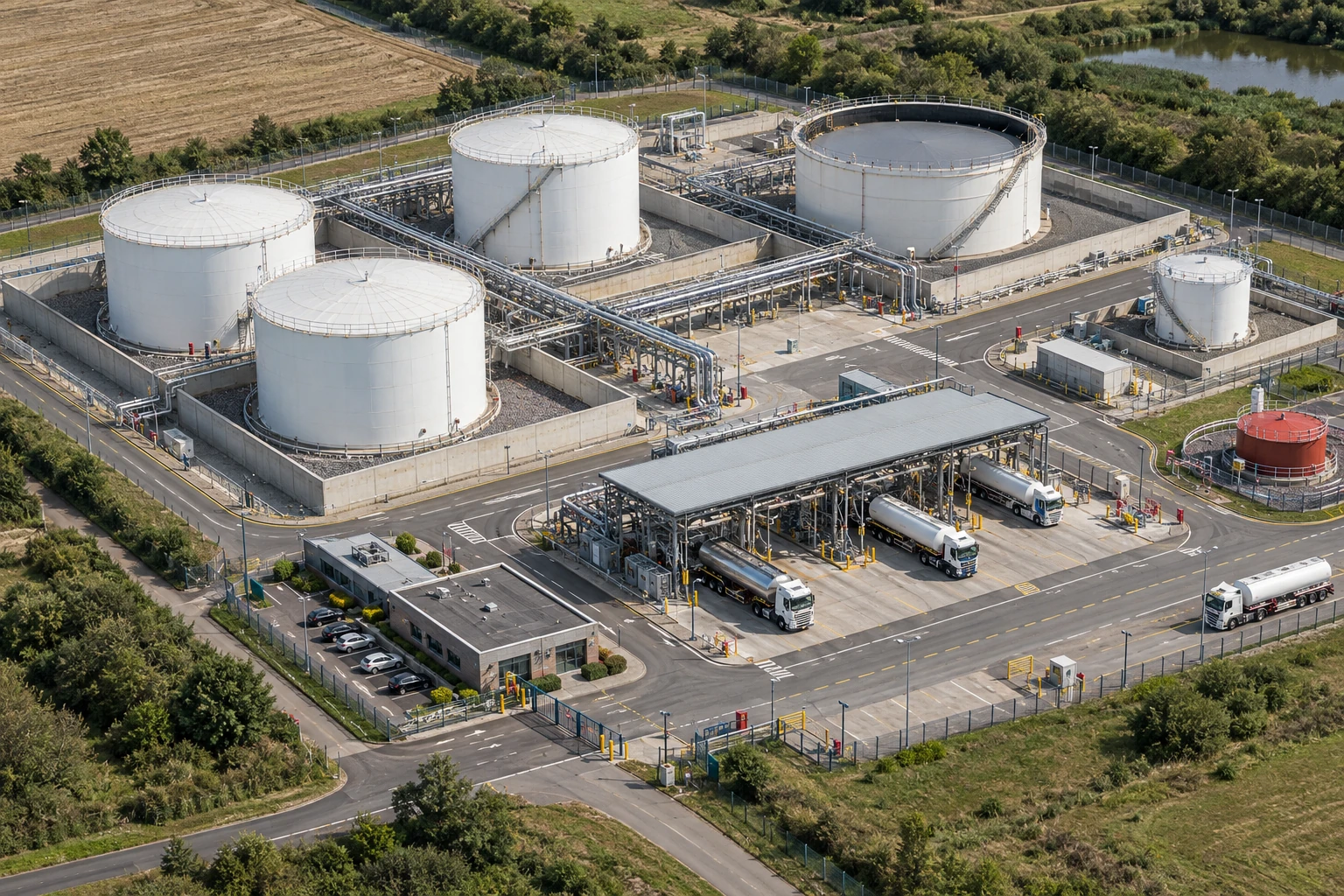

A roof repair may interrupt the lightning protection path
All related inspection points 3 across 1 location
Crown Fuels terminal 3 inspection points
Practice in the SHAREhub environment. Browser practice is separate from workplace competence and formal learning records.
How does static electricity create ignition risk?
Static ignition requires charge generation, retention and discharge where a flammable vapour, mist, gas or dust cloud can ignite. Flowing low-conductivity liquids, powders, filters, plastic parts and splash filling can generate charge. Bonding and earthing conductive parts, reducing releases, using suitable equipment and controlling transfer may help, but an insulating container is not made safe simply by clipping on an earth lead. Design and verify the whole transfer system against the dangerous-substances assessment for the actual nation.
Best-practice guide: Static Electricity and Electrostatic Ignition
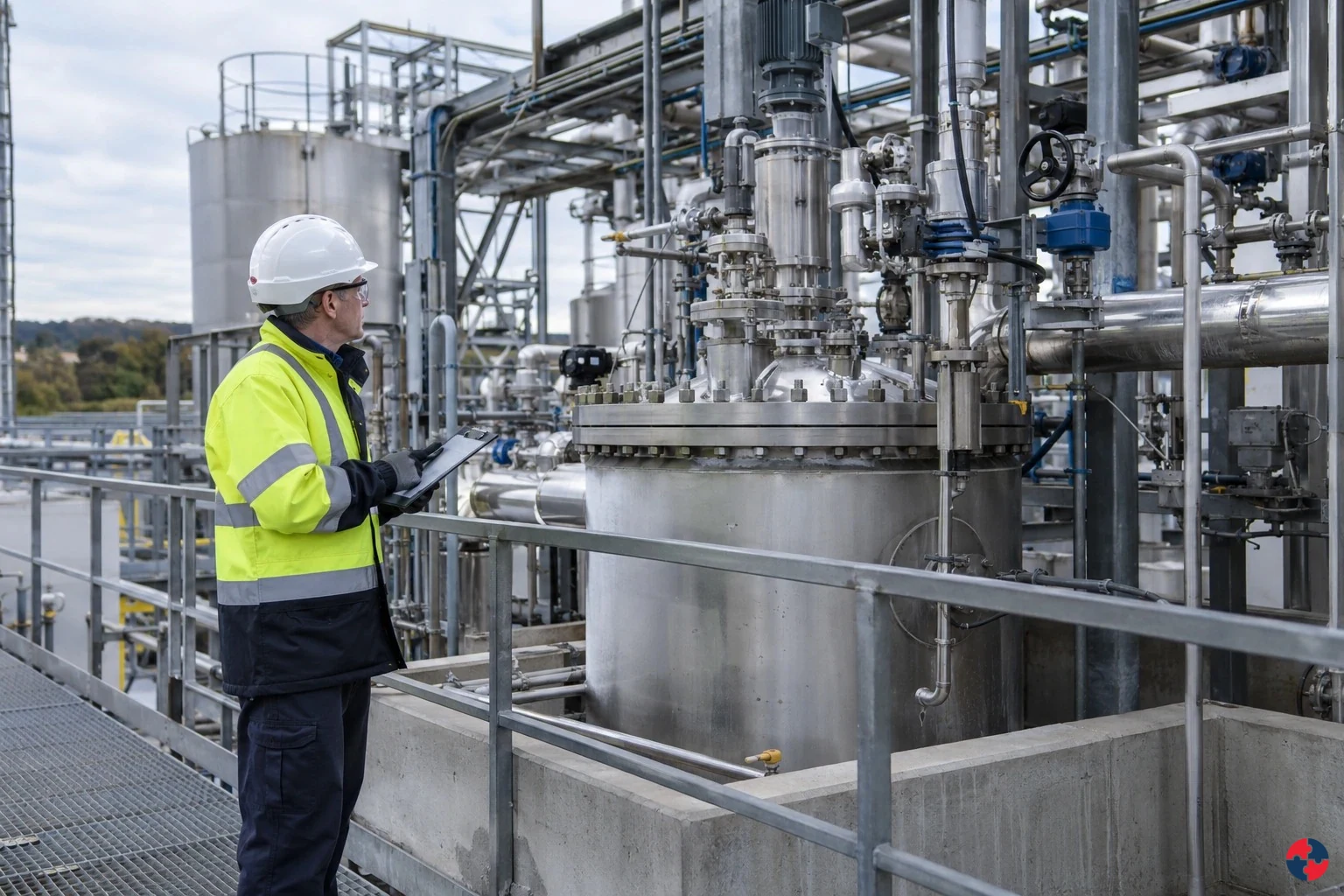
How does static electricity create ignition risk?
Static ignition requires charge generation, retention and discharge where a flammable vapour, mist, gas or dust cloud can ignite. Flowing low-conductivity liquids, powders, filters, plastic parts and splash filling can generate charge. Static electricity becomes a serious process safety hazard when charge generation, accumulation and discharge can ignite flammable vapours, gases, mists, aerosols or combustible dusts.
Turn static electricity and electrostatic ignition knowledge into a decision
Static electricity becomes a serious process safety hazard when charge generation, accumulation and discharge can ignite flammable vapours, gases, mists, aerosols or combustible dusts. This page explains static charge mechanisms, bonding, earthing, conductive and insulating materials, liquid and powder transfer, spray painting, IBC filling, clothing, hoses, verification evidence and DSEAR controls. DSEAR assessment, approved method, continuity/inspection record, operator demonstration and deviation review.
Solvent decanting into a receiving vessel
Use an approved closed/low-turbulence method, connect verified conductive parts before flow and monitor the transfer. Close, isolate and inspect the transfer route; restore protective equipment and hand back.
Where do static controls commonly fail?
Static controls fail when visible equipment is treated as proof without testing continuity, compatibility and real work practice.
Choose controls for static electricity and electrostatic ignition
Eliminate: Assess avoiding the solvent transfer. Reduce: Assess a genuinely safer compatible material. Isolate: Contain transfer and design suitable conductive paths and equipment. Control: Limit releases and splashing, with verified checks and stop rules. PPE: Task PPE cannot make an unsuitable transfer system safe. Read the full control table for qualifications, ownership and verification. Use the actual task and applicable jurisdiction; existing technical approval remains unchanged.
Use the full static electricity and electrostatic ignition lesson
Use the full topic for the decision points, practical examples, detailed control tables and source scope. HSE guidance applies to Great Britain; use HSENI for the Northern Ireland route and the source’s stated jurisdiction. A simplified guide does not change the page’s technical-review or approval status.

Read all six steps as text
1. How does static electricity create ignition risk?
Static ignition requires charge generation, retention and discharge where a flammable vapour, mist, gas or dust cloud can ignite.
- Avoid / redesign: Assess avoiding the solvent transfer.
- Control the task: Contain transfer and design suitable conductive paths and equipment.
- Verify before release: Read the full task example, checks and stop points on this page.
Static ignition requires charge generation, retention and discharge where a flammable vapour, mist, gas or dust cloud can ignite. Flowing low-conductivity liquids, powders, filters, plastic parts and splash filling can generate charge. Static electricity becomes a serious process safety hazard when charge generation, accumulation and discharge can ignite flammable vapours, gases, mists, aerosols or combustible dusts.
Apply it: Which part of this plan would you check at the workface before authorising the task?
2. Turn static electricity and electrostatic ignition knowledge into a decision
Use the evidence to improve the actual work arrangement.
- Change at source: Assess avoiding the solvent transfer.
- Make it observable: Read the full task example, checks and stop points on this page.
- Keep useful evidence: DSEAR assessment, approved method, continuity/inspection record, operator demonstration and deviation review.
Static electricity becomes a serious process safety hazard when charge generation, accumulation and discharge can ignite flammable vapours, gases, mists, aerosols or combustible dusts. This page explains static charge mechanisms, bonding, earthing, conductive and insulating materials, liquid and powder transfer, spray painting, IBC filling, clothing, hoses, verification evidence and DSEAR controls. DSEAR assessment, approved method, continuity/inspection record, operator demonstration and deviation review.
Apply it: What evidence would show that the change improves this task, rather than only completing a record?
3. Solvent decanting into a receiving vessel
Example: a practical application of the existing topic lesson.
- Setting: Workshop solvent transfer into a receiving vessel on an insulating pallet; plastic funnel, splash filling and vapour are credible.
- Act: Classify the substance and atmosphere, check vessel and hose conductivity, transfer method and validated bond/earth scheme.
- Hold / review: Do not transfer if atmosphere, container suitability, continuity or flow control cannot be verified.
Use an approved closed/low-turbulence method, connect verified conductive parts before flow and monitor the transfer. Close, isolate and inspect the transfer route; restore protective equipment and hand back.
Apply it: At which point would you hold this example, and what evidence would allow it to proceed?
4. Where do static controls commonly fail?
Connect the task, the route to the person and the control that can fail.
- Source / exposure: Static controls fail when visible equipment is treated as proof without testing continuity, compatibility and real work practice.
- Possible consequence: The most dangerous static-control failures are often quiet.
- Control failure: A bonding lead exists but is attached to paint.
Static controls fail when visible equipment is treated as proof without testing continuity, compatibility and real work practice.
Apply it: Who could be exposed, including other trades, cleaners, maintainers and people nearby?
5. Choose controls for static electricity and electrostatic ignition
Start with the stronger practicable options and verify their effect.
- Eliminate: Assess avoiding the solvent transfer.
- Reduce: Assess a genuinely safer compatible material.
- Isolate: Contain transfer and design suitable conductive paths and equipment.
- Control: Limit releases and splashing, with verified checks and stop rules.
- PPE: Task PPE cannot make an unsuitable transfer system safe.
Eliminate: Assess avoiding the solvent transfer. Reduce: Assess a genuinely safer compatible material. Isolate: Contain transfer and design suitable conductive paths and equipment. Control: Limit releases and splashing, with verified checks and stop rules. PPE: Task PPE cannot make an unsuitable transfer system safe. Read the full control table for qualifications, ownership and verification. Use the actual task and applicable jurisdiction; existing technical approval remains unchanged.
Apply it: Which stronger option can be used here, and who will verify it before accepting the remaining risk?
6. Use the full static electricity and electrostatic ignition lesson
Follow the official sources below and retain the task-specific evidence.
- Official guidance: HSE earthing and transfer guidance
- Official guidance: HSE hierarchy of controls
- Task decision: DSEAR assessment, approved method, continuity/inspection record, operator demonstration and deviation review.
Use the full topic for the decision points, practical examples, detailed control tables and source scope. HSE guidance applies to Great Britain; use HSENI for the Northern Ireland route and the source’s stated jurisdiction. A simplified guide does not change the page’s technical-review or approval status.
Apply it: Which official source and full-topic section will you use to resolve the next decision?
Static electricity is generated when materials separate, flow, rub, splash, spray, pour, filter or move through pipes and hoses. If charge cannot dissipate safely, it may accumulate on liquids, powders, containers, people, hoses or plant. A sudden discharge can then ignite a flammable vapour, gas, mist or combustible dust cloud.
The issue is not whether static shocks are painful to people. The process safety question is whether the discharge energy is enough to ignite the atmosphere. Some flammable vapours and dusts need very little ignition energy, so a small spark, brush discharge or propagating brush discharge can matter.
HSE specifically identifies static electricity as an ignition source for flammable vapours or dusts, including paint spray booths. In practical terms, static control belongs inside DSEAR assessment, hazardous area classification, transfer procedures, equipment selection, maintenance and operator training.
For advanced learning, static control is best understood as a chain: charge is created, charge is retained, a discharge occurs, an ignitable atmosphere is present and the discharge energy exceeds what the atmosphere needs. Breaking any part of that chain can reduce risk, but the preferred approach is to prevent the explosive atmosphere first wherever practicable.
A common professional mistake is to assume that earthing everything solves static risk. Earthing conductive objects is essential, but insulating plastics, non-conductive liners, powder layers, isolated metal fittings, contaminated clamps and high-resistivity liquids may still allow charge accumulation or ineffective dissipation.
| Concept | Meaning | Workplace implication |
|---|---|---|
| Charge generation | Electrical charge created by movement, separation or friction. | Pumping, pouring, spraying and powder handling need review. HSE earthing and transfer guidance |
| Charge accumulation | Charge remains because it cannot dissipate. | Insulating containers, plastic liners and isolated metal parts can be risky. HSE earthing and transfer guidance |
| Discharge | Stored charge releases as spark, brush or other discharge. | May ignite flammable vapour, gas, mist or dust. HSE earthing and transfer guidance |
| Bonding | Connecting conductive items together to remove potential difference. | Drum and container bonding before transfer. HSE earthing and transfer guidance |
| Earthing | Connecting conductive items to earth to dissipate charge. | Verified earth points and clamps. HSE earthing and transfer guidance |
| Conductive material | Allows charge to move away if connected correctly. | Metal containers and conductive hoses still need continuity. HSE earthing and transfer guidance |
| Insulating material | Retains charge and may not be made safe by earthing alone. | Plastic containers and liners need careful assessment. HSE earthing and transfer guidance |
| Minimum ignition energy | Energy needed to ignite a specific atmosphere. | Low-MIE vapours or dusts need stricter controls. HSE earthing and transfer guidance |
Start with HSE earthing and transfer guidance and assess the actual work and nation.
What is the static ignition pathway?
The pathway is charge generation, accumulation, discharge, flammable atmosphere, ignition and consequence.
The pathway approach helps learners and supervisors avoid shallow answers. Static is not controlled by a clamp alone. The assessment must ask whether charge is generated, whether it can accumulate, what discharge type is credible, whether a flammable atmosphere exists and what evidence proves the control works.
Control is strongest when flammable atmosphere formation is prevented first, then ignition sources are controlled. Bonding and earthing are important, but they are part of a wider package: material compatibility, flow rates, bottom filling, conductive hoses, equipment selection, ventilation, inerting, housekeeping, clothing, footwear and procedure discipline.
| Pathway step | Question | Control example |
|---|---|---|
| Charge generation | What movement, flow, spray or separation creates charge? | Reduce splashing, flow velocity and turbulence. |
| Accumulation | Can charge dissipate safely? | Use conductive plant and verified earthing. |
| Discharge | Could a spark or brush discharge occur? | Bond conductive items and avoid isolated metal parts. |
| Atmosphere | Is flammable vapour, mist, gas or dust present? | Ventilate, contain, inert or prevent release. |
| Ignition | Could discharge energy exceed ignition energy? | Control MIE-sensitive substances and hazardous areas. |
| Consequence | What happens if ignition occurs? | Emergency response, isolation and explosion protection. |
| Evidence | What proves static controls are alive? | Continuity tests, clamp checks, inspection and DSEAR records. |
Inerting is an engineered process safeguard with monitoring, loss-of-supply response and oxygen-deficiency controls. It is not a worker instruction to add nitrogen; an inerted space is not safe to enter. Select ventilation, flow, relaxation times and continuity criteria for the actual material and system rather than copying one value from a generic table. HSE COMAH earthing guidance provides technical context; competent assessment sets the operating basis.
How can static ignition occur during flammable liquid transfer?
A transfer example shows how static, vapour, containers and procedure can combine into ignition risk.
Solvent decanting into a receiving vessel
Task material and setting: Workshop solvent transfer into a receiving vessel on an insulating pallet; plastic funnel, splash filling and vapour are credible.
People and prerequisites: Operator, supervisor and process specialist; approved transfer method, suitable equipment and a verified bond/earth scheme.
Before: Classify the substance and atmosphere, check vessel and hose conductivity, transfer method and validated bond/earth scheme.
During: Use an approved closed/low-turbulence method, connect verified conductive parts before flow and monitor the transfer.
Hold or stop: Do not transfer if atmosphere, container suitability, continuity or flow control cannot be verified.
Completion and hand back: Close, isolate and inspect the transfer route; restore protective equipment and hand back.
Evidence: DSEAR assessment, approved method, continuity/inspection record, operator demonstration and deviation review.
A workshop decants solvent from a metal drum into a smaller container. The operator uses a plastic funnel, the receiving container sits on a plastic pallet, the liquid splashes during top filling and there is no verified bond between the drum and receiving container. Vapour is present around the opening.
A competent method would avoid open splash filling, use compatible conductive containers, bond and earth before opening or transfer, control flow rate, provide ventilation, keep ignition sources away, train the operator and verify the clamp/earth system. If the receiving container is insulating, simple earthing may not solve the problem and the method needs redesign.
| Condition | Static or ignition issue | Better control |
|---|---|---|
| Plastic funnel | May retain charge and isolate liquid stream. | Use suitable conductive/compatible transfer equipment. HSE earthing and transfer guidance |
| Splash filling | Increases charge and vapour release. | Bottom fill or reduce turbulence where practicable. HSE earthing and transfer guidance |
| No bonding | Potential difference can create spark. | Bond drum, receiving vessel and transfer equipment. HSE earthing and transfer guidance |
| Plastic pallet | May isolate container from earth. | Use conductive floor/stand or redesign transfer. HSE earthing and transfer guidance |
| Open vapour | Flammable atmosphere may be present. | Ventilation, enclosure and DSEAR controls. HSE earthing and transfer guidance |
| No continuity check | Clamp may look fitted but not work. | Test and inspect bonding/earthing system. HSE earthing and transfer guidance |
Retain temporary bonding through the assessed ignition-capable transfer, draining and disconnection stages. Record the approved disconnect point in hand-back evidence; “flow stopped” alone is not a universal permission to remove the bond.
Which activities commonly generate static charge?
Static is common in liquid, powder, coating, packaging and material-handling tasks.
Static generation becomes important when the activity also creates or enters a flammable atmosphere. Pouring water is not the same as pouring solvent. Moving cardboard is not the same as pneumatic transfer of combustible powder.
A good DSEAR assessment looks at normal work and non-routine tasks: cleaning, maintenance, filter changes, product changeover, sampling, tank dipping and emergency drain-down.
| Activity | Why charge forms | Control focus |
|---|---|---|
| Pumping flammable liquid | Liquid moves through pipe, hose, filter and valve. | Flow rate, bonding, earthing and relaxation time. HSE earthing and transfer guidance |
| Splash filling | Liquid separates and entrains air. | Bottom filling and anti-splash design. HSE earthing and transfer guidance |
| Powder transfer | Particles rub, separate and suspend as dust cloud. | Conductive plant, dust control and explosion prevention. HSE DSEAR guidance |
| Pneumatic conveying | Particles move at high velocity in pipework. | Earthing, material selection and dust explosion controls. HSE DSEAR guidance |
| Spray painting | Droplets and air movement generate charge in vapour/mist area. | Booth extraction, bonding, antistatic clothing and equipment suitability. HSE flammable-liquids guidance; HSE explosive-atmosphere guidance |
| Film or plastic handling | Insulating materials hold charge. | Material selection, humidity support and static-neutralising where suitable. HSE DSEAR guidance |
| Vehicle/personnel movement | People or vehicles accumulate charge. | Antistatic footwear/flooring and bonding before transfer. HSE earthing and transfer guidance |
What is the difference between bonding and earthing?
Bonding equalises potential between conductive items; earthing dissipates charge to earth.
Learners often use bonding and earthing as if they are the same. They are related but different. Bonding prevents a spark between two conductive items by keeping them at the same potential. Earthing connects conductive items to earth so charge can dissipate.
Both must be real, not decorative. A clamp on paint, rust, plastic or an isolated component may not provide continuity. Verification, inspection and maintenance are therefore part of the control.
| Control | Purpose | Common failure |
|---|---|---|
| Bonding | Connects conductive items together. | Clamp not connected to bare metal or receiving vessel missed. HSE earthing and transfer guidance |
| Earthing | Connects conductive items to earth. | Earth point not tested or cable damaged. HSE earthing and transfer guidance |
| Conductive hose | Allows charge path if correctly specified and connected. | Wrong hose used after replacement. HSE earthing and transfer guidance |
| Antistatic footwear | Helps dissipate charge from people on suitable flooring. | Worn with insulating floor or poor housekeeping. HSE earthing and transfer guidance |
| Interlocked system | Prevents transfer until earth continuity is confirmed. | Bypassed or not proof-tested. HSE earthing and transfer guidance |
| Inspection | Finds damage, paint, corrosion or missing clamps. | Visual check done without continuity test where needed. HSE earthing and transfer guidance |
Verification must follow the competent design: identify each conductive part, the contact points and complete path, suitable test equipment, acceptance criteria and records. A green lamp or fitted clip proves only what that system actually monitors; it does not establish safe insulating liners, liquid charge, atmosphere or all isolated fittings. HSE HSG140 flammable-liquid handling.
How does static risk appear in spray booths and accident repair centres?
Spray booths combine flammable vapours or mists, air movement, equipment, clothing and vehicle surfaces.
In an accident repair centre, static can arise during paint spraying, sanding, wiping, clothing movement, plastic sheeting, compressed-air use and movement around the vehicle. The spray booth is already a controlled environment because vapours and mists may be present.
Static control should sit alongside LEV, booth clearance time, DSEAR zoning, gun and equipment suitability, bonding, antistatic clothing and footwear, housekeeping, filter maintenance and clear rules about ignition-capable items.
| Issue | Risk | Control |
|---|---|---|
| Vehicle panel and gun | Potential difference during spraying. | Bonding/earthing as specified by equipment and risk assessment. |
| Solvent wipe-down | Vapour and charged cloth/material. | Ventilation, compatible wipes and ignition control. |
| Plastic masking | Insulating material may hold charge. | Assess material and procedure. |
| Clothing and footwear | Worker may accumulate charge. | Antistatic clothing/footwear where required. |
| Booth airflow | Controls vapour but can interact with spray and drying. | Maintain LEV and observe clearance time. |
| Equipment replacement | Wrong hose/gun/light may defeat controls. | MOC and equipment suitability check. |
A booth clearance time controls inhalation exposure and re-entry after spraying; it does not on its own establish that every location is outside a flammable zone. Check the actual extraction, equipment and ignition assessment separately. HSE explosive-atmosphere equipment guidance.
For the separate inhalation/re-entry boundary, HSE isocyanate spray-mist clearance requires measured booth/room clearance arrangements. Select substance controls and respiratory protection separately from electrostatic ignition controls.
How do charge generation, accumulation and material behaviour interact?
Static risk depends on how charge is generated, whether it can dissipate and whether discharge can ignite the atmosphere.
The physics can be made practical. Flowing liquids, spraying paint, pouring powders, unrolling plastic film, pneumatic conveying and personnel movement can all create charge. Conductive items can be controlled if properly bonded and earthed. Insulating materials may hold charge on their surface and can be much harder to make safe.
Minimum ignition energy matters because different vapours and dusts need different amounts of energy to ignite. The value used for assessment must be treated carefully because real mixtures, concentration, turbulence, humidity and contamination can change the risk picture.
| Technical point | Practical meaning | Control implication |
|---|---|---|
| Triboelectric charging | Charge forms when materials contact and separate. | Review pouring, transfer, rubbing, belts, clothing and packaging. |
| Flow electrification | Liquid moving through pipes, filters or hoses creates charge. | Control flow velocity, relaxation time, filters and conductive paths. |
| Spray charging | Droplets and aerosols can become charged during spraying. | Use booth ventilation, suitable equipment, bonding, PPE and DSEAR controls. |
| Powder charging | Powders charge during pouring, sieving, blending or pneumatic transfer. | Assess dust cloud, MIE, earthing, flexible intermediate bulk container (FIBC) type and housekeeping. |
| Conductive object | Can lose charge if connected to earth. | Verify bonding/earthing continuity and clean contact points. |
| Insulating object | May retain surface charge even near an earth. | Avoid unsuitable plastics or use specialist antistatic materials. |
| Isolated conductor | Metal part is conductive but not connected. | Bond clips, funnels, nozzles, drums and mobile vessels. |
| Human body charging | People can accumulate charge through movement and clothing. | Use antistatic footwear/flooring/clothing where justified by DSEAR. |
Where does static ignition appear in high-risk work?
Static ignition is most important where flammable atmospheres or combustible dust clouds can exist during transfer, spraying, filling, cleaning or handling.
Static is often invisible until it discharges. That is why good systems rely on engineered controls and verification rather than worker perception. No shock felt by the operator does not prove the absence of ignition-capable discharge.
The table below shows where a detailed assessment is needed. It is not enough to say 'bond and earth'; the task, material, container, atmosphere, humidity, flow and equipment specification all matter.
| Application | Static failure mode | Flagship control focus |
|---|---|---|
| Flammable liquid transfer | Unearthed drum, splash filling, high flow or isolated funnel produces spark. | Bottom filling where practicable, bonding/earthing, flow control and verified clamps. HSE earthing guidance; HSE flammable-liquids guidance |
| IBC filling or decanting | Unsuitable plastic IBC or liner retains charge. | Use suitable conductive/static-dissipative containers and competent DSEAR review. HSE flammable-liquids guidance |
| Powder charging/blending | Combustible dust cloud ignited by discharge from equipment or operator. | Dust control, FIBC selection, earthing, inerting where needed and housekeeping. HSE DSEAR guidance |
| FIBC bag emptying | Bag or liner may accumulate charge while powder moves in a dust atmosphere. | Assess bag and liner suitability for the actual dust and hazardous area; validate the control system. HSE FIBC liner static-risk example; HSE DSEAR guidance |
| Paint spray booth | Spray mist, solvent vapour, clothing or equipment creates ignition risk. | Booth extraction, Ex equipment, antistatic controls, RPE compatibility and clearance time. HSE flammable-liquids guidance; HSE explosive-atmosphere guidance |
| Tank cleaning | Steam, water jetting, cloth wiping or residue movement generates charge. | First consider avoiding entry and suitable remote cleaning. If entry is unavoidable, use the separate confined-space assessment, verified isolation, atmosphere checks, safe system and rescue arrangements; gas-freeing or bonding alone does not authorise entry. HSE flammable-liquids guidance |
| Sampling | An unearthed conductive sampling tool can spark; insulating ropes, containers or materials can retain charge by a different mechanism. Select equipment and relaxation arrangements for the actual liquid/system; bonding every item is not a solution to insulating charge. | Approved sampling equipment, relaxation time and bonding. HSE flammable-liquids guidance |
| Vacuum cleaning dust | Unsuitable vacuum or hose creates charge in dust atmosphere. | Use equipment designed for combustible dust risk and maintain continuity. HSE DSEAR guidance |
For tank cleaning, first consider avoiding entry and remote methods. Unavoidable entry needs the separate confined-space assessment, isolation, atmosphere testing, safe system and rescue arrangements. Gas-freeing or bonding alone neither establishes safe breathing air nor authorises entry.
How should a flammable liquid transfer be controlled for static?
A good transfer procedure controls atmosphere formation, charge generation, discharge potential and evidence before flow starts.
Imagine a small-batch solvent transfer from a drum into a mixing vessel. The solvent has a low flash point and vapour can be present around the opening. The operator uses a plastic funnel because it is clean and convenient. The pump runs fast, product splashes into the vessel and the bonding clamp is attached to painted metal.
The stronger method uses compatible conductive equipment, clean metal-to-metal bonding contact, verified earth continuity, controlled flow, avoidance of splash filling, ventilation, container closure, suitable PPE and a clear stop rule if bonding indication is absent, vapour control is poor or an unauthorised container appears.
| Step | Weak practice | Flagship practice |
|---|---|---|
| Preparation | SDS checked but DSEAR/static details not considered. | Confirm flash point, vapour risk, zone, container suitability and MIE sensitivity where relevant. |
| Container | Convenient plastic funnel and unverified receiving vessel. | Use approved conductive or static-dissipative equipment suitable for the substance and area. |
| Bonding | Clamp attached to paint, rust or unknown point. | Clean contact point, verified continuity and known earth route. |
| Transfer | Fast splash filling into open vessel. | Controlled flow, bottom fill where practicable and minimise free fall/splash. |
| Atmosphere | Relies on smell to judge vapour. | Ventilation/extraction and gas testing where required by assessment. |
| People | Ordinary clothing and footwear in DSEAR area. | Antistatic footwear/clothing where assessed as necessary. |
| Evidence | No record beyond batch sheet. | Pre-transfer checklist, defect record and MOC if equipment/material changes. |
Now change from liquid decanting to powder addition into a solvent vessel: liquid bonding alone does not resolve charged bags, scoops, liners or a dust/vapour hybrid. Redesign the addition and obtain competent process/static assessment. HSE HSG140 flammable-liquid handling warns against plastic scoops, chutes and bags into flammable vapour; the sewage-sludge FIBC example is sector context, not universal bag approval.
How can the hierarchy of controls prevent electrostatic ignition of flammable atmospheres?
Remove or reduce the hazard before relying on procedures or personal protection.
For static electricity and electrostatic ignition, assess the actual task and first look for a way to remove the hazard. Where that is not possible, consider a safer substitute, engineered separation and then clear work procedures. PPE protects against remaining exposure; it does not make an uncontrolled task safe. HSE hierarchy of controls
The selected measures need a named owner, a usable stop point and a check that they still work when the task or conditions change. In Northern Ireland, verify the separate legal route and site instructions.
For the solvent vessel, consider avoiding the solvent transfer or choosing a genuinely safer compatible material. Contain the remaining transfer, limit releases and splashing, and design the complete conductive paths and suitable equipment before relying on checks, stop rules and task PPE. Eliminating a vapour cloud and controlling charge are complementary; an earth clip does not make an unsuitable plastic system safe. ERICPD is a teaching aid. HSE hierarchy of controls; HSE HSG140 flammable-liquid handling.
How can the ERICPD hierarchy of controls prevent electrostatic ignition of flammable atmospheres?

| ERICPD control level | Topic-specific example | Source and full task context |
|---|---|---|
| Eliminate | Assess avoiding the solvent transfer. | Read the full task example, checks and stop points on this page. HSE hierarchy of controls · HSE HSG140 flammable-liquid handling |
| Reduce | Assess a genuinely safer compatible material. | Read the full task example, checks and stop points on this page. HSE hierarchy of controls · HSE HSG140 flammable-liquid handling |
| Isolate | Contain transfer and design suitable conductive paths and equipment. | Read the full task example, checks and stop points on this page. HSE hierarchy of controls · HSE HSG140 flammable-liquid handling |
| Control | Limit releases and splashing, with verified checks and stop rules. | Read the full task example, checks and stop points on this page. HSE hierarchy of controls · HSE HSG140 flammable-liquid handling |
| PPE | Task PPE cannot make an unsuitable transfer system safe. | Read the full task example, checks and stop points on this page. HSE hierarchy of controls · HSE HSG140 flammable-liquid handling |
| Discipline | Verify the complete system rather than relying on an earth clip alone. | Read the full task example, checks and stop points on this page. HSE hierarchy of controls · HSE HSG140 flammable-liquid handling |
How can the ISO 45001 hierarchy of controls prevent electrostatic ignition of flammable atmospheres?

| Five-level control stage(s) | Topic-specific example | Source and full task context |
|---|---|---|
| Elimination | Assess avoiding the solvent transfer. | Read the full task example, checks and stop points on this page. HSE hierarchy of controls · HSE HSG140 flammable-liquid handling |
| Substitution | Assess a genuinely safer compatible material. | Read the full task example, checks and stop points on this page. HSE hierarchy of controls · HSE HSG140 flammable-liquid handling |
| Engineering controls | Contain transfer and design suitable conductive paths and equipment. | Read the full task example, checks and stop points on this page. HSE hierarchy of controls · HSE HSG140 flammable-liquid handling |
| Administrative controls | Limit releases and splashing, with verified checks and stop rules. | Read the full task example, checks and stop points on this page. HSE hierarchy of controls · HSE HSG140 flammable-liquid handling |
| PPE | Task PPE cannot make an unsuitable transfer system safe. | Read the full task example, checks and stop points on this page. HSE hierarchy of controls · HSE HSG140 flammable-liquid handling |
| Administrative controls | Verify the complete system rather than relying on an earth clip alone. | Read the full task example, checks and stop points on this page. HSE hierarchy of controls · HSE HSG140 flammable-liquid handling |
When should static-sensitive work stop or escalate?
Stop or escalate when bonding, earthing, atmosphere control, equipment suitability or substance behaviour is uncertain.
Static-sensitive work should stop if a clamp is missing, continuity cannot be confirmed, an insulating container is being used for flammable transfer, vapour or dust is uncontrolled, ventilation is not working, or work has changed from the assessed method.
Escalation should involve the supervisor, DSEAR competent person, electrical/instrument specialist, process safety lead or fire specialist depending on the setting.
| Trigger | Immediate action | Competent review |
|---|---|---|
| Bonding/earthing missing | Stop transfer or spraying. | Check continuity and method. |
| Insulating container used for flammable liquid | Stop and redesign transfer. | DSEAR/process safety review. |
| Uncontrolled vapour or dust cloud | Stop from a safe location, raise the alarm and use the assessed emergency plan; do not enter a vapour/dust cloud or switch on unapproved ventilation. | DSEAR and emergency response if needed. |
| Wrong hose or clamp | Remove from service. | Maintenance and procurement review. |
| Ventilation/LEV failure | Stop work in spray or vapour area. | LEV/fire/DSEAR review. |
| Procedure changed informally | Hold the changed work; competent review must verify that the approved method still fits before restart. | MOC and SOP review. |
Where do static controls commonly fail?
Static controls fail when visible equipment is treated as proof without testing continuity, compatibility and real work practice.
The most dangerous static-control failures are often quiet. A bonding lead exists but is attached to paint. A conductive hose was replaced with a non-conductive one. A plastic liner is added to a container. Operators top-fill quickly to save time. Maintenance removes an earth strap and forgets to reinstate it.
A mature system verifies the control: continuity checks, inspections, correct replacement parts, operator understanding, DSEAR review and action tracking.
| Failure or weak practice | How it develops | What good looks like |
|---|---|---|
| Decorative bonding | Clamp fitted but no electrical continuity. | Test clamp, contact point and cable. |
| Wrong container | Plastic IBC or liner used with flammable liquid. | Use compatible conductive system or redesign. |
| Splash filling | Fast top filling creates charge and vapour. | Bottom fill and control flow. |
| Hose substitution | Maintenance fits non-conductive hose. | Controlled spares and MOC. |
| No relaxation time | Sampling or dipping happens too soon after transfer. | Define wait times where relevant. |
| Clothing/floor mismatch | Antistatic footwear used on insulating floor. | Assess whole personnel grounding path. |
| DSEAR gap | Static not considered in hazardous area assessment. | Include static in ignition-source register. |
What evidence shows electrostatic ignition risk is controlled?
Good evidence shows that controls are planned, used, checked, corrected and reviewed.
Evidence should be proportionate to the harm and task. Check whether the controls are used, work in practice, and trigger timely correction when conditions change.
| Evidence item | What it should show | Assurance question |
|---|---|---|
| DSEAR assessment | Flammable atmosphere, static generation, ignition sources and controls. | Does it cover static explicitly? |
| Bonding/earthing records | Continuity tests, inspection, maintenance and defects. | Are controls tested, not just seen? |
| Equipment specification | Conductive hoses, containers, pumps, guns and Ex-rated equipment where needed. | Are replacements controlled? |
| SOPs and permits | Transfer, spraying, powder handling, sampling and cleaning steps. | Do procedures specify static controls and stop triggers? |
| Training records | Operators understand bonding, earthing, vapour/dust and emergency action. | Can workers explain why controls matter? |
| MOC records | Changes to materials, containers, hoses, flow, ventilation or equipment. | Was static risk reassessed after change? |
| Incident/near-miss records | Static shocks, clamp defects, vapour releases and control bypasses. | Are weak signals escalated? |
These practical records and checks illustrate verifying the actual controls; they are not prescribed forms, technical approval or downloadable files.
How should static electricity and electrostatic ignition be assured?
Assurance should test whether controls work in practice, not whether the page or procedure exists.
Assurance should include frontline checks, manager review and periodic independent sampling where risk warrants it. The purpose is to find weak signals early, close actions properly and update the risk assessment when work changes.
| Assurance level | What to check | What good looks like |
|---|---|---|
| Frontline check | Clamp, hose, container, ventilation, ignition controls and procedure. | Work does not start until static controls are verified. |
| Maintenance assurance | Earth points, continuity, interlocks and replacement parts. | Static controls remain functional. |
| DSEAR review | Hazardous areas, substances, MIE and ignition controls. | Assessment reflects current operation. |
| Process safety audit | SOPs, permits, MOC and incident learning. | Static controls are managed as barriers. |
| Leadership review | Static-related defects, overdue tests and changes. | Resources protect critical controls. |
These practical records and checks illustrate verifying the actual controls; they are not prescribed forms, technical approval or downloadable files.
Which UK duties and guidance apply?
GB DSEAR requires dangerous-substance risks to be assessed and controlled, including avoidance of ignition sources. Northern Ireland has separate DSEAR regulations. HSE COMAH earthing and liquid-transfer guidance is a technical aid for relevant GB process settings, not a universal numeric design rule; competent engineering must set and verify the actual method.
| Jurisdiction | Route | Direct source | Decision supported |
|---|---|---|---|
| Great Britain | Dangerous substances | DSEAR in detail; COMAH technical measures: earthing | Assess and prevent static ignition with source and atmosphere controls. |
| Northern Ireland | Separate dangerous-substances duties | Dangerous Substances and Explosive Atmospheres Regulations (Northern Ireland) 2003 | Apply NI regulations to NI work. |
| Great Britain | General work and management duties | Health and Safety at Work etc. Act 1974; Management of Health and Safety at Work Regulations 1999 | Plan, train and verify the work system. |
| Northern Ireland | General work and management duties | Health and Safety at Work (Northern Ireland) Order 1978; Management of Health and Safety at Work Regulations (Northern Ireland) 2000 | Apply separate NI duties. |
How should management check this work?
Use a defined plan, carry out the controls, check performance and correct what does not work.
For static electricity and electrostatic ignition, assign a competent owner to set the work controls, check their use and review them after change, failure or new evidence. HSE managing health and safety
A management-system label or certificate is not approval of a site limit, procedure or individual work decision. Apply GB and NI duties to the correct location.
What training and competence are needed?
Demonstrate the decision each role must make in its actual task, including when to stop and seek specialist advice.
These assessment methods are illustrative SHARE implementation choices; the linked guidance supports the subject matter, not a prescribed training format.
| Role | Practice to demonstrate | Assessor and method | Evidence | Reassess when |
|---|---|---|---|---|
| Operators | Check approved bond/earth setup before flow and stop on failed indication. | Supervisor observes a simulated transfer. | Practical sign-off. | New product or vessel. HSE earthing and transfer guidance |
| Supervisors | Challenge unsafe container, splash fill and unverified continuity. | Engineer tests scenario. | Decision record. | Control failure. HSE earthing and transfer guidance |
| Process engineers | Assess charge, atmosphere, materials and transfer method. | Independent specialist reviews design. | Classification and design basis. | MOC or new material. HSE earthing and transfer guidance |
| Maintenance | Inspect bonding points and continuity without bypass. | Competent tester witnesses check. | Inspection and calibration record. | Defect or modification. HSE earthing and transfer guidance |
| Assurance lead | Trace field checks to DSEAR assessment and action closure. | Peer audit. | Sample and correction. | Incident or trend. HSE DSEAR scope |
How could Crownway Fuels Ltd manage this in practice?

Crownway Fuels Ltd can manage static ignition by integrating bonding, earthing, transfer procedures, DSEAR and maintenance assurance.
In this fuel business, static can arise during tanker loading, drum filling, solvent sampling, powder additives and maintenance work. Controls need to be verified before transfer begins.
| Management element | How the business would manage it | Evidence to review |
|---|---|---|
| Transfer | Bond/earth tankers, hoses and receiving systems before flow. | Pre-transfer checklist. |
| Sampling | Control wait time, containers and vapour exposure. | Sampling SOP. |
| Maintenance | Earth straps and conductive hoses controlled as critical parts. | Maintenance records. |
| DSEAR | Static listed in ignition-source register. | DSEAR assessment. |
| Assurance | Continuity tests and field observations sampled. | Audit and defect tracker. |
These practical records and checks illustrate verifying the actual controls; they are not prescribed forms, technical approval or downloadable files.
How can a fuel-transfer example explain static ignition controls?
Distinguish bonding between conductive parts from earthing to ground, and inspect their intended purpose. The schematic contains no resistance value or completed verification.
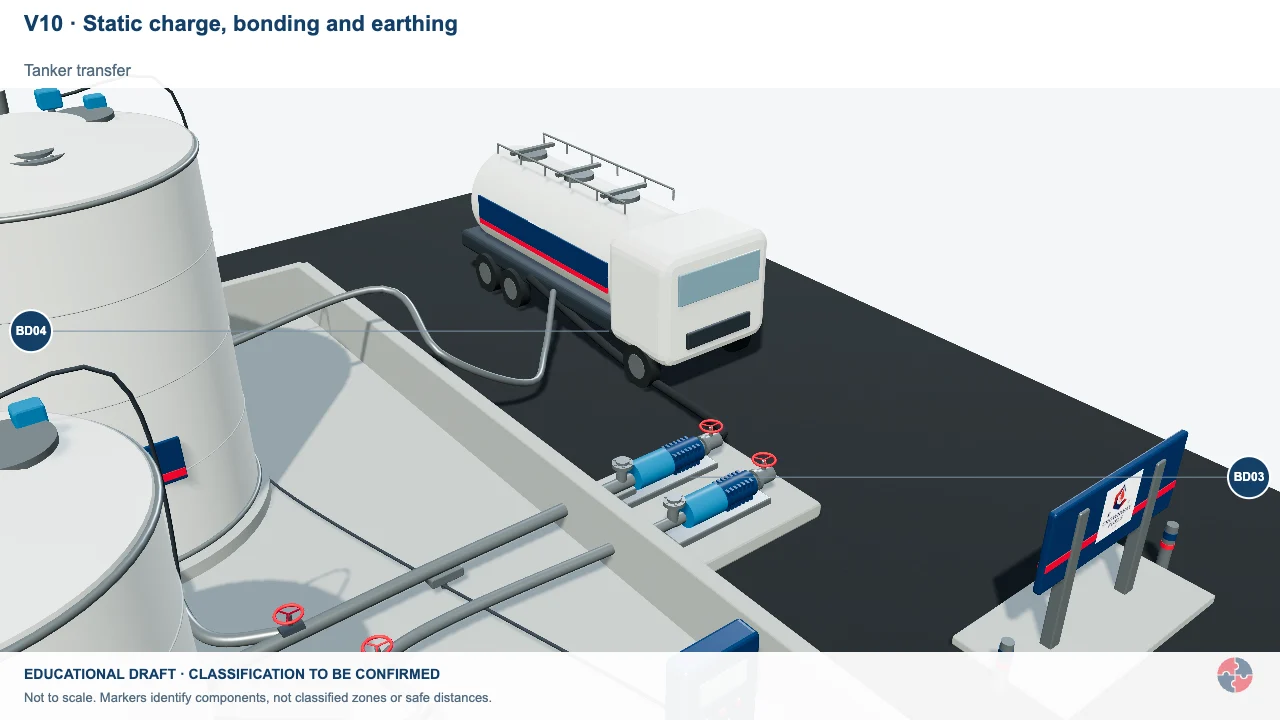
Static charge, bonding and earthing
Liquid movement can generate charge. A specified bonding or earthing arrangement controls a different part of the ignition risk.
Activity focus: Identify the intended connection and its verification evidence in the actual transfer design.
Contextual workplace scene. Use the task, control and evidence checks in this section; appearance alone does not establish safe conditions, individual health or approval.
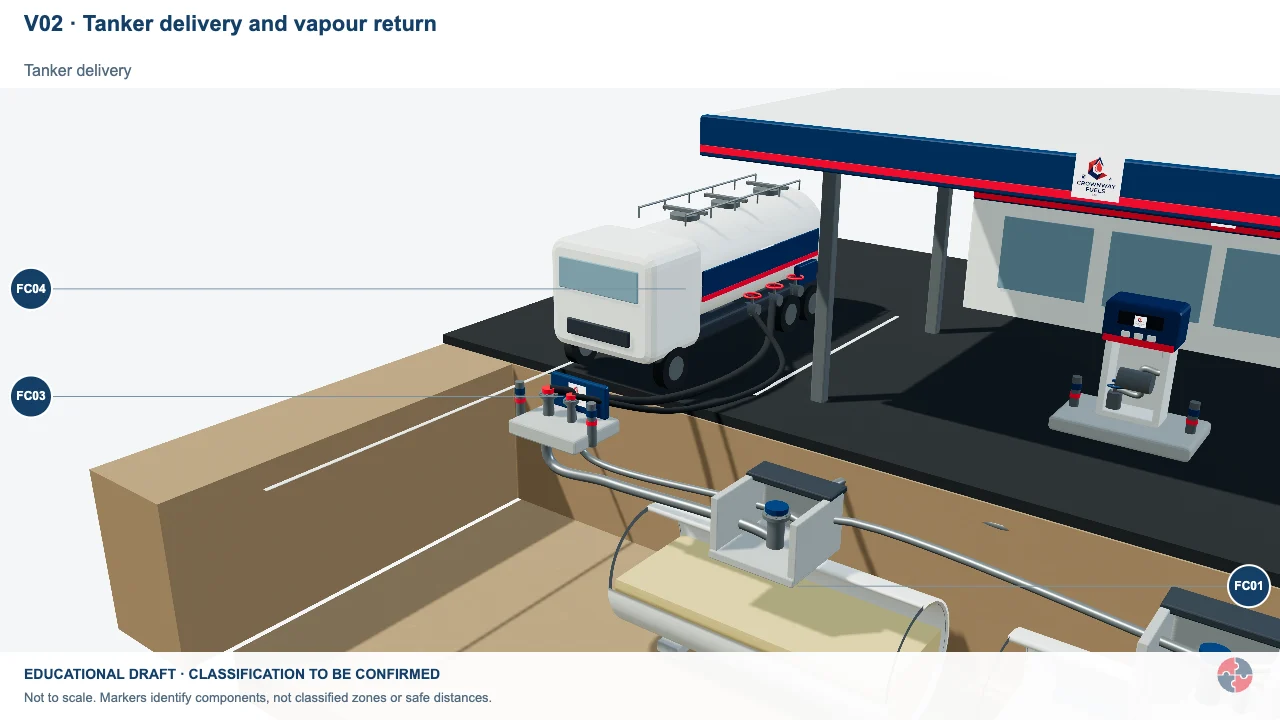
Tanker delivery and vapour return
During the proposed tanker delivery, product enters the receiving tank and displaced vapour returns to the tanker by a separate path. The delivery-hose teaching envelope follows the connected hose route.
Activity focus: Trace the tanker connection, product hose and receiving fill before following the Stage 1b vapour-return path. Inspect the whole delivery working area, including nearby traffic, dispensers and drainage.
Contextual workplace scene. Use the task, control and evidence checks in this section; appearance alone does not establish safe conditions, individual health or approval.
Educational illustration, not to scale. Coloured zones are teaching examples, not a site-specific hazardous-area classification.
What do the acronyms and key terms mean?
Acronyms should be understood before they are used in assessments, briefings, audits or learning answers.
Acronyms can exclude newer readers if they are not explained. This section keeps the main terms available at the end of the page so the article stays readable while still supporting learners and audit users.
| Acronym | Meaning | Plain-English use |
|---|---|---|
| ACOP | Approved Code of Practice | Practical guidance with special legal status. |
| ALARP | As Low As Reasonably Practicable | Risk reduction unless further control is grossly disproportionate to benefit. |
| BBV | Blood-Borne Virus | Virus that may be transmitted through blood or certain body fluids. |
| COMAH | Control of Major Accident Hazards Regulations | Regulations for major accident hazard sites involving dangerous substances. |
| COSHH | Control of Substances Hazardous to Health | Regulations for hazardous substances, including many chemicals and biological agents. |
| DSEAR | Dangerous Substances and Explosive Atmospheres Regulations | GB regulations; Northern Ireland has a separate DSEAR regime. |
| EMM | Enforcement Management Model | HSE decision framework for enforcement decisions. |
| EPS | Enforcement Policy Statement | HSE policy principles for enforcement. |
| FRA | Fire Risk Assessment | Assessment of fire hazards, people at risk, controls, emergency arrangements and review. |
| HSE | Health and Safety Executive | Great Britain regulator and official guidance source. |
| MOC | Management of Change | Formal review of changes that may affect risk controls. |
| OH | Occupational Health | Competent clinical and work-health advice route. |
| PPE | Personal Protective Equipment | Equipment worn to reduce exposure where higher-order controls do not fully remove risk. |
| RIDDOR | Reporting of Injuries, Diseases and Dangerous Occurrences Regulations | GB reporting regulations; Northern Ireland has a separate regime. |
| SDS | Safety Data Sheet | Supplier hazard, control, first-aid and emergency information for substances. |
| SOP | Standard Operating Procedure | Controlled instruction for carrying out a task or operation safely and consistently. |
| WEL | Workplace Exposure Limit | Airborne exposure limit averaged over a specified reference period. |
| IBC | Intermediate Bulk Container | Large container used for bulk liquids or solids. |
| MIE | Minimum Ignition Energy | Lowest energy capable of igniting a particular flammable mixture under defined conditions. |
| LEL | Lower Explosive Limit | Lowest concentration of vapour/gas in air that can ignite. |
| UEL | Upper Explosive Limit | Highest concentration of vapour/gas in air that can ignite. |
| ERICPD | Eliminate, Reduce, Isolate, Control, PPE, Discipline | Illustrative teaching prompt; Discipline means maintaining and checking controls. |
flexible intermediate bulk container (FIBC) means flexible intermediate bulk container. Its electrostatic suitability depends on the specific container/system and assessed use; a general bag description or bonding claim does not establish suitability.
Unlock another resource
You have used this month’s two free downloads. Publish a post in your own words to unlock one more resource, or choose SHARE Individual for 10 downloads per month.
You decide whether to share. If you do, use the relevant platform disclosure tools and do not make claims you do not genuinely hold.