
Hotel, pool and leisure safety / Food service, allergens and cellar safety
Hotel, pool and leisure safety · SH-HOTEL-04Food service, allergens and cellar safety
Free online training · Approximate learning time: 100–160 minutes · Self-paced
Carry accurate allergen information to the guest and control the hidden risks behind service.
Full public teaching and readers are free without an account. A free learner account is required for saved LMS progress and recorded assessment. Completion and any course-completion certificate depend on the configured LMS conditions.
Who this course is for
Restaurant and bar teams, chefs, cellar staff and food-and-beverage supervisors
Carry accurate allergen information to the guest and control the hidden risks behind service. Follow the task, explain harm, compare controls and justify what may be released.
Independent hotel, pool and leisure awareness using the fictional Riverside model. GB workplace guidance; apply corresponding NI and nation-specific arrangements. England-specific fire guidance is labelled. Learning does not establish practical competence, clinical advice, specialist work or operational authority.
Learning outcomes
- Resolve ingredient changes and cross-contact uncertainty before making a food claim.
- Control broken glass and maintain a safe service/waste route.
- Recognise cellar gas and keg-handling hazards without improvising rescue or handling.
Course outline
Understand the hotel work
- Information travels with the mealResolve ingredient changes and cross-contact uncertainty before making a food claim.
- Back-of-house risks affect the whole serviceControl broken glass and maintain a safe service/waste route.
Establish evidence and responsibility
- Keep allergen information connected to the served dishCheck the actual ingredient, preparation and communication chain before giving an assurance.
- Organise service without exporting the riskReview how trays, spill response, glassware and layout affect other people.
Choose controls and practise
- Treat cellar atmosphere concerns as an emergency boundaryChoose reporting and exclusion without attempting an improvised entry or rescue.
- Check the last handover before the guest receives itVerify identity and restrictions at the point where service becomes a guest decision.
- Ingredient substitution invalidates allergen informationCheck the actual product label and specification whenever an ingredient changes. Update controlled recipe and allergen information before service, including affected prepacked formats where relevant. If the business cannot provide reliable information for a requested meal, it must not guess or give unsupported reassurance.
- Broken glass contaminates service and wasteStop service in the affected area and follow the assessed breakage procedure, including disposal of potentially contaminated food or ice. Use suitable tools and a rigid appropriate waste container. Inspect and authorise return to service rather than relying on the absence of visible large pieces.
Verify the connected service
- Cellar gas leak creates a hidden atmosphere hazardPrevent leaks through suitable installation and maintenance, provide assessed ventilation and detection and plan a safe response. Assess whether the space meets the confined-space definition through its conditions and specified risks. Never enter to investigate an alarm or rescue someone without the competent emergency arrangement.
- Keg movement exposes hands and feetAvoid manual movement where a suitable handling system can do the work. Choose equipment for the actual load and route, maintain it and plan storage to prevent uncontrolled movement. Team lifting is not automatically a safe solution; assess coordination, space and the physical demand before selecting a method.
Apply, hand over and assess
- A busy hotel shift: justify each releaseRecognise cellar gas and keg-handling hazards without improvising rescue or handling.
- Take a verified action into the workplaceConnect one actual task to an owner, evidence and a clear release or escalation decision.
Activities, model practice and assessment
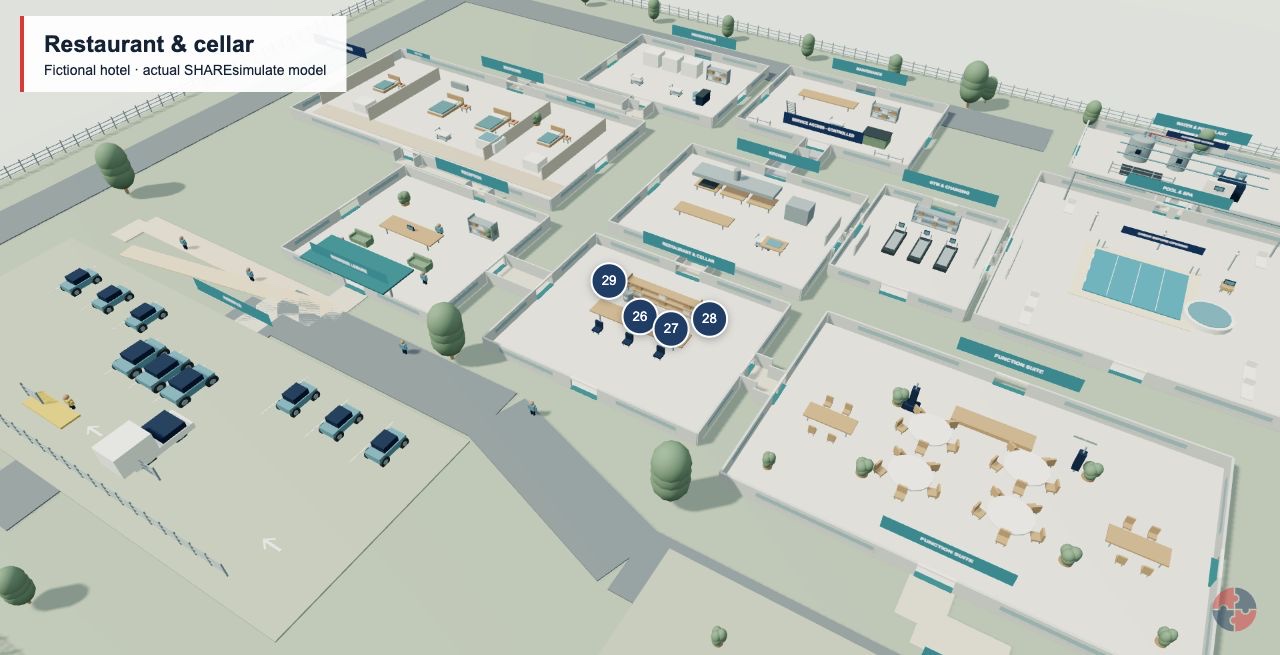
Work through 5 required applied activities and 3 model-practice pauses, with explanatory feedback and independent lesson decisions. Complete 4 distinct model mission sequences across those pauses. Use the actual fictional Riverside hotel, pool and leisure model or its equivalent accessible route to complete the required decision sequences; launching the model alone does not complete practice.
The 20-question assessment requires at least 80% plus every designated critical safety answer. Complete the required activities, practice and lesson checks. Points and badges cannot offset a critical safety error.
Use the LMS for confirmed save/resume and recorded results. Any certificate follows its configured passed-completion and grade conditions.
Open the public interactive practice copy; public practice is separate from the LMS record.
Sources and learning provenance
Original fictional cases are paired with public SHAREhub teaching and structured topic records. Use the applicable jurisdiction and primary guidance for live work.
- Official allergen guidance for food businesses
- NHS · anaphylaxis and emergency action
- Food Standards Agency · managing food safety (check nation-specific guidance)
- NHS · cuts, wounds and when to get help
- HSE · hazards of carbon dioxide
- HSE · confined spaces
- HSE · manual handling
Topic sections, source identities and versions
| Public topic | Chunk and version | Jurisdiction and sources |
|---|---|---|
| food-safety · allergens | food-safety--allergens 20261016-letter-review-1 | England, Wales, Northern Ireland, Scotland food-business-guidance-allergen-guidance-for-food-businesses, foodstandards-publications-food-allergen-labelling-and-information-requirements-technical-, food-business-guidance-labelling-guidance-for-prepacked-for-direct-sale-ppds-food-products |
| confined-spaces-risk-management · rescue-governance | confined-spaces-risk-management--rescue-governance 20261016-letter-review-1 | Great Britain, Northern Ireland source-csrm-hse-l101, source-csrm-hse-law, source-csrm-ni-law, source-csrm-ni-acop |
| sharps-awareness · response | sharps-awareness--response | sharps-awareness--primary-2 |
| manual-handling · assessment-boundaries | manual-handling--assessment-boundaries 2.0 | Great Britain, Northern Ireland hse-manual, hse-l23, hse-mac, hse-toolkit, hse-toolfaq, hse-filters, hseni-manual |
Course SH-HOTEL-04 · version 2026.10.20.hotel.2. .
Questions about this course
Is this training free?
Full public teaching and readers are free without an account. A free learner account is required for saved LMS progress and recorded assessment. Completion and any course-completion certificate depend on the configured LMS conditions.
How long should I allow?
Approximately 100–160 minutes, including teaching, lesson checks, required activities, model or accessible practice and one assessment attempt. Individual pace, review and retries vary. Save and resume in the LMS.
Can I learn without a 3D-capable browser?
Yes. The complete HTML reader provides the teaching. Required model practice has an equivalent accessible decision route in the interactive course. Use the LMS route for recorded learning.
What is required to pass?
Complete the required learning, activities, practice and lesson decisions. The 20-question final assessment requires at least 80% plus every designated critical safety answer. Points cannot compensate for a critical safety error. Follow the feedback before retrying.
Does this authorise hotel or leisure work?
Independent hotel, pool and leisure awareness using the fictional Riverside model. GB workplace guidance; apply corresponding NI and nation-specific arrangements. England-specific fire guidance is labelled. Learning does not establish practical competence, clinical advice, specialist work or operational authority. This independent course does not award an external qualification or replace competent task assessment, practical training or site authorisation.
Which manual handling assessments will you learn to use?
TILEO helps you review the wider task; MAC supports appropriate lifting, carrying and team handling of inanimate loads; RAPP supports appropriate pushing and pulling.
These aids support the activity assessment. Repetitive upper-limb work may need ART; variable or complex tasks may need other HSE tools or a fuller competent assessment. Mechanical lifting, stored energy, equipment safety and health decisions retain their separate controls. A low factor score, a downloaded report or completion of this course does not approve the work.
This additional teaching takes about 2–5 minutes, in addition to the course estimate. Optional reading and workplace assessment take additional time.
Learn how to select the method, use separate reports for mixed tasks, add a company logo and keep editable Word or PDF records. After a saved pass, the course offers a direct route to the assessment tools. Workplace assessment and practical competence remain separate from course completion.